Village Magazine

Random entry RSS

  • Posted in:

    Drastic Plastic Profligacy

    For years, it was widely ignored, even as the evidence grew more and more overwhelming. Reports had been flooding in from some of the remotest places on Earth, from the middle of the Pacific Ocean to the North Pole. Researchers found its impact was hammering every ecosystem, disrupting natural processes and spreading havoc across the living world. Then, slowly at first, the message began to resonate well beyond the usual narrow circles of scientists and environmental NGOs. The public’s ears pricked up, the media began to look deeply into the story and politicians, ever eager to follow the crowd, jumped aboard and began to huff about taking action, stepping up to the plate, not standing idly by, etc. And so, slowly, after scandalous decades of neglect and indifference, the wheels of change began their inexorable shift. The task ahead remained Herculean but at least many societies could be said to be engaged, and from there, anything is possible. I would like at this point to claim the preceding paragraphs are a description of how humanity has finally – hopelessly late – begun to grapple with the existential ecological crunch of which emissions-fuelled climate change is the most obvious manifestation. Sadly, this is not the case. The belated public response is instead to the plague of plastic pollution that has reached such an epidemic point that even the usual defenders of the free market haven’t bothered to construct a phoney ‘alternative’ narrative to beguile the media and stymie political action. The extent to which a carelessly used and discarded by-product of global industrialisation has come to present such a potent threat to the web of life on Earth has been known in scientific circles for many years. Marine biologists in particular have been trying with little success to draw attention to the rising tide of plastic pollution and its deeply insidious effects. Perhaps it was only when it became obvious that the human food-chain is also compromised did the wider public really start to sit up and take note. Plastic marine debris is now described as: “one of the most pervasive pollution problems facing the world’s oceans and waterways”, by the US National Oceanic and Atmospheric Administration. Around a million tons of plastics, comprising tens of billions of individual pieces, is now produced globally every week. Perhaps a tenth is ever recycled. People come and people go, but plastics persist. Complex polymers, under the influence of UV radiation and sea water, break down into near-microscopic monomers that enter at the base of the food chain, being ingested in their trillions by the vast shoals of tiny organisms that support and underpin the entire marine web of life. As these creatures are eaten, ever increasing amounts of toxic plastic pollutants are concentrated in the next level of the chain, and so on, until creatures at the apex, from sharks, dolphins whales and sea birds, are carrying catastrophic levels of toxins. Consider that every square mile of the surface of every sea and ocean on Earth contains around 50,000 pieces of plastic debris and you begin to get a grasp of the scale of the crisis. And, with the equivalent of a full dump truck of new plastic waste entering the world’s waterways every minute, it is manifestly clear that nothing short of a radical, global response will suffice if we are to have any chance of stemming the toxic tide of plastic pollution before it is too late. Ireland’s response has been mixed. Back in 2002, the then government introduced a modest tax on the purchase of single-use plastic bags handed out in their millions at supermarket checkouts and elsewhere. Industry critics said it was unfair, too expensive to administer, would never work etc. etc. They were all proved wrong when, within 12-18 months of its introduction, the quantity of single-use plastic bags fell by some 90%. Even more unexpectedly, the public actually supported the tax, and this support was maintained when it was increased to ensure compliance. Ireland found itself, for a short time, in the unusual position of being a global leader on an environmental issue. Success would, however, be short-lived. In the intervening decade and more, ever more plastics have made their way into our lives. It’s not unusual to find apples being sold on a plastic mat, with cellophane wrapping and perhaps an outer layer of another plastic. Milk went, in the space of just a few decades, from being sold in reusable glass bottles to in recyclable paper tetrapaks to now being largely sold in heavy plastic jugs. Meanwhile, tiny plastic yogurt pots are sold with more wrapping than yogurt. The ubiquitous ‘take-away’ coffee cup is constructed with a plastic inner lining, making the entire cup (and its plastic lid) unrecoverable. Ireland is in fact the EU’s number one per capita producer of plastic waste. Irish people account for 61kg annually – this is nearly 50% above the EU average. Repak, the industry-funded recycling group, boasts of our high levels of recycling relative to other countries, but this begs the question: what exactly happens to all this material? The short answer is that, in 2016, 95% of all Irish plastic waste was shipped to China for ‘recycling’. Conveniently for us, far lower environmental standards apply in much of China, so quite what happens to our so-called recycled waste remains unclear (China has since shut its doors to western wastes, which will now have to be dealt with much closer to home). I was involved in a recent radio debate on the issue of plastics hosted by Newstalk. Repak CEO, Seamus Clancy explained in glowing terms some of the achievements of the industry. He instanced a decline of several grams in the average weight of a plastic drinks bottle as demonstrating the industry’s determination to reduce waste. What Clancy was less forthcoming was on the total number of plastic bottles in circulation. The weight of an individual bottle is almost immaterial when overall volumes continue to increase rapidly. An

    Loading

    Read more

  • Posted in:

    Life and death on Abbey Street

    All of life is on Abbey Street, the street where I work. Stepping out of the school, humming a tune to myself, in spite of the rain, heart beating with a secret joy, I imagine my self as a smooth stone, skimming over the the grey current of the day, towards the green granite horizon of Easons. A Chinese man is smoking outside Ladbrokes, mauling betting slips, each one like a love letter from an old flame, stories that ended at the first hurdle. Five euro on Heartache each way. My heart is beating with a secret joy. I cross over to Connolly’s window and admire the sculpture of shoes, precarious heels, and wonder how it feels to walk half a foot taller than you are. I see the Collins bus in front of Wynn’s Hotel drawing its breath before heading for Carrickmacross. A Spanish man with a large blue umbrella is explaining to a group of giddy teenagers all about 1916 and where they can buy cheap clothes; Penneys. Leaning on a roadwork barricade, smoking in the morning, breathing out a thousand spirals of associations, I could dream on this street corner forever, my heart is beating with a secret joy. Recalling, how a year ago, the city was slowly having its stitches removed, its wounds healing, being filled with tar and cement. Ghost light rail vehicles crawling on new tracks, testing her unclogged arteries. Strange passenger-less carriages, new blood cells, flowing through the veins of O’Connell and Parnell. For over a year it had been open heart surgery on the streets of Dublin. Teams of hard-hat medics making incisions on her asphalt skin, extracting bales of cable and huge yellow tubes from her drill-blasted bowels. The city was a vast operating theatre. The patient stretched from Stephen’s Green to the Ambassador Theatre and there, Parnell reminded over-worked junior doctors who were tarmacking her torn flesh: “No Man has the right to fix the boundary to the march of a nation…”. Dawson Street was like intensive care, reduced to one lane; just enough to let the blood of commerce flow to the gaping tills that gurgle profit like mouth wash. High mesh fences erected all around to protect the patient’s ruptured modesty. Deep scar tissue on Westmoreland Street, trainee doctors sweeping débris on O’ Connell Street, consultants and surgeons pummelling it with diggers and drills. Dublin was bleeding with dust, its arms stitched on Abbey Street by nurses in luminous overalls and a dressage team tending the city’s scars behind a plastic green mesh in front of the GPO. Then I see her laid on the ground, wearing a duffle coat, two sizes too large, half my age, skin, milk-pale and purple with the cold. Chicken-carcass cheekbones, crutches by her side. Behind her, a garish poster for a family-sized Supermac pizza; above her a man, weeping, pushing her chest, “I’m losin’ her, I’m fuckin losin’ her… will ye come back to me..?”. Traffic lights change and hundreds of shoes and shopping bags pass by. My heart had beaten with a secret joy and hers is stopping, ignored in a public place; overdose. A friend with a ploughed line of stitches on his cheek balances on a crutch calling an ambulance. The blue umbrella bobs now in the distance above a sea of scalps. Drizzle speckles her face and I can see the flash of ambulance scissoring the grey sky before I hear the siren, like lightning before thunder. Blue paramedic gloves draw a sheet over her face and the last she sees of this world is a fever dream of shoes passing at the level of her sunken eyes and a huge pizza slice being cut from a family meal deal, lassos of melted cheese the last thing she could cling to. A Red Line Luas tram passes, pressed tight with faces and brown-paper shopping bags, the bell rings to signal its crossing over O’ Connell St; the ambulance wails down Abbey St, all that is left is her rain-sodden cardboard death-bed outside Supermacs. Traffic lights change again and a thousand shoes hurry by; nothing to see here. Billy O’hAnluain

    Loading

    Read more

  • Posted in:

    Vulnerable Monsters

    Emma Gilleece reviews ‘SOS Brutalism: a Global Survey’; published by Park Books, 2017 (RRP €68) ‘SOS Brutalism; A Global Survey’ is the first-ever international survey of Brutalist architecture from the 1950s to the 1970s, a collaboration by the Deutsches Architekturmuseum DAM and the Wüstenrot Foundation. It is an understatement to say that this book is a colossal contribution to architectural discourse and twentieth-century conservation. As explored in its essays, even the process of defining this enigmatic genre, still muscular and enthralling after almost 65 years is like grasping wet soap. Each contributor eagerly tries to grip it with the same enthusiasm and excitement that these Brutalist pioneers must have felt when their concrete ‘monsters’ were taking shape. Nevertheless, the debates and divisions are all part and of Brutalism’s contrary appeal. Cult Status The godfather of modern architectural criticism, Kenneth Frampton, contextualises Brutalism in the foreword to the book, incisively distinguishing it for example from the“people’s detailing” of the shallow-pitched, tile roofs, cavity brick walls, invariably white “amiable, unchallenging, anti-street, garden-city aesthetic” which “came under therubric of contemporary architecture asopposed to the pre-war notion of a severelyabstract modern architecture”. The scope of the database of brutalist constructions, contained in an accompanying tome, is staggering: more than 750 pages. It was an important basis for the selection of the book’s 120 case-studies from twelveregions extending to Africa, the Middle Eastand Oceania. Accompanying the survey are essays from its editors and contributors exploring questions such as whether a building is now Brutalist, or merely a late-modern, exposed-concrete, edifice; the discrepancy between the terms New Brutalism and Brutalism; contemporary efforts to preserve Brutalist buildings across the globe and theassumed continuity debate. The goal of the book is to spotlight the evaluation and preservation of the heritage value of Brutalist works. This is no small task for Brutalism is divisive. Popular Culture The compiling of the database sosbrutalism.org by architectural crowd-sourcing, reflects the egalitarian nature of Brutalism mirrored by the role social media has played in Brutalism’s renaissance. For example, think of the international reach to thePreston Bus Station campaign in 2012 which swung its fate from razing to Grade II listing. In recent years Brutalist architecture has achieved a second flowering (cementing?)on social media where its images bulge and captivate. However, there is also a renewed interest in Brutalism in scientific journals, symposia and exhibitions. It appears it’s position in the cycle of fashion and derision is upwardly bound. Perhaps not uncoincidentally, too late for many exemplars. The database was launched in October 2015 with 250 entries. By September 2017, ithad grown to 1,100 Brutalist buildings, many formerly undercelebrated, of which 120 are endangered through neglect or intended demolition. Experts, architectural buffs and photographers contributed to the survey either by contacting them directly, or by adopting the #SOSBrutalism hashtag. The Irish Contribution The only Irish case study is Stephenson, Gibney and Associates’ practice head-quarters Molyneaux House, Dublin (1971- 73)written by Erika Hanna. Hanna describes the now anachronistic attitudes not only of that firm but also of Irish planning at that time: “They also publicly delighted in confounding the conservation lobby and were at the center of the most high-profle controversies…demolishing a Georgian streetscape to construct offices for the Electricity Supply Board; building the bunkerish Civic offices on the remains of Viking Dublin;and erecting the Central Bank building higher than its planning permission permitted”. In the endangered list for Ireland they include; the IDA Small Business Centre(1983), by Scott Tallon Walker, highlighted inred as under threat; Stephenson and Gibney’s Fitzwilliam Lawn Tennis Club (1973); and the Ulster Museum Extension by Francis Pym (1962-64). Sadly Fitzwilton House (1964-1969) by Shoolheifer and Burley is in red but will soon be crossed out by demolition. With the refurbishment of the former Central Bank on Dame Street, this book and the publication later this year of ‘More Than Concrete Blocks: Dublin City’s Twentieth-century buildings and their stories, 1940 – 73 Vol. II’ (Dublin, Four Courts Press), no doubt Brutalism will attract new fans overcoming the visceral aesthetic contempt always evident from those with unimaginative good taste.   Design This hardback is accompanied by a bonus paperback supplement of contributions made to the international symposium on Brutalism that took place in Berlin in May 2012. The retro, voguishly-burlap-bound book perfectlycaptures its scintillating subject era. Many will recognisethe book’s nod to the design of Reyner Banham’s seminal book The New ‘Brutalism: Ethic or aesthetic?’ (1966), the bible of Brutalism which knew, as times were changing, heralded its death. The photographs, both colourand atmospheric black-and-white; sketches; plans andsections make it a joy to turn each page and the list in the Appendix counterpoints the easy joy with evocations of the arresting magnitude of the speed and scaleof loss. The Appendix lists 986 buildings as of September 2017. Threatened/endangered buildings are markedred, demolished buildings are crossed out. Geographic coordinates are provided. More Than a Catalogue More than a catalogue, the book’s fantastically researched essays try to define elusive Brutalism, charting its rise and fall and pinpointing its appeal. The movement went beyond aesthetics. These buildings are embedded in the debates of their time when questions of design profoundly refracted a larger political context.Although an international movement, it was regionally-embedded coinciding with a period of decolonisation and nation-building (Africa, Asia), of reconstruction (Europe, Japan), and of rapid modernisation (North/Latin America, Middle East). Wherever we look, Brutalist buildings leered, all over the world, in most political systems. How many Brutalisms are there? Did the end of Brutalism coincide with the fall of thewelfare state and the beginning of neoliberalism? Did Brutalism become too costly atsome point, because the labour required for customised sculptural products was too expensive? Oliver Eiser’s essay, ‘Just what isit that Makes Brutalism Today so Appealing’,decrees that a new form of Brutalist architecture is long overdue. Annette Busse inher paper, ‘From brut to Brutalism, Developments between 1900 and 1955’, delves into the significance of the difference in the meaning of the words brut and brutal in English, French and German; and into the

    Loading

    Read more

  • Posted in:

    Cold, and Hot

    Someone has finally said it. The Cold War is back. The man who made the statement was Antonio Gutierres and he carries some weight on the matter as Secretary General of the United Nations. Up to now most commentators and experts have stopped short of using those two words. They have spoken of a “deterioration in relations” between Russia and the United States and an end of trust between the two countries. But to those of us who remember the First Cold War certain alarm bells have started to ring. There are people alive today who remember the Cuban Missile Crisis which brought us to the verge of annihilation. In those days both the Soviet Union and the United States had enough weaponry to destroy the planet several times over but the two sides were led by men whose political flexibility served to bring the crisis to an end. Back then the US was led by John F Kennedy and the leader of the Soviet Union was Nikita Khrushchev. Today both powers can still destroy the world but they are led by Donald Trump and Vladimir Putin. A direct military clash between the two in Syria has been avoided so far and, hopefully, will be avoided in the future but the hostile propaganda that characterised the old Cold War is being used to full effect. As in hot wars the first casualty in cold wars is the truth. Nuclear warheads remain in both camps but in today’s world a new set of weaponry exists that was unheard of back in the days of Kennedy and Khrushchev. Propaganda used to be issued on radio, TV, the newspapers and, occasionally, from the pulpit. There were lots of opinions doing the rounds but the Soviets saw to it that very little news, fake or otherwise, emerged from their territory. Back then we were told that the, Soviet peoples, and the Russians in particular, were brainwashed automatons ready to give their lives at a moment’s notice if their leaders asked them to. The Red Army would pour through the Fulda Gap in its hundreds of thousands to end what we considered to be civilisation. Before long we would be as brainwashed as they were and would be ready to do the bidding of our masters. For me that particular vision of Russia came to an end on a warm July evening in Moscow in 1991. I had arrived a month earlier as the Irish Times correspondent and was settling in to life in what was still the Union of Soviet Socialist Republics. On that afternoon my wife and I decided to visit the Novodevichy Monastery one of the city’s numerous historic sites, famous for its beautiful frescoes in the Cathedral of Our Lady of Smolensk. It was there that we caught our first glimpse of a member of the dreaded Red Army that was all set to annihilate us. What we saw was not what we had expected. The soldier’s appearance was far from terrifying. He was a raw-looking kid in his late teens or early twenties. His uniform cap was slouched back on his head in a manner that would engender the ire of a sergeant in that far less threatening military organisation known to us at home as the FCA. But that was not all. This boy in uniform was not alone. He walked arm-in-arm with his mother. It was a striking message to us that Russians are as human as we are and in this case perhaps more so. As for the automatons who believed everything their leaders told them, well that wasn’t true either. There was a burgeoning industry in jokes about the past leader Leonid Brezhnev’s ineptitude. The current leader Mikhail Gorbachev was mocked by sophisticated Muscovites as a country bumpkin with a south-Russian accent. Workers took things easy under the slogan: “They pretend to pay us, so we pretend to work”. Intellectuals had their own slogan which went: “How can we know what our future is today when we don’t know what our history will be tomorrow”. Russians didn’t need western propaganda to persuade them that things were not working well. So how have they ended up supporting Putin? The answer has a lot to do with Boris Yeltsin. Yeltsin brought hope initially but eventually Russia’s economy and its moral compass disintegrated under his rule. Crony capitalism took over from crony communism. Some people became immensely rich while others were selling their belongings in Moscow’s underpasses in order barely to exist. The gun became a major business tool. The Russian Mafia emerged from the shadows and many of its members had backgrounds in the security services. The tradition of the razborka, the settling of matters by the gun, became a major feature of everyday life. On one occasion that I particularly remember a family visited the grave of one of its members only to be blown to pieces by a bomb planted by a rival group. TV pictures showed the crows picking at human flesh on the branches of the cemetery’s trees. While this was going on the West indulged Yeltsin. If the 1996 presidential election was rigged then it was done to save the country. If Yeltsin wandered at night in the Washington streets in his underpants it was endearing. If he couldn’t manage to get off the plane in Shannon he was “tired”. Russians knew better. Ordinary people rang the Irish Times Moscow office to apologise for their president’s behaviour. The word stabilnost (stability) was on everyone’s lips. Then along came Putin. Russians craved stability and they got it. The West’s tone changed. Here was someone who might make Russia strong again. Bit by bit the demonisation of Vladimir Putin began. Relentlessly he was portrayed as the evil emperor. As time went on he helped the propagandists by behaving as they predicted. We have now reached the stage that any allegations against him are instantly believed. He was responsible for Trump’s election even though it

    Loading

    Read more

  • Posted in:

    50 years since 1968

    Not a week has gone by in 2018 Ireland without several street demonstrations, especially about abortion and the housing crisis. In France, protesting is part of the vernacular. Riots are common: just look at 1789 and 1968. Ireland and France share a reputation for feistiness. A comparison between Irish and French demonstrations could be instructive. “What do we want? Public housing! When do we want it? Now!”. More than 10,000 people are currently home- less in Ireland. The demonstration I attended, organised by the National Homeless and Housing Coalition, on 7 April was good-natured: festive and serene. People played and sang music as they marched. The Garda seemed engaged and smiled while overseeing the demonstration: a safe protest. It appeared the crowd was representative of the general population, as perhaps you might want. It started at the Garden of Remembrance and ended in front of the Custom House in Dublin in light rain, as cheerful as the weather allowed. Its effectiveness was its mainstream attendance; there was no danger here. It would, I reflected, be different: more fractious, less representative, angrier – in France. Ireland fights for Human Rights At the moment Ireland is in arms over: abortion, education, sex education, health, animal welfare, drugs. But I have the sense that some of these campaigns are not mainstream, even as protests. Certainly the Water Protests were successful, albeit the underlying political message (no new taxes?) and symbolic value were not too clear. Abortion is a long-standing divisive issue in Ireland, symbolising the hegemony and, later, decline of the Catholic Church. Protests date back to 1983 when an unwise blanket prohibition was approved in a referendum. In May there will be a rerun. There are many events, debates and demonstrations on both sides, with pro-choice as fashionable politically as pro-life must have been a generation ago. The demonstration I attended in April was ‘pro-choice’- for ‘Equality, Freedom and Choice’, organised by Rosa. The rally was jubilant and confident, almost over-confident. The Daddy of all modern Irish marches is the PAYE protests from 1979-1980. Around 700,000 Dubliners marched against the stifling ‘Pay As You Earn’ tax. The BBC called it “the largest peaceful protest in post-war Europe”. But I sense things have changed since then. There is no longer an Ireland the sense that the regime is fundamentally at odds with its electorate. Perhaps it’s because the country now mostly complies with international norms or is fast moving in that direction; perhaps it’s because the country is simply much wealthier and has never been so confident. In 2003, Irish anti-war protesters organised a demonstration for peace in Iraq. The British and Americans had invaded Iraq. 100,000 walked on the streets of Dublin. It was a thoroughly internationalist protest. In 2006, a violent demonstration took place in Dublin’s O’Connell Street. For some reason Northern Unionists wanted to organise a ‘Love Ulster’ Parade to honour the victims of the IRA. A counter demonstration materialised and a riot started. Several Molotov cocktails were thrown and cars were burnt. A total amount of 14 persons were wounded and 41 arrested by Garda. Locals put the intense violence down to the alien influence of recalcitrant Northerners: it didn’t symptomise a new riot mentality. These kinds of demonstrations are pretty rare in Ireland compared to in France, where there are wide-ranging politically-driven strikes and demonstrations every year. Governments can fall as a result of demonstration culture in France. If France had had an international bailout that was forcibly inflicted on the population; if France had had the iniquities of Nama bailing out the richest failed developers there would have been strikes and riots. A country’s protest mentality varies from generation to generation. We’ll put down the Irish monster meetings and boycotts of the nineteenth century as the fruits of a different era. Where a country is colonised and not run for the benefit of the majority – or a significant minority – wideranging subversion is to be expected. In Ireland it culminated in the Easter Rising in 1916 and the War of Independence 1919-21. In the North of course discrimination against Catholics fuelled a later whirlwind. In the Bogside riots of 1969, eight people were killed, a majority Catholic, and over 150 homes destroyed; and the IRA campaign resulted in 1696 deaths. But, though important, this all speaks little to the modern-day Republic of Ireland.   France, protest pioneer French demonstrations have been well-known and lethal since at least the 18th century with a sustained and celebrated (though not of course by Edmund Burke) historic riot: the French Revolution, facilitating a declaration of the rights of man and changing forever the notion of the political establishment. In the twenty-first century, protests are still an important political phenomenon. France has been a global leader in dissent. The rockstar of street opposition was May 1968 when strikes and demonstrations led by students and workers and the occupation of universities and factories across France brought the entire economy of France to its knees and political leaders feared civil war or revolution. The moribund government itself ceased to function for a while after President Charles de Gaulle secretly fled France for a few hours in Germany. ‘68 changed France’s democracy: the super-annuated President De Gaulle resigned, the Assemblée Nationale was dissolved, and government committees were formed to restructure secondary schooling, universities, the film industry, the theatre and the news media. The Grenelle Accord gave better conditions for the unemployed, a 35% increase in the minimum wage and a fourth week of paid leave for those in employment. Mentalities started to change too with a sexual revolution from the young. Mixed schools became more common. 1968 sundered a post-War France of austerity, conservatism and asceticism. Nevertheless the movement succeeded “as a social revolution, not as a political one”. President of the Republic (2007-12) Nicolas Sarkozy famously denounced May 1968 as the source of contemporary France’s problems. The student revolts against bourgeois society introduced a “relativism”, he argued, that undermined national identity, the spirit of

    Loading

    Read more

  • Posted in:

    The appeal of Repeal

    There have been many turning points and defining moments as the debate over repealing the Eighth Amendment has unfolded over recent weeks. Some of these have been the powerful stories of individual women or groups of women; others have been the remarkable statements of specific organisations and yet others have been the unexpected campaigning experiences on the ground. Not least of these turning points has been the remarkable fund-raising campaign launched by Together for Yes just two weeks ago. It had a target of €50,000 initially but quickly increased to €100,000, €250,000,€300,000, €450,000 and surpassed €500,000 in the space of just ten days. But what moved even veteran campaigners were the heart-breaking stories and compelling responses of many of the almost 15,000 thousands who contributed. And for some, who made the decision to contribute despite being hardly in any position to afford to, they were matched in turn by other women and men welcoming the chance to make a public statement and many other thousands who contributed in silence. It was truly amazing the way you could see, feel and watch the secrecy that still thrives in Ireland as many who contributed asked to be anonymous, but were glad that they had found a way to make their statement within a society that silences and renders invisible their actual experiences as women in this country. Other defining moments have been the courageous statements by some organisations that have refused to have their stories manipulated in the interests of those who want to deny women access to health services in their own country and to reproductive justice for all women in Ireland – including migrant women, adoptees and women with disabilities. I would highlight in particular the statements of Downs Syndrome Ireland (DSI), Migrants and Ethnic-Minorities for Reproductive Justice (MERJ), Adoption Rights Alliance (ARA) and Inclusion Ireland (II). Without the timely intervention of Downs Syndrome Ireland (DSI) appealing against the exploitative use of images of children with Downs Syndrome, such images would have been far more pervasive. DSI has been joined by Inclusion Ireland making visible the often hidden experiences of women with disabilities, too many of whom have been denied the right to have a child or who have experienced disrespect and marginalisation within the maternity services in Ireland. It has been the persistent campaigning and activism of MERJ that has ensured that the rights and experiences of migrants and ethnic minorities have been kept in the forefront of the campaign for Repeal: “We often hear about Irish women who are forced to travel to England to access abortion. But what about the stories of the people who can’t travel to access healthcare due to legal status, lack of money, lack of childcare, disability, etc? Migrants and ethnic-minorities face enormous barriers to accessing abortion and maternity services and are disproportionately affected by the 8th amendment. Let’s remember Savita Halapanavar, Ms. Y and the countless others”. Another critical turning point and special moment in this Together for Yes Campaign has to be the very powerful and unstinting voice rarely heard in the mainstream debate on reproductive justice. The Adoption Rights Alliance (ARA) puts forward its compelling case for Repeal in the strongest possible terms. “For our organisation, the Eighth Amendment represents the latest incarnation of the control that was exerted over the thousands of women and girls who were forced to relinquish their children for adoption and who were incarcerated in Mother and Baby Homes, Magdalene Laundries and other institutions. Since 1983, all pregnant women in Ireland have been denied the right to choose whether to proceed with a pregnancy, just as adopted people’s natural mothers were denied any choice. ARA is opposed in the strongest possible terms to the notion that adoption represents a viable alternative to abortion. We firmly recognise the right of a woman to choose not to pro- ceed with a pregnancy. Adoption should only ever be utilised in situations where a child genuinely needs a home, and not as a mechanism whereby women and girls are forced to carry to term and then relinquish the child to a closed, secret system”. Individual voices have also brought new and unexpected emotional experiences to the urgent Repeal cause – in the last few days the story recounted by Chris Fitzpatrick, Obstetrician and Gynaecologist has caught the imagination of many. “I am a doctor. I am supposed to look after people. The woman sitting in front of me is crying. She has had a scan. Her baby’s brain has not developed. The baby will not survive. The woman is 20 weeks pregnant. Her partner has his arm around her. Her mother and father are on their way. Some of her in-laws too. I go over the options. It’s too early to make any decisions. Emotions are too raw. The midwife is very kind to them. We go through everything again the next day. The woman says she cannot go through the rest of the pregnancy. She is too upset. She is wringing her hands in anguish. I cannot help her. She will have to go to England. She and her partner will have to make their own arrangements. Of course, I’ll see her back afterwards. She has our number. She will have to talk to the doctors in England about how to bring the baby home. She wants to bury her baby with her grandparents. The woman is still crying. I offer her a tissue. I have a ticket for the hospital car park. They won’t have to pay on the way out. Inadequate gestures. Cold comfort. There is nothing more I can do. Doctors in another country will look after her. Everyone tells us how important communication between doctors is. I don’t lift a phone. I don’t write a letter. My hands are tied. As they leave, they thank me. I wonder: for what? I close the door of my office. I can hear the woman crying on the corridor.” (Chris Fitzpatrick, consultant obstetrician and gynaecologist (and former

    Loading

    Read more

  • Posted in:

    Island of Tyreland

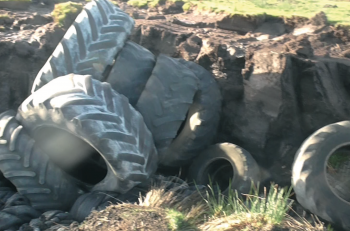
    Carndonagh is an area of outstanding natural beauty that nestles in the shadow of the Grinlieve Mountain, only eight kilometres from the designated Natura 2000 sites, Trawbreaga Bay Spa and the North Innishowen Coast. Safeguarded by the 1992 Habitats Directive both these ecological wonders are home to protected animal species and diverse wetlands. Outwardly this area seems idyllic and well-protected; however, on 4 December 2011 Sunday Life newspaper exposed Meenyollan, Carndonagh, as the location of a vast illegal tyre dump fed by KF Tyres, Corody Road, Derry (top right). The landowner, Michael McLaughlin, was also claimed to be complicit in the dumping. Nearly ten million tyres had been buried, unregulated, in the period 2008-2011 alone. At least one for everyone in the audience. It has made Carndonagh Europe’s largest illegal tyre dump. Following the Sunday Life exposé in 2011, Donegal County Council promised robust enforcement including an extensive cleanup operation. KF Tyres should have been made responsible in whole or in part for the cleanup operation Donegal County Council promised. However, seven years on, there is still clear evidence of tyres being illegally buried at this location and there is little evidence of a cleanup. The pristine fields, underpinned by tyres which leach into the meandering water table, contrast starkly with the surrounding boglands and call to mind previous violations and unseen toxicity (bottom right). Although it is difficult to find out the exact composition of a tyre, and there are lots of different types most of them include synthetic carcinogens, solvents and heavy metals, for example. KF Tyres and Michael McLaughlin escaped prosecution and in fact subsequently applied for and were granted a range of permits and planning permissions by both Donegal County Council and the Northern Ireland Environment Agency (NIEA) allowing them to legally operate at the same site. These incongruous decisions, some of which were granted in breach of the legally-man-dated sequence, reduced the promised enforcement to no more than knuckle raps. After an abortive attempt by planning consultant Jim Harley to get McLaughlin’s development deemed “exempt” from planning permission, an unlikely new wheeze was to tout it as land reclamation with secondary drainage benefit. Yet still the terms of the new permits permissions have been flouted. Photographic evidence clearly shows that illegal dumping is still going on at the site. In 2018 KF Tyres and Michael McLaughlin are still controversially involved on this site, while Donegal County Council behaves as if it is unaware of this. In 2015, Planning Permission was obtained for the use of 8448 tyres in 105 bales (80 tyres per bale) over a five- year period, suggesting even what Donegal County Council considers reasonable has been overwhelmed by illegal dumping on a much greater – indeed unconscionable – scale.   The photographic evidence (left) shows that neither McLaughlin nor KF Tyres appear to be compliant with the terms of the planning permission, which demands that the tyres that are used be baled, not loose (left, bottom right); nor do they seem to care. Moreover, Donegal County Council evidently does not appear to know what is going on. For example, after the Sunday Life article in 2011, Donegal County Council promised an investigation and robust enforcement. However, in January 2012, mere weeks after the article, Donegal County Council granted McLaughlin a five-year Waste Management Facility permit (WMP) (top right). Why? No planning permission had been granted though one is mandatory before a WMP can be issued. Without the requisite planning permission all tyres taken to Cardonagh around that time continued to be transported and dumped illegally. Jim Harley, formerly of Harley Planning Consultants, has figured in strong criticisms levelled against the Donegal County Council planning department when he worked there a decade ago. These are currently being reviewed by a senior counsel on behalf of the Department of Housing, Planning and Local Government. Harley acted as a planning consultant for McLaughlin when he was granted planning permission in November 2015. There was one condition: that he apply for a WMP. But there was an existing WMP that had been issued illegally. It was illegal precisely because it should not have been issued before planning permission was granted. The Sunday Life article stated in 2011 that KF Tyres had a WCP (waste carriers permit) with Donegal County Council to collect “end of life tyres” but it had no permission to bury tyres at Carndonagh. It is yet another anomaly that KF Tyres obtained a valid Waste Carriers Licence for the South in 2011 but no planning permission or commensurate licence for the site it operated from in Derry. It is strange that Donegal County Council neglected to contact the NIEA about KF Tyres in 2011. The NIEA went on to grant Ken Ferguson a WMP (bottom right) allegedly oblivious to the illegal dumping. This information would have been immeasurably beneficial in averting the current situation. Donegal County Council should have been monitoring the site, verifying the number of tyres being buried both by KF Tyres and McLaughlin. No assessment appears to have been made, north or south of the border, of how many Trans Frontier shipments (TFS) and what tonnage of tyres, KF Tyres declared to the NIEA it had transported between 2012 and 2015.   It is not clear how many physical border and site inspections were made by Donegal County Council and the NIEA during this period. As stated both the WMPs (previous page) were granted under Appendix II of the EU Waste Frame Directive 2008/98EC: recovery operations. R10-Land Treatment resulting in benefit to agriculture or ecological improvement; R13 – storage of waste pending (right). Amazingly there is no reference to waste tyres or indeed anything like rubber within this directive, nor to the burial of solid waste in any form. Land reclamation using tyres is deemed dangerous and illegal in Northern Ireland , but not in the Republic – yet both countries are bound by the same European Directives. Given the toxicity of tyres and the stringent legislation on their

    Loading

    Read more

  • Posted in:

    The strong centre

    Paschal Donohoe is a decent man: modest, cultured, the cleverest man in the room, according to a senior Fianna Fáil figure who spoke to Fiach Kelly in the Irish Times recently: the man other politicians envy, and a safe pair of hands. At 43, he has graduated with first-class honours from Trinity college, lived abroad, pursued a career in the private sector and risen without obstacle from local politics in Dublin city council to the heights of government, and the Ministry of Finance. Unlike his even younger boss Leo Varadkar he doesn’t have the sheen of a cultivated image. he has never attracted any suspicion of impropriety, never been excoriated, even in the unpleasant role of frugal Minister for Public expenditure (which he sure-footedly merged with the Finance brief when he took it over). When Village interviewed him he was open, generous with his time, eloquent. He reads progressive Irish fiction, has some quirky tastes, knows what is going on in his constituency about whose substandard welfare he remains committed. He even says he reads Village. Village’s agenda is equality, sustainability, accountability and it is wide and all-embracing enough that any political force, as Mr Donohoe certainly is, can be assessed against its imperatives. He is certainly in relative terms a model of accountability and openness. But what of equality and sustainability? Paschal Donohoe serves the politics of Fine Gael faithfully. He implies that Fianna Fáil is economically fickle, not always pro-european or outward looking and, increasingly implausibly now, that its attitude to ethics is demonstrably inferior to that of Fine Gael. He believes in Europe, the Open Society of Declan Costello, in an embracing attitude to outsiders. He believes in a balance between the markets and the state and, creditably from the perspective of this magazine, thinks the momentum has moved too far to the markets and needs to move back to the state, globally at least. He takes a robust attitude, as did his hero Declan Costello, to the obligations of the state. It will intervene to incentivise or nudge those who do the right thing, it will not perpetrate evil itself. He was passionate in defending the coherence of this attitude, in his interview. Mr Donohoe believes in the rights of property but will interfere at the edges, as with site-value and sugary drinks taxes. The state needs to plan systematically for development of its own lands. On national planning he was reluctant to stay how he would stop unsustainable development – such as the sprawl of Dublin into counties Meath, Wicklow, Kildare and beyond, as opposed to merely incentivise and encourage sustainable development – for example of cities and towns outside Leinster. He does not seem engaged by the environmental and climate-change agendas, though he knows its rhetoric. He rarely acknowledges, in policy, that Ireland is the laggard in Europe on climate, plastic waste and many other environmental performances. He does not seem zealous to revive the across-the-board indicators of social and environmental success, not just economics, that even the Fianna Fáil and Fianna Fáil-Green governments toyed with a decade ago. Failing them, it is likely we will continue to be a model of unsustainable, joyless growth, a paradigm of how to nearly get it right. As to equality, Mr Donohoe is exercised by the plight of those who cannot put themselves in a position to benefit from the equality of opportunity that those with strength crave. He knows from his Dublin central constituency that intergenerational inequality is difficult to mitigate. But his credo is equality of opportunity and he and his party are never going to be forces for radical redistribution, for equality of outcome. He is a decent man of the “strong centre”. He and his party have done some service bringing back elusive economic success to this country bankrupted by the now shiny principal opposition party. It has been argued that Fine Gael, with its visceral fetish for the rights of property, so well-enjoyed by its protagonists and indeed its voters, is ill-equipped to deal with the crises of housing and homelessness that do much to undermine the fabric of society in 2018. It is ideologically too wedded to the private sector to provide homes on the scale required on public lands. Mr Donohoe, in fairness, claims that he has far-reaching proposals to do just that. We’ll see. Ireland is lucky to have such an open, decent, youthful and thoughtful politician in the Department of Finance as the risen fiscal pendulum suggests we can once again explore a national Vision. But it is impossible to be radical from the centre, however strong, and – for Village, Mr Donohoe would do well to address the social and environmental agendas as stringently and competently as he continues to promote and foster the purely economic agenda.

    Loading

    Read more

  • Posted in:

    Villager May 2018

    No Catholics or bastards please, we’re British Villager despises royalty, as anyone who believes in equality, merit or good taste, must. Interesting though that new-born Prince whatsit will come in fifth in line to the “throne”. Time was the new “Prince” would have been advanced to it over his older sister (Princess whatsit), as a male. The Bill of Rights 1689 and the act of settlement 1701, restrict succession to the legitimate Protestant descendants of Sophia of Hanover, of which there are over 5000, who are in “communion with the Church of England”. Spouses of Roman Catholics were disqualified from 1689 until the law was amended in 2015. The succession to the Crown Act 2013 leaves succession to the Crown no longer dependent on gender for lucky heirs born after 28 october 2011. With such incremental progress it will only be a few aeons now before the monarchy passes for democratic. INMajor trouble 23 years ago Vincent Browne got €90,000 in a private settlement with the state because the Garda tapped his phone over an eight-year period in part believing he was talking to IRA leaders for Magill Magazine. a decade earlier journalists Geraldine Kennedy and Bruce arnold were awarded £20,000 in the high court after their phones were tapped for a short period, for absolutely no reason. So how much will the around 200 lucky victims of Leslie Buckley’s version of phone-tapping – data breach – collect? INM has a cash pile of €90m but a stock-market value of only €110.9 million valuing INM in effect at less than €20 million, plus the cash. The problem is that 200 complaints of data breaches could easily hoover up most of that sum. O’Brien has spent €500m building up his stake, partly to show the O’Reilly family what good management looked like and er partly to boost his popularity, but his holding is now worth only €33m and shares are down 40% over the last year. This is an investment even worse, though not nearly as predictably so, as one in Village Magazine over the last decade. STabbing the competition On 22 april The Sunday Times (Irish edition) unkindly editorialised that the INM group was leaking selective extracts from the 240-page affidavit of the ODCE on which it has grounded its application for the appointment of high court inspectors who would examine various allegations against the media group and its former chairman, leslie Buckley. In particular, The Sunday Times claimed that INM was strangely silent on the allegations leaked from the affidavit that the largest shareholder, Denis O’Brien, had access to sensitive commercial information, courtesy of communications minister, Denis Naughten, before other shareholders. But ironically The Sunday Times is part of the Rupert Murdoch stable, news International, which was forced to close down its News of the World brand in 2011 in the light of damning revelations that some of its senior editorial staff had condoned the widespread tapping of phones and other criminal offences. At one point former Taoiseach, Bertie Ahern, soon after his inelegant departure from office in 2008 amid evidence of financial wrongdoing, graced a TV advertisement for the News of the World from inside a kitchen cupboard, his most ignominious television appearance until the recent Tim Sebastian interview. The Sunday Times was famously less than wholehearted in pursuing the politician for failing to account for over £200,000 unexplained in various bank accounts while he was Minister for Finance in the 1980s. ahern cultivated Murdoch whose sky division famously obtained rights to cover the Ryder cup in Ireland under Bertie’s premiership. Equally intriguing is the insistence by O’Brien that the leaks to INM from the affidavit came from the ODCE rather than from the copy provided to the newspaper organisation in which he is the largest, though – significantly – non-controlling, shareholder. The leaks came from people close to the non- O’Brien wing of INM. Radio Caroline ended party early Chris Donoghue, Niall O’Connor and Ed Carty have joined the ranks of independent journalists who now advise government. Government Press advisor Nick Miller once toiled for regional titles such as the Kerryman, Tullamore Tribune and Evening Echo. Now the one-time series producer of RTÉ’s ‘The Sunday Game’, and regular voice of ‘It says In The Papers’ on ‘Morning Ireland’, Caroline Murphy, has become press advisor to Minister for Justice Charlie Flanagan. She is of course married to Sean O’Rourke, presenter of RTÉ Radio 1’s flagship current affairs programme, the ‘Today show’. The formidable Murphy described some years ago to the Irish Times how she fell for the uncontroversial presenter: “We met around 1983, when I had a singles BBQ in a house I’d bought in Killiney: everyone invited had to bring a friend of the same sex and Fintan Drury (later chairman of the RTÉ authority who resigned because of a conflict of interest over rights to cover the Ryder cup) brought Seán. He was still there with Fintan at 2am when I threw them out – Seán was shocked. I couldn’t believe anyone would think it wasn’t my right to say the party’s over”. Murphy told the Irish Independent her work at the national broadcaster has been “marginal” in recent years. Neutering neutrality Cosying up to NATO is now de rigueur inside ‘modern’ Fine Gael. Four of the party’s MEPs, Seán Kelly, Brian Hayes, Deirdre Clune and Máiread McGuinness, advocate a policy which would see us dilute neutrality by falling in line with deepening EU military co-operation. In a statement issued to accompany the launch of a discussion paper ‘Ireland and the EU: Defending our common european home’, by Brian Hayes on 9 March, the MEPs stated, “We want to make it clear that we do not support the creation of an EU army. However, Ireland can do so much more in collaboration with our EU partners in the area of security and defence”. These MEPs have not gone off on a frolic of their own volition. This is now FG and Varadkar’s euro-military policy. Ironically, the Taoiseach is known to

    Loading

    Read more