Scene: The set of Piers Morgan Uncensored (on Youtube because TV is yesterday) in either London or New York. Or perhaps it is LA.
by admin
Scene: The set of Piers Morgan Uncensored (on Youtube because TV is yesterday) in either London or New York. Or perhaps it is LA.
by admin
Friedrich Merz is back, as Chancellor, with a budget, to lead Europe and close borders to irregular immigrants
by admin
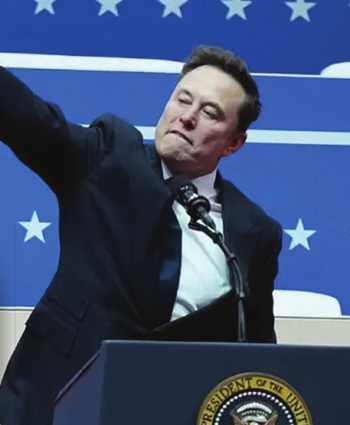
53 year-old Elon Musk is a South African-born naturalised US citizen, who wants sanctions against his native country for racially discriminating against…whites; a saluting fascist who thinks he is a free speech purist
by Village
A homeless person is more likely to die prematurely, and people are less likely to know about it By Julia Danilowa A large Garda presence was spotted in Bridgefoot Street Park, just off the quays in Dublin 8, early one morning at the beginning of the month. Witnesses saw what seemed to be a covered body and stated that access to parts of the park was restricted. Most of the area remained accessible throughout the incident indicating that no violent crime took place. No ambulance arrived on the scene. Within a few hours all parts of the park were again opened to visitors and no further Garda presence was seen that day. Bridgefoot Street Park is close to social housing, multiple homeless charity services and several emergency accommodation hostels. The area is frequented by rough sleepers. An Garda Síochána did not issue a statement regarding the incident. No further information outside of the witness accounts has been made available to the public at large nor the homeless community in Dublin 8. The event illustrates a larger trend in how the health and wellbeing of homeless people in Ireland is handled generally and specifically how information surrounding the deaths of homeless people is treated. The homelessness crisis in Ireland remains uniquely severe despite the levels of homelessness rising across Europe. The number of people in Ireland experiencing homelessness has more than doubled over the last decade and continues to rise. As of February 2025, there are 15,378 homeless people accessing emergency accommodation, of which 4,653 are children. In the month before the eviction ban was lifted, January 2023, there were 11,754 people in homeless services in Ireland. These numbers do not include ‘hidden homelessness’ adults and children staying in domestic violence refuges, sleeping in cars, couch surfing with friends and relatives, or living in unsafe and unstable accommodations. A 2022 poll by the Simon Community showed nine per cent of people had friends affected by hidden homelessness in the past 12 months. The Simon Community Official Winter Count of people sleeping rough shows that at least 134 people were sleeping outside over the week of 4 to 10 November 2024 in Dublin alone. Furthermore, many adults using emergency accommodation still occasionally sleep rough due to a lack of beds, difficulties travelling, and conflicts in hostels with staff or other service users. The Health Research Board (HRB) recorded 84 premature deaths among the homeless population in Ireland in 2019. In 2020 the figure rose to 121. 115 people died in Dublin in 2021. In 2022 the number of deaths fluctuates between 47 and 95. Despite these solid figures, further information about the deaths among the Irish homeless population is scarce. After 2022 no official data have been published. In both 2023 and 2024 only incomplete monthly data were made available for Dublin. There, twenty homeless people died in the first four months of 2023, among them a 17-year-old boy. 40 deaths were recorded in 2024 up to the month of October. There are no national figures available after 2020 and no further HRB studies have been published. Few of the deaths among people experiencing homelessness in Ireland are publicly acknowledged by officials. Furthermore, people who are homeless often have difficulties getting information about their potentially deceased friends and community members. Some report that gardaí can be dismissive, especially towards the concerns of people who are sleeping rough. The 2020 HRB report showed that many of those who died while homeless tended to be significantly younger than those dyingin the wider population. Half of the men were aged 42 years or younger at the time of death and half of the women were 36.5 years or younger. Almost all who died had a history of substance abuse, however below half had ever received treatment. 46.3% of the deceased had a history of mental health issues. Research by the UCD School of Public Health shows that experiencing homelessness increases the risk of illicit drug use, self-harm behaviour and visits to the emergency departments. At the same time, access to GP health services is limited. The findings suggest that there are not enough programmes for harm reduction, mental-health support, general healthcare access and care for frequent emergency department attenders. This increases the risk of premature death. These issues present in addition the inherent increased danger of exposure to the elements as well the inherent stress and trauma of homelessness. Authorities try to limit extreme weather exposure yearly. 400 additional cold weather beds were made available by the Dublin City Council in the winter of 2024 to 2025, 70 more beds than the year before. However, due to the quality and accessibility of the accommodations, some of those sleeping rough can choose to remain outside. Many have traumas associated with hostels, most hostels are not equipped to take care of service users’ mental health conditions and concerns. Furthermore, some individuals do not want to be separated from their communities, families or partners and so feel safer remaining outside despite weather conditions. Homeless people in Ireland experience increased health and safety risks, yet information about risks, supports, services and deaths in the community remain limited and inaccessible to both the wider public and the homeless population. A homeless person is more likely to die prematurely, and people are less likely to know about it.
Posted in:
by Village
Butchering romance J Grafton Street’s Glass Mask Theatre is offering a delightfully unpleasant chance to observe two people destroy each other from 11 February to 1 March. Men’s Business is Simon Stephens’ widely acclaimed translation of Franz Xaver Kroetz’s rarely performed 1972 cult classic, Mannersache. Rex Ryan and Lauren Farrel star as Victor, a welder with strong opinions about what it is that women are supposed to do, and ‘Charlie’, the owner of a butcher shop whose name we only learn when reading the programme after the play, as she is not referred to by that once. We meet the couple in media res, dining in the back of Charlie’s shop before proceeding to the first of many sex scenes of Men’s Business. Ryan, who graced Glass Mask last summer as the charismatic but troubling Gian Lorenzo Bernini in a production of Elizabeth Moynihan’s Celebrity, does not hold back in this role. His Victor is hateful, controlling and overall abrasive, hiding a fragile, self-doubting weakness behind performative over-masculinity. We love to hate him, which is a good thing, since for the solid first half of the show that is almost exclusively what we will be doing. ‘Charlie’ is at first more quiet, the almost too-innocent victim, clinging to her uncommitting partner as he turns more and more obviously abusive. All things come to an end, however. Farrell, in her first appearance at Glass Mask, delivers almost a double performance, captivatingly transforming on stage in front of our eyes to after reaching her breaking point. Despite the slower start, by the bloody end she expertly balances the line between sympathetic and abject. Do not let yourself be fooled by the heart-shaped poster and the release in Valentine’s season. Men’s Business is not about romance. Or rather, if it is, it does not have very nice things to say about it. From the very first scene, when Victor tells ‘Charlie’ that she is not beautiful, we know that something is rotten, and hope, for her sake, that the relationship is doomed. The signs are certainly there. Despite ‘Charlie’s’ best attempts to lead her almost-boyfriend back to her place, the pair never meets outside of the butcher shop. All of their intimacy is set with the background of cleavers, deboning knives and hanging legs of meat, occasionally to be interrupted by ‘Charlie’s’ work – sifting through entrails or chopping off finer cuts. The lighting and sound choices further flesh out the non-romantic point, breaking off colour and music mid-thrust, leaving the supposed intimacy awkward and uncomfortable to watch. all things human boil down to soft tissue and fluid mechanics The message is clear: despite what grander hopes the parties might have, all things human boil down to soft tissue and fluid mechanics. One hell of a message to discuss on the way home with your date. Finally, it would be remiss to not mention the charming performance of the third actor, who not once failed to steal the show when they appeared on stage. Spice the dog takes on the role of Wolfie, ‘Charlie’s’ dog whom Victor, for one reason or another, deems his romantic rival. Some viewers may be disturbed, as Men’s Business contains implied, off-stage depictions of violence towards animals. Let them be assured that Spice at the end is fine and a very good dog indeed. While not comparable in size to venues such as Abbey or the Gate, Glass Mask continues to provide a much-needed artistic alternative in Dublin theatre. Its productions are consistently off-mainstream, and the directors are not afraid to take them in unexpected directions. In Men’s Business’s case, the script directions of Kroetz’s plays would usually lead to a more dialogue-heavy adaptation. An extra layer of choreography, sound and lights that the Theatre settled on adds on significantly to the image. The effect is strong, if lacking in subtlety. It knows it can never be Ibsen, so why bother trying. Glass Mask’s next show, Little One written by Hannah Moscovitch and starring Hannah Brady and Dan Monaghan, premieres on 18 March 18, with tickets starting at €20. Glass Mask describes it as a “gripping psychological thriller” that “challenges our perceptions of memory and explores the complexities of what it means to love”. If that is a claim you would like to verify yourself, beware. It will not run for more than two weeks and seating is extremely limited.
by Village
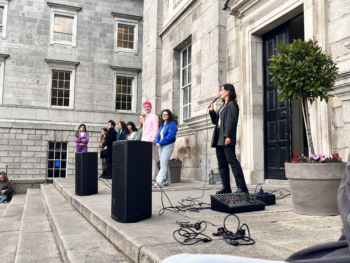
. The Student Union in Ireland’s top-ranking university, Trinity College, is currently in the process of electing new sabbatical officers. The first hustings was on 18 February. Last year, the Students Union (SU) President, Laszlo Mornafi, made headlines when it promoted an encampment that blocked access to the Book of Kells as an act of protest against the war in Gaza. Recognising the importance of Trinity’s student body, Village asked the SU’s presidential candidates to give a brief account of how, if in office, they plan to address the values of sustainability, diversity and equality. Here are their responses. Patrick Keegan “Trinity has many shortcomings, and it’s up to us to take action to hold the college to account. Students have the power to enact change, and we must engage in direct action and lobbying at every step to ensure that Trinity properly represents us all. Trinity often focuses on optics rather than real sustainability, and has partnerships with companies like Coca Cola and Ryanair, promoting greenwashing while they continue their harmful practices. On diversity and equality, we must push Trinity to do better. Student consultations are crucial to identify areas for improvement. We must ensure that all students from all backgrounds feel welcomed at Trinity, and it’s through consultations that we can best identify and address all issues, no matter how big or small. Trinity must also confront its ties to oppressive regimes, such as apartheid Israel, and address shortcomings in trans healthcare and racism. Trinity must do more to support Irish-language speakers, such as by offering modules through the medium of Irish. As President, I will work for all students, demanding the college prioritises students. Trinity also has much to do to ensure equal access to education, as many lectures are not recorded, and many students don’t have their LENS reports properly met. We will address these issues through lobbying, information campaigns, and direct action. Additionally, our campaign weeks provide a perfect opportunity to address specific issues. We are the largest stakeholders, and we must hold Trinity accountable, acting radically to ensure Trinity represents us all”. Giovanni Li “Sustainability, diversity and equality are three of the most recent popular buzz-words within this decade, advocating for the rights as well as the well-being of the average person and not just those who are privileged. No matter the race of the individual, background, status or any other external factor. If I were to be elected it would be of utmost importance to me that these core values are held to the highest standard possible, no student will be left behind, no tables unturned in fighting for what we now know as student rights, no blind-eye will be turned to any individual who poses a threat to the well-being of students. But most importantly, I will ensure that ignorance will be the last thing that shows up on the Union’s doorstep. To advocate and allow visibility for the needs of the students such as rent pressure alleviation, campus quality, poorly run examinations, lack of recourses, lack of accessibility, lack of inclusivity… the list goes on and I will not stand down or be silent in these tumultuous times. I will turn what we now know as a Trinity into a haven for students, a place where they feel safe, heard and educated without barriers. We must break free of these barriers that have been placed upon us by our oppressors. #VoteLiBreakFree”. Seán Thim O’Leary “I view all three values as deeply intertwined. Sustainability is the ability to operate and live up to one’s values in the long term. Diversity should lead one to proactively take steps to bring about fair access for those from marginalised backgrounds. Equality then is self-evidently linked in, involving proactive and codified efforts to engage and improve experiences of those from marginalised and disadvantaged backgrounds. If elected President, I would like to draw particular attention to the systemic barriers within and outside college, which impact thousands of Students within Trinity. I would like the Union to take a proactive welfare- and service-based approach to meet student needs on campus, while employing grassroots organising, to aggregate the voices of students of all backgrounds, and use that as a platform to fight the government and college administration for justice on students’ behalf. The government disregards the student perspective, and disregards some students far more than others; the fight for justice here is a fight for all students. Specifically within Trinity, I want to take the opportunity to highlight chronic underfunding of the student counselling service, college health, and necessary course equipment (impacting students from STEM to Creative Arts). Here we have a lack of focus from college administration, and chronic neglect from the government; tackling this requires targeted political action, and on campus organising over a sustained period. The Union needs to properly engage and mobilise student action on this front, and not just through token surveys”. Jes Paluchowska is studying English and Philosophy in Trinity Photos: Trinity News