admin

  • Posted in:

    Curried Chips, Uncomfortable Chairs and a Swollen Testicle. By Kevin Higgins, Poet.

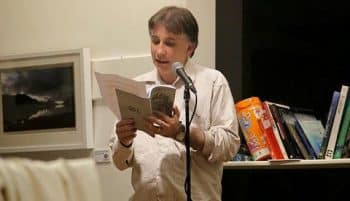
    About ten years ago I attended a poetry reading, at a location I will not disclose here, in a vast hotel conference room. One of the poets was a nearly great poet, the other not so much. One was wearing a tweed jacket, or at least my memory chooses to dress them in tweed; the other was wearing a pair of curtains which I think my Mother would have liked for her big sitting room window. The room was full of people nodding gravely. A few of the audience were nodding off to sleep. Others were trying not to. It was a most worthy gathering, and I am grateful to the Irish government for paying my air fare and hotel bill.   The poetry readings I have co-organised with my wife Susan via Over The Edge literary events in Galway for the past two decades are nothing like this. For several years we organised successful Friday night poetry readings in a wine bar above a cheese shop. The room, I’m reliably informed, smelled of sweaty cheese, a smell to which I think I must have become immune because I ceased to notice it.   If our poetry readings don’t fill your nostrils with the smell of the bluer varieties of French cheeses, the fabulously uncomfortable plastic chairs in Westside Library, where we annually partner with Westside Arts Festival to organise Ireland’s largest literary open-mic, will at least make sure you stay awake. For many years we used to take visiting poets and writers to our local Turkish burger-and-kebab house after readings where I would usually dine on the most excellent curried chips. These days, for health reasons, I have to settle for Champagne and hors d’oeuvres at the House Hotel because the medication I am on for my dodgy lungs clashes unpleasantly with the cheaper varieties of food and alcohol. It’s a sacrifice. But one I’m prepared to make in the interests of literature.   Now don’t get me wrong, while the poetry readings we organise do aim to at all times keep our audience awake, they are not pseudo-Beatnik amateur hour affairs which are all about the MC’s male member. We have had many leading Irish poets and fiction writers take part in our events: Medbh McGuckian, Denis O’Driscoll, Colette Bryce, Eamon Grennan, Ken Bruen, Claire Kilroy, and Kevin Barry to name just a few. The radical thing we do, though, which neither the pseudo-Beatniks nor the crowd in that aforementioned giant hotel conference room appear to be interested in, is we platform raw new writers alongside the very established.   If Over The Edge was a religious rather than a literary movement, we would be some offshoot of the Quakers; everyone gets to have their moment, their say.   The crowd nodding off to sleep in that hotel conference room full of tweed and carpets call to mind the Catholic Mass, with its absurd hierarchies, peculiar outfits, and me there in the midst of it all trying not to smirk.   One of the featured readers at a recent Over The Edge: Open Reading is a young woman, just turned twenty, who first joined one of my poetry workshops four years ago while she was recovering from having deliberately jumped off a motorway bridge. She vanished for a bit after that term of workshops and then emailed me during the lockdown to ask if we could meet to discuss her poetry – she had been writing again, she said.   I said of course, when the Covid restrictions allowed, we must meet for coffee and she must bring some copies of her new poems. She said this wouldn’t be possible as she was only allowed out of the psychiatric unit at University Hospital Galway, where she was detained having almost died of an eating disorder, for half an hour each day, and she was not allowed, by order of court, to leave the hospital grounds. All of this is in the public domain, and she has written about her experiences.   I said I would come and meet her in the hospital grounds. We met, and sat on the grass outside the door of the psychiatric unit and discussed her new poems while two psychiatric nurses watched us from the door. One of the nurses said to her as I approached: “Yer man looks like a poet alright”.   I gave her some editing suggestions and came up with a few places where she might submit her poems for publication. She was a featured reader alongside a poet who has published three collections, and did great. Everyone was talking about her reading afterwards. She read for the same fifteen minutes Denis O’Driscoll and Medbh McGuckian read for.   Of course it is not because I am a good person that I organise literary readings. I do so because I am a poet myself. And also because I have a compulsive need to change things for what, I think, is the better.   Many poets who go into organising/“curating” events or become publishers tend in time to cease to really be active poets. I knew I had avoided this fate, and made it as a poet when, in 2013, I gave a reading on the floor of the AWP Conference in Boston; then headed to Amherst, Massachusetts to do another reading there.   While in Amherst I rather embarrassingly developed a pretty grossly distended testicle, which was an offshoot of a kidney infection I got because of the autoimmune disease I am beset with. I carried my swollen testicle onto a bus from Amherst to Springfield, Massachusetts then onto another bus to Boston and then put it on a plane to Dublin, along of course with the rest of me. Back in Galway, having visited a doctor and shown her the nature of my problem, I then did another poetry reading that evening, as I was scheduled to do, and then immediately took my testicle home to rest

    Loading

    Read more

  • Posted in:

    An Octoroon at the Abbey: an enthusiastic Rory O’Sullivan finds actual theatre, reality as pure possibility, despite the irritating audience

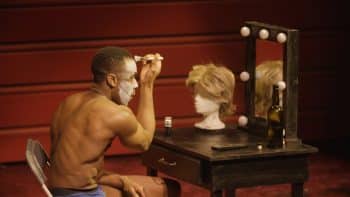
      In 2018, the New York Times named ‘An Octoroon’ by the American playwright Brandon Jacobs-Jenkins the second-best play since ‘Angels in America’ (putting first for some reason the excruciating ‘Topdog/Underdog’) – but despite this, the play is scintillating and worth seeing. It is complicated to summarise, but essentially, Jacobs-Jenkins reworks a Nineteenth-Century play called ‘The Octoroon’ by the then-famous Anglo-Irish playwright Dion Boucicault, who spent much of his life in America. ‘The Octoroon’ (Jacobs-Jenkins changes it to ‘An’) was a fairly standard melodrama with a mad plot set on a slave plantation in America. Shocking about it for us today are: on the one hand, not only its racism, but the chirpiness and assumed obviousness of this; on the other, how familiar are so many of its characters and devices. Originally all the parts would have been performed by white actors, some in blackface. Jacobs-Jenkins has actors of colour do parts in blackface and whiteface, adds some characters, and intersperses the scenes with a kind of commentary – one thing introduced by these is a sense of humour that manages seamlessly to pass into ‘The Octoroon’ – and at the beginning monologues by actors playing him and Boucicault. With this conceit the play manages to take on the entirety of race in American (and more broadly Western) culture for the last few centuries in a fresh way – none of it simply or cheaply. You leave with the feeling that you have experienced something new. I think part of the secret of this lies in how it manages to layer everything – melodrama, racism, humour, the two playwrights, the audience – so that there is not one word or gesture, not one decision that the play has made with fewer than three meanings. Like Moby Dick, this is a work of art that whenever it is faced between options somehow chooses all of them, and the result is extraordinary. Like Moby Dick, this is a work of art that whenever it is faced between options somehow chooses all of them, and the result is extraordinary. Schools should bring their students to this play instead of ‘teaching’ Shakespeare. It is true that, if they did, people would turn 18 not knowing whether the quality of mercy is strained and if a rose smells just as sweet when we call it something different, but on the other hand they would have experienced a much more important thing that in Ireland and generally life is too rare: actual theatre. Schools should bring their students to this play instead of ‘teaching’ Shakespeare. It is true that, if they did, people would turn 18 not knowing whether the quality of mercy is strained and if a rose smells just as sweet when we call it something different, but on the other hand they would have experienced a much more important thing that in Ireland and generally life is too rare: actual theatre. The whole point of actual theatre is that it is something only a play can do (otherwise it would just be something else: for example, ‘humour’) ‘But what is actual theatre – and who needs it?’ The whole point of actual theatre is that it is something only a play can do (otherwise it would just be something else: for example, ‘humour’), and so if you want to know what it is then you will have to see it for yourself. There is always a certain, essential gap between a distillation or description of something and it – any reasonably broad-minded person can understand this. But still let me try and explain. Near the beginning of this play and marking the transition from opening monologues to the action, Boucicault (played by Rory Nolan) dances to ‘WAP’ by Cardi B, at the end of which he turns into the character Wahnotee. We watch this large, bearded man playing a Richard Harris sort of character as Boucicault move his body in ways we would associate with a young, black hip-hop star. Actual theatre is the experience of actuality, of reality unmoored from the constraints of the imagination – reality as pure possibility. It would be easy to describe that movement with words such as ‘enchanting’ or ‘spellbinding’ but they would completely miss the point. In that movement there is actual theatre (which is one way of translating Bertolt Brecht’s term ‘Episches Theater’): that which puts before us with arresting and irrefutable power all the ways that our ideas about the world and ourselves and each other have nothing to do with reality. Actual theatre is the experience of actuality, of reality unmoored from the constraints of the imagination – reality as pure possibility. The mix of ignorance and feeling threatened which is behind most of the choices about our country’s education system will mean that at least in this place and time anyone who wants to experience actual theatre will have to go out and look for it with no guarantee of finding it. But what better for school students to see? This production of the play, directed by Anthony Simpson-Pike, is very good but misses opportunities here and there. Sometimes the actors show their characters’ hands too much, meaning that the obviousness of Boucicault’s play wins out over the subtlety of Jacobs-Jenkins’s. Patrick Martins is excellent as the lead once Boucicault’s play begins, but in the opening monologue he is not quite camp enough for the script. Umi Meyers and Leah Walker are memorable as Zoe and Minnie. Overall, the choice to run it by Caitríona McLaughlin, the new artistic director of the Abbey, was spot-on, and hopefully we will have more plays like this. It is certainly an overstatement in the programme for Simpson-Pike to call Boucicault “one of Ireland’s leading lights” – and awkward in a play that puts so much emphasis on exploding fake compromises to avoid the implications in the Nineteenth Century of Boucicault’s ANGLO-Irishness, however complex they may be – but for the most part such issues

    Loading

    Read more

  • Posted in:

    The St Vincent's Papers. By Marie O'Connor.

    The Religious Sisters of Charity have now transferred the assets held by them in St Vincent’s Healrhcare Group to a Catholic holding company which was  set up by offshore specialists with links to the Panama Papers.   The British Virgin Islands   have just made the news with the arrest of their Premier in Miami on Thursday on charges of money laundering and drug trafficking. The territory features sporadically in the Panama Papers, and the territory is now facing direct rule from London following a year-long UK inquiry into government malpractice. The islands have hosted more than 370,000 shell companies,  used to control assets totalling $1.5 trillion on behalf of undisclosed owners. These owners included shady oligarchs and politicians. Despite oft-repeated claims of independence, St Vincent’s Holdings CLG is effectively a spin-off of  St Vincent’s Healthcare Group Coincidentally, on the same day that the British Virgin Islands  Premier was arrested, St Vincent’s Healthcare Group announced that it had completed the legal transfer of the shareholding of the congregation in the St Vincent’s Healthcare Group into St Vincent’s Holdings CLG. Until this week, the nuns owned three hospitals:  the enormous St Vincent’s University Hospital, which the order used to mortgage the building of their private hospital: St Vincent’s Private Hospital; and St Michael’s Hospital in Dun Laoghaire. The congregation also owned the Elm Park and Dun Laoghaire sites. The hospitals and the lands were valued at €661 million in 2018. The Elm Park site now owned by St Vincent’s Holdings covers a sprawling 28.7 acres. Housing land in the vicinity  is currently making €5 m per acre. This does not represent the full site because the congregation has held onto its old private hospital, which sits on a further 1.8 acres. The Religious Sisters of Charity are set to rent the property, now known as the Herbert Wing, to its former company. The transfer of the Religious Sisters of Charity’s shareholding means that the new St Vincent’s Holdings CLG has assets worth up to three quarters of a billion euro. If the maternity hospital deal goes through, the property portfolio will be worth in or around €1.75 billion. The board of this new St Vincent’s Holdings CLG currently consists of just three members. The Religious Sisters of Charity set up St Vincent’s Healthcare Group in 2001 to own and manage its hospital at Elm Park. The Religious Sisters of Charity was the sole shareholder in the company. St Vincent’s Healthcare Group  pushed hard for ownership and control of the new maternity hospital. It got it by insisting on retaining ownership of the site on which the new hospital is to be built, and using this ownership to press for an operating licence (a key condition of the lease). The purpose of this licence, to be given back to itself, is to enable the St Vincent’s Healthcare Group to control the use of the land and, by extension, the activities of the new hospital. The subscribers to St Vincent’s Holdings CLGare Stembridge Ltd and Porema Ltd As its constitution shows, the new holding company, St Vincent’s Holdings CLG, was set up by two companies limited by shares. Informed sources say that this is a highly unusual arrangement for a not-for-profit company. The subscribers to St Vincent’s Holdings CLG, which appear on the final page of the document,  are Stembridge Ltd and Porema Ltd. Both are active in what has been termed ‘the offshore economy’. Under the constitution, these subscribers are the members of the new holding company. Stembridge and Porema are linked. CRO filings show that they share the same CEO, cross directorships; the same secretary and the same address. These offshore specialists appear on the website of the International Consortium of Investigative Journalists which details who is behind more than 800,000 offshore companies, foundations and trusts from the Panama Papers, Pandora Papers, Paradise Papers, Bahamas Leaks and Offshore Leaks investigations. Both Stembridge and Porema are listed as being linked to a vast number of offshore entities. Each one is associated, separately, with well over 200,000 offshore companies, and each is linked to over 2,000 “intermediaries”  (described as “introducers”). Even allowing for a 40 per cent overlap between these entities, these numbers are dizzying. Stembridge is itself an intermediary, according to the Irish Times. In 2016 the newspaper reported that Stembridge (cited as Stembridge Trust Ireland and owned by Paul Newman, who was listed as living in Switzerland) was one of seven intermediaries in Ireland with links to the Panama Papers. One section of the Panama Papers relates to the Mossack Fonseca leak. Mossack, described as one of the world’s largest wholesalers of offshore secrecy, was a Panama-based law firm. It kept the financial secrets of global celebrities, oligarchs and criminals for four decades, flouting rules requiring lawyers and other offshore specialists to identify and verify their clients, to prevent ill-gotten gains from being salted away. In 2016, 11.5 million documents from the firm’s records were leaked. Its bread and butter was the setting up of shell companies in tax havens, so, when the tsunami hit, the firm didn’t know who its clients, numbering tens of thousands, were. The leaked files show that Stembridge was linked to 24 offshore companies associated with Mossack Fonseca. Two of the directors of Stembridge and Porema, Karen Corcoran and Sue Jesper, signed the St Vincent’s Holdings CLG constitution. The leaked files show that Stembridge was linked to 24 offshore companies associated with Mossack Fonseca. Two of the directors of Stembridge and Porema, Karen Corcoran and Sue Jesper, signed the St Vincent’s Holdings CLG constitution. Both are employees of Corporate Formations International Ltd. All three companies share cross directorships. Corporate Formations International also has a strong presence on the International Consortium of Investigative Journalists website:  the company is linked to over 275,000 offshore entities; and well over 3,000 intermediaries. Again, even allowing for a 40 per cent overlap, these figures are eye-watering. There is no question, nor any implication, of illegal behaviour in any of the above on the part of any of these companies. What it is, however, is complex. Why did St Vincent’s Healthcare

    Loading

    Read more

  • Posted in:

    UPDATED: Newly discovered evidence of a secret Kitson-RUC plot to safeguard the UVF. By David Burke.

    The campaign for the truth about the infamous McGurk’s bar bombing has uncovered the existence of a covert intrigue hatched by the British Army’s counter-insurgency (i.e., dirty tricks) guru, Brigadier Frank Kitson, and the RUC, to conceal the truth about the UVF’s bomb attack massacre at McGurk’s bar fifty years ago. Kitson and the RUC conspired to blame the attack on the IRA. The explosion caused the building to collapse, killing fifteen Catholic civilians—including two children—and wounding seventeen more. It was the deadliest attack in Belfast during the Troubles. The Ministry of Defence has told the campaign that it has no record of the scheme to switch blame from the UVF to the IRA. The PSNI (as successor to the RUC), is being non-committal. They undoubtedly know full well that (a) there was a secret arrangement and (b) precisely what it entailed, but don’t want to admit the deeply shameful truth. The reason for believing the PSNI knows what happened is because the Police Ombudsman for Northern Ireland has details of the secret compact. It is not prepared to provide them to the families of the deceased, at least not at this stage. What are the MoD and PSNI/RUC trying to hide? What is so controverdial that it merits a cover-up 50 plus years after the event? What are the MoD and PSNI/RUC trying to hide? What is so controverdial that it merits a cover-up 50 plus years after the event? The British Army was deployed in Northern Ireland in 1969 to protect Nationalists from organised Loyalist attacks involving attempts to burn them out of their homes. The Army was sent to their rescue. The soldiers were welcomed by the Nationalist/Catholic community. Their arrival ushered in a ‘honeymoon’ period during which relations between the Army and Catholics were harmonious, if not warm. At the time, the threat to the Army and police emanated from Loyalists. In October 1969 Loyalists rioted and murdered Victor Arbuckle, the first police officer to die during the Troubles. The honeymoon period began to peter out as 1970 dragged on. The reasons for its decline are complex, multifaceted and controversial. What is crystal clear, however, is that Brigadier (later General Sir) Frank Kitson, who had been sent to Belfast in September 1970, chose to abandon peacekeeping and go on the offensive instead. He decided he did not want to take on both Nationalist and Loyalists and opted to attack the IRA (then consisting of the Officials and Provisionals). He used ancient dirty trick tactics which he had brought up to date in colonies such as Kenya and Malaya. In a nut shell, he used Loyalist terror gangs as proxy assassins to kill IRA members. I set out the evidence that Kitson and elements within the RUC were using the UDA assassination squad commanded by Tommy Herron of the UDA’s Inner Council as proxy assassins in my recent book on Kitson. It includes a chapter on Herron and one of his top killers, Albert ‘Ginger’ Baker. If the UVF attack on McGurk’s had sparked  the internment of the UVF, it was likely that figures in the UDA such as Herron and Baker would have become targets too. When internment was introduced in August 1971, Kitson’s Loyalist cats’-paws were not interned. The McGurk’s bar bomb atrocity of December 1971 – four months later – threatened to change this set of affairs. Had the truth about the bomb attack emerged, i.e. that the UVF was responsible for the bomb in the bar – not the IRA, it would have amplified calls to intern members of the UVF and UDA. Who would carry out Kitson’s assassination programme if the Army and RUC were ordered to intern Loyalist gunmen? At the time, Kitson and the SAS were also training a secret army, the MRF. Its personnel were drawn from the Army. The MRF had an assassination wing. When the MRF was deployed on shoot to kill missions in 1972, they wore civilian clothing thereby inviting the public to conclude they were Loyalist terrorists when the circumstances so demanded. If Loyalists were to be interned in a widespread and effective manner, it had the potential to strip the MRF assassins of their cover i.e., the public perception that MRF hits were the work of the UVF and UDA. Overall, the McGurk bar bombing was a threat to Kitson’s various lethal strategies. Hence, the McGurk attack was portrayed as an IRA ‘own goal’. Kitson, a black propaganda expert, saw to it that the attack was blamed on a non-existent IRA unit which was meant to have carried the bomb into the pub en route to its final destination, but that it exploded prematurely. Kitson knew that this was a lie. Kitson’s template for the exploitation and manipulation of Loyalist gangs as proxy assassins was pursued for three decades by MI5, the MRF, RUC Special Branch, the FRU and a host of other secret departments. The UVF was deeply involved in these clandestine programmes. Robin ‘the Jackal’ Jackson of the UVF featured prominently in collusive murders during the 1970s and 1980s. The newly discovered Kitson-RUC arrangement by the McGurk’s bar bomb campaign for justice threatens to reveal some of the early roots of this practice. UPDATE 2 May 2022: The following information is from a press release from the campaign for the truth about the McGurk’s bar massscre Chief Constable Snubs Massacre Families and Withholds Evidence The Chief Constable of Police Service Northern Ireland has yet again snubbed the families of the McGurk’s Bar Massacre despite a protest at the Policing Board to mark the 50th anniversary of the atrocity and an official request to meet with him. Instead, a police representative of the Chief Constable has informed the families that PSNI is withholding critical evidence of the police and British Army cover-up of the massacre. On 2nd December 2021, families of those killed and injured in the McGurk’s Bar Massacre were left out in the cold at the Policing Board when Chief Constable Simon

    Loading

    Read more