admin

  • Posted in:

    Reazoning For Mammon

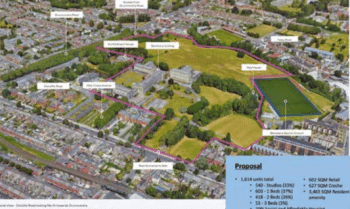
    March/April 2022 19 scheme is purely for rental and does not meet the need for local residents and their community for housing which is integrated and provides for people of mixed incomes as well as appropriate social housing. The scheme includes provision for the required 10 per cent social and 10 per cent aordable housing. Rory Hearne of Maynooth University said the “mega build-to-rent scheme would essentially be a private enclave set apart from the local area, owned by overseas institutional investors”. “This is a reversion of 100 years in the social progress of land ownership and is part of a race to the bottom in the Irish housing system”. It also appears to conflict with an assurance by former Archbishop Diarmuid Martin in advance of the, Vatican-approved, Clonlie sale that the priority for the diocese was “to ensure the buildings and lands would be used for the benefit of the local community and a legacy for the city of Dublin”. The land deal certainly benefited the Church and the GAA which hailed it as the best in its history and “the key achievement for the year, if not the decade” in 2019. “The Archbishop was very anxious that he would sell to the GAA and he really wanted to deliver a social and aordable housing complement to that part of the city,” explained GAA stadium and commercial director, Peter McKenna. a hotel, two new pitches, a clubhouse and oce facilities on the 11 acres it has retained from the land deals. Instead of helping to resolve the housing crisis, as the church says it wants to do, many of the 120 parties who objected to the Hines application have argued that it will exacerbate the emergency. The €610 million Hines plan proposes 12 apartment blocks ranging from two storeys to 18 storeys in height on the former site of the former Holy Cross seminary and college. Among those with reservations was Dublin City Council which said that it was disappointed with “the disappointingly high quantum of single aspect and studio and one-bed units” which, it argued, “is not considered appropriate to the area and could constitute an unbalanced form of development”. DCC said the proposed 71 per cent of studio and one-bed units within the scheme “is alarming” adding that “it is considered unlikely the development will provide an attractive mixed-use sustainable neighbourhood….in compliance with the Dublin City Development Plan 2016-2022”. The local authority did not, however, recommend against the planning application. What must also concern the Catholic Archdiocese is the criticism of the Clonlie and Croke Park Residents Association that the T he move by the Catholic Archdiocese of Dublin to alter the zoning of lands where 33 churches are located across the city has once again raised the question of its potential role in the provision of aordable and social homes in the midst of a deep housing crisis. In mid-February, it lodged a 130-page submission in response to the Dublin City Council development plan opposing zoning rules which preclude housing or office developments in all but “highly exceptional” circumstances on such lands. In the document, solicitors Mason Hayes and Curran claimed that “the proposed changes are unlawful insofar as they affect religious institutions such as our client”. Some of the churches “are located in disadvantaged areas where the delivery of housing is taking priority over additional institutional land uses”, according to the planning consultants Brock McClure, which contributed to the church submission. The development comes after a request last year by housing minister, Darragh O’Brien, to the Catholic archbishop, Eamon Martin, to identify vacant buildings or lands which are owned by the Church and could be used to alleviate the housing crisis. In response, the retired bishop of Killaloe, Willie Walsh, agreed in August 2021 that the church should be doing everything it could to help address the housing crisis. “I would have always had the attitude that church land is not private property. church land is land belonging to the people. The people involved in the church. It is not belonging to the bishop or parish priests or that sort of thing. It is the people’s land and I think that anything the church can do to help the housing situation I think it should be there and trying to do it”, Walsh said. All well and good. Since then, however, the Dublin Archdiocese has come under intense criticism over the circumstances surrounding its sale, in 2019, of a 31.8-acre site at Clonlie Road to the GAA from which it netted a reported €95 million. According to its financial report for 2020, the Catholic Archdiocese received a further sum of almost €3 million due to a to a clause in its contract with the GAA that it would receive “a share in the profits made by the GAA if they sold on any of the lands or buildings to a third party”. The allocation followed the sale of 19 acres of the lands by the GAA to US investment fund Hines which has been granted planning permission by An Bord Pleanála to build almost 1600 ‘build to rent’ apartments on the site. It is understood that the GAA received €105 million for the lands it sold to Hines and plans to provide NEWS Rezoning for Mammon The Catholic Church had high ideals in getting its land rezoned but there is little sense its Clonliffe lands will be used for the common good By Frank Connolly

    Loading

    Read more

  • Posted in:

    RISING Tensions

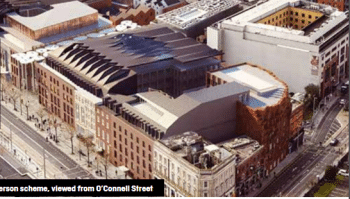
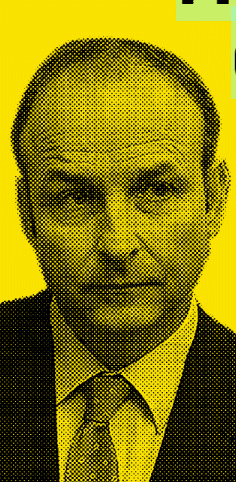
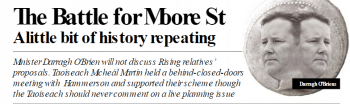
    March/April 2022 17 around Moore Street was not reflected in the final recommendation. Claims that the compensation offer was conditional on accepting the Hammerson proposals have been rejected by ocials of the Council and the Department of Heritage with knowledge of the negotiations. Butcher, Stephen Troy, has claimed his business on Moore St will be severely disrupted during construction and received no oer of compensation from the developer. The representatives of the traders did not participate in the vote taken by the Advisory Group in relation to the Hammerson proposals before it published its recommendations in May 2021. The Taoiseach, Micheál Martin, has also been dragged into the controversy after he publicly endorsed the Hammerson project as the planning application was submitted to DCC. He confirmed that he attended a private meeting with Hammerson executives in April last year after which he provided a statement to the company for a press release it issued some weeks later. The Taoiseach was accompanied by the P lans to redevelop the north city centre from the GPO in O’Connell Street to Parnell Street and including the Moore Street fish and vegetable market have led to a fresh outbreak of hostilities on the historic site linked to the 1916 Rising. The lands, known as the Carlton site, have been the subject of prolonged planning controversy going back to the late 1990s when architect Paul Clinton, and a number of property owners on Upper O’Connell Street, sought to develop a retail scheme and conference centre. For almost three decades, the site has remained derelict and a monument to the neglect, by several governments and Dublin City Council (DCC), of the main street of the capital city. A row has recently erupted over a proposal to compensate 17 street traders, who hold licences issued by DCC, for any disruption to their business caused by UK developers Hammerson, which has been granted partial planning permission to build a large shopping, residential and oce complex on the largely disused landbank. Details of a scheme to give €1.5 million to the traders in compensation while construction work is underway were confirmed at a meeting of the Council in early February by DCC chief executive, Owen Keegan. Village has learned that this oer was raised to €1.7 million in early May 2021 following discussions between the Council and the traders and that an offer of further negotiations was made on Sunday, 20 February. However, tensions over the compensation issue were dramatically raised when it emerged that a planning consultant acting for the traders said that they wanted €34 to €40 million, or more than €2 million each, to move their stalls during the construction of the Hammerson scheme. A subsidiary of Hammerson, Dublin Central GP, had agreed to pay €1 million towards the compensation package, with the Department of Housing, Local Government and Heritage and DCC contributing £300,000 and €200,000, respectively, to the overall €1.5 million oer. In a statement in reply to a question by SF €34 to €40 million, or more than €2 million each, to move their stalls during the construction of the Hammerson scheme NEWS Hmmerson scheme, viewed from O’Connell Street Debate as to whether 30-year-derelict Carlton site should be developed though scheme demolishes much of the Moore St battle site By Frank Connolly RISING TENSIONS Councillor Micheál MacDonncha, Keegan said: “In the spring of 2021, prior to a planning application….Dublin City Council’s Housing & Community Services Department, Casual Trading Section began to engage in a commercially sensitive process to try and put a framework in place to compensate traders in the event of development. This was a tripartite framework with DCC, Department of Housing, Local Government & Heritage and Dublin Central GP Ltd. (Hammerson) partaking to compensate traders as all three…. brought forward proposals that may have an impact on traders over the coming years: DCC on the upgrading of Moore Street, the Dept. on the restoration of the National Monument as a commemorative centre and DCGP on the delivery of the Dublin Central site and Enabling Works for Metrolink”. The Council chief executive insisted that the process was “entirely separate from that of the Planning Authority and that the Planning Authority has no role in matters of compensation”. Two out of three planning applications relating to the Hammerson project were granted in late 2021 after an Advisory Group set up by the Government and including politicians, street traders and relatives of those who fought in the Rising recommended support for the commercial development. Some of those who participated in the advisory group have claimed that their opposition to the development which, they argue, will destroy much of the historic battlefield site Butcher, Stephen Troy speking t  recent ‘Sve Moore Street’ protest 18 March/April 2022 secretary general of his department, Martin Fraser, at the meeting on 19 April, 2021 with Connor Owens, Ireland Director of Hammerson, its development manager Ed Dobbs and architect Friedrich Ludewig. At the meeting, Owens set out the company’s vision of the scheme including the restoration of Upper O’Connell Street, pedestrian entrances to Moore Street through a new public square and its provision of works for a Metrolink station. He said that Hammerson would retain all pre-1916 buildings on Moore Street and construct a new archway to commemorate the Easter Rising. The development includes the construction of 94 new homes, 210 hotel rooms, retail outlets, restaurants, oces and shops. In a press release by Hammerson in early June announcing its decision to lodge the planning application, Micheál Martin was quoted as welcoming the rejuvenation plans, which, he said, “will enhance the status of O’Connell Street by developing new transport links and delivering new homes, retail facilities and oces which will boost employment in the area. The locations around Moore St and the GPO will see an increasing number of visitors who will be drawn into the seminal role it played in our history”. He added that “it is important to continue to liaise with the street traders and those

    Loading

    Read more

  • Posted in:

    Rory O’Sullivan reviews Salvatore of Lucan at the Kevin Kavanagh Gallery: Painter of Universal Love The intellectual truth of modern positivist materialism is the psychedelic.

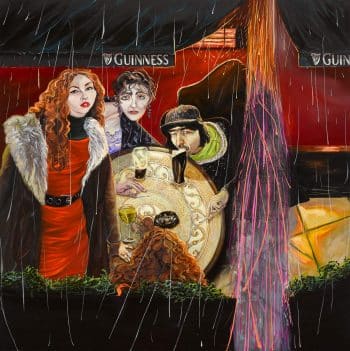
        Everywhere Salvatore of Lucan’s art combines a rigorous and searching honesty about all the most characteristic aspects of a single place, time and self with the intense feeling of a world which is not that place and time – even his name: as much serious as joking, as much old as completely new. If perspective is to visual art what drama is to theatre, then at the climax these paintings cause us to look through the eyes of a universal kinship If perspective is to visual art what drama is to theatre, then at the climax these paintings cause us to look through the eyes of a universal kinship. Most of us love no-one except maybe our families and a few friends, but here for the brief period of observing we understand that everyone, no matter who they are to us, needs and is worth love – even if sometimes they also need forgiveness. It may be (and strictly speaking there is no reason to believe not) that someday the view which is the heart of these paintings will become the global view. But for now, this perspective, arising from our own time in these paintings as from so many others before in other places, remains timeless: a perspective of un-time, of the future. Even before LSD, the psychedelic had already revealed itself as the profoundest contribution to thought of so-called modernity. Its place is equal to that in Christianity of Christ’s atheism on the cross (God, why have you forsaken me?). Those words revealed to the few among so many Christians afterwards who saw that the profoundest divinity in the human condition is the same as its most abject and most material suffering, its barest abandonment. If the divinity of wretchedness is the intellectual truth of Christian teaching, then the intellectual truth of modern positivist materialism is the psychedelic, which is about the beautiful and affective quality of things. If positivist materialism says we are protons and electrons, the psychedelic says this is what protons and electrons are like. In that strange sphere, it is possible for every convention and perception of form to melt away or else become completely different. We are forced to recognise ourselves as what Rilke called “Pollen of the blooming Godhead”. From this standpoint, the psychedelic, Salvatore of Lucan devotes himself in his paintings to understanding its brutal and widespread counterpart, the intoxicant. From this standpoint, the psychedelic, Salvatore of Lucan devotes himself in his paintings to understanding its brutal and widespread counterpart, the intoxicant. The intoxicant lures us in with its dreamlike verisimilitude to psychedelic reality, with its altered experience of drunkenness/being high, combined with the avoidance of seriousness. But in the end this same mechanism serves only to increase suffering by making everything apart from intoxication less bearable, more difficult, less changeable, more dull, less psychedelic. And as against this fear we lose the power to do anything other than repeat this intoxicating pseudo-experience, we change: the end-result of intoxication is deformity. In ‘The Castle Lounge,’ ‘Family Time/Nanny’s Shriek’ and ‘Me Being an Arse’ the subject is alcohol. But ‘Work’, which depicts two employees of what seems to be an IT-retail shop with a skeleton below under the floorboards starting a painting, and ‘Me as a Blemmyae’, where he is staring intensely at his phone, set up for Zoom with a ring-shaped webcam light, are also about intoxication. All ideologies – as well as ambition, money, power, and everything else that places the virtual above the actual – are intoxicants. All ideologies – as well as ambition, money, power, and everything else that places the virtual above the actual – are intoxicants. Currently what is missing in the public debate about alcohol is a sense of how it differs from these other things not in kind at all, only by degree. In these paintings usually the characters get drunk, and always they are subjected to the intoxicated fantasies of a broader world. The two indications of this are deformity, which is one of Salvatore of Lucan’s most developed tools; and defiance, which is his most impressive. Traditionally speaking the deformed is the other – hence all those fascinated descriptions and collections of monsters in Antiquity and the Middle Ages from which comes the ‘Blemmyae’ of one of the paintings – here deformity is about the self: the intoxicated self, deformed and distended by falseness.   But there is also the psychedelic self of whom deformity is the central condition: this is the defiant self, whom we can see in the eyes of every painting, the green and beautiful eyes for example of ‘Me as a Blemmyae’, and the deep and questioning eyes in ‘The Castle Lounge’.   The eyes of people in these paintings designate something in them that is strictly their own, that does not belong to anybody. The intoxicant offers an escape from suffering and death, but its price is deformity and at last self-destruction. If the psychedelic promises to transcend these it is only by confronting them in full horror: because horror, always, eventually, when you look at it for long enough, becomes beauty.   In the middle of this exhibition there are two paintings: ‘Forget Me Nots’, of a pot of flowers with a skeleton underground beneath them, and ‘Dead Present’, after which the exhibition is named and the smallest painting by far – of the same flowers dead and bunched hanging upside-down by a rope with a cross-shaped knot a few centimetres above in a Tiepolo-blue background, like the sky. In the first, life is stalked by death; in the second, death meets the open air of life.   There are many reasons to think our place and time is hopeless. But this exhibition shows that whatever else at least some part of it has not given up on itself. It is still possible for there to be among us an artist, who, even if just while painting, strives to comprehend the task of

    Loading

    Read more

  • Posted in:

    Letter sent to An Bord Pleanála by Village's editor, Michael Smith, concerning criminality and other ethical failures by its Deputy Chairman

    6 Ormond Quay Upper Dublin 7 D07H324   The Secretary An Bord Pleanála 64 Marlborough St Dublin 1 D01 V902 14 April 2022. By email only to bord@pleanala.ie, communications@pleanala.ie Re: the imperative of An Bord Pleanála pursuing a criminal complaint under Sections 147-149 and 156-157 of the Planning and  Development Act 2000 (the “Act”) against Mr Paul Hyde, and acknowledging that he is no longer       a member of its board Dear Sir/Madam, I am writing giving you information sufficient to ground a criminal complaint under Sections 147 and 148 of the Act which can be prosecuted by An Bord Pleanála (ABP) with the consent of the Director of Public Prosecutions. I believe for ABP to prosecute would be appropriate in this instance in circumstances where the subject of this complaint is the deputy chairperson of ABP who has brought it into disrepute. I am attaching copies of all material in my possession relevant to this complaint. Background Deputy chairperson Paul Hyde has served as a board member of ABPsince 1 May 2014. He has also served as chairperson of the SHD division since December 2017. He has engaged in behaviour that cuts across his obligations under the Planning Acts , the criminal law and the ethics acts. Failure to declare interests Below is attached a list of developments where Mr Hyde had a conflict of interest. Land registry records attached indicate Mr Hyde is the owner of the following properties: 30 Lindeville, Cork; 4 Castlefield,Baltimore, Cork; Apt 30 Pope’s Hill, Blackpool, Cork; Apt 24 Pope’s Hill, Blackpool, Cork; 16 Watergold, Douglas, Cork; Unit 2 Maryborough Green, Douglas, Cork; land at Rathduff, Grenagh, Cork (co-owner) [see attachment]. Court and other records indicate receivers were appointed to dispose of Apartment 30 Pope’s Hill; 16 Watergold and the land at . There are pending transactions on two of the folios. There are no pending transactions on the land at Rathduff  although it is currently advertised for sale. Mr Hyde also has a 25 percent shareholding in H20 Property Holdings Ltd a company incorporated in Ireland on 16 November 2001 (CRO 350179). It was previously named Fingerpost Builders Ltd.It formally changed its name on 17 May The other 75 percent shareholding is owned by Mr Hyde’s father, Stephen Hyde. According to land registry records, the company is the registered owner of Folio CK106589F, a two-acre, partially developed, plot of land at Pope’s Hill. There are no pending transactions on the folio. Mr Hyde declared he had no interests in his 2021 and 2022 declarations of interest to ABP (submitted in accordance with section 147 of the Act) [attached below] On 9 March 2022 Mr Hyde voted on an SHD application for a development in Blackpool, Part of the land of the applicant in that case is located less than 50 metres from the land owned by Mr Hyde’s company (H20 Property Holdings Ltd). Mr Hyde did not declare a conflict of interest at the board meeting as required under section 148 of the Act. The Law Section 147 of the 2000 Act states at (1): It shall be the duty of a person to whom this section applies to give to the relevant body a declaration in the prescribed form, signed by him or her and containing particulars of every interest of his or hers which is an interest to which this section applies and for so long as he or she continues to be a person to whom this section applies it shall be his or her duty where there is a change regarding an interest particulars of which are contained in the declaration or where he or she acquires any other interest to which this section applies, to give to the relevant body a fresh declaration. (2) A declaration under this section shall be given at least once a year. (3) (a) This section applies to the following persons: a member of the Board… Section 147(3)(b) requires a board member to declare “any estate or  interest which a person to whom this section applies has in any land, but excluding any interest in land consisting of any private home within the meaning of paragraph 1(4) of the Second Schedule to the Ethics in Public Office Act, 1995” and “any business of dealing in or developing land in which such a person is engaged or employed and any such business carried on by acompany or other body of which he or she, or any nominee of his or hers, is a member”. Failure to comply with the foregoing is anoffence under section 147(11) of the Act. Section 148(1) provides that “Where a member of the Board has a pecuniary or other beneficial interest in, or which is material to, any appeal, contribution, question, determination or dispute which falls to be decided or determined by the Board under any enactment, he or she shall comply with the following requirements: (a) he or she shall disclose to the Board the nature of his or her interest; (b) he or she shall take no part in the discussion or consideration of the matter; (c) he or she shall not vote or otherwise act as a member of the Board in relation to the matter; (d) he or she shall neither influence nor seek to influence a decision of the Board as regards the matter”.  Failure to comply with the foregoing is an offence under section 148 (10) of the Act. Section 149(1) provides that “proceedings for an offence under section 147 or 148 shall not be instituted except by or with the consent of the Director of Public Prosecutions”. Composition or arrangement with creditors Mr Hyde has clearly experienced compromising difficulties with several property investments since his appointment to ABP. According to The Ditch, in April 2015 Promontoria Aran took over the Ulster Bank mortgage on land in Rathduff, County Cork, owned by Mr Hyde and three co-investors. In March 2017 the distressed loan buyer issued High Court proceedings against Hyde and his co-investors but the

    Loading

    Read more

  • Posted in:

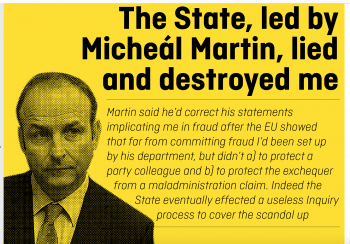
    The State, led by Michael Martin,Lied And Destoryed Me

    14 March/April 2022 I N  the chairman of ISME (the small and medium enterprise lobbyist), Seamus Butler, wildly alleed that – in my capacity as CEO of ISME – I’d been involved in fraud of the EU by submittin unpaid invoices for payment of EU rants. In fact, unknown to me and after ISME had claimed the rant, the EU chaned its rules, to prohibit what was formerly standard practice – its own acceptance of such unpaid invoices – across the EU. It was that chane that ave credibility to the alleation. Butler and others in ISME wanted to et rid of me, since I adamantly opposed ISME’s involve- ment in the social partnership process which was becomin central to its operations. Butler’s supporters were actually in private discussions with Mary Harney, Tánaiste and Minister for Enterprise, concernin her decision to include ISME in the partnership process despite my opposition. I had not been informed. Since I had the overwhelmin support of the members and I had refused the inducement of £,-plus to resin, ettin rid of me was not oin to be easy. Butler, however, was willin to o to considerable lenths to destroy my character and thus directweaken my authority. So, as explicitly threatened, Butler implemented threats to ensure that I would “never work in this country aain” by makin “poor controls and manaement…. look like fraud”. To that end he conspired in  to brin phoney complaints to the Garda. Nevertheless in , despite the prior faxed threats and to everyone’s The State, led by Micheál Martin, lied and destroyed me By Frank Mulcahy Martin said he’d correct his statements implicating me in fraud after the EU showed that far from committing fraud I’d been set up by his department, but didn’t a) to protect a party colleague and b) to protect the exchequer from a maladministration claim. Indeed the State eventually effected a useless Inquiry process to cover the scandal up NEWS Fax from accountants confirming ISME leaders Hynes, Hobdell and O’Loinsigh threatened in 1998 that “Frank Mulcahy’s name will be blackened, he will never work in this country again”. surprise, his alleations were treated seriously and forwarded to the DPP. In the end no prosecution was recommended. Two years later, after an inter – nal ISME report concluded that Butler had justified his alleations by discreetly corruptin previously audited accounts, I endeavoured to enae March/April 2022 15 Deprtment of Finnce briefing note confirms tht, fter deprtment lobbied, it EU Commission committed to not replying to further correspondence from Mulchy with the Garda. Respondin, the Garda authorities declined to accept a copy of that report. They dismissed my complaint of audit corruption as “impossible”. In  Micheál Martin as the Minister for Enterprise, when replyin to Deputy Ruairi Quinn and others, emphatically endorsed the basis of Seamus Butler’s complaint. The Department wrote that its Minister was actin in “absolute” ood faith. We had no reason to doubt that. Further we knew of no relationship between the Department, its Minister and Seamus Butler which miht have explained that endorsement. However, in  after we established further unsettlin evidence , Assistant Commissioner of the Garda, the later discredited Martin Callinan, undertook to reinvestiate the alleations levelled by Butler. He ave a “per- sonal uarantee” as to the thorouhness of that reinvestiation. Time passed. It proved that Callinan was not a ood bet on a personal uarantee. In November , when no investiation ensued, I made technically unauthorised email contact with the civilian forensic accountant to the Garda, Dave McManus. He was straihtforward. He endorsed what ISME had concluded in its private report in . That was damnin of his Garda colleaues and particularly of Martin Callinan’s stated position. I immediately wrote to Callinan notin that the Garda’s forensic account – ant’s contradiction amounted in law to admission that the Garda had enaed in collusion with Butler. However, when I met the investiatin ardaí in December  they extraordinarily denied any contact with their forensic accountant. Immedi- ately after that meetin the forensic accountant was sent to Coventry, my emails were blocked by the Garda and I was prevented from ever aain con – tactin the forensic accountant or any ocer by their direct email address. Despite repeat enquiries by Assistant Commissioner Noirin O’ Sullivan, by the GSOC and in  by the Minister for Justice, the Garda adamantly denied the block. This interdiction lasted ten years until . This was accepted recently in his report by Jude McMahon, appointed. Faced with an inexplicable wall of hostility by aents of the State, I eventu – ally turned in despair to the EU Commission for clarity. It was then that I slowly pieced toether the tale of how the Department of Finance had been locked in a battle with the European Commission since  because of the EU demand that the Irish exchequer “repay” over one billion euros in European rants. That repayment demand arose from the Department of Enterprise’s “systematic maladministration” of EU rants since  and the“overlappin” drawdown (EU code for double charin) of EU Cohesion funds. In / the Department of Finance endeavoured to prevent the EU Commission from communicatin directly with me [top riht] Memo. Indeed they recorded that they had secured that commitment. However, as if in a studied response, three months later the EU Commission wrote and dis- closed that the culpable party (in respect of Butler’s alleation) had been the Department of Enterprise, itself. The EU Commission specifically exon – erated me. In a second email the Commission oered to ive evidence to Martin Callinan and any relevant Irish Authority. Here’s the email: “From: Brian Gray <Brian.Gray@ec.europa.eu> To: mulcahyfm@eircom.net Cc: ruairi quinn <ruairi.quinn@oireachtas.ie>, eamon ilmore Sent: Mon,  Jul  :: + (IST) Subject: RE: Brian Gray Dir General, Int Audit Services, EU Comm Dear Mr Mulcahy, I confirm my availability to reply to any questions your interlocutors may have on the requirements of EC reulations as reards the declaration of

    Loading

    Read more

  • Posted in:

    Updated: The very best (and worst) of British. Simon Danczuk is one of a number of courageous British individuals who has tried to tell the truth about British government crimes in Ireland. He joins the ranks of Colin Wallace, Fred Holroyd, John Stalker, Byron Lewis and John Stevens

    Dolphin Square VIP sex abuse. Dolphin Square was opened in London’s Pimlico in 1936. It soon became a magnet for all sorts of scandal and intrigue:  espionage, political, sexual, not to mention mysterious deaths. ‘Scandal at Dolphin Square’ provides a riveting account of the lives of a rolling maul of fascinating and complex characters. As publicity for the publication accurately proclaims, it was ‘a place where the private lives of those from the highest of high society and the lowest depths of the underworld have collided and played out over the best part of a century’. It was also a cesspit where Prince Andrew’s friend Lord Greville Janner abused children. The two most important chapters in the book, both of which describe the activities of members of a VIP child abuse network, have been ignored by the British press. Cut from the same cloth: the Russian and British press Consumers of the media in the UK, have no appreciation of the extent to which they are kept in the dark about British Establishment scandals. They are completely unaware of the role Buckingham Palace played in suppressing the Jeffrey Epstein scandal for years before it broke in the US media. See: Palace of Discord and Deception. [Updated] Prince William&#8217;s officials covered-up his uncle&#8217;s involvement in the Epstein-Maxwell sex trafficking scandal. By Joseph de Burca. At the moment, many in Britain are exasperated at the ignorance of the ordinary Russian citizen who is misled by a corrupt Putlin-led media spouting nonsense about Nazism in the Ukraine. If the average Brit knew about what has been going on in Ireland, he and she might not laugh with such disdain at the typically ignorant Russian newspaper reader. The Dolphin Square book will help open a few eyes in Britain about the wretchedness of their ruling classes. However, before I return to Dolphin Square, it may be helpful to look at a few examples from recent history to understand the wider picture which explains how the ordinary British newspaper reader has been left to wallow in ignorance about British establishment crimes in Ireland. The tactic is: injure, insult and ignore. There is a deep well of hurt in Ireland felt by many as a result of the lethal misbehaviour of the British army and intelligence services on this island, a history now more than fifty years in being. Fresh evidence of transgressions continue to emerge with depressing regularity. In recent times, they include reports from the Northern Ireland Ombudsman about collusion between Loyalist paramilitaries and the State involving the murder of Catholics, many of them non-combatants who were simply in the wrong place at the wrong time. The murder of Irish citizens by British State actors is no more news in Britain than Putin’s war crimes in the Ukraine are for ordinary Russians. Astonishingly, there was little or no coverage of the fact that the State paid out £1.4 million to the families and survivors of the Miami Showband massacre. There has been – and continues to be – a pattern of State sponsored injury followed by insult. The insult takes the form of the cover-up after the event. If the cover-up falls apart, then the British press and TV go into ‘ignore’ mode. John Stalker who refused to back down when he discovered RUC-MI5 murder of a teenager. It cost him his career. The late John Stalker, the former Deputy Chief Constable of Manchester, investigated the RUC’s shoot to kill programme in Ireland in the 1980s. He discovered, for example, that the RUC and MI5 had murdered a teenage boy who had stumbled across an IRA arms dump in a hay shed. Stalker refused to back off and was stabbed in the back by his own side. The deepest wounds were those inflicted by his boss, James Anderton,  a man who believed that God spoke ‘to him and through him’. In reality Anderton became an accessory after the fact to the murder of the boy at the hay shed. Stalker was smeared by a corrupt press in Britain, linked to criminality and taken off his inquiry. The killers got away Scot free as did all of those involved in shafting Stalker. Few in Britain could have cared less. Although he cleared his name, Stalker retired from the police early a demoralised man. Byron Lewis, intimidated and vilified for telling the truth about Bloody Sunday David Cleary (better known as Soldier F) was responsible for a large number of the killings which took place on Bloody Sunday in Derry in 1972. Byron Lewis was beside him on the day of the massacre. Lewis killed no one – he was a radio operator. The journalist and broadcaster Tom McGurk conducted an investigation into Bloody Sunday and uncovered a written account by Lewis. He published it in The Sunday Business Post in Dublin. Privately, he supplied additional information to the Irish Government. This, finally, provided the ‘new evidence’ the British government required to establish a fresh inquiry. And what happened to Lewis? Although McGurk was careful not to name him, his identity was leaked – probably by the Ministry of Defence in London to a gang of soldiers who tried to persuade him not to talk to the Savile Inquiry. The soldiers found where he was living. In a case of mistaken identity, his housemate was beaten so badly he was taken to hospital. That same night Lewis’ life was threatened and he had to go into hiding. When he appeared at the Saville Inquiry, attempts were made to tear his character apart. Lewis has never emerged from hiding. And what of Cleary? The British government of Boris Johnson is presently trying to enact legislation so that he and others like him will not have to face murder charges. Fred Holroyd: smeared and vilified for exposing Robert Nairac and the Dublin  and Monaghan bombers of 1974 When Fred Holroyd, a former undercover British soldier, refused to go along with MI5’s murderous collusion with Loyalist paramilitaries in

    Loading

    Read more

  • Posted in:

    Rory O’Sullivan reviews Alberto Giacometti at the National Gallery: a genuinely philosophical artist.

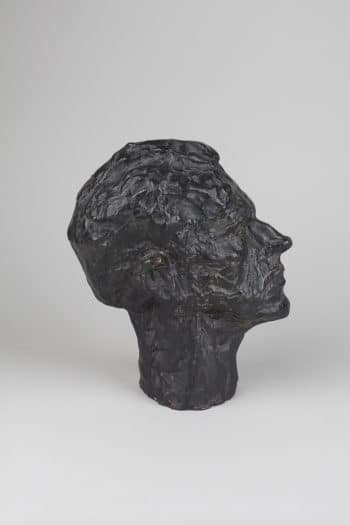
      a few hundred pages of hard books  – or else a few minutes with the sculptures of Giacometti Theorists try to understand the world as if unfolding in a giant process with certain rules, whereas for artists the point is to observe it as a spectacle of which any thoughts and representations are just shadows, like childhood memories. But digging in their ditches always they eventually find each other. Plato is beautiful and Shakespeare is wise. Eventually the theorist sits back and laughs and even in Kant there are pages where the argument is carried by nothing but sheer ecstasy, in their repetitions and motifs at last artists discover obscure laws of which the elaboration is their gift. like Jack Yeats, instead of shapes he saw the world as lines Swiss-born Alberto Giacometti (1901-1966) was a genuinely philosophical artist in this sense. Apart from the earliest  pieces those collected here have an obvious unity of purpose: he wanted to describe the human condition as the ground. His sculptures, rather than the free-standing and well-bodied Michelangelo’s David, are mostly trapped as if sinking, but also (if you look from the side rather than the front) as if in judgement, enthroned with gravity on the stream of clay. He was so much a sculptor that even his paintings and drawings look like sculptures. But like Jack Yeats, instead of shapes he saw the world as lines: from that torrential criss-crossing figures emerge, more substance than form, as if soon to vanish. The exhibition is divided according to the models Giacometti used: his wife, his brother, his friends, and a man named Isaku Yanaihara. The photos of each near their sculptures are interesting and revealing. If Giacometti chose the same people over and over it was not because he wanted to sculpt them: it was because, just like Giotto and Charles Swann, for him there were a few primordial faces that represented everything and which each time he sought to disclose. The word for such a thing, in which is contained all of Giacometti’s debt to ancient cultures, is God: neither God-the-Father, nor the stupid God-of-Fire and God-of-Sleep entities of the modern imagination of polytheism, but Gods like Roberto Calasso’s description of the Vedic Rishis: “those who know something and keep silent, those who see what is looming”. The sculptures of Giacometti never act, but he was careful to give them aura: they are severe and full of light but give nothing away. The face is at the heart of this with its serene and perfectly divine expressionlessness. The name – ‘Half Length of a Man’, ‘Bust of a Woman with Folded Arms’ – like the face, is empty, and gives the observer not a single clue. Two shortages in this exhibition are walking sculptures and small sculptures. Giacometti once said “I can never make a woman in any other way than motionless, and a man always striding; when I model a woman, then motionless; a man, always walking”. The fact that no sculptures of men walk here is a shame, but it does make clear that Giacometti rather meant that in his work every woman is imposing and each man resigned. The obvious first- and second-sex connotations of this are certainly there. For Giacometti, women are imposing because of their intensity as desire-objects: this gives them a power that manifests in a few exceptional works in the exhibition. First, near the beginning, a small bust of his wife, painted blue and red – the childishness of feeling in the colours is extraordinary. Second, the ‘Bust of a Woman with Folded Arms’ – its model a woman named Francine Torrent – smiling. In her unique, closed smile there is jouissance, the bird flying in the air: an invitation and a threat. It is striking that Giacometti, a friend of Simone de Beauvoir, regularly at Les Deux Magots, repeated from a male point of view the precise terms of the difference between men and women that their society made seem natural and she eviscerated – whether to condemn or exalt it, I am not sure. As for small sculptures, more of them would have helped with understanding what Giacometti does with size: the large he always breaks down into fragments, the small he closes into unity, each disappearing and arising together and against each other from the generative cascading of the ground. The person who has come closest to Giacometti in this regard in theory was Gilles Deleuze, whose golden period as a philosopher began just two years before Giacometti died, in 1964, with Proust and Signs. That he never refers to Giacometti is completely beside the point: it was typical of Deleuze to speak about everything except what was profoundly nearest to him. Deleuze said things like “Being is said in a single and same sense of everything of which it is said, but that of which it is said differs: it is said of difference itself” and “The inhuman in human beings: that is what the face is from the start. It is by nature a closeup, with its inanimate white surfaces, its shining black holes, its emptiness and boredom”. To understand these lines it takes a few hundred pages of hard books like Difference and Repetition or A Thousand Plateaus – or else a few minutes with the sculptures of Giacometti. Giacometti: From Life is running at the National Gallery of Ireland 9 April – 4 September 2022. Tickets €5-17 with discounted rates on Tuesday mornings and Thursday evenings. Image: Alberto Giacometti Buste d’homme (Lotar II), c. 1964-1965 © Succession Alberto Giacometti / ADAGP, Paris, 2022    

    Loading

    Read more

  • Posted in:

    Quinn was our champion when the State did nothing

    10 March/April 2022 T his is a tale of greed, destruction, violence, corruption and betrayal. The Quinn Group business employing 7000 with profits of €500m/year has turned into a husk of itself with only 800 employees and meagre profits with its construction division scandal- ously losing money. Conventional wisdom blames the recklessness of Sean Quinn but there was a further betrayal of the community that, reflecting national indif- ference to the border counties, has gone untold. Keep your eye on who was in charge as the Quinn Group has disintegrated! The name of the Quinn Group was changed to Aventas in 2013 to Quinn Industrial Holdings in 2015 and to Mannok in 2020. Along the way it sold o Quinn Glass, Quinn Plastics and Quinn Radia- tors abroad. The sale of Quinn Packaging did not complete. However, the first big event that should detain us is that on 30 March 2010, following an application by the Central Bank of Ireland, the High Court appointed joint provisional administrators to Quinn Insurance Limited, “Quinn was our champion when the State did nothing” By Michael Smith A Crossborder Community feels so betrayed that it’s issued legal proceedings against the part successors to the Quinn Group – QBRC The nme of he Quinn Group ws chnged o Avens in 2013 o Quinn Indusril Holdings in 2015 nd o Mnnok in 2020. Along he wy i sold off Quinn Glss, Quinn Plsics nd Quinn Rdiors brod. The sle of Quinn Pckging did no complee the first manifestation of regulatory stringency that has now been playing out for 12 years. Then, in April 2011, a share receiver was appointed over the whole Quinn Group, by Anglo Irish Bank Group (then owned by the State), to which the Quinn Group owed over €2.8 billion. A receiver took control of the Quinn family’s equity interest in the Quinn Group (Quinn had divested himself some years earlier), replacing them with a board of outside professionals. This served the interests of bondholders who now owned 25% but had 75% voting right, with the balance held by the State. Formerly the bondholders interest had been contingent not a shareholding and they technically had no voting rights. That is the principal grievance of Sean Quinn – he accepts that he had scandalously over-invested in con- tracts for dierence (CFDs – suspended payments, i.e. agreements to exchange the dierence in value of a financial instrument between the time at which a con- tract is opened and it is closed) but feels the situation could have been salvaged if nerves in government had been held and the bondholders not indulged. The Quinn Group and its advisors considered it could repay the €2.8 billion it owed including the €2.34 billion it owed Anglo for share support. Others say that would have depended on retaining institutional confidence that he had done a great deal to lose. Anglo and Quinn had been in discussions to avoid a legal dispute over the way Quinn had supported Anglo’s shares, with awareness from State regulators that the State has disingenuously always tried to deny. But the plug was pulled. NEWS March/April 2022 11 Quinn was declared bankrupt in the Republic on 16 January 2012. The State’s motivation may or may not have been primarily the welfare of the local community and its jobs. But it compromised on legality. A notable delinquency was ignoring the outrageous actions of Anglo Irish Bank. Ann Nolan, the Second Secretary General at the Department of Finance with responsibility for financial stability/risk management gave evi- dence in 2015 to a case taken by the Quinn family against IBRC, and Sean Quinn and former Quinn Group directors. The family had had a 25 per cent stake in Anglo, held through the CFDs. It later converted this into a 15 per cent stake in the bank, using bank finance, partly channelled through Quinn Direct Insurance, while other long-term customers, of the bank (the Maple 10) used further loans from the bank to buy the other 10 per cent. This con – version had the eect of preventing a flood of shares coming onto the market. But it was ultimately illegal and improper to facilitate the wind-down of Anglo and the Quinn Group without resolving this extraordinary illegality for it was predictable that the Quinns would get some very substantial ben – efit if it could be shown that their own delinquencies were known to the regulatory section of the Department of Finance, the State. Nolan stated [above] that a draft letter dated 3 February 2009 from the then chairman of Anglo, Donal O’Connor, to Minister for Finance Brian Leni – han stated: “As requested, I enclose a report on the extent of lending for the purposes of share acquisitions and contracts for dierences generally and Anglo shares in particular”. However, she also drew attention to an alterna – tive version of the same letter, dated the next day which was amended to read: “The total extent of lending by the Bank for the purposes of acquiring publicly quoted shares is €1.767bn (See Annex 1). We do not lend for the purpose of taking positions in contracts for dierences. Of this total, €918.6m relates to lending for the purpose of acquiring shares in Anglo Irish Bank”. The letter was changed to omit a reference that would show the Depart – ment of Finance knowing in 2009 that Quinn Group had a CFD position. There were a lot of improprieties associated with the Quinn Group, espe – cially related to the support of Anglo’s share price. The problem was that Anglo had benefited from Quinn’s support and indirectly therefore so had the state. If the support was illegal and had been approved by Anglo and the State then the State might ultimately have to suer some of the loss that it in the end seemed determined to dump on Quinn himself and his group. The Central Bank came to a weird, presumably embarrassed, settlement with Quinn Direct Insurance, the

    Loading

    Read more

  • Posted in:

    Tarry Flynn reviewed by Rory O’Sullivan: worthy, entertaining and physical:  every five minutes make you forget the previous five

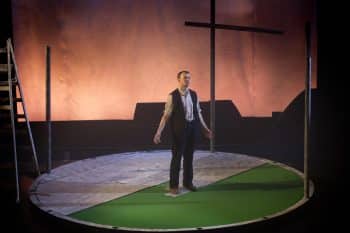
        In poetry the nearest figure to Patrick Kavanagh is Charles Baudelaire. Both were often destitute. Both found a verse that was above all music, not aspiring to music, like Walter Pater said of every art-form, but music itself made of words and because of it more profound.   For both men the heart of the effort was to make everything a spoken song, and a suspicion that it is one already; both made as much room for beauty as its privation.  But if Baudelaire’s main concern was to capture the putrid falseness of life in the modern city as an image of life everywhere Kavanagh’s was to dream of the true life gushing forth, the repose of memory and desire in happiness, too often misinterpreted as rural pantheism.   But both Kavanagh and Baudelaire succeed more often, if less thoroughly and famously, in their prose.   Baudelaire’s exalted dismissals of forgotten French painters are matched by Kavanagh’s invectives against Irish writers like WR Rodgers and FR Higgins (“Writing about FR Higgins is a problem – the problem of a labyrinth that leads nowhere”). With Baudelaire’s breath-taking asides on the French Revolution there are Kavanagh’s on the Irish question: “All of us who are sincere know that if we are unhappy, trying to forget our futility in pubs, it is due to no exterior cause, but to what is now popularly called the human condition. Society everywhere today and its beliefs are pastiche: there is no overall purpose, no large umbrella of serenity”.  And: “The questions we never ask ourselves in Ireland are: Do we believe in anything? Do we care for anything?”. Kavanagh’s two prose-books are ‘The Green Fool’, an autobiography, a masterpiece; and ‘Tarry Flynn’, a novel nearly as good as his long poem, The Great Hunger, because it is the same thing but set in Cavan instead of Monaghan. The theme of all three is a tension Kavanagh’s two prose-books are ‘The Green Fool’, an autobiography, a masterpiece; and ‘Tarry Flynn’, a novel nearly as good as his long poem, The Great Hunger, because it is the same thing but set in Cavan instead of Monaghan. The theme of all three is a tension: Kavanagh or Flynn or Maguire is caught between the beautiful world of his heart where there are no words, and society, where there is work to be done and questions in need of answers.   Writers often aim to fill gaps in themselves: every school student has heard the maxim, ‘Write what you know’,  but a more honest one may be ‘Write what you need’.   Kavanagh needed this argument with himself: he was vicious and took no shortcuts, which was what gave his words energy, how he could say O the thrilling daisies in the sun-baked hoof-tracks. O the wonder of dry clay. O the mystery of Eternity stretching back is the same as its mystery stretching forward.   He hated theatre. Its root problem for him was the audience: like a congregation in the abstract it seems like a good thing, but without the individual’s sense of real life it falls for simplicities, pietisms, cheapness, and what he called “newspaper morality”. There is a certain foolishness as well as bravery in choosing to adapt for stage a novel whose almost entire appeal is its narrative sentences – with a result its author would certainly have despised.   But this is the twenty-first century: Kavanagh is dead, and the production of ‘Tarry Flynn’ by Livin’ Dred Theatre Company, touring the country, briefly in the Pavilion Theatre in Dun Laoghaire, is lively, with huge range, impressively lurching from each thing – every five minutes make you forget the previous five – to the next, so that what comes out mostly is a theatrical sense of joy: a sense of play. this adaptation gets two important things right: it lets the words from the book do the talking (though with the ground artlessly salted here and there with lines from the poems), and it adds a lot of jumping and somersaulting to give the theatre-element. Originally by Conall Morrison and performed in the Abbey Theatre in 1997, this adaptation gets two important things right: it lets the words from the book do the talking (though with the ground artlessly salted here and there with lines from the poems), and it adds a lot of jumping and somersaulting to give the theatre-element. The worst bits are when it leans on tropes of Late Late Show Irishness: a Mammy, a spineless and severe priest, ‘Cotton-Eyed Joe’ – mercifully not as heavily or often as the kitschy Irish music at the performance’s start would mislead you to believe.   Mostly the show is entertaining singing, dancing and shouting interspersed with a few scenes and monologues by Tarry. In this production nine actors play fifty roles, which gives it a frenetic feeling and a sense of fun.   The weirdest part is when actors playing a bull and heifer act out having human-style sex to music in a cow-costume and bull-inflected gimp suit; the most touching are any of those when Tarry stands alone onstage simply talking about what is in his head.   The shame about this script and production is that it treats all its best parts the same way: raise the audience to a level of exalted feeling, bring them there with Tarry, and then pull the rug out immediately with his Mammy calling him to go to mass or pop a blister on her foot.   This makes the relation between the romance and the real, the inner and outer, tense but stable, easy to delineate and follow. On the other hand ‘Tarry Flynn’ the novel is about destabilising this, causing the real and romantic to spill into each other and contaminate both.   Which is why, at the end, when Tarry’s uncle sweeps him off to big life in the towns, his mother and he heartbroken, ‘Philadelphia Here I Come’–style, as

    Loading

    Read more

  • Posted in:

    Ireland's digital pathways are being used to launch drone attacks

    The debate in Ireland about joining NATO, or some sort of an EU military arrangement, is now on the political agenda like never before. Pro-neutrality advocates argue that the country is sleep walking into a military alignment of one sort or another with Western military powers. They point to the fact that US air force planes routinely transport American soldiers to Europe and beyond via Shannon airport as an example of an erosion of our neutrality. The pro-NATO lobby must be encouraged by the acceptance of the activities at Shannon which contrasts sharply with the anger displayed against Russian naval exercises off our coast earlier this year. What is missing from the debate is a discussion about the fact that Ireland has been playing a key role in lethal US military operations for years. Village described them in an article in 2017 which is as relevant now as it was five years ago. The piece can be accessed here: Technology neutralises our neutrality

    Loading

    Read more

  • Posted in:

    X’ntigone at the Peacock: Amanda Gorman in combat boots. Reviewed by Rory O’Sullivan. The production feels like it has been authored by a committee

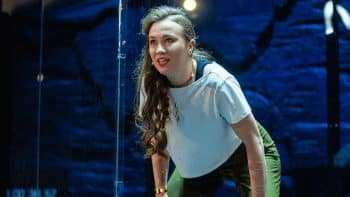
    One of Greek tragedy’s foremost concerns is the contemplation of polarities. In a part of Sophocles’s Antigone, Ismene tells her sister, “You have a warm heart for cold things”, In ancient Greek culture, warm things are alive, cold ones dead; but for Antigone, now, the fire of her life and self has its source in that cold thing, her brother’s corpse; and when she gives up her life wanting to bury it, burning with this wish, her heart, dying, becomes cold. The unity of opposites, the separability of truth: Greek tragedy. Antigone wants to bury her brother, Polyneices. The previous night he, with an army, attacking his home city of Thebes which has seven gates, at the seventh, fighting one-on-one against his brother, Eteocles, defending the city, died.  With two simultaneous blows, like on a frieze, falling, each killing the other, together at once, they died. Creon, whose role here as in Oedipus is to walk into the ruler’s part when the stage is empty and figure out what must come next, commands that Eteocles should be buried with all honours; but that Polyneices, who after all has just led an army against his own city, must lie bare on the ground to be eaten and waste away. The penalty for burying him is death. Simply, Antigone’s plot is her decision to defy this order, which, because Creon made it, is the law. The pair of Antigone and Creon have captivated among others Hegel, Brecht, Judith Butler and Séamus Heaney. For ancient Athens, a handmaid’s tale sort of city, Antigone was far over the edge just as Creon was too much in the middle. That they were interested, in Athens, in her at all shows this: the pious and the profane, the tyrant and the resistant, need each other in obscure ways; they are dance-partners. In Sophocles’s play there is no better proof of this than the side characters. Antigone’s sister, Ismene, and Creon’s son and Antigone’s husband-to-be, Haemon – stupid, reckless, caught in the middle – are equals of most of us. Teiresias, the blind seer, is like everyone when they know something pays with his powerlessness to alter it. Each is forced to where they end up by this secret, centrifugal thing, this law, which, when Antigone and Creon do not back down from each other (and she knows this better than him and mocks him for it), is what they commit to. ‘You have a warm heart for cold things’.      But the play’s best and most elusive opposition is between the action and the chorus: ‘the play’ (characters and dialogue) and the poem, in a special dialect and metre, which a group of dancing and well-dressed paid amateur actors performed between scenes. Maybe it is better to say that the play is between verses of the poem. The chorus has lines such as “There are lots of astounding things and none more astounding than humanity”,  and “Wandering far and wide, hope for many people is a dream” and “Love, who sweeps down through herds.”. The chorus, an ideal unity of the civic and religious elements, the poetic and speculative forms of thought, the individual and the group, of which it may be said that the Festival Dionysia in Athens, where the plays were first performed, was a continuous and blundering examination, has ensured that every straightforward attempt at Greek-style tragedy from the Romans to this day feels like a copy of an original.   Which makes them hard to adapt. X’ntigone (Zan-ti-guh-nee)’s biggest problem is that it does not decide whether to make the effort. On the one hand, the characters keep the original Greek names, which in modern mouths are like elements of the periodic table rather than words which a parent would call an infant; they discuss offhandedly Thebes, Persians, Oedipus, Laius; on the other, X’ntigone herself (who explains that the X signifies unpredictability, and is an homage based on – a faulty understanding of – ancient Persian mathematics), rejecting all the stories of ancient Greece, loudly and emptily says: “The Master’s Tools Will Never Dismantle The Master’s House.”.  The plot is different: the focus is a pandemic with the government and rebels both carrying around strains of the virus in test-tubes to inflict it on each other. Stripped to a discussion between X’ntigone and Creon, who both know all of this, but must repeat it so that the audience do, the play wallows in forced exposition, making its characters seem like they are inventions. Still, it is tough to divine what is going on. It is hard to shake the sense that this play wants everything but achieves nothing – Greek tragedy, Covid-19, Audre Lorde – the worst of all worlds, a play of ticked boxes authored by committee. The actors, Eloise Stevenson and Michael James Ford, do well with what they have. The problem is that the struggle between Creon and X’ntigone does not go anywhere, as if it was Blofeld versus Amanda Gorman in combat boots. X’ntigone is Good, Creon a Supervillain: there are no surprises. Near the beginning, twice, Creon is dismissive about non-binary people; later he even says that “Laius drained the swamp”.  The only twists are two “I knew about your plan all along” moments when X’ntigone and Creon each give ‘Order-66’-type instructions to the government and rebels through iProducts. The set and lighting in this production, designed by Ciaran Bagnall, are striking and interesting: for the whole of this production X’ntigone is imprisoned in a glass quarantine-cell. Unfortunately so is the performance.   X’ntigone (after Sophocles), written by Darren Murphy and directed by Emma Jordan is playing at the Peacock, Abbey St Dublin 1, from 16 to 26 March 2022        

    Loading

    Read more

  • Posted in:

    Frank Mulcahy, the media and Micheál Martin's lies

    The Media’s treatment of the lies: an epic scandal ignored. It was March 1998. The RTE journalist Geraldine Harney informed me that I was to be dismissed by the ISME directors Peter Faulkner and Eoghan Hynes. She was doing the decent thing. Nevertheless, it was a preposterous suggestion and I told her so. However, in June her prediction materialised. Both Hynes and Faulkner demanded my resignation, with threats. The demand being unlawful, I refused to comply.   (On 11 August 1998 Mr Hynes privately, by fax, instructed the incoming ISME chair Seamus Butler, a Longford businessman, to get on side with my removal.)   In September the Irish Times  journalist Barry O’ Keeffe printed a story that I had cheated on my expenses. I was not afforded the opportunity to refute the allegation. He apologised stating that he had been placed under inordinate pressure. There followed  a stream of front-page stories in the Sunday Business Post stating in turn that I had stolen a suit, insurance and pension payments, a 1996 bonus and other frauds. In September too Aileen Hickey in Business Plus Magazine ran a cover story, blazoned ‘Gunning for Mulcahy’. As with Miss Harney it predicted the future. The article referenced pending accusations so sensitive that they couldn’t be revealed at that stage. I had no idea of what I was being accused of, or was expected to disprove.   (In September Seamus Butler offered me £100,000 to resign with threats that I would “never work in this country again” if I did not oblige.)   In October 1998 Irish Irish Independent journalist Gerry Flynn published several intimidatory faxes that I had received from Eoghan Hynes. Flynn had a reputation for being forthright. Initially, the Independent committed to standing by their journalist. They advised,  “we will be fighting your case”. However, in the end management paid Mr Hynes £20,000 simply for publishing his abusive faxes. A form of apology was printed. I was damaged.   (Nevertheless, in October and November the ISME Finance Committee publicly withdrew the allegations. The ISME members dictated that  I was to be fully reinstated by the AGM in April 1999. When Hynes objected, several council members recorded him explaining his corrupt “game plan”. The council member Pat Coen had possession of the tape. His brother was a respected ranking Garda who had been kept in the loop. The tape was my reassurance. I was advised not to react to the daily provocations; to get to the AGM in April.)   On Saturday 26 January 1999 I was walking on Killiney beach at 6.05 (PM) with the civil servant Diarmaid Breathnach when my phone went wild. It transpired that Seamus Butler, had announced on RTE’s early evening news that I had been sacked because I had fiddled my expenses. The story was utter nonsense. Butler had been interviewed by his neighbour the Longford-based RTE journalist Kieran Mullooly. I had not been afforded the opportunity to refute the charge.  The following day I rang the RTE newsroom. George Lee answered. I registered my complaint – orally – at what had occurred. That evening Pat Coen collapsed and died. The tape was secured by his brother, Garda Sergeant Coen, with whom I later spoke. A year on RTE advised that I should have put my concerns in writing. (In February the Revenue Commissioners attended ISME at Butler’s request.  Yet within an hour Revenue walked out believing that they were being used to damage me. On being informed, I arranged to meet the same officials. I provided them with my expenses file and the procedures laid down by Eoghan Hynes which I had followed. They replied, “we were never shown that file”.)   The date for my reinstatement was fast approaching. However, at noon on 5 March 1999 Seamus Butler rang the then Irish Independent journalist David Murphy. Butler apologised for “lying” to him the previous day when he had denied removing the audit signatory Don Curry as an ISME director. He was, he said, making good by offering Murphy a scoop. He disclosed that he had called in the Garda in respect of his latest complaint, namely that I had defrauded the EU Commission. I had no prior knowledge of that allegation whatsoever. Aileen Hickey’s prediction had come to pass.   (In April two gardaí visited my home. I provided them with evidence of the faxed threats and the £100,000 inducement. I directed them to Sgt Coen and the tape recording, to the Revenue Commissioner’s conclusion, to the ISME auditors and the audit signatories who affirmed the vexatious nature of the complaint. We expected that the fraud squad would charge Butler with, at the least, wasting police time.)   On 2 May 1999, as the Garda commenced their investigation, I received a call from the editor of the Irish Times business page Cliff Taylor. He disclosed that he had been invited to the ISME board room the previous Thursday, with the offer of yet another “scoop”, namely that I was to be sacked on 6 May. Consequently, my lawyers threatened an “injunction”.  Butler postponed the board meeting of that day.   (Nevertheless, on 6 May ISME’s solicitors recorded Ercus Stewart SC stating “the board has been forced to dismiss Frank and that has been done. He should have sought an injunction but he didn’t…The only question now is how much he will be awarded by a court”. Clearly ISME had lied to my then lawyers, Binchys, and their lawyer Ercus Stewart SC.)   In November 2005 the daily press reported in passing that the EU courts had penalised Rehab  20 million euros because of its maladministration of European grants.The Department of Enterprise spun the story that that penalty was somehow a win for Ireland. Despite my pleas that something was badly wrong, nobody was inclined to look under the hood. Rehab analogy to ISME What follows is the statement by the National Learning Network, a subsidiary of Rehab in relation to grants under the Human Resources Development

    Loading

    Read more

  • Posted in:

    Silent Defenders

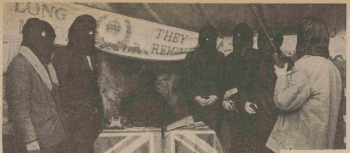
    In a whitewashed barn decked out with Ulster flags, Union Jacks and pictures of the Queen, their leader in charge of this meeting sat at an old table. He pressed a button on a tape recorder. A voice boomed out: I address you as the commander in chief of the organisation, Silent Defenders. Author Ciarán MacAirt investigates a shadowy Loyalist paramilitary group made up of former RUC Specials and British soldiers. He tracks the gang from a newspaper article in March 1972 through British military intelligence files and on to the streets of Belfast in the bloodiest month of the conflict. The paper trail leads to a sectarian gang of Red Hand Commandos, British soldiers of the Ulster Defence Regiment and a series of murders and attempted mass murders of teenagers in north Belfast. But all is not what it seems as there were other killer gangs on the loose… Who were Northern Ireland’s Silent Defenders as we stared into the abyss in the summer of ’72? Visit Paper Trail to find out >> https://www.papertrail.pro/northern-irelands-silent-defenders/

    Loading

    Read more

  • Posted in:

    Macron – and on

    78March/April 2022And whether or not Ireland likes it, on convergence. Two years ago this is what he told the Economistabout Europe: “So, frstly, Europe is gradually losing track of its history… Europe has forgotten that it is a community, by increasingly thinking of itself as a market, with expansion as its end purpose. This is a fundamental mistake, because it has reduced the political scope of its project, essentially since the 1990s. A market is not a community. A community is stronger: it has notions of solidarity, of convergence, which we’ve lost, and of political thought. Secondly, a change in American strategy is taking place; thirdly, the rebalancing of the world goes hand in hand with the rise—over the last 15 years—of China as a power, which creates the risk of bipolarisation and clearly marginalises Europe. And add to the risk of a United States/China “G2” the re-emergence of authoritarian powers on the fringes of Europe, which also weakens us very signifcantly. Finally, added to all this we have an internal European crisis: an economic, social, moral and political crisis that began ten years ago. Europe hasn’t re-lived civil war through armed confict, but has lived through selfsh nationalism. In Europe there has been a north-south divide on economic issues, and east-west on the migration issue, resulting in the resurgence of populism, all over Europe. These two crises—economic and migration—hit the middle classes particularly hard. By raising taxes, by making budgetary adjustments which hurt the middle classes, which I believe was a historic mistake. That’s incidentally what lies behind the rise in extremism throughout Europe. A Europe that has become much less easy to govern”.The Economist gives Macron an 80% chance of re-election. He has said and done what he thinks. It’s good to understand him. History if not ideology is on his side. these matters, has claimed that “Mr Macron has turned into something of a closet socialist”.The most visible evidence of the president channelling his inner Mitterrand is to be found in public spending. When the pandemic struck, Macron undertook to do whatever it took. Since then he spent ten times more last year to keep frms and furloughed workers going than France ever earned in a year from its wealth tax. France was already outspending all the Nordic countries on social programmes, and in indebtedness. Less noticed is a growing body of progressive rights and rules Mr Macron has also introduced: a doubling of guaranteed paternity leave to four weeks, with one week compulsory; fnes for frms that fail to close the gender pay gap.Internationally he has championed progressive multilateral causes, from a global minimum corporate-tax rate (a Macron pledge in 2017) to vaccines for Africa. France’s centre of political gravity has shifted to the right. This, not the left, is where his toughest competition will come from in April’s Presidential election. Macron’s nod to the left is studiously mild by French class-warrior standards, and in line with his intellectual roots. Not surprisingly his policy mix works quite well in practice, even if not in theory. Macron is much more philosophical than any other European leader, contrasting with a long-standing Irish weakness. His thinking, if he wins a second term, may drive the future of the EU. It centres on strength especially globally, on creating a community not a market, on tackling extremism and selfish nationalism and on indulging the disafected centrist middle classes. Four years ago I wrote early in Emmanuel Macron’s French Presidency that he had shown more leadership than the entire rest of the Western world since his election. “He claims to have found a political path between left and right, has made clear in the most elegant ways his disdain for Trump and has bowed to nobody, least of all Vladimir Putin, in sharing truths about international political thuggery”. I had a go at tracing his philosophic infuences largely through Paul Ricoeur of whom he was a protégé. Through Ricoeur essentially Macron is more likely to take an ethical approach, less likely to lie, more likely to keep promises, more likely to seek dialogue, see the other side and understand that two interpretations are possible of an act or situation, to be idealistic and secular.A good topical example is his role of interlocutor with Russia which bespeaks his willingness to see the other side and both his pragmatism and his idealism. He is touting the Russian perspective but is a friend to Ukraine and has made troops available just in case. Inevitably with that philosophical underpinning his overall record is dissonant. Macron has governed to the right of centre though he had promised to be in equal measure right and left of centre. A former investment banker, who scrapped the wealth tax and picked two centre-right prime ministers, he has moaned about the money the state spends on social welfare and does not idealise France’s comprehensivist welfare state. He has introduced looser labour laws into the rigid French system and he presided over the longest strikes since 1968 driven by his proposed pension reforms. He has been tough on security and Islamist extremism. Nevertheless the Economist magazine, not sympathetic on By Michael SmithINTERNATIONALGeneral government spending total, as % of GDP, 2020 or latest available (OECD)Macron – and on

    Loading

    Read more

  • Posted in:

    Ukraine: Ireland to Russia’s UK

    76March/April 2022Fragile, vibrant, modern Ukraine faces being overrun by 190,000 Russian troops, driven by an autocrat frustrated at the loss of Russia’s one-time sphere of infuenceBy Michael SmithINTERNATIONALUkraineUkraine may have been a backwater, romanticised originally as the land of the Cossacks, until recently though it is the second biggest country in Europe (after Russia of course), but as of now it is a thriving democracy with a free media and free speech, and a vibrant economy, culture and social life. Kyiv and OdessaI visited Kyiv, Ukraine’s capital, and Odessa, in August 2021. Both are sophisticated, afordable, modern cities with swanky bars full of beautiful people drinking cocktails, artesan IPAs and local champagne; lively parks swarming with rollerskaters; and cinemas showing Hollywood movies. Kyiv, where the average salary is €620 per month, is an IT hub, dotted with high-rise apartments under construction – their ubiquitous realtor-branded photographic hoardings in English showcase the cosmopolitan residents they seek to attract. Odessa is the best-preserved Neo-Classical city in the world with a ritzy beach resort. Odessa has the most stylish restaurants East of Paris. We stayed in the Londonskaya Hotel, a Renaissance style palace built by a French confectioner in 1828 near the steps that feature in Sergei Eisenstein’s revered 1925 movie Battleship Potemkin. He stayed there too.All changed in 2014Ukraine hit the spot after its 2014 ‘Revolution of Dignity’ when protesters at Maidan square in Kyiv ousted the democratically elected president Viktor Yanukovych a thuggish Russian-backed mafoso. By then he had purloined around $100bn, equal to more than half the annual economic output of Ukraine. Leaned on by Putin, in 2013 Yanukovych had abandoned Ukraine’s Association Agreement with the EU and moved to join its Russian-led rival. Yanukovych ordered police to shoot protesters who opposed him. When the crowds swelled, Yanukovych fed to Russia where he remains, poised, allegedly hauling $32 billion dollars in cash across the border in trucks as his power crumbled.History: shared heritageThe shared heritage of Russia and Ukraine goes back more than a thousand years to a time when Kyiv was the capital of the frst Slavic state, Kyivan Rus, the birthplace of both Ukraine and Russia as Vladimir Putin recently asserted: “Russians and Ukrainians are one people”. Ukraine has been carved up down the centuries by marauding empires. Mongols, Polish and Lithuanians in a way that Russia was not. In the 17th century, Russian tsars ruled lands to the east of the Dnieper River as "Left Bank" Ukraine while lands to the west of the Dnieper, or "Right Bank" Ukraine, were ruled by Poland, though in 1793 those lands too were annexed by Russia. A Russifcation policy banned the use of the Ukrainian language, and pressurised Ukrainians to convert to the Russian Orthodox religion. The people were Ukraine: Ireland to Russia’s UKKyiv, 2022 March/April 2022 77generally known as Rusyns or Ruthenians and the ethnonym Ukrainians came into wide use only in the 20th century after the territory of Ukraine obtained distinctive statehood in 1917. Stalin organised a famine that killed millions in the 1930s and shipped in lots of Russian speakers.Ties to RussiaBecause eastern Ukraine came under Russian rule much earlier than western Ukraine, people in the east have stronger ties to Russia, often speak Russian (Russian and Ukrainian share 60% stem words anyway) and have been more likely to support Russian-leaning leaders.Annexation of CrimeaCrimea was occupied and annexed by Russia, irritated by the defenestration of Yanukovych, in 2014, followed shortly after by a separatist uprising in the eastern Ukrainian region of Donbas that resulted in the declaration of the Russian-backed People’s Republics of Luhansk and Donetsk. Ukrainian forces have been fghting pro-Russia rebels in the east since 2014 in a confict that has killed some 14,000 people.Threat of imminent warExploiting its overwhelming military superiority, as Village went to press, Russia had amassed 190,000 troops on Ukraine’s borders and was expected to attack simultaneously on several fronts, from the north-east, the Donbas and Crimea. and Belarus, Airstrikes would underpin a lightning drive south to seize the capital, Kyiv. And encircle Ukraine’s army, neutralising the country and its leaders. The US estimates artillery, missile and bomb strikes and ground clashes could kill 50,000 civilians.WarAs Village went to print Putin had made an angry speech and moved troops into Luhansk and Donetsk which have been armed, fnanced and politically controlled by Russia since 2014. But until now were recognised as part of Ukraine.Putin has also sent his military on a “peacekeeping mission” to Ukraine, meaning that Russia will formally occupy sovereign Ukrainian territory for a second time following the 2014 annexation of Crimea. But in this case, Russia has not annexed the territories. A document signed by Putin on Monday also allows him to establish military bases or place missiles in the territories. The bourses were diving, Germany suspended its Nordstream gas-pipeline collaboration with Russia and Boris Johnson was tearing around fnding Russians to sanction.Invasion of Ukraine could destabilise former Soviet republics such as now independent Estonia, Latvia, Lithuania (EU members), as well as Belarus, Georgia and Ukraine. Irish analogies and infuenceRussia’s relationship to Ukraine is clearly analogous to that of the UK to Ireland: a bigger and far more powerful neighbour, partially shares history, culture and religion with a division on ethnic rather than racial lines. Most Ukrainians are Eastern Orthodox Christians. A significant minority of Ukraine‘s population consider themselves Russian – analogously to the North of Ireland where a majority considers itself British frst and Irish second.It would be preferable if Ukraine signalled it will never join Nato but in any event Ireland should exercise its influence to support Ukraine, a beleaguered but honourable and modern country in retaining its independence from foreign interference and indeed carnage. Such is the foundation of the United Nations. SolutionsIt is forgotten that early in his frst Presidency Putin wanted to join both Nato and the EU – bonds that could now be ofered, long-term. Beyond that, we should use our limited infuence to see that the balance between Nato and

    Loading

    Read more

  • Posted in:

    The Battle for Moore St A little bit of history repeating

    March/April 2022 75duplicity. Despite this, we managed once again to hold the line and steer the group’s reports from developer-friendly surrenders to solid conservation manifestos. History repeatsIn 2015 we had worked with then Fianna Fáil Senator Darragh O’Brien drafting his Moore Street Renewal Bill which reimagined the area as primarily a cultural and historic hub. It is a compelling and detailed document. In the 2019 election he stood as a TD, winning a seat and also becoming the Minister for Heritage. I emailed him offering congratulations and requesting an urgent meeting to discuss the Bill. He replied warmly saying we’d be meeting very soon. Since then, despite numerous emails, telephone calls and third-party interventions, O’Brien has not met us. Worse still, Taoiseach Micheál Martin held a behind-closed-doors meeting with Hammerson reps and allowed his praise of their planning application to be used in a company press release to accompany that planning application. A Taoiseach should never comment on a live planning issue.Following the City Council’s recent decision we now face into our second Bord Pleanála oral hearing, perhaps a judicial review, the Supreme Court and if necessary the ECJ. But we have in essence won the battle for Moore Street. Our victory lies in the simple fact, that though shabby, the 1916 terrace still stands. There will be an election quite soon and the main opposition party Sinn Féin has committed to implement the vision we have fought for. Your sense of history need be no more acute than your sense of irony to see parallels between this behaviour and the Rising itself, with Fianna Fáil somehow transformed into collaborators with the old enemy, and the insurrection being fought in windowless rooms. That the stakes are so diferent is the legacy of those who fought and died, around Moore St. The least we can do is properly mark their legacy. The Planning battleBack in 2009, we faced our frst Oral Hearing in a Soviet style conference suite at Dublin’s Gresham Hotel. Unlike Chartered Land we had no planning experts batting for us, but fought hard with an enthusiastic passion. Our case must have imprinted on the inspector as she found in our favour but her recommendation was not followed by her own board. We had to go to court.Some LawIn 2016 on the centenary of the Rising relatives of the 1916 leaders faced the Irish government in the High Court – a strange place, the gimcrack theatrics of its habitués chiming uneasily with its institutional staleness. The state’s appointment of Michael MacDowell as its lead SC was a calculated insult considering his grandfather’s attempt to call of the Rising. Before proceedings started there was an attempt by Hammerson to begin demolishing the terrace, but a spontaneous rallying of campaigners led to it being swiftly occupied while we sat in court. The judge, Max Barrett, seemed something of a maverick, with a background as a solicitor not a barrister. The two-week hearing passed in an indecisive fog of legalese and arcane ritual. On 17 March 2016 Judge Barrett read his judgment. It was framed in an impenetrable language, but the repetition of the term “granting relief” sounded positive. It was only when our solicitor who sat facing me visibly slumped in his chair that I knew something momentous had happened. I asked him: “Have we won?”, He replied “Everything”. Barrett had made much of the site a National Monument. Unfortunately ultimately the Supreme Court was to overturn much of his imaginative and learned judgment.MSAGThe government filibustered by cobbling together the Moore Street Advisory Group, essentially a talking shop for ‘stakeholders’ the MSAG was suffocated by public-service Background The Battle of Moore Street is the longest-running and most successful heritage campaign in this State. The battle is over the site of Ireland’s ‘Alamo’. undeniably the birthplace of our Republic where leaders of the Rising retreated from O’Connell St. In February 2022 it celebrates its twenty-frst birthday facing into a second An Bord Pleanála Oral Hearing following Dublin City Council’s planning permission in January to UK Developer Hammerson to destroy most of the most important modern historic site in Dublin. Modern HistoryIn 1999 there was a planning application to demolish the entire Moore St area. I contacted the National Graves Association who whipped up a campaign to take on the then owner of the site, Chartered Land. What started out as a small-scale campaign to save Number 16 Moore Street where fve signatories of the Proclamation including James Connolly spent their last hours as free men, expanded into a mass movement. Blood descendants of the 1916 executed leaders joined us, lending the campaign a unique authenticity.Over two decades the campaign met fve Taoisigh, seven successive Ministers of Heritage, countless TDs, councillors, planners and public servants. We encountered unbelievable institutional incompetence and dishonesty. Countering this we hosted packed public meetings, and staged street actions and guided walking tours of the ‘battlefeld ’. In September 2021 the campaign launched to widespread public approval our own vision for Moore Street, complete with digital renderings and a scale architectural model. And yet the Government refuses do the proper thing and compulsorily purchase the site. The Battle for Moore StMinister Darragh O’Brien will not discuss Rising relatives’ proposals. Taoiseach Micheál Martin held a behind-closed-doors meeting with Hammerson and supported their scheme though the Taoiseach should never comment on a live planning issueBy Patrick CooneyA little bit of history repeatingENVIRONMENTDarragh O’Briens

    Loading

    Read more

  • Posted in:

    Publish the Final Report on the NPWS now, Minister Noonan

    74March/April 2022‘Strategic Action Plan for the NPWS’ which is the planned outcome of the Review process”, he replied to a written Parliamentary question on 21 January 2022.This technique of making a fnal report part of an ongoing multi-part bigger report, to avoid release, has been resolutely struck down by the EU Commissioner for Environmental Information.Unfortunately for the Minister, he forgot what he had said in his written reply. Pádraic Fogarty author of ‘Whittled Away’ wrote on 4 February that he had been “assured by the Minister that the review of the NPWS and an action plan to implement its recommendations would be published next week or the week after”.The ‘NPWS Review’, was leaked to anonymous but well-informed campaigning website – irishriverproject.com’. It was even more devastating than anyone imagined. Tim O’Brien of the Irish Timessynopsised its fndings: “not ft for the task, according to a Government-commissioned report”. What was needed was “a fundamental overhaul of structures and governance” (the NPWS doesn’t even have a single boss), “a clear strategic plan and leadership to implement it, better internal and external communications, and re-energised teams”. Otherwise the NPWS “cannot meet current obligations, let alone plan for and respond to future challenges and legislation, including the Climate Action Bill and EU Biodiversity Strategy to 2030”.Paddy Woodworth summed it up: “It is vital that the review, and associated materials, are published now so that the public can judge for themselves whether this ‘action plan’ really follows through from the incisive proposals put forward in the Final Report on the key fndings and recommendations”. Final Report on the Key Findings and recommendations, June 2021’. But according to a spokeswoman for Malcolm Noonan, it is in fact not so much “fnal” as a ‘draft review’. She said “Mr Noonan will not be commenting as a fnal version is as of yet unpublished”. Clearly there is a battle over the fnal version with some people close to Noonan keen to adulterate the substance of the review. The Minister was more polished, explaining in a written parliamentary response to a question on 21 January this year that there were in fact three phases to the Review process. The frst phase of extensive research, consultation and orientation “feeds into the remaining phases as the rest of the Review process continues apace”.Veteran restoration ecologist Paddy Woodworth pointed out in the Irish Timeson 15 February that it went through a laborious process within the NPWS. Now, “It would hardly be acceptable for an independent report to be rewritten by those it’s reporting on”. We are now in the second phase. The ‘refect phase’. That is the Minister is in the ‘refect phase’. Though – keep up – we the public don’t actually get to refect before it’s all over – when we move onto the fnal phase – the ‘Renew Phase’. “None of the component parts of the Review process will be disaggregated or published separately ahead of a Government decision on the The NPWS handles the State’s nature conservation functions. As well as managing the national parks, the activities of the NPWS include the designation and protection of Natural Heritage Areas, Special Areas of Conservation and Special Protection Areas.A 2019 report to to the EU written by the informed scientifc division of the NPWS stated that “85 per cent of habitats are in unfavourable (i.e. inadequate or bad) status, with 46 per cent of habitats demonstrating ongoing declining trends”.Recognising this, the Dáil declared a biodiversity emergency that same year. Green Party leader Eamon Ryan fulminated that the climate and biodiversity emergency meant “absolutely nothing unless there is action to back it up”. Well there is no action. Ryan went on: “That means the Government having to do things they don’t want to do”. Well in government the Greens won’t push their agenda when it hurts or annoys. In an article last year in VillageI posited that the NPWS need the following: more money, deference to EU habitats laws, more emphasis on science not local politics and more power to experts not bureaucrats.Perhaps recognising these and other defciencies a strategic review of the National Parks and Wildlife Service (NPWS) by Professor Jane Stout and Micheál Ó Cinnéide had been commissioned in 2021 by Green Heritage Minister Malcolm Noonan, Last June, the authors submitted their “Final report on the Key Recommendations and Findings” to the Minister. It was expected, from the Terms of Reference, that it would be published shortly afterwards. The June report remains unpublished but details have leaked into the public domain. It appears to be an admirably frank and forensic analysis of the NPWS. The authors fnd the organisation is not ft for purpose, and “cannot meet current obligations, let alone plan for and respond to future challenges and legislation”.The title page calls it ‘Review of the NPWS 2021: It is vital that the review, and associated materials, are published now so that the public can judge for themselves whether this ‘action plan’ really follows through from the incisive proposals put forward in the Final ReportBy Tony LowesENVIRONMENTPublish the Final Report on the NPWS now, Minister NoonanAn extraordinary chance to change our conservation culture is being blown by a weak minister, intimidated by a cabal of senior civil servants and National Parks and Wildlife Service careerists who don’t want a critical report publishedGrasp the nettle, Malcolm

    Loading

    Read more

  • Posted in:

    Inis Mórto

    March/April 2022 73Health ofcer visited in 2018. He recorded complaints of “nausea, headaches, irritation of the eyes and stomach sickness”. He wrote that: ‘’The ponding was so thick and stagnant that birds and wildlife were walking along this pond of waste”. “Both solidifed and liquid material” were reported “at least 0.5-0.75 metres in depth”.As for beginning the work on the Council Cottages site, an Irish Water email dated 2 November 2021 made it clear: “As well as not having the resources to run tender, we haven’t the capability to do any required design work either’, As to the Public Toilets and their unauthorised connections, almost 10 years after first prosecuting Galway County Council for a failure to clean up the Council Cottages discharge, the EPA commenced proceeding in 2021 against Irish Water for the failure of the Public Toilet. With no planning permission, no EIA, and no Natura 2000 Impact statement, Irish Water instead lined up on the dock at Galway 20 purafow units for the Council Cottages, telling residents that: “As there is no funding in place for the site, this need will compete for funding along with other national needs in the next Investment Plan (2025-29)”. The February 2022 screening for an Appropriate Assessment under the Habitats Directive for the 20 units failed to mention the adjacent protected lagoon. Called in by residents, solicitors for Friends of the Irish Environment (FIE) stopped all work on 11 February 2021. ‘Kilronan and Killeany Sewerage Scheme’. A treatment plant was costed at €7.2 million with a Time for Delivery of 2014. On 6 June 2013 the Environmental Protection Agency brought its frst prosecution under the Waste Water Discharge (Authorisation) Regulations. In Kilronan District Court it prosecuted Galway County Council for its failure to control the pollution – from the Council Cottages only. In October 2014, a certifcate of authorisation was issued for a constructed wetland to deal with the sewage – again only for the Council Cottages. Good for one year, it was extended for a further year, costed at €350,000, and never built.A 2017 Galway County Council site-inspection report again warned that: This cesspool poses a serious environmental and public health and safety issue”. But Galway County Council published its own legal opinion the following year that the matter was not the responsibility of Galway County Council but of Irish Water.The Health and Safety Authority Environmental InIreland, raw sewage runs freely from the mountains to the sea. 54% of urban sewage is classified untreated by EU legal standards. There are 400,000 to 500,000 septic tanks across Ireland which an EU Court case required Ireland to inspect from 2014. The subsequent septic-tank inspection system of 1,000 per year shows average failure of over 50%. And of those failed, the failure rate of householders to fx the failed systems has risen every year since inspections began in 2014 – and is now more than 50%.Ireland is awash with raw sewage. It sinks into our groundwater and contaminates our surface waters, leaving us with the highest cryptosporidiosis infection rate in Europe. The debilitating parasite was responsible for the virtual close down of Galway’s mains water system in 2007. Statistics show an increase in incidence in the last two years of 33%. And it’s not just animal faeces. Recent studies have shown toxic chemicals and pharmaceuticals in wastewater have reached a third of global rivers, causing not only pollution but contributing to the build-up of antimicrobial resistance in humansBut nowhere can it be more fagrant than on Inis Mór, the largest of the Aran Islands (population 870). 160,000 tourists visit the island each year. Each time they use the public toilet in Cill Rónáin their faeces pool in an open cesspit a few hundred metres below the village. If it rains hard and there are many tourists, raw sewage runs down the main street.Up to a dozen businesses have unauthorised connections to the small septic-tank system which serves the Public Toilet and which now overfows and ponds on the surface where the original septic tank stands. In the next feld, a separate long-failed septic tank is host to the raw sewage from 10 houses, known as the Council Cottages, only metres away.Both are separated only by a traditional stone wall from a protected coastal lagoon, listed as Annex I in the Habitats Directive – the most important habitats.Kilronan/Cill Rónáin was one of 46 schemes approved by Minister Síle de Valera in 2003 at a projected total cost of €350 million for some 46 schemes. It never happened. Water Needs Assessments confrmed the need in 2006 and again in 2009. In 2008, the Council published the The ponding was so thick and stagnant that birds and wildlife were walking along this pond of waste. Both solidifed and liquid material were reported ‘at least 0.5-0.75 metres in depthInis MórtoThe biggest Aran island is awash with raw sewage but after years of neglect a legal action has been initiatedBy Tony LowesENVIRONMENT

    Loading

    Read more