admin

  • Posted in:

    Parallels in ‘Perversion’: RUC and MI5 informers and the Arlene Arkinson and Richard Kerr cases. By Donal Lavery.

    While they would seem worlds apart, their fates were all the more alike. This refers of course to the tragedies which befell young Arlene Arkinson and Richard Kerr starting when both of them were youths and culminating in two destroyed lives. Arlene was a pleasant teenage girl who seemed well-liked by her family and friends in Castlederg, County Tyrone. Richard was a young boy who was trying to make the best of a life separated from his family whilst in the care of the state under the auspices of social services in Belfast. They did not have all that much in common by way of their generalities in life, what they do share in common is their grotesquely unlawful treatment at the hands of the state authorities.Richard Kerr was a resident of the notorious Kincora Boy’s Home and Williamson House in 1970’s Belfast. In these facilities he was the victim of known sexual predators and perverts who were informants and agents of the security services, some of whom even had criminal convictions for child abuse (such as Richard’s Doctor, Morris Fraser, who made him strip to photograph his naked body). These people acted with legal immunity and impunity towards the vulnerable. Arlene was a teenage schoolgirl who was never seen alive again in 1994 after leaving home apparently to attend a disco with a person she believed to be her ‘friend’ and Robert Howard. The latter was the then partner of Arlene’s ‘friend’s’ mother and was a brutal child rapist with a known history to the authorities of sexual misconduct. Arlene was a teenage schoolgirl who was never seen alive again in 1994 after leaving home apparently to attend a disco with a person she believed to be her ‘friend’ and Robert Howard. The latter was the then partner of Arlene’s ‘friend’s’ mother and was a brutal child rapist with a known history to the authorities of sexual misconduct. When the Kincora scandal broke in 1980-81, the three staff there were eventually placed on trial for child sexual abuse. All were to plead guilty to avoid lengthy cross-examination and discovery or disclosure of illicit activities, including their relationship with the Police Special Branch and Intelligence Services. The Court was never told, in so far as we can know, about the three abusers having been ‘agents’ and or ‘informants’. The subsequent government inquiries set up to review the rape and torture of children (including Richard) in their care all neglected to disclose this vital information, including as recent as 2017 at the Historical Institutional Abuse Inquiry. This perverted the course of justice in denying Richard and other victims the transparency as well as accountability they suffered so long for. The subsequent government inquiries set up to review the rape and torture of children (including Richard) in their care all neglected to disclose this vital information, including as recent as 2017 at the Historical Institutional Abuse Inquiry. Similarly, when Robert Howard eventually was charged and put on trial for the murder of Arlene Arkinson in 2005, the Crown Court was not told either that Howard was an ‘informant’ for the RUC or that he was serving a sentence for the 2001 murder of a young girl in England, Hannah Williams. On this basis, that is the concealment of a murder conviction, the jury in Belfast’s Crown Court could not reach a ‘guilty’ verdict beyond a ‘reasonable doubt’ as the threshold due to a then lack of evidence. However, the Arkinson family courageously and resiliently fought the actions and inactions by elements of the state. Just like with the Kincora probe, the Police in the Republic of Ireland (who had a very “close” relationship with their RUC counter-parts) neglected to provide relevant information for the investigation and Inquest into Arlene’s murder. When the Coroner was able to conduct an Inquest, a Northern Ireland Office Minister, Ben Wallace, mysteriously applied for a national security “Public Interest Immunity” Certificate in 2016 – the legal instrument which prevents media reporting and disclosure of certain evidence. At the very least, the purpose of this was to disguise the fact that Howard (who died in jail for the Williams murder before the Arkinson Inquest) was a paid ‘informant’ of the Police in Northern Ireland. The argument usually is that in disclosing such information it would denigrate confidence in the administration of justice. Equally, the same argument could be said for the Police and Minister even applying for such a “certificate” – would anyone feel more reassured by this? After all, what does a brutal child murderer really have to do with “national security” anyway? Or is “national security” perhaps just a by-word in ‘polite circles’ for “crimes of state”? The real reason for “Public Interest Immunity” applications in the case of Kincora and also of Arlene Arkinson, is the total collapse in confidence the truth would bring about for some mechanisms of policing and justice. That is, those tasked with enforcing the rule of law recruited and paid people who were involved in heinous crimes against young people, while the Police turned a blind eye in exchange for murky information on paramilitaries. The PSNI are on record as refusing freedom of information requests to university academics on convicted abusers like Doctor Morris Fraser – literally for reasons of “national security”. It will be interesting to observe the High Court civil action which Richard Kerr is taking against various government agencies, including the Police and Ministry of Defence. Let us see if the same entities also plead “national security” to conceal was is really their indictable act of ‘misfeasance in a public office’. OTHER STORIES BY DONAL LAVERY:-     “Trust me, I’m a Doctor” The Richard Kerr-Kincora case has become a transatlantic campaign for justice. Sir Jeffrey Donaldson’s dubious former associates.  

    Loading

    Read more

  • Posted in:

    An Elegant cacophony: Fontaines DC at the Iveagh Gardens.

    Fontaines DC have become part of rock’s rich tapestry,  living proof that rock’s canvass is far from complete. Countless band set out to bring something new to the party. Most fail. Fontaines deliver in spades. Better again, they do so with an intelligence that permeates the lyrics and music. The group kicked up a sonic storm at the first of their two gigs at Dublin’s Iveagh Gardens on Saturday night. The hurricane was sustained by waves of intricate cross patterns delivered by the band’s guitar players, Conor Curley and Carlos O’Connell. The sensation was intensified by a series of teasing, delicate otherworldly sounds that made fleeting appearances. Grian Chatten’s mesmerising mantras  locked to the propulsive explosion of Tom Coll’s drumming; and Conor Deegan’s hypnotic bass completed a wall of sound that dominated the venue. A lot of bands labour to achieve a sonic atmosphere such as this live;   Fontaines DC do it at the flick of a switch. The future of rock ‘n’ roll is in safe hands and they are Irish, poetic, elegant and loud.

    Loading

    Read more

  • Posted in:

    If you ever thought the Irish Times wasn’t political in deciding what books to review, read this exchange.  Kevin Higgins is a poet; Martin Doyle is the Books Editor of the Irish Times; Polina Cosgrave wrote a review of Higgins’ poetry which Higgins asked the Irish Times to publish.

      From: kevin higgins <kphiggins@hotmail.com> Sent: Wednesday, June 8, 2022 7:56:21 AM To: Martin Doyle <martindoyle@irishtimes.com> Subject: For Martin   Hi Martin, hope all is well and good your side. As you may know, I have a new poetry collection – my sixth – out next week. Polina Cosgrave is launching the book in Galway. Would you be at all interested in the possibility of publishing her launch speech on you online pages? Warmest, and thanks, Kevin   From: Martin Doyle <Martin.Doyle@irishtimes.com> Sent: Wednesday 8 June 2022 09:21 To: kevin higgins <kphiggins@hotmail.com> Subject: Re: For Martin   Hi Kevin I’d be happy to consider that. But it would have to be rewritten as an article for print, be a substantial piece ie 1,000 words or so and be better than other stuff I’m being pitched. I have a backlog of three weeks’ articles so I have to be selective. An alternative is that you write a piece yourself about your work Best of luck with the collection Martin   From: kevin higgins <kphiggins@hotmail.com> Sent: Wednesday, June 15, 2022 12:39:45 AM To: Martin Doyle <martindoyle@irishtimes.com> Subject: For Martin Doyle re Polina Cosgrave article about my poetry collection   Hi Martin, just to let know, we will have Polina’s article about my new poetry collection ‘Ecstatic’ to you in the next couple of days. She says it’ll like run to just under 1,000 words. Very best, Kevin   From: Martin Doyle <Martin.Doyle@irishtimes.com> Sent: Wednesday 15 June 2022 05:40 To: kevin higgins <kphiggins@hotmail.com> Subject: Re: For Martin Doyle re Polina Cosgrave article about my poetry collection   Thanks Kevin but there is no need now. I read your piece in Broadsheet about my colleague Naomi O’Reilly and the paper she and I both work for and I really don’t see why you would want anything to do with us. https://www.broadsheet.ie/2022/05/03/kevin-higgins-this-means-war/ Martin   And here’s the launch review/launch speech:   … ‘Ecstasy’, by Kevin Higgins, reviewed by Polina Cosgrave     Kevin Higgins’ sixth poetry collection under the sardonic title “Ecstatic” starts with a dedication to the recently married Julian and Stella Assange, and this initial gesture is a perfect set-up for the poetic world we are about to enter. Prepare to be disillusioned, experience embarrassment for your government, mourn the death of journalism (and common sense at large), only to get to the core of the human condition and be inspired to choose love over gold, fear and power. “Ecstatic” is your reality check and a test to face the truth, however ugly, without a flinch. Just like a wedding ceremony in a London high-security prison, in Higgins’ poems our life becomes a celebration of humor, devotion and the beautiful mundane in confinement of global politics and oppressive social circumstances. The collection opens with the figurative lines: “The dread of being together / forcing us back to sleep”. And from there we are continuously forced to wake up and examine the world, look attentively at things that disconnect us, even if it is painful. This book is asking the reader to question not just their biased views, but the nature of thinking itself. Kevin Higgins is the Daniel Kahneman of poetry, human behavior and judgement are scrutinized through the lens of his uncompromising language. Sharp as a razorblade, not a line missing, his poems are full of what could be idiomatic phrases but are actually invented by the author: “no one hates Holocaust denial more / than the old woman who runs a bed and breakfast / five miles from Auschwitz.” These harsh truths could be overheard in an honest conversation between two old friends in a local pub, but instead they are now made available to a large audience of readers. We are dealing with the author brave and authentic enough to balance on the edge and take the risks to preserve the integrity of true art, so rare in our conformist times. Occasionally, it leaves you wondering if the expressions so easily coined all throughout the collection have always been part of colloquial speech, which might be the highest achievement for a poet. Being so close to the vernacular, that at times their voice is hardly distinguishable from that of the people. That being said, while perfectly attuned to the national discourse, Kevin’s poetry remains culturally multilayered and intellectually challenging, often metaphysical. With the focus on Higgins’ signature ruthless satire, this collection will make you laugh, bitterly and loudly, and you will hate yourself for it. Immune to inertia, his wit will keep you on your toes. From absurdist poems verging on the surrealist aesthetic (“Not time yet / to commit suicide again…”) to the beautifully shameless and staggeringly funny erotica (“Her spine is a repossessed grand piano / you still play to yourself in your sleep”), this eclectic collection covers a surprisingly broad range of subjects. Its structure develops from the specific to the general, as an extensive metaphor for inductive reasoning. We are allowed to take a peek at images of personal history, masterfully conveyed childhood memories in Coventry, 1973, share private yet universal grief for lost friendships, embrace the inevitable aging and sickness, and tenderly reflect on how our lovemaking changes as we grow older. Via the domesticity made precious and exhilarating, this collection teaches us to be vulnerable and aware how fragile we are and how little time we have left. What gives it a special depth are incredibly lyrical poems with the mental imagery of lungs and breath, trees and leaves. Together they create an almost therapeutic effect, like a blues song that helps relieve emotional tension. This sublime landscape of a rich individual inner experience comes in stark contrast to the social and environmental issues explored further on, and the entire poetic impulse of the book erupts into an anti-war, anti-capitalist and anti-colonial sequence concluding with a merciless poem called “Past” that can be read to relate to both a particular life and the chronicle of humanity. As a poet, on a personal and societal level Higgins is fighting the battle that can’t be won, and he knows it. Nonetheless,

    Loading

    Read more

  • Posted in:

    Stádas bunreachtúil na Gaeilge in Éirinn aontaithe. Le Dáithí Mac Cárthaigh.

    Tá borradh tagtha agus ag teacht faoi stádas agus úsáid na Gaeilge sa saol oifigiúil. Is teanga oifigiúil oibre den Aontas Eorpach í gan mhaolú, cíos, cás ná cathú ón 1ú Eanáir 2022. Feasta achtófar agus clófar gach rialachán, treoir agus cinneadh den Aontas as Gaeilge ag an am céanna agus ar aon dul leis na leaganacha sna 23 teanga oifigiúil eile idir mhórtheangacha domhanda cosúil le Béarla, Fraincis agus Gearmáinis agus teangacha na náisiún beag cosúil le Máltais, Eastóinis nó Laitvis. Tá Acht na dTeangacha Oifigiúla leasaithe agus an tAcht leasaithe sínithe ag Uachtarán na hÉireann. I measc na leasuithe is suntasaí anseo féachfar go mbeidh 20% ar a laghad den fhoireann a earcófar chuig comhlachtaí poiblí inniúil sa Ghaeilge faoin 31 Nollaig 2030 agus cuirfear seirbhísí poiblí ar fáil as Gaeilge sa Ghaeltacht. Beidh 20% d’fhógraíocht chomhlachtaí poiblí as Gaeilge agus caithfear 5% dá mbuiséid fógraíochta ar na meáin Ghaeilge. Éascófar úsáid síntí fada, cinnteofar lógónna dátheangacha, foirmeacha dátheangacha agus ábhar margaíochta dátheangach do chomhlachtaí poiblí. Leagfar síos prótacail nó caighdeáin chinnte maidir le seirbhísí as Gaeilge ó chomhlachtaí poiblí agus cuimseoidh na dualgais seo seirbhísí a chuireann comhlachtaí príobháideacha ar fáil thar ceann comhlachtaí poiblí. Tá reachtaíocht teanga á achtú do na Sé Chontae, reachtaíocht lena mbunófar caighdeáin teanga faoina soláthrófar seirbhísí poiblí as Gaeilge agus Coimisinéir Gaeilge a fheidhmeoidh mar ombudsman teanga. Sa chomhthéacs fáis seo, ní foláir a chinntiú go slánófar stádas na Gaeilge mar theanga oifigiúil faoi aon socrú bunreachtúil nua. Is slán don stádas láidir oifigiúil ag leibhéal an Aontais Eorpaigh agus is gá a chomhaith a chur i bhfeidhm ag baile. I gcomhthéacs Éireann Aontaithe, beidh cosaint cearta mionlach go mór i gceist, lucht labhartha na Gaeilge ina measc. Ó thaobh cosaint mionlaigh teanga de, tá múnla eiseamláireach le fáil i ndlí bunreachtúil Cheanada sa Chairt Cheanadach um Chearta agus Saoirsí a leagtar amach agus a phléitear thíos. An Ghaeilge mar phríomhtheanga oifigiúil Ó bhunú an Stáit, tá an Ghaeilge neadaithe mar theanga náisiúnta na tíre agus ó 1937 le h-achtú an bhunreachta reatha is í an príomhtheanga oifigiúil í toisc gurb í an teanga náisiúnta í. Is cuma nach ndéantar beart de réir briathair ina thaobh seo i gcónaí. Is beag dlí a chomhlíontar a chuid riachtanas an t-am ar fad ach ní chealaíonn sé sin an t-ordaitheach bunreachtúil a eascraíonn ón seasamh bunreachtúil seo. Cuimhnítear gur ráthaíodh comhionannas idir shaoránaigh ó 1937 i leith ach gurbh éigean do mhná éirí as poist stáit nuair a phósaidís anuas go dtí 1973 agus nár cuireadh deireadh leis an gcleachtas leatromach seo ach faoi anáil dlí an Aontais Eorpaigh. Mar an gcéanna, is de bharr seasamh bunreachtúil seo na Gaeilge agus an t-ordaitheach a leanann é a baineadh amach aon bhua don Ghaeilge sna cúirteanna. An té a mholann an stádas sin a mhaolú, ní ar mhaithe leis an nGaeilge atá sé, é sin nó ní thuigeann sé an Bunreacht.   Bunreacht Saorstát Éireann 1922 D’fhoráiltí le hAirteagal 4 Bhunreacht 1922 mar seo a leanas: Sí an Ghaedhilg teanga Náisiúnta Shaorstáit Éireann, ach có-aithneofar an Béarla mar theanga oifigiúil. Ní choiscfidh éinní san Airtiogal so ar an Oireachtas forálacha speisialta do dhéanamh do cheanntair nó do líomatáistí ná fuil ach teanga amháin i ngnáth-úsáid ionta. Cheadaítí maolú ar an dátheangachas oifigiúil ag deireadh an Airteagail ‘to provide for the contingency of the entry of Northern Ireland into the Free State’ dar le Kohn The Constitution of the Irish Free State (Londain 1932), lch 124. Thráchtaí ar chúrsaí teanga chomh maith in Airteagal 42: Chó luath agus féadfar tar éis d’aon dlí aontú an Rí d’fháil, cuirfidh an cléireach no pé oifigeach eile a cheapfaidh Dáil Éireann chuige sin dhá chóip chearta den dlí sin á dhéanamh, ceann aca i nGaedhilg agus an ceann eile i mBéarla (agus sighneoidh Ionadaí na Coróinneach ceann de sna cóipeanna san chun é do chur ar rolla cuimhnte in oifig an oifigigh sin den Chúirt Uachtarach ar a gcinnfidh Dáil Éireann), agus beidh na cóipeanna san mar fhínéacht chríochnuithe ar fhorálacha gach dlí dá sórt, agus i gcás coinbhlíocht idir an dá chóip a cuirfear i dtaisce mar sin, sé an ceann a bheidh sighnithe ag Ionadaí na Coróinneach a bhuaidhfidh. Tá cúpla léamh ar an bhforáil seo. Dar leis an gcéad Phríomh-Bhreitheamh, Aodh Ó Cinneide, sa chás Ó Foghludha v. McClean [1934] I.R. 469 gur thug an tAirteagal achtú dátheangach le fios seachas achtú as Béarla amháin agus tiontú Gaeilge a chur amach ar ball agus luaigh sé an nós billí/achtanna a rith go dátheangach i dtíortha eile den dlí coiteann a raibh dhá theanga oifigiúla acu .i. Ceanada (Béarla agus Fraincis) agus an Afraic Theas (Béarla agus Ísiltíris).   Bunreacht na hÉireann 1937 Foráiltear le hAirteagal 8 den Bhunreacht reatha mar seo a leanas: Ós í an Ghaeilge an teanga náisiúnta is í an phríomhtheanga oifigiúil í. Glactar leis an Sacs-Bhéarla mar theanga oifigiúil eile. Ach féadfar socrú a dhéanamh le dlí d’fhonn ceachtar den dá teanga sin a bheith ina haonteanga le haghaidh aon ghnó nó gnóthaí oifigiúla ar fud an Stáit ar fad nó in aon chuid de. Is ionann stádas príomhúil na Gaeilge in Airteagal 8.1 agus ordaitheach bunreachtúil ar ar bunaíodh na cearta a baineadh amach sna cúirteanna, an ceart chun éisteachta a fháil os comhair breitheamh a thuigeann do chuid Gaeilge, m.sh. (Ó Cadhla v. An tAire Dlí agus Cirt [2019] IEHC 503). Tugtar faoi deara gur mó an poll sa taoschnó áfach in Airteagal 8.3 más ea, in ainneoin nár achtaíodh riamh dlí den chineál a dtráchtar air ann. Tráchtar ar chúrsaí reachtaíochta agus ar chúrsaí teanga in Airteagal 25. Foráiltear le hAirteagal 25.4.4° agus 6° mar seo a leanas: 4° i gcás an tUachtarán do chur a láimhe le téacs Bille i dteanga de na teangacha oifigiúla agus sa teanga sin amháin, ní foláir tiontú oifigiúil a chur amach sa teanga oifigiúil eile. 6° i gcás téacs Gaeilge agus téacs Sacs-Bhéarla de dhlí a chur isteach ina n-iris

    Loading

    Read more

  • Posted in:

    Rory O’Sullivan reviews the compelling ‘It Is Good We Are Dreaming’ at the New Theatre, Dublin: Western ennui, our heads and our exterior faces

        These days normally we divide the world into halves: one which is inside our imagination, and another which is real and outside of us.   The first half includes things like love, sentiment, beauty, laughter, and is necessary for our own sanity but a dangerous falsity; the second is bare and severe, a brutal volcanic eruption of the elements on the periodic table, spilling over themselves onto the ground, life as a devouring tapeworm in the stomach of a small child.   Historically, ideas tend to have been veiled behind opposed contradictories. Here and now these two things: the blissful dream and the terrible sober waking morning, only seem to be in conflict with each other, but in fact they are mutually supporting.   Hedonism has power only because it is considered the sole alternative to what Kurtz saw: “The horror! The horror!”.   On the other hand, hedonism tranquillises people and stops them from fighting for the world, or even just looking out at it for themselves: it allows a certain image of the ‘real’ world to be forced on people as if it were something beyond their capacity even to observe.   Pages and pages have been written on the malaise – depression, anxiety, indifference – characterising young life in the contemporary West.   Malaise for example is at the core of Sally Rooney’s books. But the heart of this malaise is a belief, which goes by the name of ‘unbelief’, that the world is simply a horror from which our only refuge is one or another variety of hedonism.   Baudelaire’s word for that malaise was “ennui”.  The great French critic, Sainte-Beuve, horrified with Baudelaire’s poetry, wrote that it was “where the pleasure of ornament is united with self-inflicted torture”: “the extreme point of the Romantic Kamchatka [in furthest Russia]”.   But now ennui has become the frozen climate of every city that calls itself ‘Western’.   But now ennui has become the frozen climate of every city that calls itself ‘Western’.   The greatness of the sadly missed cultural theorist Mark Fisher was to perceive this, which he called “Capitalist Realism” – neither a political nor artistic strictly speaking, but a spiritual phenomenon.  It is about our current collective relationship with the real.   In this play, ‘It Is Good We Are Dreaming’, written by Ultan Pringle, directed by Julia Appleby, staged by Lemonsoap Productions in the New Theatre, the spiritual disaster of our age is perfectly visible.   The characters are 20-something Fionn, 30-something Fiadh, and their absent offstage mother -with the voice of Fionnuala Murphy which has its moments but is sometimes too hushed like the whisper of Gollum.  They are caught between the fantastical and purple poetic stories their mother told them and believed (in particular that the love of her life was a stone man she met once by the sea), and their grim and loveless daily existences.   They do not recognise how much these have in common: like a screen, each half prevents the characters from understanding the true nature of the other.   Fionn and Fiadh are consistent, believable, and well-drawn as a dichotomy: two alternative responses to the mother’s principled choice of a life of destructive fantasy at the cost of her children.   The performances (by Laoise Murray and Luke Dalton) are compelling, but sometimes too comfortable: they should be more desperate, more anxious.   The difficult thing about any relationship like theirs is that the two people cannot find their level.  They love each other but do not know how to love each other.  They know one another perfectly in a sense but not at all in others, so that naturally they always say too little or too much and they offend and are offended, and they know that this will happen for as long as they continue talking.  This makes talking as unbearable as silence: that is why things are hard for them.   These performances were not tense enough; but in other ways they achieved a great deal.   The audience feels like they know Fiadh and Fionn and their mother by the end – these people are all out there, we have met them, but they have not previously been on stage or brought together artistically.   The production has altogether managed a creative, compelling and emotive story that feels like it is already happening somewhere at a kitchen table — two things hold it back, one smaller and the other bigger.   The production has altogether managed a compelling and emotive story that feels like it is already happening somewhere at a kitchen table.   A creative and interesting play, overall – two things hold it back, one smaller and the other bigger.   The first is that the dialogue is sometimes too conscious of the audience: the seeding of expository details is a bit rough especially at the beginning, and later on the abrupt changes of tense, as Fionn or Fiadh launches into describing a scene from their childhood, jar.  They are moments when the play steps out of itself inadvertently.   The second is that the play has not been put together with a rigorous enough sense of what it means for something to be beautiful. The reason why the parts when the mother speaks – and the ones where Fionn and Fiadh describe their dreams – are so easily dismissed as purple passages or empty fantasies is that, essentially, they are.  They invent an alternative reality and sit back finding that beautiful, which is the easy and corrosive thing, rather than making the actual world beautiful and strange as it is in front of us.   This is nothing to do with fantasy as a literary genre (c.f. the books of Ursula Le Guin). It is everything to do with fantasy as an escape into meaninglessness.   Some of the writing in these dreamy passages is like simulated poetry: plenty of stars and meadows, a great deal

    Loading

    Read more

  • Posted in:

    It’s the IT, BoI. By John Vivian Cooke.

    It’s the IT, BoI Springsteen wasn’t Bank of Ireland’s only recent IT debacle.   What is the point of Bank of Ireland? Exactly what, or who, is Bank of Ireland for? Certainly not for ordinary customers if they also happen to be Bruce Springsteen fans. On Friday, the bank’s app crashed just as tickets for the Boss’s RDS concert were released.   Moreover, Bank of Ireland (BOI) is not for anyone who needs to complete any transaction face-to-face. About one third of BOI’s Irish branches were culled in 2021 – mostly in areas that already have poor access to banking hall services. And, even if you manage to find a branch that remains open, most staffed-cash-windows have been replaced with self-service teller machines.   The cumulative effect of these changes is that most bank customers now obtain their money through digital channels.   Payments are made through either websites or the mobile app that is provided by their bank. Banks have a financial incentive to deny customers access to branches and force them online regardless of customer preferences – it is far cheaper to provide day-to-day banking services to ordinary customers online than through physical bank branches.   This is a deliberate strategy on the part of banks to make customers get their money through digital channels. Or, in the case of BOI customers, to try to get their money through digital channels.   On Friday, BOI announced the latest interruption to its online services.   Although disappointed music fans drew most attention on Twitter, in fact, all its retail customers were left without any access to their accounts through BOI’s mobile app. That announcement relied on the anodyne explanation that “some customers are experiencing difficulty accessing our app”. The reassurance that “our teams are working hard to resolve this as soon as possible” will have been little comfort to customers who were unable to complete transactions.   In response to questions posed by Village, a BOI spokesperson explained that the interruption of service lasted two and half hours and was fixed later in the morning. The bank confirmed that the service was not overwhelmed by any surge of activity on its app, with the volume of transactions remaining at normal levels.   Customers attempting to use the BOI app to buy tickets were the victims of an unfortunate but unrelated coincidence as: “(U)nfortunately the timing of the technical issue overlapped with when the Bruce Springsteen tickets went on sale”. The spokesperson extended the bank’s apology “for the inconvenience caused to customer as a result of the issue”.   This carries the worrying implication that what occurred was just an ordinary banking failure – doing little to allay fears that BOI’s mobile app is unreliable even under normal conditions.   At the time of publication, BOI had not commented when this suggestion was put to it. Neither had it replied when questioned if the crash represents a repeat of the contraventions identified in the settlement agreement concluded with the Central Bank of Ireland (CBI) on 30 November 2021.   Less than 6 months ago, BOI was fined €24.5 million and reprimanded for “breaches of its IT service continuity framework and related internal control failings”.   Less than 6 months ago, BOI was fined €24.5 million and reprimanded for “breaches of its IT service continuity framework and related internal control failings”. In its statement, the Central Bank of Ireland (CBI) explained that: “IT service continuity failings were repeatedly identified from 2008 onwards but…only started to be appropriately recognised and addressed in 2015”.   The details of the settlement agreement outline that, from 2008 to 2015, and despite third-party contractors repeatedly drawing the bank’s attention to these deficiencies as critical problems, concerns about the resilience of the bank’s IT systems were not brought to the attention of the board or appropriate executive committees.   For seven years BOI senior managers either did not know, or, were not told, that its creaking IT systems were incapable of ensuring “continuity of service in the event of significant IT disruption”.   For seven years BOI senior managers either did not know, or, were not told, that its creaking IT systems were incapable of ensuring “continuity of service in the event of significant IT disruption”.   It took a further four years for BOI to take steps to remedy the situation to the satisfaction of the CBI. As a result, “(F)rom 2008 until 2019, BOI was in breach of key regulatory provisions regarding IT service continuity”.   It took a further four years for BOI to take steps to remedy the situation to the satisfaction of the CBI. As a result, “(F)rom 2008 until 2019, BOI was in breach of key regulatory provisions regarding IT service continuity”.   The CBI’s Director of Enforcement and Anti-Money Laundering, Seána Cunningham, underlined the significance of these failings for ordinary people:   “… IT disruptions, particularly if they were to happen in a bank, could have a very serious impact on millions of customers who rely on ready access to their funds and services to keep their everyday lives and businesses moving…given the ‘always on’ nature of the services BOI provides and how pivotal IT is to the entirety of its business operations”.   It is now clear that the CBI was gravely mistaken in its assessment that BOI had the requisite “operational resilience designed to protect consumers and ensure financial stability”. The basis on which the settlement agreement was reached was, in part, that BOI had in place an adequate “runbook” (the plan to ensure the continued provision of critical services should an incident arise including procedures to begin, stop, supervise, test and restart a service/system) and “failover” (a redundancy procedure by which a system automatically transfers control to a duplicate system when it detects a fault or failure) capable of protecting customers.   Friday’s debacle makes a mockery of the promise from Christine Hamill – who, without a trace of irony, holds the title of Director of

    Loading

    Read more

  • Posted in:

    Was revenge the cause of the ferocity on Bloody Sunday? By Brian Lacey, author of 'Siege City: the story of Derry and Londonderry'.

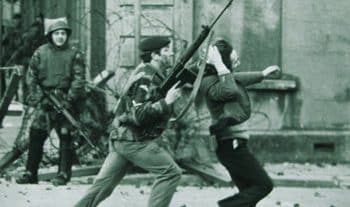
    The 2010 Report of the Saville Enquiry describes much of what happened in Derry on Bloody Sunday (30 January 1972). Various commentaries and later publications have added further information, some of it of a nature that the authorities must have hoped would never be revealed. It seems however that the ferocity of the slaughter that day has still not been adequately explained. Could ‘pure’ revenge be that explanation, as it had been on several other occasions in the past when the British army committed similar atrocities in Ireland. In the late 1980s while living in Derry and in the course of doing research for my book ‘Siege City: the story of Derry and Londonderry’ (published 1990), I became aware that as well as the terrible deaths in the city on Bloody Sunday, on the same day Major Robin Alers-Hankey, an officer in the Royal Green Jackets, had died also – but in London.  Major Alers-Hankey was the first British army officer to be killed in the Troubles.  He died of an injury sustained several months earlier while on duty in Derry’s Bogside, at a location that figured prominently in the deaths of the civilians on Bloody Sunday.  There are slightly differing accounts of the incident but, apparently, he was shot while providing security cover for the fire brigade which had been called out to a burning building in Abbey Street. It is possible that the fire had been started deliberately with the intention of luring the soldiers into an ambush. I was struck by the coincidence of the major’s death on the same day as the terrible events in Derry itself and wondered if there could have been any connection between the two tragedies.  However, I didn’t know what time of the day the major had died and in those pre-googling days I had no easy way of finding out.  Clearly his death would have had to have occurred before the slaughter in Derry if there was to have been any connection. I mentioned the subject to various people in Derry from time to time, but I never met anybody who seemed to know much about the incident.  Most times I spoke about it I got the distinct impression that people thought I’d be better not to enquire too much into the matter; at best it would be seen as a distraction from the main unresolved issues, at worst I might even be accused of providing a ‘reason’ or possibly an ‘excuse’ for the actions of the paras.  The latter, of course, was the last thing on my mind; but as an historian I felt that the question was worth pursuing or, at very least, worth asking. I was asked by the Bloody Sunday Trust to chair a fairly large public meeting in the Pilots’ Row Community Centre in the Bogside on the weekend of the 25th anniversary of Bloody Sunday, in 1997.  In the course of my introduction, I mentioned the Alers-Hankey affair and although some of my other remarks were responded to by those attending and reported, for example in the Derry Journal, my reference to the officer’s death seemed to fall totally flat and was not mentioned again. On 25 January 2002, however, the Irish Times reported that Martin McGuinness “was under pressure to state all he knows about 34 murders carried out by the IRA in Derry during 1972”. Among those listed was the killing of Robin Alers-Hankey. On 8 February 2002, the Irish Times published a letter from Jonathan Stephenson, a trades union official in Belfast and a former chairman of the SDLP (1995-8). It appeared under the heading ‘Remembering Bloody Sunday’. In the letter Mr Stephenson (who was English) mentioned that Major Alers-Hankey was ‘a member of my family’. He went on to refer to Martin McGuinness’s role in the IRA in Derry saying: ‘it is entirely possible that Mr McGuinness might have a fair idea who killed him [Major Alers-Hankey].’ I didn’t pursue the matter in any way subsequently although my curiosity about it remained. I assumed that it would be dealt with by the Saville Enquiry.  By then living in Dublin, I made a preliminary check of the Saville Report immediately on its publication on 15 June 2010. The Report does mention the major’s death on Bloody Sunday as background to the situation in Derry at that time but (as far as I know) it does not mention the time of his death or suggest any link with the atrocity.  There also seems to be some discrepancy in the dates given for the original wounding of the major: Saville states 2 September 1971, while a number of army-related sources (e.g. Holywood Palace Barracks website) suggest 16 October. On the day of the Saville Report publication (15 June 2010) and over the next few days I made attempts to contact a well-known journalist who I thought might be interested in what I had to say about the matter and who might mention it in his own coverage.* Having failed to make contact I wrote a short letter to the Irish Times, still indicating that I was unaware of the time of the Major’s death. The letter was published on 17 June and among those who contacted me as a result (18 June) was a female reporter from RTÉ/TG4 Nuacht who wanted to interview me.  Unfortunately, I cannot now remember the reporter’s name.  On the phone, I explained to her that my hypothesis that there might be a connection between the two events was dependant on the time of the major’s death and if it was possible that news of it could have reached Derry prior to the attack on the marchers. An hour later the interview crew arrived in my office in Dublin.  In the meantime, the reporter had done a bit of googling and had found a relevant reference in ‘Those are real bullets: Bloody Sunday, Derry, 1972’ by Peter Pringle and Philip Jacobson (published 2000). The following is the relevant

    Loading

    Read more

  • Posted in:

    Mr Morale and the Big Steppers by Kendrick Lamar – Thomas Pynchon for music lovers.  By Rory O’Sullivan.

      Kendrick Lamar is one of the most popular high-brow artists. He is one of very few people in history whose work during their lifetime has been at once widely listened to (nearly 20 million hits already for the top tracks of this album on Spotify) and deeply scrutinised: every lyric, every note and harmony is unravelled, put together, unravelled, put together again.   How does someone become that person? Musicality. This cannot be reduced to craft, the manipulation of melodies and harmonies, just as painting cannot seriously be made a matter of oils and sketches, nor writing vocabulary and punctuation.   To an ordinary unversed person, Lamar’s tools would just seem like melodies and harmonies, but for him they are a language, an expressive medium: a way of reaching other people’s subjective interiority.   What unites his albums, for all their differences, is that the music is for earphones, for walking around with, eating dinner to, listening to: alone, again and again.   They are made for experience, that pre-interpretive affective field that we make around us in our ordinary lives; whose shape has been theorised by many but is obscure to all; which some people have misnamed the unconscious, and which others have – more understandably, although not coherently – called presence.   Kendrick Lamar makes people feel something. Not just pleasure – most of the music is hard listening, demanding attention but chipping away , sometimes excruciatingly: songs like ‘We Cry Together’.   In Lamar’s music there is an echo, however faint, of the good.   Listeners are willing to suffer for this music because there is more than just sensation to it: listening to it is not like drunkenness. Audible , making meaning of its essence, is a sense of theme, the serenity of an idea. In Lamar’s music there is an echo, however faint, of the good.   When people wonder what truth artists can express or if there is a connection between art and morality, they miss the point completely if they do not see two things:   (1) The echo of the good is the whole source of art’s power and its one true mission on earth; (2) When people misunderstand this they try and take more from art than is there, and it becomes corrupt – this nearly always happens.   The first of these is rich and profound. The second explains why our understanding of artists is split: we tend to think of them as either prophets or pleasure-spinners while also forcing them to be both which cheapens them. Like power, when it is twisted from a means into an end, art corrupts.   It is one of the myths of our time that taste in art is subjective and arbitrary, like the consumer’s favourite foods and the citizen’s contrived support for a foreign soccer team.   Any reasonably deep thinker would tell you that people’s favourite foods and soccer teams are not arbitrary at all but a projection of where they are from, and who they would like to be (i.e., of their social class and place in history) – art too.   But it is also not arbitrary because it comes from a need which is not arbitrary: the need for things to make sense.   Like the Andromeda Galaxy, the best art in the world does not need us. But we need its inferiors   Like the Andromeda Galaxy, the best art in the world does not need us. But we need its inferiors – false images, shaky edifices of bad sense – like the lies people tell themselves: for example, that society develops, that we are a Western liberal democracy, that bad things either happen for  a certain type of ‘reason’ or will not happen as much eventually, or that we somehow stand with the people who suffer them.   In ‘Mr Morale and the Big Steppers’ we hear the voice of a brilliant musician who at once asks too little and too much of his own art.   The album is full of snippets, flourishes, hieroglyphs, loose references, subtle indicators – they lead nowhere. You could walk them around the entire earth and end up where you started. The point of each hidden reference is overwhelmingly the reference itself; the allusion always alludes first to its own allusion. Near the beginning of ‘Father Time’ for example we are told to ‘reach out to Eckhart’. Thomas Pynchon for music lovers.   With such things there is an obvious kitschiness (and the lyrics sometimes too. From ‘Worldwide Steppers:’ ‘Photoshoppin’ lies and motives. Hide your eyes, then pose for the pic’.’ From ‘Purple Hearts:’ ‘I’m not in the music business, I been in the human business/Whole life been social distant’).   But what these references, and more generally all the songs, keep coming back to is the Christian God. This is not exactly the God of James Baldwin, the sheer overwhelming joy of life together in song – nor the sublimely Christian one of Marvin Gaye – because it is delayed, deferred, like the ‘happiness’ of the ‘pursuit of happiness’.   ‘God’ here means ‘Paradise’, the fulfilment of a desire; the album honestly and vividly makes you feel America’s most devastating delusion: that you can ‘pursue’ happiness any more successfully or less destructively than you can chase a dragon.   All the best of ‘Mr Morale and the Big Steppers’ is about pain: feeling pain, admitting to it, being afraid of it, working out where it comes from, understanding it will not disappear. ‘Mother I Sober’, the best song on the album, strips everything back to this – a story about something that happened to his mother when he was young, and what it meant and means, its place in history.   The worst is when a song leans complacently on its thought, such as the gimmicky and Macklemore-ish ‘Auntie Diaries’ – whose narrator describes his two trans relatives, mixing vulgar discomfort and misgendering with supportive indignance against

    Loading

    Read more

  • Posted in:

    Solar Panels for Peace. All you need to ‘go solar’ yourself.   By Caroline Hurley.

    Why Solar In their book, ‘The Menace of Atomic Energy’,published nearly 50 years ago, Ralph Nader and John Abbotts revealed to readers that the person most responsible for developing American nuclear reactors, Dr Alvin Weinberg, admitted he would prefer solar energy if its cost could be brought down to less than 2.5 times the cost of nuclear energy.   In 2020, the International Energy Agency (IEA) declared solar electricity the cheapest in history: at least four times cheaper than nuclear.   Solar panels can be installed quickly, with minimal disruption to nature. The embodied energy used up in panels and end-of-life disposal remain concerns but diminishingly so.   In Germany, plans to open a nuclear reprocessing plant at Wackersdorf in Bavaria were discontinued in 1989 because of major public protests. The experience converted former lead nuclear exponent Dr Franz Alt to the benefits of renewable energy (RE). Alt coined the phrase, “solar panels for peace”, echoing President Eisenhower’s 1950s slogan, “atoms for peace”, referring to using fissile nuclear material for civilian electricity production not weapons.   The monstrous consequences of accidents or conflict occasionally remind us that nuclear production poses a persistent security threat.   Decentralised energy independence based on 100 % clean renewables is the alternative.   Extremely Positive Incentives for Change (EPICS), regulatory changes and financial incentives to reduce and capture carbon, are recommended by Lonergan and Sawers in their book ‘Supercharge Me’.   Solar Energy Over 99% of energy in the world comes from the sun. If the sun stopped shining, Earth’s temperature would soon drop to -150 ⁰ C and eventually -270⁰ C. Lighting fires to reach ambient temperature would exhaust fossil fuels within days. Solar energy sustains life. It remains abundant everywhere.   The remaining 1% of energy, over which most wars are fought comes from oil, uranium, gas, and coal.   Harnessing Solar A great piece last year in the excellent Low-Tech Magazine explores the evolution of solar power.   Ancient humans made use of passive heat from the sun to dry materials, light fires, and grow plants, while monuments like Newgrange and Stonehenge that stage solstice alignments suggest ritualistic devotion.   A solar cell, or photovoltaic cell (PV), is an electrical device that converts the energy of light directly into electricity by the photovoltaic effect -a physical and chemical phenomenon.   In the Victorian era, Charles Fritts’s thin selenium wafers covered with semi-transparent gold wires (1881) produced PV effects.  George Cove invented a solar thermoelectric generator, in Halifax, Nova Scotia, in 1905, with a strong photovoltaic effort, largely forgotten.   Einstein identified the photoelectric effect in 1904, and bandgap theory emerged in the 1930s, associated with Felix Bloch and others.   The modern solar cell debuted in 1954 at the prolific US Bell Labs.  It had a 6 per cent conversion efficiency, a rate which has been nudged up ever since.   Current Power Supply in Ireland Included in EirGrid’s Shaping Our Electricity Future report published in November 2021 is a chart showing assumed renewable generation capacities for Ireland by 2030.   Source Ireland (MW) Onshore Wind 5,700 Offshore Wind 5,000 Solar10 1,500 Total 12,200   One third of the 1,500 mega-watts (MW) of solar energy is expected to come from microgeneration projects, to be connected to the ESB distribution system. A special category for community-owned projects now attracts particular support. Eirgrid acknowledges  “a new era for communities investing in their long-term energy needs”.   According to Dr David Meredith of Teagasc: “The first Renewable Electricity Support Scheme (2021) included seven community projects and it will be important to learn from these in terms of good practices in order to develop appropriate models and supports that benefit rural communities in the future”.     Perhaps the solar sector is finally being taken seriously. In 2020, the National Just Transition Fund (JTF) awarded a total of €20.5 million in grant-aid to qualifying projects. The categories funded were: business development; education; training and upskilling; development of co-working and enterprise hubs, renewable energies (RE), and retrofitting.   Representative groups like the Micro-Renewable Energy Federation (MREF) are now asking that VAT on solar PV panels and their supply and installation for private homes and public buildings be reduced or eliminated.   Additionally, Planning exemptions for solar panelsare expected by June, meaning planning permission will no longer be required for larger solar installations across residential rooftops, farm buildings, schools, community centres and a range of commercial buildings.       How to go solar The website of semi-state body SEAI (Sustainable Energy Authority of Ireland) provides information on solar technologies, including those supported by grants, especially promoting Electric Ireland’s Superhomes retrofit scheme, whose website furnishes case studies.   The Common Agricultural Policy (CAP) could fund renewable energy initiatives on farms.     In February 2022, the Irish government launched the National Retrofitting Scheme, widening the range of supports available to households to improve their energy efficiency. For homeowners, there are three main dimensions to the scheme: individual energy upgrade grants offering up to 80% grant support for insulation and heating, deep retrofit grants offering up to 50% of the cost, and free energy upgrades for those at risk of energy poverty. A state-run low cost loan scheme is also being developed.   In ARC 2020’s report Rural Ireland on the Move, launched at Cultivate’s recent Feeding Ourselves2022 conference in Cloughjordan, Dr Olive McCarthy explores a just transition to energy efficiency for low-income households. She notes that provisions of the National Retrofitting Scheme and related low-cost loans fail to adequately support low-income households in achieving greater energy efficiency and lower costs, according to research conducted by the UCC Centre for Co-operative Studies and North Dublin Money Advice and Budgeting Service (MABS). On that basis, they fall short of the Nevin Institute’s just transition criteria. While most households surveyed showing environment consciousness, for those with little disposable income, qualifying for aids was too onerous. Even free retrofitting had limited appeal. A just energy transition cannot happen without other tailored measures, such as one-on-one advice. McCarthy concluded: “The introduction of Community Energy Advisors, as recommended by the Saint Vincent de Paul in its

    Loading

    Read more

  • Posted in:

     Vatican/Vested interests 10: Women of Ireland 0. The people and process failures that created the St Vincent's NMH débacle. By Peter Boylan.

    The ownership and governance arrangements for the new National Maternity Hospital (NMH) are fraught with risk for future generations of women in Ireland. The board structure of the new hospital makes it liable to capture and control by the 3/3/3 membership structure.   The NMH will have minority representation of only three out of nine on its own board, and one of its directors is limited to chairing its own board for a maximum three out of nine years.   The three St Vincent’s Hospital Group (SVHG) directors are committed to the “continuance of the fulfilment” of the  evidently Catholic mission of the Venerable Mary Aikenhead, the founder of the Religious Sisters of Charity who is well advanced in the process of becoming a saint in the Catholic Church. One of these directors too will chair the NMH board for three out of every nine years.   Minister Donnelly claims he can guarantee that his successors over the next 299 years will not appoint three anti-choice members who could combine with the three SVHG members to form a 6:3 anti-choice majority. There is no need to speculate that such a situation might arise in fifty or a hundred years.   Memories are clear of the infamous picture of the majority of the Fianna Fáil parliamentary party just four years ago — women to the forefront — holding up “Love Both” posters; while men in the background all affirm their anti-choice position.   In a final blow for NMH board independence, one of the ministerial nominees will chair the board for three out of every nine years.   The global pushback on women’s reproductive rights is constant.   Majorities on controlling boards matter.   Just look at how a majority anti-choice Supreme Court in the USA is poised to overturn Roe v Wade.   Problems with the NMH relocation plan began can be traced back to a letter written by then Master, Dr Rhona Mahony, and Deputy Chair Mr Nicholas Kearns to Kieran Mulvey in September 2016.   Problems with the NMH relocation plan began can be traced back to a letter written by then Master, Dr Rhona Mahony, and Deputy Chair Mr Nicholas Kearns to Kieran Mulvey in September 2016.   “We agree that the ownership of what is now the NMH will transfer to the ownership of SVHG, a private company owned by the Sisters of Charity”.   Simon Harris, then Minister for Health, enthusiastically embraced this plan in the Mulvey report   Simon Harris, then Minister for Health, enthusiastically embraced this plan in the Mulvey report, apparently untroubled by the history of the Magdalene laundries in Ireland and seeing no possible risk in a Catholic religious order owning the State’s flagship maternity hospital.   When the predictable public uproar ensued, five years of complicated and secretive legal manoeuvres commenced.   The Sisters announced they were departing healthcare. Not true, they were gifting their land to their successor private company, St Vincent’s Holdings.   The Sisters announced they were departing healthcare – a plan in the works for several years before May 2017 – and were “gifting lands worth €200 million to the People of Ireland”.   Not true, they were gifting their land to their successor private company, St Vincent’s Holdings.   They then tried to claim that they did not need Vatican permission for the shareholding transfer. Not true either.   They then tried to claim that uniquely among Catholic religious orders they did not need Vatican permission for their shareholding transfer.   Not true either.   Two more years passed while the machinery in Rome considered the Sisters’ petition. In Ireland, a dizzying number of legal documents whizzed between top law firms as the State’s attempt to dig itself out the hole it had created for itself became increasingly labyrinthine and Byzantine.   Following correspondence between the Sisters, the Irish Catholic hierarchy, the Papal Nuncio, and the Vatican, conditional permission was granted in 2020 for the creation of St Vincent’s Holdings. Two further years passed while the civil law process got underway.   In a spectacular failure of due diligence, that correspondence has never been seen by the Government who have now committed to spending a billion euros   In a spectacular failure of due diligence, that correspondence has never been seen by the Government who have now committed to spending a billion euros, and probably more, on a new hospital whose operating company NMH DAC will be owned by St Vincent’s Holdings – the Sisters’ Vatican-approved successor.   Only sustained opposition and public pressure forced the release of some of the tangled web of legal documentation following failure to approve Minister Donnelly’s Memo to Cabinet two weeks ago.   Contradictory “definitions” were put forward about the term “clinically appropriate” including one risible proposition that it was to ensure NMH clinicians didn’t indulge in a spot of brain surgery when they were supposed to be doing a caesarian section.   In a new twist, fresh consternation arose about the term “clinically appropriate” in the documents. Taken by surprise, different and contradictory “definitions” were put forward, including one risible proposition that it was to ensure NMH clinicians didn’t indulge in a spot of brain surgery when they were supposed to be doing a caesarian section.   Doctors such as Professor Louise Kenny and myself were clear that these words make the provision of legally permissible services dependent on the clinical decision of a doctor rather than the request of woman on a case-by-case basis. They remove patient autonomy.   Nothing has changed since the Chairman of SVHG, Mr James Menton made clear in May 2017 that the project “will only proceed on the basis of existing agreements that give ownership and control of the new hospital to St Vincent’s Healthcare Group” Irish Times May 30 2017 .   His objective has been wholly achieved.   Vatican/Vested interests 10: Women of Ireland 0.   And the Government, as we now know, has never been on the pitch.   Dr

    Loading

    Read more

  • Posted in:

    Currency warfronts: Russia is spearheading a gold- and commodity-backed Ruble, while Central Banks accelerate digital currencies which, without protections, will give them unlimited power to monitor and control how we spend our money. By Eddie Hobbs.

    Putin’s 9 May speech in Red Square came and went, without any new theatre opening up. This may indicate a change in strategy to limit the kinetic war to Donbas but he’s made it quite clear that, in his world view, the culpable protagonist, is NATO /USA. By moving away from military rhetoric his speech, along with threats to take “retaliatory steps, both of a military-technical and other nature” against NATO-bound Finland,  shifts the focus in the conflict to the financial, economic and cyber security fields. If the West is at the end of a 50-year debt-financing bubble, the global financial system, largely of American design, is very vulnerable. That is why an interview on 26 April 26 in Rossiyskava Gazeta by one of Putin’s top strategists — the man who in 1999 replaced him as head of the FSB, Nikolai Patrushev — adds new heat to the boiling pot. Patrushev, who is Secretary to the Russian Federation’s Security Council, the inner sanctum chaired by Putin and which includes Lavrov, Medvedev and Mishustin, announced a fresh challenge to the US–dominated global financial system. Nikolai Patrushev Source; Spisok-Putina.Org The Kremlin determines the West’s weakest financial spot to be its debt bubble. In its eyes it is a West burdened by decades of debt excesses, now facing runaway inflation, supply chain disruption, and faltering consumer confidence. It sees  the West’s Central Banks, led by the Fed and Bank of England, trying to perform a miracle U-turn — jacking up interest rates in a time of war without triggering recessions. This is Russia’s opportunity, as the Kremlin sees it, to lead a coalition of economic regions that strike a blow to USA pre-eminence and births a new currency system. Patrushev outlined Russia’s plans to head a multi-currency system pegged to gold and commodities and, he couldn’t have been clearer: “For any national financial system to be made sovereign its means of payment must have intrinsic value and price stability, without being pegged to the Dollar. Now experts are working on a project proposed by the scientific community to create a two-circuit monetary and financial system. In particular, it is proposed to determine the value of the Ruble, which should be backed by both gold and a group of goods that are currency values, and to put the Ruble exchange rate in line with the real purchasing power parity”.  Patrushev’s interview was first reported in the West by Ronan Manly, a precious metals analyst and writer with Singapore-based, BullionStar. Since Nixon’s break from the gold standard, the US has built power from an endless demand for Dollars to finance trade and to attract inexpensive capital flows into US Treasuries, giving it a unique competitive advantage, one that US proponents see as open-ended, immutable, and an American birth right. But in announcing plans to head a global multi-currency system, starting in the Eurasian region and extending, through intensive co-operation to half the planet, Patrushev sees things very differently: we are clearly aware that the West allows other countries to be its partner only when it is profitable for it “The West has unilaterally appropriated an intellectual monopoly on the optimal structure of society and has been using it for decades… We are not opposed to a market economy and participation in global production chains, but we are clearly aware that the West allows other countries to be its partner only when it is profitable for it. Therefore, the most important condition for ensuring Russia’s economic security is to rely on the country’s internal potential, a structural adjustment of the national economy on a modern technological basis”. Though largely ignored in the West, Russia has pegged the Ruble to gold in trades between its Central Bank and its banking system — setting a floor at 5000 Rubles per gram. Though largely ignored in the West, Russia has pegged the Ruble to gold in trades between its Central Bank and its banking system — setting a floor at 5000 Rubles per gram. This twins the Ruble with gold, which is traded in US Dollars, while simultaneously Russia demanded Rubles for gas from opponents to its war in Ukraine. Based on Patrushev’s comments, which I believe are aimed squarely at commodity-exporting nations, the next likely step is to entice payments for Russian gas in gold, in an attempt to change the nature of international energy markets away from trading in Dollars. If successful, this could trigger a flow of gold into Russian reserves bolstering its currency-peg plans.  This has the potential to damage the highly-leveraged paper gold markets and to start a contagion. Russia’s plans would ultimately require the removal of its exchange controls, which have pushed the Ruble to a two-year high against the Dollar. It would also require a post-war international agreement for commodity-backed currencies involving all participants including China, India, Iran, Latin America and Africa, if it were ever to be successful. In doing so Russia would face the double-edged sword Nixon faced when gold was demanded as payment for national debt instead of Dollars, due to sagging confidence in the US currency after it had borne the cost of the Vietnam War. Those who blindly follow the doctrine of US pre-eminence scoff at plans to restructure the global financial system, having heard it all before. What’s different this time, is the scale of debt being carried by the US and many Western economies while Central Banks, unnerved by breakaway inflation, raise borrowing rates in a desperate attempt to counteract inflation. What’s different this time, is the scale of debt being carried by the US and many Western economies while Central Banks, unnerved by breakaway inflation, raise borrowing rates in a desperate attempt to counteract inflation. If the tightening cycle, now entered into by the Fed, hobbles the US economy this year, a flip flop by the Fed, back to easing once again to avoid recession, would hobble the Fed itself. The truth is that, it is all finely poised. The advanced sign of an

    Loading

    Read more

  • Posted in:

    A saga marked by subterfuge and best resolved by simple CPO. By Marie O'Connor.

    After an unedifying week marked by an unrelenting stream of propaganda following the unexpected deferral of the Cabinet decision, yesterday’s poll in the Sunday Independent shows that the plurality of respondents (excluding ‘uncertains’), 45 per cent, believe there will be religious interference in the new hospital. Predictably, the role of offshore intermediaries, Stembridge Ltd and Porema Ltd, in St Vincent’s Holdings received scant attention, despite the association of these companies with over 200,000 offshore entities named in the Panama Papers. Documents released by the HSE earlier this week bear out the global ambitions of St Vincent’s Healthcare Group. Under the constitution of the National Maternity Hospital at Elm Park, Dublin 4, the company is empowered to carry on its business in “any part of the world”. The government has finally published what purports to be “a full set of legal documents” in connection with the State’s proposed investment in the new facility. Missing maps and unattached schedules leave the bundle incomplete. Even more concerning is the omission of documents that define St Vincent’s control over the new facility and enshrine its Catholic ethos.   The public-private mix The dysfunctional public-private mix in our publicly funded ‘voluntary’ hospitals will deepen if the government signs off on these plans. As many as 40 per cent of  Holles St Hospital consultants work in St Vincent’s hospitals. The new maternity hospital incorporates five private-practice suites (in defiance of Sláintecare principles). Consultant obstetricians average €500,000 per annum per head in private obstetric fees alone (not counting private income from gynaecology). St Vincent’s Healthcare Group has a history of being liberal, if not lax, in adhering to public pay guidelines. The Group is unlikely therefore to enforce the existing cap on private practice. Proposed ownership structure A large majority of people, 60 per cent, are opposed to the proposed ownership structure for the new facility, as the Sunday Independent poll shows. The National Maternity Hospital at Elm Park is to be a wholly-owned subsidiary of St Vincent’s Healthcare Group. Wholly-owned subsidiaries are wholly-controlled by their parent companies. The new hospital company has two parents: St Vincent’s Healthcare Group is a wholly-owned subsidiary of St Vincent’s Holdings. Both companies are successor bodies to the Religious Sisters of Charity. Their constitutions have been omitted from the ‘legal framework’, for some unfathomable reason. The lease published last week shows that the nuns’ company, St Vincent’s Healthcare Group, will continue to own the lands and the hospitals vested in it by the congregation. These assets will also be owned by St Vincent’s Holdings. Why St Vincent’s Group needed a second ownership vehicle is unclear.   The lease also shows that St Vincent’s Healthcare Group will own the buildings to be built on the land that it owns. The rent, set at €850,000 per annum — abated to €10 for observing six conditions — is being used as a mechanism of control. Power and control Not content with being the owner of the land and the landlord to a tenant State, St Vincent’s Group has also defined itself as a member of the National Maternity Hospital at Elm Park, of which it is the 99-per-cent owner. It is also the co-holder of the operating licence. This licence, which is shared opaquely with the new hospital company, further enables the company to control the hospital activities and effectively vitiates the ownership that would otherwise attach to a 299-year lease. Under the amended constitution of St Vincent’s Healthcare Group, the new maternity hospital company will be just another Vincent’s hospital, to be managed in exactly the same way as Vincent’s existing hospitals. The Group’s powers extend to healthcare policy-making, supervision, determining financial funding, laying down plans, procedures, rules and regulations, discipline, education, patient care, patient records and employing medical staff, including consultants (paras 4.1-4.8).   The golden share The much-touted golden share of the Minister for Health in the new hospital company grants certain veto rights over decisions in relation to changes in company ownership. However, no golden share can override the 100-per-cent subsidiary-status of the company. The State’s is unable to compel voluntary hospitals to do anything they are disinclined to do. Holles Street Hospital, for example, won its High Court challenge to Harris (then Minister for Health) preventing him from carrying out an inquiry into the death of Malak Thawley. Although the Department of Health has claimed that the Minister has the power to  ensure that all legally permissible services will be provided in the new facility, Minister Simon Harris, for example,  must be painfully aware of the State’s inability to compel voluntary hospitals to do anything they are disinclined to do. Holles Street Hospital, for example, won its High Court challenge to Harris (then Minister for Health) preventing him from carrying out an inquiry into the death of Malak Thawley. She died in 2016 due to what was described as ‘a cascade of negligence’ during routine surgery there for an ectopic pregnancy. Ethos Rome set conditions to the transfer of the nuns’ assets  into their new vehicle. Communications between the congregation and the Vatican remain undisclosed, with the exception of a letter to the order from Rome setting out these legal terms. One key condition is the avoidance of “harm to Church teaching”. Despite the oft-repeated claims of ‘independence’, there is “an ongoing chain of connection” between the new holding company and the Religious Sisters of Charity. The directors of St Vincent’s Healthcare Group are clerical appointees. The board nominated three former directors of the Group (also clerical appointees), as directors of St Vincent’s Holdings. The Main Object of both constitutions ties the patient care to ethical compliance. St Vincent’s hospitals have never provided procedures prohibited by the Church, such as tubal ligation and vasectomy. The constitution of the holding company commits it to continuing the “mission” of Mary Aikenhead, who is named as the founder of the order. Leasing arrangements (para 5.11) and employment terms (para 5.8) may be employed to further the Main Object. A crucial new phrase, “clinically appropriate”, recurs in the just released documents. Within a Catholic ethos, abortion is considered

    Loading

    Read more

  • Posted in:

    'God's Cop' has gone to meet his maker. He will have a few questions to answer. By Joseph de Burca.

    The article which featured Anderton was about John Stalker and a number of other honourable English police officers and soldiers who had tried to do the right thing in Ireland. The relevant section  read as follows:   The late John Stalker, the former Deputy Chief Constable of Manchester, investigated the RUC’s shoot to kill programme in Ireland in the 1980s. He discovered, for example, that the RUC and MI5 had murdered a teenage boy who had stumbled across an IRA arms dump in a hay shed. Stalker refused to back off and was stabbed in the back by his own side. The deepest wounds were those inflicted by his boss, James Anderton,  a man who believed that God spoke ‘to him and through him’. In reality Anderton became an accessory after the fact to the murder of the boy at the hay shed. Stalker was smeared by a corrupt press in Britain, linked to criminality and taken off his inquiry. The killers got away Scot free as did all of those involved in shafting Stalker. Few in Britain could have cared less. Although he cleared his name, Stalker retired from the police early a demoralised man. The photo which accompanied the article appeared and read as follows: Former Chief Constable James Anderton. He stabbed his own deputy in the back to help MI5 cover up the murder of an innocent teenager. The original article can be found here: Updated: The very best (and worst) of British.   Anderton was also a homophobe. He claimed homosexuals with AIDS were ‘swirling in a human cesspit of their own making’. According to The Guardian he ‘encouraged his officers to stalk [Manchester’s] dank alleys and expose anyone caught in a clinch, while police motorboats with spotlights cruised for gay men around the canal’s locks and bridges.’ In 2011, historian Jeff Evans told the Manchester Evening News: ‘I’ve interviewed retired officers who took part in police surveillance of public toilets, lying in the roof space watching men urinate for hours on end.’ He believed that “sodomy in males ought to be against the law”. Anderton was also a Freemason, a clandestine  organisation which rejects Christianity. How Anderton reconciled his membership of that brotherhood with his purported religious beliefs is a mystery.  “God works in mysterious ways,” he said.  Of his religion, he once boasted: “Given my love of God and my belief in God and Jesus Christ, I have to accept that I may well be used by God [in my police work].” Despite all the controversy, he was knighted in 1991 during Margaret Thatcher’s premiership before enjoying a full retirement. Patrick Walker was another criminal who never complained about what was written about him in Village. We accused him of ordering the murder of Patrick Finucane. See The D-G of MI5 who got away with the murder of Patrick Finucane has died. The article pointed out that: “Village magazine accused Walker of the murder years ago. He was named in one story which has been read more than 22,000 times. He did not sue. He did not  even seek a right of reply. His silence now condemns him.”

    Loading

    Read more

  • Posted in:

    17 Gilford Park: a case study in Ireland’s dubious planning and enforcement processes. Paul Hyde, who was one of two Bord Pleanála members who awarded the planning permission to his brother Stefan, and the brothers’ father are connected to Fine Gael

      Number 17 Gilford Park , Sandymount, in Dublin 4  is one semi-detached half of a structure adjoining number 15 which is in registered in the ownership of a Mr Anthony Duffy. The sale of No 17 went through in the second half of 2021 for €960,000 . It was sold to Caroline Barron and her husband Stefan Hyde who is the brother of Paul Hyde. Paul Hyde is the deputy chairman of An Bord Pleanála, the planning appeals board. Caroline Barron and Stefan Hyde In 2021 planning permission was sought for “an extension” of No 17 around the back and also that a side garage and a concrete coal bunker were to be demolished only: “Demolition and removal of sheds, garage and outhouses, and construction of roof extensions, elevation alterations and attic conversion”. This was misleading as wide-scale demolition of the house at No 17 was envisaged. There was a successful appeal, by Caroline Barron not her husband Mr Hyde,  of the original City Council decision to limit the size of the extension and this appeal was granted. In disagreeing with its own inspector’s recommendation on the master bedroom, the board “considered that the proposed development would not be overbearing to an extent that would injure the amenities of the neighbouring property”, according to the An Bord Pleanála order. Scandalously, as reported today by the Ditch website  https://www.ontheditch.com/abp-deputy-chair-granted-permission-brothers-controversial-development/, one of the two names on the decision on the ultimate permission was Paul Hyde’s. The whole house at No 17, save for the facade , was demolished in contravention of the planning permission sought and granted. Not only was the building demolished but the foundations were removed and new ones up to 2 metres in depth were dug to create extra space leaving Mr Duffy’s house on what appears like a sort of ledge. Some of the walls that were demolished provided support for Duffy’s house and this has, according to expert reports, led to damage to his house which would clearly cost a six-figure Euro sum to redress. Records show that Mr Duffy complained to Dublin City Council.  They were slow to come out due to “Covid” etc and when they did they indicated that the terms of the planning permission had been breached but that having spoken (only) to representatives of Stefan Hyde and Caroline Barron they were satisfied that no further action was necessary or would be taken . Village understands they never spoke to Mr Duffy less still expressed any interest or concern about damage to his house. The High Court record shows that Duffy has initiated proceedings himself against  Caroline Barron and Stefan Hyde. So the ruse appears to have worked to date as building is ongoing and despite the legal proceedings there has been no basis on which anyone can contest the substance of the Bord Pleanála decision itself nor the inevitable  disturbances that have ensued – despite the original inaccurate description of the proposed development as “an extension” . Meanwhile, Ms Barron and Mr Hyde are ploughing ahead . Whether the house will, in fact, be occupied as a family home or sold when completed is unknown . The size of the house would make it one of the largest semi ds on the road (2400 sq feet). Effectively by digging down almost 2 metres and also using an attic extension the house will be converted into a de facto three-storey dwelling. The case shows up the shortcomings of the whole planning process which are well known to those in the building and planning businesses –  you can get away with seeking to do something like an “extension” to which no reasonable neighbour would object, then, without warning, knock down the gutds of the structure, safe in the knowledge that even if anyone bothers to report it to the relevant authority, in this case, Dublin City Council ,  they probably will do absolutely NOTHING about it. Stefan Hyde is a founding partner of Maurice Johnson and Partners, Fire Engineers and Access Consultants. His company biography boasts that that he has been “involved” with the National Maritime College of Ireland in Ringaskiddy, Co Cork – where Paul Hyde was a board member and audit committee member, 2012-14. Stefan, like Paul, is an accomplished yachtsman. Stefan is a previous Round Ireland Yacht race winner, All Ireland Sailing Champion, and Student Yachting World Champion. Minister for Foreign Affairs, Simon Coveney and Paul Hyde of course were at school in PBC Cork together,  co-owned a yacht and competed in several events as a team.  Stefan was at least as accomplished and competed at events including Sovereign’s Cup week at Kinsale.  He came third at the IRC National Championship in 2005.  The Hydes’ father, Stephen, has donated at least twice to Coveney’s election campaigns, giving €2,500 in advance of the 2007 general election. Stephen and his wife have been members of Fine Gael in Cork.  Of course no wrongdoing can be, or is,  imputed to either of the boys’ parents. So much can not be said of their sons.      

    Loading

    Read more

  • Posted in:

    Malign manoeuvrings on Moore St. By Aengus Ó Snodaigh TD. Traders allegedly rejected improper payoffs linked to support for development and opposition to culture bill.

    NAMA In 2009 I was one of four Sinn Féin TDs in the Dáil when NAMA was set up. Ireland’s ‘bad bank’ was characterised then and since, by some, as the scam of the century because it would bailout billionaire developers while at the same time many ordinary people would get evicted from their homes. What was worse is that, despite public monies being involved, the public had only limited access to information about its goings on: how much a billionaire received from NAMA, what discounts it gave away on the sale of land and properties etc. Project Jewel This leads us to Moore Street and to the NAMA portfolio aptly named Project Jewel, the largest property portfolio NAMA would offload, which included a property-holding consisting of a quarter of Dublin’s main thoroughfare, O’Connell Street; a large portion of Henry Street; the vast bulk of Moore Street, Moore Lane, and Henry Place; a section of Parnell Street; and 50% of the Ilac Shopping Centre. Project Jewel – including also 50% of the Pavilions Shopping Centre in Swords, County Dublin; Dundrum Town Centre; and the old Dundrum Shopping Centre – was put up for tender in 2015[1]. Sale to Hammerson The Project Jewel sale to British shopping centres’ management and development company, Hammerson, was agreed in 2016 [2]. It was finalised in the summer of 2017 [3], under the watchful eye of Nama’s then Head of Assets Recovery, Connor Owens [4]. In 2015, before he became Head of Assets Recovery, Owens had also been, as Senior Divisional Manager for Project Jewel’s tender, the NAMA person overseeing the process [5]. That Project Jewel was a steal at the price paid for it was demonstrated within months when Hammerson sought to refinance one part of the full portfolio, Dundrum Town Centre for €1.5 billion – just shy of what it had paid for the whole package [6]. If such a gain had been made across the whole portfolio, Hammerson would have been sold €6 billion worth of property by a state company for €1.85 billion – with the state losing out on what would have been a gain to Hammerson and its partners of €4.15 billion. Nama obviously believed it was getting the best deal possible, and there is no suggestion that anything illegal or untoward occurred in relation to this portfolio sale. I nevertheless believe that, given the scale of Project Jewel, a greater price would have been achievable for Nama had the property bundle been broken up into single sites. Such a strategy would probably have attracted more interest from smaller bidders otherwise scared off by the scale of the offering. A short four years after selling NAMA’s biggest asset to Hammerson for that €1.85 billion, Connor Owens would be back in charge of the Project Jewel portfolio, this time as Hammerson Ireland’s CEO [7]. High Court judgment stymies planning application for moment A 2016 High Court case resulted in the Moore Street area becoming a National Monument. A consequence of that judgment was the blocking of a live planning application which would have destroyed much of this heritage site. Establishment of Advisory Groups to implement imperatives of High Court decision The judgment was appealed and overturned in 2018 by the Court of Appeal[8]. However, against the backdrop of the High Court decision, an advisory group had been set up[9] to “seek a positive way forward” for the area, with the then-Minister Heather Humphreys selecting certain campaigners, 1916 relatives and Moore Street market traders to be members alongside Councillors, TDs and senators. That group carried out its work and submitted ‘The Moore Street Report – Securing History’ to Minister Humphreys on 29 March 2017. A second group, ‘the Moore Street Advisory Group’, was set up on 25 May 2017, and on 31 July 2019 concluded its deliberations with the publication of its report by the Minister. I chaired one of this group’s sub-committees, the Surveys Subgroup, after Peadar Tóibín left Sinn Féin in 2018 to set up his own party. After the 2020 general election the new Junior Minister for Heritage Malcolm Noonan set up ‘the Moore Street Minister’s Advisory Group’, the third such advisory group. Third advisory group reports This group began considerations in December 2020. It was set an ambitious target to report in just over three months, at Easter 2021, but in fact ‘reported’ to the Minister a month late on 5 May 2021. Version submitted to Minister was not that which had been agreed The version submitted to the Minister and published by him was not that which was agreed by the membership of the group. I and others challenged passages contained in it which were clearly favourable towards Dublin Central, the development being proposed by Hammerson[10]. Given the original stated positions of the members of the group on Dublin Central, voting on the report or aspects of the report was likely to be tight, so any change could shift the thrust of the final report. In the final deliberations on the group’s report to Minister Noonan, the traders absented themselves, which they may have felt was better than voting for the report but given what emerged since was unfair on the rest of the advisory group membership as we were in the dark about the wheeling and dealing that had gone on in the background of our meetings. Such knowledge might have persuaded some who were inclined one way to vote the other way. Unfortunately, that report may well be material to the Bord Pleanála decisions that are awaited, that will determine the future of the site, referred to by the High Court as the Moore Street Battlefield Area. So why did the report not represent what I thought had been agreed? Inferring what happened I will set out, without naming names, what I have been told or pieced together as well as what is already in the public domain concerning Moore St and voting on its advisory group [11]. Garda Investigation Certainly a Garda investigation could better establish the reality of what is not yet

    Loading

    Read more