Posted in:
Not 15,000: 7500
One of the biggest obstacles in trying to address what has been accurately characterised by government as the housing emergency is the lack of reliable and valid data.
Posted in:
One of the biggest obstacles in trying to address what has been accurately characterised by government as the housing emergency is the lack of reliable and valid data.
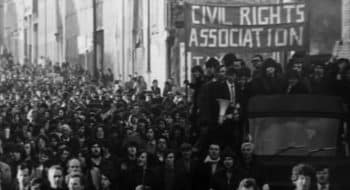
January was the 50th anniversary of the establishment of the Northern Ireland Civil Rights Association, which sponsored the civil rights marches that brought the anti-Catholic discriminatory practices of the old Stormont Unionist regime to world attention. I was at that foundation meeting on Sunday 29 January 1967 in the International Hotel, since demolished, behind Belfast City Hall as an observer from the Dublin Wolfe Tone Society of which I was then secretary. All shades of Northern political opinion were represented on NICRA’s first Executive – Liberal, Labour, Nationalist, Republican, Communist, Trade Unionist. A Young Unionist was co-opted at the next meeting in the same venue on 9 April, which I also attended. Tony Smythe, secretary of Britain’s National Council for Civil Liberties, told the January meeting how NICRA might emulate the NCCL. This meant tackling Unionist discrimination against the Catholic Nationalist minority. The novelty of the new movement was that it was not going to raise the constitutional issue, the North’s membership of the UK, and the Partition question. British rights for British citizens were to be its focus. This was deeply subversive of the sectarian political basis of the Northern statelet. The majority Unionist Government at Stormont was used to dealing with the IRA. It could handle the anti-Partition agitations that had been the focus of Nationalist minority politics since 1920. But the demand for equal treatment for Catholics and Protestants within the existing constitution was something quite different. It divided Unionism between the more liberal element backing Stormont Premier Terence O’Neill and the more anti-Catholic element that looked to Ian Paisley. It appealed to the sense of fair play of the British public. Above all it put the British Government on the spot. For how could London stand over the discriminatory practices of a devolved administration in one part of what was the United Kingdom when they were brought to world attention? All the more so as the UK and the Republic were then applying together for membership of the EEC. Northern Republicans backed the call for British rights for British citizens. This was the pre-1970-split IRA/Sinn Féin, led by Cathal Goulding and Tomas MacGiolla. They had learned the futility of trying to end Partition by force and had ‘gone political’ following the failure of the IRA’s 1956-61 Border campaign. NICRA agreed five demands at its foundation: (1) One man one vote, which meant an end to the property franchise and associated plural voting in local elections; (2) an end to the gerrymandering that put nationalist-majority towns like Derry, Enniskillen and Dungannon under permanent Unionist control; (3) an end to anti-Catholic discrimination in allocating Council housing and in public and private employment; (4) an end to the Special Powers Act, which permitted arrest without warrant, imprisonment without trial and the banning of nationalist publications and meetings; and (5) the standing down of the B-special constabulary, which allowed volunteers in this wholly Protestant force to intimidate their Catholic neighbours at will. The first NICRA-sponsored civil rights march took place from Coalisland to Dungannon the following year, on 24 August 1968. I was one of the thousand or so people that walked on that. I recall standing on a ditch outside Dungannon that lovely summer evening, the better to hear Betty Sinclair, Austin Currie, and other civil rights speakers addressing the crowd from the lorry at the front. I had a pocket radio with me on which at the same time I was listening to news of the Russian intervention in Czechoslovakia to put down Dubcek’s “Prague Spring”. The RUC stopped the marchers entering Dungannon on the ground that there was a Loyalist counter-demonstration up ahead. The second NICRA-sponsored march in Duke Street, Derry, on 5 October 1968 brought the Northern civil liberties situation to world attention. I got to that just as the RUC began batoning the few hundred marchers at its start, and was later doused by the police water-cannon as they cleared the street of protesters. Stormont Home Minister William Craig had banned the Duke Street march. Gerry Fitt, Republican Labour MP for West Belfast, had blood covering his shirt-front from a head wound received from a police baton. Fitt had brought three Labour MPs from London to be with him. The TV cameras sent pictures of the RUC batoning the marchers around the globe. Civil rights in the North became world news overnight. Harold Wilson’s Labour Government came under pressure from an appalled British public to tackle the abuses of the Unionist majority-rule regime at Stormont, which London had been happy to ignore since the 1920s. The following month, November 1968, was the culmination of the non-violent phase of the Civil Rights Movement when the Derry Citizens Action Committee, led by the Catholic John Hume and the Protestant Ivan Cooper, marched thousands of people peacefully into Derry city centre, establishing their right of protest in their own city. Between then and summer 1969 the Unionist Government was caught between the pressure of the Civil Rights Movement internally and the British Government externally. Stormont Premier Terence O’Neill was forced to concede in principle all of NICRA’s demands, although it would take years for some of them to work through, in particular ending discrimination in jobs and housing. In that time occurred the rise in Protestant-Catholic sectarian tension which culminated in August 1969 with the ‘Battle of the Bogside’ in Derry, the burning of Catholic homes and businesses in Belfast and the expulsion of hundreds of Belfast Catholics in face of Loyalist attacks. The Cameron Commission’s Report is still the best account of the early Civil Rights period. It attributed significant blame for the rise of sectarianism in 1969 to the actions of the student-based People’s Democracy. The PD split the civil rights movement. It criticised NICRA’s demands as too moderate. It disdained proper stewarding on its marches. It called for one-person-one-job rather than one-person-one- vote. Its leaders wanted what they called “socialism” and they wanted it quickly! The Cameron Commission characterised the Burntollet march organised by the
We are now witness to a pervasive acceleration in the normally glacial processes of geopolitical rebalancing in the West. Behavioural economics is helpful in analysing it. On his first full day in the White House, President Trump signed an executive order withdrawing the US from the Trans-Pacific Partnership (TPP), the core international economic legacy of the Obama Administration. The TPP, alongside its Trans-Atlantic brother, the TTIP, both trade deals, is also the most public embodiment of the elite-driven obsession with promoting political globalisation under the guise of free trade. Almost at the same time, a series of political opinion polls across the EU produced historically unprecedented results, showing a dramatic shift away from the mainstream Centre-Left political parties towards the populist parties of the more extreme Left and Right. In the Netherlands the Labour Party, traditional mainstream leader of the Left, has fallen in popularity to eighth place. To put this into perspective, since the end of WWII, it has never fallen below second place in any general election. Germany set September 24 as general election date, just as the German constitutional court ruled against banning the neo-Nazi National Democratic Party (NPD) from contesting elections. A milder and more successful version of NPD, the nationalist Alternative for Germany (AfD) is now represented in 10 of Germany’s 16 state parliaments and, with 13-15 percent support among the German electorate, is set to get into the federal Parliament, come the September election. In Sweden, the centre-right opposition is gearing up for September 2018 elections. Sweden is currently led by a centre-left minority Government that is being challenged by the traditional centre-right opposition parties through an uneasy informal alliance with the far-right Sweden Democrats. The marriage – which is ideologically not quite made in heaven – is a necessary compromise for the traditional right, as the Sweden Democrats are quickly emerging in polls as the biggest political force of the right. In Austria, the far-right Freedom Party (FPO), a member of the Europe of Nations and Freedom block of EU right-wing and far-right parties, is currently leading the polls with 33-34 percent support, while the Social Democratic SPÖ-S&D are languishing in second place with 27-28 percent support. In Greece the most recent public opinion tallies put New Dawn at 33-36 percent, well ahead of Syriza with 20-22 percent. What in January France’s Marine Le Pen called the “European Awakening” is now turning into a tide of popular discontent among the previously solidly centre-left and centre-right voters. Welcome to the Age of ‘Fu&k You!’ voters. It’s the Uncertainty, Stupid In reality, despite all the mainstream media’s attempts to argue to the contrary, the rise of populism in the US and Europe is neither new, nor unexpected. And, as in the US, that rise is firmly anchored in behavioural economics. More precisely, it is grounded in the growing chasm between the rhetoric of free trade, free markets and economic empowerment presented by centrist politicians and technocrats, and the reality of a corporatist takeover of the Western democracies that has led to an unprecedented increase in socioeconomic uncertainty in the lives of ordinary men and women. Consider the key signposts. For decades, behavioural economists have known that people make choices under conditions of uncertainty differently from when facing risk. First, people are more prone to eschew uncertainty, as opposed to avoiding risk. In simple terms, this means that we tend to focus more intensively on the potential negative effects of choices made in an uncertain environment, than when we are facing the same decisions in the presence of mere risk. For those unaware of the differences, risk refers to a situation where the potential outcomes of a gamble may be uncertain, but are known or are governed by a known probability distribution. In contrast, uncertainty occurs when we do not know all possible outcomes of a gamble in advance and cannot assign a particular probability distribution to those we do know. Second, the effect of uncertainty on our decisions is magnified by our past experiences. When losses have dominated our experience of past choices, future choices under conditions of uncertainty can lead to the acceptance of more risky gambles, while past wins tend to decrease our willingness to take risks. Whether or not you trust the official growth and employment statistics coming out of the US and other Western economies today does not matter. The salient points are how much uncertainty does the current socio-economic system generate and whether the voters are aware of the changing nature of uncertainty. Here, we have helpful data: the Economic Policy Uncertainty Index, which measures the degree of policy uncertainty encountered in the national and international news media. Between 1994 and 2008, Economic Policy Uncertainty in Europe, UK and the US tended to move within a similar and largely moderate range. In other words, with the exception of when the dot.com bubble burst in 2001-2002, there was little deep uncertainty about the direction of economic policies in the West. Even at the inception of the Global Financial Crisis, economic policy uncertainty was of relatively low concern for the news media. The Seas of Policy Tranquillity were the golden area of pre-2009 economic statism: Social Partnerships-styled corporatist politics assured industrial peace in exchange for the financial bubbles- and debt-funded spread of prosperity. This tranquility was shattered around 2009-2010, when the European Sovereign Crises took hold. As shown in the chart above, since then economic policy uncertainty took hold in Europe and the UK. In 2016, this crisis became systemic: following the Brexit vote, the UK’s economic Policy Uncertainty Index ended 2016 with an average annual reading of 562 – an all-time high and dramatically up on the 324 reading for the peak of the European Crisis period in 2012. In Europe, EPU also posted its record reading at 288, up on the previous all-time record of 222 in 2012. Even with its November 2016 election, the US EPU averaged 167 in 2016, still below the 180 readings recorded in
by Village
THE PROBLEM. Donald Trump is a purveyor of hatred, a contrarian: anti-liberal, anti-democratic and hostile to a free press, an anti-environmental, corruptible bully; a liar, a misogynist groper and a boor. He developed the political platform you would expect on the back of this persona. And as Village went to press at the beginning of February he appeared now to be implementing it. He holds the reins of power in the most powerful country in the world. He holds the nuclear codes, he can start wars, he can ensure nothing is done about climate change, so that civilisation itself is threatened. Refugees At the end of January the Trump administration announced that it would temporarily bar entry to all refugees and to travellers from Iraq, Syria, Iran, Sudan, Libya, Somalia and Yemen due to terrorism concerns. The relevant order seeks “extreme vetting” procedures for those it did allow to enter the US. In signing the order, Trump said he pledged to “keep radical Islamic terrorists out of the United States of America”. His approach comprehensively breaches the Geneva Conventions and Protocols. It is uncivilised to bar humans suffering such misery. It is unAmerican to bar what the inscription on the Statue of Liberty describes as “Your tired, Your poor, Your huddled masses yearning to breathe free”. Yet that is the new President’s agenda. International policy Trump has promised to rewrite the rules on international trade to put “America first”. He has bullied Mexico, which he claims should pay for a nonsensical wall along its US border. For good or bad he has pulled out of the Trans-Pacific Trading Partnership. He would welcome disintegration of the EU, which has kept peace in Europe since World War II. He encourages hatemongers like Nigel Farage in Britain and Marine Le Pen in France. The Trump administration is drawing up executive orders to curtail US funding to international agencies — including those connected to the United Nations — The New York Times has reported. A different draft order obtained by the Times said that the Trump administration would call for a review of all treaties with multiple countries — with the goal of determining which ones the United States should exit. Climate Trump has called climate change a Chinese hoax, threatened to pull out of the landmark Paris climate pact, said he will reopen coal mines, and facilitated two carbon-encouraging pipelines. He has removed references to climate change from federal websites and appointed climate-change deniers at every level to his administration, including to head the EPA. It is rumoured there will be a witch-hunt of those who championed climate-change mitigation in government. Climate change is the biggest problem of our age. If we fail to keep the increase in Earth’s temperature to two degrees above pre-industrial levels, we risk the end of civilisation – famine, desertification, water wars, extinctions and the demise of our coastal cities as ice melts and sea levels rise. Women Trump is sexually predatory. Even before the release of a 2005 video in which he boasted about sexually assaulting women—“Grab them by the pussy. You can do anything,” he said, as well as “I just start kissing them. It’s like a magnet. Just kiss. I don’t even wait. And when you’re a star they let you do it. You can do anything”—there was a litany of allegations against Trump. Jill Harth says Trump assaulted her in the 1990s. Trump’s ex-wife Ivana Trump once suggested he had raped her, though she has since recanted her story. Former Miss Utah Temple Taggart said he kissed her on the lips inappropriately. A woman who brought a rape case against Trump (twice) withdrew her suit in November, but in January, Summer Zervos sued Trump for defamation, after he labeled her claims of sexual assault false. There are many others. Trump denies all of the allegations and sometimes suggests the women were not attractive enough to have merited his attentions. Abortion Meanwhile he has drawn up executive orders denying federal funding to abortion clinics in the US and for organisations that give out information on abortion. He has repeatedly promised to appoint pro-life justices to the Supreme Court, and has nominated ultra-conservative Neil Gorsuch, saying this could mean the overturning of Roe v Wade, and that he will sign anti-abortion measures approved by Congress, now entirely in Republican hands. Trump has no awareness of ethics: he has not published his tax returns or distanced himself properly from his financial affairs , he lies, bullies and harasses. The Department of Justice sued Trump and his father Fred in 1973 for housing discrimination at 39 sites around New York. “The government contended that Trump Management had refused to rent or negotiate rentals ‘because of race and color,’” The New York Times reported. “It also charged that the company had required different rental terms and conditions because of race and that it had misrepresented to blacks that apartments were not available.” Trump called the accusations “absolutely ridiculous”. Four times in his career, Trump’s companies have entered bankruptcy. Hatred In support of all of his agenda, Trump brings the language and the methodology of divisiveness, difference, intolerance, misogyny and machismo. His currency is dishonesty and boorishness. Trump encouraged violence at his rallies, like Fascists do, and has incited hatred against Muslims, Mexicans and Chinese. He is a misogynist and a self-confessed greedy plutocrat. He is also a fraudulent liar in a way that no other US presidential candidate, less still President, has ever been. Moreover, Trump is driven by no coherent ideology, only policy-substitute hatreds’ and the drive for ‘America First’ that he extolled even at his inauguration. His entire influence is nefarious, he sows fracture and hatred, particularly among beleaguered white men with unrealistic expectations, most of all about their country and themselves. Trump has claimed that they are the victim of “carnage” driven by crime. Mary Robinson accurately characterised this as a “white entitlement bubble”. SO WHAT IS TO BE DONE? We have one of the
by John Gibbons
With yet another EuroMillions winning ticket sold in Ireland recently (giving some indication as to how disproportionately much we are gambling per capita), our media went into overdrive with advice on how to spend the estimated €88m fortune.
by Niall Meehan
In 2001 Irish Times reporter Carol Coulter wrote a short article outlining allegations of abuse affecting Smyly’s Church of Ireland Children’s Home. The report referred to preparation of a report by the health board. What the report said and indeed whether it was written were never reported. The paper did not investigate further. On 16 January 2003 Coulter commented on: “…the stereotypical treatment of our longest-standing minority, the Protestant community, which has been presented as a homogenous group whose minority status somehow puts it beyond any criticism or analytical discussion”. Coulter, who was from a Protestant small-farming background in the west of Ireland, is now Director of the Child Care Law Reporting Project and Adjunct Professor in the School of Law, NUI Galway. She further observed: “In college I was puzzled, and sometimes irritated, by the distorted and extraordinarily benign view my Catholic friends had of the Protestant community in Ireland… [It did] not accommodate differences in historical origin, geography or class. It glosse[d] over the undeniably unpleasant aspects of this history, like the disproportionately powerful grip a section of the Protestant community held, up into the 1960s, on swathes of the Irish economy, and the religious bigotry which surfaced from time to time. Nor d[id] it accommodate the reality of the economically underprivileged in the community”. Coulter noted of a neighbour’s child sent to a Dublin orphanage, due to her mother being unable to manage financially on a small farm after her husband’s death: “… this girl was now the beneficiary of Protestant ‘charity’, and would be trapped in this exclusive environment at the lowest level of its rigid hierarchy, destined to work at the bottom of the service industry, often run by prosperous members of the same religion”. In the course of researching the untold story of marginalised southern Protestants, I met ‘John’, another victim of this process. He was the institutionalised son of a Protestant unmarried mother. After birth in 1946 in the Church of Ireland Magdalen Home, its associated Nursery Rescue Society farmed him out, literally. John became a free agricultural labourer from the age of five, offered to families masquerading as foster parents, who treated him appallingly. For example, Christmas Day typically consisted of eating scraps separately from his ‘family’, and receipt of a colouring book and crayons as a ‘present’. Approximately six other similar children he knew during the 1950s and 1960s descended into a life of poverty, depression, alcohol and drug misuse. Deeply affected and profoundly depressed by physical and emotional knocks that kept on coming (discovering at age 58 a separated twin sister, adopted in Northern Ireland), only he survived to tell the tale. John’s is one of many such stories, largely hidden. As Coulter noted also in her 2003 piece: “While the backgrounds and situations of the [Roman Catholic] children in […] industrial schools received widespread public discussion, no one thought to inquire about the children in Protestant orphanages. Where did these children come from? Why were they there? If these children did have living family members, why were they in institutions? None of these questions were asked, as if they fell outside the known boundaries of public discourse about Catholic and non-Catholic, rich and poor, privileged and marginalised, into which the other discussion of the children’s institutions fell”. These were, assuredly, important questions, contributed on the basis of personal and professional experience, in a newspaper that was a product of the community about which Coulter wrote. Her reference to “prosperous members of the same religion” could encapsulate the work of 1959-74 Irish Times Chairman Ralph Walker. He was involved in the regulation of unmarried mothers and their abandoned children in the Protestant evangelical Bethany Home, through his legal firm, Hayes and Sons. In addition, his father sat on Bethany’s Managing Committee, while his aunt ran it. The Irish Times The Irish Times is considered one of the more open and accessible newspapers. It was originally the newspaper of business interests within a relatively privileged Protestant and mainly pro-British unionist minority, the remnant of a colonial ruling elite. After partition came into effect in 1922, the numerically declining Protestant population adapted to life in an overwhelmingly Roman Catholic and Irish nationalist 26-County state. However, residual privileges remained intact, largely preserved by protectionist economic policies. Despite dire predictions, Roman Catholics generally had no interest in doing to Protestants what had been done, historically, to them, and continued to tolerate widespread employment discrimination. Under its last Protestant Editor Douglas Gageby (1963-74 and 1977-86) and in line with the progressive evolution of southern Protestant attitudes, the paper became a recognisably Irish nationalist, liberal and also pluralist newspaper. Gageby’s Irish Times’ nationalism and republicanism were nurtured as he grew up in 1930s Belfast. He was influenced by the “broad, generous doctrine” he encountered in editor Frank Gallagher’s new Irish Press newspaper. Under Gageby, the paper experienced a steadily rising circulation, attracting liberal Catholic, left-wing, and republican readers. They were disenchanted with the southern state’s facilitation of the Roman Catholic Church’s overweening conservative influence. In helping to effect change, the newspaper became a recognisable pillar in the post-1960s modernisation of southern Irish society. It was not a seamless transition. When the Northern Ireland Troubles broke out, then managing director Major Thomas McDowell and ‘friends on the board’ intrigued against Gageby and some of his reporters. After offering his services to the British government, in October 1969 McDowell advised the British Ambassador that Gageby, though “an excellent man”, was on Northern Ireland matters “a renegade or white nigger”. When news of this racist-sectarian epithet emerged in 2003, McDowell denied he had used it, though it is clear he had betrayed the newspaper’s trust. In 1974, partly in response to political volatility introduced by the conflict, the Irish Times Trust was set up, largely under McDowell’s control. Existing directors, including Gageby, were bought out. Gageby retired as editor, though he came back in 1977, due to an editorial and financial crisis. The Irish Times still operates within
Around 25,000 undocumented people, 2000-5000 of them children, live in Ireland. Their precariousness is an inevitable consequence of a piecemeal immigration system.

by Lorna Gold
Pioneering ban – despite FG opposition – on government investment in fossil fuels must now fuel improved general climate policy

Posted in:
Reform the 2009 Act: recognise intention, eliminate aggravated and punitive damages and juries, cap awards, compensate oppressed journalists and elevate free speech.
Posted in:
by Cormac Shine
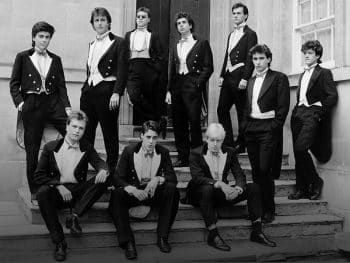
In 2007, as the spin-heavy, scandal-bruised Blair era came to a close, British journalist Peter Oborne published a harsh polemic titled ‘The Triumph of the Political Class’. The book describes the rapid growth of a professionalised cabal of career politicians in the UK from the late 1970s onwards – a self-interested clique more devoted to perpetuating long, lucrative careers than to unselfish public service. Inspired by the work of Gaetano Mosca, an early twentieth-century Italian political theorist, Oborne’s analysis of this problematic development has been repeatedly vindicated as Britain’s confidence in its politicians continues to plummet. Although Oborne dubiously concludes that the solution to the corrosion of British public life is to return to the safety of government by a mythical, highly moral and disinterested elite drawn from the traditional establishment, his identification of the career structure of modern careerist politicians is accurate nonetheless, and provides some insights on recent parallel developments in Ireland. It is worth analysing how Irish politics, always a hyper-local closed-shop, is now prey to the professionalisation of politics, and the associated problems, as Ireland’s political elite in general does little to represent the views of its constituents. Oborne describes, step by step, the well-travelled career budding British politician should follow. First, study at Oxbridge, preferably PPE at Oxford, and immerse yourself in the youth wing of your chosen party. After graduation, become a journalist or a researcher to an MP, then a special advisor, and perhaps briefly a think-tank researcher or corporate lobbyist. All going well, the party leadership will add you to the A-list, parachuting you into a safe seat by the age of thirty. Thence you can start your (hopefully swift) ascent to the cabinet. Politicians who have followed this advice to the letter include David Cameron, George Osborne, the Miliband brothers, Nick Clegg, Boris Johnson, Michael Gove, Ed Balls, Yvette Cooper and Andy Burnham. While Ireland lacks the size and political infrastructure necessary to systematically facilitate such regimented career paths, the blueprint for young politicos here is almost as straightforward. First, join your chosen party at a young age. Ideology is not a major factor in party politics, and so longevity, loyalty and graft matter above all. Next, choose your constituency, move there, and never leave. In fact, ideally you have been born there and only left for three or four years to go to college (where you spent every spare minute with your party’s youth branch, far away from actual political activity on campus). Unlike your British counterparts, you have to foster a strong local connection with your constituency due to proportional multi-seat constituencies, which don’t allow for ‘safe’ seats to be handed to favoured out-of-towners by party elders. To build this stock, run in local elections, early and often if needs be. This is the surest way of building your profile, and of gaining renown within the party and local area. 38 of the 52 TDs elected for the first time in 2016 previously served as county, city or town councillors, illustrating how crucial local experience is in getting to the Dáil. “The Political Class is distinguished from earlier governing elites by a lack of experience of and connection with other ways of life. Members of the Political Class make government their exclusive study. This means they tend not to have significant experience of industry, commerce, or civil society”. Of course, deputies emerging from the ranks of county councils are nothing new. A more recent development in the make-up of Ireland’s political class is an explicit devotion to politics as an independent vocation. An increasing number of TDs have little to no experience outside the political bubble: of the 52 first-timers elected in 2016, one in four is a member of this newly professionalised political class – that is, careerists who have worked almost exclusively as political advisors, parliamentary assistants, appointed senators, and party or union apparatchiks. The Dáil still houses plenty of teachers, barristers, solicitors, pharmacists, accountants and publicans, but an increasing number of TDs have already spent most of their adult life working at Leinster House. While the road to the Irish cabinet is more parish-pump than PPE, and more Fleadh Cheoil than Financial Times, this increasingly common career path is no less damaging to the quality of our political discourse than its British equivalent. A TD who has spent their entire career within the Oireachtas bubble is unlikely to fully represent or empathise with the concerns of most of their constituents. This is especially true since a professional politician’s priority is staying within that bubble, not only as a matter of public service, but also as a matter of survival. Members of the new political class have no career to return to should they fail to be reelected, because politics is their career. While many members of Ireland’s old political elite are solicitors or teachers in name only, at least these professions have some connection, however tenuous, to the “real” world outside politics. The professionalisation of the political class is eroding this concept, further increasing the already yawning gap between the Irish electorate and their representatives. In keeping with this, whereas once the youngest TDs were scions filling an unexpected vacancy in the family seat (think Enda Kenny, Brian Cowen, Máire Geoghegan-Quinn or Mary Coughlan), the Dáil’s freshest faces are now consummate careerists, who display a uniform lack of experience outside of the political realm. Fine Gael’s Noel Rock (elected at 27) worked as a parliamentary assistant in Dublin and Brussels for almost his entire pre-parliamentary career, and first ran in local elections at 21; Sinn Fein’s Donnchadh Ó Laoghaire (27) was a political advisor to his party’s Oireachtas members; and Fianna Fail’s Jack Chambers (25), a county councillor at 23, was once a summer intern at Arthur Cox. These men follow in the footsteps of other recent Babies of the House, like Simon Harris and Lucinda Creighton, both of whom had equally short or non-existent careers outside of politics before winning a seat. This phenomenon
by Mic Moroney
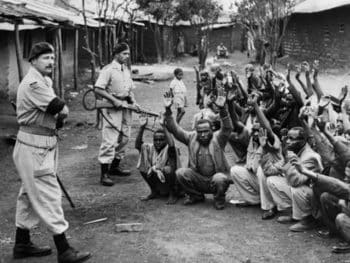
Books by Margaret Urwin, Ann Cadwallader and Ian Cobain illuminate the viciousness of end-of-Empire Britain from Ireland to Kenya

As public hearings at the Public Accounts Committee into the controversial sale of the Project Eagle portfolio of distressed assets in Northern Ireland and Britain come to a close, its members are facing some difficult choices with potentially serious political implications. However, the absence of key individuals who have declined invitations to give evidence, including of former Northern Ireland first minister, Peter Robinson, his former finance minister Sammy Wilson, Ian Coulter of Tughans Solicitors in Belfast, as well as of some unsuccessful bidders for the €4.5bn property portfolio (sold for €1.6bn to Cerberus) will make it extremely problematic to make definitive conclusions on a number of matters. Even more complicating is the absence from hearings of the former member of the Northern Ireland Advisory Committee of NAMA (NIAC), Frank Cushnahan, and of the agency’s former head of asset recovery, Ronnie Hanna, both of whom have cited the ongoing criminal investigations in the UK by the National Crime Agency as reasons for their absence as witnesses. Without this pair, it is arguable that the final report and conclusions can only rely on a great level of speculation as to the real motivation behind the decision by the eventual successful bidders, Cerberus, in paying a £15m success fee to be divided between US law firm Brown Rudnick, Tughans and Cushnahan which of course is the most dramatic and questionable aspect of the entire Project Eagle saga. The PAC inquiry is based on the finding of a report from the Comptroller and Auditor General (CAG), Seamus McCarthy that NAMA could have secured some €220m more from the sale of the mainly NI-based assets, that it applied a greater than expected discount to the buyer and that it failed properly to investigate a series of apparent conflicts of interest involving key figures in the transaction. The committee is restricted to the parameters of the comprehensive and detailed CAG report and to the broad question of whether NAMA delivered the Irish people ‘value for money’ from the purchase. But what has emerged from the public hearings goes much further than this and opens up a truly appalling vista if it emerges in time, following the various investigations in the UK and the US, and by the Bureau of Fraud Investigation in the Republic, that the executives and board of NAMA failed to uncover an attempt by a small number of key insiders, in business and politics, in the North to enrich themselves at the expense of the state agency. This was the thrust of the sensational claims by Mick Wallace TD when he revealed the £15m success-fee arrangement, in the Dáil in July 2015 and in much of the subsequent debate in the House and at the Committee hearings into the controversy while it is also central to the demand by the opposition parties, including a somewhat reluctant Fianna Fáil, for a full-scale Commission of Investigation into the Project Eagle purchase and sale. When and what NAMA knew about the details of this success fee were at the heart of the most recent hearings of the PAC when further questions were put to its chairman Frank Daly and chief executive Brendan McDonagh about this crucial issue that goes to the heart of how the property management agency dealing with billions in distressed assets across Ireland, the UK, the EU and US has dealt with its awesome responsibilities. Under robust questioning by several committee members including Josepha Madigan of Fine Gael, Mary Lou McDonald and David Cullinane of Sinn Féin and independent, Catherine Connolly on 24 November, the NAMA executives were put to the pin of their starched collars to explain how Frank Cushnahan could have been seeking purchasers for the Project Eagle assets as far back as November 2012 without any senior executive of the agency knowing about his activities. Cushnahan met Brown Rudnick along with Ian Coulter to discuss the idea of finding a buyer for the entire NI property portfolio in late 2012. Cushnahan represented six debtors, mainly in Belfast, who made up more than 50% of the entire bundle of distressed commercial property and residential assets and had declared some of these interests under NAMA compliance requirements. It has emerged in recent correspondence from PIMCO, the US fund which was forced to withdraw from the sales process in March 2014 after it revealed to NAMA that Cushnahan was to share in the three way £15m success fee. Pimco has also claimed that it was approached by Brown Rudnick and introduced to Cushnahan in April 2013. PIMCO also asserts that Cushnahan set up a meeting for PIMCO with the NI first minister Peter Robinson and finance minister Sammy Wilson a few weeks later, in May 2013. PIMCO also confirmed in a letter in early November last to the PAC that it was approached by Brown Rudnick in June 2013 about a success fee, one third of which was to go to Cushnahan. PIMCO went on to claim that it sought assurances from Brown Rudnick, whose then partner Tuvi Keinan was leading its effort to secure the Project Eagle portfolio, as to whether NAMA had been informed of, and approved, the involvement of Cushnahan in the planned deal. During all of this time, and until 7 November 2013, Cushnahan was a member of the NIAC which was chaired by Frank Daly and which sometimes held its meetings in the offices of Tughans solicitors in Belfast, where Cushnahan occupied an office. The NAMA executives claim that none of these meetings or requests were raised by PIMCO as it entered into discussions to purchase Project Eagle between September and December 2013. The discussions followed a request by Wilson in a letter to his Dublin counterpart Michael Noonan to consider PIMCO’s request to buy the entire NI portfolio of NAMA in an exclusive deal that would not involve the normal open tendering process. The board of NAMA did not agree to this exclusivity requirement but allowed PIMCO to access the virtual data room which provided details
Posted in:
The new American President is post-science just as he is post-truth. His number one environmental priority is to cancel the Paris Climate Agreement, not uncoincidentally the number one environmental priority for environmentalists.
Posted in:
by Sarah Lennon
The planned closure of the St Mary of the Angels institution in Beaufort, Co Kerry has brought a disconcerting media focus on the issue of de-institutionalisation of people with intellectual disabilities. The families of residents have made their feelings known on how the closure of that institution is being handled. They have launched a Facebook campaign to ‘Save St Mary’s’ and have been prominent in the media coverage. The families weren’t the only prominent voices in the media. Local public representatives in Kerry County Council called for a reversal of a decision to move the residents of St Mary’s to the community. Fine Gael Senator Paul Coghlan demonstrated a disturbing deficits-model of disability in saying “a stop must be put to this… (residents) cannot decide for themselves. To treat them as if they can move on…is not possible.” Even Daniel O’Donnell weighed in, saying he was sorry to hear of the struggle and lauding the care and the atmosphere in the centre. The voices of the men and women who actually live in the institution have been noticeably absent from this debate. Despite media reports, the closure is not a pilot project. It is national policy to close all such institutions by 2018. The infamous Áras Attracta in Swinford, Co. Mayo is another institution that is due to shut. Following the abuse and assaults uncovered by ‘Prime Time’, a report was commissioned from Dr Kevin McCoy called ‘What Matters Most’. This report captures the abusive nature of institutional living for people with intellectual disabilities. It undertook a ‘day in the life’ exercise of residents. It found that while staff members were pleasant and respectful, it was nonetheless a sterile environment, devoid of meaningful activity and absent of choice. Where the residents had capacity for independent living skills, this was not reflected in planning goals. It concluded that residents of “Áras Attacta have little opportunity to realise their potential to live the rich and satisfying lives that they have a right to aspire to”. Áras Attracta is far from an isolated case. Countless Health Information and Quality Authority reports show that many residents are at risk and that for many, life is demeaning and unfulfilling. An Inclusion Ireland report on the first 50 HIQA inspections found “a picture of extensive non-compliance with regulations in areas such as health and safety, independent advocacy, restrictive practices and correct checking of medicines”. Minister Finian McGrath said in a disappointing response to a recent parliamentary question that he totally accepted that “not all people residing at St. Mary of the Angels in Beaufort will be suitable for transitioning to community living”. Such a statement represents a worrying step backwards from Government policy and contradicts all evidence. Community-based models have been shown to increase personal growth, decrease challenging behaviour, and increase community participation and engagement in meaningful activity. People who are supported to live in the community do better in family contact, social networks and friendships, self-determination and choice, quality of life, adaptive behaviour, and above all else satisfaction. Ireland is not unique in closing these institutions. Across the world there is an acceptance that institutionalisation does not work. The experience in the USA has, in particular, demonstrated that everyone can live in the community and there are no exceptions to this. In fact those with the most complex needs are found to make the most gains from supported, community living. That is why the statement of Minister McGrath is so mistaken. The process of de-institutionalisation is undoubtedly challenging. Supporting the move of individuals, who have sometimes lived for 40 or more years in an institution, requires careful planning. A commitment of resources and support must be made. Independent advocacy is needed now more than ever to ensure that the voice, the will and preference of the men and women who live in such institutions is articulated and respected. Families are concerned that a move to community living will mean a reduction in support and that the de-institutionalisation process is a way of cutting costs. These fears are understandable. Political leadership is required to give reassurance and effective communication to unpick these fears. The Taoiseach admitted in the Dáil that “communication could and should have been better” in the case of St. Mary’s. The ‘Programme for a Partnership Government’ set a modest target of moving one third of the 2,725 people in these so-called congregated settings by 2021. This is not a time to roll back on this promise but a time to deliver. Even if met and sustained, that rate of de-institutionalisation will mean that we will miss the original target date by 13 years. For some people this will mean that they die in these institutions. Sarah Lennon is Training and Development Officer with Inclusion Ireland
The enforcement of Privacy and Data Protection Law is meagre in Ireland compared to the rest of the EU. This is exciting for practitioners but can be distressing for members of the public; one day it could even be for you! In the case of Max Schrems, now landmark law, an Austrian complainant notified the Office of the Data Commissioner three years ago of alleged violations of privacy law by Facebook but his complaint was originally determined “frivolous and vexatious” by the data commissioner which apparently considered its “hands were tied”. Schrems accused the US social network of breaking European privacy law because, when it transfers its European users’ data to servers in the US, it cannot guarantee that the information isn’t scrutinised by US intelligence. Facebook denied the Schrems allegations but, in a landmark case last year, the EU’s Court of Justice (ECJ) sided with the Austrian and shut down Safe Harbour, the major data-transmission agreement developed by the European Commission in 2000 which essentially promised to protect EU citizens’ data if transferred by American companies to the US, on the basis the agreement made a fool of European citizens’ fundamental right to privacy. But the case didn’t end there because data transfers to the US have not stopped. Facebook – and other companies operating on both sides of the Atlantic – have other legal means to transfer data to the US. Schrems complained again. This time around the Irish Data Protection Commissioner took the view that Schrems had raised “well-founded” objections, but that it needed further guidance from the ECJ to determine the complaint. The case is scheduled to be heard by the Irish High Court for two to three weeks in February 2017. Schrems is a competent Austrian lawyer, author and privacy activist confident enough to challenge disregard for privacy law. All this definitively suggests that even for practitioners data protection is fraught and our authorities make mistakes. However, increasingly ordinary people, non-practitioners nevertheless leading complex lives, are finding it appropriate to make data access requests to businesses, banks and financial services providers to help explain how they are being treated as part of complex operations by far-flung organisations. The experience of the ordinary person, as a recent case shows, can be burdensome and frightening. If privacy is important enough for each EU member state to fund a dedicated agency of data protection, to manage and enforce data and privacy law, why is privacy not being taken seriously by businesses? Data Protection law has been around for a long time and while there was a time for indulgence and forbearance allowing businesses to grow to compliancy, those days should be well behind us. Gerardine Scanlan from Mallow ran into minor financial difficulties and a bank foreclosed on a rental property. A partner in Grant Thornton Accountants was appointed receiver over some of her assets in 2013. Data – contained in a CD – was sent to her in September 2015, in response to her legitimate request for the data concerning her that was being held by Grant Thornton. The CD contained personal data relating to Scanlan but also a vast amount of personal and confidential data relating to third parties, and confidential proprietary matter belonging to Grant Thornton, some of which Scanlan alleges discloses wrongdoing both as to her own receivership and receivership practice in general. It included details of appointment of receivers for a large number of properties of other borrowers not connected to her. Scanlan wrote to the accountancy firm claiming she was concerned to find the extra items of information, among the documents provided to her. She said she was unsure what to do with such documents and wanted advice from the firm. Grant Thornton was unaware of the data breach until it received Scanlan’s letter. In the end Grant Thornton through its solicitors, the ever assertive McCann FitzGerald, brought legal proceedings because it claimed Scanlan repeatedly refused to confirm she would return the information, delete or destroy any copies held by her or guarantee not to provide it to anyone else. It was clear she had already furnished some of the data to confidants and informal advisors though not, as was damagingly claimed, to social media. Scanlan, who was impecunious and therefore had to defend herself without lawyers was given very little time to make her way to the Four Courts in Dublin where she received an unsympathetic hearing from Judge Paul Gilligan who made it clear she should ‘just return’ the material. Scanlan felt appalled that she was being cast as a wrongdoer, that there was no guarantee the third parties would be told by Grant Thornton that their privacy and information had been compromised, that she was being oppressed by having to move so quickly under pressure, that she’d been improperly served with legal documentation, that the name of the branch of Grant Thornton used for purposes of the case was that of the wrong branch and that it was unclear how much of the information furnished to her was rightfully hers and should not therefore have needed to be ‘returned’. She was appalled to see her improvised legal efforts, including a few allegations of dishonesty against Grant Thornton that were implausible, derided by expensive and aggressive lawyers. She was enraged to have been deemed by Grant Thornton and its lawyers to be a “data controller” (for example in paragraph 14 (iv) of their High Court Statement of Claim of 23 February 2016). Above all she was incandescent that a prominent firm of solicitors annotated a Court Order with threats of imprisonment. A data controller is the individual or the legal person who controls and is responsible for the keeping and use of personal information on computer or in structured manual files. They have a legal ‘duty of care’ and are legally obliged to be formally registered with the Office of the Data Protection Commissioner, on a public register. According to the legislation, described by the data protection commissioner: “Being
The Construction Industry have said for years that “increasing supply (housing) will reduce prices”. The government have accepted this as fact and current policy is driven by it. The graph below is compiled from Central Statistics Office (CSO ) data for 1975-2015 and includes monthly new home completions and monthly average new house prices in that 40-year period. The information has been directly imported from the CSO website and has not been weighted or adjusted. House prices are for new homes only and 1975 is the reference starting point for both curves. It calls into question that the perceived wisdom of current government policy. The relationship of price to supply appears inelastic; in other words, increasing supply does not reduce cost and in fact the opposite appears to happen (similar to luxury goods). 40 years of CSO data suggests that increasing house prices leads to increasing completions (lead and lag noted). To an architect or builder this makes sense as developments are sales-sensitive and will only proceed if there is enough of a margin to get developers up in the morning. Similarly, phases are delayed if there is any drop in prices. The incorrect assumption, that increasing supply will reduce prices, underpins Government policy aimed at the speculative residential sector: inappropriate pro-cyclical measures (First Time Buyers grant), the reduced apartment-size standards introduced in 2015, the elimination of the local authority role in adjudicating planning applications for over 100 housing units etc. These initiatives are like a landowner’s wish list and disproportionately enhance site values, minimise public input and erode our two-tier planning system. This casts doubt over the competence of Department of Housing officials who advise the Minister and explains the disproportionate influence of vested interests on policy. The net result of current government measures will be to inflate asset prices and consequently increase supply (mid and high end)- not necessarily a bad thing. However, in the absence of any balancing measures aimed at lower-income households, affordability will remain a major problem. Longer commutes to affordable areas outside the capital may become the norm with infrastructural pressures and issues of sustainability as a result. This is happening in the rental sector already. Notable measures that have not been considered for affordable housing include government interventions such as: co-housing, state direct procurement, state financed home-ownership etc. Cost-benefit analyses of such measures are sorely absent from the discourse. Correlation does not mean causation. There are other drivers of demand not shown such as net migration, obsolescence, household formation, interest rates etc. However the graph illustrates that an increase in house supply has not been accompanied by a reduction in prices in 40 years. Unfortunately recent policies conduce to the boom-bust cycle we are supposed to abhor. Maoilíosa Reynolds is a Registered Architect and Certified Passive House Designer.
Posted in:
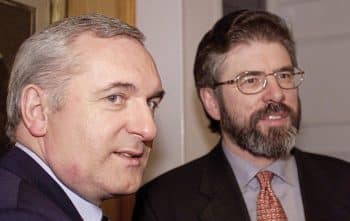
Bertie Ahern made a sensible and probably decisive intervention in the controversy surrounding Gerry Adams and the killing of senior prison officer, Brian Stack, which dominated the headlines and political discourse during the first week of December. The resurrection of a story involving the shooting of Stack as he left a boxing match in Dublin’s National Stadium in 1983 was prompted by the leak of an email sent by Adams to the Garda Commissioner, NóirIn O Sullivan, during the final days of the general election earlier this year. The email included the names of four people, including Sinn Féin TDs Martin Ferris and Dessie Ellis, said to have possibly useful information pertaining to the death of Stack eighteen months after the attack. The names, according to Adams, were given to him by Brian’s son, Austin Stack, during his encounters in 2013 with the Sinn Féin leader which culminated in a trip in a van with blacked-out windows to a rendezvous with a senior IRA figure in a house north of the border in August of that year. During the meeting Stack and his brother, Oliver, were given a written statement confirming that members of the IRA had carried out the “unauthorised action” and that one person had been “disciplined” for his role in the attack. The Stack family said that they were satisfied that the meeting had led to some closure in their 30-year-long quest for the truth about their father’s murder. That was until the general election campaign when Austin Stack said that two senior Sinn Féin politicians were among those involved in his father’s killing. He had provided the information to Fianna Fáil leader, Micheál Martin, who did not waste the opportunity to damage Sinn Féin and its leader during the latter stages of the campaign. This prompted Adams to write the email to the Garda Commissioner with the names he claims had been given to him by Austin Stack during their discussions between 2011 and 2013. He did not describe them as suspects and discussed the fact that he was sending on the names with three of those named before posting the email. The fourth was not contactable, he said. Stack has denied providing the names to Adams which in turn raises the bizarre spectacle of a party leader hanging two prominent allies out to dry for no logical reason. After Adams made a statement in the Dáil on Wednesday 7 December, Fine Gael TD, Alan Farrell used a point of order request to name Ferris and Ellis based on a copy of the email provided to him by sources whom he did not disclose. He claimed, somewhat puzzlingly and after being accused of breaching Dáil privilege, that he only revealed the names in order to allow his parliamentary colleagues the option of clearing their names of any association with the Stack killing. Ferris and Ellis were quickly on their feet to do just that and denied any involvement while the Kerry TD confirmed that he had been questioned by gardai in 2013, presumably on the back of the information Garda sources discussed with Stack, and had nothing to answer for. As the story moved along, a full Claire Byrne RTE radio show on a Saturday was devoted to the controversy with Independent Newspapers reporter, Niall O’Connor, robustly denying that he had fed the leaked emailed information to Farrell. Instead he focused, as many others hostile to Sinn Féin have done, on getting Adams to name the driver of the van in which the Stacks were transported and the IRA man they had met. On the same programme Sinn Féin TD, Peadar Tóibín, warned that the manner in which the issue had been politicised by some politicians and media outlets would make it more difficult for other victims of the conflict in the North to get information concerning their deceased loved ones from Republican ‘combatants’ using Sinn Féin mediators like Adams. He also noted that he had sought meetings with Taoiseach, Enda Kenny, on behalf of constituents whose family were killed in County Armagh during the 1970s by the notorious Glennane gang which is now known to have included and been directed by agents of the British army and other state security forces. He pointed out that neither Fine Gael nor Fianna Fáil have been exercised over the search for closure by many victims of British state and loyalist forces during the conflict and had done little or nothing to pursue the information-retrieval and truth process negotiated in the Stormont House and Fresh Start agreements signed up to by both last year. As Ahern pointed out, it is understandable why Adams could not go any further than the assistance he gave the Stack family, and many others over the years, and claimed that he had proposed a peace and truth commission “16 or 17 years ago” but that “the kite fell flat”. Like the constituency motion by his friends in Dublin North Central to bring him back into the party fold (without his knowledge of course), Ahern’s recent attempts to rehabilitate himself is as welcome as Christmas is to turkeys for Micheál Martin, who immediately threw a bucket of cold water on the proposal. Ahern did himself no favours when he told a Sindo reporter whom he just happened to encounter in the Skylon hotel that he still refuses to accept the findings of the Mahon report, which led to his leaving the party in 2012. He intimated that friends of his, including so called ‘dig out’ merchants Des Richardson who was with him in the hotel, and publican Charlie Chawke had since been vindicated with findings against them removed from the tribunal’s record. In fact, a finding against Richardson was removed after the tribunal conceded that he had not been given the opportunity to rebut details of a questionable transaction made through a bank account under his control in the late 1990s, while Chawke also successfully challenged the tribunal on a different matter. The High
by Paul Verdeau
The 2017 presidential election is a boring soap opera where the only excitement is the danger of the result.
Posted in:
by Village
Barrister Michael Cush has been appearing for Denis O’Brien in some of his exhausting judicial travails. The last two letters of the senior counsel’s name suggest posh, plush, an advocate who cushions, shushingly. The first two letters suggest something altogether less generous…
Posted in:
by Anton McCabe
December 2016 issue. Six months have been a long time in politics for Northern First Minister Arlene Foster, as storm clouds have gathered round her ascetic political persona. In May she consolidated the DUP vote and seat numbers in the Assembly elections. She seemed master of the political scene, just like newly-minted British Conservative leader, Teresa May. Like May, she is now facing multiple problems. She inherited NAMA in the North One from Peter Robinson’s time as First Minister. No criminality has been proved. However, NAMA’s Northern portfolio was sold for less than a third of its value: and a Northern politician, still un-named though implications are heavy, was due to benefit from at least part of a £Stg7m payment. Several of those involved have strong DUP connections. Foster has fumbled the inherited issue of UDA commander Dee Stitt. Stitt is Chief Executive of Charter NI, a community organisation based in East Belfast, which is overseeing a £1.7m social Investment Fund. In Northern Ireland one can just about get away with being a senior UDA member and convicted armed robber, and chairing bodies that get large sums of money from government. There is a certain feeling in the Protestant community that community projects linked to mainstream Republicans have received funding so projects from ‘their’ community should also be funded. However, he behaves as a clownish caricature of a paramilitary, for example describing the North Down Defenders flute band as “our homeland security”. Police have added to the pressure, by saying that UDA members involved in Charter have also recently been involved in paramilitary activity. In October, Foster told the Belfast Newsletter: “I do welcome the fact that he (Stitt) is stepping down”. However, Stitt failed to stand down. More recently she said it was not for her to advise the organisation on employment issues. At time of writing, it is clear Stitt’s position is untenable. The Renewable Heat Incentive scheme cost the Northern Executive at least £400m and was instigated when Foster was Minister for Enterprise and Investment. In 2012 she launched the scheme, offering grant aid to shift Northern businesses away from using oil for heating and towards renewable energy in the form of wood pellets. There was no ceiling to the level of grant to be paid. Thus, businesses found they could profit by permanently heating empty buildings. The civil servants involved wrongly believed the UK Treasury would cover the costs: in reality these were to come from the North’s Block Grant. BBC Northern Ireland’s ‘Spotlight’ programme has revealed that a whistleblower approached Foster in 2013, explaining how businesses were profiting by wasting energy. She was referred on to the civil servants involved. It took almost three years for the scheme to be wound up. It was monumental incompetence, with there being no suggestion of fraud but a general air of embarrassment about the lack of seriousness of purpose in the North towards the environment. There is another potential problem. At time of writing, it is unclear how serious Deputy First Minister Martin McGuinness’ illness is. Through all storms, McGuinness has been a sturdy mudguard for first Robinson, then Foster. While Sinn Féin has criticised, it has been in deftly measured tones, falling far short of collapsing the institutions, or seeking heads, though this magazine has noted that Adams telegraphed to Robinson that if he collapsed the executive Sinn Féin would look for his head over the NAMA dodginess. There is now significant disquiet in the Nationalist community. Many feel the DUP is being allowed to call the shots in the Executive. There is also a widespread feeling that, except for the important absence of political violence, there has not been a peace dividend for working-class areas. Instead, there have been cuts to public-sector jobs and services. This was significantly reflected the topping of the poll by Gerry Carroll of People Before Profit in Sinn Féin’s West Belfast heartland in the Assembly election. McGuinness has an authority among the Republican base, and also among the wider Nationalist electorate. He has been able to gain at least tolerance for measures once thought unpalatable. Clearly, Sinn Féin is planning its transition. However, all of the mooted future leaders – the Northerners John O’Dowd and Conor Murphy, the Southerners Pearse Doherty and the ascendant Mary Lou McDonald – will find holding the line among their own supporters much more difficult, at best: and particularly difficult if health issues force an unexpected transition in the North. By Anton McCabe