Frank Connolly

  • Posted in:

    Namaleaks

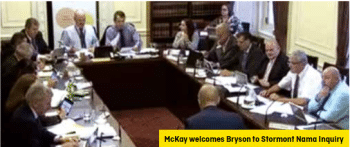
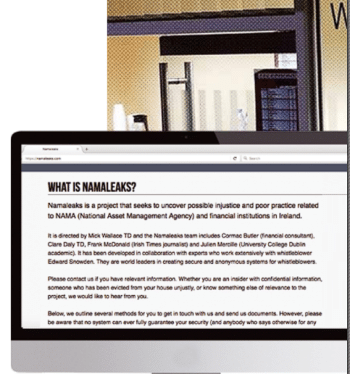
    The NAMA story is the media gift that keeps on giving. Not a day passes but further damaging revelations emerge of the manner in which the agency charged with selling off the distressed and other assets arising from the State’s property collapse has behaved. Charged with disposing of commercial and residential properties on an enormous scale across Ireland, the UK, Europe and the US, NAMA and its executives have regularly encountered media criticism, court actions and political challenges. The latest such challenge comes from the Namaleaks project sponsored by TDs Mick Wallace and Clare Daly. People who consider themselves victims of NAMA can post their experiences online and anonymously on this website. Launching it in mid-August, Wallace claimed that Namaleaks.com is a secure and anonymous whistleblowing platform if used in a careful and discreet fashion. He advised that users should: “Take your personal computer and go to a network that isn’t associated with you or your employer, such as at a coffee shop. Ideally you should go to one that you don’t already frequent. Leave your phone at home, and buy your coffee with cash. Choose a coffee shop without security cameras, or a spot within the shop where cameras aren’t recording. Be aware of your surroundings, turn your screen away from curious neighbours”. Speaking to Village Wallace added that: “We have received some really interesting correspondence but obviously we require hard evidence and we are very measured as to how we approach it”. According to Wallace, it is too early to say how much information will be processed through the site but already signs are that people, including former property developers and professionals as well as many who have lost their homes and businesses as a result of the crisis, are prepared to share their stories. He claims to have up to forty separate sources of information concerning NAMA and its operations and recently took exception to an effort by one hostile newspaper to the suggestion that he is being used by one or two disgruntled but powerful developers to undermine the work of the agency. Given the scale of transfers going on in Ireland’s distressed property market where a small number of wealthy and powerful vulture funds are acquiring substantial commercial and residential portfolios through NAMA or from receivers, at huge discounts, it is certainly inevitable that there will be sore losers. With the news that many of these funds have been availing of the controversial Section 110 tax status to greatly minimise their taxes on vast property transactions, the questions over the manner in which the State has allowed unprecedented transfers of Irish wealth to global funds are likely to intensify. US fund Cerberus paid just a paltry €2,500 in taxes from its €1.6bn purchase of Project Eagle, NAMA’s Northern Ireland loan book, a deal that is mired in controversy and inquiries on both sides of the border, in Britain and in the US, as reported extensively in Village. It was Mick Wallace who first revealed in July 2015 that a number of people, including a senior politician or party was to receive monies from the sale of Project Eagle to Cerberus. It has since emerged that a member of the Northern Ireland Advisory Board of NAMA, Frank Cushnahan, was to receive a €5m fee payment from the deal, while solicitor John Coulter was involved in routing funds from the purchaser to an offshore account. Although denied by NAMA the controversy implicated others at executive level in the agency including its former head of asset management, Ronnie Hanna, who resigned from his post in late 2014 just six months after the sale to Cerberus was agreed. Competing bidders claimed that Cushnahan and Hanna were involved in meetings with them in advance of the bidding process, while Hanna worked in an executive role with NAMA. Both men and Coulter have been questioned by the PSNI in connection with the Project Eagle purchase. Peter Robinson was the most prominent political casualty of the affair and announced his resignation as First Minister and DUP party leader in November last year, although he insisted that he had done nothing wrong in relation to Project Eagle. This followed the appearance at the Stormont finance committee of loyalist flags protester and blogger, Jamie Bryson, who said that Robinson was to receive monies from the transaction. Bryson’s appearance at the finance committee in September 2015 is now the subject of fresh controversy after it emerged that he was coached in advance by its then chairman, Sinn Féin MLA, Daithi McKay. Bryson texted McKay and his SF colleague Thomas O’Hara in advance of his appearance at committee during September 2015 and received advice on how best to get Robinson’s name into the proceedings without being blocked on procedural grounds. Bryson was widely blamed for leaking the damaging texts but vigorously denied doing so. A member of the Stormont finance committee, Jim Wells, told Village that Bryson leaked his own texts because he was annoyed that a loyalist parade near his home in Rasharkin, county Antrim was recently stopped by the Parades Commission and local nationalists. Again, Bryson disputes this. However, Village has learned that Bryson is almost certainly the source of the leak to the media which brought down McKay. In the wake of the leaked texts, McKay, stood down as a Sinn Féin MLA. O’Hara also resigned his Sinn Féin positions. Following McKay’s resignation 18 members of the party in North Antrim did likewise in a rare moment of collective disunity and internal dissension for Sinn Féin in the North. Among the claims being made by Monica Digney, a former SF member of Ballymena District Council, is that McKay would not have acted without clearance from others further up the party hierarchy but again this is denied. In this regard the other parties at Stormont have come looking unsuccessfully for the head of Sinn Féin finance minister and former finance committee member, Máirtin O’Muilleoir, who was mentioned in the leaked texts but it

    Loading

    Read more

  • Posted in:

    26% me arse thanks, Apple

    Irish politics insincerely enmires itself in the need for joined-up thinking, that ubiquitous cliché. But it skirts around the best place for it: amalgamating our erratic but once again soaring economic genius with other more real agendas – making sure we pursue ends and not just means, that we advance social, environmental, cultural and transparency agendas. Quality of Life. Not just GDP, which measures, according to Bobby Kennedy, “everything except that which makes life worthwhile”. Once in a while we get an insight into where our politicians stand on the economy and society. For example, Enda Kenny’s principal vision is to make Ireland the best little country in the world in which to do business. That’s shocking dereliction for a country’s chief visionmaker. The only “absolute red line” issue in 2010 for the Minister for Finance, Brian Lenihan, in international talks about Ireland’s banking bailout was retaining Ireland’s Corporation Tax Rate of 12.5%. Then-Tánaiste Mary Coughlan confirmed it was “non-negotiable”. Similarly tax credits for research and Ireland’s 12.5 per cent corporation tax rate, were among the “red line issues” for Ireland outlined by the Minister for Finance Michael Noonan to an EU committee on taxation that visited Dublin last year after the LuxLeaks tax-avoidance scandal. It is clear that petty red lines flow in the blood of most of our inestimably unimaginative leaders. Not once has a government minister asserted that social-welfare rates, income inequality, Traveller welfare or quality-of-life indicators were any sort of red-line factor. It’s always wheedling businesses and its horrible corporation-tax rates. Sometimes we see deference to corporations and multinationals in a broader vista. There was Michael Noonan’s ludicrous slurpings over a bovine Donald Trump on a red carpet at Shannon on the promise of some golf dollars to the peasants in Doonbeg. There’s the silence on Shannon rendition flights since ethical objections to the warfare and kidnappings effected by transient US troops using the airport as a base risk attracting a spoonful of disapproval from our friends in the headquarters of capitalism. There is our longstanding deference to international pharma and the inflationary effect this has on Irish medical costs, because many of its purveyors have their EU headquarters in Ireland. But the most Orwellian moment in the history of tax and the relationship between corporations and governments everywhere came at the end of August, courtesy of the EU Commission’s ruling on Apple’s tax liabilities to Ireland. It was pure Myles na Gopaleen. The EU Commission of course dramatically ruled against Apple, whose EU headquarters employing 6000 people is Cork. Apple paid an effective rate of tax on its earnings in 2014 of 0.005% (not much). It has pulled off the scam by filching profits into a special ‘stateless company’ with its headquarters in Ireland. Apple paid the standard 12.5pc corporate tax on its Irish earnings – indeed it is our biggest taxpayer – but it contrived simply not to earn much in Ireland. “The profits did not have any factual or economic justification. The “head office” had no employees, no premises and no real activities,” said Margrethe Vestager, the EU spoilsport competition chief. Paul Ryan, speaker of the US House of Representatives – admittedly not the smartest guide, claimed: “This is precisely the kind of unpredictable and heavyhanded taxation that kills jobs and opportunity”. Moving sharply to contradict himself he then pontificated: “Above all, this is yet another reason why we need to fix our tax code. We need more American companies to invest their money and create jobs right here in the United States. Today’s decision should be a spur to action”. Perhaps indeed it should. But you’d think even Paul Ryan would know that the action should be for people, not for corporations. The mishmash of national rules and bilateral treaties that determine how much tax companies owe, and to whom, is egregiously dated. It was designed for the manufacturing age. Business today is increasingly digital, services-based and driven by intangible assets, including rights to exploit intellectual property, from patents to logos. These are easier than physical assets to shift from subsidiaries in high-tax countries to those in low-tax ones. Hence the relentless rise of tax planning as a fundament of multinationals’ greedball business plans. The OECD conservatively reckons that the resulting revenue losses to national exchequers have grown to as much as $240 billion a year, or 10% of global corporate income tax. The ethics of this are revolting. The growth of the likes of Apple, the world’s biggest company by capitalisation, is at the expense of ordinary people whose countries forego the benefits of equitably taxing them. The US’s 500 largest firms hold more than $2tr in profits offshore. Its tax laws encourage this, because – to facilitate American corporate colonialism – profits its companies make abroad are taxable in America only when repatriated. Unless Donald Trump comes to town. Anyway the Commission wants Apple – with perhaps (many) others to follow – to reimburse Ireland for unpaid taxes of €13bn, plus interest that might amount to another €6bn. That’s €2,600-€4,000 per head of population: far more to the poor if equitably distributed. This could change the country, beleaguered after nearly a decade of austerity. It could take a chunk off the national debt, which now stands at €200 billion. It could pay a few years of the Universal Social Charge (USC) which brings in around €4bn a year annually. It could put a rocket under the school building programme between 2016 and 2021 currently limited to capital of €2.8bn, intended to deliver 310 major extension/refurbishment projects and 14 new schools. More enticingly still €13bn is the exact figure budgeted for our health system this year. Or it could pay more than twice over for the Government’s Action Plan on Housing which commits €5.5bn for building social housing and infrastructure between now and 2021. The government claims €5.5bn would fund 47,000 social houses and help to end long-term homelessness. So why do we hear so much about the need to

    Loading

    Read more

  • Posted in:

    The vanishing Devane

    Andrew ‘Andy’ Devane may not be familiar to you. However the buildings, mostly ergonomic and beautiful democratic public buildings in concrete, always imbued with his generosity and modern perfectionism, certainly will be. Early Years Andy Devane was born on 3 November 1917 in 1 Upper Hartstonge Street, in Georgian Limerick. He was the eldest of four sons, the rest of whom studied medicine like their father John Devane who maintained his practice in respectable 3 Pery Square nearby and was also a consultant on St John’s and Barrington’s Hospitals. Dr Devane was personal physician to various Limerick bishops and to the Mary Immaculate college from 1915 until his retirement in the 1950s, connections which undoubtedly helped his son’s architectural career. As befitted the son of a doctor young Andy attended Clongowes Wood before choosing to study architecture in UCD. After graduating in 1941 with a degree that was mediocre down, apparently, to “intemperance and arrogance” after he had soared high in his early years in the College, Devane turned to town planning and became an associate of the professional institute, the Town Planning Authority. In 1945 he was among a group of young architects who joined the practice of Robinson and Keefe (RKD), injecting worldly and modern ideas, and dynamism. Established in 1913, the practice had initially received commissions for housing and small commercial projects quickly winning high-profile projects such as the structures for the Eucharistic Congress 1932, the Gas Company building on Dublin’s D’Olier St and Independent House on Abbey St. But for a man of his verve the Modern School was beckoning with new paradigms. Cheeky Letter Exactly 70 years ago a mischievous Devane wrote to Frank Lloyd Wright, the genius behind the Guggenheim Museum in New York and Fallingwater, citing the low public opinion of the works of Le Corbusier and the Bauhaus, ending with the provocation: “I cannot make up my mind whether you are in truth a great architect or just another phoney”. Perhaps not knowing that he had sent a similar letter to both Mies Van der Rohe and Corbusier, Wright generously responded,“Come along and see”. He did: when offered a partnership at RKD in 1946 he deferred, to take up the Taliesin Fellowship at Frank Lloyd Wright’s studio in Scottsdale, Arizona. This decision would change his life. Devane was one of the first to cross the Atlantic to study under the great architects of the time but others followed. These included Kevin Roche, who later designed the Ford Foundation building in New York and Dublin’s anodyne Convention Centre; Robin Walker, who became a partner in Scott, Tallon and Walker and who sought the tutelage of Mies van der Rohe; and Shane de Blacam who designed the Beckett Theatre in Trinity College Dublin and who worked under Louis Kahn. American Schooling Devane diarised his first thoughts on America and Wright: “My first sighting-impression of Taliesin West sums it all up. I have never forgotten it. After four days of continuous travel (Shannon, Labrador – blizzard in both places- Boston, New York- all in TWA Constellation) – change of places in New York to DC3s, hopping across the apparently endless vastness of America- and ending up (with no bags and a last few dollars) walking into the desert from Scottsdale, hot (so hot), exhausted, confused, convinced I had made a huge mistake in my quest I was picked up in a supply truck driven by FLW’s daughter-in-law, Svetlana, on her way to Taliesin. I will never forget those first glimpses of canvas, Redwood and stone in its desert setting of cacti and mountains – and then walking into a dream- a reality of form and material such as I had never known before – and meeting ‘the man’ himself – so different – so familiar. I was home!!!”. A year after Devane returned to Ireland, another young Irish architect, Jack O’Hare, made his way to do his apprenticeship under Wright, inspired by Devane’s journey. In a public interview in 2011, O’Hare described the large open drawing-room where each student would sit hand-copying the master’s drawings. Devane kept a sample of the exquisite blueprints he copied for ‘Oboler House’, commissioned by the film director Arch Oboler and his wife Eleanor who set out to create an estate called ‘Eaglefeather’ in the Santa Monica Mountains above Malibu. Return to Ireland Devane returned to Ireland in 1948, enthusiastic about taking Wright’s ‘Usonian’ [his word for US-derived] style of architecture, seeing it as a template for post-war Ireland and eager to set himself apart from the UK models. Prosaically he mourned that, “On my return my first ‘major’ (to me) project was a mortuary chapel tacked on to the RC Church in Naas”. Educational Buildings More technicolor work soon followed: St Mary’s Girls’ National School, King’s Island, Limerick which began in 1949 and was completed in 1951. There is a striking similarity between the drawing room of Taliesin West and the auditorium of St Mary’s with its exterior ‘knuckles’ and sloped roof. This was the first of many Devane national schools in the working-class areas of Limerick city. As a true disciple of Wright he wanted to showcase concrete as the perfect building material. Devane’s mantra was: “Basic building at basic cost with real community benefit”. But I would disagree – these were not ‘basic’ buildings. With economical materials he was able to create buildings for Limerick’s poor that would make their equivalents in grander areas look dull and outdated. Wide cantilevered concrete canopies tested the limits of contemporary engineering. The clever insertion of clerestory windows, sloping ceilings, primary colours and terrazzo flooring created warm, bright rooms to ignite the children’s imaginations. His attention to detail easily extended to the playground, with tactile concrete blocks giving texture to fun shelters for children’s play in bad weather. Among his ventures in Dublin were Inchicore Technical College, Emmet Road, (1952-54) and Mary Immaculate College Dormitory Building (1955-57) both Wrightian. For Gonzaga College (1955, with Chapel later 1966-67, a rare private-school

    Loading

    Read more

  • Posted in:

    Laws of unintended coherence

    What an irony it would be, in these times of the exponentially reducing quality of public debate arising from media degeneracy, parliamentary groupthink, the tyrannical imperatives of political correctness, the moronic cacophony of the twitterati and the impoverishment of the education system, if the only functional dialectic available to our society was to occur between men and women dressed in wigs and gowns, a slo-mo exchange dragged out over years and decades, a sombre exchange of opinions and subtleties in which the most vital matters affecting our society and its future were teased out in ponderous and archaic language and encountered only at the edges of civic freedom, in the hushed and terror-inducing rooms of our legal system. The more imminent it appears, the more it seems like, to coin a phrase, an appalling vista. And yet, from time to time, a judgment emerges which, in its eloquence and reason, gives us cause for hope that, when that dreaded eventuality hits, all may not be lost. Such a feeling came over me reading the judgment of Mr Justice Richard Humphreys in the much-publicised recent case of I.R.M. and ors -v- Minister for Justice and Equality and ors. The case became a media talking-point in the month or so since its publication because of the ways in which it touched on the meaning and scope of Article 40:3:3, aka the Eighth Amendment, but, insightful and humane as were its treatment of the unborn child, it is actually more far-reaching than that. The case illustrates in a quite dramatic manner the way in which constitutional provisions and amendments can interact with legal judgments old and new to bring about quite unexpected and unintended consequences, a syndrome which I and other warned about during the referendum debates in the ‘Children Amendment’ of 2012, and the ‘Marriage Equality’ referendum of last year. One of the symptoms of our reduced public debate is that any attempt to raise the potential complexity and unpredictability of legal instruments is dismissed by media gatekeepers as either vexatiousness or intellectual conceit. Humphreys J’s judgment, however, makes for a textbook instance of the propensity for legal instruments to bleed into one another, shifting, double-shuffling and doubling back on themselves to arrive at entirely unimagined destinations. In general, this tendency leads to baleful outcomes; here, in my view anyway, it shows signs of tending in the opposite direction – extending hope to some of the most marginalised and disparaged categories of humanity now subsisting in the unfriendly territory of the former isle of Saints and Scholars. The case, somewhat incongruously, arose from a rather wearyingly typical speculative tilt at the asylum process. The case was taken by a Nigerian man, ‘I.R.M.’, his female Irish ‘partner’, Sarah Jane Rogers, and their child S.O.M., who was born in Ireland last year. I.R.M. came to Ireland as an asylum-seeker in 2007. He had been through the asylum process and ultimately been refused. His deportation was first ordered in 2008 but he managed to remain, and, as well as working illegally here, in 2009 married a Czech national, a union which broke up within a few months, although the couple did not divorce. In 2010, the man pursued an application to remain here based on his marriage to an EU citizen. This application failed. In September 2014 he became involved with a Cameroonian woman, who gave birth to his child on July 10th 2015. This woman was subsequently awarded Irish citizenship. The man was engaged in a concurrent relationship with the Irishwoman Sarah Jane Rogers, with whom he had another child, born a month after the first, on August 21st 2015. On April 28th 2015, while both women were in an advanced stage of pregnancy, the Children Amendment, which had been delayed by a court challenges, was finally enacted, becoming Article 42A of the Constitution. On May 21st 2015, a day before the passing of the Marriage Equality referendum, the man applied for the revocation of the deportation order against him, citing his imminent parentage of an Irish citizen.Following the birth of the child, S.O.M, to Sarah Jane Rogers, he applied for residency based on parentage of an Irish citizen. The case, as Humphreys J noted, had “a complex and somewhat unusual procedural history”, mainly to do with whether or not various applications made by the parties ought to be telescoped rather than dealt with separately, and also questions relating to the amending of the Nigerian applicant’s statement and his wish to remain anonymous. The judge ruled that both the man and the child should remain anonymous, but said that no legal basis of granting anonymity to the child’s mother had been pressed on him. The substantive issues arising in the case related essentially to the lawfulness of deporting the man in view of his – at the time of the original application – prospective parentage of an Irish-born child, and whether the proper process of deliberating on such an application ought to consider the rights of the child under article 40:3:3 as being confined to the right to life or whether these rights might be more extensive, and whether, arising from this and other instruments, the family rights to be considered might be more extensive also. There was also a question relating to whether, in view of the instant proceedings, the man should be given due notice of the precise date of an intention to deport him. Since I’m concerned here with issues that arose in the context of child and parental rights, under the Constitution and otherwise, I propose to glide over the asylum-related details of the case. The family-related aspects essentially revolved around the circumstance of the unmarried father, with otherwise no rights to remain in Ireland, seeking to avail of his fatherhood of an Irish-born child in order to remain here. The case arises at an interesting moment in the mutation of the Irish constitutional family, in the wake of a series of radical and highly ideological attempts to manipulate

    Loading

    Read more

  • Posted in:

    No more broken pencils

    Simon Coveney was born in Minane Bridge, Cork in 1972. Scion of a family of Cork’s rarefied merchant bourgeoisie, Simon was one of six children of Pauline and Hugh Coveney. Both his parents were Mayors of Cork and his father, Hugh, Minister for Defence in 1994 before resigning the following year after he leaked details of a Budget to the Evening Herald, a class of sin which over subsequent years has been deemed less and less venal. Hugh was subsequently appointed a junior minister in the Department of Finance with responsibility for public expenditure. Young Simon was educated locally in Cork before later attending posh fee-paying Clongowes Wood College, County Kildare, an Irish Eton for the agricultural classicist. These formative years were not easy for Coveney as he had a “significant speech impediment” – a princely stutter. In 2010 he told a cloying Miriam O’Callaghan: “Literally until I was 15 or 16 year of age, I could not string two or three sentences together. I remember breaking pencils under the desk in frustration when trying to read as Gaeilge in Irish class”. He was expelled from the college in Transition Year. He has told how, after already having received a warning for drinking, he and some friends absconded from school to attend a party – it seems to have been the last straw for the killjoy school. He completed his secondary school education in Presentation Brothers College, in Mardyke Cork, purdah for a dauphin. Coveney subsequently studied Economics and History in University College Cork but left after a year for Gurteen Agricultural College, Tipperary, before completing a BSc in Agriculture and Land Management from the Royal Agricultural College, Gloucestershire. “The college does have an upper class image – the Queen is its patron – but I didn’t find it exclusive. Many of the students are from regular farming backgrounds and quite a number of Irish people go there”. For his six months’ work placement he was attached to the Scottish Agricultural College, near Edinburgh, which is the equivalent of Teagasc. He also worked on the family farm in Mallow. He later told the Irish Times, “My background – going into agriculture from an essentially urban base, a rural-urban mix – is unusual and will be an advantage”. In 1997/8 he led the “Sail Chernobyl Project” which involved sailing his late father’s boat Golden Apple 30,000 miles around the world and raising €650,000 for charity, without ever getting his feet dirty. Charity was shaping up to be Coveney’s thing, unless the family political calling beckoned. He married his long-time girlfriend Ruth Furney, an IDA Ireland employee, in July 2008. They have three daughters Jessica (6), Beth (5) and Annalise (3). In 2014 he admitted that politicians’ “obsession with votes” puts them at risk of neglecting their own families. An urbane and good-looking fellow, particularly before his hair thinned, he is approachable, good-natured and gregarious. A keen fan of all competitive sport, he played rugby for Garryowen, Cork Constitution and Crosshaven Rugby Club. He is a fully-qualified Sailing Instructor and Life Guard. Coveney lives in Carragaline and continues to be involved in the running of the family farm. Simon’s even more orthodox brother Patrick Coveney (45), the chief executive of sandwich firm Greencore since 2008, earned pre-tax income in 2014 of around €6.3m – 40 times more than his brother’s. Another brother, Rory, currently serves as Strategic Advisor to the Director General of RTÉ, Dee Forbes. Coveney has served as Fine Gael (FG) TD for Cork South-Central since 1998 as one of FG’s youngest TDs when he won a bye-election following the death in unexplained circumstances of his father, an Ansbacher Account holder, who died after plunging from a cliff in Robert’s Cove, Co Cork. In March 1998 it became publicly known that the Moriarty Tribunal had questioned Coveney about whether he had a secret offshore account. Ten days later, on 13 March 1998, Coveney visited his solicitor to change his will. The next day, 14 March 1998, Coveney died in a fall from a seaside cliff while out walking alone. Simon insisted that his father had never held an Ansbacher account. Though this was inaccurate it is only fair to note that no impropriety was ever proved against Hugh Coveney. It later emerged that Hugh Coveney had held $175,000 on deposit in the secret Cayman Island-based bank. Coveney commented on his election win: “I probably got elected on the back of a sympathy vote if I’m honest”. Coveney was elected to the European Parliament for the South constituency in the 2004 European Parliament election and held Shadow Ministries in the areas of Drugs and Youth Affairs, Communications, Marine and Natural Resources, and Transport. He chaired the FG Policy Development Committee before the 2011 General Election and is seen to be a policy polyglot, though no innovator. During his forgettable three years as an MEP, Coveney was a member of the Foreign Affairs Committee and in June 2005 became the coordinator for Human Rights, for the largest political group in the European Parliament, the EPP-ED. He was also author of the European Parliament’s Annual Report on Human Rights in the World 2004. He returned to national politics in 2007. In June 2010, Coveney and a number of other front-bench glitterati stated that they had no confidence in their underpowered party leader, Enda Kenny. Fellow Cork TD Jim O’Keeffe suggested Coveney could be a compromise successor. Following a blistering takeout driven by Big Phil Hogan, a confidence motion in the leader was won. Coveney made a confusing call for party unity and was re-appointed to the front bench as spokesperson on Transport. In March 2011 he became Minister for Agriculture, Food and the Marine in Enda Kenny’s coalition government dealing solidly enough with debacles such as the horse-meat scandal in 2013. Though apparently a passionate believer in the need to address the reality of climate change – the Jesuits don’t do climate deniers, Coveney was a patsy for the IFA’s successful campaign

    Loading

    Read more

  • Posted in:

    Teetering

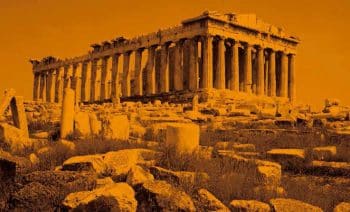
    Walking around the complex of rocks, Doric columns and temples of the Acropolis in Athens evokes the debt Western Civilisation owes to the ancient Graeco- Roman world. It was here that the Athenian City State developed the first and most sophisticated philosophical notions of how a democracy should work. It remains remarkable how much of democracy itself is attributable to this world as distinct from to the more modern world where the franchise took root and popular politics was adopted and adapted by nation states. In essence much of contemporary democracy does not reflect modernity and is ill equipped to deal with exploitative populist efforts that cut across its fundaments. For example, the ancient Greeks were so idealistic that they saw no separation between politics and philosophy, culture, the arts and theatre. In fact their notion of democracy saw philosophy and the body politic as inseparable twins. In order for democracy to survive it had to live in close proximity to the world of philosophy and that of the intellect. In the modern world that we now live in this umbilical link between philosophy and the world of politics has been utterly broken. It is hard to be precise as to when these two worlds separated but it is clear that the cleavage is such as to render latter day democracy incomprehensible and irrelevant to many citizens. After the collapse of the Berlin Wall and communism there was a public clamour to declare an unprecedented victory for the forces of freedom encapsulated by liberal democracy and free-market capitalism. The enormous recession of 2008, which leaves a long economic and social shadow and reduced the number of countries that can be described as democracies, has put paid to the heady optimism and ambitious ideas heavily promoted by writers such as Francis Fukuyama. Since the collapse of the wall there has been an extraordinary burgeoning of trade, investment and human contact powered on a global basis by adventurous risk capital and new, seemingly liberating online technologies that facilitate commercial and social transactions within the blink of an eye. The political class, with its associated elites, has been left stranded in the wake of these fast-moving, converging and engulfing technologies like the internet, social media, instant (and sometimes illusory) capital transfer. The political class have a mandate to manage and control these developments but as ever the regulation is chasing after the market reality. Modern democratic states are very unsuited to handling these changes being rooted in the ancient world and the world of nation states – both epochs that are now past. Modern day Greece serves as a good example of how the nation state model of democracy cannot deliver for its citizens. The country has been pulverised by the financial crisis which began in the US and rapidly exported its wealth everywhere. Since 2008 Greece has been subjected to a force-fed austerity programme, multiple bail-out packages, and the near destruction of its entire banking system. The main Greek Parties that dominated politics since the departure of the military, of left and right ( Pasok and New Democracy) have been swept away in favour of a street-led-protest party headed up by Prime Minister Tspiras. Greece has been scarred. The magnificent streetscapes of the capital Athens have been desecrated by vulgar and ubiquitous graffiti – testimony to pervasive radicalisation. There is no public will to remove it and the authorities –animated by Syriza – appear slow to remove it lest it becomes a vivid reminder that the anarcho-revolution they began has now run into the sand. SyrIza promised all sorts of resistance to austerity, foreign diktat, Brussels bureaucracy, the ECB, and of course Germany. Two years on and it looks like they took on more than they could chew. Quite the opposite to what was promised has occurred. Even Syriza’s high-profile former Finance Minister Varoufakis has given up the ghost and formed his own party. A former ministerial colleague of mine from Greece confided in me during my visit that notwithstanding the volte face in the confrontation with Brussels Tspiras has managed to make a connection to the ordinary Greeks public. Nevertheless the ones I have met here remain ineradicably cynical about politics. Many feel that Syriza is simply serving its apprenticeship and that it is only a matter of time before it becomes as self-serving as its predecessors. Greece has witnessed enormous public corruption and bureaucratic incompetence that is almost the civic mirror image of what happens in the Northern European core countries of the EU. The economy also has a huge black economy of private and cash transactions. On a visit eight years ago, precrisis, I was surprised at the difficulty of finding a retailer that would accept credit cards. It is now far worse and if there is a credit card machine in situ, more often than not, the shopkeeper will claim that the machine is broken. A businessman friend informs me it is quite common for a BMW car to be bought with €70k cash as part of the transaction. Given the governments they have got there is a natural reluctance to pay taxes. The miracle is that the Greek economy and democracy has managed even to survive the economic crisis. This, my business friend reminds me, would not have happened were it not for the black economy. When all else failed it was the only capitalist show in town. The events have been a crushing blow to ordinary Greeks, in particular because of their pride in their illustrious past. The Germans and their own political class have taken the lion’s share of the blame. The extent to which debilitating terms and bailout conditions were imposed on Greece shows both the strengths and weaknesses of the Eurozone system. The fight had to be taken to the streets but was ultimately resolved in the joyless back offices of Brussels, Frankfurt and Berlin. It was probably a mistake for the Greeks to depict Merkel as a latter-day Nazi but the

    Loading

    Read more

  • Posted in:

    Where optimism died

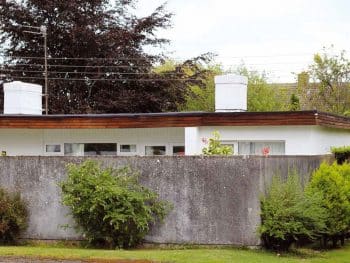
    Driving down the dreary N11 eight miles out of Dublin a curious grouping of houses peeks intermittently over a high County Councilissue boundary stone wall. It’s just another far-flung estate. But in 1963 this represented the modernist dream: open-plan clapboard-fronted American-style houses with two garages adjoining the convenient new tree-lined dual-carriageway, one of Ireland’s first. You can still catch glimpses of its adulterated sleek lines and its once-utopian, now often octogenarian and jaundiced, first settlers. With the rapid uptake in private car ownership the new professional middle classes had realised they could set up home further and further away from the office. Speculative builders were only too happy to facilitate modern suburbia. Louglinstown – just beyond Cabinteely – was a buffer zone between city and countryside cushioned by green fields as far as the eye could see, watched over by rural Carrickgollogan and within striking distance of Killiney Bay, Shankill and Bray, all then established and desirable. Excitingly half of Loughlinstown village, including its celebrated ‘Big Tree’ had been demolished to smooth the tarmac of the spanking new dual-carriageway. It was a playground for the 1960s dream. Shining Shanganagh Shanganagh Vale tapped the optimism. It was named after a beleaguered local river, the euphonious name celebrated by James Joyce: it was originally to be called the less mellifluous Hawthorn Court but individualistic residents kicked up and changed it. Shanganagh Vale was utterly undeferential to the Irish vernacular or the lumpen housing estates on the way out from the city; it was a-contextual, streamlined, uncompromising, unIrish, American. Modern. All of the houses were oriented to give maximum sunlight throughout the day. The entrance curved the road around greens of newly planted poplar trees and detached, single-storey houses hidden by shrubbery. Reflecting the age of the car as symbol of democracy, the houses originally had double garages and were surrounded by generous roads and inviting footpaths. Walking around the estate each turn brought secret laneways and pockets of green. Shrubbery, defiant of boundary lines, made the houses seem to snuggle together. It was an opportunity for Merit Homes to create a new world on a blank canvas, not contextualised. Shanganagh Vale was a Garden City model of out-of-town suburb away from the morally and physically corrupting urban centre, surrounded by parkland and connected to the city centre by unclogged roads. It was visualised as sprawling down the whole Shanganagh Valley towards the Ramblers Rest pub in rustic Ballybrack. Builders Shanganagh Vale was a the first (and last) residential development for Merit Homes Ltd, a subsidiary of John Sisk and Sons which still collects some of the land rents today. The initial modernist development was phased through four different house types, ranging from singlestorey flat-roofed houses to single-storey and two-storey, pitched roofed four-bedroom houses. Architects It was the first residential estate for the London-based practice, Diamond Redfern Anderson. This was one of the first times an architect was used to design the new rash of residential schemes. Other works by Diamond Redfern Anderson include Oak Apple Green, Rathgar; Golden Bay, Lough Corrib, Co. Galway and Claremount Court, Glasnevin Dublin. Architect Denis Anderson, now in his eighties and retired in Holywood outside Belfast says that: “Architects shied away from housing at the time”. The practice is best known for its celebrated Castlepark Village, in Kinsale Co. Cork (1969- 72), considered a seminal work of Irish residential architecture. It is renowned. By contrast little has been documented on Shanganagh Vale. Arab Quarter Anderson told Village it had been important during the design process to separate vehicular traffic from pedestrian traffic – which was novel at the time. Landscaping was also a priority to the practice and the relationship of house to site. The estate is a combination of private and public spaces along with in-between greens which ease the relationship between the houses and the road. high-screen walls around patios gained the houses the nickname the ‘Arab Quarter’, from the confounded local Edwardians. All the houses in Shanganagh Vale were at angles to each other, with different heights of walls projecting here and there and vastly different open spaces, some of which were not clearly designated public or private. It all betokened a relaxed attitude to space and property. The word that best fits the untidy house cluster is one often heard in Ireland – ‘throughother’. Denizens could shape it themselves. The estate was so green that the architects were soon receiving phone calls from the residents complaining about weekend picnickers. The lanes were ideal for the wellspoken children of the estate to cycle their Raleigh Chopper cycles in file, and years later to sneak an occasional unobserved smoke. Flat Scandinavians Closest to the entrance are the Scandinavian-looking, flat-roofed single-storey bungalows. Architect Denis Anderson comments that he took his inspiration from Finland. House+Garden magazine had started to churn out issues on Scandinavian homes, which the perspicacious Irish consumer was taking notice of. Vancouver, Loughlinstown Again fashionably foreign-inspired, the Vancouver – the second look Diamond Redfern Anderson launched was characterised by a box-like structure, low projecting roofs and balconies across the white wooden-panelled frontage. The Vancouver show-house advertised in the Irish Times on 9 November 1963 was completely furnished and “decorated by Brown Thomas and Co Ltd of Grafton Street”. The description reels off the mod cons of the day: “large plate-glass sliding windows, which may be double-glazed if desired”; “large open-plan lounge and dining area, with its fine fireplace of brick and Parana wood paneling”. The kitchen had “attractive breakfast bar with an ‘adjoining laundrette”. Upstairs the bedrooms boasted built-in wardrobes and dressing tables. The asking price was £5150. More than you’d pay for something red-brick in the inner suburbs. But then this was a different land with different rules. The Theory In a literary timepiece, Ruairí Quinn, later leader of the Labour Party, wrote in the Architects Journal in 1974: “Anderson’s design approach is a reversal of the conventional wisdom of the architecture schools, as he first formulates the solution and works back

    Loading

    Read more

  • Posted in:

    Peak Tourism

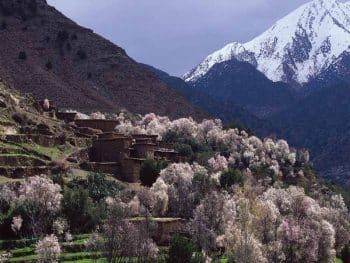
    ‘Eight Million Tourists Expected To Visit Ireland Next Year As Star Wars Effect Lifts Off’ Headline in the Irish Examiner, December 1, 2015 Marrakech is a hard city to leave, because someone is always tugging at your arm. One hour south, near the highest mountain in North Africa, you can hike to a pass with a view of three valleys and still be interrupted. I was alone up there for half an hour when an elderly man appeared, smiled and presented me with a sad lump of coal about the size of a tennis ball. I almost laughed, but I was wrong. He opened the stone to reveal a shimmering bed of purple crystals. It was a piece of amethyst. The old man seemed reluctant to part with his treasure for just €20, and I felt a bit guilty about defrauding him, but we shook hands and the deal was done. On holiday one craves experience that feels privileged, local, unusual. In Ireland that means drinking in a pub after closing time, the ancient but highly regarded lockin. In India it might be a ten-day silent meditation. Authentic and rare, here was another great travel moment. Half a mile up the road there was a hut with a rusty Pepsi sign. That’s charming, I thought, I must be their first customer today. But no! The owner was chatting to my friend the amethyst dealer. Not talking, really, so much as laughing, as if they had just played a practical joke on someone. And look! There I was, sipping a lukewarm Pepsi, not Lawrence of Arabia but something more mundane. The first proper patsy of the day. My amethyst story was not supposed to end like that. Going on holiday is meant to broaden the mind. Saint Augustine said the world is a book and people who don’t travel read only one page. If that’s true, then we’re in luck. It has never been cheaper or easier to fly to faraway places, and sometimes tourists have a benign impact. In 2003, when going to Burma – with its corrupt military dictatorship – was widely frowned upon, a diplomat told me that one of the most encouraging developments there was a rise in tourism, as it facilitated a more open society. In 2008 I discovered the power of personal diplomacy when I spent three weeks hiking in Iran. One day I taught a 12-year-old boy how to juggle. In Morocco I was a traveller until the moment I became a stupid tourist. Still, I can’t blame the chap for selling me that rock. The observer always affects the observed. And there is often a tension between visitor and host. In Barcelona, locals hang banners from their balconies, begging tourists to allow them a good night’s sleep. The 42-year-old mayor of the city, Ada Colau, was elected on a promise to recapture Barcelona for its citizens. In Hong Kong, local residents have marched in protest against visitors from China, whom they call ‘locusts’. As they say in, well, everywhere, tourists are a pain in the ass. Why do we bother going on holiday, anyway? Personally I travel to get away, to be alone, to escape myself, or at least to meet a more attractive version of myself. moments of transcendence – ‘that wine is delicious and it costs half-nothing’ – but for the most part holidays are confused, even disturbing, experiences. Consider: Your flight takes off in just five and a half hours. There you are, packing new clothes in an old suitcase. As you fantasise about lounging by the pool it’s easy to forget that you will be appearing as yourself. (Look! The skin is falling off your nose.) Then there’s the quiet domestic hell of other people. The comedian Kelly Kingham: “My wife and I can never agree on holidays. I want to fly to exotic places and stay in five-star hotels. And she wants to come with me”. Who among us knew that a hotel reception would make such a lively venue for a family row? Or that a short flight could be quite so depressing? Consider the fatalistic niceties (“In the event of an accident…”), the casual indignities and the cruel economies that are now accepted as part of the bargain. When Michael O’Leary of Ryanair joked about charging to use the toilet, many of his customers thought he was serious. The literature is of no assistance. Brochures are works of fiction. Travel journalism is PR with a suntan. And guidebooks are just as bad. Over-scripted drivel, they rob travel of its novelty, thus its charm. (“No visit to New York is complete without seeing the view at sunset from the top of the Empire State Building”.) Maybe we are not explorers, you and I. Maybe we are rough girls and lonely plonkers – a nuisance, frankly, with all our demands that strip a place of what made it attractive in the first place. When I tell you that Starbucks tastes just the same in Marrakech, I should be blushing. It was the German writer Hans Magnus Enzensberger who first argued that tourists threaten or destroy what they have come to see: originality and local colour. That was nearly 60 years ago. Enzensberger’s theory (“Tourism anticipates its refutation”) still seems topical. Writing in the Guardian a few months ago, Tobias Jones observed the same Faustian pact: “The more visitors you have and the more money you make, the less you are the naive, folkloric, authentic, untouched place of the tourist imagination”. Last year there were 1.2 billion tourists. There will be two billion tourist arrivals by 2030. We coach-tour insects like to think of ourselves as a benign presence. We imagine that a long journey absolves us of any petty provincialism. It’s good of us to meet the people. But most of the time the exchange is purely commercial. We are just a source of revenue, and most of it goes to elites. In 2006 the Canadian journalist

    Loading

    Read more

  • Posted in:

    Bremain

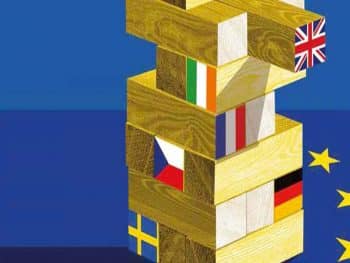
    Brexit will probably never happen. The news narrative has become one of delay, with the odd Brexiteer keeping the flag flying in the Daily Telegraph but a lot of stasis. Next year, there will be many stories about the major problems that Brexit will cause. Negative economic effects will loom. Village editorialised in its last edition that no one who understands history or economics could vote Brexit and certainly it does undermine fundaments of what many regard as political imperatives. There will be surprise at the huge range of problems involved in taking EU law out of UK law given that an integration of laws has been underway for over forty years. Gradually, a wide-ranging complex vista of Brexit problems will emerge across British social and economic life; for instance, residency, travel, employment laws, training, education, research, and also in business, whether trade, competition, employment or any of the recesses into which the EU has long delved. The probable break-up of the UK following Brexit will inevitably continue as an issue in the media background, because, very probably if Brexit happened, Scotland would become independent and join the EU. Democrats could not ignore if 5.3 million EU citizens in a separate national area, were expelled from the EU against their collective will. Furthermore, there must be a significant chance that the court challenges to unilateral UK Government action on Brexit will succeed and force an early vote in Parliament on the issue, causing further delay and uncertainty about Brexit. But behind the scenes, there are other unreported factors. We don’t know what Theresa May and Angela Merkel said to each other and it would be very hard to guess. We can be much more confident about what the current American Government from Obama to the State Department to the military are saying: don’t leave the EU. While Brexiteers will brush off the partisan advice of a lame-duck administration, the US will have a new President- elect on November 9th next. Assuming it is Clinton, she will reiterate in private the insistence of the current administration. British Government Ministers, officials and army generals will be left under no illusions by their American counterparts that Brexit is a no-no from global strategic and security perspectives and will have to be averted by whatever means. Initial post-Brexit reporting in English language media emphasised how the UK was in a strong negotiating position because of its trade deficit with the rest of the EU and that Germany’s Angela Merkel wanted a reasonable agreement for the UK, partly because of German exports to the UK. In fact, Brits will continue to buy their BMWs. In reality, the dominant market focus of big German exporters is growth of their Asian sales, especially China. More seriously for the UK, Germany, including Chancellor Merkel herself and her closest political allies, is increasingly indicating that it will take a tough negotiating position with the UK on Brexit and that it strongly supports a united EU position towards the UK. Merkel indicated this twice recently including at a high-profile meeting with France’s Hollande and Italy’s Renzi. Even more ominously for the UK, Merkel appears to be supporting an EU strategy to restrict the ability of City of London financial services, especially banks, to operate in the EU after Brexit. That is by far the UK’s most important exporting business. Michael Fuchs, deputy leader of Merkel’s CDU party, said recently that banks operating in the EU must be subject to EU supervision and can’t be run out of London when the UK is no longer a member. “I really think this is something that’s not negotiable, the so-called banking passport”. Germany and France greatly resent the extent of the economic gains and influence that the City of London gets from selling financial services throughout the EU. In the event of Brexit, they would try and repatriate as much financial business activity as possible to Frankfurt and Paris. Moreover, the issue makes a powerful bargaining chip. There will probably be an often lengthened delay before the UK triggers Article 50 and formal Brexit negotiations, if it ever does trigger it. Even if it does, Brexit is still very unlikely; mostly because it would cause too much damage to the UK economy and disruption to social and economic life in the UK. The end result will most probably be an agreement that the UK will remain in the EU, with the UK’s best hope being to maintain the favourable agreement that David Cameron negotiated in February 2016. In reality, internal British, European and global politics all mean that Brexit is a madness that will have to be averted. Brendan Lynch is an Economist and former stockbroker. He is the author of ‘EMU: Ireland’s Dream Start – The Political and Economic Impact of EMU on Ireland’ (2008).

    Loading

    Read more

  • Posted in:

    Controlling the s****

    Most Irish traditional news outlets offer some form of reader participation but there are heterogeneous requirements before comments can be left on sites

    Loading

    Read more

  • Posted in:

    Laws of unintended coherence

    The case revolved around the circumstance of the unmarried father, with otherwise no rights to remain in Ireland, seeking to avail of his fatherhood of an Irish unborn child in order to remain here – and the extent of the child’s rights

    Loading

    Read more

  • Posted in:

    Unexplained disparities in care orders

    Children are more than twice as likely to end up in care in one region of the country as they are in another, official figures from the child and family agency Tusla have shown. The records show that the number of children ending up subject to care orders is significantly above the national average in the HSE South region. There were 614 care orders in the South during 2014 – which ended up higher than two of the other regions (Dublin Mid-Leinster and the West) even when combined. Over half of those care orders, 320 in all, were in the city and county of Cork which meant that out of the 1,632 children to enter care in that year, almost one fifth were in Cork when the country makes up just 11% of the Irish population. Detailed analysis of the figures on the basis of population aged under 17 bears out the stark difference in rates around the country. On a national level, 142 children per 100,000 ended up in care during the course of 2014. However, the rate for the HSE South was significantly higher at 209 and the rate significantly lower in Dublin Mid Leinster where it was just 81. The other two regions – HSE West and HSE Dublin North East – were closer to the national average and stood at 125 and 158 respectively. Professor Pat Dolan, a childcare expert from NUI Galway, told Village that ultimately care orders should develop a consistency across the country but that “supply and demand” was still playing a major part. He said: “If you look back in the eighties, we really only discovered child sexual abuse and there was a massive increase in referrals after the Kilkenny incest case. Was there suddenly a proliferation of abuse of children? Or did we just become much more aware of referring it into the garda and social work systems? There are trends in this. The other main factor has to do with availability of service. If you take residential care, the more children’s homes you build, the more you fill. There is an issue of understanding this in terms of services available. The more [children the services] can see, the more these numbers will go up. If you have waiting lists, the numbers stay down – that doesn’t mean the cases aren’t there. But if you buy a Panadol in Cork, it should be the same dosage as everywhere else. It should be the same in terms of service provision. It should be the same regardless of where you are but the one thing we know is that it’s not”. Professor Dolan, who is Director of the Child and Family Research Centre in NUIG, said unusual spikes like this were not uncommon and that after high-profile cases of abuse referrals could suddenly rise. Similarly, highly publicised cases of abuse in care settings could have the opposite effect and lead to a reduction in the number of children being placed. He said that while poverty was a key factor – the country also tended to concentrate services of this type in areas that are more deprived. He said; “What is the level of abuse in middle and upper class Dublin? It’s not policed as much from a social perspective. [So the question becomes] is there far more abuse in one area, or is it just that we are looking much more closely? “It’s a problem and provision issue. In some areas, you have more social workers seeking care orders in some communities. It’s almost like a siege for them but you would wonder why this is the case in Cork”. Nationally, 1,632 children were taken into care in 2014 with over two-thirds of those cases involving a voluntary admission. There were 163 cases – around 10% of the total – involving emergency care orders and another 198  where interim care orders being used. One case involving a detention order of the High Court was also recorded. The figures – provided under FOI – were also listed according to age, with the largest number of cases, 231 in total, involving babies of twelve months or less. Significantly, of those cases – over 100 involved some form of care order and only 130 were by voluntary admission. By comparison, of the 118 cases involving children of eight years of age, 100 of those were a voluntary admission where a parent had given consent. In a statement, Tusla said: “Children and young people are referred into [our] Child Protection and Welfare Services in each of its four regions (West, South, Dublin North East and Dublin Mid Leinster). The rate of referrals is affected by a range of factors in each region including, but not limited to, population, demographics, deprivation levels, addiction issues and the level of supports available, e.g. family support services. These can in turn be affected by the social and economic history of the region. By Ken Foxe

    Loading

    Read more

  • Posted in:

    Pat Hickey as Moses

    For the OCI head as for Robert Moses and leaders of Console, Rehab, the Central Remedial Clinic and Irish Nationwide, too much power weakly supervised was a recipe for scandal

    Loading

    Read more