General

Random entry RSS

  • Posted in:

    Ashbourne Residents Fight Developer for Green Space

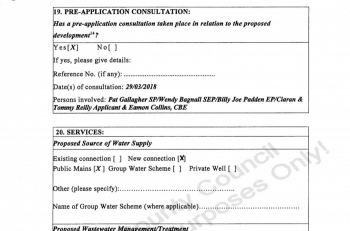
    Judicial review sought to overturn planning board decision By Frank Connolly. The residents of a housing estate in Ashbourne, County Meath, are fighting to retain the only open space available to their children after a decision by An Bord Pleanála (ABP) to grant permission for three apartment blocks on the land. The Millbourne Residents Association (MRA) has waged a stern campaign of resistance over more than a decade against developer, Michael Ryan, who wants to build apartments on the last remaining green space in the 280-house estate. When they purchased homes in the estate, residents assumed that the half-acre green would remain as a play area for children. For a decade, the developer through his company Rybo Partnership Ltd has pursued plans for housing on the land and has finally succeeded at ABP in an appeal against the rejection of his latest proposals by Meath County Council. In February, his company erected a fence around the green area provoking a protest by residents. The decision in September last by ABP to reject the advice of its own inspector and the appeal by residents to retain the only  field available to their children has baffled the community, local representatives, and their legal and planning team. Ryan came to prominence some years ago after he was acquitted on charges of bribing Waterford Councillor, Fred Forsey, with a €60,000 payment in return for zoning favours. In 2015, the developer was also dragged into a major controversy over the construction by his company, Saltan Properties Ltd of apartments at Riverwalk Court in Ratoath, after owners discovered fire hazards and rotting balconies, among other serious defects. Meath County Council which issued the fire safety certificates for the homes built in 2002 has since granted Ryan further permissions to build homes in the County. Since 2004, residents have successfully opposed three attempts by Rybo to construct houses on the 0.5 acre acre strip of land, arguing that it is the only green area for children and represents just 5% of the entire estate. The Meath County Development Plan requires that 15% of housing developments should comprise of green and recreational space. In its most recent application, Rybo and its advisors, Future Analytics Consulting Ltd, have sought permission for three, three-storey blocks containing 30 apartments, as well as parking and storage space on the land. After an earlier application for housing on the site was refused by ABP, Rybo was granted permission to build a strip road which has allowed it access to the site, thus facilitating its latest, successful application. In direct contradiction to the recommendation of its inspector, APB deputy chairman, Paul Hyde said: “In deciding not to accept the Inspector’s recommendations to refuse permission, the Board was satisfied, having regard to the range of amenities within close proximity of the site, including the permitted linear park to the east, neighbouring sports grounds to the south and adjoining schools to the south, that the proposed development on this residential zoned site, which provides adequate public space for the quantum of the development proposed, would not result in a lack of public open space for the adjoining permitted residential development which the Board considered to be adequately served by the wider range of existing amenities including as cited above”. According to the MRA, this observation is in stark contrast with the realities on the ground and is also in breach of the Meath Development Plan, despite the claim to the contrary by An Bord Pleanála. The ABP conclusion is also factually inaccurate, the residents argue. “The linear park has been under development since 2003 and only one out of its seven proposed zones has been completed and is located 900 metres from the Millbourne estate. The neighbouring sports grounds and schools referred to by the ABP are private properties which are fenced off and inaccessible to the children of Millbourne estate as open space”, said Jason McCann of MRA. “As a father of three young children I am completely distraught by this; as a mortgage holder I pay my taxes, I work hard. I feel at the very least that an impartial planning body should come up with the right decision. It is shocking. Families here are completely disillusioned with the whole planning process. All we want is somewhere for our children to play”.  Indeed ABP has previously refused development on the existing green area precisely because it “would contravene the stated objectives in the 2013-2019 Meath County Development Plan which seek a minimum rate of public open space of  15% of the total site area”. Further, Meath County Council has accepted the appeals of residents; and its Chief Executive, Jackie Maguire, has said she supports a motion to be heard by Councillors at their next meeting to re-zone the green area for recreational purposes. The residents are also planning to take judicial review proceedings against the decision by ABP to allow the Rybo apartment plan to proceed and are raising money from residents of the estate to fund the legal action. Their advisors, Marston Planning Consultancy, have also argued how the proposal by Rybo “will result in the denudation of the open space” and is “contrary to the proper planning and sustainable development of the area”. Marston also submits that the reduction of visitor parking for the existing houses on the already narrow street fronting the green area “will result in a traffic hazard”. Future Analytics, the consultancy firm which acts for Rybo and its owner, Michael Ryan, made a submission to ABP in support of his planning application and has lobbied public officials on his behalf.  Ryan has built relationships with local representatives including former Fine Gael TD and now Senator Regina Doherty with whom he has worked on local issues. The advice centre of local independent Councillor, Nick Killian, is also located in Riverwalk House, also built by Ryan, while Ashbourne Fine Gael Councillor, Alan Tobin, has met with the developer and the Millbourne residents on the contentious issue. Local Independent Councillor,

    Loading

    Read more

  • Posted in:

    Compromising RTÉ’s ‘Countrywide’

    Damien O’Reilly pushes an agenda against “some” unspecified “thug” environmentalists, in the Farmers’ Journal. By John Gibbons The announcement in October that RTÉ’s radio programme ‘Countrywide’ had entered into a 12-month sponsorship deal with the Irish Farmers Journal (IFJ) represents an unusual, arguably unprecedented departure. The IFJ  is bound at the hip with Ireland’s most powerful agricultural lobbying group, the Irish Farmers Association (IFA). The two organisations share the same premises in Bluebell, Dublin; and are historically intertwined.  The IFJ pays the IFA annual fees running into tens of thousands of euros for what it says is access to the Association’s resources. That’s how close the relationship is. Essentially, therefore, RTÉ has entered a sponsorship deal for its flagship agricultural current affairs programme with the publishing wing of agri-industry lobbyists.  The fact that both the IFA and IFJ  have actively promoted climate denial and, more recently, used almost identical selective information to play down the role of methane as a powerful greenhouse gas underlines their unity of purpose.  Given that emissions-reduction is the number one challenge facing the agricultural sector, it is no surprise this is also a major source of conflict. In recent years, the expansionary ambitions of the dairy sector in particular have drawn it into ever greater conflict with environmental and ecological limits, from emissions to air- and water- pollution.   For instance, since 2015, overall agricultural emissions have risen by around 8%, at a time when they were legally mandated to fall. In the same period, marked decreases in air and water quality have been largely attributed to aggressive dairy-sector expansion and dramatic increases in the tonnage of nitrogen being spread on Irish grasslands. Overall, Ireland’s agricultural sector accounts for around 34% of national emissions, a share wholly disproportionate either to the size or economic value of the industry. The problem overwhelmingly relates to methane emissions from ruminant agriculture, principally dairy and beef cattle.  The relative contribution of Ireland’s tillage and horticulture sectors to pollution is, in contrast, negligible. Pollution therefore is tied closely to the type of agriculture a country chooses to concentrate on, and Ireland has gone squarely for the most emissions-intensive form of agriculture (intensive dairying) at the worst possible time from the point of view of our national efforts to cut emissions. Tens of millions of taxpayers’ money have been spent on PR strategies such as Bord Bia’s ‘Origin Green’ programme portraying Ireland as a producer of clean, ecologically low-impact food.  However, the spin has been at variance with the facts.  EPA director general, Laura Burke, recently confirmed that Irish farming’s ‘green’ reputation is simply not supported by evidence -trends in water quality, emissions and biodiversity are all going in the wrong direction EPA director general, Laura Burke, recently confirmed that Irish farming’s ‘green’ reputation is simply not supported by evidence. “Taking the (agri) sector as a whole, the economic growth in recent years is happening at the expense of the environment, as witnessed by the trends in water quality, emissions and biodiversity all going in the wrong direction”.  Burke wrote this in the EPA submission to a new agri-food strategy that is being driven by a 31-person committee made up almost entirely of industry players and agri-food lobbyists, with one solitary seat at the table for the entire environmental sector. In recent years, the agri-industrial sector’s expansionary plans have been challenged by a loose but determined coalition of environmental NGOs*, activists and scientists. This in turn has led to tensions and accusations on both sides of bad faith as well as some name-calling.  In recent years, the agri-industrial sector’s expansionary plans have been challenged by a loose but determined coalition of environmental NGOs*, activists and scientists. This in turn has led to tensions and accusations on both sides of bad faith as well as some name-calling.  Conflict of this kind, given the diametrically differing perspectives of the two sides, is inevitable. I also believe that it’s a sign of a healthy democracy that powerful commercial interests can be called to account for their actions and inactions by concerned citizens, journalists and activists.  It’s worth considering the astonishingly asymmetrical nature of the conflict. On the one side are ranged multinational PLCs, billionaire meat barons and powerful, politically connected lobbyists.  These groups hold deep sway over a host of state and semi-state bodies, from Teagasc to Bord Bia, the Department of Agriculture and the National Dairy Council as well as university agriculture faculties. They also enjoy almost revolving-door media access to promote their messaging. On the other side is a handful of mostly volunteers, sparsely funded and largely reliant on people donating their time in the public interest. RTÉ Radio’s flagship agri show, Countrywide airs every Saturday morning, and enjoys a solid audience of predominantly rural and agricultural listeners. Its magazine format gives it appeal to a wider audience. This year, Countrywide won a prize from the International Federation of Agricultural Journalists for a segment titled: ‘Climate change and Irish farming The formula works. This year, Countrywide won a prize from the International Federation of Agricultural Journalists for a segment titled: ‘Climate change and Irish farming’. As the RTÉ report on the event stated, the judges noted the challenge of bridging the topic of climate change for an audience of both farmers and non-farmers, with one judge adding:“I always appreciate Damien O’Reilly’s knowledge and willingness to ask difficult questions”. Climate change is the political hot potato for the entire agricultural sector, and Countrywide makes some useful contributions towards bridging the divide. The show’s host, Damien O’Reilly is also a long-standing columnist with the IFJ, the new sponsors of his show. O’Reilly’s column, titled ‘Backchat’ is ostensibly a light round-up of his weekly musings. However, he does appear to have a particular agenda in mind, as I discovered on examining the IFJ archives.  For instance, in the September 29 edition of the IFJ he wrote: “As we grapple to tackle climate chaos, the incessant attacks on farmers border on the absurd. In the same way alcohol contributes to alcoholism, food production contributes to greenhouse gas emissions, yes. But we don’t say ban alcohol to stop

    Loading

    Read more

  • Posted in:

    Shane Ross tells nearly everything

    If only the Independent Alliance had performed as well as the rip-roaring book Part 1 Review Michael Smith reviews ‘In bed with the Blueshirts’ (Atlantic Books, €12.99) and speaks to its suspiciously unselfrighteous author Shane Ross can write, analyse and judge. We saw it when he wrote for the Sindo and in his juicy books about the Untouchables and the Bankers.  Here it is again as he reflects on four years ‘In bed with the Blueshirts’ which posits the implicit question whether he was any good as a politician.   It is the reader’s job to assess this and the assumption must be that Ross secretly hopes the evidence speaks positively for itself. Ross has a colourful past, Rugby-educated, Church of Ireland, father a big-noise in what is now Matheson solicitors, stockbroker fired by Dermot Desmond, part of the Joy’s set in the 1980s, Senator from 1981, rambunctious and iconoclastic campaigning business editor of the Sindo until 2011, one-time lioniser of Michael Fingleton; but this is not the book to go into that.  He states: “Thirty years earlier I had been a heavy drinker. In those distant days there was heavy drinking in the Dáil bar, where I spent far too much time. Boozing took place morning, noon and night”. Enigmatically he declares: “Today, I could tell tales about household names that would shock the nation. They could do the same to me, so a balance of terror still exists. Omertà. Maybe in the next book”.  They battled unsuccessfully against themselves to form a group to contest the 2011 election. It was called Democracy Now but it was neither. After a long period in the Seanad representing Trinity and a fleeting immersion in Fine Gael, he considered forming a new political party with the disparate egotistical forces that are Eamon Dunphy, David McWilliams and Fintan O’Toole as they battled unsuccessfully against themselves to form a group to contest the 2011 election. It was called Democracy Now but it was neither. You won’t find much about all of this in this book but Shane Ross’s insight into the workings of the coalition government (2016-20) is unrivalled.   He has written one of the best Irish political memoirs, bulging with casually shared nuggets and indiscretions He has written one of the best Irish political memoirs, bulging with casually shared nuggets and indiscretions, chiefly but not exclusively his own.   For some reason much of the media won’t be promoting the insights of this book.   In the Irish Independent Richard Bruton wrote a review that was largely enthusiastic though you’d have missed that as it was somewhat dismissively headlined, “In Bed With the Blueshirts: Shane Ross memoir is disarmingly honest but no kiss-and-tell. Former Transport minister portrays himself as a Robin Hood-type figure, but few scores are settled in his new book”.   There is no sign online of an Irish Times review, at the time of writing. Former Minister for Social Protection, now Senator, Regina Doherty, demanded action against the book which she says breaches Cabinet confidentiality. She told RTÉ radio’s Today show that Ross had “moved with indecent haste” to write the book, which showed that “he had no real interest in being a minister”. She said he has done away with the rules in order to “make a few quid on a tell-all book”.  The Sunday Times’ waspish Atticus column  bitterly disparages sales of the book and in a presumable bid to quell interest has drawn attention in the last few days to Ross’s extravagant ministerial entertainment budget.   The obvious incubating question is why the hostility; and the obvious answer is that it suggests in these pusillanimous times he may well have done some things right. It may be that he is an attack dog and that too many got bitten.  But this can be set against his record of achievement.  I wonder if he was a better journalist, being less susceptible to external judgement, than a politician and he laughs.  He says he made major mistakes in both but I can’t think of any he made in journalism, apart from unwise prognostications and championings.  Politics was to be different. My feeling is that a politician who the Irish Times ignorantly allowed to be repeatedly deprecated as “Winston Churchtown” was just too public-school for the Irish; too public school, I surmise, for himself.  My feeling is that a politician who the Irish Times ignorantly allowed to be repeatedly deprecated as “Winston Churchtown” was just too public-school for the Irish; too public school, I surmise, for himself.  He tells me he didn’t mind the nickname but for me it seems to have all the worst qualities of racist hate speech: a witless jab at someone for something he could do nothing about, the West Britishness for which normally-generous post-colonial Ireland, understandably derisive of ascendancy, has never offered or allowed any public sympathy.  When I meanly look for other reasons the media dislike him he also suggests journalists may have thought it was uppity for one of their number to seek political office.  And he rightly says he and the other members of the Independent Alliance were seen as mavericks, for whose brand of independence and defence of sometimes unfashionable minority rights there is little appetite.   Richard Bruton says Ross’s vision of himself as a Robin Hood figure but there is no evidence of this.   In fact I defy anyone to say how this skein of political mercury sees himself or to sum him up fairly in less than a paragraph. Certainly the cliché that he is a self-serving but lazy toff primarily driven by the market will not do. But how did that view come about? In fact I defy anyone to say how this skein of political mercury sees himself or to sum him up fairly in less than a paragraph. Certainly the cliché that he is a self-serving but lazy toff primarily driven by the market will not do. But how did that view come about? The allegation has stuck that he was difficult to work with, arrogant, uninterested, sometimes cynical and parochial. Confirming this, though when I ask him he

    Loading

    Read more

  • Posted in:

    Christopher Stanley reviews ‘Anatomy of a Killing: Life and Death on a Divided Island’ by Ian Cobain (London: Granta, 2020)

    A valuable contribution to preserving the memory of the Conflict and to the continued out-workings of the fragile peace (in) process in this Northern Ireland, this Narrow Ground.  In addition to the most recent edition of De Smith’s ‘Principles of Judicial Review’, the other two most used book on my desk are Coroners’ ‘Law and Practice in Northern Ireland’ by Leckey and Greer and ‘Lost Lives: The stories of the men, women and children who died as a result of the Northern Island troubles’.  But to ‘Lost Lives’ I have recourse at least once a day. As a lawyer working on litigation arising from the Legacy of the Conflict in Northern Ireland I inhabit what Robert Cover described as a world of legal interpretation which takes place in “a field of pain and death”.  The pall of compassion fatigue is lifted by such a book. For example, Millar McAllister is Entry 2017 page 754 in ‘Lost Lives’. One of those questioned  by the police in relation to his murder is Brian Maguire who is Entry 2019. Whenever I draft correspondence to state agencies – the PSNI, OPONI, the Attorney-General – I always name the deceased and reference their entry in ‘Lost Lives’. It is, for me, to make the loss real and to remind “Dear Sir/Madam” that this letter, submission, representation concerns someone who died violently and who was a wife, son, daughter, husband. What Ian Cobain achieves in his recent book ‘Anatomy of a Killing: Life and Death on a Divided Island’is to provide a narrative of “all the surrounding circumstances” (as the inquest process demands) concerning the murder of Millar McAllister on 22 April 1978. An unremarkable day in the history of the Conflict in Northern Ireland but one which Ian Cobain takes; and forensically and compassionately examines with this one tragic violent death at its core. He produces a compelling narrative account of the human cost of the Conflict, weaving many diverse but necessary elements to contribute to our further understanding of that ‘little local difficulty’ on the Narrow Ground.  I am not sure whether Ian Cobain intended to embark on a loose trilogy when he published his first book ‘Cruel Britannia’ in 2013 and then ‘The History Thieves’ in 2017 but this is what he has produced after many distinguished years as a senior reporter with The Guardian, which included covering events in Northern Ireland.  I was once had his dictaphone pushed under my nose when we were on the packed steps of Solihull Civic Hall following the ruling of the Senior Coroner for Birmingham to resume the inquest into The Birmingham Pub Bombings 1974. In ‘Anatomy of a Killing’ Ian Cobain gives life to the stark 200 or so words afforded to Millar McAllister in his ‘Lost Lives’, a work of 3712 lost lives spanning 1696 pages.  Ian Cobain explains why Millar and his family came to live in Lisburn, County Armagh, Millar’s work with the RUC as a photographer (often in plain clothes), his hobby as a pigeon-fancier, why he was identified as a target by an Active Service Unit of the PIRA, how his assassination was planned and executed (literally), who his killers were and why on that day they became responsible for his murder; their motivation and the stark reality of his slaying Ian Cobain explains why Millar and his family came to live in Lisburn, County Armagh, Millar’s work with the RUC as a photographer (often in plain clothes), his hobby as a pigeon-fancier, why he was identified as a target by an Active Service Unit of the PIRA, how his assassination was planned and executed (literally), who his killers were and why on that day they became responsible for his murder; their motivation and the stark reality of his slaying: “Harry pulled the gun out and took aim. He looked at Millar’s face. Millar didn’t look frightened. He just looked a little disappointed. Irritated even. Harry could see that he didn’t like being tricked. ‘Aah’, said Millar, quietly” (page 154). Millar was shot in front of his son Alan. His other son Mark rang for an ambulance. Without ever detracting from the appalling tragedy of the killing of Millar Mcallister and the effect of his murder on his family, his community and his colleagues, Ian Cobain moves back and forth through time, to events before and after 22 April 1978. He examines what happened before and immediately after the killing. He examines events from the founding of the Irish State and before; and how and why the brutality that occurred in Lurgan on 22 April 1978 happened. He examines events leading to the Belfast Good Friday Peace Agreement 1998 and beyond to the present day.  The author knows how the past in Northern Ireland determines the present and continues to shape the future – whether Westminster politicians and Whitehall civil servants admit it or not.  Ian Cobain examines the personalities involved in plotting the course of the Conflict, from within the IRA, the Whitehall-Westminster politicians and civil servants, the RUC and the British Army and Security Services, those within the UDA and the UVF. He develops threads established in ‘Cruel Britannia’ relating to the use of torture against those suspected of terrorist acts of insurgency in dark Orwellian places like the Castlereagh ‘holding centre’ and its significance. He descibes how torture actually inscribed fear and hatred, and provoked revenge on the young minds and souls of those who eventually became the killers of Millar McAllister. He analyses how the British state reacted in its regimes of imprisonment and how internment (as seen by the IRA) became a political weapon in its own right through the blanket protests and the hunger-strikes, which eventually contributed to the ceasefires and the peace.  There are a plethora of books covering similar territory from different perspectives: histories with competing narratives, fine journalism, and sensational journalism, sociological analysis, personal accounts, academic treaties, political memoirs. What places Ian Cobain with the best of those engaged with understanding the Conflict in Northern Ireland is a calm

    Loading

    Read more

  • Posted in:

    Meath Council’s inept Investigation of Conflict of Interest in Major Land Re-Zoning.

    Lands purchased for €500,000 in 2016 are put up for sale for €4.2 million in 2020 after planning obtained on behalf of sons of Councillor who discussed their rezoning By Frank Connolly A Meath County Councillor is under investigation as his two children stand to reap over €4.2 million from the sale of lands re-zoned by the Council just over three years ago. Fianna Fáil Councillor, Tommy Reilly, is now the subject of an internal Council inquiry into his disclosure of interest in the land re-zoning. The lands at Liscarton, on the road from Navan to Kells were purchased in August 2016 for a sum of €500,000 from landowner, John Carolan. The lands were re-zoned from agricultural to light industrial use in July 2017 and planning permission for development was granted in June 2018. At the meeting in July 2017, when the motion to re-zone the land to industrial use was proposed, Councillor Reilly declared a conflict of interest involving his family and did not participate in the vote. The resolution to re-zone the lands was proposed by Independent Councillor, Francis Deane, and seconded by Fine Gael Councillor, Sarah Reilly, and was unanimously agreed by the 19 (out of 40 elected) Councillors present. The effect of the motion, which involved the variation of the Navan development plan, was to open up 35 acres of land at Liscarton, close to an existing business complex, for industrial development, thereby increasing its value by multiples of its purchase price. Councillor Reilly was not asked about the nature of his conflict of interest by any of the elected Councillors or by the senior Council staff at the meeting. However, he has informed Village that he absented himself from the vote as his son, Ciarán, had an interest in the lands. The Purchase The purchase of the lands and the subsequent transfer of ownership to Ciaran Reilly is something of a mystery. An investigation by Village shows that the man who successfully bid for the property is not the man who claims to have “financed” its purchase. At the time of the re-zoning, the land at Liscarton was registered in the name of Royal Active Business Solutions, a company whose sole director was local businessman Barry Alder from Bective, County Meath. The company was first registered by Alder in August 2016, just weeks after the land was purchased for €500,000 from the previous owner. Alder said he “financed the purchase”. He said he subsequently disposed of the land to Ciarán Reilly. Notwithstanding Alder’s claims to have bought the land, it has emerged that another Meath businessman made the final and successful bid for the property. According to documents obtained from Smith Harrington, the Navan auctioneers who handled the sale, the 34.54 acres at Liscarton were purchased by Joseph Freer, of Gainstown, Navan. They show that Mr Freer, who owned a transport company at the time, paid a deposit of €25,000 after an agreement was made to buy the property for €500,000 in June 2016, subject to contract. This information is confirmed in a letter of 23 June, 2016 from auctioneer, John Harrington, to Sheila Cooney, Tallans Solicitors, Drogheda. Ms Cooney was acting for the vendor, John Carolan, of Navan, County Meath. Harrington has also confirmed that his firm received the first bid of €350,000 for the Liscarton lands on 10 May, 2016. Fourteen other bids were received “until the bidding stopped at €500,000 on 14 June, 2016”, Harrington said. “In addition, there was also an offer made of €550,000 subject to planning on the entire (property) and an offer of €90,000 on 4.5 acres only”, Harrington said. “On 22nd June John Carolan instructed us to proceed with the straight offer of €500,000. We received a booking deposit of €25,000 on 23rd June, 2016 and sales advice note was sent to Mr John Carolan’s solicitor”. It is unclear in what capacity, or on whose behalf, Joseph Freer was acting when he did the bidding for the lands as he refused to discuss the matter when contacted by Village. When asked why he had bid for the lands, as recorded by the auctioneers, Smith Harrington, and whether he was acting on behalf of the purchaser, Barry Alder, when he bid for the Liscarton property, Freer said: “It’s nothing got to with me. Ask my solicitors”. The firm of solicitors acting for Mr Freer did not respond. Meanwhile, Barry Alder confirmed that he purchased the lands from Carolan and sold them on, for an unspecified price, to Ciaran Reilly. He confirmed that he financed the €500,000 purchase of the land from John Carolan.  “I financed it at the time. It was me that put up the money”, Alder said. He confirmed that he then sold it to Ciaran Reilly but refused to confirm the sale price. Village asked Alder: “What did Ciaran Reilly pay for it? You bought it for €500k? Now it is up (for sale) for €4.2 m.  Either you lost out or…?”. “You can say that again?”, Alder replied. Asked was there much of a difference between what he paid for the lands and what he received from Reilly, he replied: “No not much. I didn’t realise it was that value at the time. I didn’t think it would be re-zoned. I was hoping it would be”. When it was pointed out that the land was zoned while he still owned it, Alder said: “I didn’t know it was going to be re-zoned…Ciaran was a director of the company…Why don’t you give him a ring?”. Ciaran Reilly refused to comment when contacted. According to Meath County Council (MCC), and to the documents supplied by Royal Active Business Solutions in its planning application of May 2018, Alder and Ciaran Reilly were then directors of the company. In this respect, Alder’s claim to have sold the land to Reilly before it was zoned conflicts with the documents filed with MCC. Getting the Land Re-Zoned Within weeks of the sale agreement, Councillor Tommy Reilly was involved in

    Loading

    Read more

  • Posted in:

    Ducking all the hard questions. Des O’Malley has vilified an array of decent men and refuses to answer obvious questions about the Arms Crisis and the manner in which the Provisional IRA was let flourish while he was minister for justice.

    The print edition of Village magazine posed a number of questions to Des O’Malley about the Arms Crisis but he ignored them. They arose out of an article he had published in the Sunday Independent in September. He also used that article as a platform to attack recent research on the crisis without addressing any of the evidence which has appeared in two new books. His Sunday Independent article vilified the organisers of the Citizen Defence Committees (CDC) alleging they were supporters of the Provisionals. He has yet to withdraw the smears about the CDC organisers. The original article with a small amount of new material is reproduced below. By David Burke. Introduction. Des O’Malley served as Chief Whip and Junior Minister for Defence to Jack Lynch’s government in 1969 and 1970. In May 1970 he was appointed as Minister for Justice by Lynch, though he was only 31 years of age – just as the Arms Crisis was erupting. Despite his youth and inexperience, Lynch chose to place him in this crucial position. On top of this, the appointment was made as the Provisional IRA was learning to crawl. The Provos maintained a low profile throughout 1970 and some of 1971 while its leaders focused on recruiting volunteers in competition with the Marxist Official IRA. So low was its profile that Martin McGuinness joined the Officials unaware that the Provisionals even existed. Cleary, O’Malley did not appreciate what was afoot either. O’Malley has recently descended from retirement claiming to be “duty bound” to set the record straight on new revelations about the controversial arms importation attempt that sparked the Arms Crisis. The new – and not so new – evidence about the crisis O’Malley contests portrays his hero Jack Lynch in a very poor light. It indicates that Lynch knew about the arms importation that sparked the Arms Crisis; moreover, that it was a secret but legal manoeuvre of the State. In making his case O’Malley pointedly vilified the memory of Captain James Kelly and a multitude of others in the Citizen Defence Committees (CDCs) whom he has recklessly and inaccurately portrayed as midwives to the Provisional IRA. Unfortunately, Des O’Malley has not engaged with any of the evidence which has emerged in recent times, not to mention that which has been in existence for decades. His account is a conceited fantasy in which he and Lynch saved the State from civil war despite daunting odds and the treachery of disloyal Fianna Fáil colleagues who were aided and abetted by menacing allies in military intelligence. All he seems prepared to offer is an assertion that Lynch was a man of great integrity incapable of deceit and that – for some bizarre reason – the authors of two new books on the Arms Crisis – Michael Heney and myself – have claimed that Jack Lynch was a party to a plot to arm the Provisionals. This is an astonishing misrepresentation for neither of us made any claim that even remotely chimes with this. I would like to test O’Malley’s account of his struggle to save Ireland from doom by reference to a number of documents which contradict his mythmaking. The Smoking Gun Document That Refers to the Taoiseach. How, if the arms importation operation which was at the centre of the Arms Crisis was conducted behind Lynch’s back, does O’Malley explain the content of a document which came into existence on 10 February 1970? It was prepared by the Department of Defence. It was withheld from the jury at the Arms Trials but eventually released by the National Archives. It was reproduced in a book by Angela Clifford entitled ‘Military Aspects of Ireland’s Arms Crisis of 1969-70’ in 2006. In other words, O’Malley has had at least 14 years to provide his account of it. He ignored its existence in his memoirs which appeared in 2014. He did not mention it in his recent Sunday Independent article. O’Malley was the Junior Minister for Defence when the document – from his Department, remember – came into existence. The document specifically referred to the Taoiseach Jack Lynch and was entitled Addendum to the Memo of 10/2/70, Ministerial Directive to CF: It stated that: “The Taoiseach and other Ministers have met delegations from the North. At these meetings urgent demands were made for respirators, weapons and ammunition the provision of which the Government agreed. Accordingly truckloads of these items will be put at readiness so that they may be available in a matter of hours”. There is no sign this document, despite it’s  unimpeachable pedigree, has yet registered with O’Malley. Question 1: How do you reconcile this document with your assertion that Jack Lynch did not know about attempts to supply weapons to the citizens of the North? The ‘Secret’ Military Document That Refers to the 150 Rifles Which Were Stored in Dundalk. It was Withheld From the Arms Trial jury. In early April 1970 panic swept across Ballymurphy, a Catholic estate in Belfast, that the British Army was about to abandon the Catholics who lived there to an onslaught by  Loyalist murder and arson gangs: in other words, a repeat of the violent killings and forced evictions of August 1969. The fear proved ill-founded and was short lived. While the panic was abroad, (senior) Minister for Defence James Gibbons ordered the transport of some of the Irish Army rifles that had been set aside under the orders given in February 1970. He did so without input from Jack Lynch who could not be contacted. A transport of army trucks with 500 rifles, 80,000 rounds of ammunition and respirators was sent to the North but did not cross the border. Instead, the trucks parked at Dundalk Barracks in the Republic. According to a Military Intelligence file, there was insufficient room to store all 500 of the rifles so 350 were returned to Dublin. The remaining 150 were kept in Dundalk. This contradicts the Gibbons-O’Malley-Lynch version of events which would have us believe

    Loading

    Read more

  • Posted in:

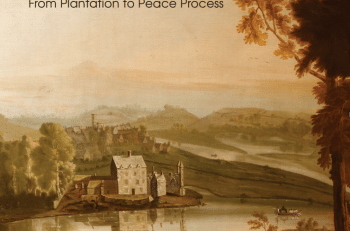
    Delving into the Past to Understand the Present, David Burke reviews Margaret Urwin’s ‘Fermanagh, From Plantation to Peace Process’.

    Margaret Urwin is known for her work with Justice for the Forgotten/the Pat Finucane Centre. Her published works include the pamphlet Counter-gangs (2012) which describes the activities of undercover British special force units in Ireland in the 1970s. In 2016 she published the highly- regarded ‘A State in Denial: British Collaboration with Loyalist Paramilitaries‘. She has now added ‘Fermanagh, From Plantation to Peace Process’ to this body of work. It delves back deeper into Irish history to help us understand the present. The book takes the reader on a compelling historical tour of Fermanagh. The early chapters deal with the Plantation and the Rebellion of 1641 and draw on depositions preserved by Trinity College, original material that brings the era vividly to life. The author then moves through the Cromwellian era and the Williamite wars. The penal laws, the famine, the Orange Order, Catholic emancipation, WW1 and the Easter Rising – and more – are all covered later. Focusing on the period from the 1920s onwards, Urwin examines what life was like in the new six-county state of Northern Ireland after partition – the systemic discrimination against Catholics in all areas of life; the role played by the Free State government; the fiasco of the Boundary Commission; the distrust of the Protestant community of their Catholic neighbours due to the IRA campaign of 1956-62; the more recent IRA campaign in the county which began after the introduction of internment in 1971. She reflects on the short-lived loyalist campaign in the county which ceased permanently in the mid-1970s, unlike in neighbouring counties, Tyrone and Armagh. Based on official declassified British and Irish Government documents, the role of the border during the conflict and Irish Government co-operation with its British counterparts are analysed while claims of ethnic cleansing and genocide are tested. The core of the book is the detailed analysis of all conflict-related deaths in the county which boosts the biographies contained in the seminal publication, Lost Lives. Case studies of particular killings are provided, e.g. Protestant civilians and alleged informers killed by the IRA; the Enniskillen bombing; the notorious ‘Pitchfork’ murders carried out by members of the British Army; the killing of IRA members by the SAS and loyalist killings of Catholic civilians. A consistent thread throughout the centuries is the enduring influence exerted by the Fermanagh aristocracy including the earls of Enniskillen, Erne and Belmore, and Baronets Archdale and Brookeborough. (The Brookeboroughs were later upgraded to Viscounts). An example of this influence occurred during the land war. This was a period of remarkable cohesion between Catholic and Protestant tenants, which gained a particular momentum in Fermanagh. (Urwin has drawn on local and national newspapers to bring this era to life). Throughout the period the aristocracy had met with limited success in their efforts to cause division but as Urwin demonstrates: In the autumn of 1882, Parnell disbanded the Land League and established in its place the Irish National League. The aims of the new organisation were more political than agrarian, the main objective being to assist the Home Rule movement. This decision sounded the death knell to Protestant and Catholic cohesion around the land issue. This at last provided the aristocracy with the opportunity they were hoping for and brought about an end to this sadly short-lived period of Catholic-Protestant cohesion The influence of the Fermanagh aristocracy was maintained up until the last century when one of their own, Sir Basil Brooke, served as prime minister of Northern Ireland 1943-63. Coming into more modern times, Urwin has conducted personal interviews with living witnesses. One of them was a participant during the IRA’s Border Campaign, Operation Harvest, 1956-62. He was involved in the best-known engagement of that conflict, the IRA raid on the RUC barracks at Brookeborough during which Seán South and Fergal O’Hanlon were killed. A fascinating fact which is brought to light in the book was the short-duration of the loyalist campaign in the county. Killings by loyalists ceased in 1975 and did not resume. This may possibly be attributed to the fact that Fermanagh is bordered on three sides by four counties of the Republic – Monaghan, Cavan, Leitrim and Donegal. Fermanagh loyalists may have felt more vulnerable to cross-border retaliation by IRA units than their neighbouring counties.   Urwin has identified another interesting fact about Fermanagh namely that it is the only county in present-day Northern Ireland that has an Anglican, as opposed to a Presbyterian, majority. Another section of the book deals with the election of hunger striker Bobby Sands as MP for Fermanagh-South Tyrone in April 1981. Urwin has unearthed new material in Britain’s National Archives. During the election campaign British officials were deeply concerned that Sands might win or, at least, get a ‘respectable’ vote. The implication of such an outcome would suggest that the Provos were a democratic alternative to the SDLP. However, the consensus among them was that a win for Sands was highly unlikely. They reckoned that, at most, 15-20,000 nationalists would vote for him. They were proved wrong and Sands emerged victorious. The result had a polarising effect which aroused huge resentment in the Protestant community. They felt betrayed by their Catholic neighbours. The events touched upon in this review are merely illustrative of the scope and breadth of this fascinating book. It will undoubtedly be received well in the subject county but has much to commend it to a wider audience. Fermanagh, From Plantation to Peace Process is published by Eastwood Books, www.eastwoodbooks.com

    Loading

    Read more