General

Random entry RSS

  • Posted in:

    Perhaps

    Enda Gormley reviews Tom Creed’s affecting revival of Barry McGovern’s adaptation of Beckett’s novel ‘Watt’, at the Everyman During the latter half of World War II, Samuel Beckett found himself in a town called Roussillon d’Apt hiding from Gestapo officers. He and his partner’s involvement with the Resistance movement had led to their exile from Paris and refuge in the Southern French town to await the end of the war. It was here Beckett finished the novel ‘Watt’. He found solace in the process of writing it and once credited the work as “a means of staying sane” during this difficult time in Vichy France which was neither at war nor at peace.  Adapting the novel to the stage must have come with a feeling of obligation to stay faithful to its opaqueness, its sense of emptiness but also its hope. Director Tom Creed’s revival of Barry McGovern’s adaptation brings with it the weight and beauty of Beckett’s language and adds only what it must. The production attains a delicate equilibrium by bringing Beckett to life in an accessible manner without significant loss of generality. In fact there is a sense of timelessness which the production invokes by use of costume design and paring down of some of the more arcane language. It expertly bridges the gap between prose and theatre. Early on, the play introduces us to Mr Watt, a man at odds, and often perplexed by the world and its inhabitants around him. He arrives at a country house in which he is due to be employed as a servant. Finding the front door locked and a state of darkness he then attempts to gain entry via the backdoor, only to find that it too is locked. Unphased he tries the front door again to no avail before trying the back door for a second time; finding that it is unlocked or “on the latch” he enters the house a little confused. The production launches from this moment, showing us the world through Mr Watt’s eyes where a dichotomous view is never sufficient. Mr Watt serves Mr Knott, the owner of the house who lives on the top floor. Mr Watt serves Mr Knott without ever actually meeting him. During his time as servant of the house Mr Watt encounters other characters who come to also serve Mr Knott. Samuel Beckett once said: “I have never accepted the notion of a theatre of the absurd, a concept that implies a judgement of value. It’s not even possible to talk about truth. That’s part of the anguish’. This production respectfully accords by never staking too much on any line and by allowing uncertainty to reign. Barry McGovern massages the air of the auditorium in the Everyman Palace as he guides us through the madcap world set out by Beckett. He allows the language to make the impact adding ornamentation tactfully. His delivery is suitably vaudevillian in parts and candid when needed. There is comedy in the language and McGovern brings it bursting to life with his natural wit. In voicing the narrator he appeals to the intellect of the audience creating a recipe of thought with what could have been a wall of sound. During brief sojourns embodying characters he is emotional and deeply engaging. The novel doubles back and repeats itself so much that it could easily be a disaster on stage but with McGovern you feel you’re in safe hands. The audience is guided through the selected parts of the novel which combine to present a cohesive message all while delivering the main body of novel efficiently under the hour mark.  But of course some compromises had to be made by bringing this rambling book to the stage. You can feel the hand of the modern producer intervening on Beckett. The gluing together of disjoint pieces to make a play breaks the rhythm of the prose at times. This can be slightly jarring when McGovern is in full flow. There are also interruptions to the stream of consciousness before it reaches its logical climax. This, however, works to foster further uncertainty. But overall the piece is well suited to the stage which offers a blank canvas for the novel to be freshly retold each night in all its vagueness. The set and lighting design complements the production. The stage is sparsely decorated with a  chair and a hand-truck. It is suitably minimalist and allows for just two acting positions-sitting and standing (McGovern opts not to lie on the ground). The lighting provides a wide range of moods and scenes. It is nuanced and offers surprises in its variation. Overall this is a greatly affecting and altogether enjoyable production. Although the subject matter is dense, the pace is brisk and the overarching message is life-affirming. This ensures we do not dwell on what is lacking. It is teeming with the hope that Beckett associates with “perhaps”.  

    Loading

    Read more

  • Posted in:

    Covid-19 compounds existing public distrust

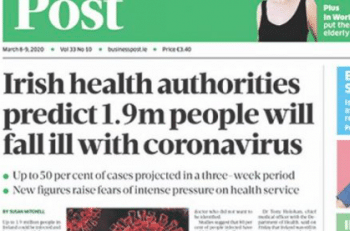
    As Italy quarantines a quarter of its people and the Business Post claims 1.9 million will get it in Ireland, it’s not just the disease that is viral By David Langwallner. “There comes a time in human history when the man who says 2 plus 2 equals 4 will be sentenced to death.” – Camus, The Plague. In his seminal ‘The Plague’ (1947) Albert Camus uses the historical plague effecting Oran in Algeria to spotlight the heroism of  engagement, and humanity in difficult times. Any perception of public emergency risks collapse of our modern universe. After hurricanes, flooding or even manifestations of police brutality riots often occasioned by urban disenchantment or inequity lead to viral barbarism.  And we have still never been deprived of the crucial two meals. There is a famous book by the recently deceased Portuguese novelist José Saramago,  called ‘Blindness’ (1989) where blindness has become a communicable disease and an epidemic. The effect is escalating panic. Individuals are quarantined and dehumanised. Human nature descends to Hobbesean  brutishness. The concepts of fairness and the rule of law disintegrate. Inept authorities run wild. Asylums are created for those quarantined. A cautionary tale for 2020.  History groans with destructive plagues. Over 3 percent of a much smaller humanity died in 541 in the Justinian Plague exported by Byzantium and named after one of the Roman emperors the same way the Americans give kitschy names to hurricanes or snow storms.  The most famous plague – exported by Mongol warriors – was the Black Death which killed 50 million people in Europe in the years around 1347 and is vividly captured in the seminal film by Tarkovsky called Andrei Rublev (1989). London’s Great Plague of 1665-6, like the Black Death an eruption of the bubonic plague pandemic, was transmitted by infected rat fleas and killed about 100,000 people, a quarter of its population, in 18 months.  The most infamous flu virus hit in 1918.  Of course more people died in that Spanish flu epidemic in the immediate aftermath of the first world war than in the entire war itself – some 50 million. They included the legendary Austrian painter Egon Schiele and the poet Apollinaire. The artists did not just die in the trenches but often afterwards. In 1918 it mainly took young adults. Those aged 75 and above had the lowest death rate of all. Such pandemics did not destroy humanity, or reach the tipping point. Of course the reason for the scale of deaths then was a lack of vaccination and the overall susceptibilities to first infection and second death was considerably higher than with the Coronavirus. But it is the rates of infection and death combined that make Coronavirus the most dangerous epidemic in 100 years. As of 7 March 2020, there have been more than 105,000 cases with the most significant outbreaks in central China, South Korea, Italy, and Iran. The number of confirmed cases worldwide is more than 10 times higher than the 8,100 known to have been infected by SARS, a related virus that caused a six-month epidemic in 2003.   More than 3,500 people have died: around 3,100 in mainland China and around 450 in other countries. As of 3 March 2020 WHO data show the percentage of patients dying after infection with COVID-19 is 3.4% globally (1.6% outside of China perhaps reflecting Western failures to diagnose all cases, but also its superior healthcare).  By comparison, seasonal flu generally kills far fewer than 1% of those infected;  measles 0.2%; but SARS and 1918’s Spanish flu 10%. The chances, surprisingly low perhaps, are that the average victim will pass the disease on to 2.5 others; though China brought that number down. There is no question but that the ratio of death to infection is nowhere near as high as in the historic pandemics. Survival is highly probable for the young and the healthy. In China around 80% of deaths recorded were from those over the age of 60, and 75% had pre-existing health conditions including heart  diseases and diabetes. But in our present universe it is increasingly difficult to disentangle fact, expertise and what is really going on. Certain Australian experts are very unclear about whether it will be numerically insignificant amounts of deaths or the appalling vista of 1919.  Italy, China and Australia are reacting with what might be externally perceived to be excessive and disproportionate measures. A day after thousands of its citizens flooded the streets of Dublin, Italy is to quarantine a quarter of its population. The Business Post is reporting as fact that 1.9 million Irish people will contract Covid-19. The present evidence from China is that the threat is diminishing and the numbers lessening. The host province Hubei is now free of new cases. But China implemented draconian, often vicious, restrictions. By 6 February 2020, four Zhejiang cities with combined populations of 30 million people were operating a “passport” system, allowing only one person per household to leave home every two days. Authorities in Wuhan city went door to door checking temperatures, rounding up suspected Coronavirus patients for forcible quarantine in stadiums, exhibition centres and the like. In London the crowded tubes and trains have become more like skeletal ghost ships. There are also very evident food runs in parts of England. I begin to sound like The Shipping News. Now the Dunkirk spirit is intrinsic to the British personality. And doubtless Johnson in his Churchill light-way will appeal to the open-minded. That is in principle good. Camus shows in ‘The Plague’ the way authorities seek to downplay a situation when they have lost control. What do they really know about the morphology and trajectory of new diseases?  We should also be wary of shamans and snake oil, and face-mask, salesman. We live in a world of despotism, lies, climate change and pestilence redolent of science fiction and we are a rapacious and destructive species enthralled by economics. Biotechnological research where innovation and funding is prized at the possible expense of morality or the public safety is very dangerous. When profits and cost-benefit analysis are the bases for decision-making then the Habermasean principle of modulating technocratic goals with

    Loading

    Read more

  • Posted in:

    MI5 FLIES A FALSE FLAG.

    MI5 faked a Loyalist arms importation to manipulate Dublin in the run-up to an IRA ceasefire. A few months later the cream of NI Intelligence were dead in the Chinook helicopter crash. Shortly afterward, the ceasefire was called. The Chinook crash files are embargoed until 2094. By Deirdre Younge. Introduction 1994 was the year of living dangerously for Northern Ireland’s spymasters. The prospect of an imminent IRA ceasefire had the intelligence community in a spin. M15 was gaining the upper hand in the battle with the RUC Special Branch for the control and flow of intelligence. Some believed the watchers were being watched. It was the year M15 attempted to pull a foolhardy false flag operation. Initially lauded as a massive coup it was quickly buried under D notices when sceptical journalists blew a hole in the story. Fronted by an Ulster Resistance leader with links to the UVF, but by now suspected by other ‘Resistance’ members of being an agent, M15 arranged a massive arms importation from Poland, aided by some members of Polish intelligence.  The shipment, seized by customs at Teesport docks in a prearranged operation, was hailed as a massive success for the security services.  The aim of the phony operation was to put pressure on the Irish Government and to ‘even up’ the threat levels in negotiations.  June 2, 1994 – The crash of a Chinook helicopter carrying 24 of  the elite of the intelligence community in Northern Ireland: senior RUC officers like Brian Fitzsimons Assistant Chief Constable and Head of Special Branch; Army Intelligence Head and founder of FRU,Lt Colonel Victor Williams; Director and Coordinator of Intelligence, M15’s John Deverall; Michael Maltby, an M15 specialist in money laundering who had spent a career investigating IRA finances; Anne James, M15, among those who died on the side of a mountain on the Mull of Kintyre when the RAF Chinook helicopter, piloted by  special forces pilots crashed in fog. The other passengers, RUC officers Detective Superintendent Ian Phoenix, Detective Chief Superintendent Des Conroy were regarded as having a mastery of the intelligence files, a vital asset in a largely non computerised system. The helicopter was heading, not towards the stated destination of Fort George, Inverness but, according to high level security sources, to Machrihanish airbase minutes away from the crash site, on the other side of the Mull of Kintyre. The purpose of the carefully arranged flight was a meeting with American Intelligence counterparts in the CIA and FBI  for an annual ‘summit’.   Machrihanish, then a top secret base which hosted high level meetings, was also used by the American Navy as a base, a training centre for Navy Seals, and for top secret flights. Just before the crash the American intelligence contingent had landed at Machrihanish in a private jet with American markings which was literally flying under the radar. After the crash  documents were strewn around the impact area which was protected by a seven mile cordon. Files relating to the Chinook are embargoed until 2094 apart from a small number of  files containing a few pages released in 2019. Immediately after the disaster on the Mull the spinning began about the destination and the purpose of the meeting. The truth got lost in the fog of disinformation. Newspapers were briefed by the RUC that the intelligence specialists were meeting to discuss a threatened bombing campaign against Dublin, the evidence of which was the importation of weapons and explosives from Poland which had been seized by customs at Teesport seven months earlier in a seeming ‘coup’ for M15. The false flag operation was being linked to the dead officers. The Sunday World covered the Chinook helicopter crash extensively three days later and detailed the RUC brief about Teesport However, the importation had been arranged by MI5 to influence the Dublin government. [Author’s note: for the avoidance of confusion: MI5 (which is attached to the Home Office) often works in co-operation with MI6 (which is attached to the Foreign Office). Both organisations appear in this story, although the primary moving party here was MI5.) Stella Rimmington, the Director-General of MI5 at the time of MI5’s false flag operation involving commercial bomb materials imported from Poland. TEESPORT RENDEZVOUS In early November 1993 a senior RUC officer was surveying the docking area of a container ship in Teesport, Cleveland, north-east England. ‘The Inowroclaw’ was sailing from Gdynia in Poland to Teesport and from there to its declared final destination of Belfast Port and into the hands of the UVF. It was jammed with armaments. Later that month the RUC officer returned with a battalion of UK Customs officers to Teesport docks to ‘intercept’ the shipment before it reached its declared destination. The RUC officer was working with MI5. He had been in Teesport  weeks in advance  to ensure that nothing could go wrong. This time the weapons would not be distributed as had happened six years previously. If the arms were added to the UVF arsenal it would match anything imported from Libya by the IRA. The Inowroclaw This is not the plot of a Northern Ireland  ‘noir’ novel, but a ‘false flag’ operation at the tail end of the undercover war in Northern Ireland. By the time it sailed from the Baltic Port, the container-load of weapons included 300 assault rifles, grenades, pistols and detonators as well as two tonnes of plastic explosives. The importation, Loyalist sources in mid-Ulster told Village, was instigated by a man linked to Ulster Resistance, an Ulster loyalist paramilitary movement established in opposition to the Anglo-Irish Agreement,  in Armagh. He was also closely aligned to some members of the  UVF  –  and the Security Services. He had apparently convinced a Loyalist faction that he could source weapons from contacts in the Polish arms industry which, perennially economically challenged, was anxious to make deals to keep factories in business. Ironically, suspicions about this man among local Ulster Resistance activists – the ‘small men’ in Armagh – had  led to the RUC’s disastrous loss of control

    Loading

    Read more

  • Posted in:

    The armalite and the ballot box: election results could vindicate Sinn Féin’s electoral strategy.

    Via violence to contempt to abstentionism to normalisation perhaps to government. By Dan Haverty. It is difficult to exaggerate the magnitude of Sinn Féin’s electoral performance in the Irish general election. Once the political wing of the paramilitary Provisional Irish Republican Army (IRA), Sinn Féin took down a political establishment that had been in power since the state’s foundation in 1922. It won the most first preference votes of any party, topping the poll in a shocking 24 out of 39 constituencies. It secured its place as the leading voice of the Irish left, probably marking the definitive end of the Labour Party’s 108-year run as a relevant force in national politics. Although it only ran 42 candidates across the 39 constituencies (thus ensuring it didn’t win even more seats), pundits agree that Sinn Féin is now one of the dominant forces in Irish politics. For outside observers, the results mark a dramatic realignment of Irish politics that began with the financial collapse in 2008. For republicans, Sinn Féin’s historic performance brings a highly controversial four-decade-old internal process of politicisation close to final vindication. The modern iteration of Sinn Féin emerged out of a split within the republican movement in 1970. The ‘Provisional’ faction of the movement (from which modern Sinn Féin emerged) opposed the ‘Official’ faction’s move toward electoral politics, choosing instead to pursue the full unification of Ireland through violence. Born in a culture of absolute contempt for party politics, Sinn Féin’s role was minimal, serving as little more than a mouthpiece for the far larger and more active Provisional IRA. Sinn Féin began to take on a more important role in the movement’s activities as tensions between authorities and republican internees in Long Kesh prison worsened in the late 1970s. In 1976, the British government chose to revoke political status from paramilitary prisoners in its attempt to “normalise” and “criminalise” the security situation in Northern Ireland. This sparked a spontaneous prison-wide protest among republican prisoners, culminating in the high-profile hunger strikes of 1980 and 1981. The republican leadership on the outside had little control over the direction of the protest movement, and rather than try to assert authority over its living martyrs, it opted instead to organise a grassroots campaign to support them. Sinn Féin was at the forefront of directing the day-to-day activities of the so-called Anti H-Block committees, organising street demonstrations and fund-raising campaigns that generated a renewed interest in—and sympathy for—the republican struggle. The campaign escalated sharply in March 1981, when independent Fermanagh and South Tyrone MP Frank Maguire died of a sudden heart attack, forcing a by-election for his seat. Sinn Féin was initially reluctant to contest the seat, fearing a loss would undermine support for the prisoners. But it ultimately decided that a strong enough loss would still serve its wider purposes, and it chose to stand lead hunger striker Bobby Sands on an Anti H-Block ticket. A groundswell of support followed, which Sinn Féin carefully channelled into electoral points for Sands. Sands won the election, sending shockwaves through both the British and Irish political establishments. Two more hunger strikers were elected to the Irish parliament in the general election in June of that year, convincing a large section of the movement that a well-organised, grassroots campaign in support of republican objectives could deliver tangible political results. In the aftermath of the hunger strikes, Sinn Féin opted for a new strategy combining armed struggle with electoral politics. But by the middle of the 1980s, the Gerry Adams and Martin McGuinness-led leadership decided a more comprehensive electoral strategy was needed to advance the struggle. They wanted to build a political movement in the Republic to support the fight for freedom in the North, but they knew this required an economic and social programme independent of the struggle that could appeal to Southern working-class voters. This necessarily had to include a commitment to take their seats in the Irish legislature, an institution Sinn Féin had never previously participated in because it was viewed as a British-imposed body with no legitimacy in Ireland. The ensuing debate over whether to end abstention from the Irish legislature opened a chasm within the movement, pitting traditionalists against reformists over the soul of republicanism. Abstentionism was first employed in the 1910s in an attempt to render the British parliament inoperable, but it was elevated to principle status after the revolutionary period of the 1920s. Traditionalists argued that it embodied their rejection of British-imposed institutions and thus justified the armed struggle. On a strategic level, traditionalists always argued that violence was the only force capable of pushing the British out of Ireland. If a political strategy was adopted, its needs would supersede the needs of the armed struggle, and the IRA would have to be restrained and eventually disbanded, thus depriving the movement of its cutting edge. Once defanged, the need to win votes would lead to ever increasing compromises which would push republicans to soften their political aims, thus neutralizing any meaningful threat to the state. But by the mid-1980s, the conflict was nearing two decades old and was seemingly in a stalemate, and the reformists privately arrived at the conclusion that the moment for armed struggle had passed and they could no longer achieve their aims militarily. They feared that if they did not change their tactics, they risked losing the tremendous wave of sympathy generated by the hunger strikes. They concluded that the conditions were ripe enough to move Sinn Féin and the IRA fully out of war and into politics. The reformists won out, and in 1986, the IRA made the historic decision to drop abstention from the Irish parliament and allow elected Sinn Féin representatives to take their seats. It followed an emotional (and deeply divisive) debate within the movement, leading a faction of traditionalists to leave and form their own breakaway group. It still took decades for Sinn Féin to build a respectable following in the Republic, but the change freed it to

    Loading

    Read more

  • Posted in:

    General Election 2020 Editorial: Vote Left and green

    In 2016  (and 2011, actually) Village editorialised, “You would think from our recent history of some of the most notoriously bad governance on the planet, that we would have learnt that our political classes need to be replaced. In fact, this election time we see no new ideas”. Sadly democracy in Ireland needs an overhaul every bit as much now as it did in 2016 and 2011. Village remains disappointed at the quality of politics, across the range.  The parties are again fairly easily characterised: Fine Gael is a centre-right party with an obsession with observing the rights of property that has failed to establish an enticing vision, especially socially and environmentally, of Irish society.  In nine years in government it has failed abjectly on housing where there are 10,000 homeless and health where there are more than 500,000 on outpatient waiting lists. It has a tendency to indulge nastiness against the most vulnerable on issues from social welfare to immigration rights. Though heralded as economically competent it is not clear that it was wise for it to facilitate a hard Brexit. Labour never does what its progressive manifestos promise. Worse, a number of its senior TDs appear ideologically jaded. Because of the elasticity of its conscience Labour has long attracted the wrong type of representatives. Fianna Fáil is tainted by its reckless and corrupt past and the incoherence of its platform. It believes serving the people, parish and business in equal measure is viable. It has an attractive leader in Micheál Martin though one who only belatedly seemed to demur from the shenanigans of Charlie Haughey and Bertie Ahern under whom he served. Its centre-left incarnation disguises regressive and socially conservative tendencies. Sinn Féin’s manifesto commitment to a Left agenda is impressive but precarious bearing in mind its preference for irredentist nationalism over ideology, its centrist pragmatism in the North and especially its willingness to coalesce with Fianna Fáil or even Fine Gael. It has been ambivalent about democracy and transparency, and its leaders lie casually about its, and the IRA’s, past. It has not fully accepted an environmental agenda. Village has had a weakness for the Social Democrats, whose mild but sensible platform is essentially the same as Labour’s, but it has probably blown its chance by personality frictions and policy divisions between an old guard centred on quality of life and a younger cohort focused on identity politics. The radical Left offers the huge appeal of integrity and seriousness but its opposition to property taxes is inexcusable, and its focus on opposition to the loathed water taxes rather than a broader anti-inequality platform, including opposition to the iniquities of Nama, corruption and the resurrection of the developer classes wasted time and energy and diverted its revolutionary ideology. As Oisín Coulter’s piece shows it may be happy avoiding power. The Green Party’s policies are often radical, and its agenda mature, but it is not hard-minded and the implications of its failure to realise how little it achieved the last time it was in government means it is difficult to be enthusiastic. The Independent Alliance (or whatever it’s called, formerly Shane Féin) is utterly incoherent of policy and membership; and appears moribund.  Village believes promoting equality of outcome, sustainability and accountability are the most important policies; and it is difficult to be optimistic about their immediate Irish prospects. A radical new venture is needed. Against this backdrop, we would again not presume to advise readers precisely where to direct their votes. However, we can say the non-ideological, non-visionary parties of the pragmatic centre hold little appeal, even when the non-vision seems to be a slightly left-of-centre non-vision. A coalition of the parties of the Left, radical Left and the Greens would, as always, best promote Village’s agenda, if no doubt imperfectly.

    Read more

  • Posted in:

    Leo Varadkar, dicing with nastiness

    Taoiseach Leo Varadkar is viscerally and divisively right-wing, socially and economically; but hides it behind incoherent and inept policies and a now-suspect nice-guy media persona.    By Michael Smith (February 2020).  A famous 2010 Après Match sketch has Ireland’s Taoiseach Leo Varadkar openly admitting he’s plotting to knife his party leader Enda Kenny while gratuitously denying, in a mid-Atlantic nasal twang, that he’s going to set up an elite party which of course suggests he is in fact intending to do just that. A stage-Vincent-Browne with an impossible wig wonders whether he was bitten by a lizard, a snake or an eel. Though the elite party isn’t part of the revealed agenda he’s an exotic and cosmopolitan proposition no doubt; young and attractive, hipsterish, agnostic; a half-Indian, gay, charming and articulate doctor; a star-turn on the international stage.  Over the last decade the satirist Oliver Callan has characterised Varadkar as an image-fetishising, gym-obsessed dude, increasingly cold to the downsides of his austere policies, the Teesh in a cabal of unpleasant elitists.  The Varadkar who presented at the first leaders’ debate on 22 January 2020 had clearly been briefed to project an image of humility, emotion and modesty.  Two and a half years into his premiership, scrutiny, the pressure of office and the relentless exposure of the policies and failures of his party are undermining his nice-guy credentials as his empathy becomes an election issue. And, as Village has always wondered, is there any beef?  Varadkar is young and attractive, hipsterish, agnostic: a half-Indian, gay, charming and articulate doctor’  Background  Varadkar was born in Dublin in 1979. the youngest of three and the only son of Ashtok and Miriam Varadkar. His Mumbai-born father had moved to England as a doctor in the 1960s. Miriam comes from a Fianna Fáil family; Ashtok considered himself a socialist and voted Labour. His Dungarvan-born mother met her husband while working as a nurse in Slough. Later they lived in Leicester and India, returning to Dublin in 1973.  Leo, it seems, was the perfect son. His mother has said: “He was too good to be true, actually. Everyone adored him. He was adorable, a gorgeous baby and then he went into  Fine Gael. And that’s it. He never said it. We just found out”. So little Leo wasn’t born a Fine Gaeler.  But he soon made up for lost time.   Varadkar was brought up Catholic and educated at the St Francis Xavier National School in his home of Blanchardstown before attending the liberalising fee-paying Church of Ireland King’s Hospital School in Palmerstown, where his classmates included the future excitable-presenter Kathryn Thomas. He obtained a wagon-load of points in his Leaving Cert. It was during his secondary schooling, debating and all that, that he joined Fine Gael.   After an abortive few weeks in the Law faculty, he got a points-upgrade and studied Medicine at Trinity College Dublin, graduating in 2003. He spent several years as a junior doctor in Connolly Hospital before qualifying as a general practitioner in 2010. He often worked 36-hour shifts as a doctor, missing a night’s sleep; but rather than finding it stressful, he has said: “I quite liked the buzz of being busy”. Nevertheless, in 2016, he declined an invitation by the Irish Nurses and Midwives Organisation (INMO) to work a 12-hour shift alongside them in an A&E because “they never formally asked”.  Around this time Varadkar was singled out for greatness by the Washington Ireland Program, which prepares ambitious young people for future leadership roles. Party grandee Nora Owen recalls him as overweight and Thatcherite around this time when he came to her attention.  In 2004 the tyro’s ambition began to find expression as he was co-opted to Fingal County Council, serving as deputy mayor.  Varadkar was first actually elected to Fingal County Council later on in 2004, drawing 4,894 votes, the highest in the State; there was a niche in Fingal for at least one meaty Thatcherite.  He won a Dáil seat in 2007 and was immediately elevated by Enda Kenny to frontbench Spokesperson on Enterprise, Trade and Employment, remaining in this position until a 2010 reshuffle when he became Spokesperson on Communications, Energy and Natural Resources.   In Government  Transport  When Kenny led Fine Gael into Government with Labour, Varadkar served as Minister for Transport, Tourism and Sport, from 2011 to 2014. He presided over ‘The Gathering’: the largest and most successful tourism initiative ever held in Ireland though one that left little in the way of a long-term imprint. He took the decision to link Dublin’s two independent Luas lines, opened up more bus routes to competition, restarted development at the National Sport Campus, and gave independence to Shannon Airport. He also developed a new Road Safety Strategy and a National Ports Policy.    These are petty enough achievements for a three-year Ministry.   He was already burnishing his lack of interest in the environment and did little to implement Noel Dempsey’s typically progressive ‘Smarter Travel – a Sustainable Transport Future’. He obtained government funding for its commitment to the €550m 57km public-private partnership of the egregiously over-scaled Gort-Tuam motorway while cancelling the necessary Dart Underground and Metro North underground plans, and again deferring Metro West, in Dublin.    ’ These are petty enough achievements for a three-year Ministry’   Health  He was then promoted to Minister for Health (2014-16) where he secured a controversial €1bn increase in the health budget, introduced free un-means-tested GP care for all children under six and seniors over 70, in what were iniquitous policy lurches. He published Ireland’s first ever National Maternity Strategy and secured funding and planning permission for the shifted National Children’s Hospital. He also introduced innovative public health legislation to regulate alcohol pricing and marketing and sought a 20% tax on sugar-sweetened drinks.   Health is never an easy gig but he did not do anything dramatic beyond disposing of his party’s clearest policy – the promise to create a universal health care system, to move away from the invidious “two-tier” health system. Remarkably, he never had to explain what he was replacing it with. It’s not evident he even thought that the particular principle, or indeed having a principle, was of any significance. The issue is only now being addressed under the fangled ‘Sláintecare’, though with a long horizon.   The HSE too, in accordance with policy, was supposed to be abolished by 2020, though beyond a “healthcare commissioning agency” it was not clear by what it would be replaced. This did not happen, anyway, and it remains very much with us, a blotch of redundancy for a regime that fancies it is business-like. Some months ago, Minister Simon Harris announced it is to become a strategy and standards body supplemented by six regional health boards, not unlike those that predated the HSE’s establishment.   Varadkar also seems to have had little problem with the entitlements of professionals and, as Minister, announced the restoration of €12,000 for consultants who backed the Haddington Road and Lansdowne Road agreements. Of course, the indulgence of the entitled elite really re-emerged when complacency about the economy set in a few years later.  In late 2019 Health Minister Simon Harris proposed that hospital consultants be offered a salary of up to €252,150, a significant increase on the rates currently applying to post-2012 consultants, under a new public-only consultant contract which prohibits private practice either on or off-site. It seems reasonable

    Loading

    Read more

  • Posted in:

    Protesting and sublime.

    Review:  Derek Jarman at IMMA. By Noelle English. Derek Jarman was a bombshell in the 1980s.  As an artist, filmmaker and gay activist, he made music videos for The Smiths, Marc Almond, The Pet Shop Boys and others.  His film ‘Jubilee’’s representation of punk so outraged Vivienne Westwood, one of its progenitors, that she designed a t-shirt in protest.  In the face of tabloid homophobia, he worked to educate and normalise the discourse about gay sex. He won Alternative Miss World in 1975 and was the first public figure to openly battle HIV and at a time when AIDS patients were still vilified and feared.   The most surprising thing about the PROTEST! exhibition of Jarman’s work currently showing at IMMA is that the artist’s fame as filmmaker and as activist is outweighed by the sublime impact of his lesser-known paintings.  In an interview with John Cartwright shortly before his death, Jarman said that he was a painter first and a filmmaker by accident: I never thought of myself as a film director I have to say that.  Canvasses are much more private and it was great to paint but every now and again it was more fun to have a lot of people around and so the element of having a party in my filmmaking is very important and anyone would come along and I would try to give them a good day.  It’s happy work. The quiet beauty of his 1960s geometric landscapes of Avebury Henge testifies to this painterly instinct.  These contrast dramatically with his series of Black Paintings from the early 1980s when, in the face of Thatcherism, Jarman’s anger and defiance explode through the widespread use of black pigment, this time over gold leaf to create a chiaroscuro effect in an explicit celebration of his sexuality.  His scathing rejection of homophobia and his campaign to educate the public about homosexuality is exquisitely articulated in NRLA (Third Eye) Installation where we see a buoyant Jarman leading the audience through his own 1989 exhibition in Glasgow. .  Most remarkable and moving, however, are the ‘Slogan Paintings’ which were commissioned by the Manchester Art Gallery in 1993, when Jarman was very ill and almost blind.  Here, we see a merging of  art as public protest with the artist’s private reflections on suffering and mortality.  Language and meaning are sublimely brought together in this tactile series of paintings, with each painting’s title scrawled across its surface.  Luscious, fingered swirls of white paint over red in ‘Infection’ are an eloquent depiction of the body under attack.   There are angry, hacking scratches of black and red paints over a series of tabloid pages in ‘Morphine’, playful daubs of green and blue in ‘Dizzy Bitch’, a romantically naïve heart-shape outlined over the title of ‘Queer’, and a bitterly ironic joke driven home in the repeatedly overwritten ‘Fuck Me Blind’.   In the iconic painting ‘Death’, a cross and circle create an archetypal form with words partially hidden underneath its layers of paint, as painter and sloganeer find equilibrium.   In the interview with Cartwright, Jarman said that he was too sick to make any more films and with a sad dignity had resolved to spend the rest of his life painting landscapes. I am much happier painting now.  Karl and I can sit in this room which is a very nice room.  The paintings are just as interesting as the films so it’s not as if one’s taking second best. Derek Jarman PROTEST!, Irish Museum of Modern Art until February 23rd.

    Loading

    Read more