General

Random entry RSS

  • Posted in:

    Co-house, co-op but only sometimes co-live

    We should look to Co-operative and Cohousing solutions to the Housing Crisis caused by dependence on developers and prejudice against social housing by Caroline Hurley and Kim O’Shea THE RUMBLING by the Criminal Assets Bureau (CAB) of a dangerous gang engaged in prolonged extortion of building companies for protection, leading to High Court drama in October 2019, was the culmination of various inquiries involving Dublin City Council into accusations of illegal practices since 2016. CAB claimed well-rewarded criminals carried out anti-social acts at building sites to pressurise developers to decamp. In Drogheda, after seventy shootings and bombings in one year between feuding families, national emergency and armed response Garda have been deployed but a lack of intelligence hampers efforts. Some believe only the type of multi-agency taskforce assembled to combat similar mayhem in Limerick in the early 2000s would work now. Feuding Ennis families repeatedly fight it out with machetes, chainsaws and slash hooks. Casualties mount as the Hutch-Kinahan war extends internationally from Dublin. Parcel bombs are being tossed through letterboxes in a Killarney housing estate. With aggression escalating, bus and rail workers voted unanimously last August to strike if nothing was done about daily assaults, threats, robberies and racist insults encountered by them. 2018 saw a 7% rise in crimes categorised as anti-social, and a 50% risein anti-social behaviour orders issued, with only about 200 served nationwide Beyond those headline-grabbing examples, noise, verbal abuse, trespassing, property damage, stalking and other intrusive and disruptive behaviour frequently forces trapped, targeted householders to uproot as complaints fall on deaf ears. Violations range from vicious random attacks to insidious sinister predation. Effective legal remedies seem to exist in theory only. It’s as if afflicted residents are suddenly conscripted by faceless officialdom into an isolated full-time social-work role, with no consultation or preparation. According to the Central Statistics Office (CSO) and Garda figures, 2018 saw a 7% rise in crimes categorised as anti-social, and a 50% rise in anti-social behaviour orders issued, with only about two hundred served nationwide. Communities live in fear of fearless malfeasants. Where the nuisance is eliminated there is a syndrome of counter-threats. None of this suggests we should condone vengefulness but it does point to the futility of pursuing approved avenues of redress, given beleaguered gardaí, disempowered Councils, conflicted Courts, and meek providers of Citizens Advice, Crime Victims Helpline, and similar bodies. The most pertinent laws are: the Housing Acts 1966 to 2014, governing local authority housing; the Planning and Development Act 2000; the Residential Tenancies Acts 2004 to 2016; the Criminal Justice (Public Order) Acts 2004 to 2016; the Non-fatal Offences against the Person Act 1997; the Children’s Acts 2001 to 2017; the Control of Dogs Act 1986; the Environmental Protection Agency Act 1992 and the Courts Act 1986. An analysis of training for local authority staff dealing with anti-social behaviour, cited in a Community Mediation Works 2010 report, ‘The State Of “Anti-Social Behaviour” In Working Class Communities’, found that “training focused on ensuring that the correct legal procedures were followed”. Equipping staff with skills conducive to impartial investigations, community mediation and tenancy support were peripheral considerations. Bureaucratic rigidity seems still to prevail, though there is a greater emphasis on rights. The report criticised “housing management policies that make enabling tenant purchase the priority”, to the detriment of quality, amenities and relationships. It blamed the 1997 Housing Act for splitting anti-social behaviour into two categories: first, drug dealing, and then, serious intimidation and threatening behaviour, suggesting the latter was less important. The 2003 Norris report faulted the Act for pushing eviction without due process as the solution of choice to anti-social behaviour. While eviction is very rare now, anti-social behaviour is not. Providing only the draconian measure of summary eviction as redress for the widespread torture of peace-loving citizens is uncivic. While not dealing directly with community conflict, management could arrange “cost effective programmes proven to help families in difficulty live peaceably with their neighbours”. These measures could include mediation, family support, monitoring, liaison and above all, real tenant participation through their own organising initiatives. However, such resources are rarely made available. The Free Legal Aid Centre (FLAC)’s 2018 Annual Report drew attention to “the vague and imprecise nature of the legislation dealing with Garda vetting prior to the allocation of local authority housing and the huge disparity between local authorities in relation to the assessment of disclosures made by Gardaí and more worryingly the nature of certain disclosures being made by An Garda Síochána itself”. The lack of standards is causing social collapse. Tenants of housing associations or Approved Housing Bodies (AHBs) report much higher levels of satisfaction than those living in either the council or private sector Residents’ suggestions for beneficial amenities are routinely refused, leaving many with nothing to do but reconcile themselves to their own containment. As anger spills over, the risk of harsh measures like fines and curfews goes up, even though research by bodies like ‘Preparing for Life’ shows that humane steps including early intervention and education are what really work. A wideranging 2017 survey by the Irish Council for Social Housing discovered that tenants of housing associations or Approved Housing Bodies (AHB) report much higher levels of satisfaction than those living in either the council or private sector. Regular property maintenance, reasonable hands-on management, tenant focus and a sense of community were advantages cited. AHBs tend to have strict anti-social policies facilitating fast, effective action. An internal audit of local authorities conducted by the National Oversight and Audit Commission (NOAC) in 2017 referenced policies and procedures meant to be followed for similar challenging situations, but they are mere aspirations. The responsibility of local authorities to co-ordinate services for citizens of varying needs, in such a way as to balance the rights of all, appears diminished. The Housing Agency, whose remit is to facilitate national housing policy, has published papers by the Centre for Housing Research shedding light on approaches taken internationally to ameliorate friction between neighbours. While taken for granted

    Loading

    Read more

  • Posted in:

    Drew Harris Drawn in.

    As allegations continue to be made about the involvement of Robert Nairac in the Miami Showband massacre, how compromised is Garda Commissioner Harris who was PSNI liaison with Britain’s intelligence services? By Deirdre Younge. In the High Court in Belfast the British Government’s Ministry of Defence (MoD) and British Army are applying to have cases relating to the Dublin and Monaghan bombing atrocity of 1974 dismissed, alleging they are out of time. The bombings were carried out by the Glennane gang also known as the Portadown UVF who were also at the heart of an organisation that came into existence in the 1980s called Ulster Resistance. A recent BBC ‘Spotlight’ programme dealing with Ulster Resistance confirmed extensive collusion across the loyalist spectrum from DUP to UVF, UDA, UFF to MI5. Members of Ulster Resistance (UR) became aware that some of its members were MI5 agents. The key MI5 agent inside UR was carved out of the distribution of the weapons it had procured in late 1987 by those who were not under the control of the intelligence services. At the same time, information was leaked from RUC and the UDR which provided them with details of ‘suspected republicans’. The BBC NI Spotlight programme showed images of RUC intelligence that ended up in the  hands of the UFF/UDA. It  was used to target suspected republicans, including Loughlin Maginn, shot in Rathfriland in August 1989. His death, following that of solicitor Pat Finucane in February 1989, sparked the decades-long investigations by Sir John Stevens into collusion by the Security forces. Stevens was not shown evidence of RUC collusion. (BBC Spotlight on the Troubles, October 2019.) The fact that the UDA were receiving large volumes of  intelligence material from RUC sources was known to the agent Brian Nelson,  his Army Intelligence handlers and M15. That intelligence also, no doubt, informs the de Silva Report into Pat Finucane’s murder. De Silva was given access to British Army and MI5 intelligence that RUC officers at every level were leaking information to Loyalists. That intelligence is also integrated into the Ombudsman’s report on the Loughinisland murders as it relates to RUC ‘tip-offs’ about surveillance operations carried out in an attempt to seize UR weapons in Armagh in 1987 and 1988.  Awareness among members of UR that some of its members were M15 agents led to a disastrous loss of control by the Security Services and Special Branch  – and multiple murders Part 1: Commissioner Harris Drew Harris, the Garda Commissioner, didn’t leave the ‘Troubles’ of Northern Ireland behind him on entering Garda HQ. Drew Harris As former Assistant and Deputy Chief Constable of the PSNI and its former interface with the Security Services (UK), Harris has been accused of  fighting attempts to get information about the perpetrators of atrocities like the Miami Showband murders and of blocking access to  files about the many murders carried out by the Mid-Ulster, UVF ‘Brigadier’ Robin  Jackson. In 2011 the Historical Inquiries Team found Jackson had been connected to a weapon used in the Miami Showband murders by fingerprint evidence. In the High Court in Belfast in 2017 Judge Seamus Treacy ruled that there should be an overarching investigation into State collusion with the ‘Glenanne Gang’ and asked the PSNI to respond. In the Court of Appeal in Belfast the Lord Chief Justice ruled in July 9 [2019] against an appeal and said there must be an independent investigation carried out by the PSNI. Chief Superintendent Jon Boutcher has started an investigation into the Glennane series of killings as part of Operation Kenova. In an extraordinary development, Eugene Reavey whose three brothers were murdered in Whitecross in Co Armagh in 1976, has been told by the Police Ombudsman of Northern Ireland that a file has been sent to the Public Prosecution Service in the case. It is believed to recommend prosecution of a former RUC man, who was a member as ‘The Glennane Gang’. With the signing into law in Ireland of the Criminal Justice (International Cooperation)  Act  2019, the Garda can now give evidence and share intelligence with Coroners’ Courts in Northern Ireland. In an interesting twist of circumstances, Commissioner Harris  now has charge of the legacy files of secret Garda intelligence. Clearly how ambitious he’d want to be in sharing this information with authorities in the North is uncertain. As Assistant Chief Constable of the PSNI Drew Harris was the liaison between the Security Services (UK) , the PSNI and the Smithwick Tribunal from 2006 to 2014. (See also https://villagemagazine.ie/how-smithwick-got-diverted/ )The Tribunal was inquiring into alleged Garda collusion in the murders of Chief Superintendent Harry Breen and Superintendent Bob Buchanan. (See also https://villagemagazine.ie/investigation-killusion/http://Killusion ) He confirmed that he had spoken to the Security Service before he gave evidence to the Tribunal in October 2012. Drew confirms his consultation with the ‘British Security Service’ In 1989 MI5 reported the overall picture seems to be one of RUC collusion and links with the Loyalists which is similar in scale to that of the UDR, but the latter is much more likely to become involved in very serious crimes Dealing with the past is also causing problems for some retired RUC men – members of the Northern Ireland Retired Police Officers’ Association (NIRPOA). They now apparently  believe a policy of  non-co-operation with bodies like the Police Ombudsman of Northern Ireland  has been counterproductive. The Miami Showband Part 2: Ombudsman confirms collusion NIPROA took a Judicial Review against the Police Ombudsman of Northern Ireland and his 2016 report on the 1994 Heights Bar murders in Loughinisland. Former Head of Special Branch and Assistant Chief Constable Ray White often acts as its spokesman. In 1989 MI5 reported the overall picture seems to be one of RUC collusion and links with the Loyalists which is similar in scale to that of the UDR, but the latter is much more likely to become involved in very serious crimes Their affidavit was submitted in the names of Ray White and retired Chief Superintendent Thomas Hawthorne, the former Sub Divisional Commander in Co Down and chief investigator of the Loughinisland

    Loading

    Read more

  • Posted in:

    Irish Reunification: possible forms it could take

      The parties’ election manifestos are elusive about the structure of the united Ireland to which they aspire. By Anna Mulligan. The biggest geo-political concern for this country is the possibility that in this decade, or even in the lifetime of the next government, a majority of people in Northern Ireland could be in favour of reuniting with the Republic.  With the tide of Brexit-caused uncertainty receding, this general election campaign finally offers us a chance to think beyond the next budget – to discuss critically what reunification might mean.  Since the Brexit referendum, commentators in the Republic have been falling into the trap of engaging with the question of reunification enough to raise hackles, but not enough to inform anyone of anything.  From Fine Gael to Sinn Fein, many of the parties state that their eventual goal is a united Ireland, but none have a clear position on what a united Ireland would look like. If the Brexit referendum holds a lesson for us, it is not to call a vote on a massive, sweeping change without first developing an understanding of the specific issues involved. The very term “united Ireland” is part of the problem. The question isn’t whether we should have a “united Ireland”, but whether we should reunite Ireland, and how, and what kind of country that new state would be.  The Good Friday Agreement is open-ended: it says that a border poll showing a majority in the Republic and the North for reunification would be a binding obligation on both governments to introduce legislation “to give effect to that wish”. The ambiguity in this statement – the nature of the wish, and how effect could be given to it – is ours to make sense of.In the Republic of Ireland, we have a bicameral parliament and a principally ceremonial President. We amend our constitution frequently by referendums. In Northern Ireland, there is a unicameral devolved legislature responsible for “transferred matters” (issues not reserved to Westminster) and for selecting the Northern Ireland Executive. This selection process is structured so that the Executive will include members from both unionist and nationalist communities, and the Good Friday Agreement requires that some controversial motions in the Assembly be passed by “cross-community vote”.  A reunification process would involve reconciling these structures. In doing so, three issues are most urgent – devolution, power-sharing, and the constitution. Any kind of reunited Ireland would involve trade-offs between these three concerns.  Keeping these in mind, there are broadly three ways that Ireland could go about the process of reunification: absorption, devolution, and integration. All of these options are on a continuum:  any arrangement can be more or less federal, involve more or less power-sharing mechanisms, and require more or less constitutional change. As a result, differences of degree need as much consideration as those of kind. The German Option: AbsorptionI’m not going to hold up any one option as preferable, but I do want to dispense with one that merits no consideration: the German model, in which the Republic of Ireland “absorbs” Northern Ireland and changes almost nothing about itself, from its flag to its constitution to its legislature. This model abandons power-sharing, devolution, and the spirit of the Good Friday Agreement, while it leaves Bunreacht na hÉireann almost untouched.  This model is the embodiment of unionist fears about reunification. There would be no protections for their interests as a minority, no safeguards to preserve the Good Friday Agreement’s delicate balance. The idea that a century of partition could be unravelled without compromise is unrealistic and inflammatory.  At times, it seems that this is what the great multitude of people who have been pushing for discussion on the issue mean when they say “united Ireland” – but if it ever does happen, they risk a shock. Now that the threat of a hard border in the near term has lifted, there’s no excuse for raising a delicate issue just to play pretend. Parties and voters in this election need to understand that reunification is not a policy towards Northern Ireland, but a policy of transformation for the Republic of Ireland and the North both. The Federal Option: DevolutionOne alternative is a federal or confederal option. This would effectively continue devolution with the Dáil replacing Westminster, allowing the institutions of the Good Friday Agreement to survive in a version of Stormont. This model would seek to acknowledge that distinct political cultures have emerged on this island over the course of partition.  The more radical option would be a “three parliament” solution, which was considered by the New Ireland Forum in 1984. This envisions separate parliaments and executives, North and South, along with an overarching government with relatively weak central authority. The “three parliaments” solution preserves power-sharing and devolution but would require serious constitutional change, and that a new Ireland bear the costs and complications of sustaining three separate bureaucracies.  It was for this reason that the Joint Committee on the Implementation of the Good Friday Agreement rejected the “three-parliaments” option in its 2017 report. It proposed another federal option: the “two parliaments” solution. Stormont, it argued, has always existed as a devolved parliament with limited authority. Just as we have seen devolution all over Britain without any apparent need or demand for a devolved authority in England, so – the report argues – would there be little demand for a 26-county parliament in a united Ireland. This model would leave power-sharing intact at a regional level by retaining Stormont as is, while the Oireachtas would operate as Westminster does now.  Sinn Féin’s manifesto appears to nod to this model, advocating for Northern MPs to be accorded membership in the Dáil – although there is no mention of whether this would foreshadow a similar structure after a vote for reunification. Fine Gael’s manifesto also discusses a commitment to the Good Friday institutions and to devolution that could be compatible with a federal or confederal model, but again, the situation envisioned after a border poll is

    Loading

    Read more

  • Posted in:

    Review of Seamus Mallon’s ‘Shared Home Place’ (Lilliput, 2019; with Andy Pollak).

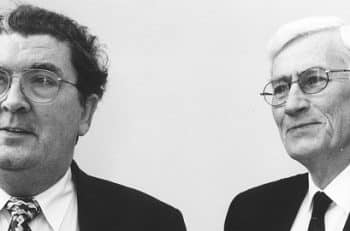
    A memoir with thin narrative and little polemic nevertheless reveals  a steely and moral man with a belief in a consensual United Ireland. Reviewed By Kevin Kiely. Most people reading this will know who they consider the heroic protagonists of Northern Ireland’s peace process.   Few will acknowledge the role of David Trimble or enthuse about the role of Bertie Ahern or Albert Reynolds; some will hail Clinton or Blair, some Adams, fewer David Ervine; least controversially most will applaud John Hume.  They will accept too the narrative that he is now mute, that his party is moribund and that he had a worthy, flintier deputy, Seamus Mallon (born 1936), the man who could “make ‘good morning’ sound like a threat”.  Mallon’s autobiography does nothing to challenge this narrative.  This is partly because the book is essentially a memoir and lacks a hard-core historical backdrop.  He and co-writer AndyPollak also seem disengaged with the present and with the future about which their predictions are half-baked.  This is a haunted retrospective on ‘a peace process’ rather than ‘the peace process’ – there’s a self-indulgent primary focus on what might have been. Less than on what might be. Mallon’s father, and mother, Jane, formerly O’Flaherty of Castlefinn (Donegal) provided an unusually stable homelife for young Seamus and his four sisters.  Inheriting the father’s “fairness, generosity and willingness to help others” he became a secondary school teacher beginning in St Joseph’s Newry having met his future wife Gertrude “when we were both around fifteen”. He played Gaelic football for Armagh.  He got involved in the civil rights movement in the 1960s and was elected to the first power-sharing executive in 1973. His home place is Markethill, “a 90% unionist village” in the murder triangle of South Armagh where “per head of the population more people were killed…than any other county in the North”. His neighbours included the paramilitary Glenanne gang. Three miles from his front door openly lived “UVF killer, Robin Jackson, a former UDR man responsible for more than fifty murders”.  Mallon acknowledges the systematic collusion of loyalists including the RUC with paramilitaries and he despairs about the demise of the Historical Enquiries Team.  Mallon’s pacifism was tested over decades in the cauldron of arson attacks, death threats, defamation, and Community-polarisation and endless sectarian intimidation: “a man appeared and marched around the house playing the flute”. He came through the other end untoxic and even gamely manifests a contrived politeness on ‘Ulster-British culture’: “I rather like pipe bands; it’s the lashing of the warlike Lambeg drum I object to”. Mallon offers no polemical exegesis but does believe in a “shared homeplace”. Surrounded by  extremism Mallon always maintained  his pacifism: “We can build a shared centre where most people, unionist and nationalist, can feel comfortable and secure and at home…”. But surely this theory rests on moderate unionism undergoing “conversion”, presumably to a quasi-Alliance politics supporting human rights and the Good Friday Agreement (GFA).  He goes on: “We can then work towards the unification of the people of Ireland, rather than the forced marriage of territorial unity”.  His vague ultimate is: “I see Britain eventually leaving Northern Ireland”. Nevertheless his republicanism is more progressive than ‘Humespeak’ on Irish unity: he does see it as the “only long-term solution”.  The 1974 Sunningdale clauses on “Irish unity in stages” and an “orderly way”. He was of course the progenitor of the theory that the GFA was Sunningdale for slow learners. He chimes with the GFA that a united Ireland should depend on the consent of the majority of people, democratically expressed, in both jurisdictions: on “parallel consent”. He recognises the decline of the staunch unionist population to “the minority” but – unlike Sinn Féin – is suspicious of any ‘”narrow vote for unity” on a “50 per cent plus one” basis, “assuming the unionists do not boycott such a Border Poll”. ‘there’s a self-indulgent primary focus on what might have been. Less than on what might be’ The narrative in this book is thin. The chapter on the peace process and GFA is surprisingly lacklustre. His anecdotes are well known and long-rehearsed as when Mallon complained about Sinn Féin to Blair, who replied;: “The trouble with you fellows, Seamus, is that you have no guns”.  His exhaustion is apparent everywhere: the eventual agreements were  “the last chance of peace for a generation”.  Mallon’s portrait of David Trimble centres on a rehashing of the details of his defenestration by siege-Unionists Donaldson, Foster and others. On Sinn Féin he quotes journalist Ed Moloney: “Sinn Féin had no interest in reaching agreement with David Trimble on decommissioning and devolution”. Mallon inculpates Adams and McGuinness in “the murderous nonsense of violent republicanism”.  But admits that by 2001 the SDLP “were completely eclipsed as the two governments worked on unionists and republicans”.  Exhaustion and eclipse beleaguer the SDLP then and now.  But the embracing morality and steely decency of Seamus Mallon defy.

    Loading

    Read more

  • Posted in:

    The Catalan Crisis Threatens to Reopen a Debate that the EU’s Power Brokers Thought They Had Long Ago Quashed.

    By Professor Thomas Harrington. Though it is  largely forgotten today, there was during the late 1980s and early 1990s a  vigorous  debate in numerous sectors of European life about whether  the EU would be best structured as a Union of Regions or as a Union of States.  Adherents of the first posture hoped and believed that the goal the then still-emerging Union should be to greatly lessen the importance of existing  national boundaries and governments and to promote, or at least not stand in the way of, the emergence of new economic and social regions.  For example, since the Galician region of Spain shares much in the way of language culture and geography with neighbouring northern Portugal, it should, according to this outlook, be free to loosen existing bonds with far-away Madrid and direct more of its resources and infrastructural  aims  toward forging economic and social integration with nearby and traditionally dynamic Oporto.   This, of course, frightened the proponents  of a Europe of States,  who quite rightly saw such developments as a threat to dramatically diminish the prerogatives of  existing governments.   For reasons that are too numerous to examine fully here, but that include bureaucratic inertia, and the desire of an always meddling  US to have the ability to play states off against each other both within a dramatically-expanded NATO and the EU as a whole, the idea of the Europe of Regions was eventually bludgeoned  into insignificance by the proponents  of a Europe of the States.   Yet, for all their success in neutering the practical day-to-day effects of a Europe of Regions, the proponents of the Europe of States were unable to fully disable certain institutions, such as the European Parliament and the European Court of Justice,  forged and/or strengthened in the early years of the EU,  and whose structure implicitly militated against the continuing weight and hegemony of state governments within the overall functioning of the confederation.  For example, while a candidate for the European Parliament nominally “comes from” one or another member state, voters from any jurisdiction in the Union can select him or her on the ballot. He or she is thus not only a representative of, say, Spain and the Spanish citizens, but of the European people as a whole.    And while almost all justice is still meted out  by state-based judicial systems, these state systems are, since the ratification of the Treaty of Lisbon, subsidiary to the European Court of justice in matters pertaining to the EU’s Charter of Fundamental Rights.  And this last matter reality is why the long-dormant debate over  the underlying nature and structure  of Union is coming  to the fore once again.  The catalyzing factor in re-opening the debate was the decision was a decision handed down by the European Court of Justice late last year.  The Junqueras Case In the early hours of December 19th, 2019, the European Court of justice ruled that Oriol Junqueras, who on October 14 2019 was condemned to 13 years in prison for his role in promoting a peaceful referendum on independence in Catalonia, had, in fact, had possessed full legal immunity from the moment of the certification of his election to the European Parliament four  months earlier, and thus should have been released from detention at that time to take his seat in that body, and  quite probably should never been condemned  to the long sentence handed down in the autumn.   A case on one lucky guy finally getting a little bit of justice? Far from it.  The Long-Troubled Relationship Between Catalonia and Spain Though Catalonia was incorporated into a centralized Spain three centuries ago, its fit within that State has never been without tensions owing, among other things, to differences of language, social structure, economic models (Catalonia has always been considerably more commercially and industrially oriented than the rest of Spain), and approaches to governance. Catalonia was, for example,  one of the first polities in Europe to see the many impose limits on the exercise of monarchical power by the few, accomplishing this feat  a number of years before  the signing  of the English Magna Carta in 1215.   Spain, led by its central kingdom of Castile, has, on the other hand,  consistently tended much more to toward top-down and force-driven approaches  to resolving  conflicts over the apportionment of civic powers. It is thus not surprising that Catalan revolts (e.g 1700-1714, 1836-1843, 1906-1923, 1931-39) against central power have been a recurrent part of Spanish life during the era of the centralized state.  Nor is it surprising that Castilian-led government in Madrid has often used the full complement of  military and legal force at its disposal to quell these uprisings.  The latest  such revolt  began in 2010 when the Spanish Constitutional Tribunal overturned a new more expansive Statute of Autonomy for Catalonia within the  constitutional  order established three years after the death of dictator Francisco Franco’s 1975.  In keeping with the rules of the 1978 Constitution, the Catalan political leadership had, after writing the new Statute, submitted the text to both the Catalan Parliament and the Spanish parliament in Madrid for approval.  After passage through these legislative bodies, it was returned to the Catalan people, who approved it by a sizable margin in a popular referendum The Judicialization of Politics, or the Resurfacing of the Spanish Deep State But while this relatively insignificant rise in regional power pleased many in Catalonia, it alarmed many elements  of José María Aznar’s Popular Party (PP)—a configuration formed in no small measure by the sons and daughters of Francoist families—, as well as  the country’s judiciary whose Francoist  structures and Francoist sociology had remained largely intact during Spain’s then three decade-old democracy. Confident that their ideological allies in the judiciary would know how to “do the right thing” when called upon, the PP lodged a constitutional challenge to the new statute. Though it took them more than  three years  to do it, the Spanish courts delivered exactly what the PP had hoped and expected: the  nullification of key elements of the new law.   And when this occurred in the summer of 2010, Catalan citizens took to the streets in massive numbers to protest what they saw as a backhanded  and back-channel abridgement not only of their voting franchise, but also the democratic constitution upon it was based. Over the next decade

    Loading

    Read more

  • Posted in:

    In a legally questionable  move, on January 3, 2020, the Central Electoral Commission of the Spanish government, an administrative body with no judicial standing, voted to remove Torra from office immediately.

      Up until two years ago Joaquim ‘Quim’ Torra was a business executive and cultural activist who had never been involved in electoral politics.  However, when the Spanish central government dissolved the Catalan parliament over its late October 2017 vote in favour of seceding from Spain, and subsequently ordered new elections that it clearly presumed would restore a pro-unionist majority in that body. To the surprise of much of the world, and the intense dismay of the Spanish government, exiled President Carles Puigdemont’s Together for Catalonia list won the elections, and hence the right to form a new government. Torra was successful as a parliamentary candidate. But Spain would have none of it. When, on January 30 2018, the Catalan Parliament was about to swear Puigdemont in by video connection from Belgium, the president of that body abruptly stopped the process in reaction to the threat of judicial sanctions – sanctions rooted in highly questionable jurisprudence – he had received from the Spanish courts. Two further candidacies centring on pro-independence figures were similarly scuttled in the succeeding months. Finally, on 17 May 2018 the then still largely unknown Torra was voted head of a pro-independence coalition government. Since assuming office he has repeatedly made clear that he believes that Carles Puigdemont is still the legitimate president of Catalonia and that his prime goal is that of advancing Catalonia toward independence in the most expeditious manner possible. The fact that he is a political newcomer who did not come up through ranks of his own party has led the generally pro-unionist press of both Catalonia and Spain, a press corps that tends to view machine politics as normative and  their continuation as inevitable, to treat this most cultured and literate of public figures  with no small amount of condescension, though Torra does not seem to care. This interview, conducted in Catalan and edited for reasons of space, took place on 30 October in the Palace of the Generalitat (The Catalan Government) in Barcelona, that is, 16 days into the massive and still ongoing acts of civil disobedience unleashed in reaction to the Spanish Supreme Court’s harsh sentencing of the politicians and civil society leaders responsible for promoting the October 1, 2017 independence referendum, 11 days before the fourth Spanish general elections in as many years, and 19 days before Torra’s own trial, at which he defiantly pleaded guilty to disobeying a Spanish government order to remove a banner hanging on the front of the Generalitat  that made reference to Catalan “exiles” and “political prisoners”. TH: How would you explain what is going on in Catalonia today to a reader who has little or no detailed understanding of the country’s history? QT: A quick response would be to compare it to a case with which most English language readers are familiar, and have to a certain extent reflected upon, which is Scotland – and the UK. I would speak of an ancient nation from Southern Europe that has always demonstrated a firm dedication to the pursuit of liberty, and that, after suffering a number of setbacks over the last three hundred years – years during which it worked to fit into the Spanish state and gain its trust – has, over the last decade or so, chosen to initiate a democratic process aimed at gaining independence. This is not about flags and borders. It is about quality of life, better education, better healthcare, an improved infrastructure and, of course, greater protections for the country’s language and culture. But above all, it is about being able to face the challenges of the twenty-first century with all of the tools that any modern country can expect to have at its disposal. TH: Do you think Catalans have a special obsession with freedom? QT: There are historians, such as Rovira i Virgili, who define the history of Catalonia precisely in terms of this special relationship to freedom. Others, such as Vicens Vives, link it more to a “will to exist”. Josep Benet, in turn, has summed it up, in a marvellous phrase, as centring on a “combat in the service of hope”. Others, of perhaps a more fatalistic cast, like Ferrater Mora say that a people cannot live life always on the defensive, that it  must arrive, or seek to arrive, to a state of vital fullness. TH: How did you come to be president of the Generalitat in the Spring of 2018? QT: I spent most of my life as a lawyer in private business, the last two years of that in Switzerland, an experience that allowed me get to know a country, the Helvetian Confederation, that I admire a lot. Returning to Catalonia, I founded a publishing house and got involved in historical research and writing. I’d always had strong cultural, civic and political interests thanks to my work in voluntary organisations of the type that are, in my view, fundamental to gaining an understanding of the country. These entities are the basis of its strongly ‘associative’ social fabric, and what provides it with very strong social cohesion from below. I had the good fortune of working side by side with the late Muriel Casals at Omnium Cultural  [along with the Catalan National Congress, the country’s most important pro-independence civic organization], an experience that allowed me to participate, as it were,  from the “second row”, in the last ten years of the country’s fast-moving history. During the latter part of this time, the country’s government was forcibly dismissed by the Spanish state (on 27 October 2017) while our elected leaders were either imprisoned or forced into exile. In the lead up to the 21 December 2017 elections imposed by Spain, I received a call from President Puigdemont in which he asked me to run as a candidate on his parliamentary list (Together for Catalonia). But owing to a series of events that would take a very long time to explain, and that are rooted in the repression that this country currently suffers

    Loading

    Read more