General

Random entry RSS

  • Posted in:

    Assessing the parties’ health manifestos.

    In terms of the range, imagination and costedness of progressive health policies, Sinn Féin is in front, though Fianna Fáil’s is scrupulously budgeted for and the Social Democrats’ most orthodox. By Michael Smith All of Ireland’s political parties have signed up to Sláintecare which should be implemented by the end of 2028. That’s the key background to their manifestos which show variations and detail on what is now the template. Apart from Solidarity which has an appealingly short health manifesto including secularisation of hospitals and nationalisation of all private health and pharmaceutical enterprises, differences in policy are therefore largely about how the parties would prioritise elements of Sláintecare.   Though in fact Sláintecare does itself lay out a timetabling of priorities. This means there is an anomaly between many parties’ support for Sláintecare up to 2029 including its timetable, and budget; and their proposals of separate interim timetables and budgets during the next, five-year, term of government.  Presumably, if they frontload expenditure into the first five years when Sláintecare envisages a longer rollout, then there will be less expenditure in the second five years.  Otherwise, the parties are implicitly disassociating from what they have all agreed as the central planks in their health policies. Extra expenditure during the term of the next government will have to come from the €11bn ‘fiscal space’ over five years projected by the Department of Finance and accepted by most parties.  Beyond this, the parties have tacked on special pet projects.  But these are likely to be compromised by coalition or partnership negotiations. Past performance is something of a guide to future performance so it is worth looking at the history of parties, particularly Fine Gael and Fianna Fáil, in drawing and implementing health policy in the State.  Implementation of health policy will be largely determined by Sláintecare with the parties’ longstanding ideologies a guide, especially on immediate funding and their indulgence of some pet projects though not necessarily the ones listed in manifestos.   On Health Policy Village cautions caveat emptor; there is every possibility there will be little change. This guide synopsises parties’ policies.  If transposition results in any mistakes Village would be pleased to correct them. Because there is such overlap the most instructive thing we can do is highlight original and different approaches, in bold. History of Health policy in Ireland In the second half of the 1940s, after it was instigated in the UK, a National Health Service was promoted by Fianna Fáil and even made it as far as a White Paper. But Ireland never got a single-tier health service, at first because of medical-profession lobbying supported by the Fine Gael Opposition, then because of-church opposition, and then because of medical-profession lobbying and revised Fianna Fáil ideology.  Donogh O’Malley, the hero of free secondary education, was against ‘socialised medicine’ when Minister for Health (1965-6): “those who could pay should pay”. The two-tier, medical-card, system of access to hospital care is a construct of Fianna Fáil governments, albeit never seriously challenged by any other party in government.  With no vision for the health system, Fianna Fáil threw money at healthcare in the late 1970s only to cut back savagely in the late 1980s. Between 1986 and 1993 over a third (5500) of beds were cut nationally.  The health budget quadrupled from under €4 bn in 1998 to over €15bn in 2008, largely playing catchup after Haughey-era cuts; and to €17.8bn in 2020.  2000 beds were cut in 2009 under Fianna Fáil/Greens/PDs but Fine Gael have put back  around 900 since 2011. In the last government HSE staffing increased by 8,868 to 119,126 by the end of last year. HSE management/administration employees increased by 2,042, an extra 328 consultants were appointed and there were 2,008 more nurses, according to Department of Health figures. Because of the shortage of hospital beds, the average hospital stay in Ireland at 6.2 days is much shorter than the OECD average of 8.2 days; and Ireland hospitalises far fewer patients, at 139 per 1,000 of the population annually, compared with an OECD average of 169. Fianna Fáil, under Finance Minister Charlie McCreevy (1997-2004), gave generous tax breaks to developers to build private nursing homes and hospitals: although it was government policy to have fewer, bigger, safer acute hospitals, another arm of government was giving away public money to build small, profitable, unregulated hospitals anywhere they decided, totally contradicting the policy.  In 2001 it gave and in 2008 it took away, un-means-tested medical cards for over-70-year-olds, recently reinstated by Fine Gael, the government then had to negotiate a very bad deal with GPs who (led by James Reilly who later finished up as a bad Minister for Health) squeezed the pips. As a result, GPs were paid three times the rate for looking after richer over-70s than those who already had medical cards. This skewed GP services so that doctors were paid more to provide care to those who needed it least.  The establishment of the HSE is the biggest public-sector reform in Irish history. Prepared by Mícheál Martin but executed by Mary Harney it was badly planned, leaderless for its first seven months, without structures, a clear plan for redeployment of staff who’d been organised on a county level, or a vision specifically to provide universal, quality care. There have been numerous attempts to reform but without any real transformation. The renegotiation of the consultants’ contract a decade ago was a lost and expensive opportunity at enormous expense to reform the Irish health system but it is only very recent and exorbitant proposals to pay €250,000 – twice what Britain’s NHS pays – to consultants to practise only publicly are something of a start.  A White Paper on Universal Health Insurance was published in 2014 with a report on the potential costs of the White Paper model published in November 2015. The debate was always too much about the cost of this rather than on how a focus on insurance might actually serve the presumed goal of universal healthcare. In the

    Loading

    Read more

  • Posted in:

    Green and Red: Ecosocialism and Ireland

    Ecosocialism promises more equitable social relations and less damaging, extractive technologies; a society that serves people rather than capital. by Niall Flynn Since survival of our species is at stake, all politics today, whether explicitly or otherwise, are ecological politics. Following this premise, all elections are now climate elections.  This, again, was supposed to be Ireland’s climate election, but it has not transpired that way. Health and housing have taken precedence, with climate in the back seat in much of the discussion happening around the country, as well as in the televised leaders debates. This may be traced to the fact that, as an article in Village claimed earlier this week, Ireland just does not get the environment. In this country, policy promises are broken and legislation goes unimplemented. Raising the problem of responsibility and obligation, the article by Village’s editor defends a progressive carbon tax through which “the richest corporations should be hammered but all of us should get a price signal”. In 2019, the ESRI published a report that showed how a well-designed carbon tax does not necessarily hurt poorer parts of society, and could in fact reduce inequality. The economics of carbon pricing remain contentious for now, retaining leverage across the political spectrum. In other words, the same mechanisms can be used to different ends: for right-wing environmentalism or for a progressive and equitable environmental politics. Smith suggests it is not clear whether Ireland’s Green party is of the left, and there is certainly a question mark as to whether we have an environmentalism in Irish life and politics today that understands how political, economic and ecological crises are entangled, and that works for normal, working people. With the current election campaign in full flow, it is worth focusing more on this. Free Market at a Crossroads Environmentalism has gone mainstream, with responses coming from diverse sectors of society. It is fair to say that forces like Greta Thunberg and Extinction Rebellion, and the mass media coverage they attract, have transformed the global political scene for the better.  In Ireland, many interest groups are offering their own manifestos on what climate action and policy in Ireland should look like. Often accompanying these manifestos is a critique of mainstream environmental politics. The Greens, for example, have come under fire for regressive taxation policy and for confused infrastructure plans. Even within the party, there is a struggle for policy direction, and differences around key topics like carbon tax and reducing the national herd. At the same time as environmental awareness is rising, institutions like the OECD and World Bank still believe in economic expansion, and seek to mitigate ecological disruption through technological solutions. Cracks in the system are beginning to appear as the realisation occurs that the dominant market power defended by these global organisations is necessarily challenged by ecological awareness and actions. Free-market capitalism has arrived, in disorienting fashion, at a crossroads. Mainstream Environmentalism Lacking Environmental politics in Ireland face a strong agricultural industry and a tax-averse populace. More troubling though is the political indifference that has emerged during this campaign. Lack of political will is the intractable barrier to sincere and concerted action on this fundamental issue.  Inaction on climate crisis is simply bad economics. More-than-decade-old warnings, such as the UK Government’s 2006 Stern Review on the economics of climate change, have not been heeded. Predictions about coming economic conditions continue to worsen, and all informed commentators agree a tardy response to climate crisis will far outweigh the costs of prompt and decisive action. Despite progress like the internationally leading Fossil Fuel Divestment Bill and innovative Citizens’ Assembly recommendations on climate action, Ireland is a poor performer in addressing EU and international ecological targets. The country is ranked low – and the worst in the EU – on the Climate Change Performance Index, which states that “near-term ambition needs to be ratcheted up quickly”.  Successive governments are not doing enough on this, and continue to fudge key issues like agriculture and transport. While the current government has gone further than predecessors, it is nowhere near enough. The target of reducing carbon emissions by 2% per annum should be at least 10% for the likes of Ireland, the Science implies. Nonetheless, General Election 2020’s party manifestos broadly represent more of the same: capitalism and incremental worsening of conditions. The major parties are wedded to market solutions and an economically-driven worldview. This is not adequate to the multiplying conjunctures of ecological crises. Looking to the UK, Labour’s recent General Election manifesto was a proportionate response to ecological crisis, which built upon principles of social justice and a vision of a radical Green New Deal. With the emergence of UK Labour as a force for social and ecological justice in their recent General Election, the UK Greens lost their central identity, and thus their legitimacy as an electoral force. Notwithstanding adroit politicians like Catherine Lucas, the Greens in the UK have been consigned to a fate of making minor, tokenistic manoeuvres without the ability to effect real change in the UK’s political landscape. In Ireland, however, the Greens still have a vital role to play. Indeed, Eamon Ryan asserts a strong agenda of ecological and climate action. At the same time, however, mainstream green politics are lacking teeth. Going forward, Ryan and his Greens must forcefully articulate a more radical, progressive environmentalism. This would supplant an environmentalism aimed at tackling individual patterns of consumption, which reproduces a neoliberal mindset.  A legitimate fear surrounding this dominant form of environmentalism is that impoverished people will bear the brunt of the costs of climate action. According to Social Justice Ireland’s Election 2020 Briefing, rural Ireland – with its low rates of meaningful work, and access to services and infrastructure – is particularly at risk from regressive climate action. Under current proposals, rural areas and agricultural communities would be disproportionately impacted by low-carbon policies and the push for green jobs. Conservative environmental policies also inform a media culture through which individuals become scapegoats for broader questions

    Loading

    Read more

  • Posted in:

    Only vote Green if they show more hard-mindedness and discipline.

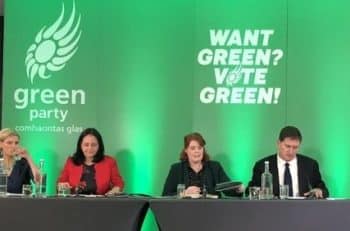
    Even in the climate emergency the Greens are all carrot and no stick.  By Michael Smith. I attended the Greens’ manifesto launch last Saturday in the Radisson Blu hotel near Dublin Castle.   I did it because, more than for any other party, their agenda – Green – matters. Being well-disposed I wanted to assess their fitness to deliver it. The media were there in force and about a hundred fairly presentable Green activists were on hand.  There would be internal training afterwards.  On the podium were three leaders of the party.  The first two spoke mostly about particular sectoral issues, reading from scripts.  Then Eamon Ryan gave a bit of a framework to it, some vision, an aspiration to ten areas where the Greens wanted more ambition, and an ambition to 15 seats which everyone seemed especially excited about.  He said something, again, about senior hurling.  There didn’t seem to be many hurlers in the crowd.  Nearly half of the candidates in Dublin went to rugby-playing Gonzaga which brings its own biases.  Then there were questions, led by Brian Dobson and the Irish Times‘ Green Party person, Harry Magee.  The questions were mostly what a non-Green would ask, with a fiscal bias.  Harry asked about insulation, and the budget for it. Eamon Ryan said if Ireland was to reach its emissions reduction goals it will need to spend a total of €50 billion over 20 years to retrofit 750,000 houses to improve energy efficiency. I asked what they’d do about implementation of their agenda bearing in mind the problems with that the last time they were in Government.  Eamon Ryan – an almost pathologically benign optimist – said what he always does, that you can achieve a lot in government (they didn’t) and that half the reduction in carbon in the period after they entered government was due to their efforts – the other half due to the fact the imploded economy meant fewer people needed to get to work.  He didn’t mention that any incursion on the soaring emission figures was highly temporary, and the energy improvements around that time were forced by the EU.   I asked what they would do about sprawl.  The answer was delegate more decisions to the community level.  That is the right answer to nearly all questions.  But not to this one.   The answer is ensure the already-agreed National Planning Framework is implemented not just referred to.  Indicatively, actually the Greens’ manifesto doesn’t even refer to it…or scandalously, outside of transport and climate, even refer to Planning. Nobody addressed my question on quality of life. It is elementary that environmentalists think quality of life should be measured, across a range of indicators, so it can be advanced instead of pursuit of a simple economic GDP metric. This is one of the biggest features of a green agenda. But there’s no reference to it in the manifesto. They didn’t advance it the last time they were in government, and clearly they won’t do it this time if they’re elected. The Green candidate in Dublin Central, Neasa Hourigan, often an impressive presence, mistook my question about introducing a constitutional referendum to reduce the power of property rights in order to promote a general pro-planning agenda for a question about housing.  They seemed to be improvising on central policy issues. This would not matter if it were not probable the Greens will shortly be in government and if they had not achieved so little last time out.  For it proves they have not learnt their lessons.  When asked about what the Greens had learnt from being in government the last time out, and the question wasn’t particularly directed at the environment, then-aspirant-MEP Ciaran Cuffe stated that it was not to go into government in the worst depression in generations.  That was not the right answer to give.  Remember, this is the party that justified going into government with dodgy Bertie Ahern on the basis that the climate imperative necessitated it, and yet which failed to pass a climate act in three and a half years, leaving only a toothless climate bill as their legacy. The Greens needed, indeed still need, to be tougher and more strategic.  They need to plot out want they need to achieve in government, in particular policies;  and to monitor its success.   Just as you can monitor economic growth month to month they should be monitoring, quality of life, air quality, mortality rates and development patterns month to month; and adjusting policy to achieve clear strategic goals.  The Greens’ manifesto is fairly thin – by comparison with Sinn Féin’s magnificently unwieldly one for example – but imaginative and progressive.  It’s great to see a proposal for an 80% tax on windfall rezoning profits and the Green Party is serious about a site value tax. Implementing the Kenny Report on public compulsory acquisition would be exciting.   I would find it difficult to argue with almost any of it as far as it goes.  Though unfortunately it is not always entirely clear that it is a party of the Left, or that it favours radical redistribution.  Though they support the radical measure of a universal basic income, their section on ‘Equality’ illuminatingly doesn’t mention income or wealth equality.  It’s not even that detailed on the environment.  There’s nothing on architecture or design. Or on urbanism; or on curtailing sprawl and one-off housing. There’s a bit on density but nothing on high-rise. Nothing from the Greens on Planning. It just doesn’t figure in the manifesto. Ciarán Cuffe must have been asleep. The Greens aren’t going to stop one-off housing – as that would generate an unholy row.  And their approach to the suckler herd is likely to be as gentle as that of the Polish government to coal-mining.  It’s an exception where we have a competitive advantage after all. And the lobby is frightening.  Anyway, it calls for a 7 per cent per year fall in emissions to reach the EU CO2 reduction target of a minimum 50 per cent by 2030. The current government target is a 2 per cent annual reduction. The Greens also want net zero

    Loading

    Read more

  • Posted in:

    Only vote Green if they show more hard-mindedness and discipline.

    Even in the climate emergency the Greens are all carrot and no stick.  By Michael Smith. I attended the Greens’ manifesto launch. I did it because, more than for any other party, their agenda – Green – matters. Being well-disposed I wanted to assess their fitness to deliver it. The media were there in force and about a hundred fairly presentable Green activists were on hand.  There would be internal training afterwards.  On the podium were three leaders of the party.  The first two spoke mostly about particular sectoral issues, reading from scripts.  Then Eamon Ryan gave a bit of a framework to it, some vision, an aspiration to ten areas where the Greens wanted more ambition, and an ambition to 15 seats which everyone seemed especially excited about.  He said something, again, about senior hurling.  There didn’t seem to be many hurlers in the crowd.  Nearly half of the candidates in Dublin went to rugby-playing Gonzaga which brings its own biases.  Then there were questions, led by Brian Dobson and the Irish Times‘ Green Party person, Harry Magee.  The questions were mostly what a non-Green would ask, with a fiscal bias.  Harry asked about insulation, and the budget for it. Eamon Ryan said if Ireland was to reach its emissions-reduction goals it will need to spend a total of €50 billion over 20 years to retrofit 750,000 houses to improve energy efficiency. I asked what they’d do about implementation of their agenda bearing in mind the problems with that the last time they were in Government.  Eamon Ryan – an almost pathologically benign optimist – said what he always does, that you can achieve a lot in government (they didn’t) and that half the reduction in carbon in the period after they entered government was due to their efforts – the other half being due to the fact the imploded economy meant fewer people needed to get to work.  He didn’t mention that any incursion on the soaring emission figures was highly temporary, and the energy improvements around that time were forced by the EU.   I asked what they would do about sprawl.  The answer was delegate more decisions to the community level.  That is the right answer to nearly all questions.  But not to this one.   The answer is ensure the already-agreed National Planning Framework is implemented not just referred to.  Indicatively, actually the Greens’ manifesto doesn’t even refer to it…or scandalously, outside of transport and climate, even refer to Planning. Nobody addressed my question on quality of life. It is elementary that environmentalists think quality of life should be measured, across a range of indicators, so it can be advanced instead of pursuit of a simple economic GDP metric. This is one of the biggest features of a green agenda. But there’s no reference to it in the manifesto. They didn’t advance it the last time they were in government, and clearly they won’t do it this time if they’re elected. The Green candidate in Dublin Central, Neasa Hourigan, often an impressive presence, mistook my question about introducing a constitutional referendum to reduce the power of property rights in order to promote a general pro-planning agenda for a question about housing.  They seemed to be improvising on central policy issues. This would not matter if it were not probable the Greens will shortly be in government and if they had not achieved so little last time out.  For it proves they have not learnt their lessons.  When asked about what the Greens had learnt from being in government the last time out, and the question wasn’t particularly directed at the environment, then-aspirant-MEP Ciaran Cuffe stated that it was not to go into government in the worst depression in generations.  That was not the right answer to give.  Remember, this is the party that justified going into government with dodgy Bertie Ahern on the basis that the climate imperative necessitated it, and yet which failed to pass a climate act in three and a half years, leaving only a toothless climate ‘bill’ as their legacy. The Greens needed, indeed still need, to be tougher and more strategic.  They need to plot out want they need to achieve in government, in particular policies;  and to monitor its success.   Just as you can monitor economic growth month to month they should be monitoring: quality of life, air quality, mortality rates and development patterns month to month; and adjusting policy to achieve clear strategic goals.  The Greens’ manifesto is fairly thin – by comparison with Sinn Féin’s magnificently unwieldly one for example – but imaginative and progressive.  It’s great to see a proposal for an 80% tax on windfall rezoning profits and the Green Party is serious about a site value tax. Implementing the Kenny Report on public compulsory acquisition would be exciting. Environmental journalist John Gibbons has applauded its plan to increase the amount of Irish land farmed organically to 20 per cent by 2030.  I would find it difficult to argue with almost any of it as far as it goes.  Though unfortunately it is not always entirely clear that it is a party of the Left, or that it favours radical redistribution.  Though they support the radical measure of a universal basic income, their section on ‘Equality’ illuminatingly doesn’t mention income or wealth equality.  It’s not even that detailed on the environment.  There’s nothing on architecture or design. Or on urbanism; or on curtailing sprawl and one-off housing. There’s a bit on density but nothing on high-rise. Nothing from the Greens on Planning. It just doesn’t figure in the manifesto. Ciarán Cuffe must have been asleep. The Greens aren’t going to stop one-off housing – as that would generate an unholy row.  And their approach to the suckler herd is likely to be as gentle as that of the Polish government to coal-mining.  It’s an exception where we have a competitive advantage after all. And the lobby is frightening.  Anyway, it calls for a 7 per cent per year fall in emissions to reach the EU CO2 reduction target of a minimum 50 per cent by 2030. The current government target

    Loading

    Read more

  • Posted in:

    Left fails properly to address scandal of Direct Provision at election time.

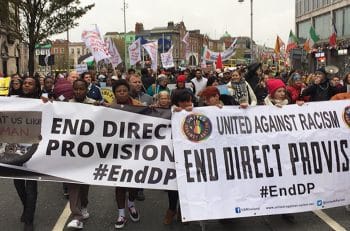
    Loth in their campaigns to address minority issues, the mainstream parties have left all the momentum on immigration to the intolerant right. By Stacy Wrenn. For how long can something be ‘next’ before it’s allowed to become ‘current’? Direct provision has been referred to, in some variation, as ‘our next great shame’ in the mainstream media for years without experiencing this elevation. Working groups have come and gone, minor reforms have been made that benefit some asylum-seekers over others, and little has fundamentally changed.  Although it was established as a temporary measure for housing asylum-seekers awaiting refugee status in 1999, direct provision — or direct provision and dispersal as it is more accurately referred to — has remained constant in contrast to its perceived attention-worthiness. This fleeting public shame appears in bursts, often for months at a time, sparked by major events that essentially serve as reminders that the system still exists. In 2019, there were at least seven co-ordinated anti-asylum seeker protests in response to proposed accommodation centres, not including arson attacks on some of the properties themselves. On the morning of October 28th, the car of Sinn Féin TD for Sligo-Leitrim Martin Kenny was set alight in what was widely accepted to be a response to statements he had made in the Dáil the previous week condemning such protests. For weeks the Irish mainstream media had the direct provision system as their primary topic of conversation, with multiple discussions in the Dáil chamber after months of silence. With powerful addresses from Brendan Ryan, Labour Party TD, and Catherine Martin, Green Party TD, among others, it felt as if a meaningful national conversation had begun. A swathe of documentaries, think pieces, and media exposés followed on the history of direct provision, the experiences of various sub-groups, with the Joint Committee on Justice and Equality report finding it “no longer fit for purpose”. The fifth-anniversary conference of the Movement of Asylum Seekers in Ireland [MASI] saw greater engagement from wider civil society than any outreach event in previous years. Then Christmas came, the election was called, and it was as if none of this had happened. An argument could be made that it was difficult to maintain such momentum over what is traditionally a lull in the political calendar. However, this was also the optimal time to develop a coherent position to make direct provision an election issue, yet no left party sought to do this. Instead, the debate has focused on health and housing with little nuance — such as consideration of the experiences of those granted refugee status who are forced to remain in direct provision because of the shortage of affordable housing. With The National Party and Anti-Corruption Ireland running thirteen candidates between them on explicitly anti-immigration tickets, this is negligence that no progressive party can justify. The momentum on immigration in general and direct provision in particular, at election 2020, has all been with the intolerant right.  There is no doubt that the candidates on the right feel emboldened by the protests of last year:  it’s clear in the openness of their messaging. Standing with two thumbs up and a broad grin, the National Party’s Longford-Westmeath candidate and deputy leader James Reynolds unveiled a large roadside poster with the message: “There are too many immigrants. Enough is enough!”[1]. At the start of the election, one columnist in The Irish Times had the optimistic take that this was not something to be concerned about, explained by some ‘attitudinal trends’ from European Social Surveys between 2002 and 2018. He claimed that the general public has reached the point of being so positive about immigration that any party that advocated for increased controls would be at a disadvantage: “Indeed, political parties both small and large that aim for broad-based support across Irish society would stand to lose more votes from adopting an anti-immigrant platform. While there is possibly some room for Independent political candidates to gain votes from playing the immigrant card this is likely to remain localised and context-bound – at least for the present time”.[2]   This would make sense if we were in a different political climate. Alongside the manufactured struggle for resources that is the housing crisis, the threshold of what is publicly considered racist is consistently raised higher and higher – the increasingly frequent debates about ‘culture wars’ online and ‘snowflakes’ testifies to this. This has enfranchised voters on doorsteps across the country, according to canvassers, to raise the need to ‘house our own first’, apparently generating heterogeneous responses across the political spectrum.  It’s likely that if Fine Gael are to remain in government, they will continue with their cycle of working groups and consultations, and the occasional rehashed press statement about Albanian and Georgian immigrants. And in an interview with JOE.ie the leader of Fianna Fáil, Micheál Martin who knows the importance of care in language when dealing with issues of tolerance, seemed to be taking the side of both the protestors in Oughterard and Rooskey and those who criticised them by saying that while some groups did exploit the “fear of the unknown”, only “some” of it was “completely unfounded”.[3] Although their candidates have been actively organising under the banner of United Against Racism and their track record is good we may take People Before Profit as an exemplar of how even the progressive parties do not have thought-through policies in in their manifestos though they do briefly state that they would “end Direct Provision and give asylum seekers the right to work”. This is a slogan, not a policy. There are no commitments to alternative accommodation or allowances, or indications on how they would implement this in practice.[4] Although election manifestos are predominantly communications exercises, the absence of detailed policies in relation to accommodation, welfare, and education, suggests that implementing their limited policy could leave many asylum-seekers in a worse position than now. One party to directly address the sensitive topic of asylum-seeker accommodation in its manifestos is the Green Party, which in the ‘Migrant Integration’ section aims to end

    Loading

    Read more

  • Posted in:

    Still accelerating

    But it’s time to stop living for consumption by John Gibbons One of the innate limitations of living in any given era is the innate assumption that the way things are is how they have always been, and will continue, more or less, into the foreseeable future. In a time of rapid shift, such assumptions can be fatal. Over the last seven decades or so since 1950, the world has embarked on an era known as the Great Acceleration. In this era, the solution to every problem and the very goal of human endeavour all seemed to be the pursuit of growth and with it, ever-increasing standards of material comfort. At the dawn of this new age, in 1955, economist Victor Lebow wrote a stunningly prescient article for the US Journal of Retailing. His key insight was to realise that, for the first time in human history, industrial output exceeded public demand for products. “Our enormously productive economy demands that we make consumption our way of life, that we convert the buying and use of goods into rituals, that we seek our spiritual satisfactions, our ego satisfactions, in consumption”. He added: “we need things consumed, burned up, worn out, replaced and discarded at an ever increasing pace. We need to have people eat, drink, dress, ride, live, with ever more complicated and, therefore, constantly more expensive consumption”. While presented as though it were human nature itself, consumerism is simply a clever ruse dreamed up by marketing Mad Men charged with persuading the public to buy ever more stuff. Not in their wildest fantasies could Lebow and his colleagues have truly understood what forces they were unleashing on the world, and how, decades later, this spiralling global orgy of consumption would have trashed the planet to the point where it teeters on the brink of the ecological abyss. It was never just about consumption. To justify this spree, “we erected new politics, new ideologies and new institutions predicated on continuous growth”, according to author JR McNeill. Writing in 2000, he warned: “Should this age of exuberance end, or even taper off, we will face another set of wrenching adjustments”. Now, some twenty years later, instead of heeding the ever more insistent warnings from the scientific community that critical planetary thresholds were being breached, humanity has instead doubled down, further accelerating growth, consumption, resource depletion and pollution throughout our already stressed biosphere. The recent report from the UN’s Environment Programme (UNEP) on the parlous state of carbon emissions didn’t pull any punches. “The summary findings are bleak”, it noted. ‘Countries collectively failed to stop the growth in global greenhouse gas emissions, meaning that deeper and faster cuts are now required”. The report says that emissions have gone up by 1.5% every year for the last decade. In 2018, the total reached 55 thousand million tonnes of CO2 equivalent. The UNEP report noted that this rate of emissions will deliver a catastrophic rise in global average surface temperature of some 3.2ºC by the end of the century, if not sooner. The Intergovernmental Panel on Climate Change (IPCC) late last year set out in the starkest terms the dangers of allowing global temperatures to rise by more than 1.5ºC this century (they have already risen by just over 1ºC). To have any chance of meeting these targets, emissions need to be cut across every country, every economy and every sector by an average of 7.6% per annum, every year for at least the next decade. This would have to mean sharp declines in living standards across the entire developed world. Largely non-essential sectors, from aviation to tourism would need to dramatically contract over the next decade, as would the use of private cars and the consumption of all meats, including of virtually all red meat. The reality is of course that no government on Earth is planning anything of the kind, and even if some brave politician or party were to come forward with such an extreme austerity programme, they would face sure and certain obliteration at the ballot box. The science says that countries like Ireland need to drastically decarbonise every aspect of their economies, food systems and societies as a whole, or face ruin. Yet the response of our Taoiseach has been to talk up the merits of re-usable keep cups while half-heartedly rolling out a Climate Action Plan that was designed to fail. Meanwhile, Ireland’s Chief Scientific Advisor thinks some carbon-sucking technology is going to magically appear and somehow scale up to solve the greatest crisis in human history. Magical thinking used to be something we associated with hippies, dropouts and dreamers. Now, it’s what passes for policy among the ‘serious’ people like economists, politicians and senior public officials and advisors. We may not be lions, but we are assuredly led by donkeys. John Gibbons is an environmental writer and commentator @think_or_swim

    Loading

    Read more