Opinion

Random entry RSS

  • Posted in:

    1916 and the ongoing danger of conservative revolution

    If there’s been one new idea introduced into the discourse by the 2016 commemorations, we haven’t registered it. The Rising was an irrational response to a colonialist foe. The proper approach would have been to analytically survey the strengths and weaknesses of the occupying power, and to have respectively avoided and exploited them with the view of achieving specific military and then political goals. The fact the Rising was a martyrdom, with in Pearse’s case a Resurrectionist underpinning, is a very bad start to a nation. This has been debated for its ethical ramifications but the political ramifications have been more dangerous and pervasive. The indulgence of mythology in politics pervaded the civil war and the parties it spawned, the 1937 Constitution and the perpetuation of non-specific Republicanism with no stress on parties that would actually stand for something like an ideology, most obviously a left or right agenda, or the data-and-evidence-based policies it might have spawned. Connolly himself considered some of the revolutionaries were motivated, according to Edward Townsend in his recent history of the Rising, by “either vacuous romanticism, or a mindless commitment to ‘physical force’ without social content’”. The Proclamation came nearly a century and a half after the American Declaration of Independence and the French Declaration of the Rights of Men. It should have been more secular and more explicitly egalitarian. While celebrating the training of its “manhood”, it did at least summon both men and women to the cause, though why it didn’t just refer to people is a good question, the phrase “suffrages” suggests some form of parallel franchises may have been intended, and worst of all for some (ungallant?) reason Cumann na mBan’s role is not registered in the Proclamation, though it is generally recognised as the unsung third participant in the Rising. The Proclamation should not have summoned in aid any (expansionist German) gallantry from Europe, assuming it was viscerally anti-colonial. It is not difficult to summon declaratory or constitutional principles. It was not then and it is not now. The principles must be transcendent. They must not date. Equality, Freedom, Sustainability, Efficiency, Openness would have done it. Article I of the Declaration of the Rights of Men [sic] isn’t bad: “Men [sic] are born and remain free and equal in rights. Social distinctions can be founded only on the common good”. Not getting it quite right (and the replacement of the brutally executed culturally imaginative 1916 leaders by mediocrities and religious zealots) opened the door to the mean weirdness of the 1937 Constitution which is invoked in the name of the holy spirit “from whom is all authority” and recognises the special position of its womanhood but only because of “her life within the home”, and the associated “duties”. If Ireland in 2016 is not serious about either ideology or policy it is in part because the grounding documentation of the republic depends on mythology, on religion, on machismo. None of our politicians seems imbued with an iota of political philosophy and it passes for a credo to believe in a Republic (as opposed presumably to a monarchy) without any positive definition of what precisely that imports, for then, for now, forever. This is no small thing. 100 years on we still have parties with no ideology and no driving policies. We have a short-termism which survived one of the worst governments in the history of the state. We have as our two biggest parties, dinosaurs almost indistinguishable the one from the other. We have a Labour Party which is prepared to sell out a fundamental vision each time it enters government and we have radical left parties that prefer to campaign on opposition to water and property taxes rather than promote the simple internationalist socialist message of equality. Indeed ironically this ‘revolutionary socialist’ stance is rooted in the campaign-for-the sake-of-it mentality that drove most of our revolutionary conservatives. The proclamation and its idealistic progenitors looked to the past and the present. Their analysis was not inaccurate. But they did not lay down any or any adequate template for the future. Their lack of interest in doing so partly explains the lack of interest of our current political generation in doing so. 1916 has left us bereft in 2016. 

    Loading

    Read more

  • Posted in:

    Big-party conservatism led to rise of others

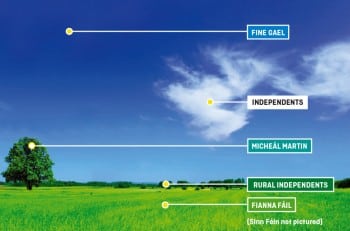
    The two big parties no longer think big. The bigger parties attract an older (more reliable?) vote while the apparently more radical parties capture the younger and more socially disadvantaged vote The elephant in the room at the so-far abortive meetings in Leinster House to form a viable government is the presence of a once popular leader now entirely without credit. Enda Kenny even assumed a very low profile in the centenary commemorations of the 1916 Rising. His presence was easily overshadowed by that of President Michael D Higgins – who occupies a position of symbolic power in our modern day republic. The Independent TD and commentator Shane Ross understood this very well when he stated that he was gazing at a “political corpse” when he was part of the first discussions with the acting Taoiseach. Independents have, and need, a keen nose for public opinion since they have no big political-party apparatus designed to keep them informed. Ross was then extensively criticised for his use of language by the politically correct classes who felt he had disrespected the office of Taoiseach as well as by the supporters of a wounded Fine Gael. Ross is in substance correct. It is virtually impossible to install a new government if it involves putting Enda Kenny in as its head. To do this would be to truly pervert the course of public opinion, as expressed in the general election. If things are changed utterly then it is because the election of 2016 delivered a hammer strike from the electorate to both Enda Kenny and the Fine Gael party. Willie O’Dea, one of the brightest men in the Dáil, also captured this point well in a recent article in the Sunday Independent. By coincidence the same paper has produced a poll which shows that Micheál Martin, not Enda Kenny, is the one most favoured by public opinion to be the next Taoiseach. A large section of the media and commentariat expressed surprise at the scale of Fine Gael’s defeat – it seems the more comfortable members of the commentariat fell for the Fine Gael spin that Labour would lose but Fine Gael would hold its own. The failure of the Fine Gael-led government started with the water-charges fiasco and continued into the election where Kenny made a pre-eminent contribution to the party’s defeat. He cannot escape blame on this front. It also appears that he has at least three hungry wolves within his own ranks who wish to replace him – Leo Varadkar, Simon Coveney and Frances FitzGerald. Enda Kenny was comprehensively outshone in the TV debates during the general election by Micheál Martin despite the fact that he has spent the past five years strategically blaming Martin and Fianna Fáil for all of the problems that beset the country. It simply did not work. The public has moved on from the blame game, even if Fine Gael has not. Moreover, Kenny told people they would not understand economics at the start of the campaign and towards the campaign’s end delivered the immortal insult that people who did not like him or his policies were ” whingers”. Fine Gael continue to defy public opinion by presuming, in the post-election discussions, that the party must be part of any government that is formed. Caretaker Taoiseach Enda Kenny has now been defeated on three occasions – all three defeats have been very clear, public and formal – first in the election and twice now in the Dáil on votes to determine who should become Taoiseach. There are signs, with over 40 days gone since the general election, that the public is wearying of the posturing and pranks of the political class as they collectively fail in the task of government formation. The first casualty of jadedness from the public will be the independents who will see the fools’ pardon extended to them in the election withdrawn if either no government is formed or an election ensues. One of the most dangerous statements issued so far was by Fine Gael’s Richard Bruton who stated on Morning Ireland that he would consider the formation of a Fine Gael minority-led government but not participate nor contemplate its polar opposite a Fianna Fáil-led minority government. Fine Gael, including its fabled leadership contenders, seems to believe that the party has some sort of divine right to be in government. Leo Varadkar, for all his faults in Health, seems to have got it right when he acknowledged openly that no government could be formed unless it combined the parliamentary numbers of both Fianna Fáil and Fine Gael. The numbers and the logic of the general election are pointing that way but neither of the two big parties wishes to accept that its rival should lead in the political equation: Fianna Fáil + Fine Gael = Stable Government. Well before the election result was known I indicated my own view that if the two big parties were in touching distance of each other, in levels of political support, then there was a real chance that there could be a Fianna Fáil- Fine Gael partnership government – with even the possibility of a rotating Taoiseach. The fact that this prediction, if you like, has not happened so far is because of internal institutional resistance to the concept, or competitive rivalry, from both parties. There is also a huge, in my belief, misplaced fear in both parties that by forming such a government they will leave a wide-open door for Sinn Féin to become the major force in opposition and the government in the election that follows. This conservative-mindedness, or risk aversion, by the two big parties is precisely the reason they have both so far lost support to Sinn Féin, anti-austerity parties, and a broad, if inchoate, collection of independents.The two big parties no longer think big in terms of their ambition. The bigger parties attract an older (more reliable?) vote while the apparently more radical parties  capture the younger and more socially

    Loading

    Read more

  • Posted in:

    Hardiman: Brilliant Libertarian With Some Deep-Rooted Prejudices

    In recent weeks much ink has been dispensed and many moving tributes have been made to the late great Adrian Hardiman. The obituaries and commentary have been universally laudatory both personally and professionally. Certainly he was a great and unique human being. An unquenchable light has been dimmed and a degree of joy and colour sadly taken from the world. He was also a man of the utmost personal integrity, which is not to say that his principles were always right. As someone who got to know him very well over the last few years in particular and as someone who had several public and indeed private disagreements with aspects of his philosophy, I believe I am in a reasonably good position to provide a more nuanced assessment of his curate’s egg ideology: sometimes very right indeed sometimes perverse and utterly wrong. It must be stressed at the outset that to be in his company was a privilege. He was not a narrow technical lawyer or indeed very much I think interested in the discipline of law save as a mechanism for doing what he thought was right and was more comfortable discussing history or literature, particularly Joyce. In this respect we were kindred spirits and we would frequently talk about the loss of learning from our culture, the absence of a historical intelligence among the younger generation and the increasingly technocratic, proceduralist and mechanical lawyering caste and how it often does great damage, acting without moral purpose. He was a tremendous raconteur: a storyteller and a weaver of tales in the traditional Irish sense and a man of the utmost sociability with a pronounced ability to talk to almost anybody about almost anything. His intellect was dazzling and he was inordinately proud particular in public debate of showing it off to full effect. Sometimes this made him a target for unfair criticism. I had often heard captious criticism that he was merely the orator grand or a caricature Falstaffian rhetorician but that was utterly wrong and a great disservice to the man who ultimately was a superb scholar. His eagerly awaited work on Joyce should tame many cynics. Moreover, quite unlike his other judicial colleagues his judgments brim with wit and erudition and mosaic together many different fields of knowledge. He was relentlessly curious. Those who trivialised his intellectual abilities were often themselves either narrow technocratic lawyers or people of the conservative orthodox Catholic social right who vehemently disagreed with aspects of his libertarian views. Many disapproved also of his edgy and exotic libertarian lifestyle and used it as a pretext to intellectually criticise him. Hardiman was no fuddy duddy, no mother superior, no blueshirt, no moral conservative. As I discovered to my own advantage he was not a man inclined to judge people at face value, and gave many a second chance. He never took intellectual disagreement for personal rebuke. He was also a man of heightened perception and intuition and very free and helpful in advice he provided. After we completed a directions hearing in the Gilligan litigation with respect to the Proceeds of Crime Act 1996 he came up to me. It was our first substantive professional encounter as I had only recently started practising in Dublin. He was bemused I had secured the brief and gave me a card from Louis Copeland tailors noting that although I was fortunate to secure this brief with the “awful polyester suit” (it was no such thing) I was wearing, I would in all likelihood secure no others. He could of course be far too candid as col- leagues and friends who were the victim of his public declamations would attest. In a lecture he gave to my class to The Kings Inns on his judgment upholding Portmarnock golf club’s discrimination against women members he regaled the assembled multitude with a digression on whether a lesbian rugby team would be compelled to accept him as a member. Apart from the late Christopher Hitchens he was the most politically incorrect person I have ever met and in this respect also we were kindred spirits as the suppression of speech and the sanitisation of our discourse is under constant threat from the thought police. In private he was softly spoken and solicitous of the welfare of anyone whose company he shared. After he had curtailed and limited a somewhat dull talk I gave at a Presumption of Innocence conference in DIT by guillotining it mercilessly he very solicitously and politely approached my UK Innocence colleague Michael Naughton and me and entreated us to join him. “I know a quiet little place (he was increas- ingly fond of quiet places perhaps due to the enormous scrutiny upon him)”, he whispered. When we adjourned he remembered that I drink red wine and my colleague a Guinness drinker before promptly ordering three straight whiskeys, for himself! The initial and overarching starting point of his judicial philosophy is that Adrian Hardiman was an arch libertarian and a neoliberal before that term was properly invented. In this he was consistent. First, he was an economic liberal and free-marketer who believed in limited governmental intervention in the market. This attitude dictated his perspective on social and economic rights with which he fundamentally disagreed Coupled with a faith in the political process, perhaps drawn from his dalliances with electoral politics, it fostered his belief that courts have no business deriving social and economic rights or intervening in government decisions on resource allocation. As I will make clearer this perspective is utterly short-sighted and contributes untold damage to our social fabric. Hardiman laboured with undue deference to the theatre of political debate. It was honed during his student debating days but the clubby and optimistic earnestness of the L and H society bespoke little of the characteristic mismanagement and parochialism of our political class. The deference was a significant error of judgment. The upside of libertarianism (a tangential egalitarianism) mandated that if someone was victimised by the machinery

    Loading

    Read more

  • Posted in:

    World Crass

    The new Workplace Relations Commission has weakened the rights infrastructure regarding landlords and there are problems with funding, procedures, fairness and expertise

    Loading

    Read more

  • Posted in:

    World Crass

    What was Richard Bruton thinking of when he referred to setting up a “world class” service, to establishing a new entity that is “all about making Ireland the best small country to do business in”, when he launched a “new era for employment rights and industrial relations”? The answer, surprisingly, is the Workplace Relations Commission instigated last October with a cacophony of overblown rhetoric. With all the fuss, it comes as a surprise when this “world class” service says it can’t adjudicate on some of the equality cases within its remit. It recently stated it did not have the resources to deal with cases of discrimination by landlords against tenants in receipt of rent allowance. Kieran Mulvey, its Director General, was quoted as suggesting “We are not the appropriate body for this, this is not a workplace issue”. This is troubling given the Workplace Relations Commission is in fact bound to adjudicate on cases in a broad range of fields beyond the workplace, under the Equal Status Act. It is indicative, however, of a deeper malaise with the Workplace Relations Commission. Richard Bruton did add, with pride, that this new “world class” service was launched with 20% fewer staff and 10% less money than its predecessor organisations”. Who did he think he was fooling with his inflated verbiage? The Workplace Relations Commission was established in October 2015 through the merger of five organisations: the Equality Tribunal, the National Employment Rights Agency, the Employment Appeals Tribunal, the Labour Relations Commission, and the Labour Court. The Equality Tribunal had been a key part of the equality infrastructure and sits uncomfortably in this new entity with a mandate that stretches beyond employment rights to discrimination in the provision of goods and services, education, and accommodation. The Employment Law Association of Ireland (ELAI) is not impressed. They raised some fundamental issues in a February 2016 submission: about the adjudication of cases and the competency of the adjudication officers, the pre-hearing process and complaint submission, and mediation. The ELAI note that the rules of procedure of the Workplace Relations Commission do not address how hearings are to be conducted. It identifies concerns among its members that “there is inconsistency in how Adjudication Officers apply basic rules of fair procedure; for example, the permissibility of cross-examination and the application of rules of evidence”. Cases are heard in private and there does not appear to be any monitoring of decisions by Adjudication Officers. The ELAI is concerned that the rules “do not guarantee users’ constitutionally protected right to a fair hearing”. It is further concerned that the “framework for appointing and training Adjudication Officers is substandard”. There is no clarity as to the qualifications or expertise required of Adjudication Officers or what training they get. This is damning given the broad spread of cases they now have to deal with. The ELAI suggests there has been a “dilution of expertise” from the specialisation that had developed among staff in the predecessor bodies. Richard Bruton made much of the importance of mediation in cases concerning employment rights. It would appear, however, that the mediation service is under-resourced and cannot meet demand. It becomes ever clearer that this is not a service set up to be “world class” but to save money. The ELAI notes that some of its members recount instances “where both parties to a dispute have requested mediation but that request has been rejected by the WRC”. The ELAI notes that while most complainants are not required to detail the substance of their complaint when it is being lodged, “exceptionally, complainants must provide substantive detail for allegations of discrimination and constructive dismissal.”. The guidance given by the Workplace Relations Commission for employees making a complaint of discrimination requires that “the complainant must set out the facts, the link between the ground(s) cited and the alleged discrimination, any other relevant information and, where appropriate, any legal points the complainant may wish to make”. Under the procedures of the former Equality Tribunal such a statement was only required when submissions were requested some time after the complaint was lodged. The approach of the Workplace Relations Commission makes it more difficult for complainants to lodge a case of discrimination, increases the need for legal representation at an early stage with additional costs, and reduces access to justice. This is only the first year of operation of the Workplace Relations Commission. There is still time to get it right. However, it is clear that urgent action is required to ensure people are able to vindicate their rights. As paid work becomes ever more precarious and as discrimination persists at high levels, the weakening of our rights infrastructure in this way must must not be accepted.

    Loading

    Read more