Politics

Random entry RSS

  • Posted in:

    Risks of high political instability are being underestimated.

    The leaderships of all three of the potential coalition participants – Greens, FF and FG – are in play.  By Conor Lenihan. An initial political risk assessment for Ireland now would rate the country as “unstable”. There is little happening at Leinster House that would re-assure external investors. It is over three months since the election and there is still no sign of a new government.  The public indulgence will only last as long as Covid-19 continues to hang over the country as an existential threat. If the opinion polls are to be believed the public seem content to leave the incumbent government in place even though they voted against them in the election.  Taoiseach Leo Varadkar has re-invented himself during the Covid-19 crisis. His steady appearances on television have converted him from the TV Anchor Man to the TV Weather Man. As we all know, sometimes the Weather Man gives solace and relief when you have just endured a bulletin diet of misery and bad news. Varadkar’s new-found popularity has rendered Fine Gael activists the pleasing possibility that if they simply hang tough and string things out they might just be able to throw up their hands in surprised despair and call an election. For some of them the thought of sacrificing their big-farmer support on the altar of climate change, via the Greens, is a step too far in erosion of their most solid voting base.  Leo Varadkar My friends in the distanced Dáil inform me the coalition formation talks are proceeding apace and may well be completed by June, with a week or two further to get the endorsement of the three parties and their memberships.  The Greens’ requirement for two thirds of those voting is a high jump given the extent of division within the party even at a parliamentary level. One can only imagine the level of disputation among ordinary members.  The election itself threw up an indeterminate result and an intractable three-way split between Fianna Fail, Sinn Féin and Fine Gael. Beyond these medium-sized parties, are a number of smaller parties of varying sizes and ideologies and of course a plethora of independents.  The decision by both Fianna Fáil and Fine Gael to exclude Sinn Féin by definition narrows the choices of the two, previously, big parties. Their requirement appears to be to favour the inclusion of the Green Party – with a bolt-on of independents to give greater comfort.  The orthodox wisdom in Leinster House and among political analysts as that this Fianna Fail, Fine Gael and Green Party configuration offers the best hope of a stable administration to see the country through the twin crises of Covid 19 and an increasingly, threatening, hard exit of the UK from the EU.  The other consensus viewpoint offered is that there will certainly be ‘trouble ahead’ as public indebtedness rises, amid high unemployment, with the traditional safety valve of emigration from the country is removed as a mitigating factor. The Franco-German axis that runs the EU, is openly promoting the idea of future harmonisation of corporate taxes – not good news for Ireland Inc. Apart from these very obvious uncertainties there is in a more insidious threat to a stable coalition involving FF, FG and the Greens. The Greens are the only one of the three which actually increased their number of seats and with Sinn Féin could claim to have been winners from the results. albeit it might be argued they had the tail wind of a climate crisis and failed to capitalise on the ubiquitous desire for change.  Nevertheless the reality is that in a normal election and political system this should be a cause of great contentment and happiness for the Greens – not so. Over the past two weeks there has been open warfare within the party and now the clear prospect of a leadership contest immediately after they select their portfolios and form their ministries.  With a clear leadership contest on between Eamon Ryan and his Deputy Leader Catherine Martin this does not suggest  stability in government. Things, of course, are not much better when one surveys the vista for both Fine Gael and Fianna Fail. While Fine Gael are stable on the surface and there is no immediate threat to Leo Varadkar, the likelihood is that he will be replaced within the first two years of any new coalition’s term. There are two clear contenders in Simon Coveney and Paschal Donoghue – both of whom presumably would like to take a big bite out of the Taoiseach Cherry when it comes to FG’s spin on the Wurlitzer. In Fianna Fáil a barely concealed leadership struggle is already underway because of the belief that Micheál Martin is a lame-duck potential Taoiseach, on the way out. Party members who hate the idea of sharing power with their civil war antagonists are vocal in expressing the belief that Martin simply wants to have the word Taoiseach on his CV – without reference to the damage that it will do the party. Micheál Martin The party faces the prospect, much-feared within FF, of being sandwiched between an opinion-poll-led resurgence of Fine Gael and the undoubted prospect of further Sinn Féin electoral expansion, as its status as the main opposition party grows and grows. Set against this feeling is the hard-headed realism of those frontbench TDs who want a shot at being ministers after nine years in opposition. Fianna Fáil has at least four who might consider themselves leadership contenders to succeed Micheál Martin – Michael McGrath, Dara Calleary, Barry Cowen and Jim O’Callaghan who has the perceived advantage of being from Dublin. None of these are making waves now given that the process of government formation is underway. The basics here are simple – the current leaderships of all three of the potential coalition participants in the Greens, FF and FG are in play. In the Greens’ case, it is just more obvious than the rest. This is not a recipe for

    Read more

  • Posted in:

    Dick Walsh’s covert committee monitored OIRA media enemies. Future Irish Times Assistant editor put colleagues on lists.

    By David Burke. Part 1 of this series can be found at https://villagemagazine.ie/dw/ THE OFFICIAL IRA AND OFFICIAL SINN FÉIN The IRA fractured in December 1969 into what became known as the Provisional IRA and the Official IRA. Sinn Féin split along the same lines the following month. Before the division, the IRA had been led by IRA veterans such as Cathal Goulding, who was its chief of staff, Seán Garland, Seamus Costello, Tomás MacGiolla, Ruairí Ó Brádaigh and Seán Mac Stíofáin. On the political front, they controlled Sinn Féin. Together the IRA and Sinn Féin were known as the Republican Movement. Goulding, Garland, Costello and MacGiolla sided with the Officials after the split and reproduced the military and political formula for their new organisation. Ruairí Ó Brádaigh and Seán Mac Stíofáin set up the Provisionals. Goulding’s faction managed to retain control of the United Irishman, the movement’s monthly newspaper. Collectively they also became known as the ‘Stickies’. Cathal Goulding avoids the media The United Irishman had been edited by Tony Meade, Denis Foley, Séamas Ó Tuathail (who brought sales to a height of 100,000 in 1969) and then Eoin Ó Murchú. In late 1972 Ó Murchú left and Dick Walsh of the Irish Times, later to become its political editor (from 1985) and indeed its assistant editor (from 1999), was asked to take care of the paper while a new editor was found. The full-time replacement turned out to be Jackie Ward, who had been in charge of the The Starry Plough which had appeared in Derry. In 1973 the Officials launched another publication, The Irish People, a weekly paper. Pádraig Yeates, who edited it between 1977 and 1982, joined the Irish Times in 1983. The Officials also produced numerous pamphlets, most but not all of which were produced openly as Official Sinn Féin publications. The Official IRA (OIRA) issued statements which were reported in the press. After they called a ceasefire in 1972, they continued to exist for purported ‘defensive’ purposes and continued to issue statements. The Irish Times continued reporting them until the mid-1970s. Bizarrely, when the paper interviewed Goulding wearing his political cap in 1983, it reported that the OIRA had ceased to exists in 1972, as if all the statements it had carried for the three to four years after the 1972 ceasefire had never appeared on its pages. It was the least of the dysfunctionalities in that paper’s nexus with the OIRA. WALSH’S SECRET COMMITTEE Behind the scenes Goulding and his GHQ staff decided to draw up a list of their friends and enemies in the media. Goulding, now chief of staff of the OIRA, appointed Dick Walsh as the kingpin of this clandestine effort. He was assigned to lead a committee which drew up lists of journalists and to characterise the attitude of each towards the Officials. The OIRA also spied on their political opponents throughout the 1970s and into the 1980s and probably well beyond. Their penetration of the Revenue Commissioners caused so much internal rancour that some civil servants tried to set up their own union. They felt the Officials had taken over the existing set up. The Officials’ spies in the Revenue Commissioners paid particular attention to the tax affairs of politicians such as Charles Haughey and well-known big -businessmen. Ultimately no use was made of the information they accrued because they did not want to draw attention to their assets in the department. The OIRA also spied on groups who were opposed to the Soviet Union such as the Irish Council for European Freedom and the Irish Czech Society. Their reports were presumably furnished to the Soviets. Amnesty International was another target. One of those monitored was Louise O’Brien. THE GOOD, THE BAD AND THE UGLY Dick Walsh broke the media into five groups. Category ‘A’ consisted of those deemed friendly towards the Official Sinn Féin and the OIRA. This group consisted of between ten and twenty reporters who were prominent in the early 1970s. Walsh included himself in it, along with members of the OIRA who were working in the media and those who, while never in any wing of the IRA, were sympathetic to the left-wing direction in which Goulding was taking the Officials. The political wing of the Party became known as Sinn Féin the Workers Party (SFWP) and later again simply the Workers Party (WP). Walsh and his committee presumably updated the list from time to time. One possible motive for the exercise was to help create a network of supporters in the media. On the other side of the coin had the revolution, that Goulding, Garland, MacGiolla and their comrades were fomenting, actually succeeded, the information would have been a useful resource to identify likely counter-revolutionaries. A number of ‘A’-listed OIRA figures were, or became, employees at the Irish Times. The purpose of this article is not to suggest that the Officials succeeded in taking control of the paper because they did not. The plot to murder a journalist at the Irish Times – which will be described in the next article in this series – demonstrates this definitively. Overall the paper was a broad church, especially under the editorship of Douglas Gageby. However, the ‘Stickies’ did have a number of notable successes in promoting their essential views, including their grossly distorted account of the Arms Crisis. THE IRA VOLUNTEERS AT THE IRISH TIMES As readers may recall from Part 1 of this series, James Downey, a former deputy editor of the Irish Times, stated that Dick Walsh was not only “an intimate of Cathal Goulding and the other leaders of what would shortly become the ‘Official’ Sinn Fein and IRA” but also that there were “two or three who were actual members of the IRA, on the paper”. (Downey p. 102.) Sean Cronin, former Chief of Staff of the IRA and Irish Times Washington correspondent during the Troubles Downey was disturbed by the OIRA presence and opined that “…the position of Dick

    Loading

    Read more

  • Posted in:

    Unscrutinised lockdown breaches: resignation territory for Varadkar and Martin.

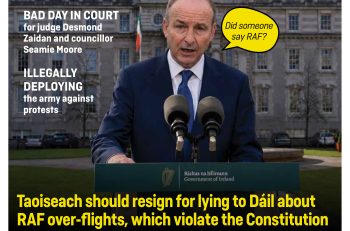
    Close analysis suggests Leo Varadkar (not for hanging out in Phoenix Park), Micheál Martin and (perhaps) Dominic Cummings should all resign, for basic and flagrant breaches of lockdown rules. By Michael Smith. We are all fed up with plague restrictions. Some of them were disproportionate; some of them are needed and will continue to be needed. We’re all tired of them. We live in the era of Fake News so when maskless Donald Donald Trump, handshaking Boris Johnson, and picnicking Leo Varadkar say something is authorised or, better still, “legal” you know it may not be true. This article is about what the law, rules and guidance say, not what some status-unclear departmental official, or a garda on duty, said. It reflects very badly on two of Ireland’s Taoiseach-candidates, and Johnson’s peripatetic advisor, Dominic Cummings. Since there are many people who have been unable to visit dying relatives or to attend the funerals of parents and children, it is clear that serious breaches cannot be dismissed as forgivable mistakes, if the social contract is to be maintained. That is why Mark Rutte, Prime Minister of the Netherlands, scrupulously avoided visiting his 96-year-old mother in her care home in the last weeks of her life https://www.theguardian.com/world/2020/may/26/dutch-pm-mark-rutte-did-not-visit-dying-mother-due-to-covid-19-restrictions. Nobody, surely, would advocate a lower standard in modern Ireland. One of the premises I take as read is that if a rule provides for an exception, acting on the exception is not a breach, however much people go on about it. Let’s see how the exceptions position Ireland’s political leaders, and – in Britain – Boris Johnson’s fractious advisor, Dominic Cummings. Varadkar, 24 May, Phoenix Park Since for the last few weeks we have been allowed to meet in groups of four, outside, the Taoiseach’s hunky beering in the Phoenix Park last weekend was ok in principle. https://www.irishexaminer.com/breakingnews/ireland/taoiseach-was-in-line-with-public-health-guidance-while-sunbathing-in-phoenix-park-1001539.html An official in the Department of the Taoiseach, Liz Canavan, thinks we should not picnic, but that’s her view, not official written government advice. Asked this week whether it was okay for people to have picnics, Canavan said that the Government was “not madly encouraging people” to take up “a lot of space and time in amenities where they are cramped”. “We’re asking people to use their head”, she said. But the outing should have been distanced and photos, like the one above, show it was not. The failures may have been brief. It’s impossible to tell. We all do it; we should probably get over it. There is something that is far worse. On 24 March, the Taoiseach said people need to stay at home and only leave to: go to work go to the shops for essential supplies care for others exercise On 27 March the Departments of Health and of the Taoiseach jointly provided the following “policy” which was stated to be a “measure in place”: “The only reasons you can leave home: Stay at home in all circumstances, except in the following situations: to travel to and from work, if your work cannot be carried out from home to shop for essential food and household goods to attend medical appointments and collect medicines for vital family reasons, such as providing care to children, elderly or vulnerable people – but excluding social family visits for farming purposes – that is food production or care of animals To take brief individual physical exercise within 2km of your home, which may include children from your household, as long as you adhere to strict 2m physical distancing. to escape domestic violence“. The reasons are exclusive. There are no further exceptions. In his televised speech to the country on 27 March the Taoiseach put it succinctly: “Apart from the activities I have listed, there should be no travel outside 2km radius from your home for any other reason”. In fact Leo Varadkar left his home and moved to Farmleign during the lockdown. That was a major breach of advice not justifiable, or close to justifiable, under the listed limited exceptions. There is no ‘Taoiseach’ exception, no ‘I need better internet’ derogation, no ‘it’s ok I work for the government’ exemption. Just ask Mark Rutte or Dominic Cummings. And so, honestly, he should resign. Micheál Martin photographed in Courtmacsherry on 1 January for New Year’s swim Meanwhile Micheál Martin went off to West Cork as late as April 4. Remember the guidance cited above had been clear for at least two weeks at that date. He told Ryan Tubridy on the Late Late show of 22 May https://www.thesun.ie/news/5460487/coronavirus-ireland-fianna-fail-leader-micheal-martin-not-seen-family-weeks/: The lockdown started – West Cork, I was there. I came to Dublin and have stayed since and that’s it. That was untrue. The Irish Independent confirms he went from Dublin to West Cork on 4 April. This is a scandal waiting to break. According to the Irish Independent the Fianna Fáil leader, “was in Courtmacsherry when the lockdown rules were announced, and travelled to work in Dublin the following Monday”. On 4 April , he returned to his holiday home. According to a Fianna Fáil spokesperson: “In line with Government advice he returned to where he was when travel restrictions were introduced”.  The spokesperson said this was in line with Government advice, the Indo swallowed it, but it was not. Where is this ‘return to where you were’ exception to be found? After he went to Dublin he should have returned to his home in Cork City. It was simple. “On April 6, he travelled back to Dublin where he has remained since”, said his handlers – from where he tells stories about missing his family and jogging in Merrion Square. The spokesperson confirmed that Mr Martin has not been to his home in Cork city since the lockdown began: “Micheál has adhered to all of the expert advice and Government restrictions during this emergency”, they said. Inaccurately. https://www.independent.ie/irish-news/politics/ff-leader-used-holiday-home-as-base-at-start-of-crisis-39137417.html For the blatancy of his flouting of the rules. for his equivocation on the Late Late show and for the cynically obfuscatory line that “Micheál has adhered to all of

    Loading

    Read more

  • Posted in:

    Charles Haughey did not run guns to the IRA in 1970 but his father Seán did decades earlier. And on the orders of Michael Collins!

    A gunrunner in the family. By David Burke. Haughey’s father Seán (on the right) who was one of Michael Collins’ most trusted officers. Collins chose him for one of his most sensitive secret operations. THE HAUGHEY FAMILY AND THE WAR OF INDEPENDENCE Haughey’s parents, Seán and Sarah (nee McWilliams), were born and reared almost next door to one another on small farms in the adjacent townlands of Knockaneil and Stranagone, near Swatragh, a few miles from Maghera town in Derry. Haughey Senior, who was born in 1897, joined the Irish Volunteers in 1917. He rose to become the Second in Command, and later Officer in Command, of the South Derry Battalion of the Irish Volunteers during the War of Independence. At the start of the conflict he carried out raids on the homes of loyalists and a number of retired British army officers. His military file marked him out as one of the most energetic IRA members in south Derry. In one attack on June 5th 1921, a Royal Irish Constabulary sergeant called Michael Burke was killed while others were seriously wounded in a late-night ambush of the barracks at Swatragh. As a result of his activities, Seán Haughey had to go on the run. According to his superior, Major Dan McKenna, he would have been killed had he been caught. “His enemies were of the opinion, and indeed not without reason, that he was the cause of all their woes in his area”. Sarah, who was born in 1901, also played an active part during the campaign as a volunteer in Cumann na mBan. She remained a member until 1923. Commandant Seán (Johnny) Haughey with his wife Sarah Ann who served in Cumann na mBan. The Anglo-Irish Treaty was signed on 21 December 1921 and ratified the following January. Yet hostilities persisted in the North. The UVF began to regroup under Lieutenant-Colonel F. H. Crawford. Thirty-one people were killed in Belfast between 12 and 16 February 1922. On 19 March 1922, 200 IRA men surrounded the town of Maghera, County Derry, cutting off the telephones before seizing the Royal Irish Constabulary barracks from which they removed 17 rifles, 5,000 rounds of ammunition and a sergeant as a hostage. The IRA campaign continued the next day with the destruction of mills, sawmills, stables and outhouses in County Derry. Burntollet Bridge (which would become infamous in 1968) was blown up. On 30 March Michael Collins, representing the Provisional Government in Dublin, and Sir James Craig, signed an agreement. Collins wanted to neutralise the security forces in the North as a threat to the Catholics. In return for a cessation of IRA activity, it was agreed that Catholics should join the Special Constabulary and assume responsibility for policing nationalist areas. In mixed areas, an equal force of Catholic and Protestant officers would be deployed. Meanwhile, all searches would be conducted by mixed units with British soldiers in attendance. The Specials were to wear uniforms with identification numbers and surrender their arms once they had finished their duties so they could be kept in barracks. On 31 March Royal assent was given to the Free State Bill which became the new constitution of the Free State. The ceasefire Collins and Craig negotiated proved a failure. On 2 April 500 Specials swooped across County Derry and Tyrone scooping up 300 men for questioning but only four were found to be in the IRA. The rest escaped to County Donegal. By now the IRA was on the verge of a split into pro- and anti-treaty factions. The 8,500 volunteers who lived in the new State in the North were virtually all anti-treaty. Michael Collins was prepared to supply them with arms for a number of reasons, one of which was that it offered him a possible way to unify the IRA, something that was a priority for him. SÉAN HAUGHEY PLAYED A KEY ROLE IN MICHAEL COLLINS’ MOST SENSITIVE AND SECRET CROSS-BORDER OPERATION AFTER THE CEASEFIRE Seán Haughey became involved in what was perhaps the most sensitive and secret covert operation Michael Collins ever mounted: it was one to provide Catholics living across the new border with weapons to defend themselves from the forces of the new state. Hundreds of Catholics (and many Protestants) had been killed during sectarian riots that had erupted in July 1920. Between 1920 and 1922,  267 Catholics were killed,  while 2,000 more would be wounded; another 30,000 people were evicted from their homes and driven from their jobs, especially at Belfast’s shipyards. Collins arranged for guns, at least some of which were supplied by the IRA in Cork, to be smuggled across the Border. Collins was keen not to use any of the weapons he had obtained from the British which could easily be traced back to forces under his control. The First Northern Division of the IRA in Donegal was led by Commandant-General Joseph Sweeney who went on record stating: “Collins sent an emissary to say that he was sending arms to Donegal, and that they were to be handed over to certain persons  –  he didn’t say who they were – who would come with credentials to my headquarters. Once we got them we had fellows working for two days with hammers and chisels doing away with the serials on the rifles… About 400 rifles and all were taken to the Northern volunteers by Dan McKenna and Johnny [i.e. Seán] Haughey”.    (See also From Pogrom to Civil War by Kieran Glennon.) Eoin O’Duffy, who later led the Blueshirts, along with Collins and Haughey, was part of the operation to smuggle the IRA guns across the border. Another IRA man, Thomas Kelly, collected a consignment of 200 Lee-Enfield rifles and ammunition from Eoin O’Duffy. In an affidavit Kelly swore many years later, he revealed that the “rifles and ammo were brought by Army transport to Donegal and later moved into County Tyrone in the compartment of an oil tanker. Only one member of the IRA escorted the consignment through

    Loading

    Read more

  • Posted in:

    THE ACCUSED AND THE ACCUSERS: IF NOT NOW, WHEN?

    Two recent hearings of the Independent Investigation Child Sexual Abuse (IICSA) in London heard arguments for and against abandoning its investigation into the allegation of sexual abuse made against the late Greville Janner. Now the Chair of the IICSA has determined that this module will go ahead but that the majority of its evidence will be adduced and examined in private and that any report will similarly be limited. In this article, Christopher Stanley, Litigation Consultant with KRW LAW LLP in Belfast, who represents a survivor of abuse in both Belfast and then in London, provides an insight into the manner in which the IICSA has approached the inquiry into the allegation against Greville Janner. Introduction The operation of a statutory inquiry is, after the initial impact of victim statements, taken little notice of until, perhaps, the publication of a report and recommendations. In Ireland, in relation to the Conflict, we saw this in the Smithwick and Barron inquiries in relation to the murder of two senior RUC officers and the Dublin-Monaghan Bombings of 1974 respectively. My wistfulness covers territory extensively covered in Village – historic institutional sexual abuse. At the point of publication of the auspicious inquiry report there may be either the furore of  joy or outrage or muted despair as a 20,000 page document enters the space of the circular filing cabinet. I have been unexpectedly involved either directly or indirectly, either as lawyer or observer, in a number of statutory inquiries in both England and Northern Ireland: those investigations established under section 1 of the Inquiries Act 2005 or by the exercise of specific legislative provisions available under devolved powers. These have included, in England, those concerning the torture and murder of Baha Mousa, the unlawful killing of Al-Sweady, the Mid-Staffs Hospital Inquiry (my Mother had been a victim), the aborted Detainee Inquiry; and in Northern Ireland  the as yet to occur Patrick Finucane inquiry, and the Historical Institutional Abuse (HIA) inquiry into systemic sexual abuse. One of the module strands of the HIA Inquiry concerned The Kincora Boys’ Home in Belfast. Arising out of the ‘failure’ of this module there continue to be demands by victims for further investigations into their abuse and the knowledge of and manipulation by state agencies and agents – a particularly low point in Ireland’s Dirty War exacerbated by the stench of collusion and political corruption. Representations had been made to have ‘Kincora’ and its associated institutions within the remit, jurisdiction and terms of reference of the Independent Inquiry into Child Sexual Abuse Inquiry (IICSA) in London. These were refused by the British government – the HIA would suffice. However, a number of victims were trafficked from Northern Ireland to London to continue their abuse as sex workers. Hence my presence at the IICSA on behalf of one of these ‘others’, on 25 September 2019. I represent a client (‘A’) who was trafficked from Belfast to London to be a sex-worker into the notorious Piccadilly Rings, a Dilly-Boy. He also ‘worked’ in a male brothel in West London. The account of his abuse in Belfast and London has been published in Village. His sister and brother were also abused in Northern Ireland and his brother was also trafficked to England but he was then 18. ‘A’ was 16 when he arrived in London having escaped the ‘care’ of the system. At the request of the IICSA he has provided a detailed Witness Statement which alleges that he was 17 when he was approached by Greville Janner in Piccadilly and then lived with him for a week at his Dolphin Square flat in Westminster and accompanied him to a performance at Earls Court where he met Prince Andrew and Sarah Ferguson. The date of that performance at Earls Court cross-referenced with Prince Andrew’s diary engagements and the date of birth of ‘A’ suggests he was 17. The date of that performance at Earls Court cross-referenced with Prince Andrew’s diary engagements and the date of birth of ‘A’ suggests he was 17. ‘A’ was paid by Janner for sexual services and provided with meals and clothes. Janner also appeared as a witness on his behalf at Bow Street Magistrates Court when ‘A’ was charged with offences relating to prostitution. ‘A’ had a number of convictions resulting in fines. His other clients included a member of the London Metropolitan Police. Being arrested and charged was seen by our client as an occupational risk. Finally, ‘A’ freely admits that he would not have thought of making a complaint to any institution as he had been abused  by politicians, social workers, judges and policemen – those who were trusted with the protection of the vulnerable. Having been invited to provide a Witness Statement to the IICSA in relation to the module “An inquiry into the institutional responses to allegations of child sexual abuse involving the late Lord Janner of Braunstone QC” I attended what in effect was a case-management hearing. ‘A’ is not a Core Participant (yet) but a potential witness. My expectations of the culture and organisation of the IICSA, given the seriousness of its work, had been raised following what can only be described as a troublesome beginning. They had been raised because of the relative silence around it proceedings. These are my observations of one day at the IICSA. 24 September 2019 A first preliminary hearing into the allegations against Greville Janner had taken place in 2016. Despite its website and apparent accessibility, the physical location of the IICSA was difficult to find. I had to telephone the inquiry: 18 Pocock Street, an anonymous street in Southwark, South London, marked on the day only by a small press presence outside the building. I had gone into Blackfriars Crown Court seeking directions. I can appreciate the need for discretion, given the nature of its work, but for a public inquiry it was as if ‘it’ did not want its location to be known. I recall I had attended the first session of

    Loading

    Read more

  • Posted in:

    The Forgotten Arms Crisis Scoop: how a London newspaper reported details of what became known as the Arms Crisis nearly seven months before it erupted in Ireland.

    Séamas Ó Tuathail was the first journalist to discover details of what was to become known as the Arms Crisis but chose not to report it. Unbeknownst to him, some of the information he dug up was relayed to a British journalist by a talkative senior member of the IRA. The resulting British newspaper article may have exacerbated British Intelligence paranoia about what was afoot in Ireland nearly seven months before the Arms Crisis erupted. Within a few weeks of the report in the English paper, a British Intelligence operation swung into action. A British secret agent nearly lost his life in Dublin during the course of it. He was saved by the intervention of Irish Military Intelligence.     By David Burke Introduction: PART 1: THE UNITED IRISHMAN Fifty years ago this month the Irish public awoke to sensational reports on the radio that Charles Haughey and Neil Blaney had been dismissed from cabinet by the then Taoiseach Jack Lynch. Another cabinet minister, Kevin Boland, subsequently resigned in protest along with a junior minister, Paudge Brennan. This became known as the Arms Crisis. What is not fully appreciated is that an Irish journalist, Séamas Ó Tuathail, now a senior counsel at the Irish Bar, had learnt about the story – and much more besides – some six months previously. He has never been afforded the credit he was due for his investigation. Why? Because he did not publish the full story. Ó Tuathail not only knew that a blind eye was being turned by the State to cross-border gun-running efforts by people ranging from the ordinary citizen to old IRA hands, but also that Fianna Fáil had engaged in a covert propaganda campaign. Ó Tuathail’s perfectly reasonable interpretation was that the campaign was designed to help Fianna Fáil take over the civil rights movement in Northern Ireland. Fianna Fáil never really opened up about the campaign but they would undoubtedly have said that it was designed to bring pressure to bear on the British government to make concessions on Northern Ireland after they had neglected the North for decades and let it turn into a place of institutionalised bigotry. Ó Tuathail went ahead with the the covert propaganda aspect of his investigation in The United Irishman. A graphic from The United Irishman: a modern jet bearing the logo ‘UI’ shoots down an old fashioned Fianna Fáil fighter. The propaganda campaign was run by George Colley with the full support of Jack Lynch but it ran out of steam after a few months and became redundant after Lynch decided to adopt a more conciliatory approach towards London.  It was being shut down in November 1969 when Lynch and Colley received an unpleasant surprise from Ó Tuathail in The United Irishman. Jack Lynch and the head of his ‘truth squad’ George Colley. Even a cursory glimpse at what Ó Tuathail reported about the propaganda campaign in November 1969 raises serious questions about the intrigues that were swirling around Lynch at the time, and of which he was aware. They add weight to the charge that Lynch knew about the efforts by some of his ministers to import arms. THE IRA ARMY COUNCIL Ó Tuathail’s story began one wet dark October night in 1967 when he was driven from Dublin to the ghostly shell of a dilapidated mansion somewhere in County Meath. He was twenty-six at the time and employed at Belvedere College as an Irish teacher. His driver was an IRA volunteer. After a long trip, the driver took a right turn off the highway somewhere between Navan and Kells. They followed a pitch-black narrow lane to the old building where Ó Tuathail was escorted into a former ballroom. An oak tree was sprouting through the roof. Close by the members of the IRA’s Army Council sat around an illuminated table: Cathal Goulding, Seán Garland, Seán MacStíofáin, Seamus Costello, Tomás McGiolla, Ruairí Ó Brádaigh and Paddy Murphy. They also happened to be the de facto directors of The United Irishman, Sinn Féin’s monthly newspaper. Ó Tuathail was escorted to a former ballroom. An oak tree was sprouting through the roof. Close by the members of the IRA’s Army Council sat around an illuminated table Ó Tuathail had come to the publication’s attention as the contributor of a series of Irish language articles to the paper’s former editors Tony Meade and Denis Foley. After a vacancy had arisen for the post of editor, a consensus had emerged that he would be the best fit for the job. Some negotiations had taken place before the meeting in the old ballroom and this was the opportunity to iron out a few details and finalise the appointment. Ó Tuathail told the panel he did not want to join the IRA. This presented no problem to Goulding who was in the process of winding down the military wing of the Republican Movement. While it might have troubled MacStíofáin, he knew Ó Tuathail a little from Irish language circles and did not raise any objection to a fellow Irish language speaker securing the post as editor of the paper. Ó Tuathail justified his stance on the basis that if he became a member of the IRA, he would be subject to possible orders from his superiors and would not be able to enjoy complete freedom as its editor. There were a few exchanges around the table but no disagreement and he was offered the post with independence a term of his contract. Taking the job also meant a 50% reduction in the salary he was receiving from Belvedere. Ó Tuathail left the ballroom while the Army Council resumed its agenda for the night. Members of the interview panel: Cathal Goulding, Seán Garland and Tomás McGiolla. INVESTIGATIVE JOURNALIST OF THE YEAR Ó Tuathail was a wild success as editor. In 1968 John Mulcahy, editor of Hibernia, awarded him the investigative journalist of the year accolade. He earned it for reporting on issues which the mainstream media was

    Loading

    Read more

  • Posted in:

    Government of national unity: cleaning up the mess of elections. Sinn Féin should be in government in (roughly) the same proportions they are in the Dáil; so should every sizeable party.

                                    By Peter Emerson Democracy The word ‘democracy’ is used with abandon, even to describe that from which it has long since been abandoned.  Take for example the Democratic People’s Republic of Korea.  They have elections, but it’s all “Candidate X, yes-or-no?”  And with turnouts of 100%, the answer is always ‘yes’.  What a nonsense.  There should be lots of candidates, and folks should be able to choose whomsoever, as they wish. Or take Britain.  They have referendums, sometimes, “Option X, yes-or-no?”  Brexit.  What another nonsense.  There should have been lots of options – the WTO, Norway plus, Canada plus, and so on – but Britain had a multi-option debate, or rather, bloody great row, only after the 2016 referendum.   As noted by Pliny the Younger in the year 105, when there’s no majority for any one thing, there’s a majority against every thing.  In other words, in a multi-option debate, taking a majority vote on only one option is (almost) as nonsensical as a North Korean election on only one candidate.  Majoritarianism or Pluralism It’s the same when considering other subjects: forming a new government, budgets, planning proposals, names for a new bridge over the Liffey, and so on; none of these debates, and none of the votes, need be binary.  They can be.  They often are.  Someone chooses the question; and usually, that question is the answer.  That’s how Napoléon did it, Mussolini, Hitler, Gaddafi, Khomeini et al.  It usually works… though not with Brexit.   It’s not just majority voting that is inadequate, so too is binary majority rule.  But we know this already.  It was problematic in Northern Ireland; in the former Yugoslavia, “all the wars started with a referendum,” (to quote Sarajevo’s famous newspaper, Oslobodjenje, 7.2.1999); the 1994 genocide in Rwanda was initiated with the slogan “Rubanda Nyamwinshi,” (“We are the majority”) and so it goes on: majorities fighting minorities, in Kenya, Ukraine, and throughout the Middle East. Accordingly, we need a more accurate way of determining the collective will: the opinion, not of a simple, comparative majority; we need the superlative, as in “the greatest good for the greatest number.”  No matter what the controversy, debates should allow not only all relevant options, one from each party or group, to be ‘on the table’; but also a (short) list, normally of up to six options, on the ballot paper.  Then let the TDs cast their preferences, to identify that option which has the highest average preference, for an average involves every TD, not just a majority of them. The appropriate voting preferential points procedure was mooted as early as the year 1199 by Ramón Llull, by Cardinal Nicholas Cusanus in 1435, Jean-Charles de Borda in 1784, and the Rev. Charles Dodgson (Lewis Carroll) one century later.  And it was demonstrated in Dublin City Council in 2013, when from a ballot of five options, Council chose to name the new bridge in honour of Rosie Hackett.   2020: Forming A New Irish Government A FF/FG minority administration?  Or one of the ‘left’?  A FF/FG majority coalition, with GP and/or Labour/SDs and/or one or other group(s) of Independents?  A Government of National Unity?  It is indeed a multi-option question. Resolving this fairly is best achieved through a multi-option vote: the Modified Borda Count, MBC.  In a vote on n options, TDs may cast m preferences, and (1st, 2nd … last) preferences cast shall be awarded (m, m-1 … 1) points.  So he who casts just one preference gives his favourite 1 point.  She who casts two gives her favourite 2 points, {and her 2nd choice 1 point}.  Those who cast all n preferences give their favourite n points, {their 2nd choice (n-1) points, etc.}.  And the winner is the option with the most points.  So the very mathematics of the count encourages the TDs to vote across the party divide, i.e., to share power.  Sinn Féin are in the Dáil, with their proportionally due number of seats.  They should also be in government to (roughly) the same proportional due; so should every sizeable party.  Don’t allow any one party to have more influence than it should. The DUP in Westminster, the Freedom Party in Austria, and the Jewish Home in Israel all accumulated so much power it became dangerous And don’t disallow any one party from any power.  Before the Troubles, Northern Ireland’s Catholics were never in government.  Today, the Muslims in India, the Arabs in Israel and the Kurds in Turkey know that, in all probability, they too will never be in government.   This too can be dangerous.   All-party Power-sharing: Will it Work? No matter what the political structure, there will always be opposition: that’s politics.  Des O’Malley and Charlie Haughey, remember, both colleagues in the same party, split into two parties… which a little later on formed a coalition.  So what was all that about?  Other battles royal have split many parties, from the UK’s Labour Party – Gordon Brown and Tony Blair – to Russia’s Communists – Josef Stalin and Leon Trotsky.   As in majority rule with a government versus opposition, so too in any power-sharing all-party coalition, arguments will still rage…but here’s the difference: in binary politics, as soon as you reveal your fall-back position, you have already fallen back to it; in consensus politics, stating all your preferences does not diminish your enthusiasm for your 1st preference.  In a word, you can negotiate. Preferential majority rule is perfectly feasible.  Let the people elect the TDs, as they do, in open and transparent elections.  Next, let the newly elected TDs elect their government – again by PR.  The appropriate methodology, a matrix vote, also encourages the TDs to vote across the party divide.  As demonstrated by the Irish Times in Ballymun after the last 2016 election, it could mean that a government could be formed, democratically (and electronically), all in the space of a week. Then, in the Dáil, let controversies be resolved, as in the recent Citizens’ Assembly, with multi-option voting.  The latter used (but did not name) a Borda methodology.  Preferential decision-making is indeed perfectly feasible.  Let any party/group propose an option: have a debate; and then let the TDs, unwhipped, cast their preferences in each debate to identify that which, to quote the New Ireland Forum, has the “highest degree of overall support”. Peter Emerson is Director, the de Borda institute, www.deborda.org and author of Majority Voting as a Catalyst of Populism, 2019, (Springer, Heidelberg).

    Read more