

Politics

Random entry RSS

  • Posted in:

    Progressive but a little light on policy and not hard-minded enough. The Green Party again tees up its conscience with a somewhat deficient set of questions for the establishment parties.

    By Michael Smith. Green Party leader Eamon Ryan has set out a ‘Green New Deal’ and 17 questions in a six-page letter sent to Fianna Fáil and Fine Gael on Wednesday in response to their framework coalition document The 17 “questions” are: Will you commit to an average annual reduction in greenhouse gas emissions of at least 7 per cent? Will you commit to an ambitious programme of development of, and investment where necessary in, renewable energy infrastructure including off-shore wind, grid and interconnector upgrades and community energy projects? Will you commit to ending the issue of exploration licences for offshore gas exploration? Will you commit to ceasing the construction of new fossil fuel infrastructure, particularly LNG import terminals that could allow the entry of unconventional liquefied natural gas into the Irish energy mix? Will you commit to the exclusive provision of public housing, social housing and cost rental housing on public lands? Will you commit to prioritising urban renewal in line with a ‘Town Centre First’ model? Will you commit to a comprehensive deep retrofit programme as part of a programme for government? Will you commit to convening a social dialogue process representative of all key stakeholders with a view to developing of a new social contract? Will you commit to working towards ending the Direct Provision system and replacing it with a not-for-profit system based on accommodation provided through existing or new approved housing bodies? Will you commit to setting us on a clear and certain path to meeting our UN obligation to spend 0.7pc of our national income on Overseas Development Aid? Will you commit to the development of a national land use plan which will inform both the new national economic plan and the new social contract? Will you commit to rebalancing our transport infrastructure spend, dedicating at least 20pc of infrastructure expenditure in transport to cycling and walking and ensuring that other public transport infrastructure investment is allocated at least two-thirds of the remaining infrastructure budget? Will you commit to establishing a trial of Universal Basic Income (UBI) within the lifetime of the next Government? Will you commit to the revision of the existing National Development Plan so that we can meet our New Social Contract goals and climate change targets? Will you commit to a review of the State’s response to the Covid-19 pandemic, undertaken by the Oireachtas, to enable us to learn lessons for the future? Will you provide a clear and detailed analysis of how your Joint Framework Document is to be financed? Will you commit to publishing and implementing a Green Procurement Policy? The questions posit a remarkably incomplete policy agenda for a Green Party. Greater quality was clearly needed in replying to a very loose document from Fianna Fáil and Fine Gael, one which included unacknowledged surprisingly progressive but waffly and incomplete agendas for “a new social contract”, “a new green deal” and “a better quality of life for all”, at its heart. There is no mention of equality in the questions. A basic income is a small part only of any modern equality agenda. It is unclear what a new social contract, a term used in the Fianna Fáil-Fine Gael document means. There is more mention of equality in the document outside of the questions, including a reference to the social contract “addressing inequality for all our people”, but little chance other parties or commentators will treat seriously imperatives that failed to make it into the headline questions. For some time now the Greens have been promoting “social justice” rather than economic equality. That is not the established term for radical movements towards equality. It’s a quainter and more opaque notion than equality, and sometimes rooted in Catholic doctrine. There are references to equality on several lifestyle and sectoral issues such as gender and race, but, despite acceptance of the need for “anti-poverty” “development” there is no reference to redistribution of wealth and income. It’s clearly not a part of the Greens’ agenda. Five of the seventeen questions relate to climate change. Four of them are filler – details on the headline question which is about guaranteeing 7% annual emissions reductions, and which to be fair they have properly emphasised. If the 7% is agreed the four other specific issues would inevitably be part of the means to that end. Their iteration suggests the Greens lack confidence in a fuller agenda. Many other conventional imperatives appear in the body of the text but in ramshackle and unclear forms so they are unlikely to be taken up by the bigger parties in this process. This is confirmed by the fact that the Greens forgot to mention biodiversity, the demise of species – after climate the vital second pillar of a proper green agenda – in any of the 17 questions, though there is an ambitious if airy-fairy reference to it in the body of the text of the letter. On planning they are looking for something that is already in place and not working – a national land use plan. Town-centre-first is scarcely a comprehensive description of a land-use planning strategy for a party for which planning is assumed to be central. They have not suggested how they propose to develop the encouraging willingness of the civil war parties, reported as the lead story in the Business Post of 23 April, to facilitate a referendum on the Kenny Report which dealt, in 1973, with the price of building land. There was no sign the Greens see the scope for a referendum that would facilitate plan-led development as well as simply keeping prices to current-use value plus 25%. In general the Greens seem, voguishly, to be emphasising delivery of affordable housing over planning for quality housing, though there approach remains better than that of other parties on the issue. On an overweening strategic level, there is no suggestion the Greens have remembered that the age-old and continuing problem with Fianna Fáil and Fine Gael and the environment is they provide

    Read more

  • Posted in:

    Ireland neutral on neutrality. We quietly but hypocritically export €3.6bn of products that can be used by foreign military and allow up to 90,000 troops through the country annually.

        By Bryan Wall. Ireland does not export heavy armaments or guns. Beyond that there seems to be extraordinary flexibility and naivety as to the military significance of exports that are neither heavy armaments nor guns but nevertheless can wreak devastation. In May last year the Sunday Business Post revealed that Irish employees of Google  in Dublin were working on the company’s drone project for the US military. According to Laura Nolan, who worked on what was called Project Maven, she had been asked “to help develop a system to keep US Department of Defence data classified on Google systems”. The project involved using Google’s “artificial intelligence (AI) technology to analyse drone footage”.  When I spoke to Nolan she said was unable to reveal much due to a non-disclosure agreement. But she pointed out that “a huge number of people” were working on the project. Nonetheless, she argued that “image is important to Google”. As a result, she believes “media pressure as well as employee pressure was likely what led to the decision not to continue with the second phase of the Maven contract”.  What the Sunday Business Post didn’t reveal was the Irish government’s apparent lack of knowledge — or concern — about the work being carried out on the project by Irish citizens in Google HQ in Dublin. In a statement the Irish Department of Defence declared that “The issue of policies relating to Irish citizens and employees working on programmes, with non-Irish companies, based here, which will be used for military and/or defence purposes does not fall within the remit of the Department of Defence”.  Ireland’s supposed neutrality is also apparently unaffected. The spokesperson argued that the Department of Defence doesn’t believe “the issues raised are such that they would have any impact on Ireland’s peacekeeping role” with regard to its “traditional policy of neutrality”. Internally the Department of Defence also seems to not be too concerned about Irish citizens working on military projects for other countries via their employers in Ireland. A freedom of information request for “memos or minutes of meetings/transcripts regarding Project Maven” returned nothing. As did a request for any correspondence between it and Google regarding Project Maven.  For its part the Irish Council of Civil Liberties (ICCL) said the use of autonomous weapons can “carry frightening implications for our rights”. It went on to insist that “Neither state military operations nor big tech companies are guided by clear regulation, oversight, or transparency”. And given this, “we can’t simply trust that they will self-regulate in a rights compliant manner”.  But this seemingly blasé attitude of the government is not entirely surprising. The arms industry in Ireland is thriving. Statistics from 2018 show that the export of military goods is worth billions to the Irish economy. Export of ammunition and weapons was valued at just over €37m. But this figure surges when dual-use products — items that can be used for defence and military purposes but not originally designed for that end — are included. When this is done the figure for 2018 came to over €3.6bn. Of course the identities of the firms are not officially disclosed, for reasons of security of workers, confidentiality and commercial sensitivity. Ireland’s official and industry ambivalence was highlighted by the appearance of Lauren Knausenberger at a conference in Cork Institute of Technology (CIT) in January. Knausenberger, who is the Director of Cyberspace Innovation for the US Air Force, had previously been at the intersection of private enterprise and the military. According to her biography, she was President of Accellint, Inc., a self-described “consulting firm” that dealt with “problems of national security importance and investing in commercial technologies that could be applied to a government mission”.  Knausenberger is on record as having praised the US Air Force’s targeting capabilities. While speaking at the Springone Platform in 2019 she approvingly highlighted the fact that her new employer’s pilots and drone operators “can hit the back end of a fly from midway around the planet”. And while speaking at an Air Force conference in 2019 she described one of her roles as “helping to get our airmen the tools that they need to do their job” [2.26]. Successive Irish governments have always done their best to play up Ireland’s supposed military neutrality. This is despite the fact that the US military has been using Shannon for decades, thereby negating any real neutrality. 280,000 foreign troops passed through Ireland between 2014 and 2019; over 90,000 in 2019 alone. Ireland’s role in the arms industry and facilitation of foreign troop movements only makes the claims about Irish neutrality all the more absurd.

    Read more

  • Posted in:

    Woohoo, Wuhan! Is it possible Ireland will be in the position China finds itself in now, in the first half of May?

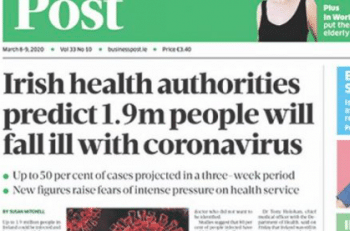
    Government projections on how long a lockdown will last hijacked by pessimism not evidence, though readers will make their own minds up as to whether Ireland’s trajectory is more like those of China, Singapore or South Korea than those of Italy and Spain. By Michael Smith. It is obligatory to preface articles about Covid-19 with a disclaimer that the author is not an epidemiologist or virologist but this article is about the derivative complex issue of how long the current pandemic may last.  In any event virology and epidemiology may not be the professional disciplines best equipped to dictate the appropriate political reactions to the findings of the science of Covid-19.  Those reactions should ultimately comprise a balance of the science with an assessment of the social, economic, environmental, cultural and even (because measures should aim to avoid a backlash) political consequences of any decisions. Nobody is expert in all of these and the role in democracies is assigned to politicians in whom there is not generally much popular confidence. Flowing from this, the role of criticising their reactions will inevitably on occasion be filled by journalists not experts.  In Ireland politicians seem to be taking decisions that properly balance all the factors.  We have, after all, become a sensible, cautious (who remembers all that change-imperative stuff from February?) body politic where even a discarded Taoiseach pretentiously deploying Churchill can sound reasonable to the point of international encomium. In the UK and the US on the other hand there is a sense that Science is not properly valued, and that the egos of their heads of government who tend to want flash solutions and downplay justifiable pessimism are interposing on the public interest. So far the high ground here has been appropriated by those who claim we have not acted fast enough.  But that is easy to say and most of what the doomers, animated formerly by China and now by horrors in Italy and Spain, recommended has been applied just a few days after they wanted it.  Towards  the end of whatever period of restrictions we face it is likely that discipline will break down as some people consider  the social, economic, environmental and cultural consequences have been disproportionate.  Delaying the imposition of draconian measures may have the effect of reducing that  breakdown later on and better equipping us to pre-empt a possible second wave. It is of course a balance. For this reason there has not until now necessarily been a moral deficit for those cautioning against closing society down as fast and as conclusively as possible in the interests of disease prevention. Of course there is a moral deficit for those who flout Science, which is to say those who offer ungrounded opinions on matters they do not understand. Or who understand, and party anyway. Normally rules would not necessarily import moral imperative but dealing with Covid-19 requires social solidarity and, at least where the advice in favour of rules seems driven by a plausible perception of the common good, it would be a breach of the fragile social contract to flout it. An ancillary challenge is to decipher the advice, and being patient with opaqueness at the edges, as with advice on pubs (until recently), restaurants, public transport, car-sharing, discreet physically-distanced socialising and much more.  For those who believe that society evokes obligations it is difficult to argue against following Irish government advice. On the other hand actually going beyond that advice, which purports to be comprehensive, seems unnecessary and – where it threatens proportionality – inadvisable.  So I would not advocate ignoring government advice. Of course nobody should exaggerate the facts and prognostications. It is unhelpful for example that during the week the Guardian negligently reported “a generation has died” in Bergamo near Milan when in fact 1959 people out of the area’s 1.2m population had died. On 15 March the front-page headline in Ireland’s Business Post was ‘Irish health authorities predict 1.9m will fall ill with coronavirus [sic: in fact the disease is Covid-19]’. Official spokespeople agreed this was accurate. In fact it is not.  It is a do-nothing prediction. The word should have been “may” not “will”. Where I demur is on the crucial area of the nexus of case-projections and how long quasi-lockdowns will probably last.  It seems to me that  – on this and this alone – policy-makers in Ireland have been hijacked by pessimism not data. It is not that they are not aware of the data and the international research it is that they are deploying it on the basis of worst-case outcomes. Such caution is desirable insofar as it is dictating life-saving policies, but it may lead to inaccurate projections of the medium-term future.  As a result they are not duly recognising two things: The consequences of the stringent measures we have now put in place and committed to putting in place soon  The lessons of the epidemiological pattern in China. The constantly and consistently iterated headline  figure of 15,000 projected cases at the end of the month, representing roughly one-third increases daily, which has been more or less registering as predicted since 16 March (though substantially less for the last three days; 906 cases, 4 deaths as of 22 March), turns out to be in the absence of the remedial measures – distancing, closures, that we have actually taken. A similar study by Imperial College London on the UK projected half a million deaths in Britain. The Imperial model’s clear message, though, was not this possible conflagration: it was how small the effects are of half-hearted strategies. Remedial measures, it accepted, would reduce the height of the epidemic’s peak by two-thirds and pushed it from May to June.  China took remedial measures.  So what happened there to the ongoing one-third increases? Just a few weeks after introduction of draconian measures cases dropped. The first case of Covid-19 was detected on 17 November in Wuhan city; the first death was on 9 January; quarantine was imposed in Wuhan and the surrounding Hubei region on 23 January. Figures leapt from around 800 then to 80,000 in mid

    Loading

    Read more

  • Posted in:

    Covid-19 compounds existing public distrust

    As Italy quarantines a quarter of its people and the Business Post claims 1.9 million will get it in Ireland, it’s not just the disease that is viral By David Langwallner. “There comes a time in human history when the man who says 2 plus 2 equals 4 will be sentenced to death.” – Camus, The Plague. In his seminal ‘The Plague’ (1947) Albert Camus uses the historical plague effecting Oran in Algeria to spotlight the heroism of  engagement, and humanity in difficult times. Any perception of public emergency risks collapse of our modern universe. After hurricanes, flooding or even manifestations of police brutality riots often occasioned by urban disenchantment or inequity lead to viral barbarism.  And we have still never been deprived of the crucial two meals. There is a famous book by the recently deceased Portuguese novelist José Saramago,  called ‘Blindness’ (1989) where blindness has become a communicable disease and an epidemic. The effect is escalating panic. Individuals are quarantined and dehumanised. Human nature descends to Hobbesean  brutishness. The concepts of fairness and the rule of law disintegrate. Inept authorities run wild. Asylums are created for those quarantined. A cautionary tale for 2020.  History groans with destructive plagues. Over 3 percent of a much smaller humanity died in 541 in the Justinian Plague exported by Byzantium and named after one of the Roman emperors the same way the Americans give kitschy names to hurricanes or snow storms.  The most famous plague – exported by Mongol warriors – was the Black Death which killed 50 million people in Europe in the years around 1347 and is vividly captured in the seminal film by Tarkovsky called Andrei Rublev (1989). London’s Great Plague of 1665-6, like the Black Death an eruption of the bubonic plague pandemic, was transmitted by infected rat fleas and killed about 100,000 people, a quarter of its population, in 18 months.  The most infamous flu virus hit in 1918.  Of course more people died in that Spanish flu epidemic in the immediate aftermath of the first world war than in the entire war itself – some 50 million. They included the legendary Austrian painter Egon Schiele and the poet Apollinaire. The artists did not just die in the trenches but often afterwards. In 1918 it mainly took young adults. Those aged 75 and above had the lowest death rate of all. Such pandemics did not destroy humanity, or reach the tipping point. Of course the reason for the scale of deaths then was a lack of vaccination and the overall susceptibilities to first infection and second death was considerably higher than with the Coronavirus. But it is the rates of infection and death combined that make Coronavirus the most dangerous epidemic in 100 years. As of 7 March 2020, there have been more than 105,000 cases with the most significant outbreaks in central China, South Korea, Italy, and Iran. The number of confirmed cases worldwide is more than 10 times higher than the 8,100 known to have been infected by SARS, a related virus that caused a six-month epidemic in 2003.   More than 3,500 people have died: around 3,100 in mainland China and around 450 in other countries. As of 3 March 2020 WHO data show the percentage of patients dying after infection with COVID-19 is 3.4% globally (1.6% outside of China perhaps reflecting Western failures to diagnose all cases, but also its superior healthcare).  By comparison, seasonal flu generally kills far fewer than 1% of those infected;  measles 0.2%; but SARS and 1918’s Spanish flu 10%. The chances, surprisingly low perhaps, are that the average victim will pass the disease on to 2.5 others; though China brought that number down. There is no question but that the ratio of death to infection is nowhere near as high as in the historic pandemics. Survival is highly probable for the young and the healthy. In China around 80% of deaths recorded were from those over the age of 60, and 75% had pre-existing health conditions including heart  diseases and diabetes. But in our present universe it is increasingly difficult to disentangle fact, expertise and what is really going on. Certain Australian experts are very unclear about whether it will be numerically insignificant amounts of deaths or the appalling vista of 1919.  Italy, China and Australia are reacting with what might be externally perceived to be excessive and disproportionate measures. A day after thousands of its citizens flooded the streets of Dublin, Italy is to quarantine a quarter of its population. The Business Post is reporting as fact that 1.9 million Irish people will contract Covid-19. The present evidence from China is that the threat is diminishing and the numbers lessening. The host province Hubei is now free of new cases. But China implemented draconian, often vicious, restrictions. By 6 February 2020, four Zhejiang cities with combined populations of 30 million people were operating a “passport” system, allowing only one person per household to leave home every two days. Authorities in Wuhan city went door to door checking temperatures, rounding up suspected Coronavirus patients for forcible quarantine in stadiums, exhibition centres and the like. In London the crowded tubes and trains have become more like skeletal ghost ships. There are also very evident food runs in parts of England. I begin to sound like The Shipping News. Now the Dunkirk spirit is intrinsic to the British personality. And doubtless Johnson in his Churchill light-way will appeal to the open-minded. That is in principle good. Camus shows in ‘The Plague’ the way authorities seek to downplay a situation when they have lost control. What do they really know about the morphology and trajectory of new diseases?  We should also be wary of shamans and snake oil, and face-mask, salesman. We live in a world of despotism, lies, climate change and pestilence redolent of science fiction and we are a rapacious and destructive species enthralled by economics. Biotechnological research where innovation and funding is prized at the possible expense of morality or the public safety is very dangerous. When profits and cost-benefit analysis are the bases for decision-making then the Habermasean principle of modulating technocratic goals with

    Loading

    Read more

  • Posted in:

    Break the cycle of Fianna Fáil and Fine Gael control.

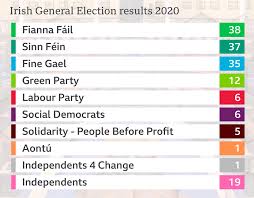
    Solidarity-People Before Profit represent people power and – unlike Labour, Greens and SF – will never prop up FF/ FG. By Richard Boyd Barrett. For nearly 100 years, this country has been run by two conservative parties, Fianna Fáil and Fine Gael. The legacy of their rule is under-funded public services. We have the highest creche fees in Europe, the longest hospital waiting lists and, after Brexit, the highest third-level fees in the EU. The two conservative parties are ideologically opposed to taxing wealth and to strongly interfering in the private market.  One in three of Fianna Fáil and Fine Gael TDs are landlords and so they have a vested interest in high rents and property prices. It is no wonder that they refuse to implement proper rent controls and support measures that increase property prices and aid property speculators. Solidarity-People Before Profit want to Break the Cycle of Fianna Fáil and Fine Gael rule. For years, this seemed a distant dream, but recent polling evidence shows a striking change. The two conservative parties now only command the support of less than half of the electorate. We can start to make a change in this election – and see the back of control by Fianna Fáil and Fine Gael into the future. Of course, the mandarins in RTE want to pretend that we still live in a two-party Tweedledum and Tweedledee system – so they give us a television debate between the ‘two leaders’. Yet on the doorsteps it is abundantly obvious that many see these parties as having almost the exact same polices. There is a wind of change sweeping across Ireland, as was evident in the votes on marriage equality and Repeal. That change is now starting to blow apart an old political system with more than 50% of people looking to vote for parties other than Fine Gael and Fianna Fáil.  There is, however, one potential major obstacle to the change. Namely, that parties which talk left today enter a coalition to prop up Fianna Fáil or Fine Gael tomorrow. This produces an old cynical game where promises are dropped and the focus becomes on ‘managing the economy’ and being realistic. There is absolutely no possibility of developing high-quality public services if you join neoliberal parties like Fianna Fáil or Fine Gael in coalition. That is why People Before Profit give you an absolute guarantee –  a vote for us will never be used to prop up a Fianna Fáil or Fine Gael in government. Unfortunately, others  – such as Labour the Greens and even Sinn Féin – say they are prepared to join them in coalition. But look what happened when Labour joined coalition last time. They gave us water charges and an increased pension age. Or when the Greens joined Fianna Fáil – they presided over the cutting of 300 buses from the Dublin Bus fleet. In the South, Sinn Fein have been vociferous in calling for a restoration of the pension age to 65. But in the North, when they were in coalition with the right-wing DUP, they supported an increase to 66. No matter what they say, the same will happen again to any party that joins Fianna Fáil or Fine Gael in government. Solidarity-People Before Profit believes Ireland needs real change. We stand for an old-style policy of re-distributing wealth. We want to tax the billionaires, the big corporations and vulture funds to raise enough revenue to develop high quality public services. Specifically, we want to: 1.      Restore the pension age to 65. 2.      Bring in proper rent controls that allow for rent reductions 3.      Stop sales of public land – use it for social and affordable housing. 4.       Take Radical climate action – Free public transport and keep fossil fuels in the ground 5.      Guarantee 33 hours a week free childcare 6.      Scrap fees for third level education 7.      Create a health service that treats patients according to medical need -not the size of their wallet 8.      Abolish property tax on family home and USC tax on those who earn under €90,000 9.      Develop proper services for the disabled and those with special needs. These are our polices but we don’t just oppose, we organise.  We have achieved real change by helping to build ‘people power’ campaigns and mass movements. Look at the defeat of water charges and Repeal. Look at how French workers stopped a rise in their pension age with mass protests. We could do the same here. That’s the change you need.

    Loading

    Read more

  • Posted in:

    Sinn Féin and the politics of the struggle

    Ireland’s largest party of the left may soon have us at last, whether we like them or not By Rory O’Sullivan Gerry Adams, the President of Sinn Féin from 1983 to 2018, published five Audacity of Hope-style books – part-autobiography, part-political manifesto – during the most intense phase of the peace process in Northern Ireland. The last one, which came out in 2003, was entitled Hope and History: Making Peace in Ireland. “Hope and history” is from those lines of Séamus Heaney’s The Cure at Troy which are quoted constantly: “Once in a lifetime/The longed-for tidal wave/Of justice can rise up,/And hope and history rhyme”. The Cure at Troy, first staged in 1990, is a version of the play Philoctetes by Sophocles, in which the Greek heroes Odysseus and Neoptolemus try to convince the wounded archer Philoctetes to return with them to Troy. A prophecy states that the Greeks will need Philoctetes’ bow of Heracles to help win the Trojan war, but at its beginning Odysseus had marooned Philoctetes on Lemnos; he had been bitten by a snake and his screams were distressing the crew. Heaney’s play is clearly about Northern Ireland, with the characters’ eventual conciliation a kind of symbol, and a roadmap. The Cure at Troy is really a play about getting over the wrong someone has done to you in order to share a future with them. But this is not quite what the Philoctetes is about, since in the end what Philoctetes agrees is to go back and fight a war which will end in destruction and massacre at Troy. During the sack of the city, all three men will commit sacrilegious acts, things which today we would call war crimes. They will in turn be punished by the Gods for them, and all of this is foreshadowed at the moment of conciliation with which the play ends. Philoctetes is not simply a guide to achieving peace or justice; it asks what justice can really mean in a world of endless conflict and guilt.  And it is out of these two sides of the mouth that Gerry Adams speaks in the title of his book: “Hope and History”, the man who put down the armalite to fight with the ballot box instead; “Making Peace in Ireland,” the man who did it, not to reconcile with Unionists, but to defeat them. Even in 2003, it would never be ‘Northern Ireland’.  Adams, now retired, has a blog called Léargas where he posts from time to time; he posted an entry last Friday, 24/1/20, entitled “Keep your eye on the prize”. He offers a Sinn Féin-centred view of the peace process, saying of the Good Friday Agreement that “we had in fact established an alternative – a peaceful way to win freedom for the first time in our history”. He closes by saying, “Unity is no longer an aspiration – it is achievable. It is a doable project. It is the prize. There for everyone on this island. All of this is part of the continuum of struggle”. Peace, or Irish unity: which is the prize? It depends who you ask; and if you ask Sinn Féin, it depends who’s asking. In the book, Hope and History, Gerry Adams describes the Sinn Féin tactic of “love-bombing”, which unnerved and bewildered Unionists during the peace process. When Adams and the UUP’s Ken Maginnis appeared together on America’s Larry King Show after the Ceasefire in 1994, Adams repeatedly tried to shake his counterpart’s hand and pat him on the shoulder. Maginnis stiffened up and didn’t know what to do. He looked out of date.  The standard Unionist charge against Sinn Féin is that they committed to ‘Northern Ireland’ in the Good Friday Agreement only in order to destroy it, and have spent their time in Stormont using power-sharing against itself. Of course, this is a regressive point on Unionists’ part since it amounts to a demand that, as a precondition of peace and power-sharing, Republicans profess loyalty to the Union. But it is also true that Adams and McGuinness had long-believed that the Republican movement needed to be mainstream to win, and that this meant putting the political above the military as a matter of strategy.  In his book, ‘Blanketmen’, the hunger-striker Richard O’Rawe claims that Adams ordered strikers to die so as to increase support for Sinn Féin and open the political theatre of the struggle. O’Rawe’s claim is disputed, but it is clear that by 1986 Sinn Féin’s leaders were carefully laying out the path that the Republican movement would follow through the 1990s and 2000s. In that year’s Ard-Fheis the party ended its policy of abstentionism in Leinster House. It was over precisely this question that Provisional Sinn Féin had split from the party in 1970; and the 1986 decision caused another split, with Ruairí Ó Brádaigh and the party’s Southern old guard breaking away and forming Republican Sinn Féin, whose military wing is the Continuity IRA.  Ó Brádaigh gave a fiery speech at the 1986 Ard Fheis, excoriating Adams and McGuinness for betraying the core values of Republicanism. He said that ending abstentionism meant recognising the ‘Free-State’ as the government of Ireland, and therefore its army as the Irish army. In other words, and in contrast to Unionists like Maginnis, he argued that Sinn Féin were repudiating the principles behind the armed struggle. He ended the speech by saying: “In God’s name, don’t let it come about…that Haughey, Fitzgerald, Spring and those in London and Belfast who oppose us so much can come out and say “Ah, it took sixty-five years, but we have them at last”.  Neither Ó Brádaigh nor the Unionists were wrong, exactly, in their criticisms of Adams and McGuinness, but neither had managed to see the pair from both sides. What drove Sinn Féin through the peace process and into Stormont was a pair of contradictory principles, each espoused in turn to different listeners. The only concession Sinn Féin made in principle

    Loading

    Read more

  • Posted in:

    The subtlety of Ireland’s leftward shift explained.

    Where they vote left, young  voters tend to focus on redistribution and inequality. Only 31% of 18-24 year olds and 32% of 25-34 year olds support Fianna Fáil or Fine Gael. By William Foley. Ireland is on the cusp of a general election which will see an unprecedented transformation of its political divisions. Surprisingly, it will be the first time in generations that questions of economic distribution will have affected the outcome. Evidence from opinion polls and surveys shows that where younger voters (under 29 years of age) reject the dominant right-wing parties they do so because they want greater economic equality. This gives the left a unique chance by focusing on their core issue – redistribution – to galvanise today’s youth to an egalitarian agenda  if, despite the failure of commentators to read the situation, they keep clear heads and take the opportunity. In postwar Europe, political parties in most countries traditionally competed over who got what, and how much. Parties were aligned along an axis – on the right were those who believed that the market should be the primary mechanism for determining the distribution of wealth, and on the left were those who believed that this distribution should be fixed in large part by the government.  Ireland has usually been regarded as an exception. Here, the main political division does not run between the left and the right.  Here it has not been between those who favour greater redistribution by the state and those who are against it, but between descendants of the opposing sides in the civil war. Those lineages may have some importance today – Fianna Fáil would probably not have attempted to rehabilitate the RIC – but what they amount to in practice is a system in which the vast majority of people have always voted for parties which have been economically right-wing, at least since Lemass.  This state of affairs has not prevailed because Irish people are inherently more right-wing than other Europeans. Political views are not the result of a simple transformation of broad values and social attitudes into party support; they are the indirect outcome of a process which filters those values and attitudes through a given ideological frame. These frames function like lenses, capable of magnification and diminution, distortion and concentration. Certain values may be filtered out – considered irrelevant for the determination of political preference. In Ireland, due to a conjuncture of historical reasons, left-wing ideological frames were largely absent.  Other factors were at play which determined political identities: the legacy of a brutal and traumatic civil war, the personalisation and parochialisation of politics, the hobbling of economic development under British imperialism, the passive role played by the Labour party from 1916 onwards, and so on. Questions which concerned the just distribution of resources were simply filtered out by the dominant post-civil war frame. Historically, the left has failed to pry even one finger loose from the FF/FG stranglehold. Parties such as Clann na Poblachta and The Workers’ Party occasionally sparked into life, achieving fleeting electoral success before flickering out like tealights in a children’s nursery. Because one of either Fianna Fáil or Fine Gael was usually in opposition, the see-saw effect of electoral politics meant that when one became somewhat unpopular, the other could take its place in government.  But the confidence and supply arrangement that prevailed in the last Dáil has meant that, while Fianna Fáil were not in the cabinet, they were not entirely in the opposition either. The economic crisis dealt them a blow from which they have not really recovered, nor have Fine Gael truly taken their place.  The result is that the two right-wing parties are more closely associated than ever – and more unpopular. Opinion polling since the general election seems to show them combined  on about fifty percent or less. Most striking is the age gradient: only 31% of 18-24 year olds and 32% of 25-34 year olds support either Fianna Fáil or Fine Gael, according to an Irish Times / Ipsos MRBI poll. If these trends hold true, then what appears to be emerging in Ireland is a more traditional “left-right” divide, characterised by competition between parties who favour more economic redistribution and those who oppose it. Survey evidence seems to support the increasing relevance of attitudes towards redistribution for determining party support. Figure 1 Support for redistribution and combined support (%) for FF / FG over time. Figure 1 makes use of Irish data from nine rounds of the European Social Survey (ESS) to illustrate this dynamic. Each round of the ESS asks respondents to indicate their support for the following statement: “Government should reduce differences in income levels”.  The respondent could say that they strongly agreed, agreed, neither agreed nor disagreed, disagreed, or strongly disagreed. I recoded the question so that everyone who strongly agreed or agreed was categorised as “supportive of redistribution” and everyone else was categorised as “unsupportive”, excluding those who didn’t answer the question (about 2.7% of the sample).  The ESS also asked respondents if they felt close to any party (about 36% did), and which party they felt closest to. I used this question to calculate the combined support for FF / FG over time, among those who are supportive and unsupportive of redistribution, excluding those who didn’t support any party. This relationship is shown in Figure 1. The data are weighted to reflect unequal probabilities of inclusion in the sample (though the unweighted results are the same), and the years given on the horizontal access correspond to the calendar years in which most of the Irish respondents were interviewed for each of the nine rounds of the ESS. These data probably overestimate support for Fianna Fáil and Fine Gael – at least compared to present opinion polls –  but the emerging relationship that they depict is valid.  As can be seen, preferences for redistribution matter a lot more after 2011. In the preceding years, those who are supportive and unsupportive of redistribution

    Loading

    Read more