David Burke

Random entry RSS

  • Posted in:

    Scappaticci, MI5 and the murder of a Westminster MP. The stench of death associated with the Kincora scandal is heady. By David Burke

    The stench of death associated with the Kincora child sex abuse scandal is heady. It includes the murder of a Westminster MP by an MI5 agent inside the IRA. The murderous agent was Alfredo ‘Freddie’ Scappaticci. The victim was Robert Bradford, a member of the Ulster Unionist Party and the Vanguard Progressive Unionist Party. He represented Belfast South. The death of Scappaticci earlier this year shut the door on the last realistic opportunity to solve Bradford’s murder.  Operation Kenova, which has been probing the Scappaticci scandal for seven years, and has cost approximately €40,000,000, is unlikely now to establish what took place. The killing was linked to the cover-up of the Kincora Boys’ Home scandal. There are other murders which are associated with Kincora. One of the most significant Loyalist terrorists of the period 1968-82, was John McKeague, a paedophile. He knew all about Kincora. McKeague was murdered by British agents when he threatened to spill the beans on the scandal. William McGrath, who was the ‘housefather’ at Kincora, was a British agent. He was involved in the clandestine importation of arms for Loyalist terrorists, including his own paramilitary organisation, Tara. Many people were shot dead due to the arms smuggling efforts of British agents inside Loyalist paramilitary circles such as McGrath. The cascade of death connected to Kincora did not end with murder. Sex-abuse victims committed suicide. One Kincora boy took his life after being violated by Lord Louis Mountbatten. Rishi Sunak’s proposed legacy legislation, if passed, will help conceal the full extent of State-Loyalist collusion, some of which was linked to McGrath. 1. Honey Trap MI5 and MI6 ran a ‘honey trap’ operation at Kincora Boys Home, a residence in Belfast for boys, aged 14 years and upwards, in the 1970s. Residents were trafficked to Loyalist politicians and paramilitaries, as well as VIPs, for sexual abuse. Some were molested at the home, others at hotels such as the Europa, Girton Lodge and Park Avenue in Belfast, as well as the Queen’s Court in Bangor. ‘Kompromat’ or dirt was collected about politicians and paramilitaries. Some were blackmailed into working for the intelligence services. The British Establishment applied a double coat of whitewash over Kincora in an attempt to cover up the full extent of this scandal decades ago. A lot – but not all of it – has been peeled away by survivors, whistleblowers and obstinate truth-seekers. 2. Driven to suicide Eric Witchell is a paedophile. He now lives in London. In the 1970s he ran Williamson House in Belfast where he preyed on pre-pubescent boys and young teenagers. He and his accomplices drove at least three of them to commit suicide; another two to attempt it. A select few were transferred to Kincora when they reached 14. Witchell was not interviewed by any of the various inquiries into Kincora. Stephen Waring, one of the residents of Kincora, ran away from the home in November 1977, a few months after being abused by Lord Mountbatten at Classsiebawn, County Sligo. Waring made it as far as Liverpool where he was captured and put on the Ulster Monarch car ferry destined for Belfast. He never made it home. Apparently, he jumped overboard to his death. His body was never found. The Garda have retained the security logs which record the visitors to Classsiebawn in 1977  but have declined to disclose them to me and Andrew Lownie, Mountbatten’s biographer. They undoubtedly record the arrival of Joe Mains, the Warden of Kincora, in a vehicle with boys, including Waring, who was seated in the rear. I am frankly aghast that the Irish government – which could intervene – has no interest in helping the survivors of sex abuse committed in Sligo by ordering Garda Commissioner Drew Harris to release the security logs. 3. A dismembered child’s body in the Lagan Brian McDermott, aged 10, disappeared from Ormeau Park on 3 September 1973. Part of his dismembered and charred body was found in a sack in the River Lagan a week later. The RUC discovered evidence that he was abducted and murdered by Alan Campbell, a founding member of the DUP. Campbell was also in Tara, a Loyalist paramilitary organisation, and was a friend of the paedophiles who ran Kincora. Colin Wallace, who worked at the British Army’s HQ at Lisburn, has told Village that the British Army, which had an interest in Tara, was alerted by the RUC that they were about to arrest Campbell. Then, suddenly, the police were ordered to stand down. Only the Northern Ireland Office (NIO) possessed that sort of authority. The security apparatus of the NIO was run by MI5 and Ministry of Defence officials. The manoeuvre ensured that the Kincora ‘honey trap’ operation did not unravel at that time. Significantly, Campbell was a British agent. Authors Jack Holland and Henry McDonald, referred to him as the ‘Demon Preacher’ in their books, describing him as an obvious British agent. Campbell and his cabal are suspects in the abduction of four other Belfast boys whose bodies were never recovered: Jonathan Aven, age 14, who disappeared on 20 September 1969; David Leckey, aged 12, who went missing on 25 September 1969; Thomas Spence, age 11, and John Rogers, aged 13, who both vanished on 26 November 1974. Had the RUC been permitted to arrest Campbell, it is probable that young Spence and Rogers would still be alive today. The BBC commissioned a documentary about the disappearance of these boys. It was completed in 2021 and entitled, ‘The Lost Boys of Belfast’. It was intended to be broadcast in May 2021 but was pulled by management. It is not certain if it will ever be aired. It uncovered evidence of MI5 involvement in the protection of Campbell and the Kincora cabal. RUC officers went on record in front of the cameras. Campbell was not interviewed by any of the various inquiries into Kincora. 4. The gunrunning operations of the ‘housefather’ of Kincora, William McGrath Colin ‘Jay’ Wyatt, joined Tara following the

    Loading

    Read more

  • Posted in:

    An appalling vista: disturbing indications of Kitson's foreknowledge of a third massacre of innocent civilians. Tragedy took fifteen lives including two children. By David Burke.

    New evidence has emerged about the UVF’s bombing of McGurk’s Bar in Belfast in December 1971. The explosion caused the entire structure of the premises to collapse, killing fifteen Catholic civilians – including two children – and wounding seventeen more. It was the deadliest attack in Belfast during the Troubles. Brigadier (later General Sir) Frank Kitson commanded the British Army in Belfast 1970-72. He was a counter-insurgency guru who created havoc on the island before he was drummed out of it by William Whitelaw, the first British secretary of state for Northern Ireland. One of the conscious choices Kitson made while still in Ireland was to take on the IRA but not Loyalist terrorist gangs such as the UVF. This coincided neatly with the policy of the British government of Edward Heath which decided to intern  members of the IRA but not Loyalist paramilitaries. On these grounds alone, the British state became indirectly responsible –  through inaction – for the crimes of the UVF, including the McGurk tragedy. Worse still, there are indications that Kitson may have exploited elements of the UVF as a proxy assassination apparatus for the British state in Belfast. 1. Redaction of Evidence The sliver of new information about the massacre was recorded in a log by the 2nd Battalion Royal Regiment of Fusiliers (2RRF)  approximately forty-two minutes after the bombing. It relates to the proprietor of the bar, Patrick McGurk, and the nearby Gem Bar. Britain’s Information Commissioner’s Office has upheld a decision by Britain’s National Archives to withhold a section of the log from the families of the victims of the massacre. The Archive acted in consultation with the British Ministry of Defence (MoD). The 2RRF log reveals: Owner of pub a moderate RC [Roman Catholic] unlikely to have allowed people to use it as a mtg [meeting] place. Bar close to Gem Bar which is a [REDACTED]. 2. The Gem Bar The information relating to the Gem Bar remains withheld even though the venue no longer exists. When they were making their case for a full declassification of the log, the families of the victims of the attack presented archival evidence to the Information Commissioner’s Office that the Gem Bar was: The original target of the bombers; Known as an Official IRA bar; Recorded in British Army files as the local HQ of the Official IRA; Under British Army surveillance; And that the premises had been targeted by 2 RRF two nights before the bombing during which 2 RRF arrested and questioned six customers from the Gem Bar raid. Put simply, the perceived connections between the Gem and the Official IRA was a known fact and therefore any information pointing in that direction was not going to endanger anyone, especially as the pub has long since closed. Moreover, former known members of both wings of the IRA walk about Belfast without any concern for their safety. Some of them have published books about their paramilitary careers, others have been interviewed on the record by the press, radio and TV Despite this reality, the log remains redacted. 3. Reaction of the families Ciarán MacAirt is a grandson of two of the victims of the McGurk’s Bar Massacre and has been fighting for sight of the information – all of it – for five years. He said: After 50 long years fighting the British state’s lies, our families are outraged but unsurprised that it is withholding evidence relating to the mass murder of our loved ones in McGurk’s Bar. The British state has lied to us from the moment the bomb exploded up to this very day.  Police Service Northern Ireland and the Office of the Police Ombudsman either failed to find this evidence or found it and buried it again as it has been left to the families to expose the truth about the McGurk’s Bar Massacre and its cover-up by the British state. Nevertheless, even when we discover new evidence, the British authorities withhold it from us and deny us access to the truth. In the meantime, many of our older family members are infirm or have gone to their graves without any justice. A video about the attack can be accessed here: https://www.youtube.com/watch?v=uQRLFnBxoWQ 4. The shape of an extremely disturbing state of affairs. The redaction is deeply disturbing. There is no good explanation for it. Why do the MoD censors want the redacted words withheld from public scrutiny, even after more than fifty years? The shape of an extremely disturbing state of affairs involving dirty tricks, collusive murder and black propaganda is swimming into focus. The following scenario is one that offers an explanation for what happened in 1971, and why the British State still feels it necessary to redact the document. 5. Kitson and the IRD Brigadier Frank Kitson was involved in a black propaganda operation that swung into action shortly after the bombing. He was almost certainly aided and abetted by Hugh Mooney who worked for the Information Research Department (IRD) of the Foreign Office. Mooney had been sent to Belfast to destabilise the IRA through the deployment of psychological operations (PsyOps). Kitson, who commanded the British Army in Belfast and its environs, was a meticulous planner who became deeply engaged in propaganda operations during his two years in Belfast. He was also the British army’s foremost counterinsurgency expert having honed and developed his skills in Kenya, Malaya, Oman and Cyprus. His infamous treatise about counterinsurgency, ‘Low Intensity Operations’ was published in 1971. One of the hallmarks of Kitson and Hugh Mooney was the meticulous manner in which they planned their operations in Ireland, invariably well in advance of their deployment. The black propaganda operation that swung into action after the bombing of McGurk’s Bar was up and running a little over four hours after the attack. The operation was a sophisticated affair, one that involved the coordination of senior British Army officers (including Kitson and his superior Lt. General Sir Harold Tuzo, General Officer Commanding Northern Ireland), the

    Loading

    Read more

  • Posted in:

    Vilifying the victims: two of the most vile British Intelligence smear campaigns of the Troubles blamed innocent murder victims for their own demise. By David Burke.

    The Information Research Department (IRD) of Britain’s Foreign Office sought to smear the victims of Bloody Sunday and the McGurks bar bomb atrocity. They even went so far as to attack a group of British politicians by linking them to a campaign for justice for the victims of Bloody Sunday. To the IRD, any association with the campaign for justice for the victims of Bloody Sunday was a shameful act. On 30 January 1972, British paratroopers murdered 13 unarmed civilians in Derry, none of whom posed any sort of a threat to the military – unless, that is, you consider the waving of a white piece of cloth in the air a potentially lethal act. Within minutes Britain’s black propaganda machine swung into action. The head of the Army’s PsyOps department, Col Maurice Tugwell, who had joined the British Army in Derry, was among them. Upfront, Col Derek Wilford, the cowardly commander of 1 Para (cowardly because he has sacrificed his own men by lying about the orders he gave them to save his own skin) spewed out a torrent of lies about an imaginary attack on his troops by the IRA. Later, the Information Research Department (IRD) of the Foreign Office took over the smear campaign against the Bloody Sunday campaigners. A man with deep Irish roots – Hugh Mooney – led the IRD charge. Mooney was a graduate of Trinity College Dublin. He had once worked for the Irish Times. As an IRD officer, Mooney was complicit in a multiplicity of MI6-IRD smear campaigns. An indication of his mindset can be gleaned from the fact that when he later tried to smear leading members of the British Labour Party, he felt the best way to bring them into disrepute was to link them to the families of the victims of Bloody Sunday. (This episode, and a forged document the IRD created to further it, are described more fully later in this article.) Mooney had assets in the British press. One of them was a Tory guru called Tom Utley. Ultley was a British intelligence ‘agent of influence’ or in modern parlance, an ‘influencer’.  At the time of the Bloody Sunday massacre, Utley was working for the Daily Telegraph and Sunday Telegraph, both pro-Tory papers popular with middle and upper class Britain. Mooney and Utley discussed the Bloody Sunday problem together. It was ultimately resolved that Utley would write a paperback about it. According to a confidential letter dated 24 March 1972, the FCO reported to the MoD that Utley hoped to ‘complete the writing in about six weeks, though this may be a little over-ambitious’. According to the letter, he was ‘obviously’ going to ‘need a certain amount of help from Army PR, particularly on the propaganda aspect’. While Utley failed to produce the book, in 1975 he published the rather grandiosely titled ‘Lessons of Ulster’ which took a broader look at Northern Ireland and a litany of developments that had occurred in the meantime. An indication of his mind-set can be gauged from the fact that he objected to the use of the phrase ‘Bloody Sunday’, something he described as ‘slavish obedience to IRA mythology’. He argued that some of those killed were ‘fresh-faced boys who might otherwise have lived to swell the ranks of patriotic militancy’. In other words, they probably would have joined the IRA if they had not been shot. An indication of his mind-set can be gauged from the fact that he objected to the use of the phrase ‘Bloody Sunday’, something he described as ‘slavish obedience to IRA mythology’. He argued that some of those killed were ‘fresh-faced boys who might otherwise have lived to swell the ranks of patriotic militancy’. In other words, they probably would have joined the IRA if they had not been shot. The IRD demonised the families of the victims of Bloody Sunday and those who supported them. Clearly, they believed they had turned them into political untouchables. Hence, they felt they could undermine British Labour Party MPs by associating them with the Bloody Sunday quest for justice. Towards this end, the IRD forged a pamphlet based on a genuine Bloody Sunday campaign leaflet. The original is reproduced hereunder: Merlyn Rees, who served as Secretary of State for Northern Ireland (and later as Home Secretary) was undermined – at least in the eyes of Mooney and his IRD colleagues  – by linking him to the Bloody Sunday campaign.  His name was added to the IRD forgery which appears under this paragraph. (See the bottom of the left hand column). A man called Stan Newens appears on the authentic pamphlet. He was supplanted by Stan Orme MP on the fabricated version. In a similar fashion, Tony Smythe became Tony Benn. David Owen MP was added to the list too.  Owen, however, had the last laugh: when he became Foreign Secretary later in the 1970s, he abolished the IRD. Mooney deployed a similar tactic to smear Charles Haughey TD of Fianna Fail, i.e., he took an original document produced in Ireland and doctored it to include smears about Haughey before printing his own version in London. Mooney was also responsible for the smear campaign against the victims of the McGurks bar bomb atrocity. 15 innocent people were murdered when the UVF attack McGurks bar in Belfast in December 1971. The black propagandists issued a statement insinuating that at least some of the victims of the attack were responsible for their own demise. The propagandists alleged that the bomb had been brought inside the pub by an IRA unit and had exploded prematurely – a so-called ‘own goal’. The campaign was furthered by statements by politicians. See Alleged disappearance of UVF Bomb Massacre Files: MoD excuse for destruction of Brigadier Kitson’s logs is far from convincing. By David Burke. Despite the best efforts of David Owen, the black propagandists found other avenues through which they managed to smear their victims including Charles Haughey. David Burke is the author of 

    Loading

    Read more

  • Posted in:

    Alleged disappearance of UVF Bomb Massacre Files: MoD excuse for destruction of Brigadier Kitson's logs is far from convincing. By David Burke.

    On 4 December 8:45 p.m., a UVF gang set out on a bombing mission. One of those involved was Robert James Campbell. The UVF bomb exploded outside a small pub in Belfast called McGurk’s, a cosy place where Catholics and Protestants from the same neighbourhood – all of whom knew each other well – met for a few drinks. The UVF unit left the bomb outside the pub, not inside it. It consisted of forty to fifty pounds of gelignite. It was ignited by lighting a fuse, not a timer. A paper boy saw the UVF car pull up and a man deposit the bomb outside the pub before fleeing. He spotted the fuse sparking and warned the man not to go up the road. According to Robert James Campbell, his unit had originally wanted to attack another establishment which they believed was frequented by the Official IRA and its supporters, but it had two guards posted outside. After waiting for an hour for them to go inside, the UVF unit decided to go elsewhere. They drove to McGurk’s. The British Army had two Ammunition Technical Officers, i.e., bomb disposal experts, circulating around Belfast on standby in case a bomb was detected. They attended at the scene in the immediate aftermath of the explosion.  Because of the darkness and the debris, they were unable to determine the exact location of the detonation. They decided to carry out a further inspection at daylight the next day. Following the daylight inspection, the Army’s 39 Brigade HQ in Lisburn recorded in its Ops Log at 11.10am: “ATO is convinced bomb was placed in the entrance way on the ground floor. The area is cratered and clearly was the seat of the explosion.  The size of the bomb is likely to be 40/50 lbs”. This information corroborated what the paperboy had witnessed. The bomb killed fifteen people, two of whom were children. Another seventeen were badly wounded. The building was demolished. A knowingly and thoroughly dishonest statement was issued stating that the bomb had been brought inside the pub by the IRA and detonated prematurely. The insinuation was that the bar was a safe haven for the IRA to stage operations, and that at least some of the victims were IRA sympathisers. The disinformation charge was led by Frank Kitson. Kitson is still alive. At the time, he was in charge of British military activities in Belfast and its environs. He was also an expert in  counter-insurgency (i.e. dirty tricks, collusive murder, torture and black propaganda). Paper Trail, a charity which helps victims of atrocities such as McGurk’s, has been digging into Britain’s National Archives to try to understand what happened. The work it has undertaken has proven beyond a shadow of a doubt that the bomb was not an ‘IRA own goal’. Aside from a few die-hard Unionist bigots, no sane and respectable commentator bothers to recirculate Kitson’s lies any more. But there is more, a lot more to this scandal, than meets the eye.  Paper Trail uncovered military logs relating to the attack which the Ministry of Defence (MoD) had failed to release when it made other logs available. Happily, the same logs were available elsewhere. Paper Trail submitted a complaint about this development to Britain’s Information Commissioner’s Office (ICO).  The ICO has just announced that it accepts the MoD’s explanation, namely that the relevant logs were in the process of being scanned before allegedly being destroyed and that the crucial logs were accidentally omitted during the scanning process. This explanation is trite. The time has long since passed for a full judicial inquiry. A full breakdown of the Information Commissioner’s conclusion and the evidence unearthed by Paper Trail can be found here: https://mcgurksbar.com/ico-accepts-mod-excuses-for-missing-massacre-files/ The Paper Trail website can be accessed here: https://www.papertrail.pro/ David Burke is the author of  Kitson’s Irish War, Mastermind of the Dirty War in Ireland  which examines the role of counter-insurgency dirty tricks in Northern Ireland in the early 1970s and the template it set for the Troubles. His next book, An Enemy of the Crown, the British Secret Service Campaign against Charles Haughey, will be released at the end of September 2022. Both books can be ordered/purchased here:  https://www.mercierpress.ie/irish-books/kitson-s-irish-war/ https://www.mercierpress.ie/irish-books/an-enemy-of-the-crown/ Other stories about British Intelligence black propaganda operations, dirty tricks, Bloody Sunday, the Ballymurphy massacre, McGurks bar bombing, Brigadier Frank Kitson and Col Derek Wilford on this website include the following:  Bloody Sunday murderers operated a mobile torture chamber. By David Burke. Soldier G – real name Ron Cook – the Bloody Sunday killer with ‘the sadistic edge’ over his ‘partner’, Soldier F. By David Burke. Bloody Sunday: Brigadier Frank Kitson and MI5 denounced in Dail Eireann   The covert plan to smash the IRA in Derry on Bloody Sunday by David Burke Soldier F’s Bloody Sunday secrets. David Cleary knows enough to blackmail the British government. Learning to kill Colin Wallace: Bloody Sunday, a very personal perspective Lying like a trooper. Internment, murder and vilification. Did Brigadier Kitson instigate the Ballymurphy massacre smear campaign? Where was Soldier F and his ‘gallant’ death squad during it? Another bloody mess. Frank Kitson’s contribution to the wars in Afghanistan and Iraq. 300,000 have died in Afghanistan since 1979. Lying like a trooper. Internment, murder and vilification. Did Brigadier Kitson instigate the Ballymurphy massacre smear campaign? Where was Soldier F and his ‘gallant’ death squad during it? A Foul Unfinished Business. The shortcomings of, and plots against, Saville’s Bloody Sunday Inquiry. Kitson’s Private Army: the thugs, killers and racists who terrorised Belfast and Derry. Soldier F was one of their number. Soldier F and Brigadier Kitson’s elite ‘EFGH’ death squad: a murderous dirty-tricks pattern is emerging which links Ballymurphy with Bloody Sunday. A second soldier involved in both events was ‘mentioned in despatches’ at the behest of Kitson for his alleged bravery in the face of the enemy. Mentioned in Despatches. Brigadier Kitson and Soldier F were honoured in the London Gazette for their gallantry in the face of the enemy during the internment swoops

    Loading

    Read more

  • Posted in:

    SECOND UPDATE: The Irish government has become complicit in the cover-up of British Royal sexual abuse committed in the Republic of Ireland. By David Burke.

    1. The Classified Garda Files. The information provided by the brothers, John and Pat Barry, confirms that the Garda (Irish police) had a checkpoint at the gate of Classiebawn castle in August 1977. Garda security appears – by some accounts – to have been downgraded in 1979, shortly before Mountbatten was murdered by the Provisional IRA. Hence, while there might be a question mark about the existence of comprehensive Garda logs from 1979, there are no concerns about August 1977. The Classiebawn logs are the key to unlocking the sordid Kincora scandal. Boys from Kincora Boys’ Home in Belfast were trafficked to Mountbatten by Joe Mains, an MI5/6 agent who worked at Kincora. The same boys were trafficked to Loyalist paramilitaries and politicians by Mains as part of MI5 and MI6 ‘honeytrap’ blackmail operations. The Garda have shown no interest in the information at their fingertips. As far as can be told, the Government has displayed no curiosity either. The survivors of child sexual abuse deserve better. 2. Confirmation of a Garda checkpoint at Classiebawn. While the Barry brothers set out to defend the reputation of Mountbatten in their Sligo Champion interview – and did so in good faith – they have nonetheless highlighted a crucial issue about the Mountbatten-Kincora connection. It is one which could yet prove precisely the opposite of what they hoped to achieve with their interview. There is no doubt now that the Garda have a record of the registration plates of the vehicles they stopped at the gates. The existence of the Garda checkpoint was already an established fact, nonetheless, the confirmation by the Barrys is important as they  are living witnesses who can attest to its presence. It would now take a very daring – not to mention corrupt – Garda or Department of Justice official, to interfere with the files. The purpose of the interview with the brothers was to afford them an opportunity to put forward a defence for Lord Mountbatten whom they do not believe was a child abuser. John Barry, who was a boy at the time, made specific reference to a Garda ‘checkpoint’ and also that: “The guards wouldn’t have allowed some guy to come, a warden from Kincora [Boys Home in Belfast] who was supposed to have driven [child abuse victims to Classiebawn], and he was supposed to sit in the car for an hour outside the castle and let the boys in – or a boy in. And you think the guards wouldn’t have asked: ‘What are you doing here?’ No way”. His brother has confirmed the presence of Gardaí at the ‘checkpoint at the gate’. 3. Times and dates. In 2019 Andrew Lownie, author of a book about Mountbatten, sought the Garda logs taken at the checkpoint. Crucially, while the Gardaí refused to declassify the files, they nonetheless confirmed they were still in existenc.  See:  THE MOUNTBATTEN FACTOR: Boris Johnson should not bully Dublin over Brexit because the Irish Government has information which could damage the Royal Family What will the records reveal? In August 1977 Stephen Waring and another boy were abused by Mountbatten in an exterior building. They gained access to the grounds in a car which was driven through a Garda checkpoint. Waring took his own life the following November. See: SECOND UPDATE: Kincora boy abused by Mountbatten committed suicide months later. The Garda logs should contain the date and the arrival time of the car that brought Waring and the second boy through the gates of Classiebawn. They should also reveal when they left, along with the make, model and registration of the vehicle in which they were trafficked. 4. Liaison with the RUC The Kincora boys were driven to Classiebawn by Joseph Mains, the Warden of Kincora in August 1977. As a matter of routine, the registration plate of the car driven by Mains to Classiebawn would have been noted and logged. Next, the Gardaí would have sent them to Garda HQ. Then inquiries would have been made with the RUC. The RUC knew that Mains had connections to the Red Hand Commando (RHC), a Loyalist terrorist group. The Garda inquiry about the visit by Mains to Classiebawn would have raised a red flag. A senior RUC special branch officer would have taken control of the request. It is inconceivable that the Gardaí would have been told about Mains’ links to MI5/6 or the RHCs. The RUC special branch was complicit in the ‘honey trap’ operation that revolved around Kincora. Hence, the RUC undoubtedly told the Gardaí there was nothing to worry about insofar as the car driven by Mains was concerned. The RUC may even have expected a call from the Gardai and were ready for it. Rumours about Mountbatten’s involvement in the abuse of Kincora boys have circulated in security circles in Northern Ireland for decades. The Garda request about the visitor to Classiebawn in August 1977 may be at the root of the gossip. 5. A report on Mains may reside in Garda files at its Phoenix Park HQ in Dublin. The Garda inquiries that took place after Mountbatten was murdered on 27 August 1979, reached back to 1974. All of those who came into contact with him formed part of a massive inquiry. All of those who visited Classiebawn were investigated. A short report on Joe Mains may very well have come into existence as early as September 1979. Indeed, a record of his identity may have existed since his visit in August 1977 (and perhaps other visits in the 1970s). The Kincora scandal did not erupt until January 1980. Thus, when the Gardaí were making inquiries with the RUC in 1977 and/or 1979, about the car Mains drove to Classiebawn in 1977, there was no particular need to conceal his name, at least insofar as Kincora was concerned. The RUC hardly anticipated that Mains would become known as a child abuser in 1980. Mains was convicted of child abuse in December 1981. 6. 60 years

    Loading

    Read more

  • Posted in:

    Lord Widgery, the judge who covered-up the murders of Bloody Sunday. How and why he did it.

    By David Burke. This article was first published on 2 July 2021. It is republished to mark the 50th anniversary of the publication of Lord Widgery’s infamous report which defamed the victims of Bloody Sunday and exculpated those who murdered them. 1. Brigadier Frank Kitson subverts the law. Brigadier Frank Kitson of the British Army was a so-called counterinsurgency guru. He was sent to Northern Ireland in 1970 to tackle the IRA. The following year his astonishingly indiscreet book, ‘Low Intensity Operations’ was published. In it he explained that there were two ways of administering the law during a counterinsurgency, the first one being that: the law should be used as just another weapon in the government’s arsenal, and in this case it becomes little more than a propaganda cover for the disposal of unwanted members of the public. For this to happen efficiently, the activities of the legal services have to be tied into the war effort in as discreet a way as possible … The other alternative is that the law should remain impartial and administer the laws of the country without any direction from the government. [Kitson (1971), p. 69.] The first tribunal investigating the events of Bloody Sunday – Widgery – is a good example of how the law was used as “just another weapon in the government’s arsenal”. On Monday 31 January 1972, Tory Home Secretary Reginald Maudling announced in the House of Commons that there would be a judicial inquiry into the Derry massacre. That evening British Prime Minister Ted Heath and Hailsham, his Lord Chancellor, asked Lord Chief Justice Widgery to chair it. Widgery had been a surprise appointment as Lord Chief Justice of England and Wales by the Tories the previous year. He was not viewed as a jurist of the first rank by his peers. His career was one which would ultimately descend into bedlam. Private Eye magazine would report that “he sits hunched and scowling, squinting into his books from a range of three inches, his wig awry. He keeps up a muttered commentary of bad-tempered and irrelevant questions – ‘What d’you say?’, ‘Speak up’, ‘Don’t shout’, ‘Whipper-snapper’, etc”. [Private Eye Issue 436, 1 September 1978.] These comments were published two years before he stepped down from the bench. The view expressed by the Eye is reflective of Widgery’s reputation for having been ‘difficult’ by members of the Bar in Britain. ‘Difficult’ in this context is a polite euphemism. Widgery was despised by the legal profession which viewed him as a second rate political appointee who strove to conceal his shortcomings in the traditional manner of the lower tier judge:   by hectoring, pelting and bullying. 2. Judicial compromise The night before Heath asked Widgery to conduct an inquiry, he had expressed his belief to Taoiseach Jack Lynch that Kitson’s paratroopers had behaved properly in Derry. If Heath truly believed what he had said to Lynch, he had an unusual way of showing it. He chose Widgery – a safe pair of hands – and left him in no doubt that he was to pervert the course of justice. At the meeting on 31 January Heath told Widgery that it “had to be remembered that we were in Northern Ireland fighting not only a military war but a propaganda war”. It is hard to conceive of a more compromising comment made by a British prime minister to a senior member of the judiciary, let alone the man at its pinnacle. No matter what way one looks at it, the comment demonstrates a breath-taking lack of esteem on the part of Heath for the independence of the judiciary. Yet Widgery did not rise to his feet and leave the room in protest. Instead, he did what his master bid him to do. 3. An Allegedly Independent Judge pre-judges the Murder Victims by Attending a Meeting at which they were referred to as ‘the other side’ At the same meeting at which Heath had given Widgery his riding orders, the parties to the discussion had also referred to the victims as the ‘other side’. [Para (viii) of minute of meeting of 31 January 1972.]  Moreover, according to confidential notes by a Widgery associate, the “LCJ” [Lord Chief Justice] could be counted on to “pile up the case against the deceased” even though the evidence provided “a large benefit of the doubt to the deceased.” [‘Hidden Truths’ (1998), p. 95. 4. Threats to Muzzle the Ever Compliant British Media In the days after the massacre, the journalist Murray Sayle and his colleagues completed a report which was submitted to the Sunday Times. There was internal opposition to its conclusion, namely  that Colonel Derek Wilford,  who had led 1 Para in Derry on Bloody Sunday, had set out to provoke the IRA into coming out into the open so his troops could wipe them out. Harold Evans, the editor of the paper, decided to ring Widgery. “I said we had done a great deal of interviewing and proposed to publish this Sunday. We also had compelling photographs. I told him I presumed contempt would not apply since nobody had yet been accused. It would be an exaggeration to say he was aghast, but he made it very clear it would be ‘unhelpful’ to publish anything and yes, he would apply the rules of contempt. .. I withheld the article, but that week I took the chance of publishing the shocking photographs by Gilles Peress of unarmed men being shot”.  [Harold Evans,  ‘My Paper Chase, True Stories of Vanished Times’ (Little, Brown and Co, New York, 2009), p 474.] On Sunday 6 February, the paper reported that, “The law is that until the Lord Chief Justice completes his enquiry nobody may offer to the British public any consecutive account of the events in Derry last weekend”. [Sunday Times 6 February 1972.] Heath’s press office rowed in declaring that anything which anticipated the Tribunal’s findings would amount to contempt. This was a highly contentious assertion without

    Loading

    Read more

  • Posted in:

    Updated: The very best (and worst) of British. Simon Danczuk is one of a number of courageous British individuals who has tried to tell the truth about British government crimes in Ireland. He joins the ranks of Colin Wallace, Fred Holroyd, John Stalker, Byron Lewis and John Stevens

    Dolphin Square VIP sex abuse. Dolphin Square was opened in London’s Pimlico in 1936. It soon became a magnet for all sorts of scandal and intrigue:  espionage, political, sexual, not to mention mysterious deaths. ‘Scandal at Dolphin Square’ provides a riveting account of the lives of a rolling maul of fascinating and complex characters. As publicity for the publication accurately proclaims, it was ‘a place where the private lives of those from the highest of high society and the lowest depths of the underworld have collided and played out over the best part of a century’. It was also a cesspit where Prince Andrew’s friend Lord Greville Janner abused children. The two most important chapters in the book, both of which describe the activities of members of a VIP child abuse network, have been ignored by the British press. Cut from the same cloth: the Russian and British press Consumers of the media in the UK, have no appreciation of the extent to which they are kept in the dark about British Establishment scandals. They are completely unaware of the role Buckingham Palace played in suppressing the Jeffrey Epstein scandal for years before it broke in the US media. See: Palace of Discord and Deception. [Updated] Prince William’s officials covered-up his uncle’s involvement in the Epstein-Maxwell sex trafficking scandal. By Joseph de Burca. At the moment, many in Britain are exasperated at the ignorance of the ordinary Russian citizen who is misled by a corrupt Putlin-led media spouting nonsense about Nazism in the Ukraine. If the average Brit knew about what has been going on in Ireland, he and she might not laugh with such disdain at the typically ignorant Russian newspaper reader. The Dolphin Square book will help open a few eyes in Britain about the wretchedness of their ruling classes. However, before I return to Dolphin Square, it may be helpful to look at a few examples from recent history to understand the wider picture which explains how the ordinary British newspaper reader has been left to wallow in ignorance about British establishment crimes in Ireland. The tactic is: injure, insult and ignore. There is a deep well of hurt in Ireland felt by many as a result of the lethal misbehaviour of the British army and intelligence services on this island, a history now more than fifty years in being. Fresh evidence of transgressions continue to emerge with depressing regularity. In recent times, they include reports from the Northern Ireland Ombudsman about collusion between Loyalist paramilitaries and the State involving the murder of Catholics, many of them non-combatants who were simply in the wrong place at the wrong time. The murder of Irish citizens by British State actors is no more news in Britain than Putin’s war crimes in the Ukraine are for ordinary Russians. Astonishingly, there was little or no coverage of the fact that the State paid out £1.4 million to the families and survivors of the Miami Showband massacre. There has been – and continues to be – a pattern of State sponsored injury followed by insult. The insult takes the form of the cover-up after the event. If the cover-up falls apart, then the British press and TV go into ‘ignore’ mode. John Stalker who refused to back down when he discovered RUC-MI5 murder of a teenager. It cost him his career. The late John Stalker, the former Deputy Chief Constable of Manchester, investigated the RUC’s shoot to kill programme in Ireland in the 1980s. He discovered, for example, that the RUC and MI5 had murdered a teenage boy who had stumbled across an IRA arms dump in a hay shed. Stalker refused to back off and was stabbed in the back by his own side. The deepest wounds were those inflicted by his boss, James Anderton,  a man who believed that God spoke ‘to him and through him’. In reality Anderton became an accessory after the fact to the murder of the boy at the hay shed. Stalker was smeared by a corrupt press in Britain, linked to criminality and taken off his inquiry. The killers got away Scot free as did all of those involved in shafting Stalker. Few in Britain could have cared less. Although he cleared his name, Stalker retired from the police early a demoralised man. Byron Lewis, intimidated and vilified for telling the truth about Bloody Sunday David Cleary (better known as Soldier F) was responsible for a large number of the killings which took place on Bloody Sunday in Derry in 1972. Byron Lewis was beside him on the day of the massacre. Lewis killed no one – he was a radio operator. The journalist and broadcaster Tom McGurk conducted an investigation into Bloody Sunday and uncovered a written account by Lewis. He published it in The Sunday Business Post in Dublin. Privately, he supplied additional information to the Irish Government. This, finally, provided the ‘new evidence’ the British government required to establish a fresh inquiry. And what happened to Lewis? Although McGurk was careful not to name him, his identity was leaked – probably by the Ministry of Defence in London to a gang of soldiers who tried to persuade him not to talk to the Savile Inquiry. The soldiers found where he was living. In a case of mistaken identity, his housemate was beaten so badly he was taken to hospital. That same night Lewis’ life was threatened and he had to go into hiding. When he appeared at the Saville Inquiry, attempts were made to tear his character apart. Lewis has never emerged from hiding. And what of Cleary? The British government of Boris Johnson is presently trying to enact legislation so that he and others like him will not have to face murder charges. Fred Holroyd: smeared and vilified for exposing Robert Nairac and the Dublin  and Monaghan bombers of 1974 When Fred Holroyd, a former undercover British soldier, refused to go along with MI5’s murderous collusion with Loyalist paramilitaries in

    Loading

    Read more

  • Posted in:

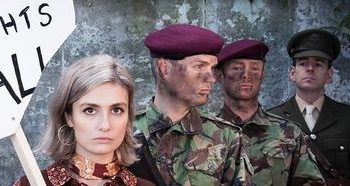
    Shot at by a handkerchief. A review of 'One Para' at the New Theatre, Dublin. By David Burke

    When Stephen Spielberg was making ‘Schindler’s List, in the early 1990s, he invited some of the Holocaust survivors who had been saved from the gas chambers by Oscar Schindler onto his movie set. The guests mingled with the actors and crew during a break. Amid all the lights, the electrical wires criss-crossing the set,  the extras who were playing the SS chatted amicably with each other. Someone noticed something odd: the SS group – and they alone – were being shunned by Spielberg’s special guests, the survivors. This was because the extras looked so much like the real thing, they exuded a cruelty that, nearly half a century later, disturbed the visitors. I felt something similar watching  the actor playing Sergeant Hutton of 1 Para during Gerard Humphrey’s riveting new play about Bloody Sunday, ‘One Para’ at the New Theatre. Andrew Kenny plays a foul mouthed, racist bigot who bullies one of his more junior colleagues, Scarrif, urging him to shoot at the unarmed and harmless civil rights marchers in the Bogside. His bragging about his colonial exploits in 1 Para is a whirlwind education in the crimes committed by men like him. Every so often he cracks a crass joke or make a jibe that should make the audience wince but something more disturbing happens: there is nervous laughter. The audience out in the dark is cowed by Hutton. If you want to know what Stockholm syndrome is like, go and see this play. Sergeant Hutton on internment and the Ballymurphy massacre: We sorted Belfast out in one night… You saw the photos put up on the wall in the corporal’s mess. .. we swept down the Black Mountain straight into Ballymurphy and shot forty bogwogs – we wasted eleven of them. Victor got himself a priest and all. He won the regimental sweepstake! The UDR wallahs told him he should put in for a bounty! While the menace and darkness of this 75 minutes play shoots at the audience through the mouth of Kenny, the piece works because each cast member hits their target dead centre. The overarching ingredient, however, is the crisp dialogue Gerry Humphreys places in their mouths. He manages to convey the complexities of  Brigadier Frank Kitson, the MRF death squads, the Ballymurphy and Bloody Sunday massacres with rapid fire shots of succinct dialogue that hits you in the solar plexus. He has a genius for boiling down the complex into brilliant historical one liners. When Hutton is asked about his actions by a military police officer he barks: “I am a professional soldier. If I had not shot – I truly believe he would have shot me! The military police officer snaps back at him: With a handkerchief? Humphreys sprinkles the script with the occasional piece of humour to lighten the brutal dialogue, but he does so with such subtlety and deftness that he never once crosses the line or disturbs the equilibrium of what is a deadly serious issue. One Para is directed by Anthony Fox. The set design is by Robert Ballagh. The show continues until the weekend. If you can, catch it. The run comes to an end on Saturday. OTHER STORIES ABOUT BLOODY SUNDAY, THE BALLYMURPHY MASSACRE, BRIGADIER FRANK KITSON AND COLONEL DEREK WILFORD ON THIS WEBSITE: Bloody Sunday: Brigadier Frank Kitson and MI5 denounced in Dail Eireann   The covert plan to smash the IRA in Derry on Bloody Sunday by David Burke Soldier F’s Bloody Sunday secrets. David Cleary knows enough to blackmail the British government. Learning to kill Colin Wallace: Bloody Sunday, a very personal perspective Lying like a trooper. Internment, murder and vilification. Did Brigadier Kitson instigate the Ballymurphy massacre smear campaign? Where was Soldier F and his ‘gallant’ death squad during it? Another bloody mess. Frank Kitson’s contribution to the wars in Afghanistan and Iraq. 300,000 have died in Afghanistan since 1979. Lying like a trooper. Internment, murder and vilification. Did Brigadier Kitson instigate the Ballymurphy massacre smear campaign? Where was Soldier F and his ‘gallant’ death squad during it? A Foul Unfinished Business. The shortcomings of, and plots against, Saville’s Bloody Sunday Inquiry. Kitson’s Private Army: the thugs, killers and racists who terrorised Belfast and Derry. Soldier F was one of their number. Soldier F and Brigadier Kitson’s elite ‘EFGH’ death squad: a murderous dirty-tricks pattern is emerging which links Ballymurphy with Bloody Sunday. A second soldier involved in both events was ‘mentioned in despatches’ at the behest of Kitson for his alleged bravery in the face of the enemy. Mentioned in Despatches. Brigadier Kitson and Soldier F were honoured in the London Gazette for their gallantry in the face of the enemy during the internment swoops of August 1971. Soldier F, the heartless Bloody Sunday killer, is named. Mission accomplished. The unscrupulous judge who covered-up the Bloody Sunday murders. Soldier F and other paratroopers have been protected by the British State for five decades. None of them now face prosecution. This perversion of justice began with the connivance of the Lord Chief Justice of England and Wales, John Widgery, a former British Army brigadier, Freemason and oath-breaker. Counterinsurgency war criminals, liars and cowards: Kitson and Wilford, the brigadier and colonel who led the soldiers who perpetrated the Ballymurphy Massacre. Brigadier Kitson’s motive for murdering unarmed civilians in Ballymurphy. The McGurk’s Bar cover-up. Heath’s Faustian pact. How a British prime minister covered up a UVF massacre in the hope of acquiring Unionist votes to enable the UK join the European Economic Community, the forerunner of the EU.

    Loading

    Read more

  • Posted in:

    David Cleary, mass murderer, aka Soldier F, named in Ireland's parliament. How will Twitter respond?

    Deputy Peadar Tóibín, leader of Aontú, referred to Soldier F by his real name, David James Cleary, in  Dáil Éireann, the Irish parliament, yesterday (9 February). Cleary was a cruel, cynical and clinical killer. He shot Patrick Doherty in the buttock on Bloody Sunday while he was on the ground crawling away from him. The bullet tore up his spine. As Doherty lay crying out in pain, his life draining away from him, Barney McGuigan, an exceptionally brave and humane man, stepped forward with a white handkerchief looking to help Doherty. Cleary dropped to one knee, aimed his rifle and shot McGuigan in the head. A UK injunction prohibiting the naming of Cleary does not apply in the Republic of Ireland.  The Cathaoirleach of the Dáil had no difficulty with Deputy Tóibín’s contribution. Village magazine named Cleary last year in a series of articles about the Ballymurphy massacre and Bloody Sunday. Twitter suspended our account after a tweet we issued named the soldier. Other accounts were suspended too, including one belonging to the brother of one of those murdered on Bloody Sunday. In a move that is the very definition of perversity, the PSNI are threatening to prosecute him. One can imagine the international outcry that will ensue if the force pursues a prosecution. The Irish contingent in the US Congress will be incandescent. There will be an anger that will unify Dáil Éireann as one if they dare proceed.  The fact that Cleary has been named by Deputy Tóibín under Dáil privilege has been tweeted and retweeted by a number of people living in the Republic of Ireland. Cleary’s name is now permanently available on the website of the Oireachtas. It will be interesting to see how Twitter responds this time around. A TikToc with a recent photo of the former 1 Para lance corporal is in circulation. Yet another recent colour photograph has been transmitted on Twitter (the publication of this picture did not lead to a suspension of the relevant, presumably as it went under the Twitter radar.)  Deputy Tóibín’s contribution was made as part of a question he put to the Taoiseach. Micheál Martin had no difficulty with the fact Cleary was named. Deputy Tóibín’s question was as follows: Ten days ago the Taoiseach laid a wreath at the Bloody Sunday Memorial in Derry. At the time and since then the Taoiseach has indicated the families of those who were lost, who were murdered, on Bloody Sunday need to find justice. We are looking at the likelihood that there is going to be an amnesty. If there is an amnesty in the North of Ireland, it means there is no rule of law and that the perpetrators will get away with murder. I attended the 50th anniversary of the Ballymurphy massacre, and speaker after speaker got up on the trailer that day and said the British Government quite simply wants to get away with murder. That is what is happening here. Over recent debates in which I have participated, I have made an effort to name every single victim of the Bloody Sunday massacre, the Ballymurphy massacre, the Springhill massacre, the murders that were researched in Operation Greenwich and those today in the Ombudsman’s report. Is it not shocking that we know the names of the people who lost their lives, the people who were murdered, but we do not know the names of the people who perpetrated those murders. Most people, for example, would not know Lance Corporal David James Cleary, better known as Soldier F, who is accused of murdering civilians on Bloody Sunday. Most people would not know the alphabet of British Army perpetrators of murder. We need to ensure people know their names. The Taoiseach has recounted what has happened, but I am asking him what steps will he take to ensure those names are known throughout the country for the murders they have committed. The Taoiseach responded as follows: In the first instance, I have told the Deputy what we are doing. I do not agree with the amnesty at all and I do not take it as a likelihood. The Irish Government has entered into discussions with the British Government and all of the parties in Northern Ireland in respect of the proposals that emanated from the British Government last year. We have made it very clear we do not accept any unilateral actions in respect of legacy that would represent a breach of the Good Friday Agreement and subsequent agreements. OTHER STORIES ABOUT BLOODY SUNDAY, THE BALLYMURPHY MASSACRE, BRIGADIER FRANK KITSON AND COLONEL DEREK WILFORD ON THIS WEBSITE: Bloody Sunday: Brigadier Frank Kitson and MI5 denounced in Dail Eireann   The covert plan to smash the IRA in Derry on Bloody Sunday by David Burke Soldier F’s Bloody Sunday secrets. David Cleary knows enough to blackmail the British government. Learning to kill Colin Wallace: Bloody Sunday, a very personal perspective Lying like a trooper. Internment, murder and vilification. Did Brigadier Kitson instigate the Ballymurphy massacre smear campaign? Where was Soldier F and his ‘gallant’ death squad during it? Another bloody mess. Frank Kitson’s contribution to the wars in Afghanistan and Iraq. 300,000 have died in Afghanistan since 1979. Lying like a trooper. Internment, murder and vilification. Did Brigadier Kitson instigate the Ballymurphy massacre smear campaign? Where was Soldier F and his ‘gallant’ death squad during it? A Foul Unfinished Business. The shortcomings of, and plots against, Saville’s Bloody Sunday Inquiry. Kitson’s Private Army: the thugs, killers and racists who terrorised Belfast and Derry. Soldier F was one of their number. Soldier F and Brigadier Kitson’s elite ‘EFGH’ death squad: a murderous dirty-tricks pattern is emerging which links Ballymurphy with Bloody Sunday. A second soldier involved in both events was ‘mentioned in despatches’ at the behest of Kitson for his alleged bravery in the face of the enemy. Mentioned in Despatches. Brigadier Kitson and Soldier F were honoured in the London Gazette for their gallantry in the face of the enemy

    Loading

    Read more