Village Magazine

Random entry RSS

  • Posted in:

    Eschatological ruminations

    Eschatology, or the study of the end of times, is at least as old as the written word. The concept spans many of the world’s major religions, usually referring to some future day of judgement or reckoning. Beyond the realms of theology, eschatology as a concept is currently undergoing something of a renaissance, especially after the tempestuous and chaotic first twelve months of the Trump regime. In this time, almost everything we once took for granted about inherent stability, even inevitability, of western democracies and the robustness of our institutions has been shaken profoundly. As if to add to the sense of impending calamity, the Bulletin of the Atomic Scientists moved their famous Doomsday Clock for 2018 forward in late January– to two minutes to midnight. This is the closest it has ever been to the witching hour. The authors of the Bulletin excoriated the US government’s reckless nuclear brinksmanship, but poured special scorn on its efforts to derail international climate diplomacy. “Avowed climate denialists have been installed in top positions at the EPA and other agencies, and the administration has announced its plan to withdraw from the Paris Agreement. In its rush to dismantle rational climate and energy policy, it has ignored scientific fact and well-founded economic analyses”. The Bulletin was particularly scathing of the role played by climate deniers in stymieing action. “Despite the sophisticated disinformation campaign run by climate denialists, the unfolding consequences of an altered climate are a harrowing testament to an undeniable reality: The science linking climate change to human activity is sound. The world continues to warm as costly impacts mount, and there is evidence that overall rates of sea level-rise are accelerating – regardless of protestations to the contrary”. The toxic wave of US science denialism has swept right across the Atlantic. As previously reported in Village, last May saw the first meeting in Dublin of the self-styled Irish Climate Science Forum (ICSF) a denialist group with opaque membership and funding sources. February sees it host its fifth meeting in just 10 months, featuring a fringe Italian academic with strong ties to US neoliberal think tanks, the latest in a procession of climate contrarians to present new (thoroughly debunked) ‘findings’ to an eager audience mostly of Irish contrarians and deniers. Their agenda appears to be to hobble effective Irish government response to the existential threats posed by climate change. Their standard operating method is to cherry-pick data, float red herrings and exaggerate uncertainties in the scientific consensus often as political cover on behalf of special-interest groups, for continued inaction. Above all, groups like the ICSF are engaging in ‘post-truth’ assaults on reason itself. A recent edition of New Scientist magazine stated baldly: “There are disturbing hints that western civilization is starting to crumble”. The article quotes intriguing research from Yale university, which examined the two broad modes of human thought: 1) fast, automatic and inflexible, and 2) slower, more analytical and flexible thinking. As flexible thinkers within society solve our various problems, from transport to energy, with complex technologies, this relieves the great bulk of the population from even being aware of these problems, and so inflexible, automatic thinking ensues as the population, in a sense, dumbs down, since technologies can create the beguiling illusion that life is magically simple. One of the psychologists who developed this theory, Jonathan Cohen, suggests this may help solve one of the great puzzles regarding societies heading for catastrophe: why do they persist with their self-destructive behaviour, in the face of overwhelming evidence of future harms? “The train had left the station”, according to Cohen, and the forward-thinking, analytical types were no longer at the controls. Separately, computer modelling carried out at the University of Maryland in 2014 examining the mechanisms that can lead to local or even global system collapse, identified two key elements. The first, unsurprisingly, is ecological strain. The panoply of chronic environmental stressors, including resource depletion, widespread pollution, ocean acidification and sea-level rise are generally well understood, at least in expert circles. What was less widely known was the systemic risk posed by economic stratification or, in plain language, the rich getting richer at everyone else’s expense. In the scenario modelled, “elites push society toward instability and eventual collapse by hoarding huge quantities of wealth and resources, and leaving little or none for commoners who vastly outnumber them yet support them with labour”, according to author Rachel Nuwer. Eventually, she argues, “the working population crashes because the portion of wealth allocated to them is not enough, followed by collapse of the elites due to the absence of labour. The inequalities we see today both within and between countries already point to such disparities”. She notes that the top 10% of global income earners are responsible for almost as much total greenhouse gas emissions as the bottom 90% combined. Here, extreme inequality and ecological stresses converge to form a toxic cocktail capable of crashing our civilisation into the dust. US academic Thomas Homer-Dixon published the influential book: ‘The Upside of Down’ in 2005. It presciently anticipated the global economic crash that occurred some three years later. The financial crisis was, he wrote, one of “five tectonic stresses which are accumulating deep beneath the surfaces of our societies”. Others include population, energy, pollution and resource exhaustion; and climate system stress. The 2008 economic crisis, along with more recent shocks, such as Brexit and the Trump election in 2016 can, according to Homer-Dixon, be seen as a series of non-linearities, or sudden and unexpected jolts to the assumed world order. These may be viewed as a random pattern of tremors presaging a truly global catastrophe, a word that derives from the Greek, meaning ‘to overturn’. To view catastrophe as imminent rather than already occurring requires a deeply anthropocentric perspective. The sequestration, plunder and simplification of the entire biosphere by a single species is without parallel in a billion years of Earth, let alone human, history. Irrespective of our own narrow fate, the human stain will be etched

    Loading

    Read more

  • Posted in:

    Some rugger-buggers hooked on group sex

     The George Hook affair – in which he scandalously suggested that a woman might hold a degree of responsibility for being raped – touched on many things, but one overlooked aspect is a connection to a worrying trend in the world of rugby, where he made his name as a trainer and commentator. Irish society is accustomed to cover-ups and prevarication within corporate organisations, especially where there are allegations of sexual abuse. So, does the Irish Rugby Football Union (IRFU) need to address the advent of a dangerous culture of sexism among its professionals? Four current or former Irish rugby players are set for trial in Belfast this year for rape. The precise details are not open for discussion, but Ulster and Ireland players Paddy Jackson (25) and Stuart Olding (24) are accused on two counts each of raping the same woman on June 28, 2016. Both deny the charges. Former Ulster player Blane McIlroy has been charged with exposing himself to cause “alarm or distress” on the same date, and former UCD player Rory Harrison (25) has been charged with perverting the course of justice by allegedly making a false witness statement to police. He is also accused of withholding evidence. Needless to say, anyone accused of a crime is innocent until proven guilty, but we need to consider the autonomous issue of whether rugby has a cultural problem with sexism and alcohol abuse. Superficial similarities Until recently rape was considered a property crime of man against man: women. Women were not their own agents. In a different and ancient way we still see this attitude in Bunreacht na hÉireann. Victims were commonly accused of incitement, and even subject to punishment. In India and Pakistan, unfortunately, that is still sometimes the case. In Ireland, rape within marriage was only recognised as an offence in 1990. Ireland, like most countries, has long had a problem with under-reporting of this heinous crime. The Rape Crisis Centre reported in 2016 that 65% of survivors using their services had not previously reported to any formal authority. The conduct of many Irish men clearly remains hugely problematic. George Hook courted controversy, and lost his job, for offensive comments he made on his Newstalk show regarding a case with superficial similarities to the Ulster players’ case now playing out in Britain. Hook was reacting to details of a court case involving a young woman who returned to the hotel bedroom of British Olympic swimmer Ieuan Lloyd and had consensual sex with him, where upon, she alleges, she was “passed on” to his friend Otto Putland who, she claims, raped her. Hook said: “Why does a girl who just meets a fella in a bar go back to a hotel room?”. “Should she be raped? Of course she shouldn’t. Isn’t she entitled to say no? Of course she is. Is the guy who came in a scumbag? Certainly. Should he go to jail? Of course. All those things”. And then the clanger – “But is there no blame now to the person who puts themselves in danger?”. The answer, to be clear, is that there is none. A woman always has a right to choose with whom, and when, she has sexual relations. Provocateurs George Hook is a proud rugby man, whose hulking six-foot-three frame equipped him for the playing fields of Presentation Cork. He would find elusive success as a rugby coach, with Connacht and London Irish, and also the United States in the first Rugby World Cup in 1987. But it was as a pundit on RTÉ sports television, beginning in 1997, that he really shot to prominence; copying the role Eamon Dunphy plays in soccer commentary – as a provocateur who stands up for the values of his game. Having found fame in his twilight, he embarked on a successful media career as conservative columnist for the Sunday Independent, and then as Ireland’s first ‘shock jock’ on Newstalk. Along the way he has championed “beleaguered” motorists against girlie-men cyclists, infuriated feminists, and proclaimed himself an unashamed Blueshirt, reaching out to those who eat their dinner in the middle of the day. When TV3’s Colette Fitzpatrick suggested he was “controversial” he lost his temper, saying it was an “outrageous accusation” which was the same as calling him a “liar” and a “fake”, that it was a stereotype that he battles every single day. George Hook may not represent mainstream views on rape in the rugby community, but his success on the airwaves attests to a constituency of angry, middle-age men among them who inveigh against a rapidly changing world. To that mindset perhaps, the scantily-clad, inebriated girl – the tart – who returns to a hotel room with a group of men should not expect to halt proceedings once she puts herself in that position. Worryingly, the Ulstermen are not the only Irish professional rugby players to have been accused of rape this year. In March Denis Coulson (23), then playing in France for Grenoble, was detained along with two non-Irish team-mates in Bordeaux after a 21-year-old woman alleged she was drugged, taken to a hotel room and raped. He strenuously denies a charge that did not prevent the IRFU re-integrating him into the Irish game as a member of the Connacht squad. It might appear that group participation in sex is a form of currency among elite rugby players. In 2013 another incident of group sex involving two other prominent Irish rugby players, being filmed by a third, was widely reported in the media, especially the Irish Independent which lapped up the sordid details. A video went viral via social media, and soon afterwards the woman involved felt compelled to leave the country. There is no suggestion that consent was absent or withdrawn, or any sexual assault committed, but there was nonetheless a serious violation of privacy. The players faced no public sanction, and the IRFU did not deem it necessary to investigate whether a culture of sexism operates among rugby players in

    Loading

    Read more

  • Posted in:

    Nati(on) off

    In 1985, the Irish-Australian writer Vincent Buckley, after spending some time in Ireland, wrote in his book ‘Memory Ireland: “Ireland has been asked to lose its national memory by a kind of policy, in which politicians of almost all parties, ecclesiastics of all religions, media operators, and revisionist historians co-operate to create (and let us hope they do not need to enforce, for if they need to, they will) a new sense of corporate identity. This sense contradicts the immediately preceding one (the one based on the rising of easter 1916 and its aftermath), which proved first so exhilarating and then so wearying to its generations, some of whom had fought to realise it. Ireland is not a nation, once again or ever, so the new story runs, but two nations; maybe several; it does not have its characteristic religion—or if it does, it ought not; it does not have its characteristic language, as anyone can see or hear; it has no particular race or ethnic integrity. Ireland is nothing – a nothing – an interesting nothing, to be sure, composed of colourful parts, a nothing mosaic. It is advertising prose and Muzak”. Buckley was saying in effect that Ireland had lost its national identity: the fact of being a nation distinguished from other nations by a combination of language, history, culture and values, and the knowledge of being that. Since 1985, the collective condition that Buckley depicted – that of being together nothing in particular – has intensified. At the centre of Ireland’s capital city a tall monument, designed in London, has been erected which honours and signifies literally nothing. (A joke says ‘The Spire’ was meant to be delivered to the other Blackpool – Duibhlinn means “black pool” – the seaside resort across the Irish Sea.) Ireland’s distinctive religious culture – women blessing themselves as they pass a church; traffic jams at city churches on Sunday mornings; fasting during Lent; May and Corpus Christi processsions; the family rosary; the TV newsreader finishing the evening news with “God bless you” – has withered almost to vanishing point; and with it a set of moral values, forceful because they pointed towards a happy eternal life and gave security against punishment there. With the study of Irish history made unnecessary for the Leaving Cert, and all forms of mass media blind to that history beyond the Famine, knowledge of Irish history by most Irish university graduates reaches no further back, with the post-revolutionary missionary movement into Africa, Asia and South America bringing Christianity, hospitals, schools and anti-imperialist sentiment omitted as a ‘merely religious matter’; not to mention, earlier, the repeated resistance to conquest or those dark times before Europe began when Irish monks and monasteries brought Christianity, literacy, art and learning to Britain and the Continent as far as Germany, Austria and Italy. Meanwhile, with the nation speaking the same language as the much larger nation beside it, its journalists, instead of writing or saying ‘in Ireland’ or ‘in the Republic’ commonly make do with ‘here’ or ‘in this state’. Irishmen use the word ‘Irishness’ derisively; politicians avoid uttering ‘Ireland’ or ‘the Irish’ with pride or in exhortation; the media treat English football and politics including ‘the Royal Family’ as part of the Irish scene. The only still habitual demonstrations of Irish nationhood, far from being everyday are occasional: everyone cheering for Ireland when an Irish football team is playing a foreign team, or people drinking together on St Patrick’s Day. In short, with regard to distinctive identity, Ireland, as an offsore island of Britain, is close to becoming a larger version of the Isle of Wight. A nation can lack a national identity for either of two reasons. It can, like Ireland, have lost the national identity which it previously had. (Ireland had a well-known, distinct identity from the sixth century to the eighteenth when it began to fade to the shadow of itself it still was in 1916.) Or it can, like say Zambia, never have had one. Formerly Northern Rhodesia and named after the river Zambezi, it was created in 1964. With English as the official language, Zambians belong to about 70 ethnic groups, speak a similar number of languages, and adhere to many religions. It is widely believed that a national identity is an important thing for a nation to have – that it favours national wellbeing; creates, when needed, a national collective effort; generally urges the nation towards success and buttresses it in bad times. If one googles “national identity” one finds at least 25 pages – I gave up counting – filled with items dealing with it. (Denmark, a small country like Ireland, seems to be particularly interested in the matter.) It is, of course, entirely possible to get along without a national identity, as Ireland and Zambia have been doing; living from day to day. Even with the consequent absence of collective zest, it is not catastrophic. But when after the Breivik massacres in Norway a few years ago, the Norwegian Prime Minister told his people: “This must strengthen our resolve to make our Norwegian values prevail”, some old-fashioned Irishman might have felt a pang of regret that no Irish Taoiseach could speak of “our Irish values”, because no such things exist. national values indicate that at least Something is there rather than nothing. They suggest that in that nation aspiring minds are at work. The present cultural condition of Ireland is the result of successful cultural colonisation by two forces: first, by the Protestant british from the sixteenth century onwards, second from the 1960s onwards by American neoliberalism working through its Irish converts. The process by which cultural colonisation works was well illustrated by an incident in which the present writer participated in the 1970s. A Dubliner, I was living for some years in a still Irish-speaking part of South Connemara. Talking one day in Irish to a local 16-year-old boy who was telling me about a Frenchman he had met on a

    Loading

    Read more

  • Posted in:

    Conflict in Corner

    A situation is unfolding in the Northern Ireland Royal Courts of Justice which calls into question the integrity of the Administration of Justice, the right to a fair hearing and fair procedures on which the entire system depends. It is the worst kept secret in legal circles in Northern Ireland and yet not one media organisation has chosen to run the story. On 9th March 2017 Justice Mark Horner, a well-regarded judge best known for a recent liberal judgment on abortion rights in the North, was asked by a litigant-in-person to recuse himself from a case involving Bank of Ireland (UK) Plc as it had been brought to the litigant’s attention that Justice Horner had a serious conflict of interest which he had failed to bring to the court’s attention at any stage while he sat as Judge on the case. Justice Horner was a director up until late 2011 and is currently a shareholder in TMKK Limited which was a financially-troubled client of the bank. On 14 March the litigant-in-person made an official complaint to the Lord Chief Justice’s office and has yet not received a substantive reply as the office seems wrongfooted. The Lord Chief Justice’s office seems nowhere close to convening the Tribunal envisaged in the Code of Practice on Judicial complaints. On 27 March Justice Horner recused himself from the litigant-in-person’s case giving a statement saying that the reason he recused himself was because the litigant in person would not accept his judgment. This is judicial nonsense. No judge ever should doubt the acceptance of his judgment by a party. The Lord Chief Justice’s office told Village: “Mr Justice Horner stated in open court that he was recusing himself in the case involving the Bank of Ireland and the personal litigant. He said he was satisfied that there was no question of actual bias or that he had any conflict of interest in the case, but that it was apparent to him that ‘the party would never feel able to accept [his] verdict’”. On 4 April in a separate case involving the same plaintiff i.e. Bank of Ireland (UK) Plc, the bank itself, presumably sensing the dangers of compromise and appeal, actually instructed its own QC, Patrick Good, to request that Justice Horner recuse himself from that case. Horner had little choice but to stand down from this case also. The same legal firm, C & H Jefferson now DWF, represented the plaintiff, Bank of Ireland (UK) Plc in both cases described above. It is obvious that the plaintiff was aware of the conflict of interest with Justice Horner as the judge had for many years been a director and is currently a shareholder in TMKK Limited which was a client of the bank. However, neither the bank nor its legal team made the court aware of the conflict though, as solicitors are officers of the court, it is normally their duty to do so. The solicitor who acted for the plaintiff in both cases seems not to have fulfilled that duty. She is no longer acting for her rm in either of the cases. After that Justice Horner stopped sitting on any cases involving Bank of Ireland in the Chancery court but moved to the Commercial Courts in September and has sat on a number of Bank of Ireland cases. On 4 october 2017, as Village was going to press, a Bank of Ireland case was listed in the Commercial Court [image C, 1] (Interestingly another case was listed for the same day (not involving Bank of Ireland) where the defendant is the current master of the High Court in Belfast, Ian Thomas Hardstaff, who was in partnership with the Harrison referred to in the list who is still a shareholder and director of TMKK Limited) [image C, 7]. Moreover Justice Horner also has dealings with The Northern Bank Ltd through TMKK Limited. Here too he sat on many cases and did not inform the parties of this. The defending party in one such case is aware of his recusal in the two Bank of Ireland cases. That defendant is currently appealing a case involving Northern Bank Ltd in which Justice Horner gave a judgment against them. They brought his conflict of interest with Northern Bank Ltd to the Appeal Judges’ attention and the court remitted the matter back to the Chancery Court as it is the appropriate court to determine such matters. Justice Horner resigned as a director of TMKK Ltd before applying for appointment to the High Court – though he and his wife both remain shareholders. Indeed his wife replaced him as a director. Relevant accounts (page 144 section 4 [image A]) for TMKK Ltd available from the Companies office show that it is indebted to Bank of Ireland and Northern Bank (now Danske bank). However, much more dramatically the company is insolvent. The final paragraph of the accounts entitled “Going concern” [image b] clearly states that TMKK Ltd is only trading at the discretion of Bank of Ireland. By any standard this Judge should not be hearing any cases involving Bank of Ireland. He has immense power and has given possession orders in favour of Bank of Ireland and Northern Bank while he has been seriously conflicted. This could have involved both commercial properties and family homes. All of his cases are on public record. Anyone who has had a case under Justice Horner involving Bank of Ireland or Northern Bank Ltd/Danske Bank may be able to have their judgment set aside due to failure to disclose a serious and fundamental conflict of interest. The Lord Chief Justice’s office notes that while the judge may be considering Queen’s bench actions which are listed for mention he is not now “adjudicating on any commercial or Chancery cases involving the Bank of Ireland”. The Lord Chief Justice’s office said it was “unable to comment further as the Justice (NI) Act 2002 provides information on complaints on judicial office holders is confidential and must

    Loading

    Read more

  • Posted in:

    Village October 2017

    Gratuitous Trump Image Section   Bean and Bucket Theresa May is the most inelegant British leader since Gordon brown. It’s funny how the same person can be perceived as utterly unrecognisable in terms of elementary human characteristics, just by the unfair elapse of time. In office, these two leaders managed to entirely lose their reputations for frugal good sense. If brown was Mr Bean, May is surely Hyacinth bucket (pronounced ‘bouquet’, if that’s not French). The bill for their party Villager likes to consider how much the bailout cost us all, when he’s counting out the five-cent pieces from the jar at the end of the month, in a quest to find the price of a miserable cheese sandwich down at the Capel St Spar. Sometimes he swoons unmanfully. At the end of 2016 the cost of bailing out our domestic banks stood at €39.9 billion, with an annual cost of servicing the associated debt of over €1 billion. €66.8 billion was used to recapitalise the banks and €14.8 billion went in servicing debt. by the end of 2016, the State had recouped €25.1 million in income from the disposal of investments, income from the guarantee scheme, and other means. Subtracting one from the other yields a figure of €56.5 billion. The C&AG has estimated the residual value of our remaining investments in AIB (a 71 per cent shareholding), bank of Ireland (14 per cent) and Permanent TSB (75 per cent) at €13.6 billion. name is projecting a €3 billion surplus. It all comes to €16.6 billion. Irish bank resolution Corporation (Anglo Irish bank and Irish nationwide building Society) cost us €35.8 billion. you mean on judges Most of the money that might have been sprayed around in budget 2018 has gone on reinstating public-sector pay. Villager will be reading a good book when the unexcitable Paschal Donohue rises to his feet. Nothing to see here. Socks and Swimming pay off with undiscerning youth According to Irish Times/Ipsos/MRBI pollsters, satisfaction with Varadkar’s performance as Taoiseach is – for some reason – high, at 49 per cent. 31 per cent are dissatisfied and 20 per cent, presumably people who – like Villager – don’t know what to make of hipsters, are undecided. Varadkar is the most highly rated leader, ahead of Micheál Martin (down two points since May, to 37 per cent), Gerry Adams (down one point, to 30 per cent) and Brendan Howlin (down two points, to 20 per cent).   Jayz, not another Healy-Rae on the Today programme Villager favours urban life and doesn’t like the rural perspective. nevertheless, Ireland’s most ostensibly serious broadcaster, Sean O’Rourke, continues to celebrate rural Ireland to the detriment of the capital and sport to the detriment of the arts. He is also the world’s leading user of the word wonderful. Villager caught it 15 times in one show, before the dial spun off the wireless. Women’s place Noel Whelan, barrister and political pundit, is a gentlemanly influence in the discourse but he has decided his schtick now is being unimpressed with the ephemeral machinations of the political process. Fresh from denouncing the serious attempt to impose identity cards for public-service users, as “silly season nonsense” over the summer, the second un-angriest man in Ireland (Colm McCarthy in this as so many other things remains unassailable) is dissing the attempt to visit a rake of referenda on an uninterested electorate as “a political stunt” from “a weak government trying to prove it has vision and durability”. but the man who found his progressive side during last year’s Marriage equality referendum campaign is surprisingly derisive of the likes of the attempt to remove purported acknowledgement of the special place within the home of (all women) from the constitution. Like the invocation of the Holy Spirit at the opening of bunreacht na Éireann the kinked vision of women taints the whole legal system. If you don’t get that you either don’t get equality, don’t get the point of the twentieth century or are from the ‘Fianna Fáil gene pool’. Arthur’s pay day Villager just loves development. And multinationals. When the two come together he loses control of his thesaurus. Diageo has announced plans to transform 12.6 acres at its St James’s Gate site in Dublin City to create a new mixed-use development, which will include residential units, and Villager says it is awesome. The maker of Guinness said that after “significant” investment since 2011 at St James’s Gate and advances in technology, it can now brew more second-rate beer with less, valuable, space. To this end it wants to transform 12.6 acres of the nearly 50-acre site it has been degrading for a generation to create a mixed-use development “a third residential, a third commercial and a third leisure”. called, inevitably, the St James’s Gate Quarter. During the boom Guinness talked of relocating to Leixlip where land was allegedly to be purchased from the ancient Guinness family for a “super brewery”. Oliver Loomes, country director for Diageo Ireland, told the Irish Independent that “it will be many, many years before a sod is turned on this site” for this latest development salvo. Villager therefore predicts it will not happen. parable of the Apple Villager is suggesting everyone should do in their own private and business lives what the Irish government is doing with our €13bn Apple loot. resist the pressure of the rich and powerful – the elite of Europe – to use if for ourselves. Give it back, we don’t need it. It’s Christianity in action and it’s endorsed by those always-just forces of global capitalism, the IT multinationals. Ireland is proving it is post-materialism. It just now needs to widen the ambit of its new strategic love for neighbour. beyond its stance on multinationals, to others. Neo-goldmanism Atavistic xenophobic populism has returned to German national politics with a ‘Knall’, in the unlikely form of a 38-year-old lesbian investment-banking economist, Germany’s own version of Ann-Marie Waters who once worked for Goldman Sachs. Alice Weidel is the

    Loading

    Read more

  • Posted in:

    Villager, July/August 2017

    A Freedom of Information Request showed that Simon Coveney and his officials knew that Departmental figures on housing completions were out, by up two thirds as it turns out, because they relied unduly on ESB-connection figures. Minutes of a meeting betewen the Housing Department and CSO shows the parties knew the figures were debased in February, though they used them up until May, confirming Village’s nasty April cover alleging Coveney was lying about housing completions.

    Loading

    Read more

  • Posted in:

    Leo’s paradox

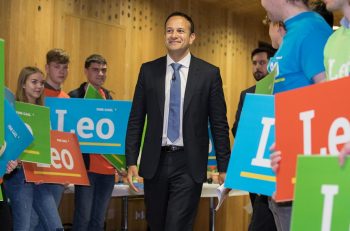
    As a younger, and perhaps wiser, Leo Varadkar once said: there is no messiah who will lead Fine Gael from the desert into the promised land. This did not prevent him from presenting a decidedly messianic image as he posed for the cameras following his decisive victory in the party’s leadership contest on 2 June. Since then politics and the media have obsessed over his choice for cabinet posts with one potential appointee after another scrambling for pole position beside the new leader to confirm their adoration for the man who holds their future in his hands. Soon forgotten was the uncomfortable truth that most of those among the party membership allowed to vote chose Simon Coveney from Carrigaline ahead of the man from Castleknock, and that Varadkar was elected through the over-whelming support of the parliamentary party and local councillors for the sole reason that they believe he is the most likely leader to ensure their re-election. The wider party it seems judged the candidates on policy, rather than geography or dare we suggest because the average blue shirt just is not ready yet for a gay man whose father comes from India as their particular cup of Barry’s tea. This is not to suggest that Fine Gael people are more likely to be homophobic or racist than any other group of political supporters but that they simply have not got their head around the rapid change in attitudes of a population with an average age of 38, which also happens to be Leo’s. For all this, Varadkar is as cautious and conservative as most in his party on both social and economic matters and is more likely to upset the wider LGBT community than endear himself to them. After all, he only came out as gay during the marriage equality referendum which many gay people saw as the culmination of decades of campaigning for their rights from which the young Leo had been silently absent. More importantly however, as Taoiseach, he is unlikely to deliver on a repeal of the eighth amendment which adequately meets the progressive demand for an end to church and State interference with reproductive rights or to tackle the huge range of discriminatory measures the State employs against women, children and minorities in health, education and social provision. There is little question that Varadkar will improve on the future prospects for his party colleagues and that they will go into the next election with greater expectations than if enda Kenny was still in charge. But that does not say much and neither does it take into account the harsh realities facing Fine Gael as it stumbles from one crisis to another while feeding from the life support provided by Fianna Fáil in government. Fianna Fáil is now looking at a general election next year and possibly ahead of the third budget it agreed to allow under the confidence and supply agreement which was negotiated by a less than enthusiastic Varadkar. His tendency to speak first and ask questions later will almost certainly cause some rocky moments over the coming months while his need to satisfy the many competing demands within his own ranks will also hinder any desire he may have to make innovative, not to mind radical, change. Varadkar will be really tested when it comes to the bigger issues facing the country and the first challenge he faces is how to deal with the ongoing and apparently unceasing crisis within the leadership of the Garda. He was among the first to criticise former commissioner, Martin Callinan, for describing the actions of whistleblower, Maurice McCabe as “disgusting”, and almost certainly precipitated the end of his long career in the force. Now he has to decide whether to allow the beleaguered Noirin O’Sullivan to remain in position. Varadkar will be happy to see the public service pay and pensions issue sorted before he takes full hold of the reins but the challenge posed by Brexit and its implications for the border and peace process would have been well outside his previous comfort zone. As to the insuperable health crisis as a medical doctor he might have been expected, when Minister for Health (2014-2016) to have led the delivery of the party’s plan for a universal health service to which he pays lip service, but there is a suspicion he ran out of ideas and little cause to think he will apply swift effective medicine as Taoiseach. Ultimately it will be his willingness to stand up to the vested private interests that sustain and feed the housing crisis, the rise in economic and tax inequality, precarious work and poverty that will test his imputed qualities as a radical young visionary. However, his party promotes the low tax, poor public service model that appeals to the very people he needs to survive in the cruel world of politics. Let’s call it Leo’s paradox. Frank Connolly

    Loading

    Read more

  • Posted in:

    Cometh the hour

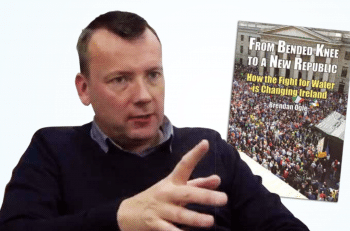
    ‘From Bended knee to a New Republic: How the fight for water is changing Ireland’ by Brendan Ogle, promises in its opening pages to take us on a journey “through the travails of a nation broken, sold and left in penury”. Ogle, unlike the many politicians and political parties he describes, fulfils this promise. The book brings you on a fascinating, inspiring, informative, and thoughtful journey through inequality in Ireland and “a nation’s fightback against it”. It should be clear from this that the book, just like the protest movement itself, is about much more than water. It comprehensively answers the question that many have asked: why was water the “issue that Irish people would take their first and biggest real stand against austerity?”. Ogle is the Education, Politics and Development organiser for the Unite trade union in Ireland and one of the founders of the Right2Water and Right2Change campaigns. The first quarter of the book provides detailed analysis of the political, economic, and social circumstances that gave rise to the Irish water protests which are “the biggest (per capita) and most peaceful protest movement for social change anywhere in the world”. These include the global water privatisation agenda, austerity, poverty and the health and housing crises. Neoliberalism is explored before an analysis of the self-evisceration of social democracy through Tony Blair’s ‘third way’ acceptance and implementation of neoliberalism, and its adoption by the Irish Labour Party. He suggests the Labour Party has become an “obstacle to progress toward a more equal Ireland, and is in fact an enabler of neoliberal inequality”. Ogle spends the rest of the book describing how the Right2Water campaign was organised and the challenges it faced in becoming a mass movement. He recounts how he and Dave Gibney, the other main organiser in Right2Water, withstood difficult negotiations with local communities who had been let down by trade unions in the past but had started this new movement in order to build trust and a strong working partnership with them. He writes about how ‘civil society’ organisations failed to offer much support to the movement. He describes the constant work required to build unity amongst the fractious left-wing parties that make up the ‘political pillar’ of the movement. We can read how he and others in the water movement which “could so easily have been just another failed campaign in a failed Republic”, actually developed the most successful mass-protest movement in modern Irish history. It is, therefore, an essential read for those looking to understand not just how and why the water movement developed in Ireland but for those seeking lessons of how to build successful social movements. A central purpose of the book is to set out the origins and purpose of the water movement, and to tell the story of the water activists, which, as Ogle rightly says, you won’t read about in the media or many other places. The book provides an important contribution to documenting Ireland’s recent socio-political history and geography, particularly the excluded voices and views in society which are too often ignored. The book documents how the movement was built from the grassroots up in working class communities like Edenmore in Coolock in Dublin and by “wonderful people” from all over Ireland “who were determined to make a difference”. It tells the inspiring story of water activists such as Karen Doyle, a “housewife and mother who also works part-time outside the home” from ‘Cobh says No’. She got involved in the water charges movement and formed one of the hundreds of ‘meter watch’ groups, which were the heart of the movement across the country, to obstruct water meters being installed. It is from such actions that a broader social movement was born. Ogle writes: “every week-day morning someone would rise about 4.00 to 5.00 am and find where the meter contractor vans were heading. Text alerts were sent so that by the time the vans arrived people like Karen were at estate entrances to protest. A caravan and trailer were procured and soup, tea and coffee produced every day for sustenance. Margaret Thatcher would have hated it. Society! People came from their homes, their individual isolated bolt holes, to start sharing stories about where it had all gone wrong, how their lives had been impacted by the breaking of a nation, which gave them the strength, the determination, to do something about it”. These groups, according to Ogle, faced problems from “some on the ultra-left” who saw the local groups “as a vehicle for advancing their own agenda, viewing people like Karen as potential recruits”. He describes how “people who got involved in a campaign out of genuine concern for their community and their country”, were hurt as they found themselves “the focal of bitter and personalised attacks”. He notes that in the past “many have walked away from the campaigns, surrendering them to the dogmatic ultra-left and the inevitable failure to deliver on their promise”. But not this time. Karen and many other community activists like her continued on and developed their own spaces and confidence to keep building a broad and inclusive movement. important in this was the support given by the Right2Water trade unions, and Unite in particular through its political economy education. It ran nine free ‘political economy’ courses for 150 ‘non-aligned’ community activists “with the objective of giving activists who were central to the growing water movement access to the type of information that would enable them to understand the political economic agenda behind water privatisation”. This was a very innovative approach which provided an important longer term empowering aspect to the movement. Ogle writes how “through the training we not only helped them connect with each other on a national level but showed how the tax and privatisation agenda are global issues…giving renewed energy as to how to challenge the neoliberal consensus”. Ogle persuasively tackles the critiques of the water movement in relation to water conservation. He highlights how people in the UK, which has

    Loading

    Read more