

The Man in Room Fourteen In one crucial respect, is like everyone else. He’s a working diagnosis about whom we know both far too much and nothing like enough The man in room fourteen spends twenty four hours either going to the toilet or not going at all; is never a happy medium for happy mediums don’t inhabit rooms like room fourteen His wife brings him a small brown Teddy bear made (naturally) in China, which he immediately names for the Minister For Finance. The man in room fourteen likely has somewhere between two years and a matter of months. While other possibilities stalk elite laboratories; and the walled gardens of certain medical imaginations; the man in room fourteen must now negotiate alone and from a position of weakness the narrow track through the dark that’s his only way back away from the jaws he can hear salivating below him.
Mr Cogito Considers The Side Effects after Dr. Janusz Crawczyk Baldness and shortness of breath a sudden urge to vomit on coats your own and other people’s. Drymouth, brittle nails, a tendency to be not very good at driving fork-lift trucks and to become even worse at pole vaulting than you already were. Explosive watery, diarrhoea and fecal impaction sometimes both simultaneously for the human body likes nothing better than a good argument with itself. Infertility, anaemia, thrombocytopenia, & Life, Life, Life, Life itself are all possible side effects of drugs such as these. KEVIN HIGGINS
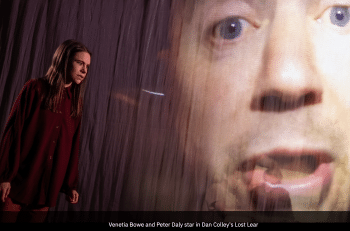
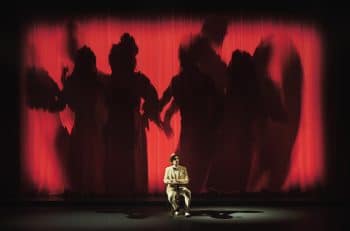
This play is brilliantly produced and performed. It is hardly uncommon these days to have a work of art whose central theme is dementia, but it is rare to see one this good. What distinguishes Lost Lear is the quality of its writing and production: the play is a carefully constructed piece of theatre with thoughtful detail and sharp drama. As the title suggests, the play depicts the rehearsals of an adaptation of Shakespeare’s ‘King Lear’ with Joy (Venetia Bowe), playing most of the parts, and Liam (Manus Halligan), playing most of the other parts. Silently in the background are the stagehands (Clodagh O’Farrell and Em Ormonde), and Conor (Peter Daly). Gradually we learn that Joy is a retired stage actor with dementia: ‘King Lear’ is just where her memories have taken her, and the other cast-members are all nursing-home staff whose care philosophy involves facilitating the constructed reality of her memories rather than trying to force her back into the day-to-day one of theirs. The exception is Conor, her son and the carrier of the play’s drama. Conor struggles to adapt to this strange way of being with his mother; he was never onstage in his life and when he is finally called to deliver lines keeps messing them up. Joy does not remember who Conor is, which breaks his heart twice over because of his past: he did not know his mother until he became a teenager. When he got in touch with her, she raised all his hopes and then rejected him, ignored him completely. Conor was never a part of Joy’s world and has carried the hurt and resentment of this through his adult life. For him, adapting to Joy’s disease simply repeats the pattern of their whole relationship in which it is Conor who must find a space, sometimes despite Joy’s best efforts, in her busy and irresponsible existence. I have just given away one of the show’s big twists – it is coy about the real circumstances of its ‘Lear’ rehearsals for a long time – but I have not given away everything because it continues to develop Joy and Conor’s relationship with great skill. Their perspectives are developed fully and without judgement, and then by circumstance forced to occupy the stage together. The drama comes naturally. The performance does not choose a side and audiences can read into it whatever they like. Maybe it is not a coincidence that a show loosely based on one of Shakespeare’s tragedies exhibits to such a degree one of his most important dramatic skills: the ability to ask questions without answering them. And it also points towards how, despite its marketing, this is not really a play ‘about’ dementia as such, but one in which dementia figures with its effect on one person’s life and relationships with other people. It is no more about dementia than ‘Raglan Road’ is about a street in Dublin. The acting is another highlight. In a high-quality cast, far and away the best performer is Manus Halligan as Liam: he moves seamlessly between roles. The acting is another highlight. In a high-quality cast, far and away the best performer is Manus Halligan as Liam: he moves seamlessly between roles corresponding to the different lived realities onstage, but every time he is completely believable. He is worth looking out for in something else. Venetia Bowe is a very convincing Joy, but sometimes the emotional changes of gear are a little jerky. Peter Daly’s Conor comes into his own as the show progresses, but at the start Conor’s nervousness is perhaps a little overplayed. Overall, the quality of each surpasses what you would normally see on one of the big stages in Dublin. This is one of those shows where elements of the stage and set design played a huge part in telling the story. Sometimes actors speak into a phone-camera on a stand stage-right which projects their faces Wizard-of-Oz-style onto a translucent curtain in front of the stage, behind which some other action is visible to the audience. Sometimes the actors say their lines in front of the curtain: this becomes important where the relatively young Venetia Bowe, who is obviously playing an old woman in Joy, speaks while behind the curtain Joy herself is represented by a puppet. Most such moments are effective as storytelling methods. The weakest one is the last, in which, sitting alone onstage, the puppet Joy’s brain lights up and the back of the stage shows a kind of intergalactic starry visual sequence with space-music as the lights go down and the curtain falls. The moment’s final emphasis on Joy’s dementia is understandable, if a little off-piste. The biggest problem is the scene’s diminution of Joy combined with its mystical mood of wonder: its ‘We are all made of stardust’ attitude. This is cheap even when Brian Cox does it on the BBC, because it is a completely manufactured sense of wonderment. What is wonderful, apparently, is the paradox that we human beings are simply a collection of chemical and physical processes whose workings are complex but essentially banal. The banality of the stars (as well as their disappearance from the modern night sky) is a central consequence of Western scientific metaphysics and engineering. But that means for artists they are not allowed to be so easily wonderful anymore, since they are nothing but instances of the mute universe that we ennoble by speaking on its behalf. The only wonderful and remarkable things are those on t Earth: we who ennoble the stars with our awareness and awe, as well as every plant and animal that does the same. Mystically the stars have nothing to give us, it is we who have everything them. There is no sense in which a person (in this case, Joy) is reducible to a pile of neural networks any more than they are reducible to their heartbeats or even something social like their nationality or which school they went to. Like
Perhaps Edna O’Brien is the greatest Irish author alive. ‘‘Country Girls’, Ireland’s ‘Bell Jar’, remains as gripping and elusive now as it must have been when it was first published. Bookshelves all over the country are crammed with inferior imitations by younger authors. O’Brien always exercises tyrannical verbal control of her writing. In ‘‘Country Girls’, that control is exerted to a stifling degree to portray a mind so straitjacketed it can barely express its own thoughts. On the other hand, ‘Joyce’s Women’ is a failure. Ironically it fails because of that same quality which made O’Brien’s writing so good throughout her life: here the straitjacket of control on the writing is unbearable in a bad way. The play’s characters are a variety of women from James Joyce’s life (of whom three appear the most: Joyce’s wife Nora, his daughter Lucia, and Nora’s housekeeper Brigitte), as well as Joyce himself and a few others. What turns O’Brien’s way of writing from good to bad here is the stage. Onstage everything feels stilted because there is no drama, nothing dynamic between the characters: they walk on and off, on and off, in-between they do not so much converse as deliver monologues about themselves, their pasts, their feelings. Even in these it is like they are indifferent to everything, the way ghosts are indifferent, because between them and every care there is the unscalable barrier of death. There are people who have managed to make this kind of play work on the page – I can think of TS Eliot’s ‘Murder in the Cathedral’ – but if there is a good reason plays like this are not staged commonly, this show exhibits it. Above all this show’s cast exhibit it, because clearly, they read the script and did not know what they were supposed to do Above all this show’s cast exhibit it, because clearly, they read the script and did not know what they were supposed to do. They had been hired to deliver dramatic dialogue for a show that did not really have characters. Obviously, the direction they received was either not clear enough or simply not good enough to bridge the space between the actors and the author. And so, like most actors when they do not know what to do, they chose to act against the script’s grain by performing their characters as the most stereotypical images of people possible. They read the script and decided to go to war with it. Something similar happens most of the time when actors are called on to play Shakespeare. The dialogue resembles nothing like modern speech, but the actors’ whole skill is at playing modern personalities. As a result, they play the script the only way they can: by amplifying, to a deafening and inhuman degree, the faintest sound of that personality in whichever character they are playing. The distortion is necessary to twist the lines into what the actors want them to be, but the effect on the drama is fatal. Goneril and Regan are spiteful and obvious grifters; Hamlet is a nice young man plagued by an unfortunate disease; Prospero is doddering and sentimental. The way out of this problem for a production team is to breathe deeply and work with the script they have rather than the one they wish they had. If the production team of ‘Joyce’s Women’ had done this, I do not know what would have happened. It is possible, perhaps likely, that the play as written is simply unworkable on the stage. But even if it had failed, the result would have been a more interesting failure than this one, which is so ordinary you will have forgotten it by the second drink in the pub afterwards. But, in defence of the cast, let me make two further observations about the writing. The best part of the entire show is the brief cinematic interlude that plays out on a large screen descended over the stage, depicting Lucia’s time in an asylum. It is the best part, not least because of the welcome dynamism afforded by the big picture and loud volume of the recording; those who fell asleep during the earlier scenes are likely to have been woken. But more than that, it is because Lucia’s story gives O’Brien a chance to use some of her obvious abilities to good effect. Two brilliant moments – when Lucia covers her face with the lunchtime gruel, and when she and the other inmate huddle together beneath a bedsheet – achieve the power of symbols. They are both like a prism through which the play absorbs and lets out multiple perspectives at the same time. What constrains the show’s ability to do this throughout the entire rest of the performance is the half-hearted simplicity of its central opposition between Joyce, the capital-A Artist who flits around among the cicadas of his mind, and the women – his women – whose lives are all damaged by this tendency. The opposition is half-hearted because none of the women seem overly to mind Joyce, and in no serious way does the play condemn him. The idea that things would be better off if Joyce had not written his books is never really contemplated. It is simplistic because it presents Joyce as an escapist, a dreamer, an artist of the kind talked about in the newspapers, and despite every quote in the script from his writings (as well as other works of Irish Literature), the play demonstrates no interest in what the books of Joyce are about. It strikes me that the author of ‘Ulysses’ had something different in mind than escaping to catatonic beauty when he wrote about the inmost dull thoughts of two men and a woman over the course of a single day in which basically nothing happens to any of them. If the more accurate image of Joyce and his art had been let into the play, it would have made him more comprehensible
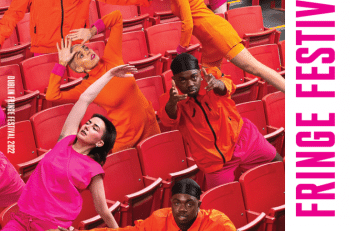
Two arts and culture festivals in Dublin this month Taking place this month in Dublin are two major arts and culture festivals – the Dublin Fringe Festival and Dublin Theatre Festival – both returning with a full programme of live events. The Dublin Fringe Festival runs from 10 September – 25 September. The Dublin Theatre Festival runs from 29 September – 16 October 2022. The fringe festival will feature a large lineup of events and installations in venues across the city. Included for example is the free event (€10 deposit) School Bus by Léann Herlihy, meeting at Bull Alley bus stop, which involves a bus journey and a history of queer, ecological and abolitionist survivalist groups. The theatre festival will feature performances in venues across the city including the Abbey, Gaiety, Pavilion, and Project Arts Theaters. It will also include performances in less traditional venues such as the National Maternity Hospital and Kennedy’s pub. Included in the lineup is Joyce’s Women, a new play by Edna O’Brien in the Abbey Theatre. Joyce’s Women examines the life of James Joyce through the lens of the women who surrounded him; including his wife, Nora, and his daughter, Lucia. The show runs from 29 September. Also included is a theatrical production in the Gaiety Theatre of Colm Tóibín’s novel The Blackwater Lightship about a gay man suffering from HIV/AIDS in Ireland in the 1990s, and his relationship with his mother. The show runs from 27 September. A full programme and tickets are available online at both festival websites: fringefest.com and dublintheatrefestival.ie. Prices for the fringe festival vary but many events are free. In some cases for the theatre festival tickets are available at a discounted price of €10. Many of the productions also have preview nights with tickets available at a cheaper price. Reviews of several of the performances will go up on the Village website in the coming weeks.