General

Random entry RSS

  • Posted in:

    Brentrance.

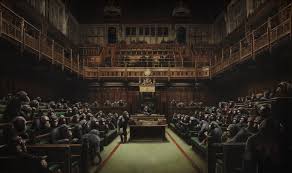
      By David Langwallner. November 2019.   Of course there is no practical benefit to Brexit.  Indeed our Irish perspective is that the British are jumping off a cliff with no parachute. However, I am a barrister in turbulent London and I also refute caricature portrayal, by the likes of Fintan O’Toole, of Brexiteers as swivel-eyed loons. He says if it was not tragedy Brexit would be comedy; Village has claimed it is comedy not tragedy.  Such deprecations represent patronising failures of imagination: Brexit is a triumph of idealism over pragmatism, of imagination over supineness and of culture over finance. It is not so bad for the nation of shopkeepers to abandon square utility and dour pragmatism.   I have a profound belief in the decency of British people and their institutions which I believe are proving resilient.  Lurches – to the right, to the anti-economic, anti-social, anti-environmental, have been abortive.  The stock markets and currency are stable. The provision-hoarders have now stood down, too.   The UK is in good shape (and not just in sport and culture).  It has a system with solid checks, a vibrant and aggressive press.  Unemployment is 3.8%, employment is 76% (Ireland 69%).  Annual earnings growth is 3.8%.   Ireland need not panic vicariously for its newly excitable neighbour.   Metternich said that Italy was not a country but an idea. This is abundantly true of the UK.  Inconveniently, however, the idea has evolved with modernity and has broken its chains. The UK is taking a stand. That cannot be said of Ireland.   While Ireland has been wrestling with the social and religious conventions that held it back (and arguably finds itself quite comfortable in its new-grown modern skin), we have failed to interrogate our largely neo-liberal economic model. Britain is demonstrably much less happy with the economic model that grounds it.  Britain would not have tolerated the abjection of Ireland’s bailout; nor the dodginess of our prostration before the might of the multinationals on which we have centred our economy. The UK is united in its abhorrence of the legacy of austerity.  Would that Ireland were so progressive. It remains in thrall to the parties of the cuts. Unlike Ireland Britain has long realised that the EU lost its way a generation ago.  Its meting out of doctrinaire and bureaucratic bailout punishments on Ireland and Greece, and of austerity on the already moribund European Economy generally, and its obliviousness to the social side of Economic Union, are inexcusable Britain is challenging globalism and that is not something to disdain, least of all for Village readers.  Its Labour party defies blind globalism, as do the nationalist parties, the Liberal Democrats and most Tories.  The ascendant right-wingers, led by perhaps the most dishonest of them all, Johnson, talk the language of unshackled international trade but they are insincere and will not fight for it. The English want control back.  Brexit is the first adventure in post-globalism and internationally the left and the thoughtful of all political hues should embrace it. Yes the adventure is admittedly inarticulate.  And it is a sad truth that freedom from the EU will in no way constitute freedom from the control and standardisation that underpin Economic Unions. In principle divorcing from multilateral norms and the nasty disciplines of trade is welcome. The deal is a hard Brexit.  The UK will exit the customs union and the single market. It has yet to be seen how free it will be to do trade deals with other countries and whether it will follow EU standards on the customs union and single market, and even more precariously, on social, environmental and consumer standards – which are not strictly required by the customs union and single market.  As an outsider and a remainer, I fear they may rue the hardness, if not the principle. But that is always the danger with taking a stand. But as well as admirable principle  there are some dramatic political benefits. DUP deference to Tories was doing no-one any good and it is good to see its demise. We are to have an ingenious double-border that will serve Northern Ireland – at least economically – very well. As for immiserated Scotland, who in Ireland would not hasten its independence? I do not dispute that the UK has pushed the bounds in dangerous directions. Its indulgence of lies is far greater even than our own.  Its society has even great class fissures and educationally it is a dead end. There is a lugubrious cynicism every bit as corrosive as our own. The UK body politic suffers from the triumph of a culture of comedy evident in news programmes such as “Have I Got News for You” which turned Johnson into a cult and the nation into cynics. Scrutiny of character seems like yesteryear’s imperative. Certainly the gorillas have taken over.  But they do not have a majority and their time is up. So much cannot be said of now-complacent and pliantly unradical Ireland. The UK is on a journey.  It does not need a parachute.    

    Loading

    Read more

  • Posted in:

    THE MOUNTBATTEN FACTOR: Boris Johnson should not bully Dublin over Brexit because the Irish Government has information which could damage the Royal Family?

    INTRODUCTION Last December Taoiseach Leo Varadkar had to slap down Priti Patel MP, who now serves as Britain’s Home Secretary, when she threatened the Republic with food shortages if the Irish Government did not drop demands for the Irish backstop. Varadkar reminded Patel of the starvation that had engulfed Ireland in the 19th century and said he hoped she would think more carefully about what she said in the future. Tensions eased as Johnson dropped the Democratic Unionist Party (DUP) and conceded a regulatory border in the Irish Sea. Now, tensions are on the increase again. Johnson has seen fit to reappoint Patel as Home Secretary and has made bellicose noises about the forthcoming trade talks with the EU. In Dublin Varadkar has stated: ‘It is going to be difficult to secure a good trade deal for Ireland, principally because Boris Johnson has fixed on a harder Brexit than we anticipated under his predecessor or at the time of the referendum, and that is one where he talks very much about divergence’.  If Britain does not get what it wants out of the  forthcoming Brexit negotiations, Anglo-Irish relations could deteriorate again. In extremis Britain could resort to its all too familiar policy of bullying Ireland.  The worst example of this was the bombing of Dublin and Monaghan in 1974 by Loyalist paramilitaries who were RUC Special Branch and MI5 agents such as Robin Jackson. Anyone who doubts Johnson’s moral vacuity and capacity for wrongdoing should listen to the infamous recording of him providing Darius Guppy, an old Etonian colleague, with the contact details of a journalist so the latter could be beaten up. Guppy told Johnson he intended to have the journalist’s ribs broken:  Boris Johnson Darius Guppy telephone call threatening violence  at https://www.youtube.com/watch?v=iDJWkS2A9T0 Unlike many of his predecessors, Varadkar is not the type of taoiseach to back down when under severe pressure. He also has an utterly ruthless streak. Anyone who doubts the latter point should study the manner in which he plotted against and undermined Enda Kenny, his predecessor as Taoiseach over the Garda Maurice McCabe paedophile smear scandal. Kenny was completely blameless in that scandal. Bearing this in mind, Johnson should note that the Irish police – the Gardai –  may very well hold a file which could be deployed to devastate the British Royal Family if relations become really toxic. 1. MOUNTBATTEN ABUSED BOYS IN THE IRISH REPUBLIC. Last August Village  published an article revealing that a boy abused by Lord Louis Mountbatten in August of 1977 committed suicide a few months later. He had been taken by car to Classiebawn, Mountbatten’s castle in the Republic of Ireland from Kincora Boys’ Home in Belfast. The man responsible for trafficking him was Joseph Mains, the Warden of Kincora, also a paedophile. Mains was a British agent and an asset of both MI5 (Home Office) and MI6 (Foreign Office).  (For further details about Mains and Kincora, please click on the Joseph Mains button at the end of this story.) Mains had to cross the Irish Border to get to Classiebawn. The Village  story about the boy who committed suicide is also available on this website. (Click on the Mountbatten tag/button at the end of this story.) 2. LOWNIE’S LABOURS Village  also revealed that the British historian Andrew Lownie had sought the Garda file on the assassination of Mountbatten in August of 1979 while preparing a book on the Mountbattens. Lownie was rebuffed politely. His book has since become an international bestseller and was listed by the Daily Mail  as one of the best biographies of 2019. Lownie’s book contained interviews with two other boys who were abused by Mountbatten in Ireland both of whom are alive. Since the publication of his book, Lownie has asked the Gardai to release the logs they made of the vehicles which visited Classiebawn. They emailed Lownie on 7 October 2019 stating that files ‘generated during the course of a criminal investigation’ are considered confidential and hence they would not be releasing them. It is significant that they did not deny that the logs still exist. Lownie responded by pointing out that the logs he was looking for related to August 1977, i.e. two years prior to Mountbatten’s assassination. There could not have been an investigation of a ‘criminal’ nature in 1977 into an assassination that did not take place until 1979. The Gardai did not – and clearly have no intention of – releasing the logs.   3. JOHNSON HAD BETTER BE ON HIS BEST BEHAVIOUR DURING THE FORTHCOMING BREXIT NEGOTIATIONS The Mains’ log (or indeed logs) are political dynamite, even forty years on, especially with the Royal Family reeling from the Prince Andrew-Jeffrey Epstein scandal. There is more to the Prince Andrew story which has been ignored by the British press thus far: his relationship with the paedophile peer Lord Greville Janner. Details, however, can be found by clicking the Prince Andrew tag/button at the end of this story. Boris Johnson should be told in no uncertain terms that MI5 and MI6 are despised in the Republic and it would be folly to unleash them to spy on, bully or coerce the Irish government during Brexit negotiations;  most particularly, they should not use their influence in the media – on either side of the Irish Sea – to besmirch Irish politicians. Village  has evidence that one of the most senior media figures in Ireland was an ally of MI6. While his influence is now nonexistent, he has surely been replaced by other traitors. It was he who got Dr Martin O’Donoghue  TD to attempt to bribe two Fianna Fail cabinet ministers – Sean Doherty and Ray MacSharry in 1982 to oust Charles Haughey as Taoiseach. Village  has referred to him in the past as the ‘Paymaster’. British spies and their agents are also blamed by all and sundry in Ireland for the Dublin and Monaghan bombings of 1974 which led to the death of 33 people; the atrocious Miami Showband massacre; the egregious assassination of the solicitor Patrick Finucane in

    Loading

    Read more

  • Posted in:

    Not Labour’s policies, not Brexit; Johnson has CORBYN to thank for his five more years.

    By Michael Smith. The only positive conclusion from the  immolation of Labour in Britain is that it was its leader and not its policies that forced the tragedy. In late November pollsters YouGov asked the British public questions about the popularity of Labour’s manifesto, published earlier in the month. The tax rises on the rich were very popular. The 50 per cent tax rate for earnings over £123,000 was supported by 64 per cent of voters, with just 20 per cent opposed and 16 per cent uncertain. The 45 per cent rate for earnings over £80,000 was popular: 60 per cent supported  it and  23 per cent opposed it. 56 per cent support nationalising railways and just 22 per cent opposed it. Water companies’ nationalisation attracted 50 per cent support and just 25 per cent opposition. Nationalising Openreach, and therefore broadband, attracted 32 per cent supporting and 31 per cent opposition -but  free broadband for all attracted 62 per cent support  and 22 per cent opposition. Jeremy Corbyn became a cult without stopping off to become understood, or clear. For an accomplished politician he is an exceptionally bad communicator.  When he speaks, his sincere passions seem contrived, he emphasises the wrong part of key sentences and, worse, he does not even attempt to answer inconvenient questions, like what he thinks about Brexit, or what his stance on Israel and Anti-Semitism is.  He could have answered these questions plausibly but he seemed more interested in bristling. Corbyn’s second-rate rhetoric failed to raise the great British public to the appropriate level of vitriol at the descent of politics into lies, base populism and wishful thinking. To convey that this was different from the Tories of yore. He did not appear to understand that Johnson and his gang are qualitatively worse even than Margaret Thatcher and hers, that Johnson  – puppeteered by the malign Dominic Cummings – like Trump, does not appear even to be a democrat. He failed to ram home a message of the scandal of the UK’s descent into a-morality and a-factuality.  He did not appear to understand the effects of manipulative and cynical populism. He did not appear to value evidence as the grounding for  ideology. He failed to rouse the UK into an obvious rage, against the charlatan Johnson. However, Corbyn’s unforgiveable failure was not of presentation but of substance.  He failed to point out how bad it is for  a once decent country to fall for a liar and bigot like Johnson.  He failed to point out how bad Brexit will be for the UK’s economy; and for its society and environment. And he didn’t seem up for a robust and analytical debate in which he would explain the benefits of egalitarianism versus capitalism. His argumentation was typically dogmatic not open. Brexit was not the cause of the Tory victory.  Brexit was the failure of the Labour party. And as to the election catastrophe, blame neither policy nor Brexit.  Blame Jeremy Corbyn.  It’s in the anecdotes and it’s in the statistics. At all material times he’s always been less popular than his Tory opponent. Never again must the Labour party put a leader with ratings of minus 50% into the fray. It’s inept to the point of being unethical. And that is really the only lesson from a dark December in Albion.

    Loading

    Read more

  • Posted in:

    DUP Leader has rich and ancient Gaelic heritage with a family tree dominated by two august Irish surnames – Doonan and Kelly.

    Arlene Foster, Leader of the DUP, has a rich and ancient Gaelic heritage with a family tree dominated by two august Irish surnames – Doonan and Kelly. Her more distant ancestors, who spoke Gaelic, would have considered themselves part of the Ó Dúnáin and Ó Ceallagh clans, not Doonans or Kellys. Her family tree also demonstrates how the overwhelming majority of her ancestors lived and died in the Barony of Clankelly in Fermanagh. The Irish language act has amounted to an impasse which continues to be a stumbling block to the reinstatement of the Northern Executive and Assembly at Stormont. To her credit, Foster has shown leadership on the issue. At the launch of the DUP’s Westminster general election manifesto she declared: “The Irish language has been made a key block by Sinn Féin. I would regret that because I do think there is a way forward through those issues, because there are those in Northern Ireland who love the Irish language.” While she was not in favour of ‘a full-blown costly Irish language act which would bring about discrimination against those of us who don’t speak the Irish language’ she did say that there ‘is a way forward – I absolutely believe there is a way forward – but there has to be a willingness on all sides to find that way forward’. The Ó Dúnáin Connection Arlene’s Doonan connection is fascinating. Doonan or Ó Dúnáin is a rare name in Ireland. According to the leading authority on Irish names, The Surnames of Ireland, by Edward MacLysaght, the Doonans of Fermanagh were ‘Erenagh’, or hereditary stewards and guardians of Roman Catholic church lands. In old Irish they were known as ‘airchinnech’. The translation is ‘head of an ecclesiastical settlement’. Hereditary stewards and guardians were nominated by the local Catholic Bishop. The Plantation of Ulster in 1609 saw the Doonans completely dispossessed by the English. The Roman Catholic church was taken over and the congregation was denied the right to worship. The Doonans never recovered their earlier status, yet the family still survives in Fermanagh as Arlene’s family tree demonstrates. Further research is required to pinpoint when the Ó Dúnáin branch in Foster’s family tree converted to Protestantism. The Ó Ceallagh Connection According to MacLysaght, the surname Kelly (Ó Ceallagh) is the second most populous name in Ireland. It is not certain where the name hails, however the most probable suggestion is that is comes the word ceallach, meaning ‘strife’ in the Irish language. The Barony of Clankelly (from the Irish: Clann Cheallaigh meaning ‘Clan Kelly’) is in Co. Fermanagh. Clankelly takes its name from Cellach, son of Tuathal, a king of the Ui Chremthainn who was killed in 731. The ruling family of Clann Cheallaigh in the late medieval period bore the surname MacDomhnaill – from Domhnall, a grandson of Cellach, whose death is recorded in the year 791. Further research is also required to pinpoint when the Ó Ceallagh line in Foster’s family tree converted to Protestantism. Arlene Foster’s Family Tree. Whilst the documented evidence traces the roots of the Kelly branch of Arlene’s family back to the early 19th century, the surnames involved establish that the roots indeed go much deeper and their respective links to the history and culture of Gaelic Ireland is well documented. Her grandparents on her father’s side were Nathaniel Kelly (born 1881), a farmer, and Alice Jane Doonan. They married in 1924 in St. Mark’s Church of Ireland Parish of Aghadrumsee and lived in Derawilt, County Fermanagh. This townland is in the Civil parish of Clones and the Barony of Clankelly. Her great grandparents were John Kelly (6 May 1851) and Alice Doonan who were married in the Church of Ireland Parish of Clones on 18 May 1873. The marriage confirms that John’s father was also a John Kelly while Alice was the daughter of Nathaniel Doonan of Drummans, Clones, County Fermanagh. Her great-great grandfather was yet another John Kelly who married Sarah Ferguson on 4 December 1846 in St. Mark’s Church of Ireland Parish Aghadrumsee. This marriage record did not note the father’s names only to say that both were deceased. However, it confirmed that John Kelly was living in the townland of Drummaw in the civil parish of Galloon, also in the Barony of Clankelly. The townland is not far from Derawilt where the family ultimately moved. The land in Derawilt came into the possession of the Kelly family in 1892 when John Kelly took over the 47-acre plot from a John Richardson. He bought the land outright under the Land Act Purchase in 1908. Great-great-grandmother Alice Doonan was born circa 1843 to Nathaniel Doonan and Eleanor. Eleanor’s maiden name is unknown. Her father, Nathaniel, was born in 1812 to James Doonan and Jane Moore. Sadly, her mother, Eleanor, died prematurely in 1849 and Nathaniel married again, to Jane Forster in 1850 and went onto have a second family. One of his sons from this marriage, John Doonan, was the father of Alice Jane Doonan (mother of John William Kelly, Arlene’s father). While Arlene Foster may not speak Irish herself, it is surely lurking in her DNA. Perhaps she can now navigate her way through the Irish language act impasse at Stormont and make her ancestors proud of her nonetheless.    

    Loading

    Read more

  • Posted in:

    Fine Gael has finally established an identity - as the Nasty Party.

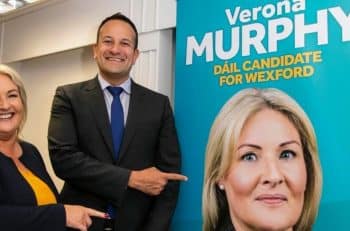
    Village often gets frustrated by the weakness of the Left and of the Greens.  However, it aims in general terms to be supportive of them, particularly in their radical forms. This is because they come closest – though still not that close – to furthering the agenda of equality of outcome, sustainability and accountability that drives this magazine. Village, not having fought in the civil war, has always struggled to register the animating idea of our bigger parties.  The absence of ideology spawns cynicism as there is a risk that the big idea becomes doing favours for friends. Fianna Fáil in government has been a confusing mélange of left and right, so that Bertie Ahern, albeit outrageously, claimed he was a socialist.  Fianna Fáil did just enough with the state pension, free bus travel, and social and local partnerships to be able to claim that it didn’t only serve the well-off and the developers who really excited it and forged its policies. But it provided parochial and venal governance. During the mismanaged boom it seemed Fine Gael might offer salvation.  It appeared less corruptible albeit there remains a mystery about fundraising under Michael Lowry who was profoundly corrupt and its performance in local planning has always been developer-serving and often corrupt. Even John Bruton never answered for dodgy behaviour over rezonings as party leader. Beyond this Fine Gael always well represented the wealthy farmers who uphold the IFA. It was pro-EU, perhaps because of that. It was for law and order because of its fascist antecedents. It thought of itself as better and more competent than thou, though it probably never was (Sweepstakes/Children’s Hospital/PrinterGate/Dara Murphy). And it was for…the Treaty. It had not been clear what Fine Gael really stood for.  It had veered from fascist-friendly under the founding Presidency of Eoin O’Duffy  to socially conservative under Liam Cosgrave to left of centre under Garret FitzGerald to right under Bruton and Kenny.  Only really under Varadkar have its true colours been allowed to flourish, in a modern Ireland which affords it no excuses. Varadkar is a Thatcherite with regressive views on abortion and gay marriage who one day realised his attractive personality could ground an ambitious career and became Fine Gael Man for the 2010s with a shinier agenda embracing lifestyle modernism. With this leadership, unsurprisingly the party allows all sorts. Cosgrave, Scully, Flannery, Bailey: Fine Gael love the years has provided a home to the corrupt and the fraudulent, to the racist and the exploitative. His MEPs unblinkingly vote against life-saving search and rescue measures for migrants in the Mediterranean on obscure grounds.  His candidate in the imminent Wexford by-election considers there is no homelessness problem in her home town and that there should be no carbon tax (or Road Safety Authority) and is “under no illusion that Isis is a big part of the migrant population”, that some asylum-seekers need “deprogramming” and that immigration risks a “return to the type of conflict seen during the troubles in the North”.   But it is by his policies that Varadkar’s Fine Gael should be judged. In Ireland in 2019 the top 1 per cent of the population gets more than 5 per cent of the national income. The bottom 40 per cent gets 22 per cent. The State’s “unusually high” incidence of low pay and weak labour protections generates inequality, with the working and lower-middle classes struggling most to make ends meet, according to Tasc. Fine Gael abandoned any vision of universal healthcare.  In September there were more than 10,000 people waiting on hospital trolleys, twice the number a decade before. Ireland has had 10,000 homeless people for each of the last eight months. 85,000 people are on social housing lists. Yet hotels and student housing are rising all over the country’s capital. Average rents are 45% of average earnings. The government lies about how many houses it was building. It won’t deal with the problem because Fine Gael is ideologically opposed to social housing as there is nothing in it for its buy-to-let-fetishising members. Its solutions are all developer-facilitating.  Its Minister for Housing is in thrall to the building industry and will not consider compulsory purchase measures. Fine Gael has no chance of implementing a National Planning Framework as it is ideologically unable to assert national planning norms such as avoidance of sprawl into Leinster and one-off housing, which interfere with the property rights of developers and landowners. Varadkar’s Ireland is the second worst climate offender in the EU. It is extraordinary that in every case where it cannot or won’t effectively intervene it is the wealthiest who benefit from Fine Gael’s inertia. Fine Gael stands above all for property rights; it stands for sniffy intolerance of those economically and socially inferior to the party’s – now often youthful and cosmopolitan – hegemons: for those who get up early; it stands for laissez faire and deference to developers and multinationals; and for indulgence of those who are intolerant of migrants. The big parties seem to have seen off demagoguery, the economy is thriving, the demographics are favourable, and the church is on its knees: the government is its own agent, and now we can finally see what Fine Gael stands for. But it has no vision, no empathy and no radicalism. It is the Nasty Party. Time for real change.    

    Loading

    Read more

  • Posted in:

    Two towns cope generously; the third, Ballinamore, is a morass of party politics, vested interests and even links to Quinn Group problems.

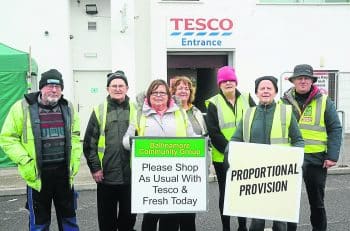
                              By Estelle Birdy. About 8,700 people in Ireland await a decision on asylum claims. 6,000 live in Direct Provision. Of these, 778 have received refugee status or ‘leave to remain’ but are unable to find alternative accommodation. Another 1,531 people live in 36 inferior,  emergency-accommodation centres opened in the past year. Between 1,200 and 2,000 asylum-seekers who do not need State accommodation are living outside Direct Provision. But this is the human story behind the statistics. It is the story of three towns and how they are dealing with people seeking asylum. Carrickmacross There had been murmurings around the town  about groups of men, foreign nationals, gathering on the Main Street.  And there’d been much discussion surrounding the alleged sexual assault of a woman in the town the previous week. Nevertheless, the apparent out-of-nowhere eruption of far-right sentiment in Carrick, on October 3  this year, took the townspeople by surprise. On that day, an online petition appeared, with the word Lawless, recalling the 1964 B-Western, scrawled across a background photo of   Carrick’s Main Street. The petition asked, “Do you feel intimidated while walking around Carrickmacross?”. People began to sign and comment.  Many comments were measured  but later additions turned to outright racism. A quick search for the text of the petition online found  it  being shared,  from the moment it was uploaded, by known far-right social-media accounts. A Facebook group,  established  under the name ‘Lawless’,  quickly became a focus for anti-immigrant organising.  Locals drawn to the Facebook group, found it already animated by far-right activists and anti-immigrant sympathisers. Several local group members , say they thought the group was “just a community discussion group”. It would prove to be much more than that. Soon the administrators were receiving requests to join the group from all over the world – a large number from the UK, the US and from around Ireland. By the afternoon of October 4, ex-British soldier and far-right activist, Rowan Croft, was livestreaming video from the town, linking a supposed lack of feminine security to immigration. Subsequently, right-wing media outlet, Gript, published a piece suggesting that   criminal gangs stalked the streets of Carrick, referencing the alleged sexual assault, stating that no one had been arrested in the investigation. This was untrue. A suspect had been in custody within 24 hours of the alleged incident. In the Lawless Facebook group, one name kept cropping up – Seamus ‘The Banty’ Mc Enaney, a local businessman,  contracted by the government since late 2018 to provide emergency accommodation for asylum-seekers in the area. A plethora of complaints about McEnaney   emerged. Some  professing interest in the welfare of asylum-seeking people, some angry at the money allegedly being earned by McEnaney to accommodate asylum-seekers. Another businessman, with links to the Yellow Vest Ireland movement, had prior beef, of a financial nature, with McEnaney. This man, highly active in the group, along with his proxies, agitated against both McEnaney and immigrant people. Gemma O’Doherty, of Anti-Corruption Ireland and Justin Barrett, leader of the far-right National Party, commented online about Carrickmacross, styling it as a matter of female safety. In fact, the National Party and assorted linked groups already had a small number of supporters living in Carrickmacross. Mark Malone of the ‘Far-Right Observatory’ says that what happened in Carrick had all the hallmarks of a pre-planned far-right attack. The speed at which the petition spread, the fact that Rowan Croft was filming from Carrick within hours of its publication and the numbers of people (1,300 at one stage) joining the Lawless group, all suggested advance preparation. Indeed, far-right and anti-immigrant activists were flushed with success   after a campaign in Oughterard, which saw protests there halting the provision of accommodation to 200 asylum-seeking people.. They were just waiting   to light the fuse and they used an alleged sexual assault as the match. Locals  began to question the credentials of some  active members of the Facebook group, some operating under false names. Questioning this or any  disinformation  being spread, resulted in locals and others being summarily banished. A week beforehand, Fiona Ryan and Jonathan Mathis, a mixed-race family who had appeared in a Lidl ad and had suffered racially motivated online abuse – notably from Gemma O’Doherty,    had been on the ‘Late Late Show’.  Somore people  were aware of the threat posed by racist, anti-immigrant campaigners.  EU and other foreign nationals, happily form a substantial percentage of the 5,000 strong population of Carrick .  The town has a history of welcoming asylum-seeking people – groups of (now long-established) Syrian and Congolese families were resoundingly welcomed. . Additionally, several humanitarian groups, both lay and religious, had been quietly operating in County Monaghan, as they have been in towns around Ireland. Officials say   that the Department of Justice is under pressure to meet Ireland’s international obligations to accommodate a small number of asylum-seekers. The recent McMahon Report on Direct Provision and the burning and blockading of some mooted accommodation centres, has forced many asylum-seekers into long-term emergency accommodation. Much of it unsuitable, cramped, rural accommodation with few transport links. Asylum-seekers have had to share beds with strangers and  are often moved to other locations at short notice, when   commercial guests require rooms. Asylum-seeking children have been unable to attend school for extended periods. This is happening currently in Carrickmacross. Asylum-seekers, like homeless families, are often segregated from other guests and must enter by the back entrance. Locals worked online countering racist and anti-immigrant claims and, crucially, working with SF local public representatives to disseminate accurate information  in the community One older local man says, “I never thought I’d have to fight the far-right in Carrick but that’s exactly what I was doing”. The following Saturday, anti-immigrant activists attempted  a protest in the town, calling it a local event. 25-30 people, in Dublin and Northern Ireland-registered cars and minivans, turned up. No locals took part, although some watched from a distance. The fact that the

    Loading

    Read more

  • Posted in:

    The Prince, the pauper and the paedophile peer: the dangerous questions the BBC failed to ask.

    SOME REALLY DANGEROUS QUESTIONS WERE NOT ASKED The BBC’s Emily Maitlis has broadcast the interview she conducted with Prince Andrew about his relationship with the convicted paedophile Jeffrey Epstein. It was billed as a ‘no holds barred’ interview. Unfortunately, Maitlis did not ask a single question about his relationship with the notorious child molester, Lord Greville Janner. Yet the Prince’s relationship with Janner raises as many questions as that of his friendship with Epstein. The British media has turned a blind eye to the Janner-Duke of York relationship. The Independent Inquiry into Child Sex (IISCA) in London chaired by Professor Alexis Jay may soon abandon its inquiry into Janner completely. If it does, the Prince will get to heave yet another deep sigh of relief for he will not have to face questions about his friendship with Janner from that quarter either. Alan Kerr, an Irish victim of sex abuse from Belfast, has provided the IICSA with details about the Prince’s friendship with Janner. Kerr’s story was revealed exclusively by this magazine. Readers who are not familiar with it are invited to read ‘The Boy on the Meat Rack’  and  ‘Out of the Frying Pan and into the Fire’ on this website. (Click on the ‘Alan Kerr’ tab at the end of this story.) A  PRINCE WHO IS ABOVE THE LAW The possibility that the IICSA will not investigate Janner comes in the wake of an announcement last August that the Metropolitian Police were not going to investigate the Prince for having had sex  in London with Virginia Roberts when she was 17. A spokesperson for the Met announced that it investigated allegations he had “had sex with Virginia Roberts Giuffre aged 17 in Ghislaine Maxwell’s bathroom” in London and confirmed that while they had received “an allegation of non-recent trafficking for sexual exploitation’ that ‘no further action is being taken”. Last August Channel 4 News discovered that the Met had “reviewed the available evidence” and decided that the matter “would not progress to a full investigation”. The Met’s purported inquiry had begun with a review of the “available evidence” in 2015 after receiving a complaint over claims in US court papers that a girl was “forced to have sex with Prince Andrew”. Independently, Roberts’ lawyers contacted the Met in 2016. A further complaint concerning the sexual trafficking of Roberts to the UK was received by the Met in 2015 from an unconnected third party. As Channel 4 disclosed, ‘The Met Police has refused to answer detailed questions about the allegations and whether they ever spoke to Epstein, his friend Ghislaine Maxwell, Prince Andrew or anyone from the Royal Household. Channel 4 News asked the Metropolitan Police a series of questions about Virginia Roberts’account of what she says happened to her at Maxwell’s London residence in early 2001. The Met told Channel 4 News: “[We] can confirm that the Metropolitan Police Service [MPS] received an allegation of non-recent trafficking for sexual exploitation. The MPS reviewed the available evidence and the decision was made that this would not progress to a full investigation. As such, the matter was closed”. It will come as no surprise that the Prince chose the BBC, not Channel 4 for his interview about Epstein. THE PRINCE IS CLAIMING THIS WOMAN IS A LIAR AND A FORGER. Ghislaine Maxwell procured and trained underage girls to have sex with adult males, as part of Jeffrey Epstein’s now infamous international paedophile ring.  Roberts has spoken about how she was taken to London in 2001 by Epstein. During her trip, she was awoken from her sleep by Ghislane Maxwell who told her ‘you’re gonna meet a prince today’. That night she went out dancing with Prince Andrew in a club where he gave her alcohol and she was later ‘forced’ to have sex with him. She claims had sex on two other occasions with the Prince. Although the Prince had precise dates, times and places at the tip of his fingers, he affected genuine surprise at the suggestion he had participated in an orgy in America with her. This demonstrates that he was putting on a performance for the cameras. His facial expression was tantamount to a lie:  how could he have been so surprised at an accusation – acting as if it was the first time he had heard it – if he was long since familiar with it?   HAS TIME RUN OUT FOR THE JANNER STRAND OF THE IICSA’S INQUIRY INTO CHILD RAPE? On 9 March 2016 Ben Emmerson QC for the IICSA said the Janner investigation “has been identified for an early hearing, partly in recognition of the length of time the complainants in this matter have had to wait before their allegations could be heard. The Janner investigation is one of four investigations in which preliminary hearings are being heard this month and in which early public hearing of the evidence are expected”. The Janner strand was intended to have opened in September 2016 but was moved to March 2017. It was adjourned again in the expectation it would be heard in 2018 but was then moved to a three-week slot in February 2020. It may now not proceed at all. Overall, the Inquiry proposes to conclude its hearing by November 2020 and publish a final report by March 2022. The threat of discontinuance of the Janner strand arises from the fact the Crown Prosecution Service (CPS) is considering whether or not to prosecute an unnamed individual on a referral from the Independent Office for Police Conduct (IOPC).  The Janner strand may not proceed while the CPS decides whether or not it will prosecute the individual. If the CPS decides to prosecute,  the IICSA will have to wait until after the prosecution has been completed. By then IICSA may have completed its hearings. If there are further delays and or appeals, the IICSA may even be wound up by the time all issues are determined. Unfortunately, the CPS was not in a position to tell the

    Loading

    Read more