admin

  • Posted in:

    Villagestands by Varadkar-leak story but, after due process, the Tánaiste remains innocent in the eyes of the law

    4August/September 2022 VillageMagazine published correspondence in November 2020 under the headline ‘Leo Always Delivers’. It showed that in April 2019 then-Taoiseach Leo Varadkar transferred the confdential draft (it was subsequently amended 30 times) heads of agreement for the contract being negotiated between government and the Irish Medical Organisation to a friend of his. That friend was the president of a rival doctors’ representative organisation, the National Association of GPs (NAGP), Dr Maitiú (Matt) O Tuathail. As this magazine said at the time, the transfer constituted a crime under the Ofcial Secrets Act (OSA) 1963 and, possibly, under the Criminal Justice (Corruption Ofences) Act 2018 (the “Corruption Act”). At no time has Villageever said that Mr Varadkar had been convicted of a crime but, instead, the assertion we made was that his actions were, objectively and precisely, a crime. Villagehas seen defnitive legal advice that the maximum allowable period for a summary prosecution of an ofence under the OSA is six months from the date of the commission of the ofence. An alternative prosecution on indictment only applies in cases of breaches of the OSA that afect national security. This one did not and so it would not have been possible for the DPP, Catherine Pierse, to prosecute this particular crime under the OSA. Villagebelieves that Pierse’s decision not to prosecute will most likely have been determined by the fact a prosecution had run out of time. It is worth, as an aside, recording, with exasperation, that no Minister has ever been prosecuted, let alone convicted, under the OSA, in Ireland (or the similar UK legislation). To be clear, a decision by the DPP not to prosecute is not the same thing as a decision that there has been no criminality. Any decision by the DPP not to prosecute could be because prosecution has run out of time — or because there is not enough evidence to prove the case beyond reasonable doubt; or because the case might not be, for whatever reason, in the public interest. Therefore the DPP’s decision not to prosecute probably does not afect the validity of our claim. We cannot be expected to row back from it.As to the Corruption Act, it provides in Section 7 (2): “An Irish ofcial [which all agree includes a Taoiseach] who uses confdential information obtained in the course of his or her ofce, employment, position or business for the purpose of corruptly obtaining a gift, consideration or advantage for himself or herself or for any other person shall be guilty of an ofence”. We will not rehearse the arguments we have made as to the applicability of the Corruption Act in this case. However, the key point is that it focuses on advantage rather than simply monetary gain, and that the advantage can be conferred on either the person passing, or the person receiving, the information. A solicitor with Arthur Cox, Tara Roche, recently wrote: “to date, investigations into allegations of bribery or corruption in Ireland have been uncommon and there have been no prosecutions under the Corruption Act”. However, this trend appears to be changing slowly. The Garda National Economic Crime Bureau now has a team dedicated to the investigation of serious and complex economic crimes. That suggests that, one way or another, white-collar crime will now be prosecuted far more often. The complexity, including, presumably, huge degree of legal complexity, of the Varadkar case resulted in inevitable delays. The Garda took 18 months to create a fle of several hundred pages, in which they made no recommendation. Furthermore, it is believed that the DPP also obtained external counsels’ advice. There cannot be any doubt that this was, and was treated by the authorities as, a non-trivial case, despite the contrary claims of many charlatans – especially charlatans in Ireland’s one-time newspaper of record. Despite all this, some still persist in claiming that Village’s headlines are defamatory. Mr Varadkar himself originally and rudely said he would not sue Villagefor defamation as it would be like suing someone on Twitter. The analogy is unsound. Then, after the decision not to prosecute him, Mr Varadkar declined to sue for fear that his “sworn enemies” would use the opportunity to immiserate him. However, he also acknowledged some time ago that the time at which it was permissible for him to launch defamation proceedings has now passed.. Arguably he could apply for an extension to that period but the preferred procedure would have been to initiate his defamation action and then apply to postpone proceedings until the investigation into his criminal conduct had concluded. The way he went about claiming defamation by Villagewas, to borrow his own phrase “not best practice”.Villageasserts Mr Varadkar’s right to due process of the law in full and we share his concerns about the invidious position in which people fnd themselves while waiting for a criminal complaint to be resolved. Villagealso asserts Mr Varadkar’s right to the presumption of innocence under the law. For all that we disagree with the outcome, the criminal process has been exhausted and the matter is closed. Politics aside, we wish Mr Varadkar well. But Villagestands by its story. Village stands by Varadkar-leak story but, after due process, the Tánaiste remains innocent in the eyes of the lawEDITORIALIssue 77August/September 2022 Challenging the endemically complacent and others by the acute promotion of equality, sustainability and accountabilityONLINEwww.villagemagazine.ie @VillageMagIRE EDITORMichael Smitheditor@villagemagazine.ieDEPUTY EDITOR J Vivian CookeREPORTERRóisín O’SheaDESIGN AND PRODUCTIONLenny RooneyADVERTISINGsales@village.iePRINTERSBoylans, Drogheda, Co LouthVILLAGE IS PUBLISHED BYOrmond Quay Publishing6 Ormond Quay Upper, Dublin 7

    Loading

    Read more

  • Posted in:

    Truss ahoy! The new PM will be worse and stupider than the last few. By Kevin Lalor Higgins.

    Today, September 5 2022,  all over Little England, the blackberry-jam-making sessions of the local Women’s Institutes were paused shortly before 12.00 noon. The tea urns and their cosies had been readied in anticipation. The members seated themselves before the old portable televisions used on such occasions, to watch the anointing of  Liz Truss MP as Leader of the Conservative and Unionist Party and by extension, the New Prime Minister. For the average Tory vote, this means that their prayers of: ‘Make it Stop’ seem to have been finally answered. Whatever comfort this may give the faithful, they seem blissfully unaware that for the ‘natural party of Government’  occupancy of Downing Street this time around, places them not so much in the driving seat, as in the last chance saloon. In choosing their new leader, the Tories contrived to empty their chocolate selection box, leaving them just just one vile acidic ‘strawberry cream’ and a rock hard indigestible (that can glue together the jaws of a T-Rex)  to choose from.  I say good luck to them. Ms Truss attended Merton College, Oxford. Now, no one in their right mind is going to throw about the term ‘red-brick’ about Merton. No College whose Statutes were being drawn up in the 1260s should be subjected to such abuse.  Certainly, she attended, but your present writer must respectfully refrain from saying she was educated there, all objective evidence being to the contrary.  Truss has recently celebrated her forty-seventh birthday. This means that she was born just four years before Merton belatedly first admitted women students.  By the time she entered, Merton’s brave new world was still in infancy. Seven-hundred-year-old Oxford colleges do not adopt tumultuous change overnight. The institutional upheaval of 1979 most certainly drew a whole cohort of wonderful scholars into the Merton fold, but it was a process of kerfuffle and anxiety about equality, inclusiveness and sensitivity to scrutiny. Would she have cut the mustard at Lady Margaret Hall (before it admitted men for the first time in 1979) ? Ms Truss’ output as a politician suggests the venerable Merton was not merely compelled to isolate some of its intake to a virtual red-brick extension but, educationally speaking, had to put up at least a temporary cavity-block annex, in a period of flux. In short, Ms Truss is stupid, incredibly stupid.  Before there are outraged cries of misogyny, the same is  true of the  entire British Cabinet and indeed the Tory party as a whole. This is quite separate from the fact that they are as a collective, deeply unpleasant human beings. Exposure of politicians to daylight in modern political landscapes is tightly controlled,  but today it requires more than a Bernard Ingham’s thuggery and physicality to protect a Prime Minister. Neither is the elaborate ‘Communications Suite’ in Downing Street, which seems to have more bugs than a bed in a Tory Landlord’s bedsit, sufficient. It is doubtful if even a reborn Charles Saatchi (80 next birthday) could do much with her, even though he is decidedly experienced at mishandling women. There will always be a herd  of hungry and ambitious brats willing to torque up the bullshit in both Downing Street and Tory Central Office and Murdoch will always be ready to supply secondments, his entire media empire and  elegant Georgian houses close to the Palace of Westminster.   Essentially on paper, the Tories are armed to the teeth and stand ready to repel Mogadon Man Starmer, and given that all Tories stand always ready to slaughter their own first borns in the pursuit and retention of power, you wouldn’t bet the house against them. Their first and greatest problem is the individual they have installed as their nominal leader. In truth, it is doubtful if she herself knows what she believes in, or actually thinks about anything. She will be overwhelmed from day one and directed by whatever party faction establishes itself as her kitchen cabinet. And then there is Boris, who sees himself as an incipient triumphant comeback kid. The only way to describe the Tory Government and British politics at this time is chaotic. Living next to these noisy neighbours will become even more unpleasant and uncomfortable. The shadow-boxing over the NI Protocol may turn very nasty indeed. We understood the faux-Churchillian bravura of Johnson and knew it was essentially gin-scented trapped wind. Truss is not merely dumb she is potentially more capable of vindictive madness than the Eton bully. In her posturing to placate the DUP, it is perfectly possible she will end the historic and indeed vital common travel area between our islands. Objectively, Truss may appear to us ridiculous, even comical; but she is not funny. No proper Conservative ever is.  

    Loading

    Read more

  • Posted in:

    Vilifying the victims: two of the most vile British Intelligence smear campaigns of the Troubles blamed innocent murder victims for their own demise. By David Burke.

    The Information Research Department (IRD) of Britain’s Foreign Office sought to smear the victims of Bloody Sunday and the McGurks bar bomb atrocity. They even went so far as to attack a group of British politicians by linking them to a campaign for justice for the victims of Bloody Sunday. To the IRD, any association with the campaign for justice for the victims of Bloody Sunday was a shameful act. On 30 January 1972, British paratroopers murdered 13 unarmed civilians in Derry, none of whom posed any sort of a threat to the military – unless, that is, you consider the waving of a white piece of cloth in the air a potentially lethal act. Within minutes Britain’s black propaganda machine swung into action. The head of the Army’s PsyOps department, Col Maurice Tugwell, who had joined the British Army in Derry, was among them. Upfront, Col Derek Wilford, the cowardly commander of 1 Para (cowardly because he has sacrificed his own men by lying about the orders he gave them to save his own skin) spewed out a torrent of lies about an imaginary attack on his troops by the IRA. Later, the Information Research Department (IRD) of the Foreign Office took over the smear campaign against the Bloody Sunday campaigners. A man with deep Irish roots – Hugh Mooney – led the IRD charge. Mooney was a graduate of Trinity College Dublin. He had once worked for the Irish Times. As an IRD officer, Mooney was complicit in a multiplicity of MI6-IRD smear campaigns. An indication of his mindset can be gleaned from the fact that when he later tried to smear leading members of the British Labour Party, he felt the best way to bring them into disrepute was to link them to the families of the victims of Bloody Sunday. (This episode, and a forged document the IRD created to further it, are described more fully later in this article.) Mooney had assets in the British press. One of them was a Tory guru called Tom Utley. Ultley was a British intelligence ‘agent of influence’ or in modern parlance, an ‘influencer’.  At the time of the Bloody Sunday massacre, Utley was working for the Daily Telegraph and Sunday Telegraph, both pro-Tory papers popular with middle and upper class Britain. Mooney and Utley discussed the Bloody Sunday problem together. It was ultimately resolved that Utley would write a paperback about it. According to a confidential letter dated 24 March 1972, the FCO reported to the MoD that Utley hoped to ‘complete the writing in about six weeks, though this may be a little over-ambitious’. According to the letter, he was ‘obviously’ going to ‘need a certain amount of help from Army PR, particularly on the propaganda aspect’. While Utley failed to produce the book, in 1975 he published the rather grandiosely titled ‘Lessons of Ulster’ which took a broader look at Northern Ireland and a litany of developments that had occurred in the meantime. An indication of his mind-set can be gauged from the fact that he objected to the use of the phrase ‘Bloody Sunday’, something he described as ‘slavish obedience to IRA mythology’. He argued that some of those killed were ‘fresh-faced boys who might otherwise have lived to swell the ranks of patriotic militancy’. In other words, they probably would have joined the IRA if they had not been shot. An indication of his mind-set can be gauged from the fact that he objected to the use of the phrase ‘Bloody Sunday’, something he described as ‘slavish obedience to IRA mythology’. He argued that some of those killed were ‘fresh-faced boys who might otherwise have lived to swell the ranks of patriotic militancy’. In other words, they probably would have joined the IRA if they had not been shot. The IRD demonised the families of the victims of Bloody Sunday and those who supported them. Clearly, they believed they had turned them into political untouchables. Hence, they felt they could undermine British Labour Party MPs by associating them with the Bloody Sunday quest for justice. Towards this end, the IRD forged a pamphlet based on a genuine Bloody Sunday campaign leaflet. The original is reproduced hereunder: Merlyn Rees, who served as Secretary of State for Northern Ireland (and later as Home Secretary) was undermined – at least in the eyes of Mooney and his IRD colleagues  – by linking him to the Bloody Sunday campaign.  His name was added to the IRD forgery which appears under this paragraph. (See the bottom of the left hand column). A man called Stan Newens appears on the authentic pamphlet. He was supplanted by Stan Orme MP on the fabricated version. In a similar fashion, Tony Smythe became Tony Benn. David Owen MP was added to the list too.  Owen, however, had the last laugh: when he became Foreign Secretary later in the 1970s, he abolished the IRD. Mooney deployed a similar tactic to smear Charles Haughey TD of Fianna Fail, i.e., he took an original document produced in Ireland and doctored it to include smears about Haughey before printing his own version in London. Mooney was also responsible for the smear campaign against the victims of the McGurks bar bomb atrocity. 15 innocent people were murdered when the UVF attack McGurks bar in Belfast in December 1971. The black propagandists issued a statement insinuating that at least some of the victims of the attack were responsible for their own demise. The propagandists alleged that the bomb had been brought inside the pub by an IRA unit and had exploded prematurely – a so-called ‘own goal’. The campaign was furthered by statements by politicians. See Alleged disappearance of UVF Bomb Massacre Files: MoD excuse for destruction of Brigadier Kitson’s logs is far from convincing. By David Burke. Despite the best efforts of David Owen, the black propagandists found other avenues through which they managed to smear their victims including Charles Haughey. David Burke is the author of 

    Loading

    Read more

  • Posted in:

    The State is abdicating responsibility for National Defence. By Gerard Humphreys, former army officer.

    Introduction. As the lights begin to go off in Europe, the State continues to abdicate responsibility for national defence and is failing to fulfil its key obligations as an independent entity  in international law. The geopolitical situation continues to rapidly deteriorate yet the government is engaged in a massive PR exercise ostensibly  celebrating the centenary of independence. Because of a reckless disregard for our security we have insufficient numbers of defence personnel to deploy our ships or put aircraft fit for purpose into the sky. Rather than discharging their duty to properly maintain and equip the defence forces the government response is to reduce the number of ships and seek to privatise the role of the defence forces. War in Europe 1939 On 1 September 1939 the government ordered the full mobilisation of the Defence Forces including all reserves. By the end of that month some 19,000 troops were under arms which was 50% of the agreed war establishment strength of 37,000. However, this limited expansion was objected to by the Department of Finance. Within two months of mobilisation Finance had forced the Army to contract its size in the interests of economy. By January 1940 Defence Force numbers had fallen to 16,000 and by May to 13,500. In January 1940 the government appointed General McKenna as Chief of Staff. He reported “a complete absence of the most important weapons, … namely anti-tank weapons, anti-aircraft weapons …”. He also had no officers. The dead hand of the Department of Finance Since the foundation of the Officer Cadet School at the Military College in 1928 up to 1939, the State had only commissioned about 100 officers through the Cadet School most of whom spent over 9 years as Second Lieutenants without promotion. No adequate provision was made by Finance for the Army. By May 1940 following the collapse of France, Germany was in possession of the Atlantic coastline from Norway to the South of France. Ireland was an obvious candidate for invasion: by Germany to seize ports and airfields with which to assist the invasion of Britain and threaten Britain’s Atlantic lifeline. It was also at risk of an invasion by Britain to seize the treaty ports. This was within seven months of the Department of Finance having drastically cut the Army. The Government finally acted, and the leaders of Fianna Fáil and Fine Gael issued a call to arms which had a dramatic effect. Those who fought on both sides of the Civil War, rallied to the colours and by March 1941 the Army was over 41,000 strong and the Local Defence Force (later the FCA now called the Reserve) had a strength of 88,000. By 1941 Britain was putting an economic blockade into effect against Ireland and denying key materiel to Ireland. The aim of the blockade was to extract Irish concessions on defence, in particular the Treaty ports. We will come back to this later. However, the dead hand of Finance was still causing major problems for the Army with Finance refusing to sanction the commissioning of experienced NCOs as officers to fill a drastic shortage of officers and further compounded the difficulty of recruiting good officer material. The Department of Defence is a decoy department; the decisions are made by the Department of Finance. Complaints about Finance obstructing NCO promotions were repeated in 1941–42. The Department of Defence is a decoy department; the decisions are made by the Department of Finance. Complaints about Finance obstructing NCO promotions were repeated in 1941–42. History Repeats Itself with War in Europe in 2022 Today, the current establishment as of the 30th of November 2021 shows a total strength of 8,539 for the Army, Navy and Air Corps against an establishment of 9,500 that is for the Permanent Defence Force. The total strength of the Reserve Defence Forces is down to 1,611 out of an establishment of 4,069. Over the 6-year period from 2015 – 2020 military expenditure as a percentage of government expenditure accounted for on average just under 1.2% of the Government of Ireland’s expenditure in contrast to eight  comparator countries where average expenditure accounted for some 2.6% of total government expenditure. The comparator countries were Austria, Belgium, Denmark, Finland, the Netherlands, Norway, Portugal and Sweden. Ireland also spends considerably less on defence in per capita terms as a percentage of overall government expenditure and as a percentage of GDP/GNI, than any of the comparator countries selected. Ireland does not maintain a defence force from a military point of view in sufficient strength to fulfil the security obligations required by international law for a neutral state. In 1986 the Permanent Defence Forces had a combined strength of 13,600 and the Reserve Forces had a strength of 15,800 which means the strength of the Army, Navy and Air Corps is 40% below what it was in 1986 and the Reserve Forces are 10% of what they were in 1986. Commission on Defence presented Government with three options The Defence Forces as constituted at present are not capable of fulfilling its primary objective of defending the State against external aggression. The Defence Forces as constituted at present are not capable of fulfilling its primary objective of defending the State against external aggression. In 1982, Ireland’s permanent representative to the United Nations, Noel Dorr told the General Assembly’s first meeting on disarmament: “We are small, militarily insignificant and outside any alliance and we have acknowledged our own vulnerability. Our armed forces are about the same size and serve the same peacekeeping and other purposes as those which every country would be allowed to maintain even in a disarmed world.” The Government needs to understand, however, that we do not live in a disarmed world. Disconnect There is a disconnect between the Government’s stated policy and the current funding of the Defence Forces. More recently, the Government engaged in a public relations exercise when it announced an increase in Defence spending. The Commission on Defence identified three levels of Ambition. Level One

    Loading

    Read more

  • Posted in:

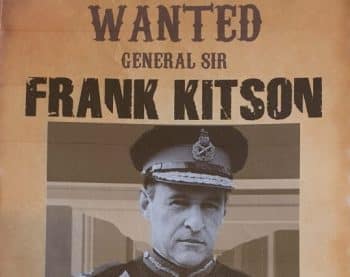
    Alleged disappearance of UVF Bomb Massacre Files: MoD excuse for destruction of Brigadier Kitson's logs is far from convincing. By David Burke.

    On 4 December 8:45 p.m., a UVF gang set out on a bombing mission. One of those involved was Robert James Campbell. The UVF bomb exploded outside a small pub in Belfast called McGurk’s, a cosy place where Catholics and Protestants from the same neighbourhood – all of whom knew each other well – met for a few drinks. The UVF unit left the bomb outside the pub, not inside it. It consisted of forty to fifty pounds of gelignite. It was ignited by lighting a fuse, not a timer. A paper boy saw the UVF car pull up and a man deposit the bomb outside the pub before fleeing. He spotted the fuse sparking and warned the man not to go up the road. According to Robert James Campbell, his unit had originally wanted to attack another establishment which they believed was frequented by the Official IRA and its supporters, but it had two guards posted outside. After waiting for an hour for them to go inside, the UVF unit decided to go elsewhere. They drove to McGurk’s. The British Army had two Ammunition Technical Officers, i.e., bomb disposal experts, circulating around Belfast on standby in case a bomb was detected. They attended at the scene in the immediate aftermath of the explosion.  Because of the darkness and the debris, they were unable to determine the exact location of the detonation. They decided to carry out a further inspection at daylight the next day. Following the daylight inspection, the Army’s 39 Brigade HQ in Lisburn recorded in its Ops Log at 11.10am: “ATO is convinced bomb was placed in the entrance way on the ground floor. The area is cratered and clearly was the seat of the explosion.  The size of the bomb is likely to be 40/50 lbs”. This information corroborated what the paperboy had witnessed. The bomb killed fifteen people, two of whom were children. Another seventeen were badly wounded. The building was demolished. A knowingly and thoroughly dishonest statement was issued stating that the bomb had been brought inside the pub by the IRA and detonated prematurely. The insinuation was that the bar was a safe haven for the IRA to stage operations, and that at least some of the victims were IRA sympathisers. The disinformation charge was led by Frank Kitson. Kitson is still alive. At the time, he was in charge of British military activities in Belfast and its environs. He was also an expert in  counter-insurgency (i.e. dirty tricks, collusive murder, torture and black propaganda). Paper Trail, a charity which helps victims of atrocities such as McGurk’s, has been digging into Britain’s National Archives to try to understand what happened. The work it has undertaken has proven beyond a shadow of a doubt that the bomb was not an ‘IRA own goal’. Aside from a few die-hard Unionist bigots, no sane and respectable commentator bothers to recirculate Kitson’s lies any more. But there is more, a lot more to this scandal, than meets the eye.  Paper Trail uncovered military logs relating to the attack which the Ministry of Defence (MoD) had failed to release when it made other logs available. Happily, the same logs were available elsewhere. Paper Trail submitted a complaint about this development to Britain’s Information Commissioner’s Office (ICO).  The ICO has just announced that it accepts the MoD’s explanation, namely that the relevant logs were in the process of being scanned before allegedly being destroyed and that the crucial logs were accidentally omitted during the scanning process. This explanation is trite. The time has long since passed for a full judicial inquiry. A full breakdown of the Information Commissioner’s conclusion and the evidence unearthed by Paper Trail can be found here: https://mcgurksbar.com/ico-accepts-mod-excuses-for-missing-massacre-files/ The Paper Trail website can be accessed here: https://www.papertrail.pro/ David Burke is the author of  Kitson’s Irish War, Mastermind of the Dirty War in Ireland  which examines the role of counter-insurgency dirty tricks in Northern Ireland in the early 1970s and the template it set for the Troubles. His next book, An Enemy of the Crown, the British Secret Service Campaign against Charles Haughey, will be released at the end of September 2022. Both books can be ordered/purchased here:  https://www.mercierpress.ie/irish-books/kitson-s-irish-war/ https://www.mercierpress.ie/irish-books/an-enemy-of-the-crown/ Other stories about British Intelligence black propaganda operations, dirty tricks, Bloody Sunday, the Ballymurphy massacre, McGurks bar bombing, Brigadier Frank Kitson and Col Derek Wilford on this website include the following:  Bloody Sunday murderers operated a mobile torture chamber. By David Burke. Soldier G – real name Ron Cook – the Bloody Sunday killer with ‘the sadistic edge’ over his ‘partner’, Soldier F. By David Burke. Bloody Sunday: Brigadier Frank Kitson and MI5 denounced in Dail Eireann   The covert plan to smash the IRA in Derry on Bloody Sunday by David Burke Soldier F’s Bloody Sunday secrets. David Cleary knows enough to blackmail the British government. Learning to kill Colin Wallace: Bloody Sunday, a very personal perspective Lying like a trooper. Internment, murder and vilification. Did Brigadier Kitson instigate the Ballymurphy massacre smear campaign? Where was Soldier F and his ‘gallant’ death squad during it? Another bloody mess. Frank Kitson’s contribution to the wars in Afghanistan and Iraq. 300,000 have died in Afghanistan since 1979. Lying like a trooper. Internment, murder and vilification. Did Brigadier Kitson instigate the Ballymurphy massacre smear campaign? Where was Soldier F and his ‘gallant’ death squad during it? A Foul Unfinished Business. The shortcomings of, and plots against, Saville’s Bloody Sunday Inquiry. Kitson’s Private Army: the thugs, killers and racists who terrorised Belfast and Derry. Soldier F was one of their number. Soldier F and Brigadier Kitson’s elite ‘EFGH’ death squad: a murderous dirty-tricks pattern is emerging which links Ballymurphy with Bloody Sunday. A second soldier involved in both events was ‘mentioned in despatches’ at the behest of Kitson for his alleged bravery in the face of the enemy. Mentioned in Despatches. Brigadier Kitson and Soldier F were honoured in the London Gazette for their gallantry in the face of the enemy during the internment swoops

    Loading

    Read more

  • Posted in:

    SECOND UPDATE: The Irish government has become complicit in the cover-up of British Royal sexual abuse committed in the Republic of Ireland. By David Burke.

    1. The Classified Garda Files. The information provided by the brothers, John and Pat Barry, confirms that the Garda (Irish police) had a checkpoint at the gate of Classiebawn castle in August 1977. Garda security appears – by some accounts – to have been downgraded in 1979, shortly before Mountbatten was murdered by the Provisional IRA. Hence, while there might be a question mark about the existence of comprehensive Garda logs from 1979, there are no concerns about August 1977. The Classiebawn logs are the key to unlocking the sordid Kincora scandal. Boys from Kincora Boys’ Home in Belfast were trafficked to Mountbatten by Joe Mains, an MI5/6 agent who worked at Kincora. The same boys were trafficked to Loyalist paramilitaries and politicians by Mains as part of MI5 and MI6 ‘honeytrap’ blackmail operations. The Garda have shown no interest in the information at their fingertips. As far as can be told, the Government has displayed no curiosity either. The survivors of child sexual abuse deserve better. 2. Confirmation of a Garda checkpoint at Classiebawn. While the Barry brothers set out to defend the reputation of Mountbatten in their Sligo Champion interview – and did so in good faith – they have nonetheless highlighted a crucial issue about the Mountbatten-Kincora connection. It is one which could yet prove precisely the opposite of what they hoped to achieve with their interview. There is no doubt now that the Garda have a record of the registration plates of the vehicles they stopped at the gates. The existence of the Garda checkpoint was already an established fact, nonetheless, the confirmation by the Barrys is important as they  are living witnesses who can attest to its presence. It would now take a very daring – not to mention corrupt – Garda or Department of Justice official, to interfere with the files. The purpose of the interview with the brothers was to afford them an opportunity to put forward a defence for Lord Mountbatten whom they do not believe was a child abuser. John Barry, who was a boy at the time, made specific reference to a Garda ‘checkpoint’ and also that: “The guards wouldn’t have allowed some guy to come, a warden from Kincora [Boys Home in Belfast] who was supposed to have driven [child abuse victims to Classiebawn], and he was supposed to sit in the car for an hour outside the castle and let the boys in – or a boy in. And you think the guards wouldn’t have asked: ‘What are you doing here?’ No way”. His brother has confirmed the presence of Gardaí at the ‘checkpoint at the gate’. 3. Times and dates. In 2019 Andrew Lownie, author of a book about Mountbatten, sought the Garda logs taken at the checkpoint. Crucially, while the Gardaí refused to declassify the files, they nonetheless confirmed they were still in existenc.  See:  THE MOUNTBATTEN FACTOR: Boris Johnson should not bully Dublin over Brexit because the Irish Government has information which could damage the Royal Family What will the records reveal? In August 1977 Stephen Waring and another boy were abused by Mountbatten in an exterior building. They gained access to the grounds in a car which was driven through a Garda checkpoint. Waring took his own life the following November. See: SECOND UPDATE: Kincora boy abused by Mountbatten committed suicide months later. The Garda logs should contain the date and the arrival time of the car that brought Waring and the second boy through the gates of Classiebawn. They should also reveal when they left, along with the make, model and registration of the vehicle in which they were trafficked. 4. Liaison with the RUC The Kincora boys were driven to Classiebawn by Joseph Mains, the Warden of Kincora in August 1977. As a matter of routine, the registration plate of the car driven by Mains to Classiebawn would have been noted and logged. Next, the Gardaí would have sent them to Garda HQ. Then inquiries would have been made with the RUC. The RUC knew that Mains had connections to the Red Hand Commando (RHC), a Loyalist terrorist group. The Garda inquiry about the visit by Mains to Classiebawn would have raised a red flag. A senior RUC special branch officer would have taken control of the request. It is inconceivable that the Gardaí would have been told about Mains’ links to MI5/6 or the RHCs. The RUC special branch was complicit in the ‘honey trap’ operation that revolved around Kincora. Hence, the RUC undoubtedly told the Gardaí there was nothing to worry about insofar as the car driven by Mains was concerned. The RUC may even have expected a call from the Gardai and were ready for it. Rumours about Mountbatten’s involvement in the abuse of Kincora boys have circulated in security circles in Northern Ireland for decades. The Garda request about the visitor to Classiebawn in August 1977 may be at the root of the gossip. 5. A report on Mains may reside in Garda files at its Phoenix Park HQ in Dublin. The Garda inquiries that took place after Mountbatten was murdered on 27 August 1979, reached back to 1974. All of those who came into contact with him formed part of a massive inquiry. All of those who visited Classiebawn were investigated. A short report on Joe Mains may very well have come into existence as early as September 1979. Indeed, a record of his identity may have existed since his visit in August 1977 (and perhaps other visits in the 1970s). The Kincora scandal did not erupt until January 1980. Thus, when the Gardaí were making inquiries with the RUC in 1977 and/or 1979, about the car Mains drove to Classiebawn in 1977, there was no particular need to conceal his name, at least insofar as Kincora was concerned. The RUC hardly anticipated that Mains would become known as a child abuser in 1980. Mains was convicted of child abuse in December 1981. 6. 60 years

    Loading

    Read more

  • Posted in:

    The constitutional status of the Irish language in a United Ireland. By Dáithí Mac Cárthaigh.

    Irish is experiencing a period of growth in its official use. It is a full official and working language of the European Union since 1 January 2022. Every regulation, directive and decision of the EU is now enacted and published in Irish at the same time and with the same status as the versions in the other 23 official languages of the Union, from world languages such as English, French and German to the languages of small nations such as Maltese, Estonian and Latvian. At national level, the Official Languages Act has been amended and the amending legislation signed into law by the President. The most noteworthy amendments provide that at least 20% of new recruits to the public service will be competent in Irish by the 31 December 2030 and that public services will be provided in Irish in Gaeltacht areas. At least 20% of public bodies’ advertising will be in Irish and at least 5% of their advertising budgets spend on Irish language media. Public bodies will facilitate the use of the síneadh fada. Bilingual logos, bilingual forms and bilingual advertising materials will be rolled out for public bodies. Protocols or ‘standards’ will be set in relation to services to be provided in Irish by public bodies, including services provided on their behalf by private agencies. Long-promised language legislation is being enacted at Westminster for Northern Ireland which will establish the office of Irish Language Commissioner and language standards for the provision of public services through Irish. In this context of growth, one must be watchful to ensure that the official status of Irish is safeguarded under any new constitutional arrangement. The status of Irish is secure at EU level and must be reproduced domestically. In the context of a united Ireland, the protection of minority rights will be very much to the fore, including the rights of Irish speakers. In relation to protecting linguistic minorities, Canadian constitutional law and language legislation, in particular the Canadian Charter of Rights and Freedoms provides a useful exemplar. This is set out and discussed below. Irish as the Premier Official Language From the foundation of the State, Irish is established as the national language of the country and from 1937, with the enactment of Bunreacht na hÉireann, as the first official language because it is the national language. There is a divergence between the Irish and English texts of Article 8.1. In cases such as this, the Irish version, under Article 25.5.4°, prevails. In the English version Irish is the “first official language”. In the Irish version it is the “príomhtheanga oifigiúil”  i.e. the premier or main official language. It matters not that this is more honoured in the breach than the observance. Very few laws are constantly observed but this does not nullify the constitutional imperative which flows from Article 8.1. Consider that equality as between citizens was guaranteed from 1937 by Article 40 of the Irish Constitution, but that the marriage-bar which obliged women to resign from state employment in the event that they married persisted until 1973 and that discriminatory practise was only ended under the shadow of European law. Similarly, it is because of this constitutional status and the constitutional imperative which flows from it that any victory for Irish language rights has been secured in the Courts. Anyone who proposes a reduction in the status of the language does not have the good of Irish at heart or is unfamiliar with the caselaw. The Constitution of the Irish Free State 1922 Article 4 of the 1922 Constitution provided as follows: The National language of the Irish Free State (Saorstát Éireann) is the Irish language, but the English language shall be equally recognised as an official language. Nothing in this Article shall prevent special provisions being made by the Parliament of the Irish Free State (otherwise called and herein generally referred to as the “Oireachtas”) for districts or areas in which only one language is in general use. A derogation from official bilingualism was permitted at the end of Article 4 “to provide for the contingency of the entry of Northern Ireland into the Free State” according to Kohn The Constitution of the Irish Free State (London 1932), p. 124. This, of course, is being superseded by the aforementioned UK language legislation for the North. Language matters are also discussed in Article 42: As soon as may be after any law has received the King’s assent, the clerk, or such officer as Dáil Éireann may appoint for the purpose, shall cause two fair copies of such law to be made, one being in the Irish language and the other in the English language (one of which copies shall be signed by the Representative of the Crown to be enrolled for record in the office of such officer of the Supreme Court as Dáil Éireann may determine), and such copies shall be conclusive evidence as to the provisions of every such law, and in case of conflict between the two copies so deposited, that signed by the Representative of the Crown shall prevail. There are a number of ways to read this provision. According to Hugh Kennedy, the first Chief Justice, in the case of Ó Foghludha v. McClean [1934] I.R. 469 bilingual enactment is implied by this Article: It is not for me here and now to express any opinion as to whether each Act should not have been enacted at the same time in the Irish language (as seems to be suggested by Article 42 of the Constitution). No doubt an Irish translation of each Act has been prepared subsequently and published officially but such translation has no effect as legislation, there being no power under the Constitution to delegate the legislative power of the Oireachtas to a staff of translators. I may add that legislation in two official languages concurrently is the settled practice elsewhere. The learned Chief Justice referred in particular in support of this contention to the practice of bilingual enactment in other

    Loading

    Read more

  • Posted in:

    'I AM NOT NUMBER 54'. By Christopher Stanley.

    “Two babies from one family, ‘gone’: Tusla unable to locate records despite ‘extensive’ search” — thejournal.ie 2 August 2022 Every day I receive at least one – and sometimes two or three – Google Alerts relating to ‘Irish Mother and Baby Homes’ [1] This edited collection of essays was published on 21 May 2022. On 27 July 2022 the Irish government approved a proposal to establish an independent office to lead an intervention at the site of the former Mother and Baby Home in Tuam. The intervention will involve the excavation, recovery, analysis, identification (if possible) and re-interment of the children’s remains located at the site. On the same day the United Nations Human Rights Committee published its report on Ireland noting “While welcoming the State party’s efforts to address and memorialize the past human rights violations and institutional abuse of women and children in the Magdalene laundries, children’s institutions, and mother and baby homes, as well as the State party’s recognition of its shortcomings in previous actions, the Committee recalls its previous concerns on the climate of impunity.” A climate of impunity and collusion which continues to demand intervention by way of an independent human rights compliant investigation and full disclosure of all records in order to ventilate the right to truth so wanted by so many women and children. [2] Including Number 54 – Mary Harney – who is not ‘pig’ , who is not ‘smelly pig’. Mary Harney born Bessborough Mother and Baby Home, not ‘eligible’ to be trafficked to America, illegally fostered then sentenced to twelve and a half years in the Good Shepherd Industrial School (pages 3 -4). Mary Harney who still waits for truth, justice and accountability which, to take W. B. Yeats out of the context of peace, comes ‘dripping slow’. [3] “We did not just hide away the dead bodies of tiny human beings, we dug deep and deeper still to bury our compassion, our mercy”- (Enda Kenny 18 March 2017 quoted at page 43) Christopher Stanley reviews “Redress: Ireland’s Institutions and Transitional Justice edited by Katherine O’Donnell, Maeve O’Rourke, James M Smith Five years on women and children still wait for the burial of Irish compassion to be exhumed and examined in the ways urged by the UN Human Rights Committee in accordance with human rights standards demanded by both ‘hard’ law and ‘soft’ justice – from criminal process to transitional justice – through police and coronial investigations, through disclosure of information to establish identity (page xi) and to establish a public record of truth, an inalienable human right – to know why. [4] This edited volume of essays is a valuable contribution to that truth-seeking process and how the right to truth can inform redress in a scheme of transitional justice (from darkness to light). In their Introduction, the Editors describe the genesis of this project by way of a two day conference at Boston College where different voices spoke on and were heard on the subject of ‘Reconciliation, Truth-Telling and Institutional Abuse in Ireland’. These were the voices of ‘scholars, policy makers, survivors, people affected by adoption, artists and advocates’ (page xiii). The voices of the survivors have so often to date been excluded from or silenced by the processes established by the state agencies (South and North) – the very agencies of truth-seeking that should have served to facilitate hearing those voices and enabling them to ask questions, to interrogate those responsible (civil servants, local councillors, clerical officials, bishops, law officiers, ‘sisters of mercy’ and others), to give their accounts of systemic abuse and suffering that was the evil of these institutions and processes (symphysiotomy, forced adoption, unlawful clinical trials, trafficking, illegal fostering, slave labour, disappearence) constituting Ireland’s crimes against humanity. [5] This is a compelling collection of essays, testimonies, analysis and interrogation. It is at times both intensely emtoional, as you would expect from the territory on which it reports, and intensely theoretical. The balance between the voices is  right. It is compelling because of the scope of the territory: from the loss and denial of identity of the survivor of institutional abuse, to the empty rhetorical gestures of state and church, to the manipulation of the public narative, to the closure of access to truth through the politics of information and the play of slippage of responsibilities. Then and Now. The volume is divided into seven conherent sections – truth-telling, law and (in)justice, transitional justice, adoption, children in state care, the Magdalene Laundries, the archive. The authors are survivors, artistists, lawyers, academics. Some of the material has been previously published but is now usefully collected together creating a ‘source book’ for further activisim and reflection on redress. Those turned to in these essays include Seamus Heaney, James Joyce, Sophocles Antigone, Giorgio Agamben, Jacques Derrida, Michel Foucault,  Gillian Rose. Perspectives are provided from contemporary thinking around the idea of the archive, the nature of archeology and preservation, historiography and epistemology. For example, Joyce’s Dubliners is deployed to interrogate institutional abuse in a Protestant setting. Heaney on poetical redress powerfully provokes thought on the shape of redress for survivors. Agamben is drawn upon in terms of shame and the collapse of the ‘sovereign self’. Gillian Rose’s thesis The Broken Middle describes social ruptures that cannot be repaired – the cleaving of Ireland – now a Potters’s Field (to apply Rose in a different voice) or cillíní. And always the figure of Antigone so oft drawn upon when considering the fate of Ireland, its women and children. To conclude: for Ireland this collection and the continued out-workings of the tragedy of abuse is a work in progress, a work to inform policies to secure redress, a work to enable access to justice, a work to prise open the vault that is the archive of truth, a work to establish identity and to continue to give voice after the violence of the imposed silence of the abused; both by the ‘sacred’ and the ‘secular’ – the forces of church

    Loading

    Read more

  • Posted in:

    FFilthy Lucre

    How it started:  A Fianna Fáil TD appearing on the national platform as low-key, unimpressive to the point of being insipid, and just a bit greasy.  Yet this TD has the good fortune to own a residential property in Dublin City – that he himself doesn’t use, despite working in Dublin as a TD and Minister of State at the Department of Enterprise, Trade and Employment.  He opts for other arrangements, perhaps commuting from his constituency of Longford-Westmeath, or availing of hotel accommodation within Oireachtas expenses provisions for elected members.   This apartment is occupied by a tenant, therefore providing Robert Troy rental income, Case V, for tax purposes.  Perhaps to assist with a mortgage payment, as Leo Varadkar himself might assume. The circumstances still make this TD and Minister of State the owner of an investment property for MARP / Mortgage lending regulations and enforcement, and a landlord requiring registration  – and therefore regulation by the State through its Residential Tenancies Board. In addition to this rental asset, Troy has a separate business of property development, which is currently developing the site where this rental asset is located into new build residential units that have already been sold ‘off plans’ as it were. This makes residential property for investment a commercial activity for Troy alongside his day job as a TD, which is boosted by being appointed a Minister of State in the 32nd Government of Ireland. I’m sure you can see that Troy has not your everyday Form 11 return, and has interests to declare as a condition of him being a member of the Oireachtas. Here I add that Troy acquired a residential property from the Criminal Assets Bureau.  The CAB themselves are required to ensure they sell off assets seized by High Court order to purchasers whose affairs are in order.  Comprehensive due diligence would be required as to the source of the funds being used, to avoid money laundering: was it earned legitimately, for example, and is it tax compliant?   The CAB may also require Garda Vetting before engaging in a material transaction with an individual.  If it doesn’t, let’s now suggest that they should.  Here’s why : what if the purchaser of an asset being disposed of by CAB has unpaid fines, or is the subject of a bench warrant? Both the CAB solicitors and those representing Troy would also be obliged to confirm the buyer was 100% compliant with all forms of AML and Tax and Rates regulations before proceeding to complete the conveyancing and close the sale. Even more so in this case, as this property was subsequently sold for a profit by Troy back to another wing of the State for the use of social housing – a wing of the state where he was in a governance position, immediately presenting a risk of influence.  As the property was to be used as social housing, it needed to be inspected by housing officers to ensure the property was suitable, as well as surveyed and independently valued.  The regulatory framework for Social Housing also requires that housing officers confirm that there is a need for that particular type of property in the area.  All this is prepared as a type of purchase order request that gets submitted to the Housing Agency for approval to then acquire the property for the local housing department in Westmeath County Council – who, as it happens, must also complete an independent valuation. For the sale to proceed, council finance staff would be required to complete standard diligence checking before being set up as an approved supplier to the Local Council, typically the provision of a valid TC1 and that his source of funds were legitimately earned, perhaps ID confirming residential address, and a simple credit check to ensure he has no outstanding bills with the Council; refuse charges, for example. As Troy was a councillor serving in this local Council chamber, additional checks and balances would be required before entering into a commercial arrangement with an elected member of its Governance Level.  Was it good value for taxpayer money?  What oversight did the Finance Committee of the Council have, likewise the Housing and Budgetary Committees, and what approval process did the County Manager complete to ensure  proper procedures were observed at all times? Standard checks and balances. With this level of activity in property trading, and very successful trading, it most certainly meets the definition of trading.  Therefore subject to Income Tax and not a matter of Capital Gains Tax on the occasional one off / windfall events. When an official accepts a nomination to run for election and submits their candidacy to the appointed Returning Officer, they immediately commit to fitness and probity regime with their signature.  That is a promise that gets underpinned with their Declarations to SIPO.  There can be no errors. Otherwise applying that signature is worth nothing, and has the same reliability as a forgery. Applying his own signature brings with it a promise of integrity, and to uphold the best interests of his constituents and the State, over his own at all times.  That’s governance. Errors and lapses in memory must come with significant sanctions, the type that make banks weep. Troy should have conducted due diligence on himself before accepting the role of Minister of State from his party leader, Taoiseach Micheal Martin, as he promised he was a person of exceptional ethical standards and watertight compliance.  He can never be trusted to sign any Government document or legislation because he has put his own seal in doubt. He has no excuse.  Neither do all the regulated lines of defence for the taxpayer all along the way from his first day as a local councillor. Which makes the questions we now pose, in response to the latest Ditch report on that failed transaction between Troy and his business and Westmeath County Council for four additional residential units for the purposes of social housing, all the more cynical.

    Loading

    Read more