Posted in:
A menace in the District Court
Village names a retired judge who pursued a woman who appeared before him in family law proceedings
Posted in:
by admin
Village names a retired judge who pursued a woman who appeared before him in family law proceedings
by admin
Bad policies lead to bad results
by admin
The Blueshirt who has inherited the most distinguished legal pedigree but lies about his background, worked for Big Tobacco and as a Commercial Lawyer, and broke electoral law
by admin
Irish Times reviews of RTE Radio 1 are as dull as the reviewees
by admin
By Sean Brennan. I have just read the article in the Sunday Independent [20 June] concerning whether RTE contacted Des O’Malley first while the station was producing the GunPlot series. It is the second article which the Sunday Independent has produced about the issue. The earlier one – written by Des O’Malley – appeared on 13 June. The article in today’s Sunday Independent [20 June 2021] concerns RTE’s apology to O’Malley and his family over a statement it issued last week about who made the first move to establish contact. This is truly a case of a very minor issue being blown up out of all proportion. It hardly undermines the quality and brilliance of the GunPlot series. One thing is absolutely clear now: it is not correct to say – as Des O’Malley claimed on 13 June – that RTE “never attempted to contact” him. Even as he says himself, his son talked at length to the producers on his behalf. O’Malley seems upset that he was not approached before the GunPlot podcasts were broadcast. However, they were aired over nine weeks. Hence, there was plenty of time to make contact with O’Malley as they rolled out. Surely O’Malley does not think he can dictate when he should have been approached? Surely the producers should be able to dictate their own pace? I have spoken to David Burke, author of a recent book on the Arms Crisis. He featured heavily in episode 8 of the podcast series (about the two Arms Trials). He was not interviewed until after episode 6 had been broadcast. (Some quotes from him in the earlier podcasts were taken from a lengthy interview he gave for the TV version of GunPlot. The TV interview was recorded earlier in the year.) Overall, O’Malley’s complaints are bewildering. He has spent well over 40 years dodging questions about the Arms Crisis. So why does it matter how contact between him and RTE was established: he was never going to answer the hard questions which he has been ducking for decades. In December 1980 Vincent Browne, the editor of Magill magazine, raised a number of issues about the Arms Crisis which involved O’Malley. Browne wrote: “Magill attempted to have Mr. O’Malley explain his side of this story for the July [1980] issue but he declined to speak to us. The offer of space to state his case is still available.” O’Malley’s silence in the interim has been deafening. In his Sunday Independent article of 13 June, O’Malley gave the impression that he has always been open about his knowledge of the scandalous series of events that surround the Arms Crisis; moreover, that he was ever willing to share it if only asked. Further, that there was a malign conspiracy at RTE to censor him. Will he now agree to do a fullscale interview for an additional episode of the GunPlot podcast? Is he now finally prepared to answer any and all questions? Will he answer the questions Magill raised over 40 years ago? Will he now agree to do a fullscale interview for an additional episode of the GunPlot podcast? Is he now finally prepared to answer any and all questions? Will he answer the questions Magill raised over 40 years ago? Des O’Malley declined to be interviewed by RTE in 2021 on the grounds of ill health. (It has presumably passed because he is now capable of writing at length for the Sunday Independent.) Yet, while in good health, he spent decades avoiding the hard questions about the Arms Crisis. The process began in earnest in 1980 after Magill magazine described two meetings he had had: one with Charles Haughey and a second one, after it, with Peter Berry of the Department of Justice. They will be examined in detail later in this article. O’Malley has failed to answer questions raised by Vincent Browne in that edition for over 40 years. In the meantime, other questions have arisen for O’Malley to answer. None of them have been addressed by him. O’Malley failed to raise and answer the difficult Arms Crisis questions in 2001 during a four-part TV series broadcast on RTE which was dedicated to his life. He also had an opportunity to put what he knew about these events in his 2014 memoirs. Instead of a thorough analysis, his book was a huge disappointment to historians who attacked it for its lack of real content. Now, he is jumping on utter trivia about who rang whom first instead of answering the really important issues about this monumental scandal. Now, he is jumping on utter trivia about who rang who first instead of answering the really important issues about this monumental scandal. Village has published a number of articles concerning Des O’ Malley’s role in the events in 1970. These articles included a number of matters which Village believes have not been addressed and satisfactorily answered by O’Malley concerning his role and actions in 1970. See: Ducking all the hard questions. Des O’Malley has vilified an array of decent men and refuses to answer obvious questions about the Arms Crisis and the manner in which the Provisional IRA was let flourish while he was minister for justice. See also: The ‘Last Man Alive’ is still saying nothing. Des O’Malley’s silence about his role in the Arms Trials and Arms Crises of 1970 has become thunderous. And: Vilification Once More For the sake of clarity, I will summarise some of the more important questions which Des O’Malley needs to answer, starting in the next section. Please also note that extracts from the December 1980 edition of Magill which addressed the O’Malley-Haughey and O’Malley-Berry meetings are reproduced at the end of this article. A letter by author Michael Heney to the Sunday Independent is also reproduced towards the end of this piece. Mr Heney was replying to O’Malley’s article of 13 June last. Army Directive dated 6 February 1970. This directive documented an order which was given by the Minister for Defence,
by admin
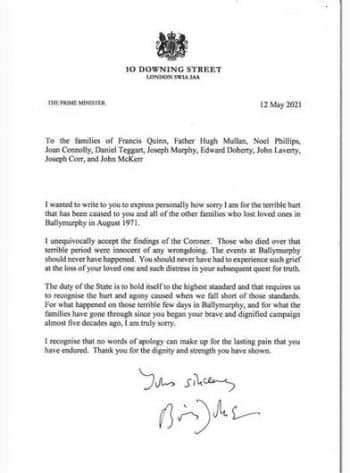
By Christopher Stanley, Litigation Consultant, KRW LAW LLP, Belfast* [i] In the last six months victims of violent abuse in Ireland have been ‘granted’ apologies. First, the Irish Taoiseach apologized to the victims and survivors of the Mother and Baby Homes. Writing in The Independent on 14 January 2021 Emer O’Toole noted: “On Wednesday, the Irish Taoiseach issued an apology to survivors, saying, rightfully, that “the shame was not theirs; it was ours”. While this state apology is important, the Taoiseach’s speech historicises the lack of respect for the dignity and rights of survivors. This trend continues across Irish political discourse, where emphasis is on closing a dark chapter in Ireland’s history. But survivors of Mother and Baby Homes and Irish adopted people are still not being listened to. They are still being denied their rights.” Second, the British Prime Minister apologized to the relatives of the victims of the Ballymurphy Massacre 1971 in which British troops shot and killed 11 civilians. Writing in The Irish Times on 25 May 2021 Sarah Burns reported that the families of the victims described the apology as “feeble and insincere”. It is widely believed, at least by the media and victims, survivors and relatives, that these apologies were hollow, weasel words, granted too late, absent of understanding, integrity or meaning. Words mouthed by politicians to an empty audience, as a gesture of apparent humility, amounting to nothing save for a ritual of vacant contrition. In terms of the violent legacy of systemic institutional abuse in Ireland (South and North) and the violent legacy of the Conflict (North and South) the apology for historic actions and inactions, acts and omissions, collusion and complicity and impunity by the State, is part of the State-sponsored system/process of Truth and Reconciliation. A societal Truth and Reconciliation process is an aspect of ‘moving on’ from the scene of violent incursion and of suturing a social wound so that such violations and breaches (of the social contract, of human rights) cannot be repeated. We Promise. Trust Us – we apologized to you. Truth and Reconciliation: Soft (Transitional) Justice. If there is a right to truth it must be a right to know why. Why was my body broken? Why was my baby forcibly removed? Why was my mammy shot by a British soldier? Why was my husband executed by the British state? This is not a Soft Right but rather it is a Hard Truth for those responsible, for those being held. “But it did not happen on my watch” says the Politician, the Civil Servant, the Bishop, the General. Therefore, the words of apology fall upon deaf ears. I reject your apology. I cannot forgive you. Is this wrong? Does it make the victim lesser than the abuser? [ii] The Oxford Reference website entry for the word ressentiment is as follows: “A vengeful, petty-minded state of being that does not so much want what others have (although that is partly it) as want others to not have what they have. The term, which might be translated as ‘resentment’, though in most places it is generally left in the original French, is usually associated with German philosopher Friedrich Nietzsche, who defined it as a slave morality. Nietzsche sees ressentiment as the core of Christian and Judaic thought and, consequently, the central facet of western thought more generally. In this context, ressentiment is more fully defined as the desire to live a pious existence and thereby position oneself to judge others, apportion blame, and determine responsibility.” (Ressentiment – Oxford Reference last accessed 11 June 2021) In psychological terms ressentiment is a profound sense of resentment, frustration, and hostility directed at that which one identifies as the cause of one’s frustration, generated by a sense of weakness/inferiority and feelings of jealousy/envy in the face of the ’cause’, that ultimately generates a rejecting/justifying ‘value system’ or morality that exists as a means of attacking or denying the perceived source of one’s own sense of inferiority. (Ressentiment last accessed 14 June 2021) Ressentiment is not resentment but rather a philosophical, ideological and psychological condition. It is the suffering of not understanding, the suffering of being located within a victim-hierarchy, and the suffering of not being able to forgive because of perceived self-weakness because I suffered. [iii] In the jurisprudence on the definition of torture (upon which there is an absolute prohibition) there is an important distinction between torture and inhuman and degrading treatment because of the stigma attached to torture. The victim of torture becomes stigmatized or scapegoated because they are the victim of torture. The victim of torture cannot escape the scar imposed upon them and the violence inscribed upon their flesh. [iv] Kafka describes the infliction of punishment as the crime is inscribed upon the flesh of the body of the condemned in his short story In The Penal Colony: “Yes, the Harrow,” said the Officer. “The name fits. The needles are arranged as in a harrow, and the whole thing is driven like a harrow, although it stays in one place and is, in principle, much more artistic. You will understand in a moment. The condemned is laid out here on the Bed. First, I will describe the apparatus and only then let the procedure go to work. That way you will be able to follow it better. Also, a sprocket in the Inscriber is excessively worn. It really squeaks. When it is in motion one can hardly make oneself understood. Unfortunately, replacement parts are difficult to come by in this place. So, here is the Bed, as I said. The whole thing is completely covered with a layer of cotton wool, the purpose of which you will find out in a moment. The condemned man is laid out on his stomach on the cotton wool—naked, of course. There are straps for the hands here, for the feet here, and for the throat here, to tie him in securely. At the head of the Bed here, where the man, as I have mentioned, first lies face down, is this small protruding lump of felt, which can
Posted in:
by admin
Des O’Malley, the Minister for Justice in 1970, continues to ignore the hard questions about the Arms Crisis. Instead, he persists in smearing anyone who dares to disagree with him. Some of his latest slurs question the integrity of those in RTÉ responsible for the ‘GunPlot’ series. It is now time to stop throwing the mud and answer the hard questions. By Sean Brennan. Introduction I have just read in the Sunday independent Des O’Malley’s article about GunPlot, the RTE television documentary on the Arms Crisis 1970 and the RTE Radio Podcast Series. Des has a problem in accepting the truth, particularly when the truth contradicts Des’s preferred narrative. The big lie as propagated by Jack Lynch and Jim Gibbons about what happened during the Arms Crisis in 1970 has finally been definitively nailed and, unusually, history has been rewritten. The purpose of the lie was to protect Jack Lynch’s position at all costs. Des O’Malley has given oxygen to this false narrative for the last 50 years. His article in today’s Sunday Independent is no surprise. O’Malley has made a career out of maligning decent men. He often does this in a cowardly way, waiting until the person to be maligned has died. O’Malley’s article today is practically the same as the article which he wrote on 27 September 2020. Both articles contain no evidence to support O’Malley’s assertions and are based purely on bluster and spoof. In contrast to O’Malley’s article, my article below contains incontrovertible documentary evidence from State papers that were hidden and suppressed by the State from the Arms Trials in 1970. RTE did invite Des O’Malley to participate in GunPlot. One of O’Malley’s claims in the Sunday Independent is that he was not asked to participate in GunPlot by RTE. RTE have just issued a statement which reveals he was invited but declined, instead nominating his son Eoin to talk on his behalf. Perhaps if he been man enough to face the cameras, he would have featured heavily in the TV broadcast and podcasts. However, that would also have meant he would have had to answer all the hard questions. According to the RTE statement: “The truth matters. And the truth is that RTÉ did make contact with Des O’Malley to ask him for an interview for the series. Des O’Malley declined to be interviewed by us and nominated his son Eoin to take part in the series in his place. The truth does matter.” Complete silence about O’Malley’s secret meeting with Charles Haughey. What might RTE have asked O’Malley? I wrote an article for Village Magazine on 17 April 2021, titled “The ‘Last Man Alive’ is still saying nothing. Des O’Malley’s silence about his role in the Arms Trials and Arms Crisis 1970 has become thunderous”. The ‘Last Man Alive’ is still saying nothing. Des O’Malley’s silence about his role in the Arms Trials and Arms Crises of 1970 has become thunderous. In my article I raised many very important questions for Des O’Malley to address but he has failed to reply. The most serious one concerns his secret meeting with Charlie Haughey just two weeks before Haughey stood trial for criminal conspiracy and sedition in the biggest criminal trial that this country has ever seen. Here we had the Minister for Justice meeting a man who stood accused of the most serious crimes surreptitiously, to discuss the evidence that a prosecution witness was to give at the forthcoming trial. Until O’Malley addresses our concerns as to why he met Charlie and what they discussed and why he forwarded Charlie’s requests to the witness, Peter Berry, the Secretary of the Department of Justice, there will be questions over O’Malley’s character. Haughey’s request was to ascertain whether Berry could be induced or intimidated or persuaded to change his evidence to suit Haughey’s case. There was also a subtle threat that Berry would be roasted while in the witness box by a particularly aggressive and brilliant lawyer, Seamus Sorohan. The fact that Berry said that O’Malley was biting his knuckles when he was relaying Charlie’s request to Berry would suggest that O’Malley was nervous. The question is: why was he nervous? Berry also said that he felt nauseated by the fact that O’Malley was pretending to Haughey that he was Haughey’s friend. Berry also said that he felt nauseated by the fact that O’Malley was pretending to Haughey that he was Haughey’s friend. What I cannot get over is the fact that O’Malley was prepared to meet Haughey behind Jack Lynch’s back. This was a disloyal and deceitful thing to do to someone who just four months earlier had promoted O’Malley to ministerial ranks. With friends like that who would need enemies? The arms importation operation was not ‘illegal’. Des O’Malley says that RTE put a gloss on the crisis that the then-Taoiseach Jack Lynch was somehow involved, that he knew all about the plot to import arms “illegally”. The jury at the Arms Trial held that the plot was not illegal. What is undeniable is that Lynch knew of the plan to import arms legally as follows: Berry told Lynch in Mount Carmel in October 1969 about the meeting in Bailieboro which was attended by Captain Jim Kelly and citizens from the North, and during which the plan to import guns was first discussed. Lynch confirmed the fact that Berry told him of this meeting to Jim Gibbons who was the Minister for Defence. Gibbons informed Colonel Hefferon of what Lynch told him. Casting doubts over Ben Briscoe While David Burke was carrying out research for his book on the arms crisis, ‘Deception and Lies, The Hidden History of the Arms Crisis 1970’, he spoke to Ben Briscoe, who was a friend of Jim Gibbons and George Colley. Briscoe told Burke, and later confirmed to the RTE Gunplot Podcast team, that he knew about the arms-importation operation months before the Arms Crisis erupted and that when the attempt to import the arms was
Posted in:
by admin
Reviewing the history and likely future of the National Parks and Wildlife Service as Minister of State for Heritage Malcolm Noonan announces a major review

Posted in:
by admin
Lockdown boom for Online Gambling poses dangers of invitations to lodge ever more money and sneakily changed stakes
by admin
By Dónal Lavery. I have been working on a book-in-progress about the issue of the Kincora Boys Home scandal involving undisclosed sexual abuse and exploitation. Part of that exploitation included victims being sent to live in the US at the behest of powerful abusers with salient influence. A Northern Protestant, Richard Kerr, was taken into the social services system at the age of 8 years old and shortly thereafter began to suffer mass sexual abuse in various state institutions while also being sent to hotels and other venues to be raped by prominent men. Amongst the paedophiles in the ring in which he became entangled was Lord James Molyneaux, Enoch Powell MP, Doctor Morris Fraser, Lord Mountbatten and the infamous lawyer to Donald Trump, Roy Cohn. These were people with real sway and clout in society, here and abroad. They were protected by the state via the Intelligence Services and their exposure was legally barred on grounds of “national security” in various instances. Essentially, they were practically “untouchable”, and could literally get away with all sorts of serious crimes without bearing the consequences that would befall the average citizen. Now that some are dead and others are withering away in the shadows, victims and survivors feel able to speak out. Scores of millions of Americans identify as Irish by extraction due to what the British did to our island – forcing many Catholics and Protestants to leave to make a life for themselves in the USA. When I get off the plane and meet people from various Irish American groups, they are always warm, interested and so accommodating. There is a deep and lasting affection in them for their indigenous European ancestors and homeland as it forms a core part of their identity as the “exiled children” of an ancient nation. Nobody can forget who they are and where they come from. Having reflecting on that, I made a phone-call out of the blue to Father Sean McManus, the President of the Irish National Caucus, in Washington, to discuss the Richard Kerr case. He was already familiar with it from reports in Village magazine and listened very attentively. I provided him with more detail and various records and documents. Then, in true ecumenical manner, he pledged his fullest support for acquiring justice for Richard. This developed into regular communication with both Father Sean and Barbara Flaherty (the Vice President of the Irish National Caucus in Washington), both of whom have worked on many cases of human rights violations concerning the conflict in the North of Ireland. In fact, when no Unionist politician would come to his assistance, Father Sean and Barbara took up the case of Raymond McCord (a Belfast Protestant) and the collusion by the British state in his son’s tragic death. This included inviting McCord to the US and gaining him access to many seminal players in the greatest power-sphere known to man; raising vital awareness of the injustice he has suffered and putting pressure on the British government. The problem of course is that justice is not a single destination but a process. It does not possess a straightforward path, and takes many twists or turns along the way. Successive British government inquiries and police investigations have failed to adequately probe the actions of personnel within MI5 who collaborated in this abomination at Kincora towards children. Minors were sacrificed on an “altar” of expediency over those “wolves” with disgusting ‘appetites’, enhancing the trauma further. Successive British government inquiries and police investigations have failed to adequately probe the actions of personnel within MI5 who collaborated in this abomination at Kincora towards children. Minors were sacrificed on an “altar” of expediency over those “wolves” with disgusting ‘appetites’, enhancing the trauma further. I hope that with the support of those with a direct link to Congress and human rights groups internationally, Richard will be able to bring world attention to one of the most horrendous crimes ever perpetrated against young boys. Undoubtedly, this campaign will come up against obstacles, whether it be the British Embassy, Intelligence Services or Unionist political intrigues. While I am no fortune teller, one thing is for sure – the Richard Kerr case will not be going away. OTHER STORIES PUBLISHED BY VILLAGE See: Trump’s mentor: another sociopathic paedophile child-trafficker in the mix; from Roy Cohn to Epstein and Maxwell. See also: The Anglo-Irish Vice Ring. Chapters 1 – 3.
Posted in:
by admin
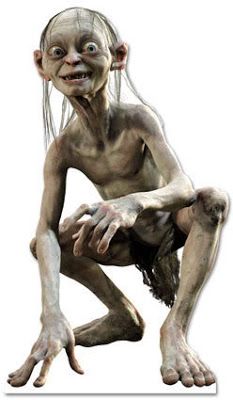
THE STONE WAS MOVED AND DOMINIC CRAWLED OUT By Christopher Stanley So, we have this sort of completely insane situation in which part of the building was saying, ‘are we going to bomb Iraq?’, part of the building was arguing about whether or not we’re going to do quarantine or not do quarantine, the prime minister has his girlfriend going crackers about something completely trivial [i] After his Passion in the Rose Garden, the Stone was Moved and Dominic crawled out into the spotlight. A hybrid Jesus Christ/Sméagol/Gollum/Deranged Technocrat. His clawed hand nailed to a whiteboard of messianic data. His name derived from the sound of his disgusting gurgling, choking cough (Gollum not Dom). It might not have been on third day but it was near to the ‘anniversary’ of his Passion in the Rose Garden of 10 Downing Street when he ‘gave’ an unprecedented Press Conference to explain his travails/travels to Barnard Castle. This week he ‘gave’ an unprecedent evidence session to politicians in Westminster. A stone’s throw from the scene (mise en scène) that marked the start of his departure from a public life of private office/devotion. Dear Village Reader you may recall I took advantage of Dominic’s Passion to write a short series of opinion pieces about Type-Cummings, Project-Cummings and how his personality and conviction were shaping the modern English way of politics, governance, service to state and management of society and economy. I described how Type-Cummings and Project-Cummings were centralising power in the Cabinet Office and not Whitehall, by way of Executive Dominance (the stranglehold of Elective Dictatorship choking those wretched constitutional checks and balances) over the Legislature (Parliament) and the Judiciary in the absence of any form of accountability, above law-morals-aesthetics, wheezing anomie. The Odyssean-education of the synthesisers whose contempt for the Overseers (politicians and judges) was completed by Cummings Ascension to dominance is a (deliberately) complex phenomenon obscured by its own use of techno-bureaucratic language of post-modern managerial Machiavellianism. My analysis of ‘phenomenon Cummings’ was offered to Readers of Village as a warning of how a radical new fashion in how to Project-manage a complex democracy in an undemocratic Soviet-style planning of a post-industrial/digital/viral/voodoo economy is emerging. [ii] After the Summer, The Fall. Cummings fell/pushed dramatically and Icarus like. He retreated into his Platonic cave in North London to do what he does best: Plan. [iii] And two days after the anniversary of his Passion in the Rose Garden (25 May 2020) the Stone of the Cave moved and Dominic rose before a House of Commons Select Committee (27 May 2021) and he spoke: for seven hours. In the Rose Garden he was late and characteristically dishevelled (another nod of contempt for Establishment norms). In the Select Committee Room assigned for his return, he was open-necked and on time. This was a joint session of Parliament’s health and social care and the science and technology Select Committees. Dominic appeared in person; some of his inquisitors appeared virtually. Dominic produced his whiteboard. [iv] Dear Village Reader please remember Dominic Cummings was employed by the Conservative Party as a SPAD – a Special Advisor. He was not a civil servant. Rather an uncivil savant. He is beyond Spin. Therefore, in his Select Committee performance he appeared with no fixed mandate as a politician or a civil servant would. As with his Press Conference, so with his spotlight part in the arena of Political Theatre. The Studio Space in this theatre (the Palace of Westminster as the Palace of Varieties) took precedence over the Main Space where the other dramatic personae in this performance were ‘doing’ Prime Minister’s Questions (the regular week in, week out of political repertory). [v] And the inquisitors allowed him to vent. This was so unlike the Select Committee I attended many years ago (2009) when Iris Robinson MP (remember her?) let loose at Dennis Bradley, the co-author of the Eames-Bradley Consultation on the Past, who was giving evidence. It was reminiscent of a recent Parish Council meeting in the North of England. What was Dominic here for? Revisionism, Confession, Retribution, Justification, Revenge, katharsis for The Fall? Or to explain why 128,000 people in the UK died of Covid-19? And in the shadow-context of that figure to exert his moral authority where others appeared to have abandoned their moral compasses, if they ever possessed them? For a person skilled in trench-warfare (recall he delivered ‘us’ – and I include you Dear Village Reader – BREXIT) he was prepared and planned for his attack. In the Bunker of 10 Downing Street, I suspect the tin-helmets were being issued and the counterattack being prepared (Operation Chaos and Lies), even as the Great Leader spoke at the Palace of Varieties, as his Princess Nut Nut flicked through the wallpaper catalogues of Barrow and Fall. [vi] So, the headline or salient points, Dom’s take on the management of a C21 pandemic. Blessed hindsight! Good old Auntie! Dominic Cummings: Five claims fact-checked – BBC News and Dominic Cummings: The seven most explosive claims – BBC News (last accessed 30 May 2021) The British government ‘failed’: “Tens of thousands of people died, who didn’t need to die” sorry for ministers, officials and advisers “like me” for falling “disastrously short of the standards that the public has a right to expect”. “When the public needed us most the government failed”, apologising to “the families of those who died unnecessarily”. The British Prime Minister was/is ‘not fit for office’: “The heart of the problem was, fundamentally, I regarded him as unfit for the job. And I was trying to create a structure around him to try and stop what I thought would have been bad decisions, and push things through against his wishes.” The British Health Secretary “should have been fired”: “should have been fired for at least 15 to 20 things” and displayed “criminal, disgraceful behaviour” and “completely incapable of doing the job”. First lockdown delay “I bitterly regret that I didn’t hit the emergency panic button earlier than I did”. Bombs, quarantine… and a dog called Dilyn “So, we have this
Posted in:
by admin
A closer look at the ‘Celebrity Psychiatrist’ closely linked to Kincora Boys Home and British Intelligence
by admin
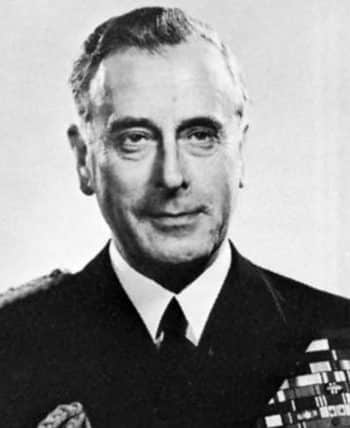
By Andrew Lownie. In 2015 I started researching my biography ‘The Mountbattens: Their Lives and Loves’. Little did I know then that six years later it would have locked me into a marathon legal battle with the Government and Southampton University. My quest was to find out what had happened to the personal diaries of the 1st Earl and Countess Mountbatten of Burma – Dickie and Edwina (who died in 1979 and 1960 respectively) – and the letters they wrote to each other. They had been extensively quoted in their official biographies by Philip Ziegler and Janet Morgan and published respectively in 1985 and 1991, but were nowhere to be found in the inventories of their papers at Southampton University. Dickie Mountbatten, an uncle of Prince Philip, had been Chief of Combined Operations and Supreme Allied Commander in South East Asia during the Second World War, and later Viceroy of India, First Sea Lord and Chief of the Defence Staff. But what interested me was his marriage. Both he and his wife were bisexual and had numerous affairs. His close relationships included the actress Shirley MacLaine; hers the conductor Sir Malcolm Sargent and India’s long-serving Prime Minister, Jawaharlal Nehru. The relationship with Nehru had huge ramifications for the perception of the couple’s impartiality over Indian Independence. Some of the early diaries up to 1934 have been released and from them I could see Mountbatten was scrupulous in describing who he met and where he went. There have long been rumours of his involvement in the Kincora scandal and, as the diaries run up to his death, I was interested to see when he had visited Belfast, when he was at Classiebawn alone except for staff, which house parties he had attended, how often he saw Peter Montgomery etc. There have long been rumours of his involvement in the Kincora scandal and, as the diaries run up to his death, I was interested to see when he had visited Belfast, when he was at Classiebawn alone except for staff, which house parties he had attended, how often he saw Peter Montgomery etc. The Broadlands Trust, a Mountbatten family trust, had sold the couple’s papers to Southampton, along with collections relating to the family’s ancestors, in 2011 , for almost £4.5 million, to save them being sold privately at auction and the collection broken up. The papers were bought after a huge fund-raising campaign with public monies, including almost £2 million from the Heritage Lottery Fund as well as the ‘Acceptance in Lieu’ tax scheme, which stressed their historical importance and the importance of them being “freely available to all”. Southampton’s fundraising claimed “this to be the most important archive to emerge in the last 30 years, only the Churchill Papers could be seen as comparable in terms of a loss to the nation if these were not secured”. Imagine my surprise to be told by the archivists at the University they could not help me on the diaries or letters and had no contact details for the Mountbatten family. I wrote to the present Countess Mountbatten and to the trustees of the Broadlands Trust. Silence. Eventually I was told that the diaries and letters had been closed in 2011 under a “Ministerial Direction”, under authority delegated by the Secretary of State for Culture, Media and Sport to the Museums, Libraries and Archives Council. I put in Freedom of Information (FOI) requests to the Cabinet Office, the University, the Heritage Lottery Fund, the Treasury, and the Department of Culture. No one seemed to know anything about such a Direction; even now, none of them has identified the name or status of the person who signed it. At the Cabinet Office’s suggestion, for swifter access, I also sought to focus on the diaries for one year – 1947. In June 2018, Southampton University disclosed that, shortly after its acquisition of the Mountbatten archive, a senior archivist had taken the initiative in procuring the Cabinet Office’s confirmation that the diaries and letters were “closed”. After my request, the archivist then approached the Cabinet Office with a view to its authorising his editing of the 1947 diaries for publication. 1947 was the year in which India and Pakistan gained their independence. Within weeks, the Cabinet Office held a series of meetings to facilitate the request. This is the very material that I have been struggling to access for years. From November 2018 I wrote several times to the then-Vice-Chancellor, Sir Christopher Snowden, the Chairman of the Council, Rear-Admiral Philip Greenish, and his deputy, Dame Judith Macgregor, a former High Commissioner to South Africa, about the University’s failure to comply either with FOI Act or with the ICO. No response. Eventually, after many letters, emails and calls, Sir Christopher replied, saying he was investigating and had asked for “a report be made to me and that a response be provided to you as a matter of urgency”. Two and a half years later I have heard nothing further. Indeed responses from both the University and the Cabinet Office to requests for information have been evasive and cursory; they have repeatedly missed statutory, regulatory and self-imposed deadlines for responding, and ignored correspondence from me, my lawyers and the ICO – to the extent the ICO was forced to take the unusual step of issuing an Information Notice and then the unprecedented step of commencing High Court proceedings for contempt to compel the University to respond. This decision was significantly delayed because the University failed to respond to the ICO’s investigation for over a year. It only did so after the ICO was forced to take the contempt of court proceedings. The ICO branded the University’s delay as “completely unacceptable” and in court filings complained about its “persistent, wholesale and unexplained failure to comply with the information notice…In effect, the (University) continues to flout its statutory duty under the Freedom of Information Act 2000″. In December 2019 the ICO finally ordered the University to release all the
by admin
A review of ‘The Irish Diaspora – Tales of Emigration, Exile and Imperialism’ by Turtle Bunbury
by admin
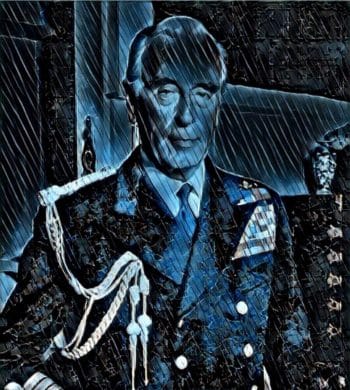
The British Government purchased Mountbatten’s archive for the benefit of historians (allegedly) but has locked it away. It may include details about his links to paedophile networks including the Anglo-Irish Vice Ring.
by admin
By David Burke. Brigadier (later General) Frank Edward Kitson is alive and well and living in Devon. He is the individual responsible for the Ballymurphy massacre. He was the Brigadier of 39 Brigade – that is to say he was the officer in charge of all British soldiers in Belfast during the Ballymurphy massacre. His accomplice was Colonel Derek Wilford, the former commander of 1 Para who is alive, alert and living in Belgium. Kitson joined the Rifle Brigade in January 1945. He would rise to become General Sir Frank Kitson, GBE, KCB, MC & Bar, DL and serve as Commander-in-Chief UK Land Forces from 1982 to 1985, and as aide-de-camp to Elizabeth II from 1983 to 1985. Along the way, he fought the Mau-Mau in Kenya for which he was awarded the Military Cross. He then took on communist rebels in Malaya and helped suppress a revolt in Oman. While fighting in the colonies, he formulated a horrifying counterinsurgency policy which he outlined in his notorious book ‘Low Intensity Operations’. In attempting to counter subversion it is necessary to take account of three separate elements. The first two constitute the target proper, that is to say the Party or Front and its cells and committees on the one hand, and the armed groups who are supporting them and being supported by them on the other. They may be said to constitute the head and body of a fish. The third element is the population and this represents the water in which the fish swims. Fish vary from place to place in accordance with the sort of water in which they are designed to live, and the same can be said of subversive organisations. If a fish has got to be destroyed it can be attacked directly by rod or net, providing it is in the sort of position which gives these methods a chance of success. But if rod and net cannot succeed by themselves it may be necessary to do something to the water which will force the fish into a position where it can be caught. Conceivably it might be necessary to kill the fish by polluting the water, but this is unlikely to be a desirable course of action. (page 49.) The Ballymurphy atrocity makes perfect sense in the context of this tactic. The IRA were the ‘fish’ he sought to eradicate. The streets and estates of Belfast were the ‘water’ in which they swam. The now confirmed FACT that the Ballymurphy murder victims were not in the IRA, had no connection to the IRA and were not any sort of a threat to the British Army mattered not a jot to Kitson or Derek Wilford, the commander of 1 Para. The Ballymurphy massacre makes perfect sense if it was part of a plan by Kitson to unleash his brutes in the hope of terrorising Ballymurphy generally so the locals would turn against the Official and Provisional IRA. Why else would separate groups of soldiers have targeted unarmed and peaceful civilians and murdered them in cold blood? One of them was a mother out looking for her children. Why else would separate groups of soldiers have targeted unarmed and peaceful civilians and murdered them in cold blood? One of them was a mother out looking for her children. Wilford’s defence is that he never became aware of the deaths. Kitson failed to recall the events either, when he appeared at the Saville Inquiry into Bloody Sunday. Both men are liars. They cannot dare tell the truth for it would destroy their reputations and that of other luminaries in the Ministry of Defence and British Army. Wilford went on to perpetrate the Bloody Sunday massacre the following January. Kitson’s dark role in that affair has yet to come to light. Kitson should now be stripped of his many awards as should Wilford. They should then face a rigorous interrogation about their activities on the days during which the murder spree took place. Mike Jackson, a captain with 1 Para, should also be stripped of his honours for vilifying the Ballymurphy murder victims as gunmen and terrorists. He also rose to become Commander-in-Chief UK Land Forces. David Burke is the author of ‘Kitson’s Irish War’. It can be purchased here: https://www.mercierpress.ie/irish-books/kitson-s-irish-war/ OTHER STORIES ABOUT BLOODY SUNDAY, THE BALLYMURPHY MASSACRE, BRIGADIER FRANK KITSON AND COLONEL DEREK WILFORD ON THIS WEBSITE: The covert plan to smash the IRA in Derry on Bloody Sunday by David Burke Soldier F’s Bloody Sunday secrets. David Cleary knows enough to blackmail the British government. Learning to kill Colin Wallace: Bloody Sunday, a very personal perspective Lying like a trooper. Internment, murder and vilification. Did Brigadier Kitson instigate the Ballymurphy massacre smear campaign? Where was Soldier F and his ‘gallant’ death squad during it? Another bloody mess. Frank Kitson’s contribution to the wars in Afghanistan and Iraq. 300,000 have died in Afghanistan since 1979. Lying like a trooper. Internment, murder and vilification. Did Brigadier Kitson instigate the Ballymurphy massacre smear campaign? Where was Soldier F and his ‘gallant’ death squad during it? A Foul Unfinished Business. The shortcomings of, and plots against, Saville’s Bloody Sunday Inquiry. Kitson’s Private Army: the thugs, killers and racists who terrorised Belfast and Derry. Soldier F was one of their number. Soldier F and Brigadier Kitson’s elite ‘EFGH’ death squad: a murderous dirty-tricks pattern is emerging which links Ballymurphy with Bloody Sunday. A second soldier involved in both events was ‘mentioned in despatches’ at the behest of Kitson for his alleged bravery in the face of the enemy. Mentioned in Despatches. Brigadier Kitson and Soldier F were honoured in the London Gazette for their gallantry in the face of the enemy during the internment swoops of August 1971. Soldier F, the heartless Bloody Sunday killer, is named. Mission accomplished. The unscrupulous judge who covered-up the Bloody Sunday murders. Soldier F and other paratroopers have been protected by the British State for five decades. None of them now face prosecution. This perversion of justice began with the connivance of
Posted in:
by admin
Ballymurphy, the UK government’s proposals to deal with legacy issues, and the dogs on the streets. By Christopher Stanley, litigation consultant. Statute of Limitations In London today (11 May 2021), the British government set out its legislative agenda by way of the Queen’s Speech to the House of Lords. Unexpectedly, the British government remains intent on its ambitions to stop investigating Conflict-related Legacy deaths in Northern Ireland and to introduce a Statute of Limitations so that British army veterans will not face prosecution. The details of the proposals remain to be published. The British government also proposed to ‘review’ the Human Rights Act 1998 and legislate to restrict access to Judicial Review. In Belfast today, Mrs Justice Keegan delivered her verdict in The Ballymurphy Massacre Inquest into the deaths of ten civilians shot by the British army in 1971. The judge found there had been a disproportionate use of force and the shootings violated Article 2 of the ECHR (the right to life). She said “All the deceased were entirely innocent of any wrongdoings on the day in question”. Whilst the verdict of an inquest cannot attribute criminal responsibility or civil liability, the verdict can prompt an investigation by the prosecuting authority. The Legacy of the Past – the Conflict – in Northern Ireland continues to shape the present and determine the future. In 2014 there was the possibility that the past could be ‘dealt with’ or ‘policed’ by way of The Stormont House Agreement and its mechanisms of investigation and truth-recovery. A mixture of Transitional Justice, Truth and Reconciliation, Hard Law and Soft Justice. In 2021 that model was abandoned by the British government by way of its New Decade New Approach proposal. Today it is apparent that the British government wants to cease contentious investigations into contentious deaths and rely upon truth-recovery mechanisms, Hard Law trumped by Soft Justice. Truth Not all relatives of victims or survivors of the Conflict want the same thing. But access to the truth is one binding want. How the truth is achieved, if it can be, is the point of contest. Once the truth is ‘out’ what should be done with it? How can truth assist securing peace when “peace comes dropping slow” (Yeats). In one way establishing a narrative of the Conflict which can be accepted across the communities in Northern Ireland contributes to cementing and securing the peace which was secured by way of the Belfast-Good Friday Agreement 1998 (GFA). But the truth is oft contested or denied by what Ian Cobain has described as The History Thieves. And truth has consequences: it cannot simply be archived by those very same History Thieves. It was dirty The Conflict in Northern Ireland was fought by three sides: Republicans, Loyalist and the British state. This is not a pernicious counter-narrative, as the exposure of collusion has pointed to, but rather a telling truth about the last Colonial adventure of the British Empire fought on the Narrow Ground of Ulster. This last bloody campaign, Britain’s Dirty War as Martin Dillon described it, has left both a human-rights deficit in Northern Ireland, which the GFA seeks to address, and a Legacy of state-sponsored terror by way of collusion with both Republicans and Loyalists depending on the political temperature at a particular juncture or the security constituency policy prevailing at prevailing point in time (the two not necessarily aligned). The difficult question for Westminster politicians and Whitehall civil servants is that a Statute of Limitations for crimes committed during the Conflict before 1998 offends the letter and spirit of the GFA. Who will it apply to – To those British army veterans responsible for the Ballymurphy Massacre? To the Birmingham Pub Bombers? To Albert ‘Ginger’ Baker? To John Downey? – to paramilitaries, agents and informers, old soldiers? Not a witch-hunt The word ‘witchhunt’ has been used a lot in relation to the prosecution of British army veterans. It started to be used following the ‘persecution’ of British soldiers accused of crimes committed during the Iraq and Afghanistan ‘campaigns’. It is now extended to apply to British soldiers who served in Northern Ireland. A witchhunt implies a form of collective hysteria against a particular group – ‘hounding’ Let us be clear: the number of prosecutions taken against former soldiers who served in Northern Ireland is low the decisions to prosecute in these cases were taken by independent law officers applying evidential thresholds. Who are the vicitms? The accused or the accusers? No hierarchy of victims In Northern Ireland there is a legislation which ensures there is no hierarchy of victims: A victim is “Someone who is or has been physically or psychologically injured as a result of or in consequence of a conflict-related incident” (The Victims and Survivors (Northern Ireland) Order 2006 Section 3(1)(a). The proposals of the British government will create a hierachy of victims (already in place regarding the eligibility criteria for the ‘Troubles’ Pension). The Statute of Limitation proposals from the British government will create a de facto amnesty for perpetrators of Conflict-related criminality. Will this limitation also apply to state agents and informers employed by the British security forces? Will this limitation also apply to Republican and Loyalist paramilitaries who remain alive? Whether these proposals violate the UK’s obligations under the ECHR seems of little consequence to the British government. HMG is intent on ‘reviewing’ the Human Rights Act 1998 and intends to limiting access to Judicial Review, as announced in today Queen’s Speech. Judicial Review is the legal application to challenge Executive decision-making. Judicial Review is a mechanism by which human rights concerns can be bought before the independent judiciary and which has been used extensively in Conflict-related Legacy litigation in Northern Ireland. Retribution not core demand One of the consequences of the process of truth-recovery can be a demand for retribution. But that is only one consequence of the process and it is not a core demand for the majority of relatives of victims and survivors. Their demand is to know why and to know who – who
by admin
By David Burke. The denial of justice for political gain. Next week will see the release of the long-awaited inquest report into the Ballymurphy massacre during which British soldiers killed and wounded a large number of unarmed civilians in Belfast. The atrocity took place after the introduction of internment in August of 1971. Adding insult to inqury, the victims were vilified as gunmen and terrorists. A documentary entitled ‘The Ballymurphy Precedent’ will be broadcast on Channel 4 on Wednesday 12 May. It contains detailed re-enactments of the actions of Kitson’s and Wilford’s troops. RTE will also be showing it at a date yet to be determined. Meanwhile, the British Government led by Boris Johnson proposes to grant all British soldiers implicated in murder in Northern Ireland immunity from prosecution, contrary to the Stormont House Agreement. Incredible as this may seem in Ireland and across the globe, it has enhanced Boris Johnson’s standing in the eyes of large numbers of the British electorate. Johnson has also set himself on a collision course with the Irish Government. Taoiseach Micheál Martin has stated that: “There is an agreement in place with the British government, with the parties in Northern Ireland and indeed with victims’ groups and that is the Stormont House Agreement of 2014 and that any move from it would amount to ‘a unilateral breach of trust”’. He added: “For us the victims are the priority and the victims remain the priority. There has to be adherence to that agreement. If people have new ideas to present they have to involve all of the parties, and above all the concerns of victims irrespective of who committed the atrocities. People must be held accountable”. Johnson’s Minister for Veterans, John Mercer MP, resigned last month in protest at what then looked like the British Government’s reluctance to change the law to prevent the prosecution of British soldiers accused of murder in Northern Ireland. In his resignation statement, he said he was stepping down to “try and shift UK Government position towards looking after these people and preventing the repeated and vexatious nature of litigation against those who served is a huge task”. There have been further developments and insights into the free rein afforded to British soldiers in Northern Ireland to shoot at human targets. Last week the trial of two paratroopers accused of shooting Official IRA volunteer Joe McCann while he ran away from them collapsed. Judge James O’Hara pointed out that: “At that time, in fact until late 1973, an understanding was in place between the RUC and the Army whereby the RUC did not arrest and question, or even take witness statements from, soldiers involved in shootings such as this one. This appalling practice was designed, at least in part, to protect soldiers from being prosecuted and in very large measure it succeeded.“ Her Majesty’s Killers. The Ballymurphy Inquest report may not address the roles played in the massacre by two of the most notorious British soldiers to set foot in Northern Ireland during the Troubles, Brigadier Frank Kitson and Colonel Derek Wilford. Kitson is a counterinsurgency expert who had served in Malaya, Kenya, Cyprus and the Oman before he was sent to Northern Ireland as the brigadier in charge of the 39 Brigade area which included Belfast, 1970-72. He set up the Mobile Reaction Force (MRF) which carried out the murder of a series of unarmed civilians in Belfast in the early 1970s. Kitson’s own pen has long since exposed him as a racist and anti-Catholic bigot. He committed perjury at the Saville Inquiry into Bloody Sunday (January 1972) on an industrial scale. Wilford assumed command of 1 Para on 21 July 1971. 1 Para formed part of 39 Brigade. Wilford believes that virtually all Catholics in Northern Ireland are IRA supporters, and has said as much in public. He had served with the SAS for two years and trained with American paratroopers at Fort Bragg, the US Army Special Forces School before coming to Ireland. He was also a veteran of Malaya and Aden. He joined the Parachute Regiment as a company commander in 1969. Perceived as a bit of a loner, he was given to reading the classics, in their original Latin. The number of unarmed Catholic civilians murdered by 1 Para reached unprecedented levels after Wilford’s arrival. Many were shot in the back or while lying on the ground. He reported directly to Kitson. The number of unarmed Catholic civilians murdered by 1 Para reached unprecedented levels after Wilford’s arrival. Many were shot in the back or while lying on the ground. He reported directly to Kitson. Both men are still alive and unrepentant at the multiple deaths caused by their troops including those who died during the Ballymurphy massacre. Wilford took 1 Para to Derry early the following year, an event that resulted in Bloody Sunday. Wilford committed perjury at the Widgery and Saville inquiries into Bloody Sunday. He has also admitted lying to the press. He is the keeper of many secrets about that massacre. While Wilford presents himself as an officer who has always been loyal to the paratroopers who served under him on Bloody Sunday, the truth is that he has thrown them to the wolves to save his own skin. One of them is facing murder charges for his actions on Bloody Sunday. Meanwhile, Wilford cowers in Belgium. While Wilford presents himself as an officer who has always been loyal to the paratroopers who served under him on Bloody Sunday, the truth is that he has thrown them to the wolves to save his own skin. One of them is facing murder charges for his actions on Bloody Sunday. Meanwhile, Wilford cowers in Belgium. Operation Demetrius was the code name ascribed to internment which commenced on 9 August 191. 342 people were swept up on that day and taken to to makeshift camps in a series of dawn swoops by the British Army. 105 were released after two days. Instead of
Posted in:
by admin
How I grew to see that without broad Marxism the arts and its unserious, networked and commodified lit-libs are for sale. An extract from the essay ‘Being a Marxist Poet in the Twenty-First Century’ by Kevin Higgins. More than a quarter of a century ago a man-child called Kevin retired from politics as he turned twenty seven. He had joined the then somewhat notorious Trotskyist group, the Militant Tendency[i], at the age of fifteen. After twelve years of activism, which began in membership of Galway West Labour Youth the month the Falklands War kicked off and fizzled like the saddest of fireworks in London in the aftermath of Mrs Thatcher’s Poll Tax, against which he had been a somewhat obsessively focused campaigner, it was over. “Retirement” was the face-saving word he used to describe his departure from politics. From the inside it felt like a personal tragedy. And it was. After more than a decade as a fiercely loyal ‘comrade’, Kevin had had enough of Militant and they had had enough of him. Dialectics being the contradictory beasts they are, a total exit from active politics may have been the best thing that could possibly have happened to him right then. But it didn’t feel like that to him. Instead of world socialist revolution, with which history had refused to oblige him, the spectres haunting the little part of Europe with which Kevin was then mostly concerned were, from his point of view, disappointing: Tony Blair and the Celtic Tiger, which got given its name the same year Blair became UK Labour leader: 1994. Kevin sloped back to Galway from London via the Holyhead ferry that April with a mouthful of bad teeth: he wasn’t much of a one for looking after himself then. Though he would march to defend the NHS for other people until his shoes disintegrated; he did not partake of such services himself. Kevin arrived in Galway with no particular plans, apart from a notion that he might do something artistic. Not artistic in the prettifying sense: he had no interest in describing the rocks around Connemara and the like. Indeed, he had little interest in any kind of beauty. Or so he thought. He wanted to express things he had been unable to say during his years as a (partly-self-appointed) leader of the vanguard of the North London semi-lumpen proletariat. Mostly, this would involve going into some detail about all the people and ideas and institutions he was against. It was no small list. High on it was his endlessly-self-sacrificing former self, who had worked himself some of the way towards a possible early grave, in an attempt to fight the political tide of the early 1990s that was, in the end, more about masochism than socialism. By “doing something artistic”, he meant stuff to do with words – songs, poems, maybe plays, novels… In the last years of his activism, when he was Chair of Enfield Against The Poll Tax in the North London Borough then represented in the House of Commons by, among others, Michael Portillo[ii],he had become increasingly focused on how best to say what needed to be said. It wasn’t enough to say it. It had to be said well. And, if possible, said wittily. He didn’t know it at the time but writing political letters with a satirical bent to the local papers in Enfield in the very early 1990s was his beginning as a poet. This Kevin, who was of course me, hoped to escape politics via poetry but also harboured illusions that he might somehow find a way of combining the two. It is a contradiction I have been working out ever since. From the inside it has felt more to be a case of this obvious contradiction working itself out using me as a somewhat extreme public example. Of late this contradiction has grown starker and as a result perhaps been somewhat resolved. In the course of my work as a poet, I regularly meet those strange creatures, the literary liberals, who ascribe to themselves every progressive and humane value while at the same time apparently finding no place in their imaginations for even the possibility of a world not run in the interests of Jeff Bezos, Elon Musk, and Apple Inc. They are the sort of people who, if they didn’t necessarily agree with her, would at least have understood where artist Tracy Emin was coming from when she called David Cameron’s coalition of 2010-15 “the best government…that we’ve ever had”. Politically, Emin may be an ignoramus. But her incontinent mouth is useful since it makes her spell out what others in the arts are only brave enough to occasionally think. It has been my experience that, post-2008, most established literary creatives cannot imagine as possible a world in which a substantial percentage of the populations of countries such as Ireland, Britain, and the United States don’t live in Victorian levels of poverty. Just look at the queues of homeless being fed each Friday night outside the GPO in Dublin by the charity, Muslim Sisters of Éire. Despite such images, the idea of properly taxing the super-wealthy, and making sure they don’t find a way of avoiding that tax, is seen by your average sensible member of the literary classes as a notion only seriously held by annoying teenagers and people who think it’s still 1975. According to this broad school of thought, if it can be called thought, there never was any other possible solution to 2008 but spending less on the lower orders and using that money to bail out JP Morgan, Anglo-Irish, and the Royal Bank of Scotland in the hope that the pre-slump status quo could somehow be restored. So your average literary stuffed jacket, or pants-suit, tends to quietly cut characters such as Varadkar, Obama, and Cameron a huge amount of slack. As long as they give them things like a side of same-sex marriage to go with all those hungry schoolchildren