Monitor and improve climate, biodiversity and equality. Leave Government if targets are not reached every quarter
by admin
Monitor and improve climate, biodiversity and equality. Leave Government if targets are not reached every quarter
Posted in:
by admin
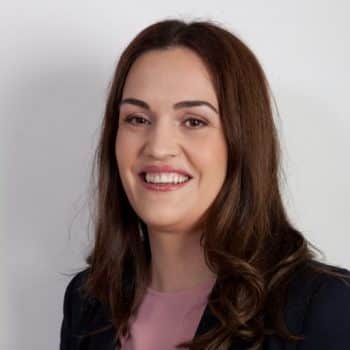
Aisling Dempsey voted for dezonings that will increase value of lands owned by the company she works for
by admin
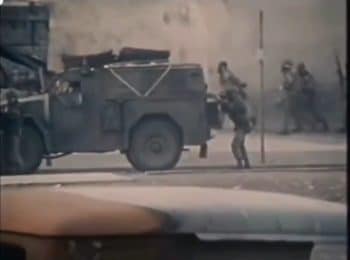
By David Burke. UPDATE: Please also see the following story where Soldier F is named as David James Cleary: Soldier F and Brigadier Kitson’s elite ‘EFGH’ death squad: a murderous dirty-tricks pattern is emerging which links Ballymurphy with Bloody Sunday. A second soldier involved in both events was ‘mentioned in despatches’ at the behest of Kitson for his alleged bravery in the face of the enem ****** While ‘Soldier F’ was running amok in Derry on Bloody Sunday, 30 January 1972, murdering people in cold blood, one of his colleagues shouted out his christian name, ‘Dave’. Lord Saville wanted to name the soldier, a former lance corporal in 1 Para, but he was overruled by the Court of Appeal in London. Hence, he remained ‘Soldier F’ for the purposes of the Saville Inquiry. Last month the Northern Ireland courts confirmed his entitlement to anonymity. After the murder charges against him were dropped in July 2021, his full name appeared on at least two notices which were hung in Guildhall Square in Derry. They first appeared on Saturday 3 July. Photographs of the notice was circulated on social media. PSNI officers removed them and initiated inquiries to establish who was responsible for their erection. The justification for concealing his name was out of concern that his life might be endangered. This was fanciful in the extreme as his name has been known in Derry and beyond for decades. Indeed, so too are the names of some of his colleagues who participated in the Bloody Sunday massacre. In any event, the cat is now well and truly out of the bag. The photograph below is of one such notice. We have blurred the killer’s surname. All of Soldier F’s legal costs to date and what have been described as “welfare support” have been paid by the State. Meanwhile, Soldier F retains the support of John Mercer MP, the former Veterans Minister, as is evident from his twitter account: Soldier F is named in the following story: Soldier F and Brigadier Kitson’s elite ‘EFGH’ death squad: a murderous dirty-tricks pattern is emerging which links Ballymurphy with Bloody Sunday. A second soldier involved in both events was ‘mentioned in despatches’ at the behest of Kitson for his alleged bravery in the face of the enemy. David Burke is the author of ‘Deception & Lies, the Hidden History of the Arms Crisis 1970’ and ‘Kitson’s Irish War, Mastermind of the Dirty War in Ireland’ which examines the role of counter-insurgency dirty tricks in Northern Ireland in the early 1970s. His new book, ‘An Enemy of the Crown, the British Secret Service Campaign against Charles Haughey’, was published on 30 September 2022. These books can be purchased here: https://www.mercierpress.ie/irish-books/kitson-s-irish-war/ https://www.mercierpress.ie/irish-books/an-enemy-of-the-crown/ https://www.mercierpress.ie/irish-books/deception-and-lies/ OTHER STORIES ABOUT BLOODY SUNDAY, THE BALLYMURPHY MASSACRE, BRIGADIER FRANK KITSON AND COLONEL DEREK WILFORD ON THIS WEBSITE: The covert plan to smash the IRA in Derry on Bloody Sunday by David Burke Soldier F’s Bloody Sunday secrets. David Cleary knows enough to blackmail the British government. Learning to kill Colin Wallace: Bloody Sunday, a very personal perspective Lying like a trooper. Internment, murder and vilification. Did Brigadier Kitson instigate the Ballymurphy massacre smear campaign? Where was Soldier F and his ‘gallant’ death squad during it? Another bloody mess. Frank Kitson’s contribution to the wars in Afghanistan and Iraq. 300,000 have died in Afghanistan since 1979. Lying like a trooper. Internment, murder and vilification. Did Brigadier Kitson instigate the Ballymurphy massacre smear campaign? Where was Soldier F and his ‘gallant’ death squad during it? A Foul Unfinished Business. The shortcomings of, and plots against, Saville’s Bloody Sunday Inquiry. Kitson’s Private Army: the thugs, killers and racists who terrorised Belfast and Derry. Soldier F was one of their number. Soldier F and Brigadier Kitson’s elite ‘EFGH’ death squad: a murderous dirty-tricks pattern is emerging which links Ballymurphy with Bloody Sunday. A second soldier involved in both events was ‘mentioned in despatches’ at the behest of Kitson for his alleged bravery in the face of the enemy. Mentioned in Despatches. Brigadier Kitson and Soldier F were honoured in the London Gazette for their gallantry in the face of the enemy during the internment swoops of August 1971. Soldier F, the heartless Bloody Sunday killer, is named. Mission accomplished. The unscrupulous judge who covered-up the Bloody Sunday murders. Soldier F and other paratroopers have been protected by the British State for five decades. None of them now face prosecution. This perversion of justice began with the connivance of the Lord Chief Justice of England and Wales, John Widgery, a former British Army brigadier, Freemason and oath-breaker. Counterinsurgency war criminals, liars and cowards: Kitson and Wilford, the brigadier and colonel who led the soldiers who perpetrated the Ballymurphy Massacre. Brigadier Kitson’s motive for murdering unarmed civilians in Ballymurphy. The McGurk’s Bar cover-up. Heath’s Faustian pact. How a British prime minister covered up a UVF massacre in the hope of acquiring Unionist votes to enable the UK join the European Economic Community, the forerunner of the EU.
by admin
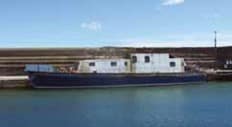
Shane Kennedy and his home, a former British naval minesweeper,
‘The Portisham’, prove resistant to legal battles
Posted in:
by admin
Poots aims to save his party, but on
environmental policy he’s agricultural
Posted in:
by admin
By Niamh Alexander. Despite expectations due to the pandemic, the cost of student accommodation in Dublin has remained steady – and costly. Two semesters in the cheapest campus accommodation in UCD will set you back just over €8,000, with the most expensive coming in at almost €14,500, per annum. Sky-high costs can have the effect of pushing students towards private landlords, creating more demand in a market that is already at capacity. Private rentals also bring with them their own issues. With the average cost of a room in a shared property costing around €680 per month, according to a Student Housing Report done in 2020, rent is not much more affordable in private properties. There is also the fact that most private landlords will only accept a 12-month lease, meaning students can be stuck paying for accommodation in the summer months when college is finished. In the current market, landlords can get away with just about anything. I once viewed a room that was completely taken up by the bed and had no floor space at all. There have been accounts of rooms with just one bed sleeping two to three people. In 2017, the Government launched the National Student Accommodation Strategy – a scheme aiming to provide more purpose-built student accommodation (PBSA) in a bid to free up private rental properties that would otherwise be occupied by students. The Higher Education Authority (HEA) estimates that 75,640 bed spaces will be required by 2024 to satisfy demand for student accommodation. It estimates that around 55,000 will be completed by this time. However, a report by Mitchell McDermott, a construction consultancy group, believes this “appears ambitious” due to the fall in construction activity during the pandemic. According to the report, around 3,500 units were built in 2020, and this is expected to fall to 1,600 in the coming year. However, according to Dr Lorcan Sirr, a housing lecturer at TU Dublin, supplying more PBSA is not the answer. “Some [PBSA][/PBSA] were looking for change of use even before the pandemic, which suggests to me that the market is oversupplied”, he says. The notion that supplying more PBSA is the best way to take students out of the private rental sector simply isn’t accurate. “Traditionally, Irish students don’t stay in student accommodation. Many attend college close to home and commute, and if they don’t, they typically stay in suburbia, along bus routes, mainly because it’s cheaper”, says Sirr. The key issue is that a lot of the accommodation is being supplied by profit-driven private companies. These companies have discovered a highly profitable, sometimes extortionate, business model: luxury purpose-built student accommodation. What little accommodation is being built is largely luxury accommodation out of the price range of the average family. Aparto is a private company with five student residences across Dublin city. Prices start at €210 per week for a shared room in its Dorset Point property, located a 20-minute walk from TU Dublin’s Grangegorman campus. The most expensive option is the Platinum Ensuite in Beckett House priced at €285 per week, meaning two semesters here will cost a shocking €11,685 in total. Many of Aparto’s properties boast amenities such as games rooms, gyms, and ‘stylish’ cinema rooms, which is exactly what every student working a minimum-wage, part- time job is looking for. Some even have ‘house pets’. The question that needs to be asked is, with so many students struggling to find reasonably priced accommodation, why has there been a surge in high – priced accommodation with such unnecessary luxuries? The answer, it seems, is international students. According to the HEA, in 2019, 12% of all students in Ireland were international students. However, a report conducted by EY found that international students represented 79% of the total students living in PBSA. Privately-owned PBSA is profit-driven and was never marketed to Irish students, but instead to wealthy overseas students, says Sirr. Developers can get away with charging international students three times the price they would Irish students. With so much uncertainty surrounding international students in Ireland post-Covid, the student accommodation market is extremely volatile. With fewer international students expected to
by admin
How is Conor so wrong? By Michael Smith
by admin
Fourth-division calibre on second-division salaries. By J Vivian Cooke
by admin
The Top Level Appointments Committee (TLAC) long since succumbed to groupthink. By J Vivian Cooke
by admin
By David Burke.
by admin
Editorial. By Michael Smith The most widely supported form of equality is equality of opportunity. Even Margaret Thatcher believed in it. But it has more of the qualities of “freedom” than of “equality”. Village has always tended to support a vision of equality that contemplates equality of outcome/condition – distributing ‘goods’/resources in inverse proportion to the bestowals of fortune and history on individuals. We are all equal from birth and ethically. Society’s goal is to recognise that, by distributing ‘goods’ to reinforce that equality. If the agenda is imperative it needs to be facilitated. The first thing is to have the information – the data – to show from what basis you need to begin redistribution. But the greatest conspiracy of them all distorts the reality of inequality. Because those who benefit from inequality often want to keep it that way. For example, inconveniently, apparently, for thoroughgoing egalitarians, it has long been the case that data from the ESRI show that the post-redistribution. Gini Co-efficient (a statistical measure of overall income distribution that is used as a measure of inequality) is improving in Ireland. Having disimproved in the early years of the boom, the Gini Co-efficient in Ireland narrowed during the economic crisis and overall from 1987 to 2019. On the back of this according, for instance, to the Irish Times, the Republic is one of the few developed countries that has avoided an increase in income inequality over the past three decades. As pointed out regularly in this magazine and forensically by Unite the Union, in particular, this falling inequality has been presented as a “fact” but is not. • The ESRI methodology skews the result because in Ireland the Gini Co efficient shows income inequality falling while the other standard measure of income inequality (the share of income to the top 1%) shows it rising. • The Gini Co-efficient is peculiarly unreliable in Ireland, not being based on information on the 1.7 million households in the state but on a small sample of them – 4,183 to be exact (around 0.2 per cent of the total). The survey is voluntary. In 2019 the CSO invited over 9,000 households to take part in the survey but in the end only 40% agreed. The CSO employs around 100 people to carry out its work, but often they call to a house and not everyone is at home. They then conduct interviews “by proxy” – that is, information is provided by “another resident of the household due to unavailability of the person in question”. Up to 50 percent of all interviews for the income survey are by proxy, which gives rise to issues “with the quality of data for proxy responses for certainvariables”, according to the CSO itself. Left think-tank TASC has said that such surveys “have well-known limitations. Being voluntary, non-response is a problem among the rich in particular, and high incomes tend to be underreported when they do respond”. Because of all this, in the case of the Gini Co-efficient, the raw data collected by the CSO are subject to a series of statistical weights, measures, and guesswork to compensate for gaps in the interviews. A more universal set of figures based on actual taxation levels is more accurate. The ESRI did indeed look at data from tax returns which duly confirmed increases in the share of income going to the very top. However, this doesn’t form part of the final output. • Income inequality itself does not suffice as a measure of economic inequality (and economic inequality is not the full measure of inequality anyway). It is but one of at least seven, according to TASC. These are: income; wealth; public services; tax; capacities; family composition; and the costs of goods and services. If economic equality does not measure full economic capacity then what is measured is meaningless. • In particular wealth is obviously an even more important component of richness than income, since it includes the total of previous income. • Equality embraces social, environmental and cultural matters as well as economic ones. Access to services, education, healthcare, leisure facilities and a good environment constitute equality of outcome/condition at least as much as money. They are ignored by income (or even wealth)-driven assessments. • There are serious issues with some of the historic data. Other data which Unite present show “zero real income growth” from 2007 to 2017 but are ignored by the ESRI and in the reportage, even though the source of the data is relied upon in other ways. We are told that, regardless of our own experience, things have never been better. Official and establishment complacency is lethal to our society and our democracy. Unaddressed inequality always ultimately generates demagoguery. Anyone who cares can see that the richest have never had it easier but that many people struggle to survive in an extraordinarily pressurised society. Everyone can see that people in their 20s and 30s will be the first generation to be worse off than their parents. We need to analyse the trajectory and act on it as appropriate. The least our public service and media owe us is to ensure the time-bomb of rising inequality is properly monitored in the first place.
Posted in:
by admin
Leo Varadkar, the Fine Gael Leader, is still touting the 1980s rhetoric of low taxes and impoverished public services. For me, the State is a force for good.
by admin
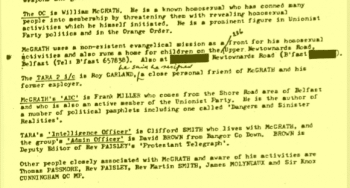
By Joseph de Burca. 1. A faction within the British Army tries to expose a child abuse network. During the summer of 1973 Captain Colin Wallace, a PSYOPS [psychological operations] officer with the British Army, tried to expose the existence of a child abuse network in Northern Ireland. He had the support of a string of honourable colleagues in the British Army who were serving in NI to achieve this aim including General Peter Leng. Wallace duly briefed a number of journalists about a man called William McGrath, an Orangeman, close ally of Ian Paisley since the 1950s, terrorist and child rapist. McGrath ran a paramilitary group called TARA. He once told one of his victims, James Miller, that he liked having sex with boys aged 10 or younger. James Molyneaux MP, who led the dominant Ulster Unionist Party (UUP), between 1979 and 1995, was a friend of William McGrath. Molyneaux was also sexually interested in young men. He was well known not only to McGrath but to other members of Tara. When one young member left the organisation, Molyneaux made inquiries to find out why he had departed from it. James Molyneaux MP, who led the dominant Ulster Unionist Party (UUP), between 1979 and 1995, was a friend of William McGrath. Molyneaux was also sexually interested in young men. He was well known not only to McGrath but to other members of Tara. When one young member left the organisation, Molyneaux made inquiries to find out why he had departed from it. In 1973 Wallace was instructed ‘to brief the press unattributably about McGrath’s sexual preferences, his use of blackmail to force young people into homosexual practices, and the fact that he “runs a home for children on the Upper Newtownards Road [i.e. Kincora Boys’ Home].” Wallace was given a briefing paper to assist in the PSYOP against McGrath. Molyneaux is named in it as an associate of McGrath. Wallace was given a briefing paper to assist in the PSYOP against McGrath. Molyneaux is named in it as an associate of McGrath. Wallace has explained that by 1973: “The PSYOPS unit had acquired a significant amount of additional information about TARA”. They were “aware that a number of prominent Tara members were closely linked with the Rev Ian Paisley”. These included James Heyburn, Secretary of Paisley’s church; Hubert Nesbitt, who provided the land on which Paisley’s church was built; and David Brown, Deputy Editor of ‘Paisley’s Protestant Telegraph. “We also had information alleging that serving members of the RUC not only attended TARA meetings, but also were involved in the running of the organisation. There were indications that McGrath was obtaining Intelligence information from the RUC on Republicans and there were even claims that RUC stations in East Belfast had supplied Tara with firearms which had been surrendered to the police by members of the public. I do not know how reliable the latter information was, but it was sufficient to make the Army very wary of the RUC when dealing with TARA-related information”. 2. The 1973 TARA press briefing designed to expose McGrath and destroy TARA. The 1973 document was prepared by the British Army to neutralise the threat posed by TARA and expose McGrath’s distasteful exploitation of children. One of those involved in the PSYOP was Hugh Mooney, a Trinity College Dublin graduate and ex-Irish Times sub-editor, who worked for the Information Research Department (IRD), the UK’s black propaganda department which was based at Riverbank House in London. Hugh Mooney’s handwriting appears on the 1973 document which was shown to journalists by Wallace . According to Hugh Mooney, the document was written by Mike Cunningham. It was furnished to Wallace at the British Army’s HQ at Lisburn. At this time Wallace and the British Army were not aware that MI5 and MI6 were running a vile blackmail operation involving the rape of children at Kincora. This would generate a lot of trouble for Wallace later on when Ian Cameron of MI5 would derail his career. Cameron did this because Wallace was persisting in his attempts to end the child rape at Kincora. Mooney left HQ NI at the end of 1973, so the Tara document must have been created before then. 3. James Molyneaux was named in the 1973 press briefing about McGrath and TARA. James Molyneaux was named in the final paragraph of the 1973 TARA document as one of a number of “people associated with McGRATH” who were “aware of his activities”. 4. Peter Broderick of the MoD tells the truth about the British Army’s knowledge that abuse was taking place at Kincora. He supports Colin Wallace after the latter’s dismissal and is pushed out of his job by the MoD. MI5 and the Northern Ireland Office (NIO) intervened to protect McGrath because he was working for them. McGrath and others were working for MI5 and or MI6. Their task was to supply boys to politicians and Loyalist terrorists so they could be blackmailed by MI5. Not everyone working in intelligence in NI swam in the same river of filth as MI5 and the NIO. Peter Broderick, who was Wallace’s boss at British Army HQ NI in 1973 and 1974, was one such person. It was he who instructed Wallace to disclose the information in the 1973 Tara Press Briefing (’73 TPB) to journalists. Moreover, years later he had the integrity to state on public record that he had initialled the document. He made this admission to two journalists, Paul Foot of The Daily Mirror and Private Eye, and Barry Penrose of The Sunday Times. Not everyone working in intelligence in NI swam in the same river of filth as MI5 and the NIO. Wallace retained a copy of ‘73 TPB. It described how the ‘OC’ or Officer-in-Command of Tara was ‘William MCGRATH. He is a known homosexual who has conned many people into membership [of Tara] by threatening them with revealing homosexual activities which he himself initiated. He is a prominent figure in Unionist Party politics and in the
UPDATE: Sir Jeffrey Donaldson is the new leader of the DUP. One of his mentors was James Molyneaux MP. Donaldson succeeded him as MP for Lagan Valley after Molyneaux retired in 1997. On 19 December 2019 Village exposed Molyneaux’s involvement with the Anglo-Irish Vice Ring. On his website Donaldson has stated that: “My involvement with the Ulster Unionist Party grew as I worked alongside two of the greatest names in Unionism in the 20th century. Between 1982 and 1984 [Enoch Powell and James Molyneaux]. .. In 1985 I was elected aged 22 to the Northern Ireland Assembly, with the distinction of being the youngest person to win a seat at Stormont with the majority of some 15,000 votes. Throughout this period I also served as the Personal Assistant to the then leader of the UUP, the Rt. Honourable James Molyneux MP. In 1988 I was elected Honorary Secretary of the Ulster Unionist Council and in 2000 I was elected Vice President of the Council. My responsibilities included overseeing the UUP Bureau in Washington DC. A regular visitor to the United States, I often accompanying leaders James Molyneaux and his successor David Trimble on delegations that included several meetings with former President Clinton and Vice President Al Gore and subsequently with President Bush.” The December 2019 profile of Molyneaux commences here: James Molyneaux MP was one of the most significant figures in Unionist politics during the Troubles. He was first elected as a Westminster MP in 1970 for the then dominant Ulster Unionist Party (UUP) and served as its leader 1979-1995. He was also an Orangeman and a member of the Monday Club, a right-wing pressure group which was associated with the Tory Party. According to Robin Bryans, the well-informed Kincora Boy’s Home whistle-blower, Molyneaux was part of the paedophile gang which preyed on vulnerable boys in care in Northern Ireland. MI5 did not hand over its files on Molyneaux to the Hart Inquiry which reported in 2017. Equally disappointing is the fact that the Independent Inquiry into Child Sexual Abuse (IICSA) in London is not looking for MI5’s files on Molyneaux. It has shown no interest in him nor in other MPs and VIPs who abused boys as part of an Anglo-Irish Vice Ring. Richard Kerr, a resident at Kincora, was trafficked from Belfast to London in the 1970s aged 16 to be abused by an MP who was a friend of Molyneaux. 1. ‘KINCORA AND PORTORA BOYS’ SCHOOLS WERE USED AS HOMOSEXUAL BROTHELS BY MANY PROMINENT FIGURES, INCLUDING LORD MOUNTBATTEN [AND] JAMES MOLYNEAUX.’ Robin Bryans tried to expose Molyneaux’s links to Kincora while he was still Leader of the UUP but without success. Bryans, however, did manage to expose Sir Anthony Blunt, the Surveyor of the Queen’s Pictures, who had been a KGB mole while he served inside MI5. Byrans knew Blunt well from his frequent visits to Ulster where Blunt seized opportunities to abuse underage boys. Bryans tried to expose Molyneaux in a letter he wrote on 3 November, 1989, which also made reference to Blunt’s treachery. This was six years before Molyneaux would step down as Leader of the UUP. The relevant extract reads as follows: “Although Margaret Thatcher showed loyalty to those who had eased her path, by fair means or foul, to office, her forthrightness and inexperience enraged many. While (Sir Anthony) Blunt had a cosy relationship with the security services (based on his knowledge of incriminating political and sexual leanings among the Royal family), Thatcher showed herself to be unsympathetic to this delicate quid pro quo. She unbalanced the status quo by admitting that Blunt had been a Soviet agent [in the House of Commons in 1979]. This betrayal (as Blunt saw it) risked letting all sorts of other skeletons out of the cupboard. Not the least of these was the long-standing arrangement whereby Kincora and Portora Boys’ Schools were used as homosexual brothels by many prominent figures, including Lord Mountbatten, James Molyneaux, Leslie Mackie and Blunt’s coterie of highly placed friends. Blunt, however, kept his mouth shut, and Thatcher learned her lesson well. The establishment knows best”. 2. MOLYNEAUX’S MENTOR WAS SIR KNOX CUNNINGHAM WHO DESCRIBED HIM A ‘PRETTY LITTLE THING’ Molyneaux was the political protégé of the child rapist, Sir Knox Cunningham QC, MP. Cunningham was a senior Unionist MP at Westminster who rose to become Prime Minister Harold MacMillan’s Parliamentary Private Secretary, 1959-63, and as such was present at the deliberations of Macmillan’s cabinet. Macmillan recalled Cunningham fondly in his memoirs and awarded him a baronetcy in his resignation honours. Molyneaux acted as Cunningham’s election agent and succeeded to his seat in 1970 when the older man retired. According to Robin Bryans, Cunningham once described the young Molyneux as ‘a pretty little thing’. Cunningham was also a senior member of the Anglo-Irish Vice Ring of which the infamous Kincora Boys’ Home was a part. Richard Kerr, a former resident at Kincora has revealed that Cunningham was an abuser of Kincora boys. A memorandum prepared by Colin Wallace a PSYOPS officer at British Army HQ Lisburn in the 1970s stated that Cunningham was ‘closely associated’ with William McGrath, the brutal child rapist and Housefather at Kincora and was ‘aware of his activities’. Cunningham became involved in the World Alliance of Young Men’s Christian Association (YMCA) in 1947 and became Chairman of its National Council two years later, something which put him in charge of the YMCA in Ireland, Wales and England. Cunningham took boys from Kincora to the YMCA in England. His Wikipedia entry suggests that he became involved with the YMCA because of his “religious faith” but it is more likely he wanted to gain access to young men. Much of his interaction with the YMCA boys involved the sport of boxing. According to Bryans, he took Kincora boys to the YMCA in England. According to Bryans, Cunningham ‘always liked to appear as the great Queen’s Counsel who knew more than anybody about everybody, especially those in my books
by admin
By Deirdre Younge. In April 2000 Jeffrey Donaldson, the new leader of the DUP, stood up in the House of Commons and made the heinous allegation on live television that former Special Branch sergeant in Dundalk Garda Station, Owen Corrigan, had colluded in the murders of Chief Superintendent Harry Breen, Commander H Division, and Superintendent Bob Buchanan, while they were on a visit to Dundalk Garda Station in 1989. Donaldson alleged Corrigan had tipped off the IRA about the two officers’ arrival at the station. As it happened the IRA operation had started early in the morning before Breen had left Armagh police station where he was based. Harry Breen and Bob Buchanan were shot dead by the South Armagh Brigade on the Edenappa Road in South Armagh a few hundred yards over the border, as they headed to Bessbrook barracks, in the afternoon of the 20th. Breen had received an order from the Chief Constable Sir John Hermon to talk to the Gardai about a joint operation to “do something” about Tom “Slab” Murphy and his smuggling activities. In fact Breen advised the Guards to ignore any such suggestions from newly arrived members of the British army. On the same day as Donaldson made his statement, Charlie Flanagan the former Minister for Justice stood in the Dail and called for an investigation into Garda collusion. At a dinner in Stormont hosted by the Secretary of State Tom King the previous week, Breen and a fellow Chief Superintendent serving on the border, Witness 27 at the Smithwick Tribunal, were joined by two British officers – described as “two Colonels” newly arrived in South Armagh. One of the officers described how on one day 90 lorries went out of Slab Murphy’s yard which straddled the South Armagh border, allegedly on a smuggling operation. King was furious and demanded action against Murphy. Both Breen and his fellow officer were disgusted that a civilian, albeit the Secretary of State, should order an operation on the strength of some loose talk over the dinner table, fuelled by newly arrived officers who had no previous experience of working on the border. Breen requested his then Sergeant Alan Mains to investigate the incidents, and he discovered that the Army monitored only 1 lorry, as he revealed at the Smithwick Tribunal. Donaldson had been convinced by meetings with former informer/agent for the British army and other agencies, Kevin Fulton whose real name was Newry man, Peter Keeley. Fulton aka Keeley had joined the Royal Irish Ranger in 1978 and in 1980 while on duty in Germany, was offered an opportunity to return to Newry as an undercover informant/ agent for Army Intelligence and later FRU. ( He later worked for RUC Special Branch, M15 and lastly CID). Keeley readily agreed to the proposition and was debriefed by Lt Colonel Victor Williams, who later died in the Chinook crash, in Wrexham in Cheshire. The object was to work his way into the IRA in Newry and Dundalk, which he eventually did by becoming the driver and accomplice of Commander Patrick “Mooch” Blair. By 2000 Keeleys varied career as an informant had come to an end. His last handler in CID Economic crimes where he had been a participating informant attempted to get him a resettlement package but it was blocked by M15. Keeley, now an ex agent with a grievance, joined up with other so called whistleblowers and aimed to make as much trouble as possible for his former employers who left him in the lurch. In 1999 Keeley was introduced to Willie Frazer in Armagh. Frazer who was now heading up his own victims group.He started to introduce Keeley as former agent Fulton, to influential unionists including as Frazer said “Lords and people like that”. One of the campaign’s that Frazer and his group started was one looking for an investigation into the murders of Breen and Buchanan. Frazer wanted answers as to why the British army did not intervene in the ambush of Breen and Buchanan. The Royal Fusiliers were carrying out a major bomb clearing operation around the Kilnasaggart/Edenappa Road area for the previous fortnight before the murders, which was due to end as soon as Breen as the RUC Commander gave the go ahead to reopen the railway line . However Frazer became persuaded by some RUC men that the collusion came from Dundalk Garda Station and in particular Owen Corrigan. Fulton was used as the vehicle for the allegations against Corrigan – that he had tipped off the IRA on the afternoon the two RUC men arrived. This was not only fiction but Fulton would completely walk away from the allegations at Smithwick. However, Donaldson stood up in the House of Commons and repeated the allegation that Owen Corrigan was the colluder. As this was broadcast live on BBC Parliament and could be received in Dundalk, the allegations had a devastating effect on Corrigan’s life. In 2003 Fulton/ Keeley was then brought by Willie Frazer to Judge Peter Cory, tasked with looking into collusion in various incidents after the Weston Park Agreement between the two Governments. At a meeting in the Merrion Hotel, Dublin ‘Fulton’ made the allegation that Owen Corrigan had told Patrick “Mooch” Blair, the IRA Commander, outside Dundalk station, that the two officers had arrived there. According to Frazer, who was the only other person in the room when Fulton met Cory in 2003, Judge Cory did not reveal the actual allegation in his report. Frazer also said the so-called Fulton Statement in the report bore little resemblance to the conversation, that there had been no actual statement passed and that Cory had actually done all the writing at the meeting. However ultimately Cory called for a public inquiry into the murders of Breen and Buchanan which resulted in the setting up of the Smithwick Tribunal,in 2005. Public hearings finally began in 2011. Drew Harris, then Assistant Chief Constable in the PSNI, was the liaison between the Security Services,
by admin
The late Enoch Powell was a racist and a violent paedophile with deranged views about the intelligence of women. He was also a mentor to Sir Jeffrey Donaldson who is about to become the leader of the DUP. Donaldson acted as his election agent, 1982-84. Another of Donaldson’s mentors was the paedophile James Molyneaux. (See JAMES MOLYNEAUX AND THE KINCORA SCANDAL.) Powell ran against Ted Heath for the leadership of the Conservative Party in 1966. He left the Tories in 1974 and became the Ulster Unionist Party (UUP) MP for South Down. He remained in Westminster as a Unionist MP until 1987. In the intervening years, the truth about Powell’s involvement in the Anglo-Irish Vice Ring and his abuse of Williamson House and Kincora resident Richard Kerr has become public knowledge. Presumably, Donaldson will now come out and condemn Powell and what he stood for. In the intervening years, the truth about Powell’s involvement in the Anglo-Irish Vice Ring and his abuse of Williamson House and Kincora resident Richard Kerr has become public knowledge. Presumably, Donaldson will now come out and condemn Powell and what he stood for. On his website Donaldson has said that: “My involvement with the Ulster Unionist Party grew as I worked alongside two of the greatest names in Unionism in the 20th century [i.e. Powell and Molyneaux]. Between 1982 and 1984 I worked as Enoch Powell’s constituency agent, successfully spearheading Mr Powell’s election campaigns of 1983 and 1986 when the South Down seat was retained by the fact the constituency contained a natural ‘nationalist’ majority.” Donaldson, who became a political activist at 18, got to know Powell very well. Powell came over to the North most weekends. He usually returned on Monday mornings. One of Donaldson’s tasks was to drive Powell to the airport. The discussions in the car were “politically orientated,” he has said. “He would talk about Parliament, about the 1974 period leading up to his resignation [from the Conservative Party], about British politics, about American politics. Sometimes, it would be completely different. He was a Greek classical scholar – you would get a lecture on the Elgin marbles. He wanted to help me get a foothold. It was real political apprenticeship”. Powell once tried to make up for Donaldson’s education deficit by gaining him access to a course in Queen’s University. Donaldson left the UUP and joined the DUP in January 2004 at the invitation of Peter Robinson. In 2018 Village published a story about the Anglo-Irish Vice Ring which featured a section on Enoch Powell. That section is reproduced below. 1. ENOCH POWELL AND THE CHURCH OF ENGLAND REVIEW INTO HISTORICAL CHILD SEX ABUSE In 2015, Powell was named in a Church of England review into historical child sex abuse concerning the 1980s. One of its spokespersons told the press that: “The name Enoch Powell was passed to Operation Fernbridge on the instruction of Bishop Paul Butler”. The information originally came from a cleric who has counselled child abuse victims in the 1980s. Last April [2018] Village gave Powell the benefit of the doubt insofar as these claims were concerned. In light of Richard Kerr’s account of his encounters with Powell – revealed here for the first time [i.e. July 2018] – that benefit must now be replaced with outright condemnation. Powell’s sexual interest in younger men was a long-standing trait. In 1937, having graduated with a double first from Cambridge, Powell had become a classics professor at the University of Sydney. He was only 25 and held the post for two years during which he wrote to his parents describing his infatuation with his male students. He told them how he was repelled by his female students, while feeling “an instant and instinctive affection” for Australian males between the ages of 17 and 23. This, he added, might be “deplored, but it cannot be altered”, and therefore had to be “endured – and (alas!) camouflaged”. Somewhere along the line Powell developed an interest in much younger boys. After serving as an intelligence officer during WW2, Powell went into politics and in 1950 became a Tory MP and later served in Cabinet. In 1966 he ran unsuccessfully for the leadership of the Conservative Party against Ted Heath, another paedophile with a taste for young boys. (See Not just Ted Heath: British Establishment paedophilia and its links to Ireland) Powell’s career went into decline after his infamous 1968 ‘rivers of blood’ anti-immigration speech. Eventually, Powell relocated to NI where he became a UUP MP in 1974. After he died in 1998, his friend Canon Eric James, a former chaplain at Trinity College, Cambridge, and Extra Preacher to the Queen, revealed that Powell had confided in him ten years earlier that he had engaged in a homosexual relationship as a young man. Powell gave him a copy of a collection of his poems called ‘First Poems’ (1937). He highlighted some verses where he had “tried to put into words what a homosexual relationship had meant to him”. It had been assumed by many that they had described Powell’s feelings for Barbara Kennedy whom he had taken on his first date with a woman to a music hall in 1948 when he was 35 or 36 years old. Canon James explained that Powell did not identify his male lover but said the relationship was “the most painful thing in my early life’. The individual in question was probably Edward Curtis, a fellow male undergraduate at Cambridge. The Canon revealed he had promised Powell he “would not disclose what he had said to me about the homosexual basis of certain of his poems until after his death. Then it would be a matter of literary history”. One of the lines read as follows: “I love the fire/ In youthful limbs that wakes desire…”. Another of his poems leaves little to the imagination: It described how he, as an “unknowing boy” was “led to sin”. ‘I did not speak, but when I saw you turn And cross your right leg on your left, and fold Your hands around your knee,
by admin
By Dónal Lavery Sir Jeffrey Donaldson MP is now the new, or rather “old”, ‘shining light’ of Ulster Unionism, as part of what seems a “coronation” after an “abdication” by Edwin Poots MLA. Both are socially conservative and oppose some LGBTQ issues, both are staunch Orangemen, but both do differ in ways that can be elaborated on. Prior to being involved in politics, Mr Donaldson was a member of the security services, having joined the Ulster Defence Regiment. But his military background is not really the point of the article. Sir Jeffrey was thoroughly acquainted with the former Tory cabinet minister and child abuser, Enoch Powell MP, as his constituency agent from 1982-84. The same Mr Powell sexually abused young Richard Kerr (a resident of the notorious Kincora Boys Home) at a hotel in Portrush, in a particularly violent manner, as well as other boys in the U.K. and Ireland. Likewise, Lord James Molyneaux was another alleged paedophile with whom Sir Jeffrey closely worked for as a Personal Assistant whilst Molyneaux was an MP. Lord Molyneaux went on to become the leader of the Ulster Unionist Party for many years and has been extensively exposed by the work of Village Magazine. Following these associations, Sir Jeffrey became a real ‘rising star’ in the Ulster Unionist Party (without the academic loftiness which his mentor, Enoch Powell, seemed to be so entrenched in and encouraged of his protégées) first becoming an Assemblyman and then eventually succeeding the paedophile Lord Molyneaux as the MP for Laganvalley when he eventually retired. When the Good Friday Peace Agreement was being finalised in 1998, Sir Jeffrey infamously walked out of the talks and opposed David Trimble consistently in his efforts for some time – with a suspicion he might oust Trimble as leader over the issue of decommissioning. In doing so, he eventually allied himself with Lord Molyneaux again and right-wing fanatics in the DUP and other groupings, who deeply opposed the Agreement, which included “demon pastors” like the notorious paedophile, Loyalist paramilitary and acknowledged child abuser, Alan Campbell (who was a school teacher in Belfast probed for distributing racist, pro-Apartheid material to his pupils, by the Ministry of Education and was a suspect in the murder of young Brian McDermott). It goes without saying that Sir Jeffrey was not involved in any criminality. However, it is his judgement that is called into question: he was closely associated politically with disturbing figures who perpetrated wicked acts against vulnerable children. Arguably, this leaves such a political figure open to potential ‘ridicule’ as a very poor judge of character, a man who failed to see what these people were really like. Astutely, Mr Donaldson went on to serve in a power-sharing administration as a Junior Minister he seemed to vehemently oppose once, after some partial concessions therein with the Saint Andrew’s Agreement in 2006-7 (which fell short of the reasons he vociferously stood against Trimble over). By this analysis, Sir Jeffrey is a ‘seasoned’ politician in ways and an able communicator, but who will probably not be capable despite even his ‘best’ efforts (or that of his party) to prevent the Brexit Protocol from being applied or to effectively ‘frustrate’ legally binding agreements reached by the two sovereign governments in London and Dublin (with the European Union) – who can simply legislate over his head if needs be, should that actually occur. He sits at Westminster, where his party are now an isolated minority faction, ignored and betrayed by the Conservatives they once kept in power under Theresa May (who as Home Secretary refused to include Kincora in the more legally ‘powerful’ Westminster based child-abuse inquiry). Ultimately, the Democratic Unionist Party are collapsing at the seams and in time it is probable more of their peculiar “secrets” and baggage will emerge due to the consternation of those people now deposed or sidelined in this Shakespearean power-struggle which ruthlessly brought down Arlene Foster (Mr Donaldson’s ally from the Ulster Unionist Party) for reasons nobody has made forthcoming. Aside from personalities, it begs one to ask why she was even knifed in the back politically in the first place when a change of direction really seems improbable. Much of this dark material can hardly be “news” to the DUP given the outing of their former “golden boy” of local government, Thomas Hogg, who has been exposed as a paedophile who tried to prey on a young boy and is set to be stripped of his ‘honours’ that were granted by the Queen herself on their recommendation for his services and character. Other figures remain within the party who were close political and social “buddies” of the “beast of Kincora Boys Home”, William McGrath (another self-professed evangelical preacher), and other child abusers deeply connected to that den of iniquity. Former U.K. Army Intelligence Officer, Captain Colin Wallace, has made clear his official brief was to inform the media as to the ‘dubious’ associations Unionist figures (including in the DUP) had, which left them open to ‘compromise’ and ridicule. So, this is hardly idle speculation by a Commentator but then again no secrets survive too long when others, in the state apparatus or public, acutely know of them. A widespread ethical clear-out and overhaul would be a constructive start for any DUP leader, with their fortunes severely dwindling as Jim Allister snaps at their heels! OTHER STORIES PUBLISHED BY VILLAGE MAGAZINE WHICH EXPOSE UK VIP SEX-ABUSE SCANDALS: Judge a (future) king by his courtiers: Prince William and the Duchess of Cambridge, pawns in the cover-up of a transatlantic paedophile network. With regard to Mountbatten: SECOND UPDATE: Kincora boy abused by Mountbatten committed suicide months later Also: Mountbatten, the Royal who abused boys aged 8-12. The British Government purchased Mountbatten’s archive for the benefit of historians (allegedly) but has locked it away. It may include details about his links to paedophile networks including the Anglo-Irish Vice Ring. With regard to Prince Andrew: The Prince, the pauper and the paedophile peer: the dangerous questions
Posted in:
by admin
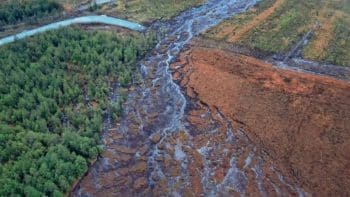
Invis Energy and An Bord Pleanála caused a bogslide in Donegal
by admin
Even when it appointed a proper environment correspondent, George Lee, it diverted him to Covid-duties