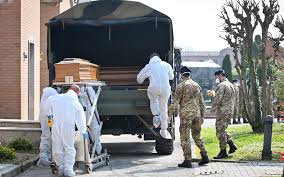
31 January Metaphorically, if not yet literally, coronavirus is on everybody’s lips in John Cabot, an American university in Rome where I teach. Most of our conversations revolve around the autocratic might shown by the Chinese government in shutting down an entire city of 11 million people, two and a half times the population of the Republic of Ireland, and, of course, we marvel at that time- lapse video of the hospital going up in just 10 days. Two Chinese tourists in Rome are hospitalised with the Corona virus, which prompts me finally to learn the name of that huge unknown city, Wuhan. I set my students a paper on epidemics, but remain comforted that the nationality of the tourists confirms my essentially racist belief that this is a Chinese thing. 9 February On the day my father, who embodies the concept of pre-existing condition, turns 80 in Dublin, the extent of the remarkable electoral surge of Sinn Fein is becoming apparent. I resist the temptation to triumphalism, and explain to my colleagues here in Rome, who, being professors, are practised at feigning polite interest in others’ academic obsessions, that the victory, similar to the victory in Italia 90 when Ireland hammered England 1-1 in Cagliari, has more to do with health and social justice than with reunification. For the next few weeks I luxuriate in long-distance outrage at the anti-SF machinations of Fine Gael and, especially, Fianna Fáil – the real class traitors. 21 February Two people, not Chinese, are hospitalised in Padua, one of whom then becomes the first Italian fatality. Seventeen new cases appear in Lombardy. The Italian government announces quarantine measures for anyone who has been infected. 22 February The region of Lombardy suffers its first coronavirus death, bringing Italian fatalities to two. There are 79 recorded infections in the country. 23 February Today is my son’s 21st birthday. He is up north in Tyrol skiing with friends. I worry slightly about enclosed cable cars full of coughing and snuffling holidaymakers from northern Italy. I just hope my son won’t bring it home with him, because now, with 25 new cases in Veneto, the ghastly symptoms of the disease are being talked about. When my sleep apnoea jolts me awake at night gasping for breath, it now takes me longer to calm myself. A third person dies in Crema (Lombardy); there are now 152 recorded infections. My old schoolmate Eamon Ryan, whose father, Bob, was a very kind mentor to me in the Dublin of the 1980s, is putting a brave face on the poor showing of the Greens. England hammers Ireland at Twickenham, and my interest in the 6 Nations tournament, Italy being my other team, evaporates. Surgical masks vanish from pharmacies in Italy. 24 February Three more deaths in Lombardy, one in the beautiful hill-top town of Bergamo, from whose city walls, on a rare clear day when the mists and industrial smog of the Po Valley have dissipated, the view extends all the way to Milan, which stands at the centre of what is essentially a single vast city the size of seven provinces. Only by looking for the 16th-century bell towers and 20th-century chimney stacks is it possible to distinguish from the sprawling conurbation the industrial and post-industrial towns of Stezzano, Dalmine, Brembate, Trezzo sull’Adda and, in the distance, Monza, Cologno Monzese, and Gorgonzola, and finally, the dim outlines of the new skyscrapers of Milan, markers of the stubborn economic survival of this part of the country in the midst of Italy’s 25-year-long economic slump. 25 February The Italian government closes schools, universities, public offices, museums and lawcourts in the regions of Emilia-Romagna, Friuli-Venezia Giulia, Lombardy, Veneto, Piedmont and Liguria. Travel outside the infected zones is prohibited. 27 February Veneto now has 111 cases, 42 of them in the tiny hamlet of Vò. Two of its inhabitants die, and over the next few days everyone there is tested. Less than 2% are positive. Cases are reported in Tuscany and Emilia-Romagna, where the victims are reported as having returned from abroad, almost as if to emphasize the non-endemic nature of the disease. Ireland gets its first case, a woman who travelled from Dublin to Belfast and thus solomonically resolved the problem of which side of the border deserved the first blame. 28 February My daughter flies from Rome to Dublin to interview my father for her Master’s thesis on Irish literature. She packs a surgical mask – an extravagance, but my father is poorly, and people are beginning to look askance at Italy. Touchy about these things, I detect some cultural stereotyping in Ireland and the UK of the tactile, gesticulating all-living-together Italians, an attitude that my father’s late friend Edward Said would have called orientalism. 3 March Covid-19, as the infection is now being called, reaches the French-speaking region of Aosta, the last hold-out of Italy’s twenty regions. My daughter returns from Dublin, having not met my father face-to-face after all, but having stayed with my active and healthy mother (81). Rumours begin to circulate in my university that the students, most of whom are non-Italian, might take fright and start returning to their homes. My classes remain full. An Irish woman who returned from Italy becomes the second case on the island of Ireland and the first in the Republic. 4 March Owing to the impossibility of quarantining only some cities and provinces, the Italian government of Giuseppe Conte issues an emergency decree declaring the entire country subject to restrictions of movement, and orders schools and universities across the entire country closed. 5 March My university calls a meeting of all professors and instructors, and tells us to prepare for remote teaching. The closure almost coincides with the spring break, which mitigates the sense of upheaval. Even so, the mood at the meeting is an odd mixture of detached amusement, disbelief, confusion and anxiety. 6 March The Ireland v. Italy rugby international, my least favourite game of the tournament, is suspended, but Italian fans from the rugby-playing north of the country continue to arrive in Dublin. The number of recorded cases in Italy now exceeds 3,000, almost all in Lombardy and Veneto. The death toll is 107. 7 March My daughter and her boyfriend along