admin

  • Posted in:

    Labour: dynamic role for State, climate action and genuine equality

    Sinn Féin is the only party in Europe claiming left and Green credentials that opposes both a property tax and carbon tax. By Brendan Howlin. According to Irish Times’  focus-group research, undecided voters are overwhelmingly in favour of change, but they’re struggling to decide which party represents the change they want to see. However, according to the opinion polls, a possible outcome of this election is no change at all. With Fianna Fáil and Fine Gael refusing to coalesce with each other, and with both of them ruling out coalition with Sinn Féin, the polls throw up figures where it may be that neither party can form any sort of government except another arms-length, noses-pinched, ‘confidence and supply’ agreement. The breakup of old-style politics, based on divisions from the Civil War, means a gradual reorientation towards the politics of ideology. But the change isn’t smooth or straightforward. For all the traditional and personal animosity between Fianna Fáil and Fine Gael, even their supporters are finding it harder to tell them apart, as can be seen in recent vote-transfer patterns. In the longer term this is a good thing but, in the short term, their mutual antagonism is delaying the inevitable and is still presenting a bogus choice to the electorate – which threatens to paralyse future government formation. I don’t yet trust Sinn Féin as a progressive alternative. It is still a party of protest and opportunism, fomenting crises for its own advantage. It protests against Brexit now, but it did not campaign at all in Northern Ireland during the Brexit referendum. In reality, Sinn Féin could not bring itself to defend the European Union. It has campaigned for No in every single one of our EU referendums. It is as Euro-sceptic as the Tories – not a policy Ireland needs in government right now. Sinn Féin’s interest in Brexit is to ramp up concerns about the border and demand a poll on Irish unity. The party with a history of doing more than any other to sustain bitterness and division on our island now wants to pour more fuel on the fire. And Sinn Féin is in thrall to populism. Comically, it presents itself as both left-wing and eco-aware but it is the only party in Europe claiming left and Green credentials that opposes both a property tax and carbon tax. Labour is a European political party. We have a vision of how Ireland can become more like other European countries – countries that have built enough homes for their people and have provided good-quality, universal healthcare. Countries that have reliable public transport, excellent schools and strong rights for people at decent, well-paid work. The children of Reagan and Thatcher put their faith in the market. Whether it is Fine Gael’s conviction – in the teeth of all the evidence – that the market can resolve our housing crisis or Fianna Fáil’s recourse to the Treatment Purchase Fund to cut down hospital waiting lists, our two centre-right parties have conspired together to strip our State of its capacity to provide decent services for our citizens. And they have wasted the public’s money, hand over fist. This Government’s aversion to decent public services provided by a well-run public service means that we have an HSE recruitment embargo, with almost €1 million every day spent on agency staff instead. Fine Gael’s love affair with business means that it will give away ownership of our national broadband network and that we’ll end up with the most expensive hospital ever built in the world. Labour stands for a dynamic role for the State, working responsively and accountably. We believe that Ireland should aim to be in the top 10 countries for quality public services, climate action and genuine equality. There is a lot to be done. Nearly a quarter of workers are on low pay, and many jobs are insecure. Around 10,500 people are homeless, including nearly 4,000 children, and housing is too expensive for those on ordinary wages. People are not getting the medical care they need due to waiting lists and overcrowding. We produce too much pollution, waste and greenhouse gases. One in every 10 children is brought up in consistent poverty. Labour wants to build homes, fix health and provide better pay and job security. We’re committed to a fair start for every child, better work-life balance and socially just climate policies. Building an Equal Society, our manifesto, available on www.labour.ie sets out our vision – and our core redline commitments. But our ability to do this depends on our level of support in this election. That is why it is so important for you to vote Labour on Saturday. And, because it will fall to Labour and other progressive, constructive parties to work together towards a better future for our people, I’m also asking you to give your preferences to the other progressive parties and candidates in your area. Let’s end the waste of public money, build homes and fix health. Brendan Howlin, TD for Wexford, is leader of the Labour Party

    Loading

    Read more

  • Posted in:

    Left government needed.

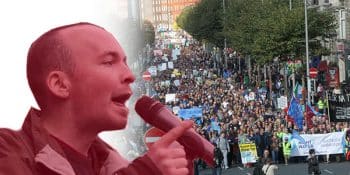
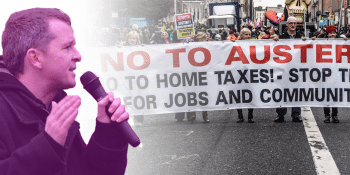
    The danger is that votes to break the cycle of Fianna Fáil and Fine Gael will be used to keep the merry-go-round spinning. By Paul Murphy. This is a change election. A majority of people are now indicating support for parties other than Fine Gael and Fianna Fáil. Is it any wonder? With crises in housing, health, childcare, education, additional needs and disability services, on top of completely inadequate action on climate change, it’s no surprise that people are fed up with parties that serve the rich while we struggle to get by. A brief look at the history of politics in the Irish state is enough to confirm that no substantial political change will come about from FG or FF in government. That is widely understood in working-class communities, where the overwhelming desire of people is to kick both of those parties out. Having been responsible, together with Labour and the Greens, for the bank bailout and brutal austerity which followed, people want them gone.  The Sinn Féin surge, as well as the Green wave taking place in a different part of the electorate, are reflections of that wish for change. The tragedy of Irish politics is that on many occasions in the past, that wish for change has been betrayed by Labour and the Greens. Votes to break the cycle of Fianna Fáil and Fine Gael were used to keep the merry-go-round spinning. There is a real danger of this being repeated in this election. RISE and People Before Profit have issued numerous calls on Sinn Féin to rule out coalition with Fianna Fáil or Fine Gael. Unfortunately, Mary Lou McDonald’s answer was clear – she refused to do it and spoke about the necessity to be prepared to go into government. While a Fianna Fáil and Sinn Féin government would not be a direct repeat of Labour or the Greens in government, the same fundamental process would be at play. Fianna Fáil representing the capitalist class in this country would block the change that Sinn Féin voters are hoping for. For example, there is no way that Fianna Fáil would agree to a rent freeze that is the minimum necessary to give renters a break. Such a freeze would hit the bottom line of the one in three Fianna Fáil TDs who are landlords, and more importantly the big landlords whose class interests they represent. Even at this late stage, if Mary Lou McDonald came out clearly and said she won’t be voting for Varadkar or Martin or any candidate from FF or FG for Taoiseach and that she wants to lead an alternative government, this dynamic in the election against FF and FG could be further strengthened. Sinn Féin doesn’t have to look to coalition with the right-wing parties to form a government. The forces outside Fianna Fáil and Fine Gael could continue to grow in the final week of the campaign and have a potential majority in the Dail.  In those circumstances, what should the socialist left do? In the first place, we should vote against the formation of any government involving FF or FG. We should then use our votes in the Dail to allow an alternative government to come to power. Then we should vote consistently in the interests of working-class people. Outside the Dail, we should seek to help build the biggest possible people power movements to demand the radical change we need, including separation of church and state, the repeal of the Industrial Relations Act, and the abolition of Direct Provision. Should the socialist left join such a government? That depends on what policies that government would implement. If it is to be a government that accepts the right of big polluters to maximise their profits, of corporate landlords to maximise their rent and employers to minimise the wages they pay, and only attempts a better redistribution of the crumbs, then that government will ultimately betray its promises, and we should not participate. Instead, the kind of left government with socialist policies that we would participate in is one that would challenge the rule of the 1% in this state and open the door to fundamental socialist change. Essential red lines would include; a commitment to take on the big landlords and developers by eliminating the housing list within three years and cutting rents including through nationalisation of the big corporate landlords and introducing a new model of public housing accessible to all; to commence the building of a single-tier properly resourced National Health Service by taking private hospitals into public ownership and incorporating them into the public health service; and to cut net carbon emissions by 10% a year, which would require public ownership of the big polluters. Regardless of the outcome of the elections, recent years have shown that change can be won when people take the streets in their tens of thousands to demand it. The water charges movement remains an important reference point for large sections of the population who experienced a sense of their own power. Repeal and 12 weeks on request were also not delivered from on high by a liberal government, but driven from below. The emerging global climate movement, including the school students strikes and Extinction Rebellion, can demonstrate the same pattern. It is no accident that the socialist left was to the fore in all of these movements. Our vision for socialist change is based on the desire of working people for a better, fairer and just world, and our ability to bring that about through collective mass action.  We used our platforms in the Dáil and the media to advocate for the strategy and tactics that were necessary to win – for example spreading the idea of mass non-payment, which was crucial to defeat the water charges. Outside the Dáil, our resources were used to build these movements and organise in communities. Inside the Dáil, Solidarity-People Before Profit has punched far above its weight. We have proposed and passed crucial legislation

    Loading

    Read more

  • Posted in:

    Break the cycle of Fianna Fáil and Fine Gael control.

    Solidarity-People Before Profit represent people power and – unlike Labour, Greens and SF – will never prop up FF/ FG. By Richard Boyd Barrett. For nearly 100 years, this country has been run by two conservative parties, Fianna Fáil and Fine Gael. The legacy of their rule is under-funded public services. We have the highest creche fees in Europe, the longest hospital waiting lists and, after Brexit, the highest third-level fees in the EU. The two conservative parties are ideologically opposed to taxing wealth and to strongly interfering in the private market.  One in three of Fianna Fáil and Fine Gael TDs are landlords and so they have a vested interest in high rents and property prices. It is no wonder that they refuse to implement proper rent controls and support measures that increase property prices and aid property speculators. Solidarity-People Before Profit want to Break the Cycle of Fianna Fáil and Fine Gael rule. For years, this seemed a distant dream, but recent polling evidence shows a striking change. The two conservative parties now only command the support of less than half of the electorate. We can start to make a change in this election – and see the back of control by Fianna Fáil and Fine Gael into the future. Of course, the mandarins in RTE want to pretend that we still live in a two-party Tweedledum and Tweedledee system – so they give us a television debate between the ‘two leaders’. Yet on the doorsteps it is abundantly obvious that many see these parties as having almost the exact same polices. There is a wind of change sweeping across Ireland, as was evident in the votes on marriage equality and Repeal. That change is now starting to blow apart an old political system with more than 50% of people looking to vote for parties other than Fine Gael and Fianna Fáil.  There is, however, one potential major obstacle to the change. Namely, that parties which talk left today enter a coalition to prop up Fianna Fáil or Fine Gael tomorrow. This produces an old cynical game where promises are dropped and the focus becomes on ‘managing the economy’ and being realistic. There is absolutely no possibility of developing high-quality public services if you join neoliberal parties like Fianna Fáil or Fine Gael in coalition. That is why People Before Profit give you an absolute guarantee –  a vote for us will never be used to prop up a Fianna Fáil or Fine Gael in government. Unfortunately, others  – such as Labour the Greens and even Sinn Féin – say they are prepared to join them in coalition. But look what happened when Labour joined coalition last time. They gave us water charges and an increased pension age. Or when the Greens joined Fianna Fáil – they presided over the cutting of 300 buses from the Dublin Bus fleet. In the South, Sinn Fein have been vociferous in calling for a restoration of the pension age to 65. But in the North, when they were in coalition with the right-wing DUP, they supported an increase to 66. No matter what they say, the same will happen again to any party that joins Fianna Fáil or Fine Gael in government. Solidarity-People Before Profit believes Ireland needs real change. We stand for an old-style policy of re-distributing wealth. We want to tax the billionaires, the big corporations and vulture funds to raise enough revenue to develop high quality public services. Specifically, we want to: 1.      Restore the pension age to 65. 2.      Bring in proper rent controls that allow for rent reductions 3.      Stop sales of public land – use it for social and affordable housing. 4.       Take Radical climate action – Free public transport and keep fossil fuels in the ground 5.      Guarantee 33 hours a week free childcare 6.      Scrap fees for third level education 7.      Create a health service that treats patients according to medical need -not the size of their wallet 8.      Abolish property tax on family home and USC tax on those who earn under €90,000 9.      Develop proper services for the disabled and those with special needs. These are our polices but we don’t just oppose, we organise.  We have achieved real change by helping to build ‘people power’ campaigns and mass movements. Look at the defeat of water charges and Repeal. Look at how French workers stopped a rise in their pension age with mass protests. We could do the same here. That’s the change you need.

    Loading

    Read more

  • Posted in:

    Assessing the parties’ health manifestos.

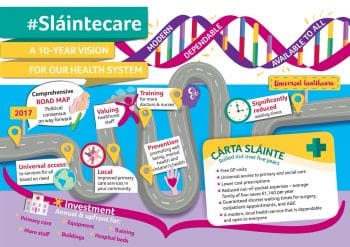
    In terms of the range, imagination and costedness of progressive health policies, Sinn Féin is in front, though Fianna Fáil’s is scrupulously budgeted for and the Social Democrats’ most orthodox. By Michael Smith All of Ireland’s political parties have signed up to Sláintecare which should be implemented by the end of 2028. That’s the key background to their manifestos which show variations and detail on what is now the template. Apart from Solidarity which has an appealingly short health manifesto including secularisation of hospitals and nationalisation of all private health and pharmaceutical enterprises, differences in policy are therefore largely about how the parties would prioritise elements of Sláintecare.   Though in fact Sláintecare does itself lay out a timetabling of priorities. This means there is an anomaly between many parties’ support for Sláintecare up to 2029 including its timetable, and budget; and their proposals of separate interim timetables and budgets during the next, five-year, term of government.  Presumably, if they frontload expenditure into the first five years when Sláintecare envisages a longer rollout, then there will be less expenditure in the second five years.  Otherwise, the parties are implicitly disassociating from what they have all agreed as the central planks in their health policies. Extra expenditure during the term of the next government will have to come from the €11bn ‘fiscal space’ over five years projected by the Department of Finance and accepted by most parties.  Beyond this, the parties have tacked on special pet projects.  But these are likely to be compromised by coalition or partnership negotiations. Past performance is something of a guide to future performance so it is worth looking at the history of parties, particularly Fine Gael and Fianna Fáil, in drawing and implementing health policy in the State.  Implementation of health policy will be largely determined by Sláintecare with the parties’ longstanding ideologies a guide, especially on immediate funding and their indulgence of some pet projects though not necessarily the ones listed in manifestos.   On Health Policy Village cautions caveat emptor; there is every possibility there will be little change. This guide synopsises parties’ policies.  If transposition results in any mistakes Village would be pleased to correct them. Because there is such overlap the most instructive thing we can do is highlight original and different approaches, in bold. History of Health policy in Ireland In the second half of the 1940s, after it was instigated in the UK, a National Health Service was promoted by Fianna Fáil and even made it as far as a White Paper. But Ireland never got a single-tier health service, at first because of medical-profession lobbying supported by the Fine Gael Opposition, then because of-church opposition, and then because of medical-profession lobbying and revised Fianna Fáil ideology.  Donogh O’Malley, the hero of free secondary education, was against ‘socialised medicine’ when Minister for Health (1965-6): “those who could pay should pay”. The two-tier, medical-card, system of access to hospital care is a construct of Fianna Fáil governments, albeit never seriously challenged by any other party in government.  With no vision for the health system, Fianna Fáil threw money at healthcare in the late 1970s only to cut back savagely in the late 1980s. Between 1986 and 1993 over a third (5500) of beds were cut nationally.  The health budget quadrupled from under €4 bn in 1998 to over €15bn in 2008, largely playing catchup after Haughey-era cuts; and to €17.8bn in 2020.  2000 beds were cut in 2009 under Fianna Fáil/Greens/PDs but Fine Gael have put back  around 900 since 2011. In the last government HSE staffing increased by 8,868 to 119,126 by the end of last year. HSE management/administration employees increased by 2,042, an extra 328 consultants were appointed and there were 2,008 more nurses, according to Department of Health figures. Because of the shortage of hospital beds, the average hospital stay in Ireland at 6.2 days is much shorter than the OECD average of 8.2 days; and Ireland hospitalises far fewer patients, at 139 per 1,000 of the population annually, compared with an OECD average of 169. Fianna Fáil, under Finance Minister Charlie McCreevy (1997-2004), gave generous tax breaks to developers to build private nursing homes and hospitals: although it was government policy to have fewer, bigger, safer acute hospitals, another arm of government was giving away public money to build small, profitable, unregulated hospitals anywhere they decided, totally contradicting the policy.  In 2001 it gave and in 2008 it took away, un-means-tested medical cards for over-70-year-olds, recently reinstated by Fine Gael, the government then had to negotiate a very bad deal with GPs who (led by James Reilly who later finished up as a bad Minister for Health) squeezed the pips. As a result, GPs were paid three times the rate for looking after richer over-70s than those who already had medical cards. This skewed GP services so that doctors were paid more to provide care to those who needed it least.  The establishment of the HSE is the biggest public-sector reform in Irish history. Prepared by Mícheál Martin but executed by Mary Harney it was badly planned, leaderless for its first seven months, without structures, a clear plan for redeployment of staff who’d been organised on a county level, or a vision specifically to provide universal, quality care. There have been numerous attempts to reform but without any real transformation. The renegotiation of the consultants’ contract a decade ago was a lost and expensive opportunity at enormous expense to reform the Irish health system but it is only very recent and exorbitant proposals to pay €250,000 – twice what Britain’s NHS pays – to consultants to practise only publicly are something of a start.  A White Paper on Universal Health Insurance was published in 2014 with a report on the potential costs of the White Paper model published in November 2015. The debate was always too much about the cost of this rather than on how a focus on insurance might actually serve the presumed goal of universal healthcare. In the

    Loading

    Read more

  • Posted in:

    Green and Red: Ecosocialism and Ireland

    Ecosocialism promises more equitable social relations and less damaging, extractive technologies; a society that serves people rather than capital. by Niall Flynn Since survival of our species is at stake, all politics today, whether explicitly or otherwise, are ecological politics. Following this premise, all elections are now climate elections.  This, again, was supposed to be Ireland’s climate election, but it has not transpired that way. Health and housing have taken precedence, with climate in the back seat in much of the discussion happening around the country, as well as in the televised leaders debates. This may be traced to the fact that, as an article in Village claimed earlier this week, Ireland just does not get the environment. In this country, policy promises are broken and legislation goes unimplemented. Raising the problem of responsibility and obligation, the article by Village’s editor defends a progressive carbon tax through which “the richest corporations should be hammered but all of us should get a price signal”. In 2019, the ESRI published a report that showed how a well-designed carbon tax does not necessarily hurt poorer parts of society, and could in fact reduce inequality. The economics of carbon pricing remain contentious for now, retaining leverage across the political spectrum. In other words, the same mechanisms can be used to different ends: for right-wing environmentalism or for a progressive and equitable environmental politics. Smith suggests it is not clear whether Ireland’s Green party is of the left, and there is certainly a question mark as to whether we have an environmentalism in Irish life and politics today that understands how political, economic and ecological crises are entangled, and that works for normal, working people. With the current election campaign in full flow, it is worth focusing more on this. Free Market at a Crossroads Environmentalism has gone mainstream, with responses coming from diverse sectors of society. It is fair to say that forces like Greta Thunberg and Extinction Rebellion, and the mass media coverage they attract, have transformed the global political scene for the better.  In Ireland, many interest groups are offering their own manifestos on what climate action and policy in Ireland should look like. Often accompanying these manifestos is a critique of mainstream environmental politics. The Greens, for example, have come under fire for regressive taxation policy and for confused infrastructure plans. Even within the party, there is a struggle for policy direction, and differences around key topics like carbon tax and reducing the national herd. At the same time as environmental awareness is rising, institutions like the OECD and World Bank still believe in economic expansion, and seek to mitigate ecological disruption through technological solutions. Cracks in the system are beginning to appear as the realisation occurs that the dominant market power defended by these global organisations is necessarily challenged by ecological awareness and actions. Free-market capitalism has arrived, in disorienting fashion, at a crossroads. Mainstream Environmentalism Lacking Environmental politics in Ireland face a strong agricultural industry and a tax-averse populace. More troubling though is the political indifference that has emerged during this campaign. Lack of political will is the intractable barrier to sincere and concerted action on this fundamental issue.  Inaction on climate crisis is simply bad economics. More-than-decade-old warnings, such as the UK Government’s 2006 Stern Review on the economics of climate change, have not been heeded. Predictions about coming economic conditions continue to worsen, and all informed commentators agree a tardy response to climate crisis will far outweigh the costs of prompt and decisive action. Despite progress like the internationally leading Fossil Fuel Divestment Bill and innovative Citizens’ Assembly recommendations on climate action, Ireland is a poor performer in addressing EU and international ecological targets. The country is ranked low – and the worst in the EU – on the Climate Change Performance Index, which states that “near-term ambition needs to be ratcheted up quickly”.  Successive governments are not doing enough on this, and continue to fudge key issues like agriculture and transport. While the current government has gone further than predecessors, it is nowhere near enough. The target of reducing carbon emissions by 2% per annum should be at least 10% for the likes of Ireland, the Science implies. Nonetheless, General Election 2020’s party manifestos broadly represent more of the same: capitalism and incremental worsening of conditions. The major parties are wedded to market solutions and an economically-driven worldview. This is not adequate to the multiplying conjunctures of ecological crises. Looking to the UK, Labour’s recent General Election manifesto was a proportionate response to ecological crisis, which built upon principles of social justice and a vision of a radical Green New Deal. With the emergence of UK Labour as a force for social and ecological justice in their recent General Election, the UK Greens lost their central identity, and thus their legitimacy as an electoral force. Notwithstanding adroit politicians like Catherine Lucas, the Greens in the UK have been consigned to a fate of making minor, tokenistic manoeuvres without the ability to effect real change in the UK’s political landscape. In Ireland, however, the Greens still have a vital role to play. Indeed, Eamon Ryan asserts a strong agenda of ecological and climate action. At the same time, however, mainstream green politics are lacking teeth. Going forward, Ryan and his Greens must forcefully articulate a more radical, progressive environmentalism. This would supplant an environmentalism aimed at tackling individual patterns of consumption, which reproduces a neoliberal mindset.  A legitimate fear surrounding this dominant form of environmentalism is that impoverished people will bear the brunt of the costs of climate action. According to Social Justice Ireland’s Election 2020 Briefing, rural Ireland – with its low rates of meaningful work, and access to services and infrastructure – is particularly at risk from regressive climate action. Under current proposals, rural areas and agricultural communities would be disproportionately impacted by low-carbon policies and the push for green jobs. Conservative environmental policies also inform a media culture through which individuals become scapegoats for broader questions

    Loading

    Read more

  • Posted in:

    Only vote Green if they show more hard-mindedness and discipline.

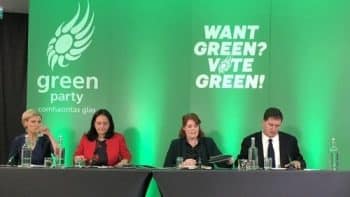
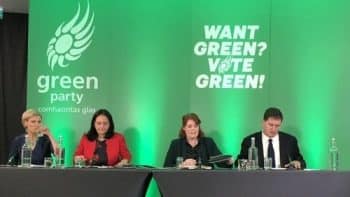
    Even in the climate emergency the Greens are all carrot and no stick.  By Michael Smith. I attended the Greens’ manifesto launch last Saturday in the Radisson Blu hotel near Dublin Castle.   I did it because, more than for any other party, their agenda – Green – matters. Being well-disposed I wanted to assess their fitness to deliver it. The media were there in force and about a hundred fairly presentable Green activists were on hand.  There would be internal training afterwards.  On the podium were three leaders of the party.  The first two spoke mostly about particular sectoral issues, reading from scripts.  Then Eamon Ryan gave a bit of a framework to it, some vision, an aspiration to ten areas where the Greens wanted more ambition, and an ambition to 15 seats which everyone seemed especially excited about.  He said something, again, about senior hurling.  There didn’t seem to be many hurlers in the crowd.  Nearly half of the candidates in Dublin went to rugby-playing Gonzaga which brings its own biases.  Then there were questions, led by Brian Dobson and the Irish Times‘ Green Party person, Harry Magee.  The questions were mostly what a non-Green would ask, with a fiscal bias.  Harry asked about insulation, and the budget for it. Eamon Ryan said if Ireland was to reach its emissions reduction goals it will need to spend a total of €50 billion over 20 years to retrofit 750,000 houses to improve energy efficiency. I asked what they’d do about implementation of their agenda bearing in mind the problems with that the last time they were in Government.  Eamon Ryan – an almost pathologically benign optimist – said what he always does, that you can achieve a lot in government (they didn’t) and that half the reduction in carbon in the period after they entered government was due to their efforts – the other half due to the fact the imploded economy meant fewer people needed to get to work.  He didn’t mention that any incursion on the soaring emission figures was highly temporary, and the energy improvements around that time were forced by the EU.   I asked what they would do about sprawl.  The answer was delegate more decisions to the community level.  That is the right answer to nearly all questions.  But not to this one.   The answer is ensure the already-agreed National Planning Framework is implemented not just referred to.  Indicatively, actually the Greens’ manifesto doesn’t even refer to it…or scandalously, outside of transport and climate, even refer to Planning. Nobody addressed my question on quality of life. It is elementary that environmentalists think quality of life should be measured, across a range of indicators, so it can be advanced instead of pursuit of a simple economic GDP metric. This is one of the biggest features of a green agenda. But there’s no reference to it in the manifesto. They didn’t advance it the last time they were in government, and clearly they won’t do it this time if they’re elected. The Green candidate in Dublin Central, Neasa Hourigan, often an impressive presence, mistook my question about introducing a constitutional referendum to reduce the power of property rights in order to promote a general pro-planning agenda for a question about housing.  They seemed to be improvising on central policy issues. This would not matter if it were not probable the Greens will shortly be in government and if they had not achieved so little last time out.  For it proves they have not learnt their lessons.  When asked about what the Greens had learnt from being in government the last time out, and the question wasn’t particularly directed at the environment, then-aspirant-MEP Ciaran Cuffe stated that it was not to go into government in the worst depression in generations.  That was not the right answer to give.  Remember, this is the party that justified going into government with dodgy Bertie Ahern on the basis that the climate imperative necessitated it, and yet which failed to pass a climate act in three and a half years, leaving only a toothless climate bill as their legacy. The Greens needed, indeed still need, to be tougher and more strategic.  They need to plot out want they need to achieve in government, in particular policies;  and to monitor its success.   Just as you can monitor economic growth month to month they should be monitoring, quality of life, air quality, mortality rates and development patterns month to month; and adjusting policy to achieve clear strategic goals.  The Greens’ manifesto is fairly thin – by comparison with Sinn Féin’s magnificently unwieldly one for example – but imaginative and progressive.  It’s great to see a proposal for an 80% tax on windfall rezoning profits and the Green Party is serious about a site value tax. Implementing the Kenny Report on public compulsory acquisition would be exciting.   I would find it difficult to argue with almost any of it as far as it goes.  Though unfortunately it is not always entirely clear that it is a party of the Left, or that it favours radical redistribution.  Though they support the radical measure of a universal basic income, their section on ‘Equality’ illuminatingly doesn’t mention income or wealth equality.  It’s not even that detailed on the environment.  There’s nothing on architecture or design. Or on urbanism; or on curtailing sprawl and one-off housing. There’s a bit on density but nothing on high-rise. Nothing from the Greens on Planning. It just doesn’t figure in the manifesto. Ciarán Cuffe must have been asleep. The Greens aren’t going to stop one-off housing – as that would generate an unholy row.  And their approach to the suckler herd is likely to be as gentle as that of the Polish government to coal-mining.  It’s an exception where we have a competitive advantage after all. And the lobby is frightening.  Anyway, it calls for a 7 per cent per year fall in emissions to reach the EU CO2 reduction target of a minimum 50 per cent by 2030. The current government target is a 2 per cent annual reduction. The Greens also want net zero

    Loading

    Read more

  • Posted in:

    Only vote Green if they show more hard-mindedness and discipline.

    Even in the climate emergency the Greens are all carrot and no stick.  By Michael Smith. I attended the Greens’ manifesto launch. I did it because, more than for any other party, their agenda – Green – matters. Being well-disposed I wanted to assess their fitness to deliver it. The media were there in force and about a hundred fairly presentable Green activists were on hand.  There would be internal training afterwards.  On the podium were three leaders of the party.  The first two spoke mostly about particular sectoral issues, reading from scripts.  Then Eamon Ryan gave a bit of a framework to it, some vision, an aspiration to ten areas where the Greens wanted more ambition, and an ambition to 15 seats which everyone seemed especially excited about.  He said something, again, about senior hurling.  There didn’t seem to be many hurlers in the crowd.  Nearly half of the candidates in Dublin went to rugby-playing Gonzaga which brings its own biases.  Then there were questions, led by Brian Dobson and the Irish Times‘ Green Party person, Harry Magee.  The questions were mostly what a non-Green would ask, with a fiscal bias.  Harry asked about insulation, and the budget for it. Eamon Ryan said if Ireland was to reach its emissions-reduction goals it will need to spend a total of €50 billion over 20 years to retrofit 750,000 houses to improve energy efficiency. I asked what they’d do about implementation of their agenda bearing in mind the problems with that the last time they were in Government.  Eamon Ryan – an almost pathologically benign optimist – said what he always does, that you can achieve a lot in government (they didn’t) and that half the reduction in carbon in the period after they entered government was due to their efforts – the other half being due to the fact the imploded economy meant fewer people needed to get to work.  He didn’t mention that any incursion on the soaring emission figures was highly temporary, and the energy improvements around that time were forced by the EU.   I asked what they would do about sprawl.  The answer was delegate more decisions to the community level.  That is the right answer to nearly all questions.  But not to this one.   The answer is ensure the already-agreed National Planning Framework is implemented not just referred to.  Indicatively, actually the Greens’ manifesto doesn’t even refer to it…or scandalously, outside of transport and climate, even refer to Planning. Nobody addressed my question on quality of life. It is elementary that environmentalists think quality of life should be measured, across a range of indicators, so it can be advanced instead of pursuit of a simple economic GDP metric. This is one of the biggest features of a green agenda. But there’s no reference to it in the manifesto. They didn’t advance it the last time they were in government, and clearly they won’t do it this time if they’re elected. The Green candidate in Dublin Central, Neasa Hourigan, often an impressive presence, mistook my question about introducing a constitutional referendum to reduce the power of property rights in order to promote a general pro-planning agenda for a question about housing.  They seemed to be improvising on central policy issues. This would not matter if it were not probable the Greens will shortly be in government and if they had not achieved so little last time out.  For it proves they have not learnt their lessons.  When asked about what the Greens had learnt from being in government the last time out, and the question wasn’t particularly directed at the environment, then-aspirant-MEP Ciaran Cuffe stated that it was not to go into government in the worst depression in generations.  That was not the right answer to give.  Remember, this is the party that justified going into government with dodgy Bertie Ahern on the basis that the climate imperative necessitated it, and yet which failed to pass a climate act in three and a half years, leaving only a toothless climate ‘bill’ as their legacy. The Greens needed, indeed still need, to be tougher and more strategic.  They need to plot out want they need to achieve in government, in particular policies;  and to monitor its success.   Just as you can monitor economic growth month to month they should be monitoring: quality of life, air quality, mortality rates and development patterns month to month; and adjusting policy to achieve clear strategic goals.  The Greens’ manifesto is fairly thin – by comparison with Sinn Féin’s magnificently unwieldly one for example – but imaginative and progressive.  It’s great to see a proposal for an 80% tax on windfall rezoning profits and the Green Party is serious about a site value tax. Implementing the Kenny Report on public compulsory acquisition would be exciting. Environmental journalist John Gibbons has applauded its plan to increase the amount of Irish land farmed organically to 20 per cent by 2030.  I would find it difficult to argue with almost any of it as far as it goes.  Though unfortunately it is not always entirely clear that it is a party of the Left, or that it favours radical redistribution.  Though they support the radical measure of a universal basic income, their section on ‘Equality’ illuminatingly doesn’t mention income or wealth equality.  It’s not even that detailed on the environment.  There’s nothing on architecture or design. Or on urbanism; or on curtailing sprawl and one-off housing. There’s a bit on density but nothing on high-rise. Nothing from the Greens on Planning. It just doesn’t figure in the manifesto. Ciarán Cuffe must have been asleep. The Greens aren’t going to stop one-off housing – as that would generate an unholy row.  And their approach to the suckler herd is likely to be as gentle as that of the Polish government to coal-mining.  It’s an exception where we have a competitive advantage after all. And the lobby is frightening.  Anyway, it calls for a 7 per cent per year fall in emissions to reach the EU CO2 reduction target of a minimum 50 per cent by 2030. The current government target

    Loading

    Read more

  • Posted in:

    The subtlety of Ireland’s leftward shift explained.

    Where they vote left, young  voters tend to focus on redistribution and inequality. Only 31% of 18-24 year olds and 32% of 25-34 year olds support Fianna Fáil or Fine Gael. By William Foley. Ireland is on the cusp of a general election which will see an unprecedented transformation of its political divisions. Surprisingly, it will be the first time in generations that questions of economic distribution will have affected the outcome. Evidence from opinion polls and surveys shows that where younger voters (under 29 years of age) reject the dominant right-wing parties they do so because they want greater economic equality. This gives the left a unique chance by focusing on their core issue – redistribution – to galvanise today’s youth to an egalitarian agenda  if, despite the failure of commentators to read the situation, they keep clear heads and take the opportunity. In postwar Europe, political parties in most countries traditionally competed over who got what, and how much. Parties were aligned along an axis – on the right were those who believed that the market should be the primary mechanism for determining the distribution of wealth, and on the left were those who believed that this distribution should be fixed in large part by the government.  Ireland has usually been regarded as an exception. Here, the main political division does not run between the left and the right.  Here it has not been between those who favour greater redistribution by the state and those who are against it, but between descendants of the opposing sides in the civil war. Those lineages may have some importance today – Fianna Fáil would probably not have attempted to rehabilitate the RIC – but what they amount to in practice is a system in which the vast majority of people have always voted for parties which have been economically right-wing, at least since Lemass.  This state of affairs has not prevailed because Irish people are inherently more right-wing than other Europeans. Political views are not the result of a simple transformation of broad values and social attitudes into party support; they are the indirect outcome of a process which filters those values and attitudes through a given ideological frame. These frames function like lenses, capable of magnification and diminution, distortion and concentration. Certain values may be filtered out – considered irrelevant for the determination of political preference. In Ireland, due to a conjuncture of historical reasons, left-wing ideological frames were largely absent.  Other factors were at play which determined political identities: the legacy of a brutal and traumatic civil war, the personalisation and parochialisation of politics, the hobbling of economic development under British imperialism, the passive role played by the Labour party from 1916 onwards, and so on. Questions which concerned the just distribution of resources were simply filtered out by the dominant post-civil war frame. Historically, the left has failed to pry even one finger loose from the FF/FG stranglehold. Parties such as Clann na Poblachta and The Workers’ Party occasionally sparked into life, achieving fleeting electoral success before flickering out like tealights in a children’s nursery. Because one of either Fianna Fáil or Fine Gael was usually in opposition, the see-saw effect of electoral politics meant that when one became somewhat unpopular, the other could take its place in government.  But the confidence and supply arrangement that prevailed in the last Dáil has meant that, while Fianna Fáil were not in the cabinet, they were not entirely in the opposition either. The economic crisis dealt them a blow from which they have not really recovered, nor have Fine Gael truly taken their place.  The result is that the two right-wing parties are more closely associated than ever – and more unpopular. Opinion polling since the general election seems to show them combined  on about fifty percent or less. Most striking is the age gradient: only 31% of 18-24 year olds and 32% of 25-34 year olds support either Fianna Fáil or Fine Gael, according to an Irish Times / Ipsos MRBI poll. If these trends hold true, then what appears to be emerging in Ireland is a more traditional “left-right” divide, characterised by competition between parties who favour more economic redistribution and those who oppose it. Survey evidence seems to support the increasing relevance of attitudes towards redistribution for determining party support. Figure 1 Support for redistribution and combined support (%) for FF / FG over time. Figure 1 makes use of Irish data from nine rounds of the European Social Survey (ESS) to illustrate this dynamic. Each round of the ESS asks respondents to indicate their support for the following statement: “Government should reduce differences in income levels”.  The respondent could say that they strongly agreed, agreed, neither agreed nor disagreed, disagreed, or strongly disagreed. I recoded the question so that everyone who strongly agreed or agreed was categorised as “supportive of redistribution” and everyone else was categorised as “unsupportive”, excluding those who didn’t answer the question (about 2.7% of the sample).  The ESS also asked respondents if they felt close to any party (about 36% did), and which party they felt closest to. I used this question to calculate the combined support for FF / FG over time, among those who are supportive and unsupportive of redistribution, excluding those who didn’t support any party. This relationship is shown in Figure 1. The data are weighted to reflect unequal probabilities of inclusion in the sample (though the unweighted results are the same), and the years given on the horizontal access correspond to the calendar years in which most of the Irish respondents were interviewed for each of the nine rounds of the ESS. These data probably overestimate support for Fianna Fáil and Fine Gael – at least compared to present opinion polls –  but the emerging relationship that they depict is valid.  As can be seen, preferences for redistribution matter a lot more after 2011. In the preceding years, those who are supportive and unsupportive of redistribution

    Loading

    Read more

  • Posted in:

    Left fails properly to address scandal of Direct Provision at election time.

    Loth in their campaigns to address minority issues, the mainstream parties have left all the momentum on immigration to the intolerant right. By Stacy Wrenn. For how long can something be ‘next’ before it’s allowed to become ‘current’? Direct provision has been referred to, in some variation, as ‘our next great shame’ in the mainstream media for years without experiencing this elevation. Working groups have come and gone, minor reforms have been made that benefit some asylum-seekers over others, and little has fundamentally changed.  Although it was established as a temporary measure for housing asylum-seekers awaiting refugee status in 1999, direct provision — or direct provision and dispersal as it is more accurately referred to — has remained constant in contrast to its perceived attention-worthiness. This fleeting public shame appears in bursts, often for months at a time, sparked by major events that essentially serve as reminders that the system still exists. In 2019, there were at least seven co-ordinated anti-asylum seeker protests in response to proposed accommodation centres, not including arson attacks on some of the properties themselves. On the morning of October 28th, the car of Sinn Féin TD for Sligo-Leitrim Martin Kenny was set alight in what was widely accepted to be a response to statements he had made in the Dáil the previous week condemning such protests. For weeks the Irish mainstream media had the direct provision system as their primary topic of conversation, with multiple discussions in the Dáil chamber after months of silence. With powerful addresses from Brendan Ryan, Labour Party TD, and Catherine Martin, Green Party TD, among others, it felt as if a meaningful national conversation had begun. A swathe of documentaries, think pieces, and media exposés followed on the history of direct provision, the experiences of various sub-groups, with the Joint Committee on Justice and Equality report finding it “no longer fit for purpose”. The fifth-anniversary conference of the Movement of Asylum Seekers in Ireland [MASI] saw greater engagement from wider civil society than any outreach event in previous years. Then Christmas came, the election was called, and it was as if none of this had happened. An argument could be made that it was difficult to maintain such momentum over what is traditionally a lull in the political calendar. However, this was also the optimal time to develop a coherent position to make direct provision an election issue, yet no left party sought to do this. Instead, the debate has focused on health and housing with little nuance — such as consideration of the experiences of those granted refugee status who are forced to remain in direct provision because of the shortage of affordable housing. With The National Party and Anti-Corruption Ireland running thirteen candidates between them on explicitly anti-immigration tickets, this is negligence that no progressive party can justify. The momentum on immigration in general and direct provision in particular, at election 2020, has all been with the intolerant right.  There is no doubt that the candidates on the right feel emboldened by the protests of last year:  it’s clear in the openness of their messaging. Standing with two thumbs up and a broad grin, the National Party’s Longford-Westmeath candidate and deputy leader James Reynolds unveiled a large roadside poster with the message: “There are too many immigrants. Enough is enough!”[1]. At the start of the election, one columnist in The Irish Times had the optimistic take that this was not something to be concerned about, explained by some ‘attitudinal trends’ from European Social Surveys between 2002 and 2018. He claimed that the general public has reached the point of being so positive about immigration that any party that advocated for increased controls would be at a disadvantage: “Indeed, political parties both small and large that aim for broad-based support across Irish society would stand to lose more votes from adopting an anti-immigrant platform. While there is possibly some room for Independent political candidates to gain votes from playing the immigrant card this is likely to remain localised and context-bound – at least for the present time”.[2]   This would make sense if we were in a different political climate. Alongside the manufactured struggle for resources that is the housing crisis, the threshold of what is publicly considered racist is consistently raised higher and higher – the increasingly frequent debates about ‘culture wars’ online and ‘snowflakes’ testifies to this. This has enfranchised voters on doorsteps across the country, according to canvassers, to raise the need to ‘house our own first’, apparently generating heterogeneous responses across the political spectrum.  It’s likely that if Fine Gael are to remain in government, they will continue with their cycle of working groups and consultations, and the occasional rehashed press statement about Albanian and Georgian immigrants. And in an interview with JOE.ie the leader of Fianna Fáil, Micheál Martin who knows the importance of care in language when dealing with issues of tolerance, seemed to be taking the side of both the protestors in Oughterard and Rooskey and those who criticised them by saying that while some groups did exploit the “fear of the unknown”, only “some” of it was “completely unfounded”.[3] Although their candidates have been actively organising under the banner of United Against Racism and their track record is good we may take People Before Profit as an exemplar of how even the progressive parties do not have thought-through policies in in their manifestos though they do briefly state that they would “end Direct Provision and give asylum seekers the right to work”. This is a slogan, not a policy. There are no commitments to alternative accommodation or allowances, or indications on how they would implement this in practice.[4] Although election manifestos are predominantly communications exercises, the absence of detailed policies in relation to accommodation, welfare, and education, suggests that implementing their limited policy could leave many asylum-seekers in a worse position than now. One party to directly address the sensitive topic of asylum-seeker accommodation in its manifestos is the Green Party, which in the ‘Migrant Integration’ section aims to end

    Loading

    Read more

  • Posted in:

    Keeler Concealer: the British Establishment’s severe embarrassment at the depth of the Soviet Union’s penetration of MI5 and MI6.

    By David Burke The BBC’s lavish Christine Keeler drama concealed her claim that the Director-General of MI5 was a Soviet mole and ignored what she knew about the infidelities of Prince Philip. The real story is one of treachery, depravity, judicial corruption and the sexual abuse of children by VIPs such as Lord Mountbatten. The six-part BBC drama, ‘The Trial of Christine Keeler’,  has just come to an end. It was meant to be an accurate and comprehenisve portrayal of the notorious Profumo Affair during which a teenager, Christine Keeler, slept with Captain Eugene Ivanov, a Russian naval attaché at the Soviet Embassy in London, while also having a relationship with the much older John Profumo, the high-flying Conservative MP who was Secretary of State for War. Profumo, who met Keeler in July 1961, dramatically denied a relationship with her in the House of Commons but later admitted he had lied and, in June 1963, resigned in disgrace. Stephen Ward, the artist and society osteopath who had introduced Keeler to Profumo, was subsequently put on trial for living off the immoral earnings of prostitutes. He took an overdose of medication before the jury returned a verdict against him and died shortly thereafter. He was found guilty on two charges. 1. THE WIMPOLE MEWS SPY RING. The puzzle that lies at the heart of the BBC’s production is that it ignored the most significant claim Keeler made about the affair: that Sir Roger Hollis was a Soviet mole who was part of a network consisting of Stephen Ward and Sir Anthony Blunt. Hollis served as the Director-General of MI5, 1956 – 1965. Blunt was a KGB mole who penetrated MI5 during WW2. Keeler made the claim in her book, Secrets and Lies (2001). Keeler says she told Lord Denning about D-G Hollis in 1963 while the latter was carrying out his controversial inquiry into the affair and that he made notes of what she said. Hence, there is one straightforward way to resolve the question of D-G Hollis’ loyalty: declassify Denning’s files. Clearly, Keeler could not have known that D-G Hollis was a suspected Soviet mole until the 1980s when this allegation emerged into the public domain, except from her observation of him at Ward’s residence at Wimpole Mews where she had lived with Ward for a while. She said she was witness to a string of meetings between D-G Hollis and Ward at the address. There is a way to resolve the question of D-G Hollis’ loyalty: declassify Denning’s files. 2. THE TRUE DEPTH OF THE KGB’S PENETRATION OF MI5 AND MI6 MAY BE UNFATHOMABLE. Anthony Blunt joined MI5 at the start of WW2 and supplied the Soviets with classified and sensitive secrets throughout the conflict. The perceived wisdom is that he cut all links with Moscow after he retired from MI5 after the war ended and became the Surveyor of the King’s Pictures at Buckingham Palace. Keeler’s revelations, however, indicate that he was still an active Soviet agent as late as the early 1960s. Blunt eventually confessed his role as a Soviet agent and hence there is no doubt about his duplicity. If D-G Hollis was yet another traitor, it means that he had over a decade to plant and promote fellow conspirators up the ranks and turn a blind eye to Soviet operations directed against Britain and her colonies. (MI5 is responsible for the security of UK and her colonies; MI6 spies on foreign soil.) The British media has been obsessed with the hunt for the so-called ‘Fifth Man’ inside the Cambridge Spy Ring for decades. For many years D-G Hollis was viewed as a serious candidate for that perch. The Cambridge Ring consisted of Kim Philby, Guy Burgess, Blunt and Donald Maclean. British commentators now generally agree that a man called John Cairncross was the Fifth Man. Yet, there is no logical reason to believe there were only five high level traitors inside the Establishment or that Cambridge was the only campus visited by Soviet talent scouts. If Keeler’s revelations about D-G Hollis are reliable, there is a strong possibility that MI5 was nothing less than a burgeoning nest of traitors. Indeed, D-G Hollis was only one of an array of suspects. A slew of books have been published which make out cases against a variety of suspects including the man D-G Hollis appointed as his deputy, Graham Mitchell. Another senior MI5 officer, Guy Liddell, was also put under the microscope as was Lord Victor Rothschild who served in MI5 during WW2. There is no logical reason to believe there were only five high level traitors inside the Establishment or that Cambridge was the only campus visited by Soviet talent scouts. 3. AND THEN THERE WERE THE BLACKMAIL TARGETS Aside from ideologically motivated traitors, the KGB used blackmail to recruit reluctant informants. Incredible as it may seem, the FBI suspected Lord Mountbatten – who held a senior position in the Admiralty and had access to NATO secrets – was a traitor and monitored his private life. They learnt that he was a paedophile with a ‘lust for boys’. The Provisional IRA, who monitored and attempted to assassinate Sir Maurice Oldfield of MI6 in the mid-1970s, learnt he was a homosexual. If they knew, is it likely the KGB did not? In 2016 MI6 told the Hart Inquiry in Northern Ireland that Oldfield had a ‘relationship’ with the man who ran the notorious Kincora Boys’ Home in Belfast where sex abuse was rampant. If the Soviets knew even a fraction of this, why did they not destroy his career by exposing him? Instead, did they coerce him into spilling MI6 secrets? MI5 carried out an investigation into the possibility he had been blackmailed in 1980 and concluded he had not. Was Oldfield’s reputed successor as Deputy Chief of MI6, Sir Peter Hayman, another of their blackmail targets? Hayman was a notorious paedophile with a conviction for gross indecency in a public lavatory. One of his victims was

    Loading

    Read more

  • Posted in:

    Still accelerating

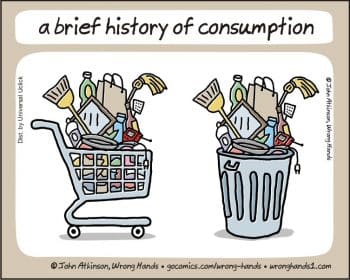
    But it’s time to stop living for consumption by John Gibbons One of the innate limitations of living in any given era is the innate assumption that the way things are is how they have always been, and will continue, more or less, into the foreseeable future. In a time of rapid shift, such assumptions can be fatal. Over the last seven decades or so since 1950, the world has embarked on an era known as the Great Acceleration. In this era, the solution to every problem and the very goal of human endeavour all seemed to be the pursuit of growth and with it, ever-increasing standards of material comfort. At the dawn of this new age, in 1955, economist Victor Lebow wrote a stunningly prescient article for the US Journal of Retailing. His key insight was to realise that, for the first time in human history, industrial output exceeded public demand for products. “Our enormously productive economy demands that we make consumption our way of life, that we convert the buying and use of goods into rituals, that we seek our spiritual satisfactions, our ego satisfactions, in consumption”. He added: “we need things consumed, burned up, worn out, replaced and discarded at an ever increasing pace. We need to have people eat, drink, dress, ride, live, with ever more complicated and, therefore, constantly more expensive consumption”. While presented as though it were human nature itself, consumerism is simply a clever ruse dreamed up by marketing Mad Men charged with persuading the public to buy ever more stuff. Not in their wildest fantasies could Lebow and his colleagues have truly understood what forces they were unleashing on the world, and how, decades later, this spiralling global orgy of consumption would have trashed the planet to the point where it teeters on the brink of the ecological abyss. It was never just about consumption. To justify this spree, “we erected new politics, new ideologies and new institutions predicated on continuous growth”, according to author JR McNeill. Writing in 2000, he warned: “Should this age of exuberance end, or even taper off, we will face another set of wrenching adjustments”. Now, some twenty years later, instead of heeding the ever more insistent warnings from the scientific community that critical planetary thresholds were being breached, humanity has instead doubled down, further accelerating growth, consumption, resource depletion and pollution throughout our already stressed biosphere. The recent report from the UN’s Environment Programme (UNEP) on the parlous state of carbon emissions didn’t pull any punches. “The summary findings are bleak”, it noted. ‘Countries collectively failed to stop the growth in global greenhouse gas emissions, meaning that deeper and faster cuts are now required”. The report says that emissions have gone up by 1.5% every year for the last decade. In 2018, the total reached 55 thousand million tonnes of CO2 equivalent. The UNEP report noted that this rate of emissions will deliver a catastrophic rise in global average surface temperature of some 3.2ºC by the end of the century, if not sooner. The Intergovernmental Panel on Climate Change (IPCC) late last year set out in the starkest terms the dangers of allowing global temperatures to rise by more than 1.5ºC this century (they have already risen by just over 1ºC). To have any chance of meeting these targets, emissions need to be cut across every country, every economy and every sector by an average of 7.6% per annum, every year for at least the next decade. This would have to mean sharp declines in living standards across the entire developed world. Largely non-essential sectors, from aviation to tourism would need to dramatically contract over the next decade, as would the use of private cars and the consumption of all meats, including of virtually all red meat. The reality is of course that no government on Earth is planning anything of the kind, and even if some brave politician or party were to come forward with such an extreme austerity programme, they would face sure and certain obliteration at the ballot box. The science says that countries like Ireland need to drastically decarbonise every aspect of their economies, food systems and societies as a whole, or face ruin. Yet the response of our Taoiseach has been to talk up the merits of re-usable keep cups while half-heartedly rolling out a Climate Action Plan that was designed to fail. Meanwhile, Ireland’s Chief Scientific Advisor thinks some carbon-sucking technology is going to magically appear and somehow scale up to solve the greatest crisis in human history. Magical thinking used to be something we associated with hippies, dropouts and dreamers. Now, it’s what passes for policy among the ‘serious’ people like economists, politicians and senior public officials and advisors. We may not be lions, but we are assuredly led by donkeys. John Gibbons is an environmental writer and commentator @think_or_swim

    Loading

    Read more

  • Posted in:

    Co-house, co-op but only sometimes co-live

    We should look to Co-operative and Cohousing solutions to the Housing Crisis caused by dependence on developers and prejudice against social housing by Caroline Hurley and Kim O’Shea THE RUMBLING by the Criminal Assets Bureau (CAB) of a dangerous gang engaged in prolonged extortion of building companies for protection, leading to High Court drama in October 2019, was the culmination of various inquiries involving Dublin City Council into accusations of illegal practices since 2016. CAB claimed well-rewarded criminals carried out anti-social acts at building sites to pressurise developers to decamp. In Drogheda, after seventy shootings and bombings in one year between feuding families, national emergency and armed response Garda have been deployed but a lack of intelligence hampers efforts. Some believe only the type of multi-agency taskforce assembled to combat similar mayhem in Limerick in the early 2000s would work now. Feuding Ennis families repeatedly fight it out with machetes, chainsaws and slash hooks. Casualties mount as the Hutch-Kinahan war extends internationally from Dublin. Parcel bombs are being tossed through letterboxes in a Killarney housing estate. With aggression escalating, bus and rail workers voted unanimously last August to strike if nothing was done about daily assaults, threats, robberies and racist insults encountered by them. 2018 saw a 7% rise in crimes categorised as anti-social, and a 50% risein anti-social behaviour orders issued, with only about 200 served nationwide Beyond those headline-grabbing examples, noise, verbal abuse, trespassing, property damage, stalking and other intrusive and disruptive behaviour frequently forces trapped, targeted householders to uproot as complaints fall on deaf ears. Violations range from vicious random attacks to insidious sinister predation. Effective legal remedies seem to exist in theory only. It’s as if afflicted residents are suddenly conscripted by faceless officialdom into an isolated full-time social-work role, with no consultation or preparation. According to the Central Statistics Office (CSO) and Garda figures, 2018 saw a 7% rise in crimes categorised as anti-social, and a 50% rise in anti-social behaviour orders issued, with only about two hundred served nationwide. Communities live in fear of fearless malfeasants. Where the nuisance is eliminated there is a syndrome of counter-threats. None of this suggests we should condone vengefulness but it does point to the futility of pursuing approved avenues of redress, given beleaguered gardaí, disempowered Councils, conflicted Courts, and meek providers of Citizens Advice, Crime Victims Helpline, and similar bodies. The most pertinent laws are: the Housing Acts 1966 to 2014, governing local authority housing; the Planning and Development Act 2000; the Residential Tenancies Acts 2004 to 2016; the Criminal Justice (Public Order) Acts 2004 to 2016; the Non-fatal Offences against the Person Act 1997; the Children’s Acts 2001 to 2017; the Control of Dogs Act 1986; the Environmental Protection Agency Act 1992 and the Courts Act 1986. An analysis of training for local authority staff dealing with anti-social behaviour, cited in a Community Mediation Works 2010 report, ‘The State Of “Anti-Social Behaviour” In Working Class Communities’, found that “training focused on ensuring that the correct legal procedures were followed”. Equipping staff with skills conducive to impartial investigations, community mediation and tenancy support were peripheral considerations. Bureaucratic rigidity seems still to prevail, though there is a greater emphasis on rights. The report criticised “housing management policies that make enabling tenant purchase the priority”, to the detriment of quality, amenities and relationships. It blamed the 1997 Housing Act for splitting anti-social behaviour into two categories: first, drug dealing, and then, serious intimidation and threatening behaviour, suggesting the latter was less important. The 2003 Norris report faulted the Act for pushing eviction without due process as the solution of choice to anti-social behaviour. While eviction is very rare now, anti-social behaviour is not. Providing only the draconian measure of summary eviction as redress for the widespread torture of peace-loving citizens is uncivic. While not dealing directly with community conflict, management could arrange “cost effective programmes proven to help families in difficulty live peaceably with their neighbours”. These measures could include mediation, family support, monitoring, liaison and above all, real tenant participation through their own organising initiatives. However, such resources are rarely made available. The Free Legal Aid Centre (FLAC)’s 2018 Annual Report drew attention to “the vague and imprecise nature of the legislation dealing with Garda vetting prior to the allocation of local authority housing and the huge disparity between local authorities in relation to the assessment of disclosures made by Gardaí and more worryingly the nature of certain disclosures being made by An Garda Síochána itself”. The lack of standards is causing social collapse. Tenants of housing associations or Approved Housing Bodies (AHBs) report much higher levels of satisfaction than those living in either the council or private sector Residents’ suggestions for beneficial amenities are routinely refused, leaving many with nothing to do but reconcile themselves to their own containment. As anger spills over, the risk of harsh measures like fines and curfews goes up, even though research by bodies like ‘Preparing for Life’ shows that humane steps including early intervention and education are what really work. A wideranging 2017 survey by the Irish Council for Social Housing discovered that tenants of housing associations or Approved Housing Bodies (AHB) report much higher levels of satisfaction than those living in either the council or private sector. Regular property maintenance, reasonable hands-on management, tenant focus and a sense of community were advantages cited. AHBs tend to have strict anti-social policies facilitating fast, effective action. An internal audit of local authorities conducted by the National Oversight and Audit Commission (NOAC) in 2017 referenced policies and procedures meant to be followed for similar challenging situations, but they are mere aspirations. The responsibility of local authorities to co-ordinate services for citizens of varying needs, in such a way as to balance the rights of all, appears diminished. The Housing Agency, whose remit is to facilitate national housing policy, has published papers by the Centre for Housing Research shedding light on approaches taken internationally to ameliorate friction between neighbours. While taken for granted

    Loading

    Read more

  • Posted in:

    Taking Liberties

    An Bord Pleanála is anachronistically heedless to the heritage of Dublin’s most famous and vibrant working-class suburb by Kevin Duff THE LIBERTIES area is a special part of Dublin with a rich social and architectural history. Dating to the twelfth century, the area preserved its own jurisdiction although it was otherwise part of the city. Considered to maintain an authentic sense of historic and working-class Dublin to a greater extent than other parts of the city, the feeling is that great care needs to be taken in its development so as not to erase or further diminish these particular qualities. Following years of underinvestment, the area has seen an explosion of recent construction activity. While on the one hand repair of the area’s fabric is welcome, there is significant disquiet over the avalanche of new hotels, aparthotels and – in particular – student accommodation constructed in the past five years, and the parallel absence of construction and delivery of much-needed affordable housing in the area for locals or for those who wish to live in the area. As has happened in other parts of the city, the smaller artisan houses and terraces of the area have been attractive to young professionals for the past couple of decades, pushing prices up and contributing to housing shortage and unaffordability. Successful new additions to the area include the Hyatt Centric hotel on the Coombe, and the Maldron hotel, Upper Kevin Street, both of which are well-mannered and reinstate historic streetscapes in the vicinity of Saint Patrick’s Cathedral. The redevelopment currently underway of the Tivoli Theatre and adjoining carpark, on Francis Street, will provide a mixed-use scheme to include a cultural and performance space. There are plans to regenerate a 12-acre site at the Guinness Brewery as a new mixed, commercial and residential district. At Newmarket, where the market was closed and the Teeling Distillery opened, the restoration of the early-eighteenth-century house at No. 10 Mill Street as part of an adjacent new development provided a public gain in the rehabilitation of an historic building that had fallen into dereliction over two decades in Eircom’s ownership, and redevelopment of the square itself at Newmarket has commenced. Successful new additions to the area include the Hyatt Centric hotel on the Coombe, and the Maldron hotel, Upper Kevin Street, both of which are well-mannered and reinstate historic streetscapes in the vicinity of Saint Patrick’s Cathedral. The main streets of the Liberties are medieval in origin and the area is richly endowed with architecturally outstanding buildings, including Saint Catherine’s church, the former Fire Station on Thomas Street (now part of NCAD), John’s Lane church, and the Iveagh Market, Francis Street. Built in a neo-Palladian style in 1907, the regeneration of the latter is long-awaited and much concern has been expressed over the unnecessary deterioration of its fabric through a gross lack of maintenance. Owned by Dublin City Council and leased to Temple Bar publican Martin Keane, a sensitive redevelopment proposal for the complex was expected to include retention and rehabilitation of the adjacent nineteenth-century brick buildings of the former Mother Redcap’s pub and Winstanley factory on Back Lane, close to An Taisce’s headquarters where the tailors had their hall. Unfortunately a recent application provided for an eight-storey lump with facade retention only. Apart from its well known historic architectural landmarks, the Liberties, as a former industrial quarter, has an abundance of smaller-scaled buildings of interest – mills, pubs, malthouses and stores. However, poor planning decisions are routinely being made by the State appeals board, An Bord Pleanála, resulting in the needless destruction of this vital and understated component of the area’s built heritage. A recent case concerned an unlisted stone industrial building on Warrenmount Lane, off Mill Street, formerly part of a malthouse complex adjacent to the River Poddle. The building had sat for some years within a development site known as ‘the Tenters Site’ and had been identified by the conservation architects Shaffrey Associates as being of value and interest and worthy of repair and retention within the new development. An example of ‘urban vernacular’ architecture, it was envisaged that the building would form a marker or ‘gatepost’ at the western entrance to the new development. The building (or a previous building on the same footprint) is seen on the 1756 John Rocque map of Dublin forming part of a stepped street-line leading towards the early-eighteenth-century mansion Warrenmount House, a protected structure, which was later converted to a convent. The Tenters Site had been the subject of numerous planning applications for development stretching back to 2005, all of them providing for retention and integration of the stone industrial building within the new scheme. Building work finally got underway in 2016 and was largely complete when, out of the blue in March 2017, an application was made by the developer, BAM Property Ltd (of Children’s Hospital fame), to demolish the historic stone building. Demolition would extend to part of the adjacent, roofless, cement-rendered building, also visible on the Rocque map and forming part of the boundary wall with Warrenmount House. Objections were lodged by An Taisce and a local resident, citing the heritage value of the existing building and the planning precedents for its retention, but permission was nevertheless given by Dublin City Council. As a vital ‘safety valve’ within the system, An Bord Pleanála could generally be relied upon in cases like this where vulnerable built heritage was endangered, and so an appeal against the City Council’s decision was lodged by An Taisce with the aim of saving the building. The appeal arguments were straightforward: The building was characteristic of the Liberties and an example of historic stone construction and craftsmanship It provided a valuable link to and reminder of the area’s rich industrial past, and its retention would add value to the new development Its footprint was evident on maps going back to the mid-18th century It formed part of the historic laneway approach to and setting of the early-Georgian mansion, Warrenmount House, and

    Loading

    Read more

  • Posted in:

    Drew Harris Drawn in.

    As allegations continue to be made about the involvement of Robert Nairac in the Miami Showband massacre, how compromised is Garda Commissioner Harris who was PSNI liaison with Britain’s intelligence services? By Deirdre Younge. In the High Court in Belfast the British Government’s Ministry of Defence (MoD) and British Army are applying to have cases relating to the Dublin and Monaghan bombing atrocity of 1974 dismissed, alleging they are out of time. The bombings were carried out by the Glennane gang also known as the Portadown UVF who were also at the heart of an organisation that came into existence in the 1980s called Ulster Resistance. A recent BBC ‘Spotlight’ programme dealing with Ulster Resistance confirmed extensive collusion across the loyalist spectrum from DUP to UVF, UDA, UFF to MI5. Members of Ulster Resistance (UR) became aware that some of its members were MI5 agents. The key MI5 agent inside UR was carved out of the distribution of the weapons it had procured in late 1987 by those who were not under the control of the intelligence services. At the same time, information was leaked from RUC and the UDR which provided them with details of ‘suspected republicans’. The BBC NI Spotlight programme showed images of RUC intelligence that ended up in the  hands of the UFF/UDA. It  was used to target suspected republicans, including Loughlin Maginn, shot in Rathfriland in August 1989. His death, following that of solicitor Pat Finucane in February 1989, sparked the decades-long investigations by Sir John Stevens into collusion by the Security forces. Stevens was not shown evidence of RUC collusion. (BBC Spotlight on the Troubles, October 2019.) The fact that the UDA were receiving large volumes of  intelligence material from RUC sources was known to the agent Brian Nelson,  his Army Intelligence handlers and M15. That intelligence also, no doubt, informs the de Silva Report into Pat Finucane’s murder. De Silva was given access to British Army and MI5 intelligence that RUC officers at every level were leaking information to Loyalists. That intelligence is also integrated into the Ombudsman’s report on the Loughinisland murders as it relates to RUC ‘tip-offs’ about surveillance operations carried out in an attempt to seize UR weapons in Armagh in 1987 and 1988.  Awareness among members of UR that some of its members were M15 agents led to a disastrous loss of control by the Security Services and Special Branch  – and multiple murders Part 1: Commissioner Harris Drew Harris, the Garda Commissioner, didn’t leave the ‘Troubles’ of Northern Ireland behind him on entering Garda HQ. Drew Harris As former Assistant and Deputy Chief Constable of the PSNI and its former interface with the Security Services (UK), Harris has been accused of  fighting attempts to get information about the perpetrators of atrocities like the Miami Showband murders and of blocking access to  files about the many murders carried out by the Mid-Ulster, UVF ‘Brigadier’ Robin  Jackson. In 2011 the Historical Inquiries Team found Jackson had been connected to a weapon used in the Miami Showband murders by fingerprint evidence. In the High Court in Belfast in 2017 Judge Seamus Treacy ruled that there should be an overarching investigation into State collusion with the ‘Glenanne Gang’ and asked the PSNI to respond. In the Court of Appeal in Belfast the Lord Chief Justice ruled in July 9 [2019] against an appeal and said there must be an independent investigation carried out by the PSNI. Chief Superintendent Jon Boutcher has started an investigation into the Glennane series of killings as part of Operation Kenova. In an extraordinary development, Eugene Reavey whose three brothers were murdered in Whitecross in Co Armagh in 1976, has been told by the Police Ombudsman of Northern Ireland that a file has been sent to the Public Prosecution Service in the case. It is believed to recommend prosecution of a former RUC man, who was a member as ‘The Glennane Gang’. With the signing into law in Ireland of the Criminal Justice (International Cooperation)  Act  2019, the Garda can now give evidence and share intelligence with Coroners’ Courts in Northern Ireland. In an interesting twist of circumstances, Commissioner Harris  now has charge of the legacy files of secret Garda intelligence. Clearly how ambitious he’d want to be in sharing this information with authorities in the North is uncertain. As Assistant Chief Constable of the PSNI Drew Harris was the liaison between the Security Services (UK) , the PSNI and the Smithwick Tribunal from 2006 to 2014. (See also https://villagemagazine.ie/how-smithwick-got-diverted/ )The Tribunal was inquiring into alleged Garda collusion in the murders of Chief Superintendent Harry Breen and Superintendent Bob Buchanan. (See also https://villagemagazine.ie/investigation-killusion/http://Killusion ) He confirmed that he had spoken to the Security Service before he gave evidence to the Tribunal in October 2012. Drew confirms his consultation with the ‘British Security Service’ In 1989 MI5 reported the overall picture seems to be one of RUC collusion and links with the Loyalists which is similar in scale to that of the UDR, but the latter is much more likely to become involved in very serious crimes Dealing with the past is also causing problems for some retired RUC men – members of the Northern Ireland Retired Police Officers’ Association (NIRPOA). They now apparently  believe a policy of  non-co-operation with bodies like the Police Ombudsman of Northern Ireland  has been counterproductive. The Miami Showband Part 2: Ombudsman confirms collusion NIPROA took a Judicial Review against the Police Ombudsman of Northern Ireland and his 2016 report on the 1994 Heights Bar murders in Loughinisland. Former Head of Special Branch and Assistant Chief Constable Ray White often acts as its spokesman. In 1989 MI5 reported the overall picture seems to be one of RUC collusion and links with the Loyalists which is similar in scale to that of the UDR, but the latter is much more likely to become involved in very serious crimes Their affidavit was submitted in the names of Ray White and retired Chief Superintendent Thomas Hawthorne, the former Sub Divisional Commander in Co Down and chief investigator of the Loughinisland

    Loading

    Read more

  • Posted in:

    Irish Reunification: possible forms it could take

      The parties’ election manifestos are elusive about the structure of the united Ireland to which they aspire. By Anna Mulligan. The biggest geo-political concern for this country is the possibility that in this decade, or even in the lifetime of the next government, a majority of people in Northern Ireland could be in favour of reuniting with the Republic.  With the tide of Brexit-caused uncertainty receding, this general election campaign finally offers us a chance to think beyond the next budget – to discuss critically what reunification might mean.  Since the Brexit referendum, commentators in the Republic have been falling into the trap of engaging with the question of reunification enough to raise hackles, but not enough to inform anyone of anything.  From Fine Gael to Sinn Fein, many of the parties state that their eventual goal is a united Ireland, but none have a clear position on what a united Ireland would look like. If the Brexit referendum holds a lesson for us, it is not to call a vote on a massive, sweeping change without first developing an understanding of the specific issues involved. The very term “united Ireland” is part of the problem. The question isn’t whether we should have a “united Ireland”, but whether we should reunite Ireland, and how, and what kind of country that new state would be.  The Good Friday Agreement is open-ended: it says that a border poll showing a majority in the Republic and the North for reunification would be a binding obligation on both governments to introduce legislation “to give effect to that wish”. The ambiguity in this statement – the nature of the wish, and how effect could be given to it – is ours to make sense of.In the Republic of Ireland, we have a bicameral parliament and a principally ceremonial President. We amend our constitution frequently by referendums. In Northern Ireland, there is a unicameral devolved legislature responsible for “transferred matters” (issues not reserved to Westminster) and for selecting the Northern Ireland Executive. This selection process is structured so that the Executive will include members from both unionist and nationalist communities, and the Good Friday Agreement requires that some controversial motions in the Assembly be passed by “cross-community vote”.  A reunification process would involve reconciling these structures. In doing so, three issues are most urgent – devolution, power-sharing, and the constitution. Any kind of reunited Ireland would involve trade-offs between these three concerns.  Keeping these in mind, there are broadly three ways that Ireland could go about the process of reunification: absorption, devolution, and integration. All of these options are on a continuum:  any arrangement can be more or less federal, involve more or less power-sharing mechanisms, and require more or less constitutional change. As a result, differences of degree need as much consideration as those of kind. The German Option: AbsorptionI’m not going to hold up any one option as preferable, but I do want to dispense with one that merits no consideration: the German model, in which the Republic of Ireland “absorbs” Northern Ireland and changes almost nothing about itself, from its flag to its constitution to its legislature. This model abandons power-sharing, devolution, and the spirit of the Good Friday Agreement, while it leaves Bunreacht na hÉireann almost untouched.  This model is the embodiment of unionist fears about reunification. There would be no protections for their interests as a minority, no safeguards to preserve the Good Friday Agreement’s delicate balance. The idea that a century of partition could be unravelled without compromise is unrealistic and inflammatory.  At times, it seems that this is what the great multitude of people who have been pushing for discussion on the issue mean when they say “united Ireland” – but if it ever does happen, they risk a shock. Now that the threat of a hard border in the near term has lifted, there’s no excuse for raising a delicate issue just to play pretend. Parties and voters in this election need to understand that reunification is not a policy towards Northern Ireland, but a policy of transformation for the Republic of Ireland and the North both. The Federal Option: DevolutionOne alternative is a federal or confederal option. This would effectively continue devolution with the Dáil replacing Westminster, allowing the institutions of the Good Friday Agreement to survive in a version of Stormont. This model would seek to acknowledge that distinct political cultures have emerged on this island over the course of partition.  The more radical option would be a “three parliament” solution, which was considered by the New Ireland Forum in 1984. This envisions separate parliaments and executives, North and South, along with an overarching government with relatively weak central authority. The “three parliaments” solution preserves power-sharing and devolution but would require serious constitutional change, and that a new Ireland bear the costs and complications of sustaining three separate bureaucracies.  It was for this reason that the Joint Committee on the Implementation of the Good Friday Agreement rejected the “three-parliaments” option in its 2017 report. It proposed another federal option: the “two parliaments” solution. Stormont, it argued, has always existed as a devolved parliament with limited authority. Just as we have seen devolution all over Britain without any apparent need or demand for a devolved authority in England, so – the report argues – would there be little demand for a 26-county parliament in a united Ireland. This model would leave power-sharing intact at a regional level by retaining Stormont as is, while the Oireachtas would operate as Westminster does now.  Sinn Féin’s manifesto appears to nod to this model, advocating for Northern MPs to be accorded membership in the Dáil – although there is no mention of whether this would foreshadow a similar structure after a vote for reunification. Fine Gael’s manifesto also discusses a commitment to the Good Friday institutions and to devolution that could be compatible with a federal or confederal model, but again, the situation envisioned after a border poll is

    Loading

    Read more

  • Posted in:

    Review of Seamus Mallon’s ‘Shared Home Place’ (Lilliput, 2019; with Andy Pollak).

    A memoir with thin narrative and little polemic nevertheless reveals  a steely and moral man with a belief in a consensual United Ireland. Reviewed By Kevin Kiely. Most people reading this will know who they consider the heroic protagonists of Northern Ireland’s peace process.   Few will acknowledge the role of David Trimble or enthuse about the role of Bertie Ahern or Albert Reynolds; some will hail Clinton or Blair, some Adams, fewer David Ervine; least controversially most will applaud John Hume.  They will accept too the narrative that he is now mute, that his party is moribund and that he had a worthy, flintier deputy, Seamus Mallon (born 1936), the man who could “make ‘good morning’ sound like a threat”.  Mallon’s autobiography does nothing to challenge this narrative.  This is partly because the book is essentially a memoir and lacks a hard-core historical backdrop.  He and co-writer AndyPollak also seem disengaged with the present and with the future about which their predictions are half-baked.  This is a haunted retrospective on ‘a peace process’ rather than ‘the peace process’ – there’s a self-indulgent primary focus on what might have been. Less than on what might be. Mallon’s father, and mother, Jane, formerly O’Flaherty of Castlefinn (Donegal) provided an unusually stable homelife for young Seamus and his four sisters.  Inheriting the father’s “fairness, generosity and willingness to help others” he became a secondary school teacher beginning in St Joseph’s Newry having met his future wife Gertrude “when we were both around fifteen”. He played Gaelic football for Armagh.  He got involved in the civil rights movement in the 1960s and was elected to the first power-sharing executive in 1973. His home place is Markethill, “a 90% unionist village” in the murder triangle of South Armagh where “per head of the population more people were killed…than any other county in the North”. His neighbours included the paramilitary Glenanne gang. Three miles from his front door openly lived “UVF killer, Robin Jackson, a former UDR man responsible for more than fifty murders”.  Mallon acknowledges the systematic collusion of loyalists including the RUC with paramilitaries and he despairs about the demise of the Historical Enquiries Team.  Mallon’s pacifism was tested over decades in the cauldron of arson attacks, death threats, defamation, and Community-polarisation and endless sectarian intimidation: “a man appeared and marched around the house playing the flute”. He came through the other end untoxic and even gamely manifests a contrived politeness on ‘Ulster-British culture’: “I rather like pipe bands; it’s the lashing of the warlike Lambeg drum I object to”. Mallon offers no polemical exegesis but does believe in a “shared homeplace”. Surrounded by  extremism Mallon always maintained  his pacifism: “We can build a shared centre where most people, unionist and nationalist, can feel comfortable and secure and at home…”. But surely this theory rests on moderate unionism undergoing “conversion”, presumably to a quasi-Alliance politics supporting human rights and the Good Friday Agreement (GFA).  He goes on: “We can then work towards the unification of the people of Ireland, rather than the forced marriage of territorial unity”.  His vague ultimate is: “I see Britain eventually leaving Northern Ireland”. Nevertheless his republicanism is more progressive than ‘Humespeak’ on Irish unity: he does see it as the “only long-term solution”.  The 1974 Sunningdale clauses on “Irish unity in stages” and an “orderly way”. He was of course the progenitor of the theory that the GFA was Sunningdale for slow learners. He chimes with the GFA that a united Ireland should depend on the consent of the majority of people, democratically expressed, in both jurisdictions: on “parallel consent”. He recognises the decline of the staunch unionist population to “the minority” but – unlike Sinn Féin – is suspicious of any ‘”narrow vote for unity” on a “50 per cent plus one” basis, “assuming the unionists do not boycott such a Border Poll”. ‘there’s a self-indulgent primary focus on what might have been. Less than on what might be’ The narrative in this book is thin. The chapter on the peace process and GFA is surprisingly lacklustre. His anecdotes are well known and long-rehearsed as when Mallon complained about Sinn Féin to Blair, who replied;: “The trouble with you fellows, Seamus, is that you have no guns”.  His exhaustion is apparent everywhere: the eventual agreements were  “the last chance of peace for a generation”.  Mallon’s portrait of David Trimble centres on a rehashing of the details of his defenestration by siege-Unionists Donaldson, Foster and others. On Sinn Féin he quotes journalist Ed Moloney: “Sinn Féin had no interest in reaching agreement with David Trimble on decommissioning and devolution”. Mallon inculpates Adams and McGuinness in “the murderous nonsense of violent republicanism”.  But admits that by 2001 the SDLP “were completely eclipsed as the two governments worked on unionists and republicans”.  Exhaustion and eclipse beleaguer the SDLP then and now.  But the embracing morality and steely decency of Seamus Mallon defy.

    Loading

    Read more

  • Posted in:

    The Catalan Crisis Threatens to Reopen a Debate that the EU’s Power Brokers Thought They Had Long Ago Quashed.

    By Professor Thomas Harrington. Though it is  largely forgotten today, there was during the late 1980s and early 1990s a  vigorous  debate in numerous sectors of European life about whether  the EU would be best structured as a Union of Regions or as a Union of States.  Adherents of the first posture hoped and believed that the goal the then still-emerging Union should be to greatly lessen the importance of existing  national boundaries and governments and to promote, or at least not stand in the way of, the emergence of new economic and social regions.  For example, since the Galician region of Spain shares much in the way of language culture and geography with neighbouring northern Portugal, it should, according to this outlook, be free to loosen existing bonds with far-away Madrid and direct more of its resources and infrastructural  aims  toward forging economic and social integration with nearby and traditionally dynamic Oporto.   This, of course, frightened the proponents  of a Europe of States,  who quite rightly saw such developments as a threat to dramatically diminish the prerogatives of  existing governments.   For reasons that are too numerous to examine fully here, but that include bureaucratic inertia, and the desire of an always meddling  US to have the ability to play states off against each other both within a dramatically-expanded NATO and the EU as a whole, the idea of the Europe of Regions was eventually bludgeoned  into insignificance by the proponents  of a Europe of the States.   Yet, for all their success in neutering the practical day-to-day effects of a Europe of Regions, the proponents of the Europe of States were unable to fully disable certain institutions, such as the European Parliament and the European Court of Justice,  forged and/or strengthened in the early years of the EU,  and whose structure implicitly militated against the continuing weight and hegemony of state governments within the overall functioning of the confederation.  For example, while a candidate for the European Parliament nominally “comes from” one or another member state, voters from any jurisdiction in the Union can select him or her on the ballot. He or she is thus not only a representative of, say, Spain and the Spanish citizens, but of the European people as a whole.    And while almost all justice is still meted out  by state-based judicial systems, these state systems are, since the ratification of the Treaty of Lisbon, subsidiary to the European Court of justice in matters pertaining to the EU’s Charter of Fundamental Rights.  And this last matter reality is why the long-dormant debate over  the underlying nature and structure  of Union is coming  to the fore once again.  The catalyzing factor in re-opening the debate was the decision was a decision handed down by the European Court of Justice late last year.  The Junqueras Case In the early hours of December 19th, 2019, the European Court of justice ruled that Oriol Junqueras, who on October 14 2019 was condemned to 13 years in prison for his role in promoting a peaceful referendum on independence in Catalonia, had, in fact, had possessed full legal immunity from the moment of the certification of his election to the European Parliament four  months earlier, and thus should have been released from detention at that time to take his seat in that body, and  quite probably should never been condemned  to the long sentence handed down in the autumn.   A case on one lucky guy finally getting a little bit of justice? Far from it.  The Long-Troubled Relationship Between Catalonia and Spain Though Catalonia was incorporated into a centralized Spain three centuries ago, its fit within that State has never been without tensions owing, among other things, to differences of language, social structure, economic models (Catalonia has always been considerably more commercially and industrially oriented than the rest of Spain), and approaches to governance. Catalonia was, for example,  one of the first polities in Europe to see the many impose limits on the exercise of monarchical power by the few, accomplishing this feat  a number of years before  the signing  of the English Magna Carta in 1215.   Spain, led by its central kingdom of Castile, has, on the other hand,  consistently tended much more to toward top-down and force-driven approaches  to resolving  conflicts over the apportionment of civic powers. It is thus not surprising that Catalan revolts (e.g 1700-1714, 1836-1843, 1906-1923, 1931-39) against central power have been a recurrent part of Spanish life during the era of the centralized state.  Nor is it surprising that Castilian-led government in Madrid has often used the full complement of  military and legal force at its disposal to quell these uprisings.  The latest  such revolt  began in 2010 when the Spanish Constitutional Tribunal overturned a new more expansive Statute of Autonomy for Catalonia within the  constitutional  order established three years after the death of dictator Francisco Franco’s 1975.  In keeping with the rules of the 1978 Constitution, the Catalan political leadership had, after writing the new Statute, submitted the text to both the Catalan Parliament and the Spanish parliament in Madrid for approval.  After passage through these legislative bodies, it was returned to the Catalan people, who approved it by a sizable margin in a popular referendum The Judicialization of Politics, or the Resurfacing of the Spanish Deep State But while this relatively insignificant rise in regional power pleased many in Catalonia, it alarmed many elements  of José María Aznar’s Popular Party (PP)—a configuration formed in no small measure by the sons and daughters of Francoist families—, as well as  the country’s judiciary whose Francoist  structures and Francoist sociology had remained largely intact during Spain’s then three decade-old democracy. Confident that their ideological allies in the judiciary would know how to “do the right thing” when called upon, the PP lodged a constitutional challenge to the new statute. Though it took them more than  three years  to do it, the Spanish courts delivered exactly what the PP had hoped and expected: the  nullification of key elements of the new law.   And when this occurred in the summer of 2010, Catalan citizens took to the streets in massive numbers to protest what they saw as a backhanded  and back-channel abridgement not only of their voting franchise, but also the democratic constitution upon it was based. Over the next decade

    Loading

    Read more