admin

  • Posted in:

    Civil War binary squeezes out the left

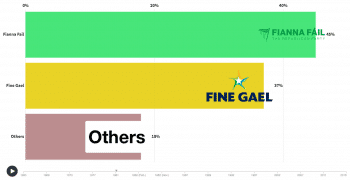
      By Rory O’Sullivan   Election 2020 threatens to be another continuity vote with the Taoiseach yet again coming from one of Ireland’s two civil-war parties. Given their projected vote share this should be the left’s best election since the foundation of the state. Instead, despite having support equalling the combined vote-shares of Fine Gael and Fianna Fáil, they cannot hope to enter the next Dáil as anything more than a mere constellation of minority partners in a sprawling coalition. They have been muted and nearly silent so far in this campaign, with the traditional media effectively deciding that this is between Martin and Varadkar and skewing their coverage accordingly. Maybe the dusty corners of Twitter are right, and this is all because of bias; maybe the dominating past of the two parties and respective tooth-lengths of Ireland’s gregarious political correspondents have unfairly inflated their importance. But mostly it is because the mutual antagonisms and jealousies of the other parties mean that the only workable coalitions in the next Dáil will involve Fine Gael and/or Fianna Fáil, with some smaller parties, which has allowed them to dictate the terms of the campaign to everyone else. Labour have said they will never join a coalition with Sinn Féin, which removes even the faintest prospect of a government without either Fianna Fáil or Fine Gael. Those two could technically go into coalition together but it would outrage their bases, and surely accelerate their decline by making them even less distinct than they are now. Varadkar’s apparent offer to join a coalition with Martin in the Virgin Media debate was more an effort to seem grown-up than a genuine offer to share a government. Martin’s refusal earlier today to countenance any coalition with Fine Gael made this even clearer. This aside, neither party will govern with Sinn Féin, meaning neither can enough seats to govern without Labour and the Greens, which have both expressed a vague willingness to serve with both, even if the Greens will have to wrangle with their grassroots membership over a coalition agreement.  This has meant that to ensure that one of them wins and can govern without the other, Fine Gael and Fianna Fáil have both been aggressively spinning to convince everyone that every big question about the next Dáil is pretty much settled, apart from that of which party will be the largest. It is for this reason that the two parties have collaborated and so far succeeded in setting the terms of the whole election.  It is not simply that doing this sidelines the other parties, but that it pulls voters into an American and British-style binary decision between Martin and Varadkar; that in the next Dáil the Taoiseach will be one of those two has become the premise of the discussion rather than a potential outcome.  The irony of Virgin Media’s head-to-head debate between Martin and Varadkar is that, while seeming to oppose each other, they were in fact performing nearly as great an act of strategic political cooperation as confidence and supply. Before the debates even began, they had won hours of airtime and pages of newspaper-print characterising the election as a contest between two men.  Sinn Féin are right to be furious about it: it is a political coup, and they have been completely blindsided. The high polling numbers have made their exclusion even more controversial, but they are still not enough to overturn the logical conclusion of the last local election results: Sinn Féin are hitting their current electoral ceiling. They have tried to pivot from entrenched opposition party to party of government, only to find that no one wants to be in a government with them. But still to most Fine Gael, Fianna Fáil, Labour and Green voters they are toxic, bathed in historical violence, radical, unthinkable; to their own republican base and the rest of the left they are ever-less reliable. People like Martin Ferris, while dwindling in number and kept away from the television cameras, are still everywhere in the rank-and-file of Sinn Féin, and too many people know it for them to get away with it. Eventually, if they want to expand their coalition, they will need to take the short-term hit and jettison that support base. But even still, the moves to shut Sinn Féin out are an expression of weakness rather than strength. The only reason the two biggest parties are cooperating at all is that they have no choice; both will be scuppered if the election simply returns a result close to the same as now. Say, the Greens and Labour win no more than 15 seats between them (according to The Irish Times, a ‘bad’ day for both parties would leave them with a combined 14), and neither Fine Gael nor Fianna Fáil win more than 50: then, even with Independents and Social Democrats, the arithmetic becomes almost unworkable. For both men who hope to become Taoiseach there is only one, precarious, path to power that does not involve bringing a bitter end at last to the Irish Civil War. There is no chance of a straight majority for either  because of the 40-50% of the country who won’t vote for them, most won’t vote for them at all.  They know this very well; which is why their campaigns so far have largely been efforts by each to downplay their own perceived weaknesses in relation to the other, and win over their mutual swing voters, rather than serious attempts to win over anyone else. Fine Gael have always suffered from the perception that they’re a sneering elite who don’t care about ordinary people, and so their campaign and its slogan are targeted at the dormant guilt about poverty and homelessness among middle-class swing-voters. 2016’s “Keep the Recovery Going” has been supplanted in 2020 by “A Future to Look Forward to”. Fianna Fáil’s politicians have repeatedly mocked the Fine Gael slogan, and then with a straight face told interviewers that they have no slogan;

    Loading

    Read more

  • Posted in:

    Rotten fruit: has anybody actually read the EU Commission’s Apple decision?

    By Edmund Honohan   MEDIA ANALYSIS of the EU Commission’s 2016 Apple judgment that Ireland gave the company €13bn in illegal tax aid is half-baked, and the Irish government’s defence even worse. The implications of the judgment are much further-reaching than many realise. The Commission has argued that Apple’s two subsidiary companies in Ireland – ASI and AOE – should have paid Corporation tax here at the full Irish rate of 12.5% on the profits of their businesses between 1991 and 2015. There’s no suggestion from either side in this case that profits on sales of merchandise abroad should be booked abroad and taxed there. In other words, if the EU is right, the entire balance must be paid here and not be subject to some international shareout. The EU Commission’s judgment refers to a 1991 ruling by Ireland’s Revenue Commissioners which fixed AOE’s net profit at 65% of branch operating costs (sic) up to US $50-60m and 20% above that, and ASI’s at 12.5% of branch operating costs. The basis of capital allowances was fixed in the ruling, but not explained. In 2007, for example, ASI’s bill under the 12.5% liability came to $230m; but, in what was described in the accounts as “an adjustment for income taxed at lower rates”, this was then lowered to $8.9m. Ireland doesn’t want any of that money back, but the EU says the adjustments were State Aid to ASI and AOE and, as such, in breach of Article 107 of the Treaty on the Functioning of the European Union, one of the two main Treaties that underpin EU law. To be exact, the EU’s argument is that the accepted accountancy approach to the allocation of profits among companies in a group company architecture was neither followed in 1991 nor in the Revenue ruling in 2007, when Apple sought and obtained assurances from the Revenue Commissioners in Dublin as to the basis on which ASI and AOE would be taxed. The Commission says that all of Apple’s retail business outside of the Americas and Singapore was handled in Ireland, and that the respective head offices of ASI and AOE in the USA were brass-plate addresses with no employees. It adds that any functions performed, or “fictitious remuneration for services provided for free” by Apple Inc employees for ASI and AOE would be outside the scope of the assessment of profit allocation as between ASI, AOE and their respective head offices. In its 300,000-word decision issued in late 2016, the Commission was deeply critical of instances of poor professional quality in the Irish submissions. In paragraph 353, it notes: “at least three of the 52 companies chosen by PwC as comparables are in liquidation”. But it is even more critical of the actions of Revenue, who issued the rulings, stating that “none of the documents provided in support of the contested tax rulings contain either a contemporaneous profit allocation study or a transfer pricing report”. It later says that Revenue “should have at the very least analysed how that branch’s access to the Apple IP (intellectual property), which it needed to perform its functions, was ensured and set up within the company. There is no evidence that such an analysis was ever conducted”. The Commission says that in regard to allocation of profits to Irish branches of non-resident companies for the purposes of applying Section 25 of the 1997 Taxes Consolidation Act, “the profit allocation ruling practice of Irish Revenue demonstrates that no consistent criteria are applied”. But the Commission also cites cases of Revenue applying the arm’s length principle, with a Revenue tax advisor in one case confirming the OECD model as “little more than a restatement of the position under domestic law”. There’s no suggestion here that if a Pear or an Apricot were to come knocking, Ireland could still legitimately offer it the same deal it gave Apple in 1991. Nor does Ireland attempt to approach the case on a collaborative basis, to reconcile differing perspectives. Ireland hasn’t even offered a draft formula for a judgment in its favour, except to say that what we know now about fiscal State Aid was not known then, even by the Commission. The Commission was not happy with an after-the-event attempt to represent the profit allocation as a bona fide group company accounting exercise, with justifiable transfer pricing, holding that “the fact that the costs of the CSA (cost sharing agreement) were allocated to AOE’s Irish branch by Apple itself should have made Irish Revenue question the unsubstantiated assumption underlying the profit allocation methods ultimately endorsed by it”. The Commission goes on dramatically: “Even if Irish Revenue had been right to have accepted the unsubstantiated assumption that the Apple IP licences held by ASI and AOE should be allocated outside of Ireland, which the Commission contests, the inappropriate choice of operating expense and the inappropriately low levels of return accepted by Irish Revenue in the application of the one-sided profit allocation methods endorsed by the contested tax rulings result in an annual taxable profit for ASI and AOE in Ireland that, in any event, departs from a reliable approximation of a market based outcome for their respective Irish branches”. And in relation to a possible derogation if justified by the nature or general scheme of the tax system: “Ireland has not put forward any justification at all for the selective treatment”, and ”the argument (is) put forward by Apple that ‘the( tax rulings) derive from the intrinsic principles of Section 25 TCA 97’, without further explaining how this is to be understood or how this could justify the selective treatment in this case”. While it’s an arguable defence that the Commission’s pursuit of fiscal State Aid is in conflict with Member States’ general autonomy in taxation, the last time Ireland intervened in Court to make that point – in a case against Belgium – the Court gave it short shrift. Ireland has also pleaded that even if the accounting was a back-of-an-envelope exercise

    Loading

    Read more

  • Posted in:

    In a legally questionable  move, on January 3, 2020, the Central Electoral Commission of the Spanish government, an administrative body with no judicial standing, voted to remove Torra from office immediately.

      Up until two years ago Joaquim ‘Quim’ Torra was a business executive and cultural activist who had never been involved in electoral politics.  However, when the Spanish central government dissolved the Catalan parliament over its late October 2017 vote in favour of seceding from Spain, and subsequently ordered new elections that it clearly presumed would restore a pro-unionist majority in that body. To the surprise of much of the world, and the intense dismay of the Spanish government, exiled President Carles Puigdemont’s Together for Catalonia list won the elections, and hence the right to form a new government. Torra was successful as a parliamentary candidate. But Spain would have none of it. When, on January 30 2018, the Catalan Parliament was about to swear Puigdemont in by video connection from Belgium, the president of that body abruptly stopped the process in reaction to the threat of judicial sanctions – sanctions rooted in highly questionable jurisprudence – he had received from the Spanish courts. Two further candidacies centring on pro-independence figures were similarly scuttled in the succeeding months. Finally, on 17 May 2018 the then still largely unknown Torra was voted head of a pro-independence coalition government. Since assuming office he has repeatedly made clear that he believes that Carles Puigdemont is still the legitimate president of Catalonia and that his prime goal is that of advancing Catalonia toward independence in the most expeditious manner possible. The fact that he is a political newcomer who did not come up through ranks of his own party has led the generally pro-unionist press of both Catalonia and Spain, a press corps that tends to view machine politics as normative and  their continuation as inevitable, to treat this most cultured and literate of public figures  with no small amount of condescension, though Torra does not seem to care. This interview, conducted in Catalan and edited for reasons of space, took place on 30 October in the Palace of the Generalitat (The Catalan Government) in Barcelona, that is, 16 days into the massive and still ongoing acts of civil disobedience unleashed in reaction to the Spanish Supreme Court’s harsh sentencing of the politicians and civil society leaders responsible for promoting the October 1, 2017 independence referendum, 11 days before the fourth Spanish general elections in as many years, and 19 days before Torra’s own trial, at which he defiantly pleaded guilty to disobeying a Spanish government order to remove a banner hanging on the front of the Generalitat  that made reference to Catalan “exiles” and “political prisoners”. TH: How would you explain what is going on in Catalonia today to a reader who has little or no detailed understanding of the country’s history? QT: A quick response would be to compare it to a case with which most English language readers are familiar, and have to a certain extent reflected upon, which is Scotland – and the UK. I would speak of an ancient nation from Southern Europe that has always demonstrated a firm dedication to the pursuit of liberty, and that, after suffering a number of setbacks over the last three hundred years – years during which it worked to fit into the Spanish state and gain its trust – has, over the last decade or so, chosen to initiate a democratic process aimed at gaining independence. This is not about flags and borders. It is about quality of life, better education, better healthcare, an improved infrastructure and, of course, greater protections for the country’s language and culture. But above all, it is about being able to face the challenges of the twenty-first century with all of the tools that any modern country can expect to have at its disposal. TH: Do you think Catalans have a special obsession with freedom? QT: There are historians, such as Rovira i Virgili, who define the history of Catalonia precisely in terms of this special relationship to freedom. Others, such as Vicens Vives, link it more to a “will to exist”. Josep Benet, in turn, has summed it up, in a marvellous phrase, as centring on a “combat in the service of hope”. Others, of perhaps a more fatalistic cast, like Ferrater Mora say that a people cannot live life always on the defensive, that it  must arrive, or seek to arrive, to a state of vital fullness. TH: How did you come to be president of the Generalitat in the Spring of 2018? QT: I spent most of my life as a lawyer in private business, the last two years of that in Switzerland, an experience that allowed me get to know a country, the Helvetian Confederation, that I admire a lot. Returning to Catalonia, I founded a publishing house and got involved in historical research and writing. I’d always had strong cultural, civic and political interests thanks to my work in voluntary organisations of the type that are, in my view, fundamental to gaining an understanding of the country. These entities are the basis of its strongly ‘associative’ social fabric, and what provides it with very strong social cohesion from below. I had the good fortune of working side by side with the late Muriel Casals at Omnium Cultural  [along with the Catalan National Congress, the country’s most important pro-independence civic organization], an experience that allowed me to participate, as it were,  from the “second row”, in the last ten years of the country’s fast-moving history. During the latter part of this time, the country’s government was forcibly dismissed by the Spanish state (on 27 October 2017) while our elected leaders were either imprisoned or forced into exile. In the lead up to the 21 December 2017 elections imposed by Spain, I received a call from President Puigdemont in which he asked me to run as a candidate on his parliamentary list (Together for Catalonia). But owing to a series of events that would take a very long time to explain, and that are rooted in the repression that this country currently suffers

    Loading

    Read more

  • Posted in:

    Brentrance.

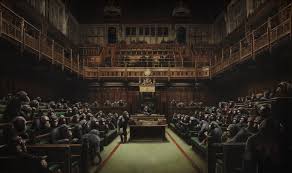
      By David Langwallner. November 2019.   Of course there is no practical benefit to Brexit.  Indeed our Irish perspective is that the British are jumping off a cliff with no parachute. However, I am a barrister in turbulent London and I also refute caricature portrayal, by the likes of Fintan O’Toole, of Brexiteers as swivel-eyed loons. He says if it was not tragedy Brexit would be comedy; Village has claimed it is comedy not tragedy.  Such deprecations represent patronising failures of imagination: Brexit is a triumph of idealism over pragmatism, of imagination over supineness and of culture over finance. It is not so bad for the nation of shopkeepers to abandon square utility and dour pragmatism.   I have a profound belief in the decency of British people and their institutions which I believe are proving resilient.  Lurches – to the right, to the anti-economic, anti-social, anti-environmental, have been abortive.  The stock markets and currency are stable. The provision-hoarders have now stood down, too.   The UK is in good shape (and not just in sport and culture).  It has a system with solid checks, a vibrant and aggressive press.  Unemployment is 3.8%, employment is 76% (Ireland 69%).  Annual earnings growth is 3.8%.   Ireland need not panic vicariously for its newly excitable neighbour.   Metternich said that Italy was not a country but an idea. This is abundantly true of the UK.  Inconveniently, however, the idea has evolved with modernity and has broken its chains. The UK is taking a stand. That cannot be said of Ireland.   While Ireland has been wrestling with the social and religious conventions that held it back (and arguably finds itself quite comfortable in its new-grown modern skin), we have failed to interrogate our largely neo-liberal economic model. Britain is demonstrably much less happy with the economic model that grounds it.  Britain would not have tolerated the abjection of Ireland’s bailout; nor the dodginess of our prostration before the might of the multinationals on which we have centred our economy. The UK is united in its abhorrence of the legacy of austerity.  Would that Ireland were so progressive. It remains in thrall to the parties of the cuts. Unlike Ireland Britain has long realised that the EU lost its way a generation ago.  Its meting out of doctrinaire and bureaucratic bailout punishments on Ireland and Greece, and of austerity on the already moribund European Economy generally, and its obliviousness to the social side of Economic Union, are inexcusable Britain is challenging globalism and that is not something to disdain, least of all for Village readers.  Its Labour party defies blind globalism, as do the nationalist parties, the Liberal Democrats and most Tories.  The ascendant right-wingers, led by perhaps the most dishonest of them all, Johnson, talk the language of unshackled international trade but they are insincere and will not fight for it. The English want control back.  Brexit is the first adventure in post-globalism and internationally the left and the thoughtful of all political hues should embrace it. Yes the adventure is admittedly inarticulate.  And it is a sad truth that freedom from the EU will in no way constitute freedom from the control and standardisation that underpin Economic Unions. In principle divorcing from multilateral norms and the nasty disciplines of trade is welcome. The deal is a hard Brexit.  The UK will exit the customs union and the single market. It has yet to be seen how free it will be to do trade deals with other countries and whether it will follow EU standards on the customs union and single market, and even more precariously, on social, environmental and consumer standards – which are not strictly required by the customs union and single market.  As an outsider and a remainer, I fear they may rue the hardness, if not the principle. But that is always the danger with taking a stand. But as well as admirable principle  there are some dramatic political benefits. DUP deference to Tories was doing no-one any good and it is good to see its demise. We are to have an ingenious double-border that will serve Northern Ireland – at least economically – very well. As for immiserated Scotland, who in Ireland would not hasten its independence? I do not dispute that the UK has pushed the bounds in dangerous directions. Its indulgence of lies is far greater even than our own.  Its society has even great class fissures and educationally it is a dead end. There is a lugubrious cynicism every bit as corrosive as our own. The UK body politic suffers from the triumph of a culture of comedy evident in news programmes such as “Have I Got News for You” which turned Johnson into a cult and the nation into cynics. Scrutiny of character seems like yesteryear’s imperative. Certainly the gorillas have taken over.  But they do not have a majority and their time is up. So much cannot be said of now-complacent and pliantly unradical Ireland. The UK is on a journey.  It does not need a parachute.    

    Loading

    Read more

  • Posted in:

    THE MOUNTBATTEN FACTOR: Boris Johnson should not bully Dublin over Brexit because the Irish Government has information which could damage the Royal Family?

    INTRODUCTION Last December Taoiseach Leo Varadkar had to slap down Priti Patel MP, who now serves as Britain’s Home Secretary, when she threatened the Republic with food shortages if the Irish Government did not drop demands for the Irish backstop. Varadkar reminded Patel of the starvation that had engulfed Ireland in the 19th century and said he hoped she would think more carefully about what she said in the future. Tensions eased as Johnson dropped the Democratic Unionist Party (DUP) and conceded a regulatory border in the Irish Sea. Now, tensions are on the increase again. Johnson has seen fit to reappoint Patel as Home Secretary and has made bellicose noises about the forthcoming trade talks with the EU. In Dublin Varadkar has stated: ‘It is going to be difficult to secure a good trade deal for Ireland, principally because Boris Johnson has fixed on a harder Brexit than we anticipated under his predecessor or at the time of the referendum, and that is one where he talks very much about divergence’.  If Britain does not get what it wants out of the  forthcoming Brexit negotiations, Anglo-Irish relations could deteriorate again. In extremis Britain could resort to its all too familiar policy of bullying Ireland.  The worst example of this was the bombing of Dublin and Monaghan in 1974 by Loyalist paramilitaries who were RUC Special Branch and MI5 agents such as Robin Jackson. Anyone who doubts Johnson’s moral vacuity and capacity for wrongdoing should listen to the infamous recording of him providing Darius Guppy, an old Etonian colleague, with the contact details of a journalist so the latter could be beaten up. Guppy told Johnson he intended to have the journalist’s ribs broken:  Boris Johnson Darius Guppy telephone call threatening violence  at https://www.youtube.com/watch?v=iDJWkS2A9T0 Unlike many of his predecessors, Varadkar is not the type of taoiseach to back down when under severe pressure. He also has an utterly ruthless streak. Anyone who doubts the latter point should study the manner in which he plotted against and undermined Enda Kenny, his predecessor as Taoiseach over the Garda Maurice McCabe paedophile smear scandal. Kenny was completely blameless in that scandal. Bearing this in mind, Johnson should note that the Irish police – the Gardai –  may very well hold a file which could be deployed to devastate the British Royal Family if relations become really toxic. 1. MOUNTBATTEN ABUSED BOYS IN THE IRISH REPUBLIC. Last August Village  published an article revealing that a boy abused by Lord Louis Mountbatten in August of 1977 committed suicide a few months later. He had been taken by car to Classiebawn, Mountbatten’s castle in the Republic of Ireland from Kincora Boys’ Home in Belfast. The man responsible for trafficking him was Joseph Mains, the Warden of Kincora, also a paedophile. Mains was a British agent and an asset of both MI5 (Home Office) and MI6 (Foreign Office).  (For further details about Mains and Kincora, please click on the Joseph Mains button at the end of this story.) Mains had to cross the Irish Border to get to Classiebawn. The Village  story about the boy who committed suicide is also available on this website. (Click on the Mountbatten tag/button at the end of this story.) 2. LOWNIE’S LABOURS Village  also revealed that the British historian Andrew Lownie had sought the Garda file on the assassination of Mountbatten in August of 1979 while preparing a book on the Mountbattens. Lownie was rebuffed politely. His book has since become an international bestseller and was listed by the Daily Mail  as one of the best biographies of 2019. Lownie’s book contained interviews with two other boys who were abused by Mountbatten in Ireland both of whom are alive. Since the publication of his book, Lownie has asked the Gardai to release the logs they made of the vehicles which visited Classiebawn. They emailed Lownie on 7 October 2019 stating that files ‘generated during the course of a criminal investigation’ are considered confidential and hence they would not be releasing them. It is significant that they did not deny that the logs still exist. Lownie responded by pointing out that the logs he was looking for related to August 1977, i.e. two years prior to Mountbatten’s assassination. There could not have been an investigation of a ‘criminal’ nature in 1977 into an assassination that did not take place until 1979. The Gardai did not – and clearly have no intention of – releasing the logs.   3. JOHNSON HAD BETTER BE ON HIS BEST BEHAVIOUR DURING THE FORTHCOMING BREXIT NEGOTIATIONS The Mains’ log (or indeed logs) are political dynamite, even forty years on, especially with the Royal Family reeling from the Prince Andrew-Jeffrey Epstein scandal. There is more to the Prince Andrew story which has been ignored by the British press thus far: his relationship with the paedophile peer Lord Greville Janner. Details, however, can be found by clicking the Prince Andrew tag/button at the end of this story. Boris Johnson should be told in no uncertain terms that MI5 and MI6 are despised in the Republic and it would be folly to unleash them to spy on, bully or coerce the Irish government during Brexit negotiations;  most particularly, they should not use their influence in the media – on either side of the Irish Sea – to besmirch Irish politicians. Village  has evidence that one of the most senior media figures in Ireland was an ally of MI6. While his influence is now nonexistent, he has surely been replaced by other traitors. It was he who got Dr Martin O’Donoghue  TD to attempt to bribe two Fianna Fail cabinet ministers – Sean Doherty and Ray MacSharry in 1982 to oust Charles Haughey as Taoiseach. Village  has referred to him in the past as the ‘Paymaster’. British spies and their agents are also blamed by all and sundry in Ireland for the Dublin and Monaghan bombings of 1974 which led to the death of 33 people; the atrocious Miami Showband massacre; the egregious assassination of the solicitor Patrick Finucane in

    Loading

    Read more

  • Posted in:

    Not Labour’s policies, not Brexit; Johnson has CORBYN to thank for his five more years.

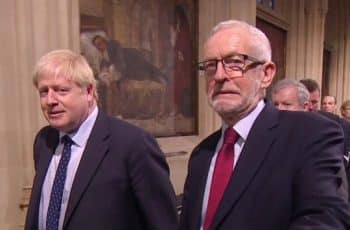
    By Michael Smith. The only positive conclusion from the  immolation of Labour in Britain is that it was its leader and not its policies that forced the tragedy. In late November pollsters YouGov asked the British public questions about the popularity of Labour’s manifesto, published earlier in the month. The tax rises on the rich were very popular. The 50 per cent tax rate for earnings over £123,000 was supported by 64 per cent of voters, with just 20 per cent opposed and 16 per cent uncertain. The 45 per cent rate for earnings over £80,000 was popular: 60 per cent supported  it and  23 per cent opposed it. 56 per cent support nationalising railways and just 22 per cent opposed it. Water companies’ nationalisation attracted 50 per cent support and just 25 per cent opposition. Nationalising Openreach, and therefore broadband, attracted 32 per cent supporting and 31 per cent opposition -but  free broadband for all attracted 62 per cent support  and 22 per cent opposition. Jeremy Corbyn became a cult without stopping off to become understood, or clear. For an accomplished politician he is an exceptionally bad communicator.  When he speaks, his sincere passions seem contrived, he emphasises the wrong part of key sentences and, worse, he does not even attempt to answer inconvenient questions, like what he thinks about Brexit, or what his stance on Israel and Anti-Semitism is.  He could have answered these questions plausibly but he seemed more interested in bristling. Corbyn’s second-rate rhetoric failed to raise the great British public to the appropriate level of vitriol at the descent of politics into lies, base populism and wishful thinking. To convey that this was different from the Tories of yore. He did not appear to understand that Johnson and his gang are qualitatively worse even than Margaret Thatcher and hers, that Johnson  – puppeteered by the malign Dominic Cummings – like Trump, does not appear even to be a democrat. He failed to ram home a message of the scandal of the UK’s descent into a-morality and a-factuality.  He did not appear to understand the effects of manipulative and cynical populism. He did not appear to value evidence as the grounding for  ideology. He failed to rouse the UK into an obvious rage, against the charlatan Johnson. However, Corbyn’s unforgiveable failure was not of presentation but of substance.  He failed to point out how bad it is for  a once decent country to fall for a liar and bigot like Johnson.  He failed to point out how bad Brexit will be for the UK’s economy; and for its society and environment. And he didn’t seem up for a robust and analytical debate in which he would explain the benefits of egalitarianism versus capitalism. His argumentation was typically dogmatic not open. Brexit was not the cause of the Tory victory.  Brexit was the failure of the Labour party. And as to the election catastrophe, blame neither policy nor Brexit.  Blame Jeremy Corbyn.  It’s in the anecdotes and it’s in the statistics. At all material times he’s always been less popular than his Tory opponent. Never again must the Labour party put a leader with ratings of minus 50% into the fray. It’s inept to the point of being unethical. And that is really the only lesson from a dark December in Albion.

    Loading

    Read more

  • Posted in:

    DUP Leader has rich and ancient Gaelic heritage with a family tree dominated by two august Irish surnames – Doonan and Kelly.

    Arlene Foster, Leader of the DUP, has a rich and ancient Gaelic heritage with a family tree dominated by two august Irish surnames – Doonan and Kelly. Her more distant ancestors, who spoke Gaelic, would have considered themselves part of the Ó Dúnáin and Ó Ceallagh clans, not Doonans or Kellys. Her family tree also demonstrates how the overwhelming majority of her ancestors lived and died in the Barony of Clankelly in Fermanagh. The Irish language act has amounted to an impasse which continues to be a stumbling block to the reinstatement of the Northern Executive and Assembly at Stormont. To her credit, Foster has shown leadership on the issue. At the launch of the DUP’s Westminster general election manifesto she declared: “The Irish language has been made a key block by Sinn Féin. I would regret that because I do think there is a way forward through those issues, because there are those in Northern Ireland who love the Irish language.” While she was not in favour of ‘a full-blown costly Irish language act which would bring about discrimination against those of us who don’t speak the Irish language’ she did say that there ‘is a way forward – I absolutely believe there is a way forward – but there has to be a willingness on all sides to find that way forward’. The Ó Dúnáin Connection Arlene’s Doonan connection is fascinating. Doonan or Ó Dúnáin is a rare name in Ireland. According to the leading authority on Irish names, The Surnames of Ireland, by Edward MacLysaght, the Doonans of Fermanagh were ‘Erenagh’, or hereditary stewards and guardians of Roman Catholic church lands. In old Irish they were known as ‘airchinnech’. The translation is ‘head of an ecclesiastical settlement’. Hereditary stewards and guardians were nominated by the local Catholic Bishop. The Plantation of Ulster in 1609 saw the Doonans completely dispossessed by the English. The Roman Catholic church was taken over and the congregation was denied the right to worship. The Doonans never recovered their earlier status, yet the family still survives in Fermanagh as Arlene’s family tree demonstrates. Further research is required to pinpoint when the Ó Dúnáin branch in Foster’s family tree converted to Protestantism. The Ó Ceallagh Connection According to MacLysaght, the surname Kelly (Ó Ceallagh) is the second most populous name in Ireland. It is not certain where the name hails, however the most probable suggestion is that is comes the word ceallach, meaning ‘strife’ in the Irish language. The Barony of Clankelly (from the Irish: Clann Cheallaigh meaning ‘Clan Kelly’) is in Co. Fermanagh. Clankelly takes its name from Cellach, son of Tuathal, a king of the Ui Chremthainn who was killed in 731. The ruling family of Clann Cheallaigh in the late medieval period bore the surname MacDomhnaill – from Domhnall, a grandson of Cellach, whose death is recorded in the year 791. Further research is also required to pinpoint when the Ó Ceallagh line in Foster’s family tree converted to Protestantism. Arlene Foster’s Family Tree. Whilst the documented evidence traces the roots of the Kelly branch of Arlene’s family back to the early 19th century, the surnames involved establish that the roots indeed go much deeper and their respective links to the history and culture of Gaelic Ireland is well documented. Her grandparents on her father’s side were Nathaniel Kelly (born 1881), a farmer, and Alice Jane Doonan. They married in 1924 in St. Mark’s Church of Ireland Parish of Aghadrumsee and lived in Derawilt, County Fermanagh. This townland is in the Civil parish of Clones and the Barony of Clankelly. Her great grandparents were John Kelly (6 May 1851) and Alice Doonan who were married in the Church of Ireland Parish of Clones on 18 May 1873. The marriage confirms that John’s father was also a John Kelly while Alice was the daughter of Nathaniel Doonan of Drummans, Clones, County Fermanagh. Her great-great grandfather was yet another John Kelly who married Sarah Ferguson on 4 December 1846 in St. Mark’s Church of Ireland Parish Aghadrumsee. This marriage record did not note the father’s names only to say that both were deceased. However, it confirmed that John Kelly was living in the townland of Drummaw in the civil parish of Galloon, also in the Barony of Clankelly. The townland is not far from Derawilt where the family ultimately moved. The land in Derawilt came into the possession of the Kelly family in 1892 when John Kelly took over the 47-acre plot from a John Richardson. He bought the land outright under the Land Act Purchase in 1908. Great-great-grandmother Alice Doonan was born circa 1843 to Nathaniel Doonan and Eleanor. Eleanor’s maiden name is unknown. Her father, Nathaniel, was born in 1812 to James Doonan and Jane Moore. Sadly, her mother, Eleanor, died prematurely in 1849 and Nathaniel married again, to Jane Forster in 1850 and went onto have a second family. One of his sons from this marriage, John Doonan, was the father of Alice Jane Doonan (mother of John William Kelly, Arlene’s father). While Arlene Foster may not speak Irish herself, it is surely lurking in her DNA. Perhaps she can now navigate her way through the Irish language act impasse at Stormont and make her ancestors proud of her nonetheless.    

    Loading

    Read more

  • Posted in:

    Fine Gael has finally established an identity - as the Nasty Party.

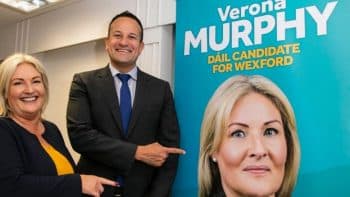
    Village often gets frustrated by the weakness of the Left and of the Greens.  However, it aims in general terms to be supportive of them, particularly in their radical forms. This is because they come closest – though still not that close – to furthering the agenda of equality of outcome, sustainability and accountability that drives this magazine. Village, not having fought in the civil war, has always struggled to register the animating idea of our bigger parties.  The absence of ideology spawns cynicism as there is a risk that the big idea becomes doing favours for friends. Fianna Fáil in government has been a confusing mélange of left and right, so that Bertie Ahern, albeit outrageously, claimed he was a socialist.  Fianna Fáil did just enough with the state pension, free bus travel, and social and local partnerships to be able to claim that it didn’t only serve the well-off and the developers who really excited it and forged its policies. But it provided parochial and venal governance. During the mismanaged boom it seemed Fine Gael might offer salvation.  It appeared less corruptible albeit there remains a mystery about fundraising under Michael Lowry who was profoundly corrupt and its performance in local planning has always been developer-serving and often corrupt. Even John Bruton never answered for dodgy behaviour over rezonings as party leader. Beyond this Fine Gael always well represented the wealthy farmers who uphold the IFA. It was pro-EU, perhaps because of that. It was for law and order because of its fascist antecedents. It thought of itself as better and more competent than thou, though it probably never was (Sweepstakes/Children’s Hospital/PrinterGate/Dara Murphy). And it was for…the Treaty. It had not been clear what Fine Gael really stood for.  It had veered from fascist-friendly under the founding Presidency of Eoin O’Duffy  to socially conservative under Liam Cosgrave to left of centre under Garret FitzGerald to right under Bruton and Kenny.  Only really under Varadkar have its true colours been allowed to flourish, in a modern Ireland which affords it no excuses. Varadkar is a Thatcherite with regressive views on abortion and gay marriage who one day realised his attractive personality could ground an ambitious career and became Fine Gael Man for the 2010s with a shinier agenda embracing lifestyle modernism. With this leadership, unsurprisingly the party allows all sorts. Cosgrave, Scully, Flannery, Bailey: Fine Gael love the years has provided a home to the corrupt and the fraudulent, to the racist and the exploitative. His MEPs unblinkingly vote against life-saving search and rescue measures for migrants in the Mediterranean on obscure grounds.  His candidate in the imminent Wexford by-election considers there is no homelessness problem in her home town and that there should be no carbon tax (or Road Safety Authority) and is “under no illusion that Isis is a big part of the migrant population”, that some asylum-seekers need “deprogramming” and that immigration risks a “return to the type of conflict seen during the troubles in the North”.   But it is by his policies that Varadkar’s Fine Gael should be judged. In Ireland in 2019 the top 1 per cent of the population gets more than 5 per cent of the national income. The bottom 40 per cent gets 22 per cent. The State’s “unusually high” incidence of low pay and weak labour protections generates inequality, with the working and lower-middle classes struggling most to make ends meet, according to Tasc. Fine Gael abandoned any vision of universal healthcare.  In September there were more than 10,000 people waiting on hospital trolleys, twice the number a decade before. Ireland has had 10,000 homeless people for each of the last eight months. 85,000 people are on social housing lists. Yet hotels and student housing are rising all over the country’s capital. Average rents are 45% of average earnings. The government lies about how many houses it was building. It won’t deal with the problem because Fine Gael is ideologically opposed to social housing as there is nothing in it for its buy-to-let-fetishising members. Its solutions are all developer-facilitating.  Its Minister for Housing is in thrall to the building industry and will not consider compulsory purchase measures. Fine Gael has no chance of implementing a National Planning Framework as it is ideologically unable to assert national planning norms such as avoidance of sprawl into Leinster and one-off housing, which interfere with the property rights of developers and landowners. Varadkar’s Ireland is the second worst climate offender in the EU. It is extraordinary that in every case where it cannot or won’t effectively intervene it is the wealthiest who benefit from Fine Gael’s inertia. Fine Gael stands above all for property rights; it stands for sniffy intolerance of those economically and socially inferior to the party’s – now often youthful and cosmopolitan – hegemons: for those who get up early; it stands for laissez faire and deference to developers and multinationals; and for indulgence of those who are intolerant of migrants. The big parties seem to have seen off demagoguery, the economy is thriving, the demographics are favourable, and the church is on its knees: the government is its own agent, and now we can finally see what Fine Gael stands for. But it has no vision, no empathy and no radicalism. It is the Nasty Party. Time for real change.    

    Loading

    Read more

  • Posted in:

    Two towns cope generously; the third, Ballinamore, is a morass of party politics, vested interests and even links to Quinn Group problems.

                              By Estelle Birdy. About 8,700 people in Ireland await a decision on asylum claims. 6,000 live in Direct Provision. Of these, 778 have received refugee status or ‘leave to remain’ but are unable to find alternative accommodation. Another 1,531 people live in 36 inferior,  emergency-accommodation centres opened in the past year. Between 1,200 and 2,000 asylum-seekers who do not need State accommodation are living outside Direct Provision. But this is the human story behind the statistics. It is the story of three towns and how they are dealing with people seeking asylum. Carrickmacross There had been murmurings around the town  about groups of men, foreign nationals, gathering on the Main Street.  And there’d been much discussion surrounding the alleged sexual assault of a woman in the town the previous week. Nevertheless, the apparent out-of-nowhere eruption of far-right sentiment in Carrick, on October 3  this year, took the townspeople by surprise. On that day, an online petition appeared, with the word Lawless, recalling the 1964 B-Western, scrawled across a background photo of   Carrick’s Main Street. The petition asked, “Do you feel intimidated while walking around Carrickmacross?”. People began to sign and comment.  Many comments were measured  but later additions turned to outright racism. A quick search for the text of the petition online found  it  being shared,  from the moment it was uploaded, by known far-right social-media accounts. A Facebook group,  established  under the name ‘Lawless’,  quickly became a focus for anti-immigrant organising.  Locals drawn to the Facebook group, found it already animated by far-right activists and anti-immigrant sympathisers. Several local group members , say they thought the group was “just a community discussion group”. It would prove to be much more than that. Soon the administrators were receiving requests to join the group from all over the world – a large number from the UK, the US and from around Ireland. By the afternoon of October 4, ex-British soldier and far-right activist, Rowan Croft, was livestreaming video from the town, linking a supposed lack of feminine security to immigration. Subsequently, right-wing media outlet, Gript, published a piece suggesting that   criminal gangs stalked the streets of Carrick, referencing the alleged sexual assault, stating that no one had been arrested in the investigation. This was untrue. A suspect had been in custody within 24 hours of the alleged incident. In the Lawless Facebook group, one name kept cropping up – Seamus ‘The Banty’ Mc Enaney, a local businessman,  contracted by the government since late 2018 to provide emergency accommodation for asylum-seekers in the area. A plethora of complaints about McEnaney   emerged. Some  professing interest in the welfare of asylum-seeking people, some angry at the money allegedly being earned by McEnaney to accommodate asylum-seekers. Another businessman, with links to the Yellow Vest Ireland movement, had prior beef, of a financial nature, with McEnaney. This man, highly active in the group, along with his proxies, agitated against both McEnaney and immigrant people. Gemma O’Doherty, of Anti-Corruption Ireland and Justin Barrett, leader of the far-right National Party, commented online about Carrickmacross, styling it as a matter of female safety. In fact, the National Party and assorted linked groups already had a small number of supporters living in Carrickmacross. Mark Malone of the ‘Far-Right Observatory’ says that what happened in Carrick had all the hallmarks of a pre-planned far-right attack. The speed at which the petition spread, the fact that Rowan Croft was filming from Carrick within hours of its publication and the numbers of people (1,300 at one stage) joining the Lawless group, all suggested advance preparation. Indeed, far-right and anti-immigrant activists were flushed with success   after a campaign in Oughterard, which saw protests there halting the provision of accommodation to 200 asylum-seeking people.. They were just waiting   to light the fuse and they used an alleged sexual assault as the match. Locals  began to question the credentials of some  active members of the Facebook group, some operating under false names. Questioning this or any  disinformation  being spread, resulted in locals and others being summarily banished. A week beforehand, Fiona Ryan and Jonathan Mathis, a mixed-race family who had appeared in a Lidl ad and had suffered racially motivated online abuse – notably from Gemma O’Doherty,    had been on the ‘Late Late Show’.  Somore people  were aware of the threat posed by racist, anti-immigrant campaigners.  EU and other foreign nationals, happily form a substantial percentage of the 5,000 strong population of Carrick .  The town has a history of welcoming asylum-seeking people – groups of (now long-established) Syrian and Congolese families were resoundingly welcomed. . Additionally, several humanitarian groups, both lay and religious, had been quietly operating in County Monaghan, as they have been in towns around Ireland. Officials say   that the Department of Justice is under pressure to meet Ireland’s international obligations to accommodate a small number of asylum-seekers. The recent McMahon Report on Direct Provision and the burning and blockading of some mooted accommodation centres, has forced many asylum-seekers into long-term emergency accommodation. Much of it unsuitable, cramped, rural accommodation with few transport links. Asylum-seekers have had to share beds with strangers and  are often moved to other locations at short notice, when   commercial guests require rooms. Asylum-seeking children have been unable to attend school for extended periods. This is happening currently in Carrickmacross. Asylum-seekers, like homeless families, are often segregated from other guests and must enter by the back entrance. Locals worked online countering racist and anti-immigrant claims and, crucially, working with SF local public representatives to disseminate accurate information  in the community One older local man says, “I never thought I’d have to fight the far-right in Carrick but that’s exactly what I was doing”. The following Saturday, anti-immigrant activists attempted  a protest in the town, calling it a local event. 25-30 people, in Dublin and Northern Ireland-registered cars and minivans, turned up. No locals took part, although some watched from a distance. The fact that the

    Loading

    Read more

  • Posted in:

    French Toast

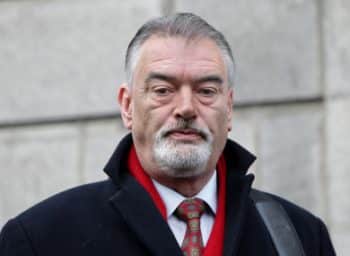
    By Bryan Wall. In a development that shocked very few people Ian Bailey was found guilty of the murder of Sophie Toscan du Plantier in a French court in May. After a four-day trial and deliberating for five hours a panel of three judges sentenced Bailey to 25 years in prison. He was also ordered to pay a total of 1225,000 in compensation, 1110,000 of which is to go to Toscan du Plantier’s family. Bailey, who has always denied his involvement in the murder of the French woman, was tried in absentia. A peculiar aspect of French law allows the authorities there to prosecute people suspected of crimes against French citizens that were carried out abroad. The French had therefore tried twice before to have him extradited to stand trial. In both cases the Irish courts ruled against his extradition, with the High Court ruling in 2017 that the demand for extradition was an “abuse of process”. Nonetheless, the French went ahead and held a trial with Bailey’s absence noted. But Bailey was not the only person absent from the trial. Irish witnesses received a letter asking them to appear at the trial only two weeks before it began. In some cases they were given as little as one week’s notice. As a result only three witnesses gave evidence, one of whom, Helan Callanan, had a statement read out on her behalf. Callanan, one-time editor of the Sunday Tribune, wrote in her statement that Bailey had confessed to her that he murdered Toscan du Plantier in order to “to resurrect my career”. At the time he was freelancing for the paper and wrote about the case for the paper. Of the two other witnesses, Amanda Reed gave evidence on behalf of her son Malachi. As a 14-year-old he had received a lift home from Bailey on 4 February 1997, less thantwo months after Toscan du Plantier’s death. He claimed that Bailey said to him “I bashed her f**king brains in”. His mother. related this to the French court. Back on the evening of 4 February 1997 Malachi arrived home, with no apparent concerns, having being dropped off by Bailey. The next day gardaí visited Malachi in school. There they questioned him about his journey with the journalist. And it was after he arrived home from school in an “agitated” state that he informed his mother what Bailey allegedly told him. Bill Fuller, the third witness, told the court that Bailey had confessed to him. Fuller stated that Bailey, speaking in the second person, said “It’s you who killed her”. Bailey denied this conversation ever took place. But these evidential issues with the trial pale in comparison to the French prosecution’s dismissal of the Irish Director of Public Prosecutions (DPP) and its opinion of the murder. The DPP file about the case was leaked a number of years ago and makes for astounding reading. It contains a litany of concerns with how the murder was investigated. These embrace wide-ranging issues such as witnesses who lacked both credibility and consistency being taken at face value and members of the gardaí stonewalling the DPP itself. It’s pointed out at the start of the report that there is “No forensic evidence linking Ian Bailey to the scene”. He had volunteered blood, hair, and fingerprint samples to the gardaí. This was in spite of the fact that, as the DPP highlights, in his former profession as a crime reporter in the UK Bailey “was aware of the nature of forensic evidence” and that it could comprehensively incriminate the guilty. The trial in France introduced no new forensic evidence to link him to the scene and the murder. The evidence of Marie Farrell, the witness who initially claimed she saw Bailey walking late from the direction of Toscan du Plantier’s home on the night of her murder, was described by the DPP as being unreliable. Yet these initial statements by Farrell, which she retracted years later, were accepted by the French. As for Bailey’s apparent admissions of guilt, the DPP found that they “appear to be sarcastic responses to questions”. This includes his comments to Callanan about trying to “resurrect” his career. And it includes the apparent conversation between Bailey and Fuller. The DPP noted that Fuller’s statement came at a time when the Garda’s actions were “bound to create a climate in which witnesses became suggestible”. The DPP report also discusses the statement made by Malachi Reed. It noted that it was “abundantly clear that Malachi Reed was not upset by Ian Bailey” after the latter had dropped him home. In fact, the DPP pointed out that it was after a conversation with a garda the following day that “he became upset and turned a conversation which had not apparently up until then alarmed him into something sinister”. And then there’s the Garda’s arrest of Bailey’s partner, Jules Thomas. She was arrested for the Toscan du Plantier murder on 10 February 1997. But the arrest appeared to the DPP to be illegal. This was because it discovered she was asked no questions about her involvement in the murder. The DPP wrote that her “questioning indicates that she was arrested to obtain information which could be used against Bailey”. And given this, “her arrest and detention was unlawful”. The French ignoring of the report means that none of this was taken into consideration. It means that a trial was held using evidence that was roundly dismissed by the DPP; evidence which resulted in the DPP clearly stating in unequivocal terms that “A prosecution against Bailey is not warranted by the evidence”. Frank Buttimer, Bailey’s solicitor, is explicit in his condemnation of the French trial, or “so-called trial” as he refers to it. Although not present in France, based on the information he’s seen he says what took place there “was not in any way a trial that we in a common law jurisdiction would understand a trial to be”. He said that what actually happened

    Loading

    Read more

  • Posted in:

    Weather forecasts are horribly inaccurate.

    WEATHER FORECASTS were always things for older people, like manners and leaf tea. And indeed for olden days: D-Day was only possible because of some superhuman advance-weather-divining from a sage in Blacksod. Many of the ‘War’ generation seemed obsessed with the weather forecast, well beyond the point of refusing to acknowledge its shocking deviance. The weather forecast was the most tedious thing on television. Of course, in Ireland, you couldn’t make plans. Outside of sustained heat waves, no one in Ireland should plan a picnic or barbecue in advance. So you never did. I never cared. I just got on with it. Operationally, you just had to look at the sky when you got up out of your bed and assume it would last. Equally, in Ireland, there was always a good chance of grey. Like today only greyer. Beyond that it seemed pointless, and unyouthful, to speculate. But there are other decisions – a snap weekend away, a walk, dependant others to be born in mind, that may depend on an accurate weather forecast – and so with age you find yourself seeking comfort in experts. And when you pay attention you find they nearly always seem to get it wrong. It’s not that they get it wrong with hurricanes, snowstorms and heatwaves, it’s that they get it wrong – all the time – saying it’s going to shine, or rain, where you’re going to be. The first thing to notice, even before they get it wrong, is that they smother you with ambiguity, those beguiling, soothing-tongued prognosticators: ‘Sunshine and scattered showers, in the West’. ‘Partly clear becoming cloudy, with a risk of rainspells, in the afternoon’. ‘Fine becoming fair’ It means nothing. Words like ‘should’, ‘possibly’, ‘probably’, ‘may’, ‘likely’, ‘some’ and of course ‘occasional’ compound the cloudiness. Getting it wrong is the weather forecaster’s speciality. One study found that when television meteorologists in Kansas predicted that there was a 100 percent chance of rain, it didn’t rain at all a third of the time. On the evening before the worst storm to hit the UK for almost 300 years, the BBC’s well-liked Michael Fish proclaimed on the night of October 15, 1987: “Earlier on today, apparently, a woman rang the BBC and said she heard there was a hurricane on the way. Well, if you’re watching, don’t worry, there isn’t”. There was; and gales at 115mph caused utter devastation across the southern half of the country, leaving 18 people dead, 15 million trees flattened, and damage of £2bn. Though his boss, Bill Giles – the lead forecaster for the station – took the blame for the mistake in 2011, the term “Michael Fish moment” is applied to public forecasts, on any topic, which turn out to be embarrassingly wrong. On September 29, 2016 the National Hurricane Center in Miami announced that Hurricane Matthew was nothing to worry about just before it exploded into a Category 5 monster that slammed Haiti, killing over 1,000 people before moving on to wreaking 30 mortalities in the US. In Ireland, during the big freeze of January 2010, Batt O’Keeffe, as minister for education, directed all schools to close for three days, based on a Met Éireann forecast of snow and ice. A thaw immediately kicked in, and he ignominiously rescinded his decision. Documents released under freedom of information to thejournal.ie a few years ago revealed widespread anger at this carry on in Ireland. Typical letters to the Met service were: “How can Met Eireann get away with wrong forecasts so much, I am baffled? If another service provider got it wrong so much, that service provider would be long gone… Met Eireann says one thing and the sky above our heads says another”. “What a joke. From forecasting that today would be mostly sunny yesterday to now saying it will be dull and cloudy. This is not forecasting, it’s nowcasting”. Some years ago Donegal County Council decided to start up its own weather-forecast website because RTÉ was reporting the north-west as a constant wash-out when Donegal had in fact had a scorcher of a summer. However, let’s be clear: the issue of regional bias is a different problem which I don’t want to get into (because it’s ludicrous). I’m talking here just about inaccuracy. Last year dodgy councillor and hotel mogul, Donegal’s Sean McEniff, threatened to sue Met Éireann for money lost by cancelled business. He instructed his solicitors to investigate the possibility of legal action against Met Éireann over what he claimed as an inaccurate weather forecast. Sadly he died shortly after the instruction. The main problem, it seems to me, is that the weather in Ireland is made over the seas, particularly the vast Atlantic ocean but also the Irish sea, and so varies over very small distances. If you live in Germany or Colorado there’s simply less sea to go around and you can see the weather coming. We’re also precariously positioned in a zone of complex transition between warm, moist air (sometimes of tropical origin) moving northwards and colder, denser, drier air (usually of polar origin) which is moving southwards. This is the devious and manipulative ‘polar front’ that ruins so many weekends. Nevertheless it is claimed, by those concerned only with the facts, that one-day forecasts have an average accuracy within 2 degrees, and that they predict rain (or a lack thereof) correctly 82 percent of the time. That drops to 70 per cent at three days, but even the seven-day forecast has a 50 per cent chance of being accurate. The UK Met Office does a 10-day forecast but – wisely, given its reputation – has ditched its seasonal forecasting which really never amounted to much more than hubris. In April 2009 the Met Office had unwisely issued a press release about the oncoming summer – “barbecue weather”. But it was a washout. A project at the 2018 Young Scientists Exhibition tended to absolve Met Éireann: two boys from Avondale Community School concluded that: “The

    Loading

    Read more

  • Posted in:

    First impressions of the new European Parliament

    By Mick Wallace OF COURSE I understood that the European Parliament represents a different way of working to that of the Dáil, but to say just how the European Parliament compares with what I had expected is difficult, mainly because I didn’t really know what to expect. I knew that it could be even more frustrating, if that’s possible, than the Dáil, that it was a structure which had neoliberalism built into its very essence, and that it was likely to present us with the political challenge of addressing the difficulty of making a real difference. Deciding to run for the European elections was not an easy decision. I’m still not certain that it was the right one; only time will tell. I’ve spent the best part of six weeks in Brussels and Strasbourg and the early experience has been head-melting. So far it’s been a mix of negative and positive. On the negative side the bureaucracy does my head in! Both Clare Daly and I got elected as Independents under the Independents 4 Change banner, with every intention of remaining Independent. One of our first challenges was to join a group of some sort: we soon discovered that there’s no perfect group, they all seem to be a bit of a mixed bag, and all challenging our natural allergy to political parties. We ended up with GUE/NGL (the Confederal Group of the European United Left/Nordic Green Left which brings together left-wing MEPs) – by no means perfect, but it was the grouping that allowed us the most freedom as Independents and they were the only grouping that didn’t apply a whip system – God knows, I was never very fond of being told what I should think. The battle for committees was next, and I eventually got what I wanted – Environment and Food Safety, which is a huge area, and is sure to be central to much of the parliamentary proceedings for the next five years. I also got Foreign Affairs, along with Security and Defence – the battle to prioritise peace over war, and to stop the ‘not so gradual’ militarisation of Europe has begun. A cursory glance suggests that I might regularly find myself in a minority – but nothing new there. The real work in the European Parliament takes place at committee level, and there are many strands to it. As an individual member of a committee you can look for a file on a particular issue, or for a directive, or for another piece of legislation that you are interested in. You can also look to be a co-ordinator where you would be the rep for your group on a particular file or piece of legislation, or you could look to be a rapporteur where you would be spokesperson for the file for all the co-ordinators of the different groups. There are also good opportunities to speak at committees. On the last pre-vacation sitting week, I managed to speak twice at the Environmental Committee. I spoke first on the Mercosur trade deal which I strongly believe should be opposed – it is bad for the environment, bad for food-safety standards and bad for the future of smaller family farms across Europe. I also spoke on the need to stop the use of glyphosate, better known in Ireland as ‘Roundup’. Its connection to any form of food production should not be tolerated. It is extremely bad for our health despite what the best science, that Monsanto’s money could buy, may have said. I also got to speak twice at the Foreign Affairs committee, and aside from having the opportunity to have my say, it was also good to be allowed to challenge two big hitters. I got to question the impressive Helga Schmid, Secretary General of the European Union’s diplomatic service, the EEAS, on Iran, and I also got to challenge the less impressive Gilles Bertrand, Head of the EU Delegation to Syria, about his outrageous support for regime-change in Syria. The previous week, I got to speak four times at the Parliament’s Plenary session in Strasbourg. I had fought like a bear for speaking time through the GUE/NGL group and failed, but by sitting through long debates from start to finish, managed to grind out speaking time on issues ranging from the Mercosur trade deal to challenging Federica Mogherini, EU Commission Head of Foreign Affairs, on how the EU is prepared to ignore International laws when it comes to Venezuela and Iran, conceding to the will of the US regime. It is early days yet but we do realise that we will have to work harder in Europe than at home, to make a difference, but that’s a challenge we relish. The numbers of MEPs are big out here but already we see a lot of people who we don’t believe will put the work in. We are also conscious of the fact that there’s a serious lack of democracy in how Europe works – but we didn’t stand for election to the European Parliament to just go with the flow. We believe in the European project but Europe must change, and we will do our damndest to change it. Right now it is undemocratic, it is wedded to neoliberalism, and if it continues to prioritise the interest of large corporations and big business over those of the people of Europe, the European project as we know it will perish. If it doesn’t change direction, the likely departure of the British could be the beginning of the end – but we didn’t come to Brussels to put an end to the European project, we’ve come to try to save it from itself.

    Loading

    Read more

  • Posted in:

    The Prince, the pauper and the paedophile peer: the dangerous questions the BBC failed to ask.

    SOME REALLY DANGEROUS QUESTIONS WERE NOT ASKED The BBC’s Emily Maitlis has broadcast the interview she conducted with Prince Andrew about his relationship with the convicted paedophile Jeffrey Epstein. It was billed as a ‘no holds barred’ interview. Unfortunately, Maitlis did not ask a single question about his relationship with the notorious child molester, Lord Greville Janner. Yet the Prince’s relationship with Janner raises as many questions as that of his friendship with Epstein. The British media has turned a blind eye to the Janner-Duke of York relationship. The Independent Inquiry into Child Sex (IISCA) in London chaired by Professor Alexis Jay may soon abandon its inquiry into Janner completely. If it does, the Prince will get to heave yet another deep sigh of relief for he will not have to face questions about his friendship with Janner from that quarter either. Alan Kerr, an Irish victim of sex abuse from Belfast, has provided the IICSA with details about the Prince’s friendship with Janner. Kerr’s story was revealed exclusively by this magazine. Readers who are not familiar with it are invited to read ‘The Boy on the Meat Rack’  and  ‘Out of the Frying Pan and into the Fire’ on this website. (Click on the ‘Alan Kerr’ tab at the end of this story.) A  PRINCE WHO IS ABOVE THE LAW The possibility that the IICSA will not investigate Janner comes in the wake of an announcement last August that the Metropolitian Police were not going to investigate the Prince for having had sex  in London with Virginia Roberts when she was 17. A spokesperson for the Met announced that it investigated allegations he had “had sex with Virginia Roberts Giuffre aged 17 in Ghislaine Maxwell’s bathroom” in London and confirmed that while they had received “an allegation of non-recent trafficking for sexual exploitation’ that ‘no further action is being taken”. Last August Channel 4 News discovered that the Met had “reviewed the available evidence” and decided that the matter “would not progress to a full investigation”. The Met’s purported inquiry had begun with a review of the “available evidence” in 2015 after receiving a complaint over claims in US court papers that a girl was “forced to have sex with Prince Andrew”. Independently, Roberts’ lawyers contacted the Met in 2016. A further complaint concerning the sexual trafficking of Roberts to the UK was received by the Met in 2015 from an unconnected third party. As Channel 4 disclosed, ‘The Met Police has refused to answer detailed questions about the allegations and whether they ever spoke to Epstein, his friend Ghislaine Maxwell, Prince Andrew or anyone from the Royal Household. Channel 4 News asked the Metropolitan Police a series of questions about Virginia Roberts’account of what she says happened to her at Maxwell’s London residence in early 2001. The Met told Channel 4 News: “[We] can confirm that the Metropolitan Police Service [MPS] received an allegation of non-recent trafficking for sexual exploitation. The MPS reviewed the available evidence and the decision was made that this would not progress to a full investigation. As such, the matter was closed”. It will come as no surprise that the Prince chose the BBC, not Channel 4 for his interview about Epstein. THE PRINCE IS CLAIMING THIS WOMAN IS A LIAR AND A FORGER. Ghislaine Maxwell procured and trained underage girls to have sex with adult males, as part of Jeffrey Epstein’s now infamous international paedophile ring.  Roberts has spoken about how she was taken to London in 2001 by Epstein. During her trip, she was awoken from her sleep by Ghislane Maxwell who told her ‘you’re gonna meet a prince today’. That night she went out dancing with Prince Andrew in a club where he gave her alcohol and she was later ‘forced’ to have sex with him. She claims had sex on two other occasions with the Prince. Although the Prince had precise dates, times and places at the tip of his fingers, he affected genuine surprise at the suggestion he had participated in an orgy in America with her. This demonstrates that he was putting on a performance for the cameras. His facial expression was tantamount to a lie:  how could he have been so surprised at an accusation – acting as if it was the first time he had heard it – if he was long since familiar with it?   HAS TIME RUN OUT FOR THE JANNER STRAND OF THE IICSA’S INQUIRY INTO CHILD RAPE? On 9 March 2016 Ben Emmerson QC for the IICSA said the Janner investigation “has been identified for an early hearing, partly in recognition of the length of time the complainants in this matter have had to wait before their allegations could be heard. The Janner investigation is one of four investigations in which preliminary hearings are being heard this month and in which early public hearing of the evidence are expected”. The Janner strand was intended to have opened in September 2016 but was moved to March 2017. It was adjourned again in the expectation it would be heard in 2018 but was then moved to a three-week slot in February 2020. It may now not proceed at all. Overall, the Inquiry proposes to conclude its hearing by November 2020 and publish a final report by March 2022. The threat of discontinuance of the Janner strand arises from the fact the Crown Prosecution Service (CPS) is considering whether or not to prosecute an unnamed individual on a referral from the Independent Office for Police Conduct (IOPC).  The Janner strand may not proceed while the CPS decides whether or not it will prosecute the individual. If the CPS decides to prosecute,  the IICSA will have to wait until after the prosecution has been completed. By then IICSA may have completed its hearings. If there are further delays and or appeals, the IICSA may even be wound up by the time all issues are determined. Unfortunately, the CPS was not in a position to tell the

    Loading

    Read more

  • Posted in:

    Jeremy Corbyn's record shows he would end the cover-up of MI5's exploitation of the rape of Irish children.

    While the UK’s 2019 general election will focus on Brexit, the outcome will have far-reaching implications for Buckingham Palace and Her Majesty’s intelligence services. Boris Johnson is unlikely to order a new inquiry into MI5 and MI6’s role in the abhorrent Kincora scandal, nor the role played by Lord Louis Mountbatten in it. Jeremy Corbyn has no such inhibitions. The survival of the Royal Family’s reputation and that of the UK’s intelligence services may very well depend on keeping Corbyn out of 10 Downing Street. Meanwhile, Johnson’s government has finally voted to set up a compensation scheme to aid the victims of child sex abuse in Northern Ireland and hopes the scandals they are associated with will go away. The establishment of the new scheme must not be exploited as an opportunity to consign the horrors the abuse victims suffered to history. The torture meted out to children at institutions such as Kincora Boy’s Home, Williamson House, Bawnmore and elsewhere, must not be forgotten. The abuse they suffered should not be described as ‘historic’. On the contrary, they are livid wounds on the British body politic. Some victims committed suicide. Many of the survivors  lead precarious, lonely and impoverished lives as a result of their traumatic experiences. The British Government needs to tell them the truth about what happened to them as children for the sake of their mental well-being. They need closure in the form of apology, acknowledgement and the truth, not lies, insults and defamation. Judge Anthony Hart, who produced a lamentable report in 2017 about the so-called ‘historical’ abuse that took place in institutions run by the State in Northern Ireland, understood none of this. On the contrary, he was condescending and disdainful towards victims such as Richard Kerr. The ongoing Independent Inquiry into Child Sexual Abuse (IICSA) in London looks like it will result in an even bigger car crash, especially as it may not proceed with its probe of Lord Greville Janner. This is incredible as Janner is beginning to look like he acted as a pimp for the British Establishment, the very issue the IICSA was set up to inquire into. There are many substantial reasons to condemn Hart’s 2017 Report and many reasons to abandon all hope that the IICSA wil unravel the seedy Anglo-Irish Vice Ring that preyd on children for decades. A fresh inquiry should be ordered into (a) the role MI5, MI6, the Northern Ireland Office (NIO) played in the original Kincora scandal and (b) the VIPs who abused Irish and British children and (c) the mammoth cover-up which persists to this day. Most particularly, Margaret Thatcher’s Cabinet Secretary, Sir Robert Armstrong, should be invited to tell such an inquiry all that he knows about the cover-up. General election candidates in Northern Ireland should be asked where they stand on the issue. Naomi Long, Leader of the Alliance Party, has already displayed outstanding leadership on the issue. The DUP has multiple connections to the scandal through its former leader Ian Paisley. He was surrounded by a relay of paedophiles and pederasts who raped children in the 1960s and 1970s. Foremost among them is a notorious wife beater who raped at least one boy Village  has spoken to at the Park Avenue hotel in Belfast. The Ulster Unionists have questions to answer too about a number of former Westminster MPs who served in their ranks such as their former leader, James Molyneaux. Sinn Fein and the Provisional IRA can hang their heads in shame too. They have had their own own sex abuse scandals which they mishandled badly (not to mention the incalculable number of children whose lives were destroyed by the acts of IRA bombers and gunmen). Compared to Boris Johnson, Jeremy Corbyn loathes, hates and despises MI5 and the other UK intelligence services. He has no love for the Royal Family either. Moreover, his key aide, Seumas Milne, a former journalist, has written extensively about MI5 dirty tricks. His book, ‘The Enemy Within’, first published in 1994,  has now reached its fourth edition. It is an indictment of MI5’s dirty tricks campaign during the Miners’ Strike. MI5 should be afraid, very afraid that Corbyn and Milne may yet reach Downing Street. There is nothing they would rather do than grind MI5 into dust. Kincora, the Patrick Finucane assassination, collusion with Loyalist paramilitaries and the type of dirty tricks Milne has written about, will more than provide them with the ammunition they need to shut it down and replace it with an organisation that has respect for law and order. The report Judge Hart issued – insofar as Kincora and its links to the UK’s intelligence services was concerned – was riddled with mistakes and pitiful speculation. Hart was not a cunning and deceitful fraud in the tradition of Lord Widgery (who produced the first Bloody Sunday report). Instead, Hart was a basically honest yet severely naive plodder. He failed to persuade a string of crucial witnesses such as Colin Wallace and Richard Kerr to talk to him. With the benefit of hindsight, they undoubtedly took the right decision in boycotting him. Hart did not merely fail at persuading high-profile people like Wallace and Kerr to co-operate with him, he was lazy and badly informed. He skill set did not include the ability to  seek out and ask  key figures such as Eric Witchell and Alan Campbell – two former member of the vice ring that swirled around Kincora – to tell him the truth about what had happened. Witchell is still alive and living in London. Campbell died in June of 2017. Like Hart, it appears the London inquiry will ignore Witchell too. Hart also ignored Albert ‘Ginger’ Baker, a former member of the UDA, despite the fact he had spoken about what the UDA had known about Kincora to Ken Livingstone in the 1980s. Baker is also still alive. Livingstone wrote about what Baker told him in one of his books. Baker knows about Westminster MPs from the

    Loading

    Read more

  • Posted in:

    Did Thatcher sanction the Finucane murder? It is now up to PM Boris Johnson and his Home Secretary, Priti Patel, to order a full judicial inquiry into the murder of Patrick Finucane to establish whether or not Margaret Thatcher gave Sir Patrick Walker, Director-General of MI5, the green light to murder him.

    Update: this article was published in October 2019. One year later the British government has refused to carry out a judicial inquiry. One of the stated reasons is that the PSNI and Police Ombudsman are reviewing the case. However, no  review is about to take place. Patrick Finucane’s widow has responded by saying that “as long as there is breath” in her body she will continue to seek answers about her husband’s murder and that the decision by the British government was “quite a shock” and showed “startling arrogance at ignoring the highest court in the land”,  i.e. the UK Supreme Court which has ruled that an inquiry should take place. Mrs Finucane has also pointed out that Brandon Lewis, the Northern Ireland Secretary of State, did not go into any detail about why the decision to refuse the inquiry was made. It  “does seem rather bizarre” she added  “that he [Lewis] is insisting the police [will investigate]” as the PSNI later issued a statement saying there is nothing new to investigate. The Police Ombudsman has no funding for a review. In any event such a review would be pointless and it is a judicial inquiry that is required. Clearly, there are other reasons Lewis and his boss Boris Johnson are blocking an inquiry. Village’s 2019 investigation addressed some of the issues the Tories, MI5 and other elements of the British Establishment are trying to suppress. That article starts here: Introduction: Margaret Thatcher and the cold-blooded murder of an Irish lawyer On 12 February, 1989, the UDA assassinated Patrick Finucane, a highly-regarded Belfast solicitor, at his North Belfast home. Finucane, who was 38-years-old, was shot 14 times by two masked UDA gunmen who sledgehammered their way into his house. His wife Geraldine was also injured during the attack which took place while the couple was enjoying a meal with their young family. In 2019 the Supreme Court in London ruled that the British Government had failed to investigate the murder properly. The only tenable reason for this is because the murder was organised by MI5, the intelligence service attached to the Home Office. A retired Canadian judge, Peter Cory, investigated the murder on behalf of the British State. During his inquiry MI5 officers broke into his office and stole some of the evidence he had accumulated. Cory also told Geraldine Finucane that he had seen a document relevant to her husband’s case which was marked  “for Cabinet eyes only”. Mrs Finucane knows no more. This raises the distinct possibility that her husband’s case was discussed in Whitehall in sinister circumstances before the murder. These revelations formed part of BBC NI’s compelling seven part Spotlight  series,  ‘The Secret History of the Troubles’. They have been ignored by the mainstream British media. Put simply, the finger of blame is now pointing at Margaret Thatcher. It now looks like she gave MI5 the green light to murder a perfectly respectable, law abiding lawyer. If Thatcher  and her circle did not order the murder, why are the Tory top brass so terrified of an inquiry? MI5 was led by Sir Patrick Walker at the time the assassination was planned and executed. If MI5 was involved, it is inconceivable he did not call  the shots – literally. When David Cameron was in 10 Downing Street he told the Finucane family that he could not order a public inquiry into the scandal. When Finucane’s brother Martin asked him why, he turned to Mrs Finucane and said: “Look, the last administration couldn’t deliver an inquiry in your husband’s case and neither can we”. According to Cameron this was because “there are people all around this place, [10 Downing Street], who won’t let it happen”. As he was saying this, he raised a finger and made a circular motion in the air. Theresa May, who was Cameron’s Home Secretary between 2010 and 2016, did not order a proper inquiry either when she took over at 10 Downing Street. The opportunity and duty to do the right thing and call one has passed to Theresa May’s successor, Boris Johnson, and his Home Secretary, Priti Patel. Yet, will they prove every bit as disdainful and corrupt as Blair, Cameron and May and continue the cover-up? Time is fast running out to hear what potentially key living  witnesses have to offer about the Finucane case. The list includes  Thatcher’s then Home Secretary, Douglas Hurd. Born in March 1930, he published a 524 page autobiography in 2003.  Unfortunately, there is no entry under the word “Finucane” in its index. Village  offers him the freedom of this website to inform our readers about what he know about the case, most particularly anything about “cabinet eyes only” documents. The evidence that continues to accumulate points to the probability that Finucane, a skilful lawyer, was targeted by the British State because he had mastered the intricacies of the Diplock Court system in NI and was representing his clients to the best of his very considerable abilities. A lot of Provos were walking free from court. In the mind of Thatcher and others in London, he had to have been a Provo and his death warrant was approved. In these circumstances, the task of assassinating him was passed to Walker and his gang of cutthroats at MI5. However, Finucane was not a Provo. On the contrary, he represented both Republicans and Loyalists. Who ever heard of a Provo securing the freedom of the Loyalist enemy? Moreover, he was married to a Protestant. Finucane was perfectly innocent of any involvement with the IRA although he was vilified as a member after his death. Insofar as the UDA was concerned, the kill-order was issued by Tommy ‘Tucker’ Lyttle, the UDA’s ‘brigadier’ or commander in West Belfast. Ian Hurst, who served with the then top secret Force Reconnaissance Unit (FRU) of the British Army, has stated “with cast iron certainty” that Lyttle was a British agent who was “handled” by the RUC’s Special Branch (RUCSB) using the codename “Rodney Stewart”. Lyttle himself

    Loading

    Read more

  • Posted in:

    Maurice The Mole? The Provisional IRA knew Sir Maurice Oldfield, Chief of MI6, was a homosexual. Did the Soviets know too?

    Forty years ago this month Margaret Thatcher sent Sir Maurice Oldfield, the former Chief of MI6, to Belfast to co-ordinate the activities of the various branches of British Intelligence in Ireland. Within a few weeks MI5 was reporting to Downing Street that he was a homosexual and an inquiry was launched to see if he had been blackmailed by the Soviets or any of Britain’s other enemies. He was soon given a clean bill of health. Kieran Conway, the former Provisional IRA Director of Intelligence in the 1970s, has confirmed to Village   that the Provos knew Oldfield was gay. What, if anything, did the Soviet intelligence apparatus, the KGB, know about Oldfield’s homosexuality? More significantly, if the KGB found out, what did they do with the information? The answer is nothing despite the fact it could have destroyed him.  Such inaction makes no sense as Oldfield was reputed to have been a highly effective opponent of the KGB. The notorious MI6 traitor Kim Philby described him as an officer of “high quality” and “formidable” in his memoirs.  In 2017 the Hart Report into child sex abuse published details of an MI6 document which revealed a “small collection of papers in file three which relate to the relationship [Oldfield] had with the Head of the Kincora Boys’ Home (KBH) in Belfast”. The “Head” of Kincora was “Warden” Joseph Mains who abused teenage boys at Kincora and elsewhere. Joseph Mains, according to MI6 records he had a “relationship” and  a “friendship” with Oldfield. PART 1: OLDFIELD AS A SECURITY RISK A DANGEROUS ATTRACTION TO YOUNG MALES Oldfield was in fact attracted to young males. The KGB could have ascertained this through routine surveillance or from its spies inside MI6 such as Kim Philby and George Blake who would have been on the lookout for blackmail material on their colleagues. There is, of course, a world of difference between being a homosexual and being attracted to underage males. However, back in the unenlightened 1970s and 1980s, few in politics would have  acknowledged this important distinction.  Incredible as it now seems, the mainstream print media routinely referred to the Kincora scandal as a “homosexual” one when it was nothing of the sort. In the dark days of the 1970s and 1980s those who ran British Intelligence definitely viewed a homosexual in the ranks as a security risk. Hence, when Margaret Thatcher was told about Oldfield’s sexuality, his security clearance was withdrawn while an inquiry was carried out to see if he had been compromised by the Soviets. It determined that he hadn’t. However, inquiries into the loyalty of Kim Philby, another senior MI6 officer,  had failed to expose evidence of his true allegiance to the Soviet Union. Furthermore, MI5 and MI6 had let at least Anthony Blunt, Guy Burgess, Donald MacClean, John Cairncross, George Blake – all Soviet agents – run amok inside Britain’s intelligence community for decades. HER MAJESTY’S SPYMASTER  Who was Maurice Oldfield and what was he capable of? When ‘The Troubles’ erupted, Oldfield was Deputy Chief of MI6. He assumed control of Irish affairs because his Chief, Sir John Rennie, did not share the same experience as he in the dark arts of the secret world. Rennie, who had been a surprise appointment as Chief of MI6, had a diplomatic and propaganda background whereas Oldfield had participated in deception campaigns during WW2; fought terrorism in Palestine after it; monitored the flow of weapons and money to the communist guerrillas fighting the British in Malaya in the 1950s. And, if all this wasn’t enough to square up to the IRA, he had a good idea of what it took to run a paramilitary campaign due to his knowledge of MI6’s guerrilla campaign against Albania, something that happened in the 1950s during his stint as deputy chief of MI6’s counter espionage directorate, R5. The Albanian campaign was a disaster. Most observers believe it was betrayed from the inside. Oldfield was a tubby little man who waddled when he walked, often dressed badly and was allegedly afflicted with occasional psoriasis. He has become more famous than most of his contemporaries, probably because Alec Guinness drew on his bespectacled appearance for his celebrated portrayal of George Smiley for the BBC’s production of John Le Carre’s Tinker Tailor Soldier Spy. The glamour of the association with Le Carrie has eclipsed the true nature of Oldfield’s character When Rennie retired prematurely in 1973 after a drug smuggling scandal in Hong Kong involving his son, Oldfield finally secured the top spot he had coveted for so long. Once in the driving seat, he steered MI6 until his retirement in early 1978 under an appropriately misleading title, ‘Head of the Foreign and Commonwealth Office, Research Department’. Under Oldfield, MI6 HQ continued to be what it had always been: a haven for criminals and the sort of place where a visitor would have been well advised to wipe his or her shoes on the way out of the building. Oldfield’s retirement as MI6 Chief was not to prove the death of his career: he re-emerged from his crypt to become Ulster Security Co-ordinator at the behest of Margaret Thatcher in 1979. By then too many intelligence cooks had congregated in NI and were spoiling the spy broth. Oldfield was asked to knock heads and streamline their work. While he was in Northern Ireland MI5 discovered he was gay. An MI5 report submitted to Cabinet Secretary, Sir Robert Armstrong, on 31 March 1980 revealed that on 28 March Oldfield had after “some preliminaries” admitted he “had first been introduced to homosexuality at university and he admitted having engaged in homosexual practices, intermittently, up till the time of his acceptance of his Northern Ireland appointment. His relationships were, for the most part, with restaurant waiters and the like: he had none, he said, with (MI6) staff or agents”. In other words, Oldfield admitted that he had engaged in homosexual activity throughout his career as an MI6 officer with random individuals. A copy of

    Loading

    Read more

  • Posted in:

    Report on NoWar2019 Pathways to Peace Conference, Limerick, 5-6 October 2019.

    By Caroline Hurley. An anti-war conference called ‘NoWar2019 Pathways to Peace’ took place last weekend at Limerick’s South Court Hotel, organised by WorldBeyondWar.Irish and international concerned parties met to consider the extent of militarism in Ireland and elsewhere, and to work towards preventing the war response everywhere with all its inhumane impacts. Speakers included seasoned Irish and American activists, contributors from Germany, Spain, Afghanistan, journalists and others. A video link enabled MEP Clare Daly to join from Brussels. Presenter and producer of RTÉ Global Affairs series What in the World, Peadar King attended a screening and post-discussion of his 2019 documentary, Palestinian Refugees in The Lebanon: No Direction Home, which features extracts of King’s previous discussion with Robert Fisk on the issues. Panel discussions covered topics such as awareness of army bases, nonviolent protest, the arms trade, Irish neutrality, sanctions, divestment, space militarisation, and refugees. Most of the presentations are now online at WorldBeyondWar.org YouTube channel, while #NoWar2019was the Twitter hashtag used. A highlight was the presence of Nobel Peace Laureate Mairead (Corrigan) Maguire from Belfast, co-founder of The Peace People, who movingly participated on Saturday but delivered the impassioned and erudite speech of the weekend on Sunday, as published by the International Press Agency, Presenza. The conference doubled as the annual gathering of World BEYOND War members. Co-founded by acclaimed journalist, author, activist, Nobel peace prize multi-nominee and radio host, David Swanson in 2014, World Beyond War ‘is a global nonviolent movement to end war and establish a just and sustainable peace’. Under the ‘how’ section of the international organisation’s professional website, instruction is given about taking practical actions. Their award-winning book, A Global Security System: An Alternative to War offers a wealth of innovative and viable material showing means to proceed. The event wrapped up on Sunday afternoon with a rally near Shannon Airport, in objection to the airport’s use by US military in violation of Irish neutrality. Shannon’s exclusive civilian function ended in 2002 with the Irish government’s decision to support US vengeance missions after the 9/11 bombings, as elucidated at the gathering by academic and activist John Lannon. Chairperson and founder of Veterans For Peace Ireland, Edward Horgan,added that in permitting this traffic, the Irish government is facilitating wars in the Middle East. Horgan estimated that since the First Gulf War in 1991, up to a million children have died in the region as a result: “roughly the same number of children who died in the Holocaust”. 100,000 Irish people marched in 2003 against the country’s proposed complicity. Even though America then wavered, protesting citizens were over-ruled and the new military-friendly regimeinstalled at Shannon. Shannonwatchdescribes itself as a group of peace and human rights activists based in the mid-West of Ireland. In the tradition of the Irish anti-war protest that began almost a decade ago, they continue to hold monthly protest vigils at Shannon on the second Sunday of every month. They also do continuous monitoring of all military flights and rendition-linked flights in and out of Shannon and through Irish airspace, details of which are logged online. They dislike what ‘killing in the name of’ is doing to Ireland’s reputation. The Peace and Neutrality Alliance, PANA, promotes neutrality and reform of UN security policy, and is critical of the European Defence Agency’s PESCO programme for a coordinated European military force, to which Ireland is subscribed through the controversial Lisbon Treaty – “PESCO allows thus willing and able member states to jointly plan, develop and invest in shared capability projects, and enhance the operational readiness and contribution of their armed forces. The aim is to jointly develop a coherent full spectrum force package and make the capabilities available to Member States for national and multinational (EU CSDP, NATO, UN, etc.) missions and operations”. Two special guests at the Limerick conference were the American Veterans For Peace Tarak Kauff and Ken Mayers who were not only recently arrested but were also banned from leaving the country. Mr Kauff is 77 years of age, Mr Mayers 82. They were imprisoned for thirteen days and held on remand at Limerick Prison for entering Shannon Airport and causing a ‘security breach’ on St. Patrick’s Day 2019. They were freed on bail paid by Edward Horgan but the revocation of their visas is currently being contested in the Irish courts. They shared experiences and ideas with those present. Such treatment of those caring about vulnerable people by Ireland of the welcomes, with our history of colonial oppression, seems egregiously shameful. Pat Elder addressed the US military’s use of fire-extinguishing foam, which contains long-lived carcinogens, PFAS, dubbed ‘forever’ chemicals. No longer can one source of pollution be isolated for clean-up, however, when the earth is being poisoned by plastics, pesticides, industrial and nuclear waste, and more. And when it comes to war, all these come into play on a massive scale as preparations for war weaken and destroy the ecosystems on which civilization rests. World Beyond War’s manual makes the following claims: Military aircraft consume about one quarter of the world’s jet fuel. The US Department of Defense uses more fuel per day than the country of Sweden. An F-16 fighter bomber consumes almost twice as much fuel in one hour as a high-consuming US motorist burns in a year. The US military uses enough fuel in one year to run the entire mass transit system of the nation for 22 years. One military estimate in 2003 was that two-thirds of the US Army’s fuel consumption occurred in vehicles that were delivering fuel to the battlefield. The US Department of Defense generates more chemical waste than the five largest chemical companies combined. During the 1991 aerial campaign over Iraq, the US.  utilised approximately 340 tons of missiles containing depleted uranium (DU) – there were significantly higher rates of cancer, birth defects and infant mortality in Fallujah, Iraq in early 2010. And so on. Given war’s significant contribution to the degradation of nature and to climate change, peace groups are increasingly linking up with environmental organisations such as Extinction Rebellion (XR) which is running a global fortnight of activities from Monday 7 October

    Loading

    Read more

  • Posted in:

    Was Thomas Passmore, paedophile, politician and County Grand Master of the Belfast Loyal Orange Lodge, an MI5 agent?

    On 16 September last Paul Graham told RTE’s ‘Liveline’ that he had been sexually abused by a senior figure in the Orange Order. Although not named, the abuser was Thomas Passmore, the County Grand Master of Belfast Loyal Orange Lodge.  That Passmore was a paedophile will not come as news to the Northern Ireland Office, MI5 and MI6. In 1973 he was named in a press briefing prepared by the British Army at Lisburn, Northern Ireland. The briefing concerned Tara, a Loyalist paramilitary organisation led by William McGrath, the notorious child rapist and Housefather at Kincora Boys’ Home. McGrath, who acted as an agent for MI5 and MI6, was convicted for child rape in 1981. To its credit, a number of senior military figures in the British Army tried to put an end to the abuse of children at Kincora. Foremost among them was Captain Colin Wallace. He and his military colleagues were thwarted by the NIO, MI5 and MI6, especially by a senior MI5 officer called Ian Cameron. Cameron was once a runner for the post of Director General of MI5. Those organisations and the PSNI persist to this day in covering up the full extent of the abuse at Kincora and elsewhere. The 1973 Tara Press Briefing (’73 TPB) described how ‘other people closely associated with McGrath and aware of his activities are, Thomas PASSMORE, Rev PAISLEY, Rev Martin SMYTH, James MOLYNEAUX and Sir Knox CUNNINGHAM QC MP’. In July 2018 Village published an article entitled ‘Kincora’s Smoking Guns: The Documents With Hugh Mooney’s Handwriting On Them’ which included a description of ’73 TPB. The ‘Kincora’s Smoking Guns’ article also described a number of other documents which demonstrated that the British Government knew about the sexual abuse of children at Kincora Boys’ Home long before the scandal was exposed by The Irish Independent in 1980. In addition, it demonstrated how a number of journalists Wallace had briefed remembered the Tara briefing. If that wasn’t enough, a number of Wallace’s colleagues at British Army HQ, Lisburn, also confirmed they knew about McGrath. Regrettably, Judge Hart who conducted a lighweight inquiry into Kincora was unable to comprehend the significance of any of this before he published his lamentable mistake-riddled report in 2017. Paul Graham’s RTE interview can be heard at https://www.rte.ie/radio/radioplayer/html5/#/radio1/21620062 Passmore was not named during the RTE interview but is the Orange Order figure mentioned briefly (at 13 minutes 30 seconds). The fact that Passmore abused Paul Graham would explain why he did nothing to halt the rape of children perpetrated by his friend and brother Orangeman William McGrath when he was informed about it. It is extremely unlikely that Paul Graham was Passmore’s only victim. Richard Kerr, who was a resident at Kincora, has long since described how he too was abused by Orangemen. The reference to Passmore in ’73 TPB was not highlighted in the ‘Kincora Smoking Guns’ article as its focus was on other aspects of the Kincora scandal. However, a copy of the 1973 document was reproduced in full in the printed edition of Village. WAS THOMAS PASSMORE AN MI5 AGENT? Thomas Passmore JP, was a senior Loyalist politician and Orangeman who operated at the highest levels of Unionist politics in the 1970s and 1980s. He became County Grand Master of Belfast Loyal Orange Lodge in 1973. He was unmarried and lived in Townsend Street, Belfast. He was not only an associate of McGrath but purchased the printing press which McGrath’s paramilitary group Tara used for its publicity. Passmore published an evangelical magazine with it. Like McGrath, Passmore believed that the Protestants of Ireland were descendants of one of the lost tribes of Israel. He was briefly a member of the Woodvale Defence Association in 1970s. It was set up by Alan Moon who was soon replaced by Charles Harding Smith who later became Chairman of the UDA. Passmore later became Chairman of the Woodvale Unionist Association. It supported the Ulster Workers Council (UWC) strike that brought down the 1974 power-sharing Government of 1974. Roy Garland was a member of Tara but walked out of it in 1971 when he discovered that McGrath was abusing boys. He immediately began trying to put a stop to it by telling the Orange Order of which McGrath was a senior member. Passmore was one of those who blocked the taking of any action against McGrath. He may have done this for any one of three reasons: first, because he wanted to protect a fellow child abuser; second, because he was being blackmailed by MI5 and MI6 for whom McGrath was an agent; third, because by 1973 he had become an MI5/6 agent. Perhaps it was a combination of all of the foregoing. Roy Garland persisted in his efforts to put an end to McGrath’s abuses but  met brick walls everywhere he turned. In 1976, the IRA killed Passmore’s father in an attack which he claimed was aimed at him. When Merlyn Rees was NI Secretary, MI5 smeared him and other Labour politicians as part of what they called Operation Clockwork Orange. One of the smears was that he was easy on Republican paramilitaries, especially his release of internees. Passmore reflected these views perfectly. On 3 December 1975 The Belfast Telegraph reported that ‘Mr. Thomas Passmore, said the fact that an ex-detainee had been killed while working with a bomb exposed the foolishness of Mr. Rees’ security policies…’ Passmore opposed the short-lived and unsuccessful 1977  United Unionist Action Council (UUAC) strike. It was led by Ian Paisley of the DUP and Ernie Baird, then leader of the United Ulster Unionist Movement (UUUM). The strike was disrupted by the release of an anonymous document which bears all the hallmarks of an MI5 dirty trick. It portrayed some of the UUAC leaders as homosexuals, something that was deemed reprehensible in Loyalist circles at that time. On 23 April, 1977,  Passmore launched a verbal attack on the strike which was due to commence in early May. One of his allegations was that a member of the UUAC had been

    Loading

    Read more

  • Posted in:

    Generation Extinction Rebellion

    In 2007, in the run up to a crucial general election, I was involved in setting up a campaigning group of environmental activists which we called HEAT to campaign on climate change. We believed that a reduction in carbon emissions of 90% by 2030 was necessary to avoid the tipping point for global warming catastrophe of a rise of more than 2 degrees Centigrade above pre-industrial levels. We wanted Legislation – a law! – providing for 3% annual reductions in our greenhouse gas emissions. We arranged for a cockroach to follow then Minister for the Environment Dick Roche to highlight his civilisation-threatening carbon-profligate policies, we elevated raised helium balloons over Leinster House saying the likely new government should prioritise climate, we produced research, we beamed images on to the Department’s offices in the Custom House. We helped with a televised invasion of the Ryanair AGM and a spoof contribution to a Bord Pleanála hearing on Dublin airport expansion. Our primary stunt was baking effigies of our leading politicians in a sauna. RTE sent cameras but it got bumped off the TV news by some more pressing matter. In short I have a firm gauge on how difficult it was to engage citizens, media and politicians on climate, in 2007. HEAT became moribund without making much of an impact and various other groups including Stop Climate Change, Friends of the Earth and An Taisce have made the running without really capturing imaginations. The fault has not been theirs but that of a public that lacks the capacity to address existential threats. Twelve years later, perhaps too late, a movement is sweeping all before it. Extinction Rebellion (XR) styles itself a socio-political movement and it applies the lessons of psychology and sociology to work out what protests have worked. The idea is to use nonviolent resistance to protest against climate breakdown, biodiversity loss, and the risk of social and ecological collapse. Extinction Rebellion was established in England as recently as May 2018 with about 100 academics signing a call to action in support in October 2018 and launched at the end of October by activists from the campaign group Rising Up! including  Roger Hallam, 52, famous for daubing a wall of King’s College London with the words ‘divest from oil and gas’ in 2017 as a protest against the institution’s fossil fuel investments – and avoiding a court conviction. When university security guards intervened, the veteran protester handed them home-grown salad including red mustard leaves, rocket, and rainbow chard as a gift.  In November 2018, five bridges across the Thames River in London were blockaded. In April demonstrators brought parts of central London to a standstill, causing roadblocks on Waterloo Bridge, Oxford Circus and Marble Arch, while others glued themselves to trains and buildings. More than 1,000 people were arrested.In May, the Metropolitan Police said they would push for all the 1,151 people arrested – which included Olympic gold medal-winning canoeist Etienne Stott – to face charges. So far 232 files of evidence have been passed to the Crown Prosecution Service, with 180 people charged, one cautioned for outraging public decency and 32 released with no further action. Citing inspiration from grassroots movements such as Occupy, Gandhi’s Satyagraha, the suffragettes,  Martin Luther King and others in the civil rights movement, Extinction Rebellion has attracted activists who have pledged to be arrested, and even to go to prison, following the mass arrest tactics of Bertrand Russell’s anti-war Committee of 100 in 1961. Activists also look to the Marriage equality, Repeal, UK Momentum and Bernie Sanders campaigns. Sanders, for example, had a strategy of immediately involving volunteers to recruit more volunteers. The movement is participatory, decentralised, and inclusive. It uses a circled hourglass, known as the Extinction Symbol, signifying that time is rapidly running out for many species. In Ireland there are small local affinity groups in Dublin, Cork, Clare, Galway, Kildare, Limerick, Derry, Leitrim, Wexford, Dingle, West Cork and Northern Ireland, and there is a steering committee, elected at a national meeting in November, to help coordinate actions, trainings and talks. The group’s demands include: Tell The Truth; Act Like It’s An Emergency; Ensure A Just Transition. It is nothing if it is not radical. Some of its principles include: WE HAVE A SHARED VISION OF CHANGE
Creating a world that is fit for generations to come. WE SET OUR MISSION ON WHAT IS NECESSARY
Mobilising 3.5% of the population to achieve system change – using ideas such as “Momentum-driven organising” to achieve this. WE NEED A REGENERATIVE CULTURE
Creating a culture which is healthy, resilient and adaptable. WE OPENLY CHALLENGE OURSELVES AND THIS TOXIC SYSTEM
Leaving our comfort zones to take action for change. WE VALUE REFLECTING AND LEARNING
Following a cycle of action, reflection, learning, and planning for more action. Learning from other movements and contexts as well as our own experiences. WE WELCOME EVERYONE AND EVERY PART OF EVERYONE
Working actively to create safer and more accessible spaces. WE ACTIVELY MITIGATE FOR POWER
Breaking down hierarchies of power for more equitable participation. WE AVOID BLAMING AND SHAMING
We live in a toxic system, but no one individual is to blame WE ARE A NON-VIOLENT NETWORK
Using non-violent strategy and tactics as the most effective way to bring about change. WE ARE BASED ON AUTONOMY AND DECENTRALISATION
We collectively create the structures we need to challenge power. Anyone who follows these core principles and values can take action in the name of RisingUp! In Ireland XR has pulled a number of stunts, mostly led by a small number of key activists: In May they dressed as Adam and Eve and met a receptive President at the Bloom festival. In June activists dressed in white overalls holding red flowers representing “innocent children” while others dressed like grubby politicians in cheap suits who poured blood – actually a red, sugary syrup – over them. Then more members in green overalls, to symbolise the “greenwashing” of the climate and biodiversity crisis, arrived to clean up the mess. In July, Minister for Climate Action Richard Bruton was constantly interrupted by protestors as he attempted to address a conference on forestry as a solution

    Loading

    Read more

  • Posted in:

    British Labour Party essays suggest move from austerity, financialisation and neoliberalism to radical democratic ownership of the means of production

    WHAT HAVE the Romans ever done for us? There’s a clear echo of that question in the essay collection of UK Labour-leaning economists edited by Labour’s deputy leader John McDonnell and published last year under the title ‘Economics for the Many’. For them the question is now “What has capital ever done for us?”. The book features contributions from the participants in McDonnell’s New Economics conferences, including Simon Wren Lewis, Professor Costas Lapavitsas, Professor Nick Srnicek, Prem Sikka, Ann Pettifor, according to McDonnell: “just one small part of the ferment of ideas . . . which has flourished since the crash and the economic and social decay of neoliberalism”. This book is the latest in a line of research papers starting with the 2017 Labour Party Manifesto ‘For the many not the few’, and ending with the recently published ‘Land for the Many’ co-authored by, among others, George Monbiot. Unfortunately, Monbiot himself got the ‘usual suspect’ treatment after the publication. As he wrote himself in the Guardian: “It proposed a set of policies that would be of immense benefit to the great majority of Britain’s people: ensuring that everyone has a good affordable home; improving public amenities; shifting tax from the ordinary people to the immensely rich; protecting the living world and enhancing public control over the decisions that affect our lives”. (What’s not to like?) He wrote on: “the result has been four extraordinary attacks in the Mail, Express, Sun, Times and Telegraph… Some of these reports peddle flat out falsehoods”. The Mail on Sunday reported that “we will soar to become one of the world’s few Marxist-Leninist states”. And the capital gains tax on people’s main homes which prompted the criticism? Monbiot writes, “We made no such recommendation, in fact specifically rejected it. He commented “you couldn’t make it up. But they did”. The argument about mediation of the political narrative by edict from press oligarchs is for another day. But it works. I’ll lay odds not a single Irish politician has googled the report. Or, for that matter, the volume of essays with which this article is concerned. N.B: the UK’s problems are mirrored here. McDonnell’s team of authors seeks to dam the trickle down of credit to the “precariat” and create a social or pluralist capitalism, perhaps even a common fund, sovereign to the people, based on a revitalisation of the old architecture of created wealth as a common good. Rubbish? Check out China! The context The neoclassical Keynesian synthesis allows for a deficit spending stimulus to cushion temporary frictions but, ten years after the crash, lingering unemployment must be regarded as a longer-term structural problem. The current ‘solution’ is the fragmentation of the jobs market with a lot of casualisation, temping, and on-call zero-hours labour. The UK has the richest single area in Europe – central London – but also nine of the top ten most deprived regions in Northern Europe. The precariat are being habituated to a life of unstable insecure labour, relying almost entirely on money wages or earnings. “In short, the precariat suffers from chronic economic uncertainty” even with the “cynically named” universal credit benefits system. They note that “The UK has a historically unprecedented mortgage debt overhang”. Banks create money when issuing mortgages and are the winners in what is a pseudo savings market. “Many households use debt to participate in economic life using debt to consume and, like all overleveraged investors, are vulnerable to income shocks”. “The power of finance is mediated through cultural conversations that make finance the legitimate means through which individuals access and participate in the economy”. “The Office for Budget Responsibility predicates its growth forecasts on ever rising household debt-to-income levels”. Undemocratic economics has fed into the rise of the post-truth world, as self-serving elites exploit people’s lack of understanding of the subject with narratives which contort self-serving politics into a story that falsely claims to benefit the individual. Reviewing a sixteen-essay volume in a few lines does it an injustice. Of course you want to know does it propose a re-nationalisation, don’t you? And the deficit? And where’s the tax burden going to fall? It’s clear: “Labour must end its love affair with the centralised state”. And McDonnell himself says that “the old Morrisonian model too often meant creating distant bureaucratic hierarchies that could seem as out of touch with workers and the public as any private-sector monolith. Counterbalancingly he also notes that the privatisation racket of private finance initiative contracts, ‘Public Private Partnerships’, should end. Instead regionalisation and local democratic governance will take up the reins. Can I offer an insight? Human nature is no longer geared to sharing the heavy lifting. The closest analogy I can think of is the structure of support for sport. Locals will cheer the local team, but someone has to manage the teams (without democratic accountability). We don’t want managers who are afraid to move without professional suits signing off on the idea. The question is: must there not be an incentive structure to get results? Gordon Brown “made a key mistake by suggesting that policy could help the recovery and tackle the deficit at the same time”. McDonnell now rejects the austerity narrative which has caused a general crisis of trust in our economic institutions. Instead, his proposed ‘fiscal credibility rule’ has a deficit target, but if interest rates hit their zero lower bound (similar to Keynes “liquidity trap”) the goal of fiscal policy changes from meeting a deficit target to stimulating the economy. And as for tax, for me the issue should not so much be about taxing the wealthy as such, but about using taxation to curb financialisation (‘the making of money from money’). Taxing the rentiers is taxing those who asset strip the earning capacity of the productive sector. One writer notes ruefully that “by the time any process for wealth capture is in place, the wealth has already been extracted into the ether of the global economy”. But another confirms that “a

    Loading

    Read more