admin

  • Posted in:

    SMITHWICK’s SECRET WITNESS

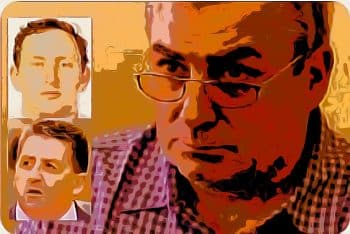
    By Deirdre Younge. The Smithwick Tribunal concealed its relationship with Freddie Scappaticci whom it treated as a credible source of information while the Kenova Inquiry is investigating him for multiple murders. The Smithwick Tribunal found Garda collusion in murder of RUC officers, but couldn’t name the colluder.  This was partly because it allowed a motley band of FRU operatives, informants and agents  like the serial ‘intelligence nuisance’ Fulton and elusive thug Scappaticci endlessly to mislead it on who the colluder was so that, when MI5 conduit Drew Harris gave definitive evidence to the contrary, the Tribunal was forced to give what the authorities, North, South and in the UK wanted: a false finding of collusion that was impossible for anyone, particularly an unnamed colluder, to challenge. Since this article was written the Public Prosecution Service of Northern Ireland has decided not to press charges relating to perjury against three people – two public officials and another, believed to be Freddie Scappaticci, on foot of files submitted by Operation Kenova.  The present DPP N.I Stephen Herron, appears to have accepted that Scappaticci was entitled to rely on the ‘defence of necessity’ in May, 2003 when he took a judicial review against Jane Kennedy, a Minister in the Northern Ireland Office. Scappaticci had asked the Minister to deny allegations in the media that he was the agent called ‘Steaknife’ or ‘Stakeknife’ which she refused to do on the grounds that it was standard policy to give a  ‘neither confirm nor deny’ (NCND) response to  questions related to National Security. The Minister’s decision was upheld in August 2003 when Scappaticci’s application for Judicial Review was dismissed.  An official in the Public Prosecution Service in 2006, reviewing Scappaticci’s sworn statements of 2003 on foot of complaints received, accepted that Scappaticci had committed perjury but that he was justified in claiming that he was not the agent ‘Steaknife’ or ‘Stakeknife’ in the circumstances, as to do otherwise would have put his life in danger – the ‘defence of necessity’. That decision was itself reviewed in 2018 by the then DPP Barra McGrory with the consequences explained below. The latest decision by the DPP Stephen Herron therefore, accepts Scappaticci’s defence.   Freddie Scappaticci, the British spy who came to Dublin to testify. Chief Constable Jon Boutcher, from Bedfordshire Police, is leading operation Kenova whose independent team is investigating a range of activities surrounding an elusive individual intriguingly codenamed Stakeknife, or Steaknife. Kenova detectives arrested and interviewed the British Army agent Freddie Scappaticci, a 72-year-old Belfast man, in early 2018. He is widely suspected of being that individual. A member of the Belfast IRA from the early 1970s, he was recruited as an agent for the Army’s Intelligence Corps in the mid to late 1970s. He moved to British Army intelligence Force Research Unit (FRU) in Northern Ireland which secretly penetrated terrorist organisations in 1982 with his then handler, Major David Moyles, who instructed him and channelled his information.  Scappaticci was observed operating around Dundalk and the Border region North and South from around 1982 until 1990. He is believed to have attempted to take over a unit run by another IRA man in Louth in the early 1980s. He was also described as the co-ordinator of its North-South operations. Later he was second in command to JJ Magee in the Internal Security Unit which conducted IRA interrogations along the border. He is linked to at least 20 murders.  But he fell out with the IRA, and in with MI5 and its emanations which paid him £80.000 a year. Serious allegations have emerged to the effect that, to protect his cover, the British government allowed up to 40 people to be killed via the IRA’s Internal Security Unit or ‘Nutting Squad’ which he led.  It appears Kenova is pursuing several perjury cases against Scappatacci for denying he is Stakeknife or Steaknife.  Some are sceptical whether he will be held to account as it has, for example, been alleged he retains tapes of his dealings with his handlers. A number of individuals connected to the Stakeknife scandal, and keen for an accounting, have claimed perjury is the easiest way to ensure the alleged spy will appear in a court of law. According to Henry McDonald in the Guardian, “The whistleblower who first publicly identified Stakeknife as Scappaticci, the former Force Research Unit soldier Ian Hurst, has described the perjury route as a ‘slam dunk’ if Boutcher and his detectives decide to prosecute on that front”. The focus of this article is on how such an eminently unreliable persona was allowed to elaborately subvert the naïve and misdirected Smithwick Tribunal that reported in the Republic in 2013. One gauge of the unreliability is perhaps that in court in 2019 counsel for Britain’s Ministry of Defence revealed the total number of lawsuits against the alleged spy. Tony McGleenan QC said: “There are 31 claims. Some have taken the form of correspondence [but] 24 writ actions have been issued. All of these name the second defendant (Scappaticci)”. Scappaticci had been outed as the alleged agent Stakeknife or Steaknife at the time of the Stevens Inquiry in London in 2003. The outing is credited to his sometime associate Peter Keeley aka Kevin Fulton. But it is also attributed to a former Sergeant in the Army Intelligence Corps and FRU, Ian Hurst aka Martin Ingram. Scappaticci was also the subject of allegations in relation to the Tom Oliver murder in County Louth in the book ‘Stakenife’ published in 2003 by Journalist Greg Harkin and Ian Hurst under his pseudonym Martin Ingram. That’s three different lineups alleging the identity. Keeley and Hurst are egregiously shadowy figures who were to feature in the Smithwick Tribunal and whose allegations led to Scappaticci being afforded unlikely credence and indeed getting legal representation there.  Members or agents of British Army Intelligence  were to play a huge role in the Smithwick Tribunal which investigated whether there was collusion between the Garda in Dundalk and the IRA killers of two RUC officers, Chief Superintendent Harry Breen  and Superintendent Bob Buchanan, who were shot dead

    Loading

    Read more

  • Posted in:

    Jeff has enough money. Save Ireland’s publishers this Christmas.

    By David Burke. I was fortunate to have a book published recently. I won’t personally be much affected by who sells it it but it did spark me thinking about the beleaguered publishing industry in Ireland. It does sterling work promoting diverse, minority and high-quality works. Writing is an Irish speciality. Reflecting this, thankfully Ireland has more than its fair share of small publishing houses, a fact that reflects well on this country. Unfortunately, even  in good times many of them just about managed to scrape by. Without them, the work of many Irish novelists, poets and historians would never see the light of day. Covid-19 now threatens to crush many of them. While heroic efforts have been made by some small  bookshops to set up click and collect facilities and others are able to remain open because they sell other essential items, many have had to shut their doors. Tragically, Amazon is set to make a killing in their place. This is a shame because most independent Irish publishers have their own websites which do exactly what Amazon does with one big difference: Jeff Bezos – who doesn’t even know their books exist – grabs an enormous slice of the purchase price for doing very little. This is a shame because most independent Irish publishers have their own websites which do exactly what Amazon does with one big difference: Jeff Bezos – who doesn’t even know their books exist – grabs an enormous slice of the purchase price for doing very little. This article is a plea to go directly to the website of an Irish publisher or your local bookshop if open (and many bookshops have their own websites too) if you wish to purchase a homegrown – or any – book instead of visiting Amazon. There are quite a number of Irish books which were selling well before the latest lockdown. The bestselling example of this – literally – is ‘Champagne Football’ by Mark Tighe  and Paul Rowan. In this instance the authors and their publishers have received a well deserved reward for their superb effort and hopefully will continue to do so. But what about the books which have just been launched or are about to come out over the next day or two? Frank Greaney’s ‘Crowded House, The Definitive Story behind the Gruesome Murder of Patricia O’Connor’  is a perfect example of this. Greaney attended the trial on a daily basis of those accused of both the murder itself and other offences in the aftermath thereof and, in the finest traditions of quality Irish journalism,  has produced a riveting book length account of it. He gets to grips with the story behind the tragic death and dismemberment of Patricia O’Connor as well as the lengthy trial that followed the discovery of her remains scattered in the Dublin Mountains. In human terms this is an important book because it sets the record straight about the victim who had, in the course of the evidence which unfurled during a seven-week-long trial been portrayed as a monster. Greaney’s work tips the scales very much in favour of the deceased to build up a picture of what she was really like: a warm, caring, generous individual, a solid employee – she worked as a caterer in Beaumont Hospital – and decent colleague. Greaney weaves in the evidence given at trial (particularly that of the forensic anthropologist who dealt with examination of the bones of the dismembered parts, and the pathologist) into a chronological narrative to give the story the feel of a novel. Patricia O Connor had no voice but Frank Greaney has given her one. Anyone who followed this trial will also be able to read about many of the events and facts that had to be kept from the jury and therefore were not reported in the media but are now. The book also provides a fascinating insight into how a modern trial is run in our democracy. Does Jeff Bezos deserve to scoop up the lion’s share of the proceeds from this book and all the others which are about to be published? Greaney’s publishers are Gill. If you or anyone you know is interested in this or any other Irish publication, bypass Amazon and go to the website of the publisher.

    Loading

    Read more

  • Posted in:

    [Expanded] British Intelligence must have known that Seán MacStíofáin was a Garda ‘informer’.

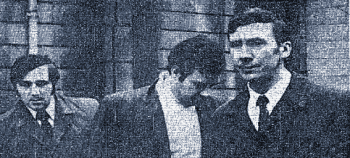
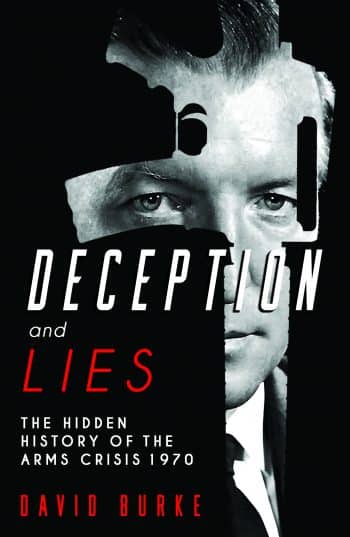
    By David Burke. The letter from the Garda officer who had served in C3. In 1973 a former Garda intelligence officer, Patrick Crinnion, wrote a letter which he addressed to three politicians: Garret FitzGerald, Conor Cruise O’Brien and Richie Ryan. All three were prominent government ministers at the time. Crinnion had served with the overarching Garda intelligence directorate known as C3 until the end of 1972. The letter refers to Seán MacStíofáin, the former Chief of staff of the Provisional IRA, as having misled the Garda into believing he was a bona fide informer during the 1960s and early 1970s. I have written about MacStiofáin’s machinations in my book, ‘Deception and Lies: the Hidden History of the Arms Crisis’. During my research I was able to speak to a number of former senior Gardaí about MacStíofáin’s masquerade as an informer. The letter from Crinnion emerged from a separate avenue of research and has no connection whatsoever to these former Gardaí. The letter merely adds to what they have said. It also shows that 47 years ago revelations about MacStíofáin’s role as an informer/double agent were circulating in Irish government circles. If this was part of an MI6 plot to destabilise the Provisional IRA as a sceptic might suggest, why did the story not surface until many decades later? In the letter Crinnion wrote that: Mac STIOPHAIN had until July 1972 conducted a brilliant masquerade as a Garda informant and been well paid to boot. His status would in all probability have continued but for documents found in the home of a retired Irish/American and a former Clann na Gael Treasurer, James CONATY, Drumshirk, Stradone. These documents were such that they were brought to the Minister for Justice for his personal perusal. That MacSTIOPHAIN should have been in receipt of State funds and regarded as an Informant must, to any sane objective person, appear the height of improbability but it is a fact. MacSTIOPHAIN was recruited in good faith in approximately 1961 but the justification of his later role must surely bewilder men of goodwill. You know how the PROVOS were formed, how SAOR EIRE acted as their Financial agents in the Republic so as not to incur the disapproval of the State against the Provos and until disenchantment about MacSTIOPHAIN occurred in July 1972 his immunity was at a reasonable level.   Crinnion is a controversial figure. He was arrested at the end of 1972 for allegedly having attempted to pass certain highly sensitive documents to John Wyman, an acknowledged MI6 agent. Both men were convicted on lesser charges and released from custody in 1973. Crinnion knew Wyman but has always denied that he passed him State secrets. The more serious charge against Crinnion of having passed highly sensitive Garda documents to Wyman was dropped. The traditional appreciation of what happened is that this was done purely because the documents were too sensitive to produce in court, even behind closed doors (in camera). There are reasons to believe that the documents were planted in Crinnion’s car on the orders of certain security officials who were actually responsible for passing secrets to the British Secret Service, MI6, and that Crinnion served as their scapegoat. Ultimately, the cabal may have pulled the strings in the background to ensure that the more serious charges were dropped because they knew Crinnion was innocent. The real culprits proceeded to co-operate with the British Secret Service for decades. Crinnion’s life was destroyed. He had to go into exile. False evidence was furnished against Crinnion during his trial on the lesser charges but that is a story for another day. Further evidence of a high-level informer. The existence of a high-level informer has been known for five decades. The former Head of the Special Branch, John Fleming, spoke about him at the Public Accounts Committee in 1971. This means that British Intelligence knew about the existence of a high-level informer at the very latest at this stage. In addition, Peter Berry, who was Secretary General at the Department of Justice at the time of the Arms Crisis, confirmed the existence of an informer in his diaries which were published by Magill magazine in 1980. In his memoirs former Minister for Justice, Des O’Malley, stated that the Garda had received a “tip-off” about the pending arms flight from the Continent to Dublin Airport which sparked the Arms Crisis. Other gardaí who knew about MacStíofáin’s role as an informer The revelation that MacStíofáin had this strange relationship with the Special Branch was based on information provided by a number of Gardai. Since the publication of my book another retired Garda with knowledge of the MacStíofáin case has confirmed that he was once considered an ‘informer’ by the Gardai. Since the publication of my book another retired Garda with knowledge of the MacStíofáin case has confirmed that he was once considered an ‘informer’ by the Gardai. And there is more: Liam Clarke and Barry Penrose published an interview with Hugh McNeilis, a Special Branch officer in Meath, after MacStíofáin died. McNeilis told them that he and three other Garda officers had maintained contact with MacStíofáin – whom he stated had been an informer. This uneasy relationship was maintained during the mid-1970s. In other words, MacStíofáin continued to provide information which the Garda were prepared to accept from him even though he had concealed important intelligence from them in the past. Presumably, MacStíofáin was supplying details about his opponents inside the Provisional IRA who had blocked his return to a leadership role within the organisation. MacStíofáin also remained a potential thorn in the side of the Marxist Official IRA which he despised. A group of Officials set up the Irish National Liberation Army (INLA) in the mid-1970s. At one stage MacStíofáin offered himself as leader of the INLA. At another point in the 1970s MacStíofáin had considered setting up his own paramilitary organisation. Against this background, MacStíofáin possessed plenty of information which remained of interest to the Garda. One hopes

    Loading

    Read more

  • Posted in:

    The long shadow of the Arms Crisis: more to Haughey’s question than meets the eye

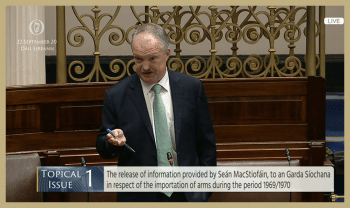
    By David Burke. Deputy Sean Haughey has repeated his request for the release of certain Garda files from the Department of Justice. There is a lot more to his question than readily meets the eye. In the late 1960s and 1970s C3 was the most secretive and sensitive department within an Garda Síochána. It provided reports to the Department of Justice based on information gathered by the various wings of the Special Branch across the country. It had the additional resource of a former Special Branch officer who was working inside C3 who had retained his contacts within the Republican Movement. Reports were furnished by C3 to the Department on a monthly basis and were known as the Confidential Monthly Reports. They were usually written by one individual and signed off by the Head of C3, Patrick Malone (who later became Garda Commissioner); and after 1971 by Larry Wren (who also later became Garda Commissioner). When they reached the Department of Justice, they were digested by Peter Berry who served as General Secretary to that department until early in 1971 when his deputy, Andrew Ward, took over from him. They were also read by Des O’Malley, who served as Minister for Justice between May 1970 and February 1973. It is the Confidential Monthly Reports to which Haughey is trying to gain access. He believes they will prove that Sean MacStíofáin was the informant who told the Special Branch that the weapons which were due to have been flown into Dublin Airport in April 1970 were destined for the IRA. This was a lie, for the weapons were due to have been stored by Irish military intelligence, G2, and only to be released in the most dire of circumstances to the Citizens Defence Committees (CDCs) of Northern Ireland. The CDCs were mainly made up of lawyers, businessmen and priests; and were not a front for the Provisional IRA. Haughey suspects that there will be a change in the pattern of the reports that reached the Department of Justice after July 1972. That was the month when the Garda realise that the information Sean MacStíofáin was feeding them was designed to suit his own purposes, not because he was a genuine informer. The change of pattern will corroborate the revelation that the Garda lost faith in MacStíofáin as a reliable informant from that time. Normally there would be little prospect that the Department of Justice would even entertain such a question. However, there is nothing normal about the MacStíofáin case. MacStíofáin was not an informer, but rather somebody who ran rings around the Special Branch. During the research for my book on the Arms Crisis, I spoke to a number of former Garda officers who do not believe he should be protected and that this is an exception to the general rule of anonymity furnished to informants. Another interesting aspect of this affair is that Haughey belongs to Fianna Fáil whereas the Minister for Justice is a member of Fine Gael. Put simply, a minister from Fine Gael – the party of law and order, not to mention truth and justice – now finds herself in the position of having to cover up for the former chief of staff of the Provisional IRA who made a fool of the Special Branch Put simply, a minister from Fine Gael – the party of law and order, not to mention truth and justice – now finds herself in the position of having to cover up for the former chief of staff of the Provisional IRA who made a fool of the Special Branch with his deception and lies. What she may not yet have realised is that Haughey has the support of backbench figures inside his own party for his initiative and that the pressure to get some sort of response about the machinations of Sean MacStíofáin is not going to go away. Indeed the Fine Gael minister may yet find she has to diffuse this issue before it becomes a more serious one for her Fianna Fáil colleagues in Cabinet. Last week, Deputy Sean Haughey posed the following question to the Minister for Justice: “To ask the Minister for Justice if she will release files in respect of reports from the C3 Division of an Garda Siochana, sent routinely to her Department by a person (details supplied) concerning information provided for the period 1969 to 1972, with particular reference to the importation of arms; her views on whether such files would be of interest to historians in view of the length of time which has since elapsed; and if she will make a statement on the matter. (Details Supplied) by Sean MacStíofáin, former member of the IRA army council”. On Thursday last (8 October 2020), the Minister repeated her commitment to review the files. As things stand, it appears unlikely that any further files will be released in the near future. Her answer was as follows: The National Archives Act provides that departmental files are subject to consideration for release to the National Archives, where appropriate, and open to public inspection. I understand that many of the records relating to the Arms Trial were released to the National Archives in 2000. While the Deputy will appreciate that some of the records could not be released because they contain sensitive Garda reports or potentially defamatory information, it should be noted that these files are subject to periodic review, including as to whether they should be released. As the Deputy is also aware, related matters were also the subject of reviews by the Attorney General and then Minister for Justice in 2001. There were also debated in the House at that time. As I recently informed the Deputy, it is not possible, given the current restrictions, to physically examine all of the remaining documents that exist in my Department. I gave a commitment to the deputy that the files will be reviewed and will be released as appropriate. In advance of any such review,

    Loading

    Read more

  • Posted in:

    Obit(ch)uary [Updated]: RUC Special Branch and MI5’s friend in the media passes away. Journalist who cast doubt on the truth about the Kincora Boys’ Home scandal has died. He once described the brutal abuse at it as ‘homosexual high-jinks’.

    The legacy of Chris Ryder, the former Sunday Times (ST) journalist who passed away last Friday, is not one to be proud of: he was one of a number of journalists who helped MI5 and the RUC’s Special Branch cover up the rape of children who had fallen into the grip of a paedophile gang that revolved around Kincora Boys’ Home. Some of them were as young as 10-years of age. He did not understand that there was a difference between a person being a homosexual and a paedophile. He once described the abuse of children at Kincora as ‘homosexual high-jinks’. One of the abusers at Kincora was William McGrath. McGrath once described his sexual preference for ten-year-old boys. He was a prolific rapist. His victims did not think they were participating in ‘high-jinks’ rather excruciatingly painful rape and humiliation, something that destroyed their lives. Some of the victims of the Kincora rape gang later committed suicide. Ryder’s negligence also nearly led to the death of a British agent in the IRA called Louis Hammond in 1973. The Hammond fiasco appears to have acted as a catalyst which led to Ryder becoming one of MI5’s many assets in the Irish media. By 1977 he was sending the following type of reports on his colleagues in the media to British Army HQ at Lisburn where MI5 had a station. THE JOURNALIST DOTH PROTEST TOO MUCH Ryder became a frequent visitor to the private dining (and drinking) area at the RUC’s Knocknagoney HQ where he rubbed shoulders with his friends in the RUC Special Branch and MI5. When Ryder appeared at the Smithwick Tribunal he denied suggestions that he had worked for MI5. “That is what people of a Republican disposition have said against me – I did not know a soul in MI5.” He also said that at “one point a person did approach me but I was not interested.” Even if we are to take this denial at face value, it still raises the question: why did MI5 think he might work for them? Surely the person who made the ‘approach’ to him would have been from MI5 or a similar organisation such as MI6? It was hardly someone from the NI Roads Authority. Readers can make up their own minds if they believe Ryder never met anyone from MI5. RYDER AND THE BRITISH-IRISH ASSOCIATION Ryder was also a regular guest at the British-Irish Association (BIA) which was heavily infiltrated by MI5. Former Taoiseach Charles Haughey forbade his ministers from attending the BIA in the 1980s on the basis it was an MI5 front. Surely Ryder met many British intelligence officers and assets at it such as Dame Daphne Park (senior MI6 officer) and David Astor (MI6 media asset)? RYDER AND HAMMOND Ryder’s path crossed with that of Louis Hammond in 1973 courtesy of British Intelligence. On May 13 1972 the British Army arrested Hammond, a Royal Irish Ranger deserter, at a barricade in the Slievegallion area of Andersonstown, West Belfast. Hammond had been born in 1954 and had grown up in Andersonstown. Having joined the Army in 1970 , he had disappeared after a visit home in 1972. He opted to become a Military Reaction Force (MRF) spy instead of facing charges for desertion and IRA membership. The MRF had been set up by Brigadier Frank Kitson before he left NI in 1972. It was based at Palace Barracks, Holywood. It ran a network of informers and agents who identified IRA members who were then sought out by MRF assassination units. After two other MRF agents, Seamus Wright and Kevin McKee, were lifted by the IRA (and later ‘disappeared’), Hammond was spirited to Liverpool. That should have been the end of his entanglement with the intelligence services. However, the Psychological Operations [PSYOPS] unit at British Army HQ in Lisburn was engaged in an operation to sow dissent inside the Provisional IRA by planting stories that certain IRA members were embezzling the proceeds of robberies. A document was prepared which was made to look like it had been written by a senior IRA member being held in Long Kesh. The plan was to pretend it had been intercepted by the security forces. It was addressed to the IRA’s Belfast Commander, Seamus Twomey, and named IRA members who had allegedly misappropriated funds. It would not appear that Ryder was an asset of Her Majesty at this stage as an elaborate ruse was mounted to convince him that the Long Kesh forgery was genuine. The forgery was passed to Ryder who alerted The Sunday Times in London.  The ST delegated Ryder and Paul Eddy, another journalist, to investigate the story. The teenage Hammond was now brought back into play.  He was ordered to contact Ryder and reveal he had been the Intelligence Officer of the Provisional IRA’s E Company in Riverdale and was prepared to sell him information about IRA embezzlement.  To Ryder, it appeared that Hammond was corroborating what was in the Long Kesh document. Ryder published an article in the ST which quoted an unnamed “former Intelligence Officer from E Company” as the paper’s source. The IRA quickly realised it was Hammond and ascertained that he was back in Belfast. He was lured to a house in the Markets district and interrogated for three days after which he was shot three times in the head and once in the stomach. Yet he somehow managed to survive albeit partially paralysed and blind in one eye. Ryder and the ST were clearly negligent in revealing that their information had come from a “former Intelligence Officer from E Company”. Following the publication of the story, the IRA considered killing Ryder. Ed Moloney has revealed on his Broken Elbow blog that they were talked out of this by a journalist – still alive and therefore unnamed – who advised them this would backfire on them by alienating the media. THE SPOOKS MOVE RYDER TO MANCHESTER The intelligence services decided not to take any

    Loading

    Read more

  • Posted in:

    Government must release Des O’Malley, the former Minister for Justice, from the shackles of official State-imposed secrecy – for the sake of history. UPDATE: O’MALLEY IS GOING TO TALK TO THE SUNDAY INDEPENDENT.

    UPDATE: Des O’Malley is going to reveal what he knowns about the new allegation that Seán MacStíofáin was a Garda informer in The Sunday Independent tomorrow. Hopefully, O’Malley will answer the 10 questions Village raised in the original version of this article In the event that O’Malley does not address these questions in The Sunday Independent, these pages are open to him to answer them here.   By David Burke. To his credit, Des O’Malley is one of a small number of former government ministers who have taken the trouble to publish a memoir. In this respect Ireland compares poorly to other modern democracies where memoirs are more common. O’Malley was Minister for Justice at a crucial moment in our recent history fifty years ago this week. The Official Secrets Act was hardly designed to deny the citizens of this nation the insight of figures such as O’Malley who occupied sensitive positions such a long time ago. Seán MacStíofáin, the former Chief of Staff of the Provisional IRA, masqueraded as an IRA informer for years. Helen McEntee, the present Minister for Justice, indicated earlier this week that she is open to the possibility of declassifying some of the files the State possessses about him. Surely it follows that the government could relax the restrictions on former ministers such as O’Malley so that they too can provide their memories of MacStíofáin, the key figure in the creation of the Provisional IRA? When O’Malley was Minister for Justice in 1970, Chief Superintendent John Fleming was Head of Garda Special Branch while Peter Berry was in charge of the Department of Justice. To a greater or lesser extent, all of these key figures have revealed that the State was running a high-level informer, albeit that none of them ever named him in public. There was another high-level informer but he was in a separate paramilitary group called Saor Éire. For the avoidance of any confusion, it must be stressed that  MacStíofáin was never a genuine informer. He abused his position to mislead and deceive the Irish State true to his agenda which was to bring about a military campaign to end partition. For the avoidance of any confusion, it must be stressed that  MacStíofáin was never a genuine informer. On the contrary, he abused his position to mislead and deceive the Irish State. He was always true to his agenda which was to bring about a military campaign to end partition. In the event, he created one of the most dangerous and violent paramilitary organisations in Western Europe, the Provisional IRA. MacStíofáin went to his grave with a lot of blood on his hands. From a historical perspective, MacStíofáin’s masquerade as a mole is far too important to let sink into oblivion. As things stand, his deceitful machinations will make the work of historians extremely difficult to unravel. This is particularly unfair on all of the victims of the Provisional IRA for MacStíofáin was the key individual in its creations. The gardai have a serious question to answer over its staggering negligence in its handling of MacStíofáin. We now, after the dust has settled, have some important information about him from the key sources: PETER BERRY: The fact of the existence of a high-level informer became apparent when Vincent Browne published the ‘diaries’ of Peter Berry in Magill magazine in 1980. They were replete with references to the information which an unnamed informer had provided to the Special Branch in 1969 and 1970. The Berry papers included a reference to an allegation made by a high-level IRA source with access to the deliberations of the IRA Army Council, one of which was that “the previous week a Cabinet Minister had [held] a meeting with the Chief of Staff of the IRA [i.e. Cathal Goulding], at which a deal had been made that the IRA would call off their campaign of violence in the Twenty-six Counties in return for a free hand in operating a cross Border campaign in the North”. The fact that the then Taoiseach, Jack Lynch, had spoken out against the IRA on 19 August did not dent Berry’s confidence in the ‘information’ he was being fed. Instead of realising he was being played by MacStíofáin, Berry wrote that the Army Council “could not understand the Taoiseach’s statement on 19th August as it had been accepted that the Cabinet Minister was speaking to their Chief of Staff with the authority of Government”. A wiser man might have suspected that the story was a vortex of lies. An operation to test the information MacStíofáin was providing could have been set in train. Instead MacStíofáin continued to furnish information which was accepted as fact until June/July 1972 when it finally became clear MacStíofáin had been playing the Gardaí all along. Micheál Ó Móráin has been much derided – especially by Berry – despite the fact he never fell for the diet of lies which was being fed to the Branch. JOHN FLEMING: We also know there was an informer from the evidence provided by CS Fleming to the Public Accounts Committee in 1971. He alleged that the source had alleged that Irish military intelligence had provided funds to Cathal Goulding, the chief-of-staff of the IRA. The information was a potage of lies. DES O’MALLEY: In his memoirs, Des O’Malley wrote about a “tip-off” that the Garda received in April 1970 about a flight that was due to arrive at Dublin Airport with arms. This was the event that sparked the Arms Crisis. According to O’Malley: “Those involved had planned to bring arms through Customs without the consignment being examined; but the Gardaí had received a tip-off about the plot, as well as intelligence that Haughey, as Minister for Finance, had authorised passage through Customs”. (See pages 50-51). O’Malley’s memoirs also reveal that earlier, in the ‘autumn of 1969 the Special Branch received further information that small consignments of arms were being imported through Dublin Airport at times when a sympathetic customs officer was

    Loading

    Read more

  • Posted in:

    Captain James Kelly’s family phone was tapped

    By David Burke. The family phone of Captain James Kelly and his wife Sheila, in Terenure, Dublin, was tapped by the gardai in 1970. Captain Kelly was one of the Arms Trial defendants who went on trial 50 years ago this week. He was acquitted. It is inconceivable that Mícheál Ó Móráin, who served as minister for justice until early May 1970 would have permitted such an intrusion on an officer of military intelligence. Equally it is impossible to believe that Des O’Malley, who succeeded him, would have done any differently unless – as is sadly possible – the Garda presented him with compelling information from their valued ‘informer’ Seán MacStíofáin. Unfortunately, MacStíofáin was a peddler of deceit who spun the most amazing yarns which his gullible Garda handlers swallowed whole. Hence, if O’Malley signed a warrant, he did so in good faith. Perhaps O’Malley will clarify this issue should the State permit him to address the issue. It is more probable that there was no warrant and none of the politicians was aware of what was afoot. I will provide some additional details about the tap in ‘Deception and Lies, the Hidden History of the Arms Crisis’ next week. I will be able to show that tape recordings were made of an unhinged individual who set out to terrify the children who answered the phone. The tapes of the horrific things he said to them were reviewed by the gardaí in charge of the surveillance. To their credit, they admitted the tapping was taking place unofficially and helped identify the culprit. The Kelly family is entitled to know when the tap was placed (and possibly renewed) and if it was continued after their father was acquitted at the second Arms Trial of October 1970. If it transpires that there was no warrant it means that officers of the gardai were tapping phones illegally behind the back of their minister. The late James Downey described in his biography of Brian Lenihan how, after the Arms Crisis had erupted, ministers were placed under surveillance. “For the Lenihan family”, Downey wrote, “this was a terrible time. Anyone associated with Haughey and Blaney came under suspicion … Telephones were tapped…”. Downey’s source was a “senior official of the Department of Justice” who informed him that the Special Branch had “filled an entire room in Dublin Castle with tapes of tapped conversations, mostly involving ministers”. According to Downey, “Men, presumably from the intelligence services, lurked outside Lenihan’s house. He was ‘shadowed/ on his way to work and social functions”. A few years later, the dilapidated RIC toilets at Garda HQ at the Phoenix Park were packed with files which were burnt on the orders of the then Assistant Garda Commissioner Ned Garvey who was in overall charge of Garda Intelligence. This was in either 1974 or 1975. It is likely that the transcripts of the phone-tap targets were destroyed at this stage along with other records and files. However, there is no reason to suspect that the original warrant for any legal tap was destroyed in Garvey’s bonfire. The originals would have been kept in the Department of Justice. The Department should still hold any of the warrants issued to permit the tapping of the phones described by Downey. It is looking increasingly likely that the State will finally apologise to the family of Captain Kelly for the many wrongs occasioned to him. Whether the tap on his phone was legal or not, any such apology should include this invasion of the privacy of the entire family. The level of intrusion was so intense that – in a repeating vignette illustrative of the seamy side of Irish political life in the 1970s – Mrs Kelly often had to ask the Garda tappers who she could hear chatting to each other on the line to go away while she rang her mother. OTHER STORIES ABOUT THE ARMS CRISIS AND RELATED EVENTS ON THIS WEBSITE: Misrepresenting Haughey’s relationship with the Provos. The Irish Times promoted the Official IRA’s version of the Arms Crisis. The Official IRA planned the murders of journalists Ed Moloney and Vincent Browne. Dick Walsh’s covert committee monitored OIRA media enemies. Future Irish Times Assistant editor put colleagues on lists. Ducking all the hard questions. Des O’Malley has vilified an array of decent men and refuses to answer obvious questions about the Arms Crisis and the manner in which the Provisional IRA was let flourish while he was minister for justice. The ‘Last Man Alive’ is still saying nothing. Des O’Malley’s silence about his role in the Arms Trials and Arms Crises of 1970 has become thunderous. RTE’s ‘Gun Plot’: Why has it taken so long for the true narrative of the Arms Crisis 1970 to emerge? Vilification Once More British Secret Service Smear sheet: the document that proves Charles Haughey was the target of MI6 vilification after the Arms Trial. [Expanded] British Intelligence must have known that Seán MacStíofáin was a Garda ‘informer’. Vandalising history. How the truth about Ireland’s Arms Crisis was corrupted by a gang of NI paedophiles, a dissembling Taoiseach, Private Eye magazine in London, some British Intelligence black propagandists as well as an Irish Times reporter who was an ally of the Official IRA. The long shadow of the Arms Crisis: more to Haughey’s question than meets the eye Minister for Justice confirms existence of unreleased “sensitive” Garda files about Arms Crisis but fails to commit to their release after Seán Haughey TD describes Seán MacStíofáin of the IRA as mis-informer in Dáil Éireann. ‘Deception and Lies’: A thrilling history that confirms Lynch not Haughey as unprincipled and explains how a named IRA double agent deceived the nation and the record. Paudge Brennan, the forgotten man of the Arms Crisis The Forgotten Arms Crisis Scoop: how a London newspaper reported details of what became known as the Arms Crisis nearly seven months before it erupted in Ireland. Government must release Des O’Malley, the former Minister for Justice,

    Loading

    Read more

  • Posted in:

    Minister for Justice confirms existence of unreleased “sensitive” Garda files about Arms Crisis but fails to commit to their release after Seán Haughey TD describes Seán MacStíofáin of the IRA as mis-informer in Dáil Éireann.

    By Michael Smith. Justice Minister Helen McEntee has confirmed the existence of secret and “sensitive’” Garda files relating to the Arms Crisis. She did not rule out releasing them in “appropriate” circumstances. Her comments were made on Tuesday evening in response to Seán Haughey TD of Fianna Fáil who was asking her to confirm that Seán MacStíofáin, the former chief-of-staff of the Provisional IRA, was a Garda informer but – crucially – one who had misled the Special Branch for his own devious ends and had sparked the Arms Crisis. This week marks the 50th anniversary of the opening of the Arms Trial. Haughey was looking for the files on MacStíofáin insofar as they related to information he had provided to the Special Branch about the Arms Crisis. Haughey made a compelling case to distinguish the MacStíofáin case from those of other informers who deserve anonymity and protection: MacStíofáin misled and damaged the State wilfully and was never a bona fide informer. Furthermore, that the Dáil was misled about events connected to MacStíofáin and that the record remains in error 50 years on. Seán Haughey is the son of the former Taoiseach Charles Haughey who was put on trial exactly 50 years ago this week. Haughey began his call as follows: The events which became known as the Arms Crisis convulsed the politics of this island 50 years ago. Some people came to believe that certain Fianna Fáil ministers, along with a cabal of Irish Army officers, attempted to import arms for the IRA through Dublin Airport. A trial involving four defendants opened exactly 50 years ago today (22 September). All were acquitted.  An account of these events was provided a decade later by the late Peter Berry, Secretary General of the Department of Justice, who made it clear that the Special Branch had a source inside the IRA who had had access to the deliberations of the IRA Army Council.   Colonel Michael Heffron, the Director of Military Intelligence, G2, in 1970, knew that the Special Branch had two paramilitary sources. One was in the IRA, and the other in Saor Éire.   In his 2016 memoirs, Des O’Malley, who was Minister for Justice in 1970, revealed that the Special Branch had received a “tipoff” about the incoming arms flight at Dublin Airport, that foreshadowed the Arms Crisis.   The informer has now been identified as Seán MacStiofáin, a member of the IRA Army Council, in a new book to be published on 23 September, ‘Deception & Lies, the Hidden History of the Arms Crisis’ by David Burke.  The author reveals that MacStíofáin exploited his position to create mischief for his arch rival, Cathal Goulding. In August of 1969 MacStíofáin convinced the Special Branch that the Army Council had struck a deal with the Irish government led by Taoiseach Jack Lynch to assist a campaign of violence in Northern Ireland. This was untrue.  In October 1969 Capt. Kelly of G2 hosted a meeting of the Citizens Defence Committees of Northern Ireland at a hotel in Baileboro. It was called to discuss the defence of Catholic communities and the possibility of arms being supplied to them by the Irish government. The ranks of the defence committees included priests, lawyers, a future SDLP minister, Paddy Devlin, as well as some IRA veterans. Yet, MacStiofáin portrayed Baileboro as a gathering of the IRA in furtherance of Goulding’s alleged links with FF.        Seán Haughey added that: During November and December 1969, MacStíofáin told the Special Branch that FF was channelling funds to Goulding via Capt. Kelly. This was also untrue.   The IRA as we know split into the Provisional and Official IRA in December 1969.   In March 1970 MacStíofáin, who joined the Provisionals, discovered that G2 was about to land an arms shipment at Dublin docks. It was destined for a monastery in Co. Cavan and earmarked for release to the citizens defence committees — not the Official IRA — in the event of a pogrom. Even then, the guns were only to be released after a vote at Cabinet. MacStiofáin sent a Provisional IRA unit to hijack the weapons. In the event, the arms were not on the boat and the hijack was called off at the last minute. This demonstrates that MacStiofain was not a genuine informer and that the guns were not destined for the Provisional IRA.    By April 1970 the Provisionals had established their own arms supply from America and did not need the inferior arms that G2 was now arranging to fly into Dublin. Deviously, MacStiofáin told the Special Branch that guns were on their way to Goulding’s Official IRA. This sparked the Arms Crisis.      Haughey asserted that it was clear from the foregoing that:  the Special Branch had what they believed was a genuine source of information at the highest reaches of the IRA;  But that he was peddling misinformation, and that;  Des O’Malley, the Minister for Justice at the time, was aware of a tip-off to the Special Branch about the arms flight.  Seán Haughey then turned to an inference that flowed from the new facts, namely that the Dáil had been misled: Regrettably, this house was misled about how the State came to learn of the imminent arrival of the arms flight. It was told it had been discovered by civil servants who were concerned about certain aspects of the paperwork associated with the flight.  After McEntee had confirmed the existence of “sensitive” Garda files, Haughey said, I am calling on the Minister to confirm that MacStíofáin was in fact an informer and to declassify all files relating to the information, he provided to the Special Branch about the events I have just outlined.  I appreciate what the Minister has just said in relations to the sensitive nature of these files. However, I think this House was given inaccurate information on 8 May 1970 when it heard a version of events which purported to explain how the State had discovered the

    Loading

    Read more

  • Posted in:

    ‘Deception and Lies’: A thrilling history that confirms Lynch not Haughey as unprincipled and explains how a named IRA double agent deceived the nation and the record.

    Conor Lenihan reviews ‘Deception and Lies – the Hidden History of the Arms Crisis 1970’  by David Burke: the arms crisis was a legitimate operation of state which history has falsely judged as a nefarious adventure by Haughey who went on trial 50 years ago this week for alleged illegal gunrunning. The year 1970 was a pivotal year for Northern Ireland. The political earthquake discharged by the evidence of the Arms Trial left the career of Charles J Haughey in tatters. While acquitted of charges that he had trafficked weaponry for the benefit of the IRA, the public belief that he had done so left a shadow of suspicion over him that even to this day it is difficult for new evidence to dissipate. Haughey clawed his way back to power and in the process effectively toppled his nemesis in the Arms Trial –  the then Taoiseach Jack Lynch.  The main career victims of the Arms Crisis were those on the republican wing of Fianna Fáil, most prominently Neil Blaney, Kevin Boland and the less celebrated Wicklow TD Paudge Brennan. However, in human terms, the biggest victim was Captain James Kelly, who as a career army officer, dutifully carried out his duties in the military intelligence section of the defence forces. Though acquitted in the Trial, Captain Kelly and his family were on the receiving end of state harassment and persecution for years afterwards. It was only after his death that the state, through a statement from then Taoiseach Bertie Ahern, frankly acknowledged he had done no wrong.  ‘While acquitted of charges that he had trafficked weaponry for the benefit of the IRA, the public belief that Haughey had done so left a shadow of suspicion over him that even to this day it is difficult for new evidence to dissipate’ At the heart of the Arms Crisis was an attempt by the government in Dublin to grapple with a situation that was veering out of control in the north with the potentially lethal possibility of a “doomsday” situation or civil war on the island of Ireland pitching Catholic against Protestant. From the summer of 1969 feelings were running high. Loyalist mobs ran amok in response to the minority Catholic population’s embrace of peaceful protests through the civil rights agitation. Catholic homes were burnt in what had all the appearance of an organised pogrom perpetrated by the sectarian elements in the loyalist community. If the Dublin government were wrong-footed by the crisis so too were the forces of moderate unionism as well as the entrenched interests of the Stormont government. Extreme loyalists, including the Reverend Ian Paisley, were brutally outflanking the moderates by exaggerating the influence of the IRA and suggesting the civil rights marches were being orchestrated by republican paramilitaries.  Against this background and failed efforts by the Dublin government to escalate the crisis at UN level ministers launched efforts to deal  with the plight of the nationalists in the north. The Irish army was ordered to the border and relief camps set up for those who were fleeing the early stages of the conflict. Delegations from the north demanded that the southern government supply them with guns so that they could defend their communities.  The Taoiseach Jack Lynch agreed to supply weapons, if the situation worsened,  and initiated arrangements through his Minister for Defence Jim Gibbons that the army would discreetly acquire weaponry that could not be traced to Dublin should the “doomsday” scenario occur.  Captain Jim Kelly, an assistant to the head of Army Intelligence, was given the lead role to travel north, assess the situation on the ground, and ensure that citizen defence committees got the assistance they needed. These committees had only come about because the IRA’s campaign, under the leadership of Cathal Goulding, had become political and Marxist with little actual military capability to defend the community. Captain Kelly was, with the full knowledge of ministers, putting together a covert operation of state that was designed to get weapons and make them available to suitable people north of the border. Too many people got to know of his operation as it progressed. ‘David Burke’s new book on the Arms Crisis slots in  a final, but vital, piece of the jigsaw. Why was it that, while the Irish army were fully involved in the operation, the Department of Justice and Garda intelligence were left out of the loop?’ David Burke’s new book on the Arms Crisis slots in a final, but vital piece of the jigsaw, into play. Why was it that, while the Irish army were fully involved in the operation, the Department of Justice and Garda intelligence were left out of the loop? It appears that the then Secretary of the Department of Justice Peter Berry, an overpowering figure, was simply not trusted to be involved given his paranoia on security matters generally. Few of the books to date have focused on Berry’s motivations and weaknesses.  ‘David Burke, for the first time ever, explains why Berry and the Special Branch moved to close down what, as a matter of political and historical fact, was a legitimate operation of state, approved by the Taoiseach’ Berry used his considerable influence to blow the whistle on the operation. David Burke, for the first time ever, explains why Berry and the Special Branch moved to close down what, as a matter of political and historical fact, was a legitimate operation of state, approved by the Taoiseach and supervised by his most important ministers. ‘The reason is truly startling: Seán MacStíofáin – the first Chief of Staff of the Provisional wing of the IRA played the Special Branch – to damage Goulding’s Marxist wing of the IRA and perhaps to split, and corrupt history’s view of, Fianna Fáil’ The reason is truly startling and the book takes on the aspect of a thriller as Burke posits the figure of “the deceiver” and finally unmasks him later in the book as (spoiler alert)…Seán MacStíofáin, the first Chief of

    Loading

    Read more

  • Posted in:

    Recognise their place in the system and care for them

    VILLAGE IS about nothing if it isn’t giving space to whistleblowers. Reflecting this, the magazine has several times illustrated articles with a cartoon whistleblower, cheeks inflated to bursting, typically to no political avail. It’s a good image for the magazine in general, Village’s frustrated sympathy is nearly always with those prepared to blow and it remains confounded by official concealments. The success of the whistleblowers covered by Village in getting the recalcitrants held to account has been variable. George McLoughlin figured on the cover of the last edition of the magazine for his insider allegations that the Workplace Relations Commission is systemically biased against employees but there was no pick-up by other media or the body politic. Meanwhile he is enmired in a miasma of legal actions with his employer, itself the WRC, about its failure to renew its contract with him after his retirement. Village has gone nuts about diverted funding at the long-dysfunctional Irish Red Cross, about a heavyweight Ansbacher cover-up, about Jonathan Sugarman, about the abuse of its dominant position in the market by Ireland’s biggest company – CRH, about the illegal dumping of 10 million tyres in the Donegal bog, about corruption in local authorities around the country, led by a former county manager in Donegal, about the role of MI5 in promoting compromising paedophilia in Northern Ireland; all to little avail. There’s a vague glamour to whistleblowing. It has been the centrepiece of works of art from Henrik Ibsen‘s ‘An Enemy of The People’, (1882) and Nobelist Halder Laxness’s ‘Independent People’, (1934) to Elia Kazan’s ‘On The Waterfront’, (1952) and Steven Soderbergh’s ‘Erin Brockovich’ (2000). But the glamour mostly attaches to journalists. Unless they’re from Village. Englishman WT Stead is considered to be the founding father of investigative journalism and the inventor of the sensationalism that gave rise to tabloid newspapers. His famous investigation into the trafficking of young girls in 1885 earned him a jail sentence but precipitated passage of a law raising the age of consent, and indeed Shaw’s play ‘Pygmalion’. Journalistic whistleblowing became a phemonenon with Emile Zola who was convicted by a French court for criminal libel for his campaign to establish the innocence of Jewish army officer Albert Dreyfuss of passing secrets to Germany in the late 1890s. Nellie Bly, a pseudonym used by journalist Elizabeth Cochrane Seaman around the same time, famously feigned insanity as part of her 1887 undercover exposé of the Women’s Lunatic Asylum in New York City. But modern investigative journalism took forensic shape in 1960s Britain. From Ludovic Kennedy’s 1960s re-examining of cases such as the murder convictions of Timothy Evans and Derek Bentley to Harold Evans’ 1970s exposé of thalidomide in the Sunday Times to Pilger and Hitchens and the crusades of Paul Foot on James Hanratty hanged in 1962 for the A6 murder, journalists in Britain have in a de facto sense acted as whistleblowers even if there is scant legislative protection for them. They are never legislatively classified as whistleblowers. These journalists attained a measure of respect, especially among the cognoscenti. We should nevertheless be clear that with the demise of the likes of Don McCullin and Peter Hitchens and even ‘Prime Time Investigates’ and the rise of the plutocratic oligarchs in the press, that intrepid investigation is under threat and in decline. The underlying characters who break from their peers to tell tales on their institutions, that’s a different matter. Most of them finish up destroyed. An excellent recent book by NUIG academic Kate Kenny, ‘Whistleblowing: Towards a New Theory’ (2019, Harvard University Press), makes the case that journalists make life more difficult for whistleblowers by spotlighting them and making them targets for scrutiny “We see this clearly in the recent media obsession with well-known whistleblowers such as Edward Snowden, Julian Assange and Chelsea Manning in which more attention is given to the individuals, their private selves and their personalities than to the information they report“. There is much literature on the dynamic and motivation of whistleblowing. Elements of vanity are often to the fore, proponents are rarely comfortable team players. Antagonists can often have a field day at their expense. Indeed though you’ll mostly recognise one when you see one in fact there are divergent views as to who should be classified as a whistleblower in the first place. Certainly an employee but what about a consultant or an associate or an independent journalist? Does criminal behaviour lose you the status? And what sectors? Certainly blowing the whistle on crime, terrorism, national security, and corruption are protected in most jurisdictions. Beyond that there is a definite ambivalence, reflected in official inertia. This is manifest in the fact that legislation is not in general effective and the whistleblower may expect to be subjected to what the literature deems reprisals or retaliation. This typically means internal disciplinary sanctions on a spectrum from an informal warning to dismissal on fabricated grounds. Bullying, harrassment, termination of career prospects or employment and threats are common but some have paid even higher prices. A notable such casualty was journalist, Daphne Anne Caruana Galizia, who led the Panama Papers investigation into corruption, targeting widely from the Prime Minister to the Mafia, in Malta. She was killed last year by a car bomb. Her experience was the worst but nearly all whistleblowers suffer for their stance. This is shown by a review of the best known. Before his recent eviction and jailing for skipping bail, Julian Assange was forced to seek refuge in London’s Ecuadorian embassy after facing an investigation by Swedish prosecutors into rape offences centring on his refusal to use a condom or have a STD test with two woman he stayed with while he was giving talks in Stockholm in 2010. Meanwhile, the US is applying for his extradition. Assange is not charged with anything related to Russia or Russiagate or even with breaking a law. Assange is charged with being in a conspiracy with Chelsea Manning “to commit computer intrusion” over the Collateral Murder

    Loading

    Read more

  • Posted in:

    Environmentalism without class struggle is gardening:

    The Green Party should be – and appear to be – this century’s equivalent to the trade union movement. By Councillor Oliver Moran. Protests against environmental taxes in Europe, farmers’ blockades in the Netherlands, urban unrest in France, and the water-charges movement here in Ireland should cast a long shadow for the Green Party in government.  The Waste Action Plan for a Circular Economy launched last week contains much that is worthwhile, but an awareness of the political importance of avoiding an environmental transition that lacks social empathy should be visible in everything the party says and does. Climate change and ecological decline disproportionately punish the worst off. The systems of economics that underlie them are exploitative of the poor, both globally and domestically, every bit as much as they are exploitative of nature and the planet. The solutions not only should not add to that but must necessarily challenge the assumptions of ecologically and socially exploitative capitalism. This is not an easy balance to strike. System change, if not implemented well, is more likely to affect the most vulnerable first. The party has progressive values at its core. This is a party that has among its founding principles that (a) unrestricted economic growth must be replaced by an ecologically and socially regulated economy and (b) the poverty of two thirds of the world’s family demands a fair re-distribution of the world’s resources. But the Green Party has missed opportunities since entering government to speak in that sociological voice with the same conviction that it speaks about technocratic solutions for environmentalism. This shortcoming isn’t derived from any malice on behalf of my party colleagues in government but from a cultural reluctance within the party to publicly express these convictions in clear and unequivocal tones. One of the roles of the Just Transition Greens, an explicitly left-wing faction affiliated with the party, is to challenge the party in government. Demanding more of it.  Time, both political and in the context of climate and biodiversity emergencies, does not allow us the luxury of waiting. The Just Transition Greens’ critique is evolving. Its end-point is not defined. What unites our members is not particular stances or policy demands that are very different to the rest of the party but a shared conviction. A conviction that it is the duty of the green movement in government to ensure that environmental solutions not only do not punish the exploited further but actively improve their conditions. A just transition For some this conviction is based in eco-socialism. For others it is faith based. One of the most acerbic criticisms of Pippa Hackett’s forestry bill was from the Jesuit Centre for Faith and Justice. Others, like me, reach for the traditional green pillars of peace, democracy and social justice. This does not boil down to simplistic notions of “cycles lanes” vs “social justice”. It is about the lenses through which we see the world. Cycle infrastructure can and should be seen through the lens of social justice too, empowering communities through accessible and safe transportation. The unifying aspect is a philosophy that refuses to disentangle the social from the environmental. A just transition recognises that not everything that is good for the planet is good for people. If, in our rush to save the planet, we neglect the dignity of the poorest in our society, what kind of world will we leave our children?  A just transition should lift up the horizons of all people, improving standards of living and protecting at risk workers and communities. Waste policy On 4 September, Eamon Ryan launched the new national waste policy. Justified or not, a far reaching policy that puts emphasis on the producers of waste was overshadowed by two bullet points in an 89-page document that seemingly lacked a nous for social justice. The irony was this drove some people to in effect defending exploitative capitalism. It was lost in some of the criticism that ‘buy one get one free’ on items like confectionery and fizzy drinks does not benefit the lower paid. It is itself a system of exploitation driving consumption and waste. The supermarkets and retail multiples are no friends of the left or workers and producers. They work actively to exploit the poor, labour, farmers and the environment. Neither is ‘fast fashion’ – as opposed to affordable clothing – a source of liberation for the poor. It too is exploitation, based on driving consumption, and it is a source of humiliation for people without the resources to keep up. The waste policy is very good at what it sets out to do. What it does, it does well on its own terms. Where it falls short is in addressing some of the greater social challenges with equal strength. It describes but doesn’t explicitly challenge the inherent wastefulness of capitalism. It lacks a sociological perspective. It doesn’t mention the income of households and how this affects consumption and waste patterns. Politically, launching a waste policy – that on the face of it would levy low cost clothing and ban cheap food offers – the day after a report had shown that 18% in Ireland are suffering deprivation is tone deaf. Not wrong, as I have described above, but tone deaf – and seemingly lacking in empathy and equal conviction for matters of social justice. A socio-economic lens Over-consumption and waste need to be seen through a lens that is socioeconomic every bit as much as technocratic. Tackling over-consumption and waste will only succeed if simultaneous efforts are undertaken to tackle income inequality, food sovereignty and human-rights violations. Our environmental policies should recognise the interconnectedness between economic development and environmental degradation. They should, as the UN Sustainable Development Goals demand, seek to reach the furthest behind first.  That is why our policies include a Universal Basic Income and a commitment to transform the relationship between producer and consumer, bringing them closer together – without the mediation of the consumption-driven capitalism of supermarkets and retail multiples. Both

    Loading

    Read more

  • Posted in:

    Mass violence: the difference between paramilitaries and militia

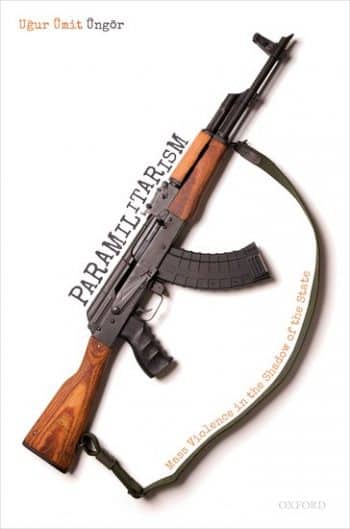
    “Paramilitarism: Mass Violence in the Shadow of the State” by Uĝur Ümit Üngör (Oxford: Oxford University Press, 2020). Reviewed by Chris Stanley. The genesis for this book was an analysis of Assad of Syria’s unleashing of militias to repress an uprising against his regime in 2011. Upon reflection the author realised that that violent episode deserved a monograph in its own right. But the Syrian episode provides a prism through which Uĝur Ümit Üngör compellingly considers paramilitarism, violence and the state. He uses the metaphor of the solar eclipse to reveal the dark heat of the relationship between state and paramilitarism (page 186).  Üngör opens with the recent and continuing Syrian ‘experience’ of violent conflict reliant upon the paramilitary militias. Episodes of insurgency and counter-insurgency can be painfully drawn out over years, as those in Northern Ireland are all too sadly aware. And this aspect of paramilitarism is possibly more important than Üngör realises.  Today in Northern Ireland there continue to be the entrails of violent paramilitary activity by Republican dissidents set against the peace process. This activity relies upon political and economic disenfranchisement largely among the young and led to the murder in 2019 of the journalist Lyra McKee in Derry. But the structure and activities of these Republican dissients paramilitary groups are vastly different to those of the PIRA and INLA at the height of the Conflict.  Also today in Northern Ireland the remnants of Loyalist paramilitary exists in the form of low-level violent gangsterism and criminality. Üngör has a sound understanding of the relationship between paramilitarism and criminality.  The shadow of paramilitarism still looms as a presence in Northern Ireland; its force still to be understood through the continued contested out-workings of the Legacy of the Conflict and the relations between the British state and Loyalist and Republican paramilitarism through the policies and practices of collusion, most recently explored by Mark McGovern in ‘Counterinsurgency and Colllusion in Northern Ireland’ (London: Pluto Press, 2019). But what is paramilitarism? Üngör conceptualizes it as “a system in which a state has a relationship with irregular armed organisations that carry out violence. But what is paramilitarism? Üngör conceptualizes it as “a system in which a state has a relationship with irregular armed organisations that carry out violence. These armed groups have different forms and types of relationship with the state, but nevertheless are linked to it” (page 7).  By having a link to the state these organisations achieve a quasi-legitimacy (even if for many it is deniable) – unlike militias. By having a link to the state these organisations achieve a quasi-legitimacy (even if for many it is deniable). There is both a dynamic and a relational proximity between paramilitary groups and the state (page 8) which sets them aside from militias which might have a more dominant role in a failing state or a state which is ceasing to exist or coming into existence. Hence the importance of the organic nature of this relationship.  PIRA was terrorist because it was anti-state (despite collusion between it and aspects of the British security forces, characterised by the role of PIRA-informer Freddie Scappaticci aka Stakeknife) whilst the UDA/UVF/UFF grouping was paramilitary because of direct links between elements within the UDR and the RUC In a counter-insurgency situation such as the Conflict in Northern Ireland, the PIRA was terrorist because it was anti-state (despite collusion between it and aspects of the Britsih security forces, characterised by the role of PIRA-informer Freddie Scappaticci aka Stakeknife) whilst the UDA/UVF/UFF grouping was paramilitary because of direct links between elements within the UDR and the RUC, the latter providing intelligence, personnel and equipment – most notoriously in the Dublin-Monagham Bombings in 1974 which former British Army Military Intelligence Officer (MIO) Fred Holroyd described as the closest point Britain came to invading Ireland in the post-war period.  The UDA was more than tolerated by the British state; it was indeed relied upon because it was outside a legitimate (and therefore accountable-deniable) structure The UDA was more than tolerated by the British state; it was indeed relied upon because it was outside a legitimate (and therefore accountable-deniable) structure (page 11). The UDA was manageable for a period but as with similar organisations described by Üngör (page 15) its value to the state was determined by political-security need and with the Good Friday Peace Agreement 1998 its work for the state was done.  Thus it fragmented into its present form of low-level Loyalist gangsterism mirrored by fragmented dissident Republicanism.   Üngör’s book starts with a loose history or survey – necessarily so given the shadowy nature of his subject – of paramilitarism. He traces its development from militias in emerging modern states and their role in supporting those seeking or claiming territorial rights. The paramilitary subaltern can well be imagined in the Machiavellian world of The Prince. It is in the twentieth century that what might be described as modern paramilitarism emerges, as state authority becomes more settled. The role of the state evolves to protecting its ideological values and countering attempts at insurgency. Regarding Northern Ireland, Üngör considers three heads. First, the security dilemma between identity communities (the sectarian divide). Second, collusion. Third, criminal infighting ‘after the war’. It is welcome that Üngör recognises the centrality of collusion to the Conflict in Northern Ireland – collusion which is still being exposed and contested – as it goes to state impunity for  ‘political’ violence.  I suggest Üngör is wrong in describing the Conflict as ‘war’.  It was a counterinsurgency for the British state and struggle for equality and British withdrawal for Republicans However, I suggest Üngör is wrong in describing the Conflict as ‘war’. Whereas the Conflict has been described as the “Irish War” or “The Dirty War” in fact the Conflict was never designated as either a war or an internal armed conflict as such designations would have invoked the Geneva Conventions. It was a counter-insurgency exercise for the British state and a Republican struggle for equality and the forced withdrawal of the British. Üngör

    Read more

  • Posted in:

    Bin the Spike

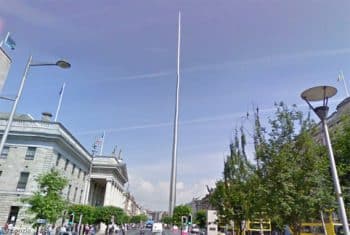
    by Michael Smith It’s 2020.  We’re transitioning to a civilisation with a wiser sensibility. We’re defenestrating monuments that subvert our values.  What’s the first erection we should remove? On its twentieth anniversary, it’s Dublin’s spike, the ‘Spire of Dublin’, a tiger in metal. Dublin lost the run of itself in a boom that started in the mid-1990s and found its monument in a lump of pointed pointless metal on its main street erected in 2003 after a battle, to celebrate the millennium. It was non-functional, non-contextual and sterile, a  searing icon of the times. It replaced Nelson’s Column, the tallest Doric column in Europe which afforded full public access, and complemented the classical architecture of the street perfectly.  Nelson could have been pulverised and replaced by James Joyce, Ulick O’Connor, Mannix Flynn, Maeve Binchy or Maureen Potter atop the statuesque and visitor-friendly pillar. No. In 1966 the whole column went up! The spire of Dublin was selected by Dublin City Council in March 1999 by 34 votes to 14.  It was designed by the London-based firm Ian Ritchie Architects. It is a 120m high cone that is three metres wide at the base and tapers to 150mm at the top.   At the time, I wrote a submission, on behalf of An Taisce, decrying the proposal.  I conspired with Mícheál O Nualláin, a wry artist and ex-school-inspector, to challenge the scheme for want of an Environmental Impact Statement.  He was the perfect person to do this as he was Flann O’Brien’s sibling, figuring in the great surrealist writer’s works as “the brother”.  Na Gopaleen had an acute sense of Dublin and would have murdered this ridiculous self-conscious symbol. “The vainglorious spire of Dublin has had its day and should be chain-sawed“  The brother’s own design, one of the original 205 competition entries, had been rejected. As reported by Frank McDonald in the Irish Times, Ó Nuallain had proposed a ‘skypod’ mounted on a huge hexagonal column rising from a three-storey glazed box at street level, a ‘sculpted flying saucer’. Ó Nualláin’s scheme was awful but he was justifiably miffed when the winner proposed something much bigger and aesthetically outside the bounds of what was envisaged in the architectural competition they had both entered – which had required that the monument relate to the scale of the buildings on O’Connell St. If “relate” was to mean anything by reference to the quantitative phenomenon of height it must have meant “be similar to”.  At 120m it clearly was dissimilar to the heights of all other buildings on the street and thus did not relate to their scale – though as regards the qualitative criterion of materials – “quality” it may indeed have “related”, though perhaps primarily through contrast! Ó’Nualláin found a good vehicle for his case in the EIS Directive and a forceful advocate for it in the well-named Colm MacEochaidh, a young barrister and a friend of mine. The case was never really treated seriously. Joan O’Connor, President of the Architects’ Institute, who thought the spire would be best “infinitely” high, claimed  that  the  spire was the first time an EIS has been required for anything as “ephemeral as a slim and beautiful object”. As Chairwoman of the architectural-competition panel for the spike she might usefully have been aware that the last thing beauty (which aspires to transcendence) aims at is  ephemerality  (which means transience). In the Irish Times, Frank McDonald focused more on Ó’ Nualláin’s own entry than the breach of the competition’s rules or the need for an impact study.  McDonald was a worshipper at the altar of the phosphorescent architecture of the Celtic Tiger and here championed its icon. In July 1999, Judge TC Smyth ruled that an EIS had indeed been required before the spire could be built. Commentators then and now don’t realise that any urban development that “is likely to have a significant effect on the environment by virtue inter alia of its nature, size or location”, requires an EIS. The nature, size and location of the spire could not have been more important, even if it was ephemeral, beautiful and slim. Subsequently, a detailed EIS was compiled and submitted in June 2000 to the Minister for the Environment rather than to the City Council itself as would have been the case if the EIS had not been requisite.  Of the 121 submissions received on it, three-quarters were against the project. Nevertheless it was approved. Progressives are looking for monuments to topple.  The spire symbolises how a country lost the run of itself, sterilised its national genius, lost its sense of irony and came to respect quantity over quality, and money over values. At the time I noted that the scheme was “reversible and could be erected somewhere else if its siting jars with  a future generation”. It should be chain-sawed at its base and removed, on the shoulders of the citizenry, to the Croppies’ Acre park where it can be interred next to its sister in folly, the floozie in the jacuzzi. And then we can have a debate about what aspirations we want to see enshrined in a magnificent and democratic replacement.  

    Loading

    Read more

  • Posted in:

    Incitement to hatred of the speckled.

    An Outsider’s view  of always present, now boiling, racism in Ireland By David Langwallner  Hugo Hamilton wrote a book called ‘The Speckled People’ (2003) which to some extent mirrored my experience in growing up with a Germanic mother and a Gaeilgeoir Irish father who refused to allow him to speak English. “Speckled, ‘half and half…Irish on top and German below’”. I was raised largely in Dublin, half Austrian. My school days in a minor school were blighted by Nazi remarks: “go back to Germany Hitler” in the school yard from kids who are now our envied establishment: police or civil servants, or indeed family or criminal lawyers. Austria, I knew, was the country of Mozart,  Schubert, Haydn and Strauss, and Egon Schiele: they did not understand or care when they spied a vehicle for their bullying. They instinctively knew to search for something to which there could be no comeback, to something innate I could do nothing about. It was a huge struggle to survive that and I did so through academic achievement which diminished the bullying somewhat. Like many who have been tormented I also developed the facility with the spoken word which has stood me in good stead. In fact I over-compensated, though I say so myself, with a certain loquaciousness in desperation to gain an acceptance never willingly forthcoming.  When I eventually went to Trinity College in Dublin there was an initial sense of release but there was always an element of bullying and my relationship with the Trinity Law Faculty then and now was terrible, particularly since the importation of academics from UCD. There are far too many little Irelanders in positions of institutional responsibility in Trinity and certain extremists of a fundamentalist nature. Insidious. For them I was neither fish nor fowl. Guinness with blackcurrant. Half-caste, speckled. I remember in the Irish Observer Mace for Trinity an international debate competition I subsequently won I  was undermined with a choice racist comment which drew great guffaws of laughter from the mobocracy of UCD’s premier debating society the L and H: Nein Danke, Herr Langwallner.  I have always considered UCD a breeding ground for corporate criminals and social glibness and the two go hand in glove.  Have you ever gone to the Gaeltacht or a session of traditional Irish music, a UCD-spawned non-entity senior counsel with a Gaelgeoir name asked me a few years ago? Well why should that matter? UCD’s law faculty spawned Sutherland, Cowen, McDowell, Paul Gallagher: all agents of the globalised neo-liberal establishment. But also a disproportionate number of jailbirds such as solicitor Thomas Byrne and ‘Cocaine Jim’ who robbed his own bank.  At times the difference seems to me to be missable. Having studied and worked in the UK and America I am now confirmedly multicultural and non-racist. In effect I am a mongrel, so my antennae are always raised about racist biases and evaluations. I think my worldview constitutes the acquisition of empathy through bitter personal experience. I escaped Ireland’s adolescent universities and enjoyed a time in better colleges in the US and the UK. Harvard is a multi-cultural and mixed-race community and the LSE is immersed in heterogeneous London.  They were models of cosmopolitan tolerance. I might add that interaction with the protestant Brahmin community in Harvard was also a slightly odd experience. I felt not unlike the way Woody Allen imagines himself turning into a caricature Jew at a protestant thanksgiving in Annie Hall. I suspect that is why I got on so well with the legendary Alan Dershowitz, Professor of Criminal Law at Harvard, like Allen a secular Jew, who has represented the likes of Assange, Tyson, OJ Simpson, and Epstein. Outsiders. The recently departed Gunter Grass wrote many novels and was a vigorous political polemicist and  a German national figure. He is most famous for his novel ‘The Tin Drum’(1959).  Its premise is that Oscar, a severely mentally handicapped child or child adult, sees everything that is going on at the onset of fascism in Germany; and reacts by banging a tin drum. It is the perspective of the outsider, the clown observant, the not-to-be-taken-seriously, the boy who cried wolf. The person suffering from a disability. He cannot be seen as a threat. Like a lot of autistic people and those suffering from Aspergers, of which I have had considerable professional experience, he is inclined to tell the truth or call it as he sees it. His mind is unfiltered by bourgeois hypocrisy. When the lunatics have taken over the asylum they designate the truth-teller as mad.  So yes, I have always been an outsider: precarious but at  least equipped with an objectivity. It was always going to be dangerous to return to Ireland thirty years ago and deploy a faux cosmopolitanism or vicarious celebrity that local parochialism and the parish pump of Ireland do not accept or endorse. And so, ill-equipped, I practised and lectured law in Ireland. I became dean of Griffith College’s law department and lectured for years in the King’s Inns. My role in establishing The Irish Innocence Project, which seeks to get innocent prisoners off death row, gradually led to moves against me and frankly attempted state murder. Some of the spectres of my minor school now in positions of institutional authority came back to haunt, for racism in fact is very much on the ascendant in Ireland. Certainly the more public you become. I should of course state that the level of racism I have encountered is not equivalent to that often suffered by people of colour. More generally, a very recent EU Survey from its Fundamental Rights Agency confirmed that Ireland has a particular problem. In Ireland 17 per cent of immigrants said they had faced discrimination at work because of their background, whereas on average in the EU less than one in 10 had. 38 per cent said they had been harassed, though in the EU it was less than a quarter. In Ireland, 8 per cent had had suffered racist violence compared to 3 per cent in the EU. In Ireland in 2020 we

    Loading

    Read more

  • Sleeping rough

    Posted in:

    Agency Capture Part 1: Homelessness

    by Mannix Flynn The root cause of the homelessness crisis in Ireland is the broken housing system. Ireland does not have a public housing system to meet the needs of the society. The biggest mistake was the decision by Labour’s Joan Burton  to cut social housing spending by 72% between 2008 and 2012 (€1.38bn to €390m), but Rent Supplement levels, rising rents, easy evictions and reduced welfare rates for under-25s all represent serious policy failures. It is four years since the Fine Gael government introduced ‘Rebuilding Ireland’, their insincere and uninformed strategy to reduce homelessness. Nearly every single month for that period the number of homeless people has gone up.  Even though there are over 180,000 vacant dwellings – excluding hoilday homes  – in Ireland, there are now around 9000 homeless people across Ireland. The number of homeless families has increased  115% in the last five years of economic ascendancy. More than one in three people in emergency accommodation is a child. However, this number does not include ‘hidden homelessness’ – women and children staying in domestic violence refuges or people who are sleeping rough. In November 2019, the official rough sleeping count confirmed 92 people sleeping rough in Dublin, with an additional number in the Night Café, without a place to sleep. Accountancy firm Mazars found there were more than 75 housing and homelessness service-providers in Ireland. In 2019, a total of €170 million was spent providing temporary and emergency accommodation for the homeless, an  increase of 19 per cent over 2018. The numbers of homeless accommodated in hotels and B&Bs increased by 15.6 per cent from 2,282 in January 2019 to 2,638 in  December 2019.  €80.16 million was paid to hotels and B&Bs; €70.26, an increase of 16% over 2018, was paid to homelessness charities for temporary and emergency accommodation, including family hubs; €19.9 million was paid to ‘other’. Hotels received payments totalling €56.6 million to provide temporary and  emergency accommodation. 19 Dublin hotels each received payments in excess of €1 million. One hotel received payments of €4 million-€5 million There are nearly 3000  homeless adults in private temporary or emergency accommodation in Dublin – which is more than in charity-run facilities, according to the Department of Housing. Fr Peter McVerry, the anti-homelessness campaigner, recently told the Dublin Inquirer he was surprised by that distribution. In Glasgow most homeless people have their own rooms yet, apart from the Iveagh Trust, most homeless hostels for single people in Dublin accommodate people in shared rooms or dorms. The conditions in most of Dublin’s temporary and emergency accommodation and hostels are simply appalling.  They are ghettos  staffed by untrained individuals with no real understanding of the homeless and the traumas they’ve been through, acting ad hoc.  Of the respondents to a 2018 Dublin Inquirer/Amárach survey of homelessness-hostel users, 61 percent said noise levels and privacy were “poor”, and 40 percent said cleanliness was “poor”. Of the 126 people surveyed, over 90 percent said they had witnessed drinking or drug-taking at one-night-only hostels, and 89 percent said they had experienced bullying or intimidation. 38  percent of those surveyed said staying in one-night-only hostels had a “very negative” impact on their physical health, and 41 percent a “very negative” impact on their mental health. Survey respondents used hostels run by Depaul, Peter McVerry Trust and Iveagh Trust most frequently. The Depaul hostel on Little Britain Street was rated highest, and Peter McVerry Trust’s emergency accommodation was ranked lowest.  Although a captive media rarely gets beyond parroting the incoherent mantras of the middle-class worthies who front these pampered institutions, officials have admitted to me that they themselves are deeply disturbed with the appalling management of facilities that they were spending nearly €170m annually on, but which are not inspected or properly regulated and the rights of whose users remain unclear.  I remember one incident where an untrained staff member gave a homeless client the wrong medication which resulted in a complete breakdown of the individual and the person being sectioned by the Garda who had to be called in to restrain the individual who had such a bad reaction to the wrong medication. But none of this is recorded and nothing is ever done about it. Until recently charities that ran hostels would say that they have their own standards in place. But it was never clear whose role it was to ensure these standards were high enough, and adhered to. Neither Peter McVerry Trust nor Cedar House Crosscare Homeless Shelter responded to queries about quality-control in hostels. These queries included what oversight is in place to monitor standards, how many times their hostels had been inspected in 2018, whether they gathered feedback from their users, and what measures were in place for addressing complaints. Depaul and Focus Ireland did respond to the queries. A spokesperson for Depaul referred to the DRHE’s National Quality Standards Framework. Focus Ireland adopted a full set of “standards of customer services” around 2008 according to Mike Allen, director of advocacy. It carries out “detailed customer-satisfaction surveys” every three years, he said. For “customers who have disengaged with our services”, the charity calls them six months later, asking questions including about quality of service. Some of those surveyed also mentioned the Iveagh Trust hostel, even though it isn’t a one-night-only hostel. Peter Fitzpatrick, a spokesperson for Iveagh Trust, told the Dublin Inquirer the Iveagh Hostel differs from other hostels in Dublin because all residents have their own individual room and are free to stay for as long as they choose. Having single rooms “affords a level of privacy and significantly reduces the potential for issues to arise between residents”, said Fitzpatrick. This is key to the future of homelessness services. If you provide decent facilities you get better results for users, local authorities and the public. The Dublin Regional Homeless Executive (DHRE) is provided by Dublin City Council as the lead statutory local authority in the response to homelessness in Dublin. It was set up to provide accommodation and support for those falling into homelessness. DHRE is an ambulance without wheels. It

    Loading

    Read more

  • Posted in:

    Carl Beech and the ‘Useful idiots’ at the BBC. The incompetence of the BBC has now made it a pawn in the cover-up of VIP sex abuse. The darkest forces in MI5 and MI6 are the true beneficiaries of its ineptitude.

    By Joseph de Burca. Introduction. The documentary on the liar and fraud Carl Beech raises the most serious questions about the competence of the BBC which broadcasted it on 24 August. For years Beech masqueraded as the survivor of a VIP sex-abuse ring that allegedly engaged in the rape, torture and murder of children. During his charade, Beech enjoyed the attention of the mainstream British media and a now defunct website called Exaro. Meanwhile, the reporters who gave Beech acres of publicity ignored the existence of genuine victims of sex abuse. Some even misreported what they said. The BBC documentary on Beech did not reveal a single new fact of any relevance and was a pointless exercise from a journalistic point of view. All it has done is cast doubt on the credibility of genuine victims of sex abuse such as Richard Kerr. Instead of devoting its massive resources to a meaningful inquiry into the issue of actual VIP sex abuse, the BBC has now produced two documentaries on Beech. Village magazine has produced an online book which describes the role of MI5 and MI6 in the exploitation of children in Ireland and Britain in the 1970s and 1980s for those who would like to look beyond the output of the BBC and the Murdoch press. It begins at The Anglo-Irish Vice Ring. Chapters 1 – 3. One question about Beech was raised repeatedly during the BBC documentary, namely why did he lie? Yet, having raised this extremely important question, it did not provide anything resembling an answer. Instead, it offered speculation and bewilderment. Significantly, none of the speculation touched upon the possibility that Beech was a player – and a well-paid one at that –  in a plot by a cabal determined to convince the public that VIP sex abuse was nothing more than a figment of his imagination. Once he had achieved his goal, it was his plan to start a new life in Sweden with his financial rewards. The media had not published a single picture of his face and had only referred to him as ‘Nick’. Then he was thrown to the wolves by his erstwhile colleagues, discredited and sent to prison. Now, even if he were to reveal that he was part of a plot to discredit claims of VIP child sex abuse, his credibility has crumbled and no one will ever believe a word of what he has to say. If this is actually what has happened or close to it, the BBC has served the cabal’s purposes admirably. Intelligence services have a term for people who advance the agenda of those they oppose without realising they are being manipulated: they are called “useful idiots”. 1. THE USEFUL IDIOTS AT THE BBC Last year the more excitable elements of the British media went into something of a frenzy after the conviction of Beech by a Newcastle jury. Beech, a former NHS manager then aged 51, was convicted for perverting the course of justice, i.e. telling the police a pack of lies. He was sentenced to 18 years imprisonment. Beech’s deceit related to the existence of an alleged murderous  VIP paedophile ring based around Westminster involving Jimmy Savile, the former British prime minister Ted Heath (1970-74), and others. Beech’s allegations prompted a £2million Scotland Yard inquiry. Beech claimed he was a survivor of an “establishment group” which including politicians, military figures and spies. Absurdly, he claimed the group kidnapped, raped, tortured and murdered  boys in the 1970s and 1980s. This had triggered an ill-fated police probe that ended without a single arrest being made. The BBC broadcast did not attempt to answer any of the questions which Village  magazine and other publications raised last year. It did not even ask: Who funded Beech’s lavish expenditure in Sweden; Why did the police treat Beech as a credible witness when it was obvious he was a liar; Who was the “high-level” figure who told the police not to look at Beech’s laptop computer for two years, something that permitted him to engage in the crime of watching child pornography during that time period. 2. WHO FUNDED BEECH’S EXPENDITURE IN SWEDEN? Beech planned to make a new life for himself under an assumed identity in Sweden. He was in the process of arranging this while his lies were unravelling and he was facing a slew of criminal charges in Britain.  He purchased a riverside property in the village of Overkalix near the Artic Circle in the name of Stephen Anderson. Yet, the BBC did not bother to ask: Did he have a passport in the name of Stephen Anderson? Did he have fraudulent legal documents in the name of Anderson? If so, how did he acquire them? Did he get them from MI5, MI6 or another government agency? What documents did he use in the purchase the house in Sweden? The BBC did not raise the issue of his funds apart from mentioning that he had received the sum of £22,000 in compensation for his alleged abuse. That sum, however, could not possibly have funded his lavish lifestyle. The BBC did not make that important fact clear. Even if the BBC lacked the wit to raise the mystery surrounding Beech’s wealth on its own volition, the issue was already in the public domain. The Daily Telegraph reported last year as follows: “Seemingly flush with cash [in Overkalix], Beech, who was given £22,000 from the Criminal Injuries Compensation Authority in the wake of his claims of abuse, did not hesitate to pay 450 Krona (£38) for a haircut, £84 for a tin of paint, or £1,350 to fix the air conditioning in his car”. The Sun reported how the house cost £17,000 and that Beech planned to buy a “large house across the road plus several cabins by the riverside, including a luxury villa”. A local plumber called Patrik Elemalm has revealed how he installed a new bathroom and renovated the pipework for £4,500.  According to Par Andersson, the budget for the villa was £85,000. The BBC also

    Loading

    Read more

  • Posted in:

    Philibuster

    The wily Trade Commissioner’s future rests on a report into his implausible explanations from the circumspect but stringent EU Commission President. By Jonathan Baxter. National morale had already been starting to crack before more than 80 attendees sat down for dinner at the Clifden Station House Hotel. As a result, this was never going to be a story that could be waited-out and wished-away. Yet that is exactly what one of Ireland’s most influential politicians has been manoeuvring towards. In the first three months of the pandemic, Irish people were among the most positive in the world in rating their government’s response to the crisis. A large part of that was due to the trust and credibility that Leo Varadkar and Simon Harris generated. It was impressive. So often criticised as elitist and out of touch, Fine Gael had managed to position themselves as the guardians of the people. There were mistakes and disapproval but never enough to bring the position of the government into question. When British anger erupted over Dominic Cummings in May, there was some gratitude that we in Ireland did not have to suffer such a personality. That has now changed with Fine Gael’s Phil Hogan and his stuttering three-stage response to fury over his choice to attend the Oireachtas Golf Society dinner in Galway. His initial statement included no apology, instead diverting blame to the Irish Hotels’ Federation. The lack of personal responsibility – so emphasised by public health frontmen Dr Tony Holohan and Dr Ronan Glynn – was evident and damning.  His second response was a textbook political non-apology, stating he apologised “for any distress caused by his attendance”. This artful placement of “any” instead of “the” was another refusal to meet public anger with a real, direct and humble apology. It was a simple but deliberate choice, and one which has no favourable interpretation. On Sunday, Hogan issued a third statement and second apology. This time he apologised “fully and unreservedly”, stating his actions “touched a nerve” and that he was “extremely sorry”. It seemed he was on the right track. It was inevitably too, he said, “fulsome” a word that is so widely misused that most people have forgotten it means insincere. But then came the choice to state that he recognised “the issue is far bigger than compliance with rules and regulations and adherence to legalities and procedures.” Within that is a subtle suggestion that he had not broken any rules. Even if that were true, the need to include such a point is another example of hubris on Hogan’s part. Very few politicians are willing to jump before they’re pushed and resign out of a principled acknowledgement of wrongdoing. Hogan is not unusual in that respect. But there is a tipping point when the consequences of not resigning are greater than any benefit of staying on.  The intervention by Michéal Martin and Leo Varadkar in asking Hogan to “consider his position” was initially significant but later recast. On RTE Radio 1’s Sunday ‘This Week’ programme, Varadkar said Hogan must apologise, explain himself and – only if the explanation was wanting – consider his position. Antagonism was waning where it mattered.  Retribution was quick for others but Hogan is prevaricating.  He doesn’t want to step down, either because he feels he doesn’t need to or his importance in the European Commission is too great. But ultimately the Trade Commissioner is prevaricating because he can. Big Phil is too big to fail. Fianna Fáil backbencher Jim O’Callaghan suggested to This Week that the balance lay with retaining his expertise where it was unlikely any Irish replacement for him would retain his portfolio. This seemed to be weighing apples against oranges: ethics against pragmatism. Micheál Martin’s stance too was unclear or at least without vigour. The Irish Times, whose views on these things is respected among some of the people who will take decisions on Hogan, seems on balance to be suggesting the Big Man should go. The calculations for Hogan’s fellow attendees Dara Calleary and Jerry Buttimer, or at least their respective parties, was clear. They were not going to get out of this scandal intact and offered what they thought was a proportionate sacrifice in resigning from an elevated position in the Oireachtas. While both remain in place as elected representatives, they have lost their offices. The public has been satisfied. The position is different with Phil Hogan and Supreme Court judge Séamus Woulfe who, only appointed to the highest judicial authority in July, also attended the dinner. Separation of powers make a government move against Woulfe unrealistic while Hogan has no title or role within the Oireachtas to resign from.  Beyond their signal to the public that Hogan’s action were unacceptable, neither Martin or Varadkar hold much power over Hogan. Varadkar could expel him from Fine Gael but, as European Commissioner for Trade, Hogan serves the EU, not the appointing member state. The real power over Hogan rests with his boss, European Commission President Ursula von der Leyen. Technically dismissal requires an adjudication of the European Court of Justice but no-one believes that he would not jump if von der Leyen demanded it. At that point, even the most stubborn and arrogant politician would have no option but to resign.  At the time of writing and according to high-ranking sources, the Irish government is awaiting Von der Leyen to receive the trade commissioner’s report before deciding on Hogan’s future. Her decision will have to take into account that Hogan appears to have lied about observance of national quarantine restrictions. His European Commission spokesperson initially said compliance was complete but it now emerges he returned to locked-down Kildare to collect “personal belongings and essential work documents”. Why did he need to do this? It is implausible he could not have taken his work material with him when he left pre-lockdown Kildare for Kilkenny. And that is to assume some significant purpose of his return was genuinely work-related.  The EU has an acuter eye for

    Loading

    Read more

  • Posted in:

    Tune into BBC 2 tonight. From Jimmy Savile to Carl Beech, the BBC’s lamentable coverage of VIP sex abuse.

    By Joseph de Burca. The BBC has a lamentable record insofar as VIP sex abuse is concerned. It allowed Jimmy Savile prey on children for decades while countless officials knew what he was like. Johnny Lydon (aka ‘Johnny Rotten’ of the Sex Pistols) was shut down when he tried to expose Savile. If Lydon – a complete outsider –  knew he was a child molester, it is not hard to imagine how many people inside the BBC also were aware. Why the BBC really covered up for Savile is still a matter for conjecture. The most likely answers are deference to the British Establishment and the malign influence of British Intelligence, especially MI5 which is attached to the Home Office. Savile was a friend of the Royal Family, Margaret Thatcher and other VIPs. Savile was also part of the various overlapping VIP abuse rings which were being exploited by Britain’s intelligence services for various nefarious reasons. The BBC continues to turn a blind eye to evidence of VIP sex abuse. Grotesquely, it enjoys a reputation for quite the opposite, especially in light of its tepid interview of Prince Andrew late last year, saved only by Andrew hanging himself through his hubris. During that interview, Prince Andrew was not asked about his friendship with Lord Greville Janner and Alan Kerr, a teenage male prostitute that Janner had introduced to him at a performance of the Prince and the Pauper in the 1980s. See The Prince, the pauper and the paedophile peer: the dangerous questions the BBC failed to ask. BBC 2 is about to broadcast a documentary on Carl Beech (9.30 tonight). Beech is the conman once known only as ‘Nick’, who has somehow managed to convince the British public that VIP sex abuse was a figment of his imagination. People who have defended the reputation of former British Prime Minister Ted Heath have claimed that the conviction of Beech last year for his lies was a vindication of their position. This is illogical. Logically, if Heath is to be deemed innocent of child abuse simply because Beech included him as part of his litany of lies, Jimmy Savile must be innocent too as he was also included in Beech’s output. The case against Heath was made by the Wiltshire Police after a very thorough investigation. Its commendable report can be found online.See also Does ‘Nick’s’ conviction mean Jimmy Savile and Ted Heath are innocent? Yes, if you work for the British tabloid press. By Joseph de Búrca Last year,  Village  magazine examined Beech’s background and put forward the case that he is a lot more than a mere fantasist. On the contrary, he appears to have been either used or exploited or employed by a cabal which is determined to convince the British public that VIP sex abuse did not take place. There are very serious questions to be answered about the large sums of money which Beech acquired. The acid test will be to see if the BBC documentary asks questions about:  Beech’s motives (was he is a paedophile himself, and part of the cabal which wished to protect VIP paedophiles) the motives of the police officers who afforded Beech credibility (when all the evidence pointed against Beech having any);  the source of Beech’s income (which was sufficient to purchase a house in Scandinavia where he planned to flee) Meanwhile, the Independent Inquiry into Child Sexual Abuse (IICSA) has turned out to be a monumental failure. One of the many reasons for its failure has been its point-blank refusal to interview a string of living witnesses who could have provided it with evidence of VIP sex abuse. Combined, it would appear that the cabal behind Beech, the BBC and the IICSA have persuaded – and will continue to persuade –  the British public that VIP sex abuse did not exist. The former Tory MP Harvey Proctor may feature on the BBC documentary. Beech alleged that Proctor had been involved in child murder. That was a lie. Proctor never murdered anyone. He did, however, exploit teenage rent boys. He was convicted for this in the 1980s. If he is interviewed by the BBC, will Proctor provide a full account of his dealings with teenage male prostitutes, or simply focus on his reaction to Beech’s false murder allegation? Will Proctor provide details about: The rent boys he abused? Will he be asked if he paid rent boys on other occasions? Will he name other MPs who exploited them? Will he explain what steps – if any – he took to ensure that the rent boys he exploited had not been groomed and abused in orphanages or care homes earlier in their lives? Will he be asked why he thought the rent boys let him and others abuse them if not on account of poverty? Will he name the restaurant where he took one particular now high profile teenager from Northern Ireland for a meal and describe the full nature and background to his contact with this individual? Will he be asked about his views on the exploitation of impoverished and disadvantaged teenage prostitutes by adults? A balanced documentary would address these isssues as well as the motive behind Beech’s campaign of lies. The purpose of the documentary should be to strip away the lies and refocus on VIP sex abuse. The main beneficiary of Beech’s campaign of lies was MI5 and MI6. The BBC and MI5 and MI6 have a long fraternal history. The BBC was used by the various branches of British Intelligence during World War II in its operational activities. While it is difficult – if not impossible – to take issue with the use of the BBC during World War II as a propaganda tool to help suppress the Nazis, it should be noted that the deep symbiosis between the two organisations remained in place during the Cold War and beyond. MI5 was permitted to vet all employees at the BBC until at least the 1980s. The

    Loading

    Read more

  • Posted in:

    What are the Garda doing at evictions?

    The presence of gardaí at evictions may lead tenants to believe that they have no choice but to vacate their home. By Conor Doyle. Video footage emerged last Thursday of the latest iteration of what’s become a familiar scene. Men, dressed head to toe in black, with dark glasses and face coverings (although on this occasion not balaclavas, because perhaps conveniently Covid-19 masks are now mandatory) pouring into a private residence to carry out an eviction, with gardaí present. In the video, three gardaí can be seen informing the tenants, the majority of which are foreign nationals, that they have no right to be on the property. But Garda have no function at a private eviction, except in cases where there’s a criminal act – or a credible threat of a criminal act – taking place. And furthermore reports are claiming that the eviction was illegal suggesting their primary role should have been to defend those who were victims of a serious illegality, the tenants. So why were they in fact here? The exact reason why the gardaí first arrived is unclear. Some reports, including in The Journal, claim it was the tenants that called them for assistance. A legal representative for An Garda Síochána (AGS) told The Journal on Thursday that gardaí were dispatched to the scene to “prevent breaches of the peace and ensure the safety of all persons involved” and that “no injuries occurred and no damage was caused”. When the storm of marauding and intimidating black-clad men had blown through, the tenants, eight of whom were foreign nationals, were left out on the road with their belongings. Many of the tenants had been living in the property for years. One tenant, Theresa Chimamkpam told The Irish Times that she’d lived there since 2011. She said she was “terrified” and that her home was boarded up, rendering her homeless. With the help of housing activists and solicitor Gary Daly, who’s representing the tenants, they were able to regain access to the property. Daly said there is no legal document which would form the basis for a lawfully authorised eviction. The video footage shows a man arguing with tenants, claiming that he gave notice on Facebook seven days beforehand. However of course, a message on Facebook is not a valid form of notice. And 7 days is not the appropriate notice period. Daly also said that to the best of his knowledge, the Garda were not in possession of a court order or an order from the Residential Tenancies Board to authorise the eviction. Housing activists Dublin City Housing Action told The Journalthat tenants’ belongings, including laptops, were damaged as they were being removed. Photos of further damage have since surfaced on Twitter, from Irish Times Journalist Jack Power and others. The photos show smashed toilets and walls partially torn down. If it is the case that the Garda were called to the scene by the tenants, the pertinent question is why they can be heard telling the tenants “you have no right to be here” and “as far as we’re concerned you’ve been given notice”. Especially if it’s true that they had not seen any documentation that would authorise the eviction. Last Thursday, the ICCL wrote a letter to the Garda Commissioner, asking these questions. Sinéad Nolan from the ICCL told me: “Garda shouldn’t be present unless there is a crime taking place or the very real threat of a crime. A culture has grown up in Ireland where Garda sometimes arrive at evictions to uphold public order, however this isn’t really a good legal reason to be there”. Deputy Commissioner John Twomey had called for an urgent review of the events at Thursday’s eviction. Deputy Twomey also said there’s a criminal investigation being carried out into the damage caused. The call for review seemed to come off the back of the Garda becoming “very aware of the current public discourse around an incident on Berkeley Road”. It seems their position has changed from we came to keep the peace and no damage was caused. One would wonder whether it was the “current public discourse” that caused the sudden change of stance and thus introspection from the Gardaí. “We think last week’s protest got so much attention because those tenants were well connected in activists groups and were able to access their support networks on social media etc”, Sinéad Nolan continued. “We worry there are other evictions being carried out under the radar”. This Garda introspection will come in the form of a ‘lessons learned report’ according to Deputy Twomey who unconvincingly said that the Garda is a “learning organisation”. However, this isn’t the first time the Garda have had to learn from such an incident. In 2018, the ICCL wrote a similar letter in relation to an eviction on North Frederick Street. On that occasion Gardaí could be seen wearing face coverings resembling balaclavas and protestors were evicted, with several arrested and injuries sustained. In the aftermath, Garda commissioner Drew Harris claimed that Garda had learned lessons and that balaclavas were not the correct form of dress. But modern history shows that lessons don’t really seem to be a ‘thing’ for the Garda. “What happened last week would seem to suggest that the lessons that needed to be learned, weren’t”, Sinead Nolan continued. “I mean, it’s a low bar to set but obviously it’s good that they weren’t wearing face coverings”. . Also perhaps ironically, on this occasion they should have all been wearing face coverings in the form of Covid-19 face masks, whereas only two out of the three were. The Garda claim that their attendance at these evictions is to ‘keep the peace’. However, with the damage caused last week and the injuries sustained in 2018 while gardaí were present, questions arise as to exactly what their motivation for attending these evictions is. Or perhaps more specifically, what or who they are there to protect. If information from solicitor Gary Daly is correct, it would appear that some of the Garda turned up to

    Loading

    Read more

  • Posted in:

    Beware of Murmuring Judges and prepare for Whigs on the Green.

    The current political administration in Britain attacks the Civil Service (by cull) and the Judiciary (by murmuring) while tightening the grip of the Executive, particularly through unelected advisers and ‘specialists’. By Christopher Stanley For readers of Village the names of Gina Miller and Shamina Begum may not immediately be recognised. They are two women with British citizenship. That is probably all they have in common. But both have made headlines in the British press by way of their (ab)use of the courts. They have atttracted notoriety within parts of the British media and have now provoked the hositility of the  Conservative government or rather its Executive (right) wing in the Cabinet Office. Their actions may have dangerous constitutional consequences, not by any fault of their own but by the reaction of unelected officialdom (SPADS), including media commentators (The Daily Telegraph and The Spectator) and right-wing think-tank ‘influencers’ (intellectuals) such as Policy Exchange.  My last post for Village examined an apparent  constitutional ‘crisis’ in Britain. This ‘crisis’ was presented from the perspective of “The Narrow Ground” of Northern Ireland. However, it was also written as a warning to other advanced democracies tempted to tamper with the constitutional machinery of their systems of governance and also to identify emerging trends in the governance of complex societies under threat from ‘emergency’ situations including terrorism, fiscal downturn and pandemics.  For Northern Ireland, any tinkering with the British constitutional settlement (actually English constitutional convention within a devolved jurisdictional structure) must be considered in terms of The Belfast/Good Friday Agreement 1998 (GFA98), the expectations of all people in Northern Ireland and the current political arrangements including the maintenance of the security of what is a politically and economically fragile society.  A semblance of stability at Stormont has only recently been restored.  Northern Ireland has its own ‘particular circumstances’ and within the fabric of its society is a commitment to human rights and the Rule of Law, of which the judiciary are the principal guardians.  I have been critical of the most recent Whitehall proposals for Northern Ireland which, if implemented, would, I suggested, undermine the commitment to human rights and the Rule of Law for Northern Ireland. These proposals could lead to valid legal challenge (or disruptive ‘political litigation’?), dissent and fracture (see: The Pall is Lifting written for readers of Village). As ever Whitehall-thinking and Westminster-ideology ignore the subtleties required to secure the peace process in Northern Ireland. [i] Where do Gina Miller and Shamina Begum figure in this view from The Narrow Ground? In short, their cases are being used as an excuse by the Conservative government to reign in “excessive” judicial power. This is part of a process of radical response to the apparent constitutional “crisis” which, if implemented, would further increase dominance by the Executive over the Legislature (Parliament) and the Judiciary.  This is happening on the false pretext of restoring Parliamentary Sovereignty which is the none too subtle sleight of hand within an Elective Dictatorship by which the roles of Parliament and the Judiciary within the dynamic of the Separation of Powers are dangerously diminished, undermining accountability and transparency by limiting scrutiny of Executive discretionary powers. It severs the trust – the fiduciary relationship – required between those who govern and those who are governed and blurs government for the public good, needed now more than ever in an era of uncertainty and emergency.  [ii] Why should Westminster Politicians and Whitehall Ministers, Civil Service Mandarins and Cummings-Type SPADS be careful when Murmuring Judges?  Murmuring judges is an offence in Scottish law (called Scandalising Judges in English law) and is the act of causing offence to judges, accusing them of corruption – or indulging in judicial overreach (See: BBC News 10 12 2012). Judicial overreach or the exercise excessive judicial power is the present scourge of some in the current British government, of their advisers and their friends in right-wing neo-liberal think-tanks such as Policy Exchange whose express role is Protecting the Constitution: “The rise of judicial power in the UK in recent years is a striking change in our constitutional arrangements – in how we are governed – a change that threatens good government, parliamentary democracy, and the rule of law. The expansion of judicial power is a function both of Parliament’s decision to confer new powers on courts, most notably by enacting the Human Rights Act 1998, and of the changing ways in which many judges, lawyers and scholars now understand the idea of judicial power. Parliament is responsible for maintaining the balance of the constitution and should restate limits on judicial power, restoring the political constitution and the common law tradition.  The Government has been elected on a manifesto commitment “to look at the broader aspects of our constitution: the relationship between the Government, Parliament and the courts”, to “update the Human Rights Act and administrative law to ensure that there is a proper balance between the rights of individuals, our vital national security and effective government” and to “ensure that judicial review … is not abused to conduct politics by another means or to create needless delays” (page 7). Gina Miller’s ‘offence’ was (on two occasions) to challenge the British government regarding exiting from the EU. On both occasions the UK Supreme Court (UKSC) upheld her application.  In R (Miller) v Secretary of State for Exiting the European Union [2017] UKSC 5 the court ruled that fresh legislation had to be enacted before the Government could trigger Article 50 and begin the process of the UK leaving the EU.  In Miller (No 2) [2019] UKSC 41 following the prorogation of Parliament — a step formally brought about by the Queen on the advice of the Prime Minister — the court was ask to determine whether that advice, and the resulting prorogation, was unlawful.  The court held that the issues raised by the case were properly justiciable and concluded that the advice and the prorogation were unlawful.  The UKSC held that the prorogation prerogative does not extend to a situation where a fundamental constitutional principle would be impinged upon without a reasonable justification.  Shamina Begum’s ‘offence’ was more straightforward. She is a British-born woman

    Loading

    Read more