admin

  • Posted in:

    The Official IRA planned the murders of journalists Ed Moloney and Vincent Browne.

    An Irish Times insider passed a spiked Ed Moloney article about the Official IRA to its commanders, who spread a rumour he was a terrorist, expecting the UDA would murder him. The material was later published by Vincent Browne inspiring plans by the Official IRA to murder him. By David Burke. Ed Moloney A MEETING WITH THE HARD EDGE OF THE UDA’s INNER COUNCIL Shortly after the February 1982 general election, Ed Moloney of the Irish Times found himself standing in a room “in the office of Andy Tyrie at the UDA’s HQ in Gawn Street on the Newtownards Road” with three senior UDA leaders. The trio included John McMichael, a member of the UDA’s Inner Council and Commander of the Ulster Freedom Fighters (UFF), the name the UDA used when it perpetrated assassination, torture and other acts of violence. The name was used so that the UDA itself would not be proscribed. No-one was fooled, least of all the British government and its security services. The second individual was “a very senior member of the Inner Council who is still alive”. Ed Moloney does not want to name him. The third man was Davy Payne, one of the UDA’s most feared killers and torturers. Like the other two, he was a member of its ‘elite’ Inner Council. John McMichael Moloney still recalls how “Payne was to my left. The other two were to my right. Their presence lent considerable authority to what Payne told me, since these three were the UDA’s main military men on the Inner Council”. Ed Moloney survived his encounter with these men. He continued to work as the Northern Editor of the Irish Times and went on to be voted Irish journalist of the year in 1999. Before the encounter with the UDA, he had worked for  Hibernia and Magill. After his time at the Irish Times, he went to work at the Sunday Tribune. He now lives in New York and publishes a blog, ‘The Broken Elbow’. He has contributed to Village. He is also the author of a string of acclaimed books about the Troubles. A CRITIC OF THE WORKERS PARTY During the course of Moloney’s work he had gathered ample evidence that the Official IRA (OIRA) was still in existence despite claims by its political wing, Sinn Féin the Workers Party (SFWP), to the contrary; and, moreover, that it was engaged in a wide range of criminality including bank robberies and extortion. After SFWP won three seats in the February 1982 general election, the party found itself holding the balance of power. The new SFWP TDs voted for Charles Haughey as Taoiseach in a stark choice between him and Garret FitzGerald of Fine Gael. Dick Walsh of the Irish Times, who was an ally of Cathal Goulding, chief of staff of the Official IRA, was appalled by his party’s support for Haughey. He described the development as a “Hitler-Stalin pact of sorts” in the Irish Times. The pact was never destined to last and Haughey’s government would collapse eight months later when the SFWP deputies withdrew their support. After the February 1982 election, Moloney wrote two pieces for the Northern Notebook of  the Irish Times. He has explained to Village  that one part of the series “dealt with the political journey SFWP had taken to power in the South. That part duly appeared on the Saturday as all Northern Notebooks did”. He submitted a second piece which was not published. It  “dealt with the continued existence of the SFWP’s military wing and the various criminal activities it was involved in, including racketeering and paramilitary activity”. This part “never appeared and I was never officially informed nor given any explanation by the Irish Times.  I cannot even say whether my copy was even shown above the level of sub-editor”. Moloney believes that “the real SFWP/OIRA influence was wielded at sub-editor level where stories could be changed and challenged without senior figures even knowing”. Shockingly, someone in the Irish Times – position unknown – passed the article to the Officials behind Moloney’s back. Moloney subsequently handed the research over to Magill, then edited by Vincent Browne, who published a two-part series on SFWP in March and April 1982. The magazine flew off the shelves and sold out completely. This was egregiously embarrassing for SFWP. It later changed its name to the Workers Party (WP) in an effort to distance itself from the whiff of sulphur that clung to the Sinn Féin part of its old name. Vincent Browne (left); Cathal Goulding on the cover of one of the two 1982 Magill articles which incensed the Official IRA; Ed Moloney (right) As Moloney has confirmed to Village, “I certainly gave Vincent the material I had gathered over the years, including material the IT had refused to publish”. THE MACHIAVELLIAN OFFICIAL IRA PLOT TO MURDER ED MOLONEY That the OIRA tried to set Moloney up for murder is not in doubt. The only issue is whether they did so after the publication of the Magill articles, or before. If it was before, it means that the murder attempt was designed to prevent the information he had gathered from reaching the public. If after, it was an act of revenge and a possible attempt to prevent further revelations. The plot was deeply Machiavellian: two Sinn Féin the Workers Party members told the UDA that Moloney was in the INLA. “Since people like Andy Tyrie and John McMichael knew me and doubted the claim, the UDA stayed its hand. The allegation against me was apparently made to the UDA by two members of Sinn Féin the Workers Party” Moloney has told Village that: “I learned about the threat to my life from the late UDA North Belfast Commander Davy Payne who informed me one day that the UDA had been told that I was a member of the INLA but, since people like Andy Tyrie and John McMichael knew me and doubted the claim, the UDA stayed its hand.

    Loading

    Read more

  • Posted in:

    Risks of high political instability are being underestimated.

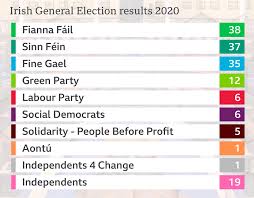
    The leaderships of all three of the potential coalition participants – Greens, FF and FG – are in play.  By Conor Lenihan. An initial political risk assessment for Ireland now would rate the country as “unstable”. There is little happening at Leinster House that would re-assure external investors. It is over three months since the election and there is still no sign of a new government.  The public indulgence will only last as long as Covid-19 continues to hang over the country as an existential threat. If the opinion polls are to be believed the public seem content to leave the incumbent government in place even though they voted against them in the election.  Taoiseach Leo Varadkar has re-invented himself during the Covid-19 crisis. His steady appearances on television have converted him from the TV Anchor Man to the TV Weather Man. As we all know, sometimes the Weather Man gives solace and relief when you have just endured a bulletin diet of misery and bad news. Varadkar’s new-found popularity has rendered Fine Gael activists the pleasing possibility that if they simply hang tough and string things out they might just be able to throw up their hands in surprised despair and call an election. For some of them the thought of sacrificing their big-farmer support on the altar of climate change, via the Greens, is a step too far in erosion of their most solid voting base.  Leo Varadkar My friends in the distanced Dáil inform me the coalition formation talks are proceeding apace and may well be completed by June, with a week or two further to get the endorsement of the three parties and their memberships.  The Greens’ requirement for two thirds of those voting is a high jump given the extent of division within the party even at a parliamentary level. One can only imagine the level of disputation among ordinary members.  The election itself threw up an indeterminate result and an intractable three-way split between Fianna Fail, Sinn Féin and Fine Gael. Beyond these medium-sized parties, are a number of smaller parties of varying sizes and ideologies and of course a plethora of independents.  The decision by both Fianna Fáil and Fine Gael to exclude Sinn Féin by definition narrows the choices of the two, previously, big parties. Their requirement appears to be to favour the inclusion of the Green Party – with a bolt-on of independents to give greater comfort.  The orthodox wisdom in Leinster House and among political analysts as that this Fianna Fail, Fine Gael and Green Party configuration offers the best hope of a stable administration to see the country through the twin crises of Covid 19 and an increasingly, threatening, hard exit of the UK from the EU.  The other consensus viewpoint offered is that there will certainly be ‘trouble ahead’ as public indebtedness rises, amid high unemployment, with the traditional safety valve of emigration from the country is removed as a mitigating factor. The Franco-German axis that runs the EU, is openly promoting the idea of future harmonisation of corporate taxes – not good news for Ireland Inc. Apart from these very obvious uncertainties there is in a more insidious threat to a stable coalition involving FF, FG and the Greens. The Greens are the only one of the three which actually increased their number of seats and with Sinn Féin could claim to have been winners from the results. albeit it might be argued they had the tail wind of a climate crisis and failed to capitalise on the ubiquitous desire for change.  Nevertheless the reality is that in a normal election and political system this should be a cause of great contentment and happiness for the Greens – not so. Over the past two weeks there has been open warfare within the party and now the clear prospect of a leadership contest immediately after they select their portfolios and form their ministries.  With a clear leadership contest on between Eamon Ryan and his Deputy Leader Catherine Martin this does not suggest  stability in government. Things, of course, are not much better when one surveys the vista for both Fine Gael and Fianna Fail. While Fine Gael are stable on the surface and there is no immediate threat to Leo Varadkar, the likelihood is that he will be replaced within the first two years of any new coalition’s term. There are two clear contenders in Simon Coveney and Paschal Donoghue – both of whom presumably would like to take a big bite out of the Taoiseach Cherry when it comes to FG’s spin on the Wurlitzer. In Fianna Fáil a barely concealed leadership struggle is already underway because of the belief that Micheál Martin is a lame-duck potential Taoiseach, on the way out. Party members who hate the idea of sharing power with their civil war antagonists are vocal in expressing the belief that Martin simply wants to have the word Taoiseach on his CV – without reference to the damage that it will do the party. Micheál Martin The party faces the prospect, much-feared within FF, of being sandwiched between an opinion-poll-led resurgence of Fine Gael and the undoubted prospect of further Sinn Féin electoral expansion, as its status as the main opposition party grows and grows. Set against this feeling is the hard-headed realism of those frontbench TDs who want a shot at being ministers after nine years in opposition. Fianna Fáil has at least four who might consider themselves leadership contenders to succeed Micheál Martin – Michael McGrath, Dara Calleary, Barry Cowen and Jim O’Callaghan who has the perceived advantage of being from Dublin. None of these are making waves now given that the process of government formation is underway. The basics here are simple – the current leaderships of all three of the potential coalition participants in the Greens, FF and FG are in play. In the Greens’ case, it is just more obvious than the rest. This is not a recipe for

    Read more

  • Posted in:

    Dick Walsh’s covert committee monitored OIRA media enemies. Future Irish Times Assistant editor put colleagues on lists.

    By David Burke. Part 1 of this series can be found at https://villagemagazine.ie/dw/ THE OFFICIAL IRA AND OFFICIAL SINN FÉIN The IRA fractured in December 1969 into what became known as the Provisional IRA and the Official IRA. Sinn Féin split along the same lines the following month. Before the division, the IRA had been led by IRA veterans such as Cathal Goulding, who was its chief of staff, Seán Garland, Seamus Costello, Tomás MacGiolla, Ruairí Ó Brádaigh and Seán Mac Stíofáin. On the political front, they controlled Sinn Féin. Together the IRA and Sinn Féin were known as the Republican Movement. Goulding, Garland, Costello and MacGiolla sided with the Officials after the split and reproduced the military and political formula for their new organisation. Ruairí Ó Brádaigh and Seán Mac Stíofáin set up the Provisionals. Goulding’s faction managed to retain control of the United Irishman, the movement’s monthly newspaper. Collectively they also became known as the ‘Stickies’. Cathal Goulding avoids the media The United Irishman had been edited by Tony Meade, Denis Foley, Séamas Ó Tuathail (who brought sales to a height of 100,000 in 1969) and then Eoin Ó Murchú. In late 1972 Ó Murchú left and Dick Walsh of the Irish Times, later to become its political editor (from 1985) and indeed its assistant editor (from 1999), was asked to take care of the paper while a new editor was found. The full-time replacement turned out to be Jackie Ward, who had been in charge of the The Starry Plough which had appeared in Derry. In 1973 the Officials launched another publication, The Irish People, a weekly paper. Pádraig Yeates, who edited it between 1977 and 1982, joined the Irish Times in 1983. The Officials also produced numerous pamphlets, most but not all of which were produced openly as Official Sinn Féin publications. The Official IRA (OIRA) issued statements which were reported in the press. After they called a ceasefire in 1972, they continued to exist for purported ‘defensive’ purposes and continued to issue statements. The Irish Times continued reporting them until the mid-1970s. Bizarrely, when the paper interviewed Goulding wearing his political cap in 1983, it reported that the OIRA had ceased to exists in 1972, as if all the statements it had carried for the three to four years after the 1972 ceasefire had never appeared on its pages. It was the least of the dysfunctionalities in that paper’s nexus with the OIRA. WALSH’S SECRET COMMITTEE Behind the scenes Goulding and his GHQ staff decided to draw up a list of their friends and enemies in the media. Goulding, now chief of staff of the OIRA, appointed Dick Walsh as the kingpin of this clandestine effort. He was assigned to lead a committee which drew up lists of journalists and to characterise the attitude of each towards the Officials. The OIRA also spied on their political opponents throughout the 1970s and into the 1980s and probably well beyond. Their penetration of the Revenue Commissioners caused so much internal rancour that some civil servants tried to set up their own union. They felt the Officials had taken over the existing set up. The Officials’ spies in the Revenue Commissioners paid particular attention to the tax affairs of politicians such as Charles Haughey and well-known big -businessmen. Ultimately no use was made of the information they accrued because they did not want to draw attention to their assets in the department. The OIRA also spied on groups who were opposed to the Soviet Union such as the Irish Council for European Freedom and the Irish Czech Society. Their reports were presumably furnished to the Soviets. Amnesty International was another target. One of those monitored was Louise O’Brien. THE GOOD, THE BAD AND THE UGLY Dick Walsh broke the media into five groups. Category ‘A’ consisted of those deemed friendly towards the Official Sinn Féin and the OIRA. This group consisted of between ten and twenty reporters who were prominent in the early 1970s. Walsh included himself in it, along with members of the OIRA who were working in the media and those who, while never in any wing of the IRA, were sympathetic to the left-wing direction in which Goulding was taking the Officials. The political wing of the Party became known as Sinn Féin the Workers Party (SFWP) and later again simply the Workers Party (WP). Walsh and his committee presumably updated the list from time to time. One possible motive for the exercise was to help create a network of supporters in the media. On the other side of the coin had the revolution, that Goulding, Garland, MacGiolla and their comrades were fomenting, actually succeeded, the information would have been a useful resource to identify likely counter-revolutionaries. A number of ‘A’-listed OIRA figures were, or became, employees at the Irish Times. The purpose of this article is not to suggest that the Officials succeeded in taking control of the paper because they did not. The plot to murder a journalist at the Irish Times – which will be described in the next article in this series – demonstrates this definitively. Overall the paper was a broad church, especially under the editorship of Douglas Gageby. However, the ‘Stickies’ did have a number of notable successes in promoting their essential views, including their grossly distorted account of the Arms Crisis. THE IRA VOLUNTEERS AT THE IRISH TIMES As readers may recall from Part 1 of this series, James Downey, a former deputy editor of the Irish Times, stated that Dick Walsh was not only “an intimate of Cathal Goulding and the other leaders of what would shortly become the ‘Official’ Sinn Fein and IRA” but also that there were “two or three who were actual members of the IRA, on the paper”. (Downey p. 102.) Sean Cronin, former Chief of Staff of the IRA and Irish Times Washington correspondent during the Troubles Downey was disturbed by the OIRA presence and opined that “…the position of Dick

    Loading

    Read more

  • Posted in:

    Contempt in the rose garden.

    Inside Dominic Cummings’ mind and project.By Christopher Stanley. On a sunny English Whitsun Bank Holiday afternoon we would have been ordinarily watching The Eagle has Landed or Ice Station Zebra. On ITV10 there was a (further) repeat of Midsomer Murders – how appropriate for these death-ridden Covid-19 strange and sad times. But no, we waited and waited for Boris Johnson’s chief advisor’s television explanation of why he drove to Durham instead. In one sense Dominic’s Passion in The Rose Garden was the final out-workings in his Mind of his Project, in which the media plays no part. But ironically of course the only audience permitted to this performance was the media. By the final out-workings of his Project I mean that in an unprecedented political-media-Covid-19-stained event an unelected, unaccountable, ‘political advisor’ took centre stage…eventually; it was his first public performance in years, he said, and he was late. He did not find a tie – why should he? His confession and contrition never came – why should it? This was a moment of significant political transition in the political waft and weave of the English constitutional system – whether Dominic Cummings survives or not. It was a moment of dedicated and profound contempt. One which left Dominic Cummings stronger and more powerful because the English constitutional system of checks and balances, of trust and accountability, failed and a new more malevolent form of politics was exposed with Cummings as its incarnation: a new elitism, a new contempt, a post-modern managerial Machiavellianism, with Cummings stronger because he went back to work the next day. Even after he was exposed in all the calibrated contempt. In Downing Street. London. SW1A. Dominic Cummings His Mind and His Project Let us look at his Twitter profile first. Let us look at his Wikipedia entry second. Let us look at his Mind third. Let us look at his Project finally. Twitter BUT THIS IS A PARODY ACCOUNT (perhaps or simulation when Dominic is in charge of the narrative?) “BoJo’s best bud, bus lie writer, government tinkerer, not Benedict Cumberbatch” 53 following 4,881 followers May 25 It’s true, I’m #NotSorry. Now get back to work poor people! #ToriesLovePooriesMay 24 Phew, well done @BorisJohnsonthanks for covering my back! #StayAtHomeBTW: Bus Lie Writer: The Spectator 31 October 2017 (last accessed 26 May 2020) Not sure whether or not to resign, can’t find @BorisJohnsonto discuss it so might go and see my folks, they’ll know what to do Wikipedia “After attending state primary school, he was privately educated at Durham School and Exeter College, Oxford, where he studied under Norman Stone, graduating in 1994 with a First in Ancient and Modern History. One of his professors has described him to the New Statesman as “fizzing with ideas, unconvinced by any received set of views about anything”. He was “something like a Robespierre – someone determined to bring down things that don’t work.” Also in his youth, he worked at Klute, a nightclub owned by his uncle in Durham”. Note: Maximilien Robespierre: “England! Ha! What good are they to you, England and its depraved constitution, which may have looked free to you when you had sunk to the lowest degree of servitude, but which it is high time to stop praising out of ignorance or habit!”. “After university, Cummings moved to Yeltsin’s post-Soviet Russia from 1994 to 1997, working on various projects at the encouragement of Stone. He worked for a group attempting to set up an airline connecting Samara in southern Russia to Vienna in Austria which was ‘spectacularly unsuccessful’. He subsequently returned to the UK”. Note: Norman Stone once said “I wear my enemies like medals”. “In December 2011, Cummings married Mary Wakefield, sister of his friend Jack Wakefield, former director of the Firtash Foundation. Mary Wakefield has worked at the weekly magazine The Spectator for decades, since Boris Johnson was editor, and is now commissioning editor. She is the daughter of Sir Humphry Wakefield, 2nd Baronet, of Chillingham Castle in Northumberland. Her mother is Katherine Wakefield, née Baring, elder daughter of Evelyn Baring, 1st Baron Howick of Glendale.” “Cummings is reportedly an admirer of Otto von Bismarck, Richard Feynman (see further on), Sun Tzu, and U.S. fighter pilot and military strategist John Boyd. Journalist Owen Bennett claimed that Cummings “is a Russophile, speaks Russian, and is passionately interested in Dostoyevsky”, while Patrick Wintour in The Guardian reported that “Anna Karenina, maths and Bismarck are his three obsessions.” Note: Fyodor Dostoevsky: “Right or wrong, it’s very pleasant to break something from time to time.” “Cummings has said he has never been a member of a political party Despite this, he was second in a list by LBC of the ‘Top 100 Most Influential Conservatives of 2019’.” The Mind “He is now the country’s de facto project manager, but what does he actually believe?” (Stefan Collini) (The Guardian 6 February 2020) (last accessed 26 May 2020). In that question Stefan Collini identifies what is central to The Project of Dominic Cummings – he is The Project Manager of the New Model Polity for England but he is not political (unless he is post-political) – he is so over politics. He is an expression of a new form of ideologue. This means his Project is a project to implement a new kind of post-political system – it is about planning and a form of quasi-scientific rationality – in which the role of the democratically elected and accountable politician, and indeed those of all other parts of the Executive – including the Civil Service, are negligible. Dominic Cummings is a Type similar to the ‘Types’ who succumb to Communist Party rule in Nobel laureate Czesław Miłosz’s ‘The Captive Mind’ (1953). Which is why if he does depart it does not signify much as he will be replaced by the same form of functionary/synthesiser. He is an intellectual with a good academic pedigree. Collini notes: “Dominic Cummings is the best-known unknown historian of ideas in the country”. He has a big

    Read more

  • Posted in:

    Unscrutinised lockdown breaches: resignation territory for Varadkar and Martin.

    Close analysis suggests Leo Varadkar (not for hanging out in Phoenix Park), Micheál Martin and (perhaps) Dominic Cummings should all resign, for basic and flagrant breaches of lockdown rules. By Michael Smith. We are all fed up with plague restrictions. Some of them were disproportionate; some of them are needed and will continue to be needed. We’re all tired of them. We live in the era of Fake News so when maskless Donald Donald Trump, handshaking Boris Johnson, and picnicking Leo Varadkar say something is authorised or, better still, “legal” you know it may not be true. This article is about what the law, rules and guidance say, not what some status-unclear departmental official, or a garda on duty, said. It reflects very badly on two of Ireland’s Taoiseach-candidates, and Johnson’s peripatetic advisor, Dominic Cummings. Since there are many people who have been unable to visit dying relatives or to attend the funerals of parents and children, it is clear that serious breaches cannot be dismissed as forgivable mistakes, if the social contract is to be maintained. That is why Mark Rutte, Prime Minister of the Netherlands, scrupulously avoided visiting his 96-year-old mother in her care home in the last weeks of her life https://www.theguardian.com/world/2020/may/26/dutch-pm-mark-rutte-did-not-visit-dying-mother-due-to-covid-19-restrictions. Nobody, surely, would advocate a lower standard in modern Ireland. One of the premises I take as read is that if a rule provides for an exception, acting on the exception is not a breach, however much people go on about it. Let’s see how the exceptions position Ireland’s political leaders, and – in Britain – Boris Johnson’s fractious advisor, Dominic Cummings. Varadkar, 24 May, Phoenix Park Since for the last few weeks we have been allowed to meet in groups of four, outside, the Taoiseach’s hunky beering in the Phoenix Park last weekend was ok in principle. https://www.irishexaminer.com/breakingnews/ireland/taoiseach-was-in-line-with-public-health-guidance-while-sunbathing-in-phoenix-park-1001539.html An official in the Department of the Taoiseach, Liz Canavan, thinks we should not picnic, but that’s her view, not official written government advice. Asked this week whether it was okay for people to have picnics, Canavan said that the Government was “not madly encouraging people” to take up “a lot of space and time in amenities where they are cramped”. “We’re asking people to use their head”, she said. But the outing should have been distanced and photos, like the one above, show it was not. The failures may have been brief. It’s impossible to tell. We all do it; we should probably get over it. There is something that is far worse. On 24 March, the Taoiseach said people need to stay at home and only leave to: go to work go to the shops for essential supplies care for others exercise On 27 March the Departments of Health and of the Taoiseach jointly provided the following “policy” which was stated to be a “measure in place”: “The only reasons you can leave home: Stay at home in all circumstances, except in the following situations: to travel to and from work, if your work cannot be carried out from home to shop for essential food and household goods to attend medical appointments and collect medicines for vital family reasons, such as providing care to children, elderly or vulnerable people – but excluding social family visits for farming purposes – that is food production or care of animals To take brief individual physical exercise within 2km of your home, which may include children from your household, as long as you adhere to strict 2m physical distancing. to escape domestic violence“. The reasons are exclusive. There are no further exceptions. In his televised speech to the country on 27 March the Taoiseach put it succinctly: “Apart from the activities I have listed, there should be no travel outside 2km radius from your home for any other reason”. In fact Leo Varadkar left his home and moved to Farmleign during the lockdown. That was a major breach of advice not justifiable, or close to justifiable, under the listed limited exceptions. There is no ‘Taoiseach’ exception, no ‘I need better internet’ derogation, no ‘it’s ok I work for the government’ exemption. Just ask Mark Rutte or Dominic Cummings. And so, honestly, he should resign. Micheál Martin photographed in Courtmacsherry on 1 January for New Year’s swim Meanwhile Micheál Martin went off to West Cork as late as April 4. Remember the guidance cited above had been clear for at least two weeks at that date. He told Ryan Tubridy on the Late Late show of 22 May https://www.thesun.ie/news/5460487/coronavirus-ireland-fianna-fail-leader-micheal-martin-not-seen-family-weeks/: The lockdown started – West Cork, I was there. I came to Dublin and have stayed since and that’s it. That was untrue. The Irish Independent confirms he went from Dublin to West Cork on 4 April. This is a scandal waiting to break. According to the Irish Independent the Fianna Fáil leader, “was in Courtmacsherry when the lockdown rules were announced, and travelled to work in Dublin the following Monday”. On 4 April , he returned to his holiday home. According to a Fianna Fáil spokesperson: “In line with Government advice he returned to where he was when travel restrictions were introduced”.  The spokesperson said this was in line with Government advice, the Indo swallowed it, but it was not. Where is this ‘return to where you were’ exception to be found? After he went to Dublin he should have returned to his home in Cork City. It was simple. “On April 6, he travelled back to Dublin where he has remained since”, said his handlers – from where he tells stories about missing his family and jogging in Merrion Square. The spokesperson confirmed that Mr Martin has not been to his home in Cork city since the lockdown began: “Micheál has adhered to all of the expert advice and Government restrictions during this emergency”, they said. Inaccurately. https://www.independent.ie/irish-news/politics/ff-leader-used-holiday-home-as-base-at-start-of-crisis-39137417.html For the blatancy of his flouting of the rules. for his equivocation on the Late Late show and for the cynically obfuscatory line that “Micheál has adhered to all of

    Loading

    Read more

  • Posted in:

    Charles Haughey did not run guns to the IRA in 1970 but his father Seán did decades earlier. And on the orders of Michael Collins!

    A gunrunner in the family. By David Burke. Haughey’s father Seán (on the right) who was one of Michael Collins’ most trusted officers. Collins chose him for one of his most sensitive secret operations. THE HAUGHEY FAMILY AND THE WAR OF INDEPENDENCE Haughey’s parents, Seán and Sarah (nee McWilliams), were born and reared almost next door to one another on small farms in the adjacent townlands of Knockaneil and Stranagone, near Swatragh, a few miles from Maghera town in Derry. Haughey Senior, who was born in 1897, joined the Irish Volunteers in 1917. He rose to become the Second in Command, and later Officer in Command, of the South Derry Battalion of the Irish Volunteers during the War of Independence. At the start of the conflict he carried out raids on the homes of loyalists and a number of retired British army officers. His military file marked him out as one of the most energetic IRA members in south Derry. In one attack on June 5th 1921, a Royal Irish Constabulary sergeant called Michael Burke was killed while others were seriously wounded in a late-night ambush of the barracks at Swatragh. As a result of his activities, Seán Haughey had to go on the run. According to his superior, Major Dan McKenna, he would have been killed had he been caught. “His enemies were of the opinion, and indeed not without reason, that he was the cause of all their woes in his area”. Sarah, who was born in 1901, also played an active part during the campaign as a volunteer in Cumann na mBan. She remained a member until 1923. Commandant Seán (Johnny) Haughey with his wife Sarah Ann who served in Cumann na mBan. The Anglo-Irish Treaty was signed on 21 December 1921 and ratified the following January. Yet hostilities persisted in the North. The UVF began to regroup under Lieutenant-Colonel F. H. Crawford. Thirty-one people were killed in Belfast between 12 and 16 February 1922. On 19 March 1922, 200 IRA men surrounded the town of Maghera, County Derry, cutting off the telephones before seizing the Royal Irish Constabulary barracks from which they removed 17 rifles, 5,000 rounds of ammunition and a sergeant as a hostage. The IRA campaign continued the next day with the destruction of mills, sawmills, stables and outhouses in County Derry. Burntollet Bridge (which would become infamous in 1968) was blown up. On 30 March Michael Collins, representing the Provisional Government in Dublin, and Sir James Craig, signed an agreement. Collins wanted to neutralise the security forces in the North as a threat to the Catholics. In return for a cessation of IRA activity, it was agreed that Catholics should join the Special Constabulary and assume responsibility for policing nationalist areas. In mixed areas, an equal force of Catholic and Protestant officers would be deployed. Meanwhile, all searches would be conducted by mixed units with British soldiers in attendance. The Specials were to wear uniforms with identification numbers and surrender their arms once they had finished their duties so they could be kept in barracks. On 31 March Royal assent was given to the Free State Bill which became the new constitution of the Free State. The ceasefire Collins and Craig negotiated proved a failure. On 2 April 500 Specials swooped across County Derry and Tyrone scooping up 300 men for questioning but only four were found to be in the IRA. The rest escaped to County Donegal. By now the IRA was on the verge of a split into pro- and anti-treaty factions. The 8,500 volunteers who lived in the new State in the North were virtually all anti-treaty. Michael Collins was prepared to supply them with arms for a number of reasons, one of which was that it offered him a possible way to unify the IRA, something that was a priority for him. SÉAN HAUGHEY PLAYED A KEY ROLE IN MICHAEL COLLINS’ MOST SENSITIVE AND SECRET CROSS-BORDER OPERATION AFTER THE CEASEFIRE Seán Haughey became involved in what was perhaps the most sensitive and secret covert operation Michael Collins ever mounted: it was one to provide Catholics living across the new border with weapons to defend themselves from the forces of the new state. Hundreds of Catholics (and many Protestants) had been killed during sectarian riots that had erupted in July 1920. Between 1920 and 1922,  267 Catholics were killed,  while 2,000 more would be wounded; another 30,000 people were evicted from their homes and driven from their jobs, especially at Belfast’s shipyards. Collins arranged for guns, at least some of which were supplied by the IRA in Cork, to be smuggled across the Border. Collins was keen not to use any of the weapons he had obtained from the British which could easily be traced back to forces under his control. The First Northern Division of the IRA in Donegal was led by Commandant-General Joseph Sweeney who went on record stating: “Collins sent an emissary to say that he was sending arms to Donegal, and that they were to be handed over to certain persons  –  he didn’t say who they were – who would come with credentials to my headquarters. Once we got them we had fellows working for two days with hammers and chisels doing away with the serials on the rifles… About 400 rifles and all were taken to the Northern volunteers by Dan McKenna and Johnny [i.e. Seán] Haughey”.    (See also From Pogrom to Civil War by Kieran Glennon.) Eoin O’Duffy, who later led the Blueshirts, along with Collins and Haughey, was part of the operation to smuggle the IRA guns across the border. Another IRA man, Thomas Kelly, collected a consignment of 200 Lee-Enfield rifles and ammunition from Eoin O’Duffy. In an affidavit Kelly swore many years later, he revealed that the “rifles and ammo were brought by Army transport to Donegal and later moved into County Tyrone in the compartment of an oil tanker. Only one member of the IRA escorted the consignment through

    Loading

    Read more

  • Posted in:

    SHINE A UV LIGHT FOR FREEDOM

    Once upon a time the US produced lacerating protest singers. Not any more. It has fallen to the Irish to fill the gap. Paddy Goodwin and the Holy Ghosts’ new song, ‘Jesus Is My Vaccine’, was written in anger at the treatment meted out by the knuckle-dragging neanderthals who abused nurses during the recent anti-lockdown protests in the US. Goodwin constructed the piece with his collaborator Enda Whyte in the hope that it would be woven into a video of clips and quotes from the heart of Trump-land. Then, Irish artist Conor Casby (famed for his painting of Brian Cowen) provided a picture depicting Trump as a Plague doctor. (See:  https://en.wikipedia.org/wiki/Brian_Cowen_nude_portraits_controversy) The plague doctors were charlatans who went around with hocus pocus snake-oil cures for the bubonic plague. Most of them helped spread the plague rather than cure it. Remind you of anyone? The combination of slide guitar, coruscating lyrics, Casby’s artwork and the video clips can be viewed at https://www.youtube.com/watch?v=MthVGsirxhM

    Loading

    Read more

  • Posted in:

    Greens need a wellbeing prenup.

    Quality-of-life indicators guarantee good policies and, crucially, implementation that can save Eamon Ryan from allegations of unrealism. By Michael Smith. The danger: farce When Napoleon III, nephew of the dictator Napoleon Bonaparte became dictator of France himself in 1851, Karl Marx wrote: Hegel remarks somewhere that all great world-historic facts and personages appear, so to speak, twice. He forgot to add: the first time as tragedy, the second time as farce. The problem: last marriage didn’t work out The Green Party, which was married to Fianna Fáil from 2007-2011 (and the PDs up to 2009) is in danger of entering a farcical re-marriage to Fianna Fáil and Fine Gael. If you’re marrying someone you think isn’t into you, you should get a detailed and watertight pre-nup.  Especially if you were married to them before and it didn’t work out; and they’ve been making nasty comments about you for years. Unfortunately, as they endlessly but secretively progress their formal talks not on nuptials but on a programme for government, there is no suggestion on a strategic level the Greens.  have remembered that the age-old and continuing problem with Fianna Fáil and Fine Gael and the environment is they are often happy to make promises and even to provide new measures, it is just that they do not provide for their enforcement. If the Greens do not adjust their capacity for realism there is a danger they will split. Worse, at the moment, the split on offer – between Catherine Martin,  Deputy Leader and Eamon Ryan, Leader – isn’t even on ideological grounds.  The Greens, who can often be soft-minded seem to be  teed up for a silly contest pitting the need for loyalty to a lovely fella on the one hand against the need for someone who’s a woman and not (deepdown) from Dublin 4 on the other; without particular reference to efficacy, radicalism or lessons learnt. The solution: “credible” quality of life indicators The Greens already failed to plant the ball in the open net Fianna Fáil and Fine Gael left them when those parties notably committed in their framework document for coalition of 15 April to “credible” quality of life indicators. Indicators means measurements of success. It has long been established that environmentalists best achieve both a) the full breadth of their quality of life agenda (also known as a wellbeing or sustainability agenda)  and b) its enforcement, through up to 100 of these indicators which replace GDP as the gauge of society’s success. This agenda is well recognised by the UN, OECD, EU and others. The point is that it covers a multitude including reduction of emissions and protection and enhancement of biodiversity; and a full range of other environmental and of social and economic indicators that are established progressively, rendered as targets and systematically monitored. If the targets are flouted the pre-nup kicks in dictating divorce. Environmentally you might have climate, biodiversity, balanced rural development, numbers, quality and mix of new housing etc. Socially you might have equality of income and wealth, employment rates, imprisonment rates, implementation of Sláintecare etc. Economically you might have growth, inflation, household and national debt etc. …A hundred indicators in total. What else? Official buy-in including from Finance Department Through these, enshrined in a programme for government and with buy-in from top civil servants and the Departments of Finance and the Taoiseach, the Greens should establish, and guarantee implementation of, radical policies and standards. The Greens’ current approach: following up 17 questions The letter from Eamon Ryan to the bigger parties of 23 April, following up the big parties’ framework document, did duly outline that such indicators should “shape the economic recovery”. But that suggests he sees them as secondary to the economy and there is no mention of them in the 17 questions included in the letter or, inevitably then, in the nice flexible follow-up letter from the bigger parties of 28 April. Unlike other Green parties, interestingly the Irish Greens down the years, even in their constitution, seem never to have embraced the centrality – promoted by the UN –  of sustainability and quality of life. Then again the Greens also left out biodiversity – remember we’ve lost 60% of vertebrate animals in the last fifty years and it’s supposed to be the second most important issue for them – from their questions. They’re making it up, you know. Many commentators, who know nothing about the environmental agenda, assume the Greens are big policy wonks.  Environmentalism is a bit off the track for the sort of journalists who become respected political commentators in the Irish Times and Business Post.  They don’t want to do any research about whether the Greens have good policies or indeed how they did when they were in government from 2007-11 and they don’t want to be mean to this new agenda and its sunny leadership.  So they assume the Greens are masters of policy. A recent profile of Eamon Ryan in the Business Post and another assessment by Harry McGee in the Irish Times on whether the Greens ‘played senior hurling’ in government, fall into this category. If you have a reputation  for getting up early you can sleep until noon. The Greens were no good at policy when they were in government 2007-2011 and they are not good at it now.  Of course most of the other parties are worse. The Greens’ history: underachievement I’ve been around long enough to be aware how little the Greens achieved in coalition from 2007 to 2011. We need only to look at the statistics on what sort of impression they made on the guts of their agenda. Planning If we had planning legislation that worked we wouldn’t have continued to build one in four houses one-off in the middle of the countryside and allowed  Dublin to sprawl all over Leinster when the ideal, and even the national planning strategies, required channelling development away from Dublin into other cities and rural towns.  Biodiversity and transport We did not arrest cascading

    Loading

    Read more

  • Posted in:

    How the Irish Times got its biggest story of the last 50 years wrong.

    The Assistant Editor of the Irish Times distorted the truth about the Arms Crisis. He was a friend of both the chief of staff of the Official IRA and the Taoiseach, ‘Honest’ Jack Lynch. The Official IRA had a vested interest in manipulating the story. Over time, the journalist portrayed Lynch as the hapless victim of the Arms Crisis. This article will look at his relationship with the Marxist wing of the IRA, the Officials.   By David Burke   Part 1: Dick Walsh and the Official IRA. CATHAL GOULDING AND THE ALDERSHOT MASSACRE Cathal Goulding In February 1972 the Army Council of the Marxist wing of the IRA, the Officials, directed an attack on the HQ of the British Army’s 16th Parachute Regiment Brigade at Aldershot in Hampshire. At the time, the Army Council consisted of Cathal Goulding, Sean Garland, Tomás Mac Giolla and others. On 22 February a time bomb was conveyed to the Aldershot complex in a Ford Cortina vehicle. It weighed 280 pounds (130 kg). The driver alighted and fled the scene with the bomb detonating seconds later. The Officials who had scouted the complex cannot have missed the fact there were many civilians in the vicinity. A few seconds later five kitchen staff were slaughtered: Jill Mansfield (34); a mother of an eight-year-old boy. Her body was identified by a tattoo on her arm; Thelma Bossley (44); Margaret Grant (32); Cherie Munton (20); Joan Lunn (39), a mother of three. So too was a gardener, John Haslar (58) who died from a fractured skull. Finally, a Catholic priest, Gerry Weston (38) perished. 19 others were wounded by the explosion. Not a single soldier died. CROCODILE TEARS AND LIES Goulding and his cronies declared that “initial reports confirmed that several high-ranking officers had been killed [at Aldershot]. British propaganda units then moved into action, and miraculously the dead officers disappeared”. The statement added that the Official IRA’s intelligence department, had ascertained that 12 officers of the Parachute Regiment had been killed in the attack. These claims were entirely dishonest. On 23 February, the Officials explained that the attack had been perpetrated in revenge for Bloody Sunday: “Any civilian casualties would be very much regretted as our target was the officers responsible for the Derry outrages [i.e. Bloody Sunday]”. Stripped of the crocodile tears, Goulding was saying that it was acceptable to kill a handful of kitchen staff, a gardener and a priest in a botched atrocity because his motive had been pure – the murder of soldiers. Stripped of the crocodile tears, Goulding was saying that it was acceptable to kill a handful of kitchen staff, a gardener and a priest in a botched atrocity because his motive had been pure – the murder of soldiers. The Officials also said that the bombing would be the first of many such attacks on buildings occupied by British Army regiments which were serving in the North. In November 1972 Noel Jenkinson from Meath was convicted for his part in the Aldershot atrocity. He died from a heart attack in October 1976. Cathal Goulding The Army Council of the Official IRA remained tight-lipped about the other members of the Aldershot unit and they all escaped justice. I spoke to Sean Garland – briefly – about the Aldershot atrocity many decades later. He acknowledged that the attack was “indefensible”. In fairness to him, he did seem genuinely remorseful. A FUNERAL ORATION FOR A FALLEN OFFICIAL IRA VOLUNTEER Dick Walsh was the political editor of the Irish Times. He died in 2003 at the age of 65. After his death, his former colleagues at the paper described him as someone who was “believed to have used his influence in the left-wing circles in which he then moved to urge the Official republican movement to abandon violent means to settle the Northern Ireland problem”. If he did, he certainly took his time about it. Joe McCann of the Official IRA. The violence continued. Walsh did not shun the Official IRA after Aldershot, nor does he appear to have advocated an abandonment of “violent means to settle the Northern Ireland problem” in the immediate aftermath of the attack. Why can this be said? Because Walsh helped write the funeral oration for an Official IRA volunteer called Joe McCann which was delivered by Goulding. McCann was killed on the streets of Belfast on 15 April 1972 while being chased by soldiers of the Parachute Regiment. He was unarmed. Details of his death can be found at https://en.wikipedia.org/wiki/Joe_McCann. McCann is the silhouetted figure in the main photograph of this article, the man crouching with a gun in his right hand.) There was little sign of a foreswearing of ‘violent means’ in the oration. Goulding said that “those who are responsible for the terrorism that is Britain’s age-old reaction to Irish demands will be the victims of that terrorism, paying richly in their own red blood for their crimes and the crimes of their Imperial masters”. Perhaps blood was still high after the Bloody Sunday atrocity and the murder of the unarmed McCann by soldiers of the Parachute Regiment and Walsh only came around to lobbying for non violence tactics later. Perhaps Goulding added the blood-curdling rhetoric himself. Walsh was presumably strongly in favour of the ceasefire the Officials purported to call on 30 May 1972. I say “purported” because Goulding, Garland and Mac Giolla et al reserved the right to engage in “defensive actions”. Hence, the Official IRA did not go away; far from it in fact. They retained their arms and engaged in murderous feuds with the Provisionals, the INLA and others. The Officials killed 25 people between the calling of the ceasefire and 1983. While the feuding might conceivably be shoehorned into the category of “defensive actions”, the bank robberies and building-site extortion rackets the Officials carried out, could not. Interested readers should purchase a copy of ‘The Lost Revolution’ by Hanley and Millar for further details about the feuding – and much

    Loading

    Read more

  • Posted in:

    The pall is lifting on Northern Ireland’s Legacy stitch-up.

    Proposals to cover up the past breach elementary human rights and received wisdom built up over a generation. By Christopher Stanley. Through the pall of a pandemic Patrick Corrigan,  Northern Ireland Programme Director for Amnesty International UK, wrote in the Belfast Telegraph (19 April 2020), on the current crisis wrought by the coronavirus/Covid-19 pandemic and the importance of learning lessons from it. He noted, eloquently and compellingly, that we could emerge from it into a society where politics and society cohere around human rights.  He concluded: Such a human-rights-based approach to government can help us forge a better, shared Northern Ireland and build upon the strong bonds of social solidarity so evident in our current crisis. When we finally emerge from the curse of coronavirus – and we will – what a legacy that would be. (Belfast Telegraph) Human Rights lie at the heart of the Good Friday Agreement 1998. They are embodied in its letter and spirit. Patrick Corrigan wrote about the commitment to a Bill of Rights for Northern Ireland which was contained in the GFA and is now being revisited under the British government’s New Decade, New Approach document which guides the devolved administration at Stormont. Human Rights must be the core of the out-workings of the Legacy of the Conflict in Northern Ireland. The current pandemic will alter the landscape of our jurisdiction when it is finally defeated. It will change our attitudes and perceptions, needs and priorities. It may open a possibility where the violent Legacy of Past in Northern Ireland, which haunts the present and determines the future, can at last be sutured after years of contested narratives of truth about what happened here between 1969 and 1998.For what many of those – relatives of the victims and the survivors and their families – want is truth. Many also want justice and accountability but at the fore is to know why a death or an injury happened. It is not about retribution or reparation. It is about being able to move forward with the past  – bear in mind these dead.   Before the pandemic crisis, the British government published its latest approach to the Legacy of the Conflict. The proposals are a dramatic departure from a) the Stormont House Agreement 2014 (SHA) and b) the attitude towards the Legacy that was taken by the most recent Secretary of State for Northern Ireland (Smith). The position of the British government now is to conflate a specific narrative (an interpretation of the Conflict) with a swift Draconian measure to finally sever the present from the past and to protect one particular group of perpetrators/victims – the agents of the state. At present these agents are British Army Veterans but they will inevitably eventually include all members of the British Security Forces, including those from paramilitary organisations used as agents or informers. This political positioning will cause resentment and resistance in Northern Ireland. The intention is to introduce: A new independent body [that] will conduct swift, final examinations of all the unresolved deaths. Only those cases where there is new compelling evidence and a realistic prospect of a prosecution will be investigated. Once cases have been considered there will be a legal bar on any future investigation occurring. This will end the cycle of reinvestigations for the families of victims and veterans alike.This new approach seeks to put victims first with information recovery and reconciliation as the overarching goal – with a way forward that delivers for all those affected by the legacy of the Troubles and enables all sides of the community to continue to reconcile and prosper. In these two short paragraphs, the British government lays bear an intent which has been clearly seen in some sections of the Tory party since the GFA and which has been articulated by some of the inhabitants of Hillsborough Castle (Patterson, Villiers,  Bradley). The end will be swift and final. There is a hierarchy of victims. Veterans (agents of the state and British Security Forces deployed or recruited (as agents or informers) during the Conflict) become victims if they face arrest and prosecution. Therefore they will be granted immunity. The evidential threshold is high;’‘compelling evidence” and “realistic prospect of prosecution”. After years of being consulted, the people of Northern Ireland were faced before the present lockdown with a stark reminder of the way Westminster/Whitehalll saw Northern Ireland as ’good soldier’ and ‘bad terrorist’ – all other contested narratives being ‘pernicious’. In Northern Ireland there was a robust civil society reaction of disapproval.  For example, Relatives for Justice (RFJ) said: These measures will further deepen divisions in society and will certainly not aid any measure of reconciliation – they will aggravate existing hurts and wounds and will be seen as further evidence of a systemic cover-up of British State crimes. This will be challenged on every level by families including in the domestic and European Courts. For example, the Committee on the Administration of Justice (CAJ) and  a group of academics from Queen’s University Belfast (QUB) analysed the British government’s new proposals against a three-point test: a. The extent to which it is consistent with binding domestic and international human rights obligations, in particular Article 2 of the European Convention on Human Rights regarding the right to an effective investigation into conflict-related deaths.b. The extent to which it is compatible with the Good Friday Agreement (GFA), the cornerstone of the Northern Ireland peace process.c. The extent to which it is compatible with the Stormont House Agreement. Although the design of that (SHA) is complex, it was arrived at after months of tortuous negotiations between the two governments and the five largest political parties, and it remains the closest we have come to a workable consensus on dealing with the legacy of the past since the GFA of 1998. On each test the proposals of the British government is setting itself up to fail. Just as the English politicians and their Whitehall civil servants knew they would. In the words of RFJ: Throughout the statement

    Loading

    Read more

  • Posted in:

    GREENS CAN OWN THE NARRATIVE FOR A NEW GOVERNMENT:

    By Dr Peter Doran, Katherine Trebeck and Dr Tony Shannon. WELLBEING ECONOMY AGENDA FOR PEOPLE AND PLANET “Country marks a commons of earth and elements: a shared ecology of lands and waters”. (Richard Kearney and Sheila Gallagher, 2017) The Green Party may be lining up as relatively junior partners in the new government formation but the Atlantic wind is at their backs when it comes to owning and leading the narrative for a pioneering post-pandemic recovery that places a holistic vision of ‘wellbeing’ at the centre of a new programme for government.  In doing so, the new government will find allies in an emerging alliance of wellbeing economy leaders in New Zealand, Iceland, Scotland and beyond. These countries’ leaders have been to the forefront of the response to the pandemic and they will also pioneer transformations for mid- to long-term wellbeing economies as part of a Wellbeing Economy Government network (WEGo). We are calling on Ireland to join other leaders in the Wellbeing Economy Government (WEGo) partnership so that Ireland can collaborate in learning how to ensure its economy works for people and planet: building a new economy fit for the 21st century. We are calling for all government outcomes and budget calls to be measured against agreed wellbeing outcomes with the full participation of all ministers, departments and agencies.  New Zealand’s Prime Minister, Jacinda Ardern, has already placed intergenerational wellbeing goals at the heart of her Government’s programme. Ardern says fundamental values pursued by the New Zealand Government are empathy, care, compassion and collaborating for the common good.  In her thought-leading book ‘Doughnut Economics: 7 ways to think like a 21st Century Economist’, Kate Raworth explains:  “For over 70 years economics has been fixated on GDP, or national output, as its primary measure of progress. That fixation has been used to justify extreme inequalities of income and wealth coupled with unprecedented destruction of the living world. For the twenty-first century a far bigger goal is needed: meeting the human rights of every person within the means of our life-giving planet”. Those profound challenges that Covid-19 herald, offer an opportunity to society, to now build back a wellbeing economy instead of reverting to the same old structures: ‘building back better’ rather than returning to business as usual. Building on ‘The Great Pause’ The  new Irish government looks set to emerge during this ‘great pause’ in the global economy. The unthinkable has become the imperative. In our homes, our workplaces, and places of education we have been on an enforced retreat, a time of reflection on what is most important to us. Connections with friends, family and colleagues have never appeared more important. The hidden, under-valued and intimate economy of regard and care – exemplified by the contributions of workers in hospitals and care settings. They are our new super-heroes. Nature has taken a breather, skies have cleared of urban pollution, and climate change emissions are on their way down. Foxes are reclaiming the night streets.  Design is the first step to a new system. This applies to our economic systems just as surely as it applies to architecture, so it applies to the way in which we produce our food, our shelter and other necessities.  Our societal and ecological crises are, at root, a crisis of value. This moment of pause has brought increasing clarity to the things we value most, we now see how valuable food, health, income security, education, mobility, access to nature, social connection and public services are to us. Our fixation on other measures of value, such as the relic of GDP, does more to obfuscate than inform such vital policy decisions.  The root cause of our multiple challenges – of inequality, access to adequate shelter, universal health provision and the climate emergency – is how the economy is currently designed – in a way that does not balance the needs of people and planet and in a way that values measures such as short-term profit and GDP, rather than those broader values that are key to a decent society. These economics structures are design choices from the past – and hence can now be reconsidered and redesigned, for the future. Building Back Better The negotiations on the formation of a new government present a unique opportunity to (re)consider the policies required to ‘build back better’ so that, rather than our society remaining in service to our economy, our economy must serve us and our societal and ecological wellbeing. With international allies in other thought-leading nations shifting towards wellbeing, these negotiations present the next Irish government with a once-in-a-generation opportunity to advance society via positive disruption to the economic status quo, shifting to ‘build back better’ while easing back on the gears of an economic machine designed for another age.  We can live well and flourish with some boundaries. In fact some limits are strangely liberating.  Signatories Katherine Trebeck, Advocacy and Influencing Lead Wellbeing Economy Alliance; Co-author: The Economics of Arrival: Ideas for a Grown Up Economy; Senior Visiting Researcher University of Strathclyde | Honorary Professor University of the West of Scotland. katherine@wellbeingeconomy.org   Dr Tony Shannon, Ripple Foundation, Dublin, Ireland  tony.shannon@ripple.foundation Dr Peter Doran, School of Law, Queens University Belfast; Advisory Committee, UK What Works Centre for Wellbeing; Wellbeing Economy Alliance; Co-Convenor of Northern Ireland Roundtable on Wellbeing (with Carnegie United Kingdom Trust) (2014-2015). Author: A Political Economy of Attention: Reclaiming the Mindful Commons. p.f.doran@qub.ac.uk Reference:  Ten principles for building back better to create wellbeing economies 

    Read more

  • Posted in:

    Power Without Full Responsibility. Caroline Hurley reviews ‘The Education of an Idealist’, by Samantha Power.

    Named one of Time’s ‘100 Most Influential People’ in both 2004 and 2015, Irish-American Samantha Power served as US President Obama’s human rights advisor for four years and a further four as US UN Ambassador. She is famed for her achievements but also for her conscience.  By Caroline Hurley. Samantha Power was born in 1970 to Dubliner Jim Power, a musical dentist and Vera Delaney, a multi-talented sportswoman and medical doctor from Cork, both dividing studies between London and Dublin. She was brought up in Dublin, living in Castleknock and attending Mount Anville school, sadly spending too much time downstairs in Hartigan’s pub while her father drank his health away upstairs. Her mother’s specialities took her to Kuwait in 1977 to set up the first kidney-transplant and dialysis unit. Power retained strong memories of visiting. An affair between Vera and her boss Eddie Bourke inspired their plan to emigrate to America.  Vera sued Jim, whose alcoholism was worsening, for child custody. The judge’s comment opens the book: “what right has this woman to be so educated?” With no divorce and less than 10% of married women working, Vera’s confrontation of the Irish system for her rights was exceptional, and paid off. The new family resettled quickly in Pittsburgh, Pennsylvania, and never looked back. As a young adult, Power heard how her father’s decomposed remains were found in her childhood bed. Therapy in response to severe anxiety symptoms centred on this relationship. She suffers demobilising anxiety attacks and back pain: “lungers” is the term used by a former boyfriend who witnessed her struggling to breathe. Pathos aside, Power’s depiction of Irishness veers towards caricature, perhaps because although well-disposed she invests so much in the damage her father seems to have precipitated. She went to school in Atlanta, Georgia, obtained a BA in Yale and a JD law degree in Harvard. A trip around Europe in 1990 broadened young Samantha’s horizons, as did a stint as administrative assistant to Mort Abramowitz, highly-respected President of the Carnegie Endowment for International Peace think tank.  Abramowitz’s opinion columns, friendships and diplomatic efforts for the former Yugoslavia momentously drew Power away from a possible career in sports journalism and into the escalating ethnic conflict between Bosnian Serbs and non-Serbs. She became a war reporter there. On her own initiative, she drafted a chronology of events titled ‘Breakdown In The Balkans’. The hundred copies she self-printed quickly ran out due to the ‘hugely useful’ content, as American leaders struggled to comprehend and top officials resigned in protest at US inertia.  Feistily forging a news pass at the Foreign Policy desk, Power toured the Balkans in August 1993, relying on UN papers and protection at checkpoints, meeting many tortured bereaved refugees and making new journalist friends. Back in Washington, US News published her eye-witness account. She returned to Zagreb, proceeding to Sarajevo, Srebrenica and beyond. Hazardously chronicling survivors’ experiences for nearly two years, demand grew for her reportage. She blames herself for not personally preventing the 1995 murder of some 8,000 Bosnian Muslim men and boys in Srebrenica: I was the correspondent in Munich while the bodies burned in Dachau. … I had power and I failed to use it. The book makes it clear that Samantha held herself to the highest standards, at this stage.  To her indignation, loopholes in UN approval of the no-fly zone patrolled by US and NATO aircraft allowed slaughters to continue. Throughout her career, Power has repeatedly banged her head against such internal UN dysfunction, especially the veto system pitting the five permanent members at cross-purposes. A theme developed here too, of Russia’s reflex denials, accusations of fake news and weaponising social media, ploys aped by Russian allies.  By now Samantha Power was being noticed, and she impressed. Declining a job from Richard Holbrooke who had brokered the Dayton peace accords on Yugoslavia in 1995, she decided to study law with a view to prosecuting human rights abuses. Three years later she became the Founding Executive Director of the Carr Center for Human Rights Policy at the Harvard Kennedy School. In 2001 she wrote a piece in the Atlantic featuring exclusive interviews with scores of those in the US administration who had dealt with atrocities in Rwanda. It outlined countless missed opportunities to mitigate a genocide. Researching exhaustively, complemented by some human rights and teaching work, she grabbed a book deal. ‘A Problem From Hell: America and the Age of Genocide’ was published in 2002. Blending activism and diplomacy, she stressed the importance of recognising war’s human consequences and considering every non-military solution first, stopping short of embracing non-aggression and a global security system without war (see WorldBeyondWar.org/alternative).  In the end she wonders why American leaders who vow “never again” repeatedly fail to halt genocides. It is an appealing message from the pen of a talented, and idealistic, future leader. And being Samantha Power, she won a Pulitzer for it. She went on to cover the 2004 massacres from Darfur, Sudan.   Power’s first and latest books covers – “A Problem from Hell” and “The Education of an Idealist” As early as 2005 diplomat Peter Galbraith connected Power to then-Senator Obama’s team and in 2008 she moved onto his campaign group as he vied with Hillary Clinton for the Democratic nomination.  In March 2008 she suggested, irritatingly for her boss but as it turned out accurately, that Obama would not be in a position to withdraw as quickly as he was promising in his campaign he would, from Iraq. A major hiccough a few days later was an interview about the campaign with The Scotsman, where she proclaimed: We fucked up in Ohio. In Ohio, they are obsessed and Hillary is going to town on it, because she knows Ohio’s the only place they can win. She is a monster, too—that is off the record—she is stooping to anything … if you are poor and she is telling you some story about how Obama is going to take your job away, maybe it will be more effective. The amount of deceit she has put forward is

    Read more

  • Posted in:

    THE ACCUSED AND THE ACCUSERS: IF NOT NOW, WHEN?

    Two recent hearings of the Independent Investigation Child Sexual Abuse (IICSA) in London heard arguments for and against abandoning its investigation into the allegation of sexual abuse made against the late Greville Janner. Now the Chair of the IICSA has determined that this module will go ahead but that the majority of its evidence will be adduced and examined in private and that any report will similarly be limited. In this article, Christopher Stanley, Litigation Consultant with KRW LAW LLP in Belfast, who represents a survivor of abuse in both Belfast and then in London, provides an insight into the manner in which the IICSA has approached the inquiry into the allegation against Greville Janner. Introduction The operation of a statutory inquiry is, after the initial impact of victim statements, taken little notice of until, perhaps, the publication of a report and recommendations. In Ireland, in relation to the Conflict, we saw this in the Smithwick and Barron inquiries in relation to the murder of two senior RUC officers and the Dublin-Monaghan Bombings of 1974 respectively. My wistfulness covers territory extensively covered in Village – historic institutional sexual abuse. At the point of publication of the auspicious inquiry report there may be either the furore of  joy or outrage or muted despair as a 20,000 page document enters the space of the circular filing cabinet. I have been unexpectedly involved either directly or indirectly, either as lawyer or observer, in a number of statutory inquiries in both England and Northern Ireland: those investigations established under section 1 of the Inquiries Act 2005 or by the exercise of specific legislative provisions available under devolved powers. These have included, in England, those concerning the torture and murder of Baha Mousa, the unlawful killing of Al-Sweady, the Mid-Staffs Hospital Inquiry (my Mother had been a victim), the aborted Detainee Inquiry; and in Northern Ireland  the as yet to occur Patrick Finucane inquiry, and the Historical Institutional Abuse (HIA) inquiry into systemic sexual abuse. One of the module strands of the HIA Inquiry concerned The Kincora Boys’ Home in Belfast. Arising out of the ‘failure’ of this module there continue to be demands by victims for further investigations into their abuse and the knowledge of and manipulation by state agencies and agents – a particularly low point in Ireland’s Dirty War exacerbated by the stench of collusion and political corruption. Representations had been made to have ‘Kincora’ and its associated institutions within the remit, jurisdiction and terms of reference of the Independent Inquiry into Child Sexual Abuse Inquiry (IICSA) in London. These were refused by the British government – the HIA would suffice. However, a number of victims were trafficked from Northern Ireland to London to continue their abuse as sex workers. Hence my presence at the IICSA on behalf of one of these ‘others’, on 25 September 2019. I represent a client (‘A’) who was trafficked from Belfast to London to be a sex-worker into the notorious Piccadilly Rings, a Dilly-Boy. He also ‘worked’ in a male brothel in West London. The account of his abuse in Belfast and London has been published in Village. His sister and brother were also abused in Northern Ireland and his brother was also trafficked to England but he was then 18. ‘A’ was 16 when he arrived in London having escaped the ‘care’ of the system. At the request of the IICSA he has provided a detailed Witness Statement which alleges that he was 17 when he was approached by Greville Janner in Piccadilly and then lived with him for a week at his Dolphin Square flat in Westminster and accompanied him to a performance at Earls Court where he met Prince Andrew and Sarah Ferguson. The date of that performance at Earls Court cross-referenced with Prince Andrew’s diary engagements and the date of birth of ‘A’ suggests he was 17. The date of that performance at Earls Court cross-referenced with Prince Andrew’s diary engagements and the date of birth of ‘A’ suggests he was 17. ‘A’ was paid by Janner for sexual services and provided with meals and clothes. Janner also appeared as a witness on his behalf at Bow Street Magistrates Court when ‘A’ was charged with offences relating to prostitution. ‘A’ had a number of convictions resulting in fines. His other clients included a member of the London Metropolitan Police. Being arrested and charged was seen by our client as an occupational risk. Finally, ‘A’ freely admits that he would not have thought of making a complaint to any institution as he had been abused  by politicians, social workers, judges and policemen – those who were trusted with the protection of the vulnerable. Having been invited to provide a Witness Statement to the IICSA in relation to the module “An inquiry into the institutional responses to allegations of child sexual abuse involving the late Lord Janner of Braunstone QC” I attended what in effect was a case-management hearing. ‘A’ is not a Core Participant (yet) but a potential witness. My expectations of the culture and organisation of the IICSA, given the seriousness of its work, had been raised following what can only be described as a troublesome beginning. They had been raised because of the relative silence around it proceedings. These are my observations of one day at the IICSA. 24 September 2019 A first preliminary hearing into the allegations against Greville Janner had taken place in 2016. Despite its website and apparent accessibility, the physical location of the IICSA was difficult to find. I had to telephone the inquiry: 18 Pocock Street, an anonymous street in Southwark, South London, marked on the day only by a small press presence outside the building. I had gone into Blackfriars Crown Court seeking directions. I can appreciate the need for discretion, given the nature of its work, but for a public inquiry it was as if ‘it’ did not want its location to be known. I recall I had attended the first session of

    Loading

    Read more

  • Posted in:

    Looking up in a lockdown.

    An Indian woman’s experience of isolation downs and ups on Irish shores. By Mehar Luthra I was about to leave and take the bus to the university when I got a call from one of my classmates. An older Irishwoman, she asked me if I needed her help with anything and implored me to give her a call if I did. Thoroughly bewildered, I thanked her and asked why she sounded so worried. RTE had just broken the news: Ireland was now officially in lockdown. I had, of course, anticipated this but there was momentary shock still; eclipsed, however, by immense countervailing gratitude that this kind lady’s first thought was concern for a stranded Indian girl. I reassured her that I was well and living in a secure apartment with a nearby grocery store. In a country that had only ever shown me smiles, banter and kindness, I was preparing to hunker down and weather the storm. But still for several days I would sit still in the bedroom of my apartment as the unseen divider raged on outside the curtained windows. I made to-do lists and pondered whether to stick around or go home. Everyone I saw asked me why I had chosen to stay back in Galway and hadn’t raced home to my family in New Delhi.  But one thought recurred over and over: if I did go back home, I would simply be sitting in the bedroom of another apartment (this one shared by my parents and sister) and I would still be doing the same things I am doing here. So why would I drag myself through traumatised airports and risk infection just to go and sit beside a different curtained window in another city ravaged by the same virus?  It’s curious. Before I made my unhasty choice, every person I encountered suggested the same thing: stay where you are. The universe, in all its simultaneously unwavering and perpetually varying wisdom, had decided to nudge me to stay put. But neither did I leave my heart in India. I had feared that I would be crying tears of regret every night into my pillow, missing the company of my oldest friends, weak in the solitude. But no. I did cry into my pillow sometimes in the early hours of the mornings, unable to sleep, heavy with exhaustion and the heartbreak of a carefully planned-out summer shattered. But then I would have done the same into the pillows that I left behind in New Delhi too, wouldn’t I? Regret, I was not open to. Now, hysteria and doom did come in gentle waves slithering through the letterbox studded in my front door. They peeked out from behind windows and verandas and underneath the empty and cold oven in my kitchen. I begrudged my body its daily need to be fed, it’s urgent imperative to be stretched, fed, comforted and entertained. Dating apps were useless and my laptop looked at me expectantly, waiting for me to empty buckets of words into its hungry void on days I could barely formulate coherent thoughts.  Why did I have to eat and shit and breathe and hydrate? It seemed unfair somehow that I could not count on oblivion when so many other things and routines had been wiped out.   And my mouth remained bare of lipstick, my shoes unworn. I spent many days under the covers, simply wishing I could stay under and hibernate as bears do.  During long nights spent willing myself to sleep, the bathroom light from under the doorway anchored me like the North Star and pulled me out of my own head with its swirling thoughts and bubbling worry. Spring came knocking on our doors and tugged at our sleeves, even in Galway. It seemed like the rampant new season hadn’t received news of its cancellation. Flowers bloomed defiantly, leaves latched onto branches and the pathway to the grocery store began to line itself with cheerful tulips. Birds reclaimed lost lands and cats sunned themselves on shining roofs.   I took my coffee on the tiny, square balcony that gives over roads, filled now with car after car passing by in a hurry. Where were these people going? The virus was stalking us – were they running away? I now felt warmth and a gentle breeze in a land that had only ever given me winter.  Some days I was productive and could almost remember routines that had seemed endless to me only a few weeks beforehand. I stretched, and performed sit-ups, push-ups, leg raises and ab-crunches – until my body sang with soreness and the delight of tested muscles. I read great tomes, lost myself in my writing and sucked, as reward and vitaliser, at my coffee until not a drop remained in my oversized, cheerful yellow mug. I waged war with my skin and exiled pimples and blackheads.  Didn’t they know there was a lockdown in place? Go home.  I called people incessantly, perhaps as a reminder to myself that I still had friends and people I could count on. I devoured comedy movies and revelled in the twin pulls of irritation and gratitude when I spoke to my parents who couldn’t help but worry and fret. I embraced moments of sympathy and gushes of affection for my parents. Mothers and fathers must live in a cloud of self-inflicted anguish and anxiety, even without this novel plague.  I retreated into a shell for days on end, reappearing with a thwarted zest for conversation and camaraderie. It was becoming easy to resign myself to the blanket of powerlessness that covered me and my life, a dome which had descended on my hopes and dreams. Much harder was to find joy; and the urge to express hatred, love, ambition. Or even hunger. My anxiety packed a suitcase and settled down to wait in the corners. Its roar began to sound farther and farther away until I could tune it out and go about my dinner. The world was at a

    Read more

  • Posted in:

    The Forgotten Arms Crisis Scoop: how a London newspaper reported details of what became known as the Arms Crisis nearly seven months before it erupted in Ireland.

    Séamas Ó Tuathail was the first journalist to discover details of what was to become known as the Arms Crisis but chose not to report it. Unbeknownst to him, some of the information he dug up was relayed to a British journalist by a talkative senior member of the IRA. The resulting British newspaper article may have exacerbated British Intelligence paranoia about what was afoot in Ireland nearly seven months before the Arms Crisis erupted. Within a few weeks of the report in the English paper, a British Intelligence operation swung into action. A British secret agent nearly lost his life in Dublin during the course of it. He was saved by the intervention of Irish Military Intelligence.     By David Burke Introduction: PART 1: THE UNITED IRISHMAN Fifty years ago this month the Irish public awoke to sensational reports on the radio that Charles Haughey and Neil Blaney had been dismissed from cabinet by the then Taoiseach Jack Lynch. Another cabinet minister, Kevin Boland, subsequently resigned in protest along with a junior minister, Paudge Brennan. This became known as the Arms Crisis. What is not fully appreciated is that an Irish journalist, Séamas Ó Tuathail, now a senior counsel at the Irish Bar, had learnt about the story – and much more besides – some six months previously. He has never been afforded the credit he was due for his investigation. Why? Because he did not publish the full story. Ó Tuathail not only knew that a blind eye was being turned by the State to cross-border gun-running efforts by people ranging from the ordinary citizen to old IRA hands, but also that Fianna Fáil had engaged in a covert propaganda campaign. Ó Tuathail’s perfectly reasonable interpretation was that the campaign was designed to help Fianna Fáil take over the civil rights movement in Northern Ireland. Fianna Fáil never really opened up about the campaign but they would undoubtedly have said that it was designed to bring pressure to bear on the British government to make concessions on Northern Ireland after they had neglected the North for decades and let it turn into a place of institutionalised bigotry. Ó Tuathail went ahead with the the covert propaganda aspect of his investigation in The United Irishman. A graphic from The United Irishman: a modern jet bearing the logo ‘UI’ shoots down an old fashioned Fianna Fáil fighter. The propaganda campaign was run by George Colley with the full support of Jack Lynch but it ran out of steam after a few months and became redundant after Lynch decided to adopt a more conciliatory approach towards London.  It was being shut down in November 1969 when Lynch and Colley received an unpleasant surprise from Ó Tuathail in The United Irishman. Jack Lynch and the head of his ‘truth squad’ George Colley. Even a cursory glimpse at what Ó Tuathail reported about the propaganda campaign in November 1969 raises serious questions about the intrigues that were swirling around Lynch at the time, and of which he was aware. They add weight to the charge that Lynch knew about the efforts by some of his ministers to import arms. THE IRA ARMY COUNCIL Ó Tuathail’s story began one wet dark October night in 1967 when he was driven from Dublin to the ghostly shell of a dilapidated mansion somewhere in County Meath. He was twenty-six at the time and employed at Belvedere College as an Irish teacher. His driver was an IRA volunteer. After a long trip, the driver took a right turn off the highway somewhere between Navan and Kells. They followed a pitch-black narrow lane to the old building where Ó Tuathail was escorted into a former ballroom. An oak tree was sprouting through the roof. Close by the members of the IRA’s Army Council sat around an illuminated table: Cathal Goulding, Seán Garland, Seán MacStíofáin, Seamus Costello, Tomás McGiolla, Ruairí Ó Brádaigh and Paddy Murphy. They also happened to be the de facto directors of The United Irishman, Sinn Féin’s monthly newspaper. Ó Tuathail was escorted to a former ballroom. An oak tree was sprouting through the roof. Close by the members of the IRA’s Army Council sat around an illuminated table Ó Tuathail had come to the publication’s attention as the contributor of a series of Irish language articles to the paper’s former editors Tony Meade and Denis Foley. After a vacancy had arisen for the post of editor, a consensus had emerged that he would be the best fit for the job. Some negotiations had taken place before the meeting in the old ballroom and this was the opportunity to iron out a few details and finalise the appointment. Ó Tuathail told the panel he did not want to join the IRA. This presented no problem to Goulding who was in the process of winding down the military wing of the Republican Movement. While it might have troubled MacStíofáin, he knew Ó Tuathail a little from Irish language circles and did not raise any objection to a fellow Irish language speaker securing the post as editor of the paper. Ó Tuathail justified his stance on the basis that if he became a member of the IRA, he would be subject to possible orders from his superiors and would not be able to enjoy complete freedom as its editor. There were a few exchanges around the table but no disagreement and he was offered the post with independence a term of his contract. Taking the job also meant a 50% reduction in the salary he was receiving from Belvedere. Ó Tuathail left the ballroom while the Army Council resumed its agenda for the night. Members of the interview panel: Cathal Goulding, Seán Garland and Tomás McGiolla. INVESTIGATIVE JOURNALIST OF THE YEAR Ó Tuathail was a wild success as editor. In 1968 John Mulcahy, editor of Hibernia, awarded him the investigative journalist of the year accolade. He earned it for reporting on issues which the mainstream media was

    Loading

    Read more

  • Posted in:

    Starring in a novel, just for being famous Pól Ó Muirí reviews ‘Actress’ by Anne Enright (Jonathan Cape, €16.99)

    As of a few weeks ago Kourtney has quit Keeping Up With The Kardashians. I do not keep up with the Kardashians but could not avoid the news. I’m embarrassed to say it. I couldn’t escape her fame. Fame, then. Norah FitzMaurice in Anne Enright’s latest novel Actress (Jonathan Cape), is not a media celebrity but is, in Irish terms, well-known for being the off-spring of someone well-known. Her mother, Katherine O’Dell, is an actress who found fame in Hollywood in days gone by but who lived long enough to see that fame become diluted over time. Still, in contemporary Dublin, she was once someone of note and her daughter inherits some of the cachet of being the daughter of someone famous.  The daughter narrates the story and it brings us from Dublin to London to Los Angeles. In between all the travelling, O’Dell’s fame is examined, as is her relationship with her daughter, the poverty of Irish arts (in every sense) is touched upon, religion is ticked, and then there is the student who is writing a thesis on O’Dell and has enlisted Norah for help: “I sit down and write a long email to Holly Devane, who wanted to know about my mother’s ‘sexual style’ (these phrases burn into you slowly, I find)”. Enright’s exploration of Katherine O’Dell’s life is fluent and shallow; her sudden rise from walk-on bit-player to Hollywood stardom; the unimagined fame and money that follow and then the gradual fall from grace and favour as Hollywood finds newer, younger, talent. The theme is certainly one with which contemporary readers will be familiar: there is Gabriel Byrne in Miller’s Crossing, Brónagh Gallagher in Tarantino’s Pulp Fiction and Domhnall Gleeson in Star Wars.  We all know about the Hollywood star factory by now. We know how it can make you and break you and we know how actors from Dublin to Ballymena can become stars.  There is much skimming on Dublin’s literary and cultural life. Various characters and chancers appear, none of whom are particularly pleasant. There is the university lecturer, Niall Duggan, ‘Duggan the Fucker’, with whom Norah sleeps voluntarily once and reluctantly a second time: “Perhaps this is why I helped Niall Duggan with my underwear. The need to sort men’s incompetencies, perhaps. Here let me get that. Even though I was at the time saying no and he was not taking no for an answer”.   (Author’s emphasis.) There is a duplicitous priest and there are other bits and bobs of bohemian flotsam afloat on the cultural current in joyless Dublin. The city’s pubs, hotels and streets feature while the Troubles also encroach on the sad, sad life of the poor “hackette” as she tries to make a living in an impoverished city. In short, a little bit of everything is thrown at a gloomy city’swalls in the hope that some of it might cling.  There are one or two genuinely humorous moments: “There was talk of jobs in the Irish Times or ‘out in’ UCD. Are you out in UCD? A place that was exactly two miles down the road”. A hare is, madly, buried at a television centre. A famous actor has a fist fight in a pub and a plaque is put up to mark the occasion while a Garda at a trial says: “She would only provide answers in the Irish language, he said, but the language that came out of her was not Irish, though she had the feel of it all right. He was from Gweedore himself, he said, which anyone would tell you was the hardest Irish in the world to understand…”.  The light-hearted moments relieve what is a very turgid story; chiefly because neither of the main characters is particularly engaging or charismatic. O’Dell suffers one horrific, and forensically described, episode in her early career which is intended to give her character depth but which occurs so late in the book as to leave the reader wondering why it is there at all. It certainly points to more contemporary events, such as the fall from grace of Hollywood producer, Harvey Weinstein. It is, without doubt, a life-defining event but one which does not seem to have shaded O’Dell’s character up until that point. While Norah is just dull and a bit sour; she belongs to that peculiar class of Dublin intellectual who are really not that interesting but, because of who they are and who they know, dominate the roost, such as the roost is. Kourtney has left the Kardashians. Kourtney may come back. Who really cares? Fame cannot prop a novel. Pól Ó  Muirí is a freelance journalist and writer.

    Read more

  • Posted in:

    Government of national unity: cleaning up the mess of elections. Sinn Féin should be in government in (roughly) the same proportions they are in the Dáil; so should every sizeable party.

                                    By Peter Emerson Democracy The word ‘democracy’ is used with abandon, even to describe that from which it has long since been abandoned.  Take for example the Democratic People’s Republic of Korea.  They have elections, but it’s all “Candidate X, yes-or-no?”  And with turnouts of 100%, the answer is always ‘yes’.  What a nonsense.  There should be lots of candidates, and folks should be able to choose whomsoever, as they wish. Or take Britain.  They have referendums, sometimes, “Option X, yes-or-no?”  Brexit.  What another nonsense.  There should have been lots of options – the WTO, Norway plus, Canada plus, and so on – but Britain had a multi-option debate, or rather, bloody great row, only after the 2016 referendum.   As noted by Pliny the Younger in the year 105, when there’s no majority for any one thing, there’s a majority against every thing.  In other words, in a multi-option debate, taking a majority vote on only one option is (almost) as nonsensical as a North Korean election on only one candidate.  Majoritarianism or Pluralism It’s the same when considering other subjects: forming a new government, budgets, planning proposals, names for a new bridge over the Liffey, and so on; none of these debates, and none of the votes, need be binary.  They can be.  They often are.  Someone chooses the question; and usually, that question is the answer.  That’s how Napoléon did it, Mussolini, Hitler, Gaddafi, Khomeini et al.  It usually works… though not with Brexit.   It’s not just majority voting that is inadequate, so too is binary majority rule.  But we know this already.  It was problematic in Northern Ireland; in the former Yugoslavia, “all the wars started with a referendum,” (to quote Sarajevo’s famous newspaper, Oslobodjenje, 7.2.1999); the 1994 genocide in Rwanda was initiated with the slogan “Rubanda Nyamwinshi,” (“We are the majority”) and so it goes on: majorities fighting minorities, in Kenya, Ukraine, and throughout the Middle East. Accordingly, we need a more accurate way of determining the collective will: the opinion, not of a simple, comparative majority; we need the superlative, as in “the greatest good for the greatest number.”  No matter what the controversy, debates should allow not only all relevant options, one from each party or group, to be ‘on the table’; but also a (short) list, normally of up to six options, on the ballot paper.  Then let the TDs cast their preferences, to identify that option which has the highest average preference, for an average involves every TD, not just a majority of them. The appropriate voting preferential points procedure was mooted as early as the year 1199 by Ramón Llull, by Cardinal Nicholas Cusanus in 1435, Jean-Charles de Borda in 1784, and the Rev. Charles Dodgson (Lewis Carroll) one century later.  And it was demonstrated in Dublin City Council in 2013, when from a ballot of five options, Council chose to name the new bridge in honour of Rosie Hackett.   2020: Forming A New Irish Government A FF/FG minority administration?  Or one of the ‘left’?  A FF/FG majority coalition, with GP and/or Labour/SDs and/or one or other group(s) of Independents?  A Government of National Unity?  It is indeed a multi-option question. Resolving this fairly is best achieved through a multi-option vote: the Modified Borda Count, MBC.  In a vote on n options, TDs may cast m preferences, and (1st, 2nd … last) preferences cast shall be awarded (m, m-1 … 1) points.  So he who casts just one preference gives his favourite 1 point.  She who casts two gives her favourite 2 points, {and her 2nd choice 1 point}.  Those who cast all n preferences give their favourite n points, {their 2nd choice (n-1) points, etc.}.  And the winner is the option with the most points.  So the very mathematics of the count encourages the TDs to vote across the party divide, i.e., to share power.  Sinn Féin are in the Dáil, with their proportionally due number of seats.  They should also be in government to (roughly) the same proportional due; so should every sizeable party.  Don’t allow any one party to have more influence than it should. The DUP in Westminster, the Freedom Party in Austria, and the Jewish Home in Israel all accumulated so much power it became dangerous And don’t disallow any one party from any power.  Before the Troubles, Northern Ireland’s Catholics were never in government.  Today, the Muslims in India, the Arabs in Israel and the Kurds in Turkey know that, in all probability, they too will never be in government.   This too can be dangerous.   All-party Power-sharing: Will it Work? No matter what the political structure, there will always be opposition: that’s politics.  Des O’Malley and Charlie Haughey, remember, both colleagues in the same party, split into two parties… which a little later on formed a coalition.  So what was all that about?  Other battles royal have split many parties, from the UK’s Labour Party – Gordon Brown and Tony Blair – to Russia’s Communists – Josef Stalin and Leon Trotsky.   As in majority rule with a government versus opposition, so too in any power-sharing all-party coalition, arguments will still rage…but here’s the difference: in binary politics, as soon as you reveal your fall-back position, you have already fallen back to it; in consensus politics, stating all your preferences does not diminish your enthusiasm for your 1st preference.  In a word, you can negotiate. Preferential majority rule is perfectly feasible.  Let the people elect the TDs, as they do, in open and transparent elections.  Next, let the newly elected TDs elect their government – again by PR.  The appropriate methodology, a matrix vote, also encourages the TDs to vote across the party divide.  As demonstrated by the Irish Times in Ballymun after the last 2016 election, it could mean that a government could be formed, democratically (and electronically), all in the space of a week. Then, in the Dáil, let controversies be resolved, as in the recent Citizens’ Assembly, with multi-option voting.  The latter used (but did not name) a Borda methodology.  Preferential decision-making is indeed perfectly feasible.  Let any party/group propose an option: have a debate; and then let the TDs, unwhipped, cast their preferences in each debate to identify that which, to quote the New Ireland Forum, has the “highest degree of overall support”. Peter Emerson is Director, the de Borda institute, www.deborda.org and author of Majority Voting as a Catalyst of Populism, 2019, (Springer, Heidelberg).

    Read more

  • Posted in:

    Progressive but a little light on policy and not hard-minded enough. The Green Party again tees up its conscience with a somewhat deficient set of questions for the establishment parties.

    By Michael Smith. Green Party leader Eamon Ryan has set out a ‘Green New Deal’ and 17 questions in a six-page letter sent to Fianna Fáil and Fine Gael on Wednesday in response to their framework coalition document The 17 “questions” are: Will you commit to an average annual reduction in greenhouse gas emissions of at least 7 per cent? Will you commit to an ambitious programme of development of, and investment where necessary in, renewable energy infrastructure including off-shore wind, grid and interconnector upgrades and community energy projects? Will you commit to ending the issue of exploration licences for offshore gas exploration? Will you commit to ceasing the construction of new fossil fuel infrastructure, particularly LNG import terminals that could allow the entry of unconventional liquefied natural gas into the Irish energy mix? Will you commit to the exclusive provision of public housing, social housing and cost rental housing on public lands? Will you commit to prioritising urban renewal in line with a ‘Town Centre First’ model? Will you commit to a comprehensive deep retrofit programme as part of a programme for government? Will you commit to convening a social dialogue process representative of all key stakeholders with a view to developing of a new social contract? Will you commit to working towards ending the Direct Provision system and replacing it with a not-for-profit system based on accommodation provided through existing or new approved housing bodies? Will you commit to setting us on a clear and certain path to meeting our UN obligation to spend 0.7pc of our national income on Overseas Development Aid? Will you commit to the development of a national land use plan which will inform both the new national economic plan and the new social contract? Will you commit to rebalancing our transport infrastructure spend, dedicating at least 20pc of infrastructure expenditure in transport to cycling and walking and ensuring that other public transport infrastructure investment is allocated at least two-thirds of the remaining infrastructure budget? Will you commit to establishing a trial of Universal Basic Income (UBI) within the lifetime of the next Government? Will you commit to the revision of the existing National Development Plan so that we can meet our New Social Contract goals and climate change targets? Will you commit to a review of the State’s response to the Covid-19 pandemic, undertaken by the Oireachtas, to enable us to learn lessons for the future? Will you provide a clear and detailed analysis of how your Joint Framework Document is to be financed? Will you commit to publishing and implementing a Green Procurement Policy? The questions posit a remarkably incomplete policy agenda for a Green Party. Greater quality was clearly needed in replying to a very loose document from Fianna Fáil and Fine Gael, one which included unacknowledged surprisingly progressive but waffly and incomplete agendas for “a new social contract”, “a new green deal” and “a better quality of life for all”, at its heart. There is no mention of equality in the questions. A basic income is a small part only of any modern equality agenda. It is unclear what a new social contract, a term used in the Fianna Fáil-Fine Gael document means. There is more mention of equality in the document outside of the questions, including a reference to the social contract “addressing inequality for all our people”, but little chance other parties or commentators will treat seriously imperatives that failed to make it into the headline questions. For some time now the Greens have been promoting “social justice” rather than economic equality. That is not the established term for radical movements towards equality. It’s a quainter and more opaque notion than equality, and sometimes rooted in Catholic doctrine. There are references to equality on several lifestyle and sectoral issues such as gender and race, but, despite acceptance of the need for “anti-poverty” “development” there is no reference to redistribution of wealth and income. It’s clearly not a part of the Greens’ agenda. Five of the seventeen questions relate to climate change. Four of them are filler – details on the headline question which is about guaranteeing 7% annual emissions reductions, and which to be fair they have properly emphasised. If the 7% is agreed the four other specific issues would inevitably be part of the means to that end. Their iteration suggests the Greens lack confidence in a fuller agenda. Many other conventional imperatives appear in the body of the text but in ramshackle and unclear forms so they are unlikely to be taken up by the bigger parties in this process. This is confirmed by the fact that the Greens forgot to mention biodiversity, the demise of species – after climate the vital second pillar of a proper green agenda – in any of the 17 questions, though there is an ambitious if airy-fairy reference to it in the body of the text of the letter. On planning they are looking for something that is already in place and not working – a national land use plan. Town-centre-first is scarcely a comprehensive description of a land-use planning strategy for a party for which planning is assumed to be central. They have not suggested how they propose to develop the encouraging willingness of the civil war parties, reported as the lead story in the Business Post of 23 April, to facilitate a referendum on the Kenny Report which dealt, in 1973, with the price of building land. There was no sign the Greens see the scope for a referendum that would facilitate plan-led development as well as simply keeping prices to current-use value plus 25%. In general the Greens seem, voguishly, to be emphasising delivery of affordable housing over planning for quality housing, though there approach remains better than that of other parties on the issue. On an overweening strategic level, there is no suggestion the Greens have remembered that the age-old and continuing problem with Fianna Fáil and Fine Gael and the environment is they provide

    Read more

  • Posted in:

    Ireland neutral on neutrality. We quietly but hypocritically export €3.6bn of products that can be used by foreign military and allow up to 90,000 troops through the country annually.

        By Bryan Wall. Ireland does not export heavy armaments or guns. Beyond that there seems to be extraordinary flexibility and naivety as to the military significance of exports that are neither heavy armaments nor guns but nevertheless can wreak devastation. In May last year the Sunday Business Post revealed that Irish employees of Google  in Dublin were working on the company’s drone project for the US military. According to Laura Nolan, who worked on what was called Project Maven, she had been asked “to help develop a system to keep US Department of Defence data classified on Google systems”. The project involved using Google’s “artificial intelligence (AI) technology to analyse drone footage”.  When I spoke to Nolan she said was unable to reveal much due to a non-disclosure agreement. But she pointed out that “a huge number of people” were working on the project. Nonetheless, she argued that “image is important to Google”. As a result, she believes “media pressure as well as employee pressure was likely what led to the decision not to continue with the second phase of the Maven contract”.  What the Sunday Business Post didn’t reveal was the Irish government’s apparent lack of knowledge — or concern — about the work being carried out on the project by Irish citizens in Google HQ in Dublin. In a statement the Irish Department of Defence declared that “The issue of policies relating to Irish citizens and employees working on programmes, with non-Irish companies, based here, which will be used for military and/or defence purposes does not fall within the remit of the Department of Defence”.  Ireland’s supposed neutrality is also apparently unaffected. The spokesperson argued that the Department of Defence doesn’t believe “the issues raised are such that they would have any impact on Ireland’s peacekeeping role” with regard to its “traditional policy of neutrality”. Internally the Department of Defence also seems to not be too concerned about Irish citizens working on military projects for other countries via their employers in Ireland. A freedom of information request for “memos or minutes of meetings/transcripts regarding Project Maven” returned nothing. As did a request for any correspondence between it and Google regarding Project Maven.  For its part the Irish Council of Civil Liberties (ICCL) said the use of autonomous weapons can “carry frightening implications for our rights”. It went on to insist that “Neither state military operations nor big tech companies are guided by clear regulation, oversight, or transparency”. And given this, “we can’t simply trust that they will self-regulate in a rights compliant manner”.  But this seemingly blasé attitude of the government is not entirely surprising. The arms industry in Ireland is thriving. Statistics from 2018 show that the export of military goods is worth billions to the Irish economy. Export of ammunition and weapons was valued at just over €37m. But this figure surges when dual-use products — items that can be used for defence and military purposes but not originally designed for that end — are included. When this is done the figure for 2018 came to over €3.6bn. Of course the identities of the firms are not officially disclosed, for reasons of security of workers, confidentiality and commercial sensitivity. Ireland’s official and industry ambivalence was highlighted by the appearance of Lauren Knausenberger at a conference in Cork Institute of Technology (CIT) in January. Knausenberger, who is the Director of Cyberspace Innovation for the US Air Force, had previously been at the intersection of private enterprise and the military. According to her biography, she was President of Accellint, Inc., a self-described “consulting firm” that dealt with “problems of national security importance and investing in commercial technologies that could be applied to a government mission”.  Knausenberger is on record as having praised the US Air Force’s targeting capabilities. While speaking at the Springone Platform in 2019 she approvingly highlighted the fact that her new employer’s pilots and drone operators “can hit the back end of a fly from midway around the planet”. And while speaking at an Air Force conference in 2019 she described one of her roles as “helping to get our airmen the tools that they need to do their job” [2.26]. Successive Irish governments have always done their best to play up Ireland’s supposed military neutrality. This is despite the fact that the US military has been using Shannon for decades, thereby negating any real neutrality. 280,000 foreign troops passed through Ireland between 2014 and 2019; over 90,000 in 2019 alone. Ireland’s role in the arms industry and facilitation of foreign troop movements only makes the claims about Irish neutrality all the more absurd.

    Read more

  • Posted in:

    Media fails to report truth – success in Ireland’s handling of Coronavirus. The ICUs and graveyards will not be swamped. We’re looking at 500-1000 deaths, not 68,000; and c19,000 infections not 1.9 million – the projections were out by a factor of 100. By Michael Smith.

    Those who predicted swamped ICUs, scandalous shortages of equipment and overflowing morgues in Ireland were utterly wrong. If you haven’t realised that, you’re not following.  The Irish Times, Irish Independent, RTE and other media in Ireland have failed  their democratic duty to keep the public aware of the significance of the evolving pattern of Coronavirus cases in Ireland over the last three weeks. There may indeed be “the darkest days ahead” as the Taoiseach intoned, to media head-nodding,  on Easter Sunday, but there is no evidence for it. I am not saying this to be provocative but because it is the truth. There is a pattern of reported cases it is just that the media have not followed it, or conveyed what the pattern indicates as the probable outcome of at least the first wave of Coronavirus cases and deaths in Ireland. Their job was not to convey this as a certainty but as the probability, based on the curves – the data. Instead they have plied, and continue hour after hour to ply, pictures of improvised morgues, invitations to submit stories about deceased love ones, pieces about our non-existent devastating shortages of PPE and ventilators, and of rockstars still organising emergency imports of it,  and po-faced pieces about how funerals, so central of course to Irish life,  will never be the same again.  The catastrophism is compounded by the fact that many countries and in particular the two countries from which we draw most of our external news, the US and the UK, genuinely face shortages of equipment and rampant deaths. Unlike here, in these countries the media are doing their best to reflect the context of the reality of cases and deaths.  On the other hand if we remove centres of infection like greater New York, Wuhan, Lombardy and Madrid, the rates of infection and indeed of death are really quite small (73 deaths per million in Ireland).  It is also the case that in Ireland 65% of cases come from three sectors, healthcare workers in hospitals, nursing homes and residential institutions like Direct Provision centres.   The incidences of people outside particular hotspots of this type catching Covid-19 have been low. And 90% of deaths have been of people over 65 (with the median age of death 82), mostly with underlying health conditions, “comorbidities”. The limited range of the incidences have not been reflected in reportage. And that’s apart from the numbers which we’ll come to later. So why the pessimism in optimistic Ireland? Let’s start by looking at the sequence of what happened in Ireland. The Department of Health oversaw a system underprepared for a pandemic and then specifically underestimated the dangers from China – on 20 February the Chief Medical Officer Tony Holohan ineptly faced a camera and said: “We don’t expect to see anything more than individual cases occurring that we believe we’ll be well-positioned to manage within the next couple of months”.   Within a few weeks, however,  the official view had flipped the other way and by 8 March Paul Reid, CEO of the Health Service Executive (HSE) was endorsing a report in the Business Post which quoted the health authorities massively overestimating cases.   The lead story in that newspaper on that day five weeks ago predicted 1.9 million infected cases for Ireland which would have implied 68,000 deaths, since the death rate given by the WHO at the time was 3.4%.  The report did not say there “might” or “would probably” be 1.9 million cases.   Its best-selling headline on 8 March,  a date on which there had been no deaths in Ireland, was  “Irish health authorities predict 1.9m people will fall ill with coronavirus”; the subheadline was “Up to 50 per cent of cases projected in a three-week period, while the new figures raise fears of intense pressure on health service”.  The premise was that we would see 30% daily increases in cases. The smaller print of the report clarified that the prognosis depended on there being no lockdown measures.  The debate in the country seems to be premised on the 1.9 million projection, though on one level the Taoiseach has acknowledged that the 30% daily increases lasted only a few days after it was used to justify the first phase of lockdown.  There is overall a vague (accurate)  sense of a battle being won despite (inaccurate senses of) turmoil in the ICUs and, somehow, the rolling probability of an imminent surge. It is important to digest the consequences of the central countervailing fact that the daily increases in Ireland four weeks after the first salvo at a lockdown here on 15 March, when the pubs were closed, closely reflect those in China four weeks after the lockdown in China on 13 January. Crucially, if we continue to follow China within a week we will have daily increases in cases of no more than three percent and then two percent dwindling to nothing over the following couple of weeks.  There may be a subsequent rise, if we choose to reduce protections, but that is a different matter. The chart of Corona cases Ireland shows that the rate has already fallen to 8.5 percent or under for each of the last ten days, and is still reducing. It started at 30%. As a footnote, ineptly the Department of Health has excluded (as of 13 April) 2083 cases tested in Germany, though they all date from some weeks ago.  There is no advantage in including them since their exact dates remain unknown.  They do not change the pattern. As of 13 April total cases were 10,647; total deaths were 365. Over the last three weeks I have written two articles for Village following the pattern of cases in China and transposing them onto the Irish situation https://villagemagazine.ie/woo-hoo-wuhan-is-it-possible-ireland-will-be-in-the-position-china-finds-itself-in-now-in-the-first-half-of-may/ https://villagemagazine.ie/lessons-learnt-about-probable-covid-19-cases-and-deaths-in-ireland/.  I said it looked like we’d be out of the woods by the middle of May with 35,000 cases and 500-1000 deaths. As of 13 April the cases look destined to be around half that number while the deaths seem around accurate. This is despite research by Seamus Coffey in Ireland, mirroring reports from the Economist magazine about the general experience

    Loading

    Read more