John Cradden

  • Posted in:

    Deaf have human interpreter in court

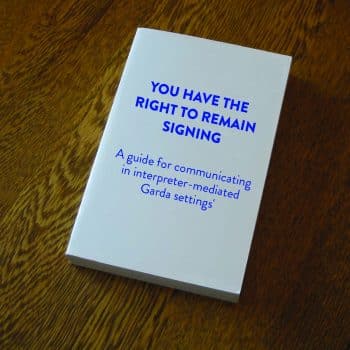
    In May 2016, two District Court hearings took place that were notable for the things they had in common, but also for the disparity in their outcomes. In Letterkenny, a deaf man successfully appealed against his 2014 conviction for drink-driving on the grounds that gardaí were unable to provide an Irish Sign Language (ISL) interpreter following his arrest and questioning, and mistakenly assumed he could understand notes given to him in written English. In allowing the appeal by Gerard Doherty, who has poor literacy, the judge said: “I am not satisfied he appreciated what was fully going on. I have a suspicion but a suspicion is not enough. It would be dangerous to uphold the conviction”. Just over a week later, on May 18, another deaf man, John McGrotty, who a few days previously had pleaded guilty to a number of charges of harassing and stalking his neighbours – GP Dara McEniff and his wife Eimear and their children – in Dungloe, was brought to the nearby Falcarragh district court after they complained of further harassment. While Mrs McEniff was allowed to give evidence, Mr McGrotty was unable to because an interpreter was not available that day. However, instead of adjourning the case, Judge Paul Kelly then informed Mr McGrotty that he could either be remanded in custody or stay away from Donegal until sentencing the following month. If your first or only language is not English, you can reasonably expect in 2017 that having an interpreter to help you give evidence in court would be a fundamental part of your rights under the Irish justice system. Yet the stark contrast in the outcomes of these two court hearings – both in Donegal, both involving deaf men for whom Irish Sign Language is their first language – strongly suggests that many deaf citizens still cannot take these rights for granted. According to Mr McGrotty’s daughter, who was also at the hearing, Judge Paul Kelly decided to allow Mrs McEniff to give evidence despite there being no interpreter for Mr McGrotty and despite objections from his solicitor, Patsy Gallagher. Judge Kelly did ask Mr Gallagher and Mr McGrotty’s social worker and advocate, Declan Boyle, if they could communicate with Mr McGrotty in writing, but they said no because his literacy is poor. Nonetheless, he proceeded to give him the choice of custody or to go and stay with his daughter in Dublin until the next hearing on June 14. Without an ISL interpreter, it is understood that Mr McGrotty, who does not speak or lip-read, could not meaningfully follow any part of the May 18 hearing, let alone give any evidence in his defence. Afterwards, when word reached the Irish Deaf community via social media of Judge Kelly’s decision, an online petition condemning his failure to ensure an interpreter was provided garnered well over 1,000 signatures and was submitted to the Department of Justice. It has since emerged this was not the first time the State had failed to ensure that Mr McGrotty had access to an interpreter. According to his daughter, on the two occasions when Mr McGrotty was arrested by gardaí in 2014 and 2015 in connection with the alleged harassment, no interpreter was provided, a fact that emerged during an earlier hearing. Although the first proper hearing had been scheduled for October 2015 (having been adjourned twice since June 2015), Mr McGrotty’s daughter says that it was only after she intervened and said they couldn’t proceed without an interpreter that the case was deferred again. According to the Sign Language Interpreter Service (SLIS), the agency which books interpreters, neither the Courts Service nor the Garda had made any requests for interpreters for Mr McGrotty until after October 2015. Criminal cases like these based mainly on ‘he said/she said’ testimonies are always fraught with difficulty, but what seems clear is that on too many occasions Mr McGrotty had been denied his right to put forward his version of events. On the morning of June 14, standing outside the old converted church that houses the Dungloe District Court as well as the local library, tourist information office and a café, John McGrotty is pleasant, good-humoured and chatty. It’s his first day back in the town after his enforced four-week absence from Donegal county. Amid the flow of local people walking in and out, a number stop to say hello or shake his hand. He is joined by his daughter, his social worker, Declan Boyle from Deafhear, and two ISL interpreters. Also outside the courthouse is Elaine Grehan from Deaforward (an advocacy service run by the Irish Deaf Society), Lorraine Leeson of Trinity College Dublin’s Centre for Deaf Studies (which trains interpreters) and Haaris Sheikh, a consultant. Ms Grehan had written to Judge Kelly outlining her organisation’s concerns about the failure to provide an interpreter at the last hearing, while Ms Leeson and Mr Sheikh are also following McGrotty’s case with acute interest. The two have been working together on the Irish element of a wider EU project called Justisigns, which looked closely at access to the justice system for Deaf sign language users. “When we look at Mr McGrotty’s case, we would suggest that natural justice affords all citizens a right to respond; a right to know and understand the charges against them”, said Mr Sheikh. “Without an interpreter how is this possible? Whether it’s in Donegal or Dublin, whether it’s a speeding offence or a serious assault charge, an interpreter must be provided, and if one is not available, the judge should adjourn the case”. In response to a Dáil question from independent TD Clare Daly on June 8, the Minister for Justice and Equality, Frances Fitzgerald, acknowledged that cases should be postponed where an interpreter cannot be found in time for a hearing. Mr Sheikh says that it’s not always about “an intention to deny” access, but there is a need to understand the root cause of why the courts or Garda might decide not to provide

    Loading

    Read more

  • Posted in:

    Brother is bigger than you think

    With worldwide news leading with elaborate but anonymous hacking operations that have interfered with recent elections in the US and France – and pose a threat to the upcoming one in the UK – many are wondering how a foreign intelligence agency can conduct a surveillance or hacking operation without engaging with local law enforcement. Many have speculated why Ireland had been spared the terrorist attacks seen in other countries across Europe. It is possible there is a form of ‘Entente Cordiale’ between Islamic extremists and Irish law enforcement ensuring we remained untouched. In such circumstances a foreign agency would naturally be suspicious of any shared information and might look to conduct operations in a more ‘independent’ manner. Finding Targets Surveillance requires getting close to chosen targets to establish behaviour patterns and movements with the ultimate goal of eavesdropping on meetings and conversations to establish their intentions. The initial challenge would be to actually find a person of interest. There are many technologies that can be brought to bear on this problem including surveillance satellites, but there are far easier ways. Extremists need to hide where there is a large population, which immediately limits the choice of locations to one of only three or four cities in Ireland. Assuming an Islamic extremist is also somewhat devout, this narrows the search down to locations around our few mosques. They don’t need to live close by, merely to attend. Peppered around our target mosques will be mobile-phone-network antennae. Whenever a phone is powered on, when leaving religious services in a mosque for example, it reaches out to a number of mobile phone antennae to establish a connection. There would be two pieces of information of interest to our agency here, the initial connection information and the call detail records – more on those a little later. The initial connection information allows specific mobile phones to be identified. From this our agency might establish an initial group of targets, and start tracking on a rudimentary level. The phones don’t have to be smartphones with fancy GPS units, although that would make the process easier: the information is fundamental to the operation of the network and it is generated by every phone. Each phone has a unique identity that is used to tie it with all sorts of interesting information. Of particular interest is the call detail record, or CDR, used by telephone companies and hackable using illegal software. The CDR is a little nugget of information that underpins billing on mobile networks. It identifies, among other things, the number that is making a call, the number that is receiving the call, how long the call lasts and information on the telephone exchanges from which a general location of the caller and receiver could be largely established. From a CDR our agency could now track down a billing address and also a range of associates. Now it can start to infiltrate the homes of its targets. Through the Front Door Many extremists like the Internet, for its propaganda-spreading potential, sharing videos and pictures of their beliefs, ideals and manifestos, sometimes with abandon. Watching ISIS videos in a public place is not the best way to stay hidden so they have Internet connections to their homes. With the details from the CDR in hand, our agency could target Facebook, Twitter, Google and all of the other multiple Internet hangouts frequented by our extremists. With very little information a user’s Internet Protocol, or IP, address can be established. The IP address, while not unique, is enough to identify an Internet Service Provider; from there it’s a short hop for an intelligence agency to get to the Internet router, the anonymous device with the flashing lights connecting the extremist’s house, and probably yours, to the Internet. Suddenly, and invisibly, the agency can penetrate the perimeter of the target’s house. Closing the Noose The Internet router represents an extraordinary vulnerability in a house if not properly protected. Every Internet-enabled gadget connects through this single device and, to a sufficiently well-trained operative, it provides a digital potpourri of surveillance opportunities. There are three things to note at this stage, first the router cannot be properly protected, second even the poorest of intelligence agencies have sufficiently-well-trained operatives and finally routers can be compromised for weeks and months before raising any suspicion. Using the router as a stepping-stone, laptops, smart phones, tablets and increasingly ‘smart’ televisions all with microphones and cameras that can be turned on remotely and silently become available to the agency. The extremist has literally brought the surveillance device into their home and opened the door through which it can be accessed. Phishing for fun and Electoral Disruption The recent attacks on election campaign candidates fall into the realm of ‘phishing attacks’, bait-and-hook attacks with bad spelling. Phishing attacks present emails, instant messages and websites under a false flag. They look legitimate, but their entire purpose is to have the target reveal sensitive information such as passwords or bank account details. In the case of Macron, a mysterious Russian cyber espionage group, ‘Fancy Bear’ aka APT28, possibly associated with the Russian military intelligence agency GRU, last month registered decoy domain names, the addresses that drive the internet, which resembled the name of En Marche. Using these domain names, a flood of communications would have been issued, often, ironically, containing a security warning requesting password verification leading back to the false-flag domain. With this simple step, a user’s credentials are obtained, leaving access to the legitimate systems utterly compromised. In the case of Macron, those domains include onedrive-en-marche.fr and mail-en-marche.fr. OneDrive of course is the name of the cloud-based document service offered by Microsoft. The attackers’ standard mode of operation is to access these systems to download sensitive documents and materials, releasing it to the internet via Wikileaks or other leak sites, or through their own sites, to an agog international public. The Next Domestic Surveillance Device What do Siri, Alexa, Cortana, Amy, Bixby and Google Home all

    Loading

    Read more

  • Posted in:

    Czechs Kafka Kundera and consent

    I am now working in the Czech Republic. Before I arrived I had a certain tourist’s knowledge of Prague and had visited briefly twice previously for short periods but the main tourist sights sell this flecked and overlaid tapestry of a city short, neglecting its diversity of specialist shops and bookstores – fast disappearing from Dublin – and its shadowy labyrinth of side streets enveloped in mystery, particularly at night. My knowledge of the Czech Republic was solely of its florid culture. The novels of Milan are a crash course in uninhibited European eroticism framing a social culture unknown in Ireland – European decadence alien to our deeply repressive mindset and our low grade obsession with the smutty and tabloid side of sexuality. Kundera‘s novels are also written in an exquisite lapidary style. Short, precise staccato but also lyrical. Everybody should make time to read at least ‘The Farewell Party’, ‘The Unbearable Lightness of Being’ and the glorious collection of short stories ‘Laughable Loves’. There is also a lot of dark laughter in those books not unlike Flann O’Brien‘s and culturally there is at least here a reference in the black and lachrymose senses of humour and despair. Of course Kundera is not even close as far as The Czechs are concerned to their greatest writers led by Franz Kafka. Kafka is like a shadow over Prague. In the Jewish quarter there is a rather bold modernist statue of him. His visage and silhouette adorns mugs and t shirts in every tatty tourist shop. There is an expensive and uninformative Kafka museum and a bookshop in his name. There is above all else his house by the great castle where he lived a hundred years ago, not dissimilar to the two-bedroomed artisan houses near the Four Courts. Kafka was Jewish, an anomaly in the Czech Republic and of course he wrote in German. Since I have been taken aback at how Germania has been expurgated from Prague culture. The Czechs speak English and Russian primarily outside their own language. Still they venerate Kafka. It is a legal reference from a case that unsettled and derailed my career at the Dublin bar – Gilligan v Ireland (1997) – that sparked my later interest in Kafka. I used the expression “a Kafkaesque situation” in that case impromptu. It conjures a situation of absurdity and perversity. The Proceeds of Crime Act 1996 met it well. I am not sure it helped my career. Franz Kafka trained as a lawyer though he did not enjoy it. According to one account he found that the study of law: “Had the intellectual excitement of chewing sawdust that had been pre-chewed by thousands of other mouths”. The leading feminist scholar Robin West in a philosophical monograph, in the 1985 Harvard Law Review, argues that Kafka’s world presents law as alienating and excessively authoritarian, exerting in people a craving for conformity. People have an urge to conform or obey the law and may obey a law which is intrinsically unjust. As West argues: “Kafka’s world is peopled by excessively authoritarian personalities. Kafka’s characters usually do what they do – go to work in the morning, become lovers, commit crimes, obey laws, or whatever – not because they believe that by doing so they will improve their own wellbeing but because they have been told to do so and crave being told to do so”. She contrasts this negative view with the view of law as facilitating the maximisation of one’s own welfare, presented by the right-wing Law and Economics scholar Richard Posner, perennial candidate for appointment to the US Supreme Court: “Whereas Posner’s characters relentlessly pursue autonomy and personal wellbeing, Kafka’s characters just as relentlessly desire, need and ultimately seek out authority”. In evaluating these views, West points out that although both Kafka and Posner see people as consenting to the various transactions they enter into, for Kafka such consent can lead to humiliating and degrading employment, sex and even death. For Posner, the ultimate free-marketer, such consent is rational and self-fulfilling. For Kafka, such consent leads to victimisation, self-mutilation and death”. West draws from her reading of Kafka on consensual market transactions a conclusion laden with foreboding: “In all of these market transactions – commercial, employment, and sexual – Kafka portrays one party consenting to a transfer of power over that party’s body, and in each instance the transfer, although consensual, is horrifying. In none of Kafka’s depictions does consent entail an increase in wellbeing…The participants are often motivated by a desire to submit to authority, not to enhance autonomy”. West summarises the polar opposite visions of Posner and Kafka thus: “Posner teaches us that when the risk of the loss is voluntarily assumed, the ultimate suffering of that loss is consensual and we consequently need concern ourselves no more with losers in the market than with those in the lottery. Kafka’s stories tell a different tale. In Kafka’s stories, the community’s refusal to intervene and come to the aid of the market losers is revealed as a breakdown of community and brotherhood, not a legitimate response to a morally satisfactory state of affairs”. From this, she concludes that Posner’s theory is deeply flawed: “The problem with Posner’s argument is that even if these losses have been impliedly consented to, he has not shown that anything of moral significance follows from that fact”. And moral significance is the framework. West also examines the question of consent to law in Kafka. According to Posner, people consent to legal imperatives that are wealth-maximising. According to Kafka, they consent to impersonal state imperatives not because they are wealth-maximising but out of a deep-seated desire for judgment and punishment. Thus, in the short story ‘The Judgment’, a son submits to death by drowning as his father has decreed. In the short story ‘The Refusal’, the townspeople obey the colonel in charge of the town because authority has “just come about”. The most dramatic example of this submission to authority is, I

    Loading

    Read more

  • Posted in:

    US and EU

    All States and aspiring States have their ‘myth of origin’ – that is a story, true or false, of how they came into being. The myth of origin of the European Union is that it is fundamentally a peace project to prevent wars between Germany and France. Most wars are civil wars, not inter-State ones. One can make a plausible case that the EU contributed to the Yugoslav civil war in the early 1990s by recognising Croatia and Serbia as sovereign States within their internal-Yugoslav administrative boundaries, without any consultation with the large Croat and Serb national minorities that found themselves on the ‘wrong’ side. This was against all the norms of international law governing the recognition of new States. And did not the EU contribute to the Ukrainian civil war since 2014 by pushing an EU “economic partnership” agreement on Kiev and working with the US to lever Ukraine and the Crimea out of Russia’s sphere of influence? An important new book by University of California historian Ivan T Berend, ‘The History of European Integration, a New Perspective’ (Routledge, 2016) uses the American national archives for the first time to show that the EU’s own historical origins lie in war preparations rather than peace strivings. America was the original demiurge of European supranationalism. Europe was divided between East and West following World War II. The Cold War between the US and USSR took off in the later 1940s and the possibility of it turning into a real, ‘Hot’ War persisted until the 1980s. In the later 1940s American policy was to push Europe’s former imperial powers towards economic and political integration with one another. In 1947 the two Houses of the US Congress passed a resolution that “Congress favours the creation of a United States of Europe”.That same year US economic aid to revive Western Europe under the Marshall Plan was premised on support from the recipients for economic and political integration. “Europe must federate or perish”, said John Foster Dulles, later US Secretary of State.  In 1948 the American Committee on United Europe was established, supported by the Rockefeller and Ford Foundations. For years the Central Intelligence Agency (CIA) channelled money to the European Movement. That movement’s national sections became the main non-governmental lobbyists for ever further integration in the different European countries and have remained so to this day. In 1949 at the time of NATO’s formation the US wanted a rearmed West Germany as a member. This greatly alarmed France, which had been occupied by Germany only five years before. Jean Monnet, who was America’s man in the affair, came up with the solution. Monnet and other technocrats had been pushing schemes of federal-style supranationalism for Europe since the end of World War I in 1918. These had had no effect in preventing World War II, but in the new situation post-1945, with America now supporting Euro-federalism as a bulwark against communism, Monnet and his colleagues saw their opportunity. To assuage France’s fears of German rearmament Monnet drafted the Schuman Declaration, named after France’s Foreign Minister Robert Schuman, proposing to put the coal and steel industries of France, Germany and Benelux under a supranational High Authority as “the first step in the federation of Europe”. This led to the European Coal and Steel Community Treaty of 1951, the first of what were to become the three supranational Community treaties – the other two being the Atomic Energy Treaty, which gave us EURATOM, and the European Economic Community Treaty, which gave us the EEC. A federation is a State, so the political aim of establishing a European State or quasi-superstate under Franco-German hegemony was there from the start. The preamble to the German Constitution, adopted in 1949, speaks of Germany as “an equal partner in a united Europe”. Far from European integration being a peace project therefore, the historical fact is that the first step towards supranationalism in Europe, the 1951 European Coal and Steel Community, was advocated and supported by the US to facilitate German rearmament in the early years of the Cold War, and to reconcile France to that fact. The EU celebrates 9 May 1950, the date of the Schuman Declaration, as “Europe Day” each year.  Jean Monnet became secretary of the supranational High Authority which ran the Coal and Steel Community. This was the predecessor of today’s Brussels Commission. Forty years later, in 1992, the central political purpose of the single currency, the euro. was to reconcile France to German reunification following the collapse of the USSR. This was Monetary Union for Political Union or, put crudely, the Deutschemark for the Eurobomb, with Germany and France as effective joint hegemons of the European Union that was first mooted in the 1992 Maastricht Treaty that gave us the euro. Following the Coal and Steel Community Treaty and against the background of the 1950-51 Korean War, the French Government, again pushed by the Americans, produced an ambitious plan for a European Defence Community (EDC) in 1952. As Monnet put it in his Memoirs, “Now the federation of Europe would have to become an immediate objective. The army, its weapons and basic production, would all have to be placed simultaneously under joint sovereignty. We could no longer wait, as we had once planned, for political Europe to be the culminating point of a gradual process, since its joint defence was inconceivable without a joint political authority from the start”. This proposed European Defence Community was to have a European Army, a European Defence Minister, a Council of Ministers, a common budget and common arms procurement under the overall aegis of a European Political Community. The treaty establishing the EDC was ratified by the German Bundestag, but it caused a political storm on the Right and Left in France and in 1954 the French National Assembly narrowly rejected it. Chastened by this setback the Euro-federalists decided henceforth to play down their ultimate goal of political integration and to stress economic integration as the supposed route to

    Loading

    Read more

  • Posted in:

    Corporate welfare fares well

    Corporate welfare is controversial. Negatively, it can mean ‘crony capitalism’ – politicians using public resources to benefit their friends in business, or at best propping up failing enterprises for short-term political gain. A more positive understanding is that corporate welfare involves the state, employers and workers co-operating on a shared project of economic development. Corporate welfare, in a broad sense, is when public resources are used to give businesses one or more benefits. This can include direct payments or subsidies, the purchase of goods and services by public bodies (€8.5bn annually in Ireland), the provision of infrastructure, the availability of support services (like Enterprise Ireland), preferential tax treatment, tax breaks or lax regulation. Corporate welfare is highly prevalent across even the most avowedly ‘free market’ economies. There is no agreed definition of corporate welfare, and there is no standard way of measuring it. The CATO Institute (a US think-tank dedicated to limited government and free markets) estimates that just the most obvious state subsidies to business cost US taxpayers $100bn  [€90bn] in 2012. In the UK, a more expansive definition of corporate welfare was estimated by Dr Farnsworth of York University to cost £85bn [€120bn] in the year 2011-12. In Ireland, Paul Sweeney – Chair of the network of economists available to TASC, an independent progressive think-tank whose core focus is economic equality and democratic accountability – conservatively estimated state support to the Irish enterprise sector at between €4.7bn  and €6.2bn  in 2011. Governments routinely support businesses in order to boost employment, which in turn makes people – and the country as a whole – more prosperous, and reduces the cost of social protection payments to the public purse. In this way, corporate welfare is part of wider welfare policy. More recently, Ireland’s Department of Social Protection has supported people to leave unemployment by helping them to become self-employed, switching ‘welfare’ payments for ‘enterprise’ payments and blurring the boundaries of social protection and industrial policy. Unlike social welfare to households and individuals, the distributional effects of corporate welfare are much harder to measure. Although a business might gain from state supports, the effect in the economy might be to provide more jobs for people on low-to-middle incomes rather than to provide any additional profit for the business owner. In some cases, corporate welfare may be cost-neutral or even generate returns for the state. The cost might be off-set by benefits from increased exports, higher employment and more tax paid by companies in receipt of supports. Sometimes wider policy goals, like more balanced regional development, might be judged to outweigh the financial cost of business supports. Nonetheless, corporate welfare can mean public money benefiting individuals who are already wealthy. For example, businesses in receipt of state supports may give high pay to their executives and the effect of the state intervention may be to make a business more profitable in the long term, which means more wealth flowing to owners and shareholders. One of the most egregious examples of excessive pay in businesses supported by the state was the €500,000 agreed as the cap on executive remuneration in Ireland’s bailed-out banks, which even then met resistance from bankers. Distinguishing cronyism from genuine industrial policy can be difficult. The social costs and benefits of corporate welfare are not easy to calculate, as some measures may genuinely benefit the economy but also involve giving benefits to friends of the government of the day. Various Tribunals have passed judgment on crony capitalism in Ireland – Tribunals into beef export subsidies, planning decisions and a telecoms licence. These processes took years, and are not a practical or economical way to safeguard probity in business dealings with government. The Irish state has a long history of corporate welfare – from basic economic development such as electrification, to various supports and inducements to foreign direct investment today. Politically, the tendency has been for the radical extremes to oppose corporate welfare – the Left based on the accusation of crony capitalism and the Right out of deference to the religion of free markets, while those closer to the centre of the political spectrum are more likely to favour it. The connection between industrial policy and corporate welfare highlights the pro-enterprise role of the welfare state. This perspective also raises issues of equity that have been absent from earlier discussions of industrial policy, where the focus was chiefly on economic goals such as technological development or employment. The complex and changing role of the state in the economy is perhaps best described in terms of inter-dependence. It is widely accepted that the state should aid private enterprise in the developed capitalist economies. However, in the absence of detailed official data to permit more thorough analysis, it is impossible to say whether corporate welfare in Ireland delivers the best value for public money, or whether it is ethical.  Nat O’Connor is Lecturer in Public Policy and Public Management at Ulster University. This article is based on ‘Crisis and Corporate Welfare’ by Nat O’Connor and Paul Sweeney, in Murphy, M.P. and Dukelow, F. (editors 2016) ‘The Irish Welfare State in the

    Loading

    Read more

  • Posted in:

    Even kingdoms have rights

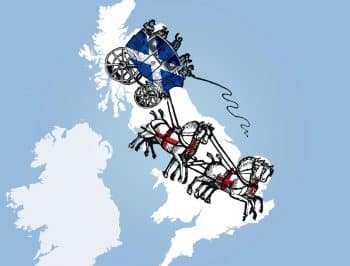
    Democracy means rule by people, however, there is some dispute as to what exactly this means in practice. It must mean more than majority rule – it cannot allow minorities to be oppressed just because they are minorities.   Democracy and fairness Democracy must embrace fairness in its broadest sense. It needs to engage with people’s identities, aspirations and sense of community, and through mechanisms including human rights and rule of law. Some procedural aspects of democracy are contentious; for example, whether proportional representation should prevail over single seat constituencies. Jurisdictional fairness is important too: gerrymandering is often circumscribed by allowing an independent commission to delineate constituency boundaries.   Unclear Boundary Rules Determining the boundaries and jurisdictions of countries too presents certain conundrums: Who decides what boundary defines a nation? When can part of a ‘kingdom’ decide to be sovereign and demand secession? History suggests that there are no rules, only that those who hold the power decide, retrospectively justifying the decisions or alternatively acquiescing to regional demands for regional sovereignty for reasons of political expediency. In the US for example in the Nineteenth Century the federalist states objected to the southern states’ demands for secession. Majority rule within the southern (confederate) states held no sway; the will of the more powerful “division” prevailed, after the Union Civil War. The US Supreme Court has been robust, holding in 1869 that Texas could not secede from “an indestructible Union”. The rights of persons other than those seeking secession are clearly at issue and must tempore any regional secession majority vote. Canada has been more circumspect. When Quebec secessionists sought independence and failed in two referenda, the last one in 1995 by a margin of 0.6%, the Canadian Supreme Court was asked to rule in 1998 on whether a vote for secession in Quebec would require implementation by federal authorities. It held, ambivalently, that both sides would be obliged to negotiate with due regard to constitutional principles and that any impasse should not be subject to judicial supervision due to its political nature. It did say though that the democracy principle “cannot be invoked to trump… the operation of democracy…in Canada as a whole”. Canada passed the Clarity Act in 2000 which sets out a broader participatory framework for any secession claims.   Secession versus Unification If two sovereign countries contemplate unification, a referendum which requires a majority in both ‘countries’ appears reasonable. However, when one ‘country’ such as Scotland aspires to independence, then a majority vote in the secession-claiming region is alone sometimes seen as sufficient, as when David Cameron conceded a referendum to Alex Salmond in October 2012, in the Edinburgh Agreement. But there may be an asymmetry between unification and separation. If the secessionist region times its challenge for a period of general instability of the larger region, as now with Brexit, regarding Scotland, then one lucky vote can forever divide a country, with no replay for the disenfranchised. Unfairness inevitably results from the asymmetry of process, whereby a vote for secession only needs to win once, whereas the unified region must win every time. Imagine a boxing match in which a challenger only needs to win one round out of fifteen, and can skip any round for a rest. The rights of citizens in the ‘abandoned’ region are clearly an issue too; the secessionist region may contain valuable resources (oil reserves for example) over which the abandoned region has a legitimate claim. The identity of the abandoned citizenry may be intrinsically tied to the unified country and the esteem, identity, integrity, power and military might associated with this greater power risk being downgraded. Without some bulwarks against secession there is a risk of fragmentation and chaos. Resource-rich regions could claim ‘Independence’ opportunistically to enhance the wealth of its citizens to the detriment of others. States could fragment into mini-kingdoms, each with its own laws and boundaries. Even the bald rule of law, a necessary component of democracy, requires that a brake be put on secessionist claims, which are based solely on regional ‘majority’ claims. One solution is to provide the (potentially) abandoned region with some say in any secession referendum process.   Everyone needs a say In the case of Scotland, for example, the remainder of the UK could also be allowed to vote in any new independence referendum. The more that Scotland’s independence is opposed in the UK, the higher the threshold which should be imposed upon Scottish voters to achieve independence. The percentage in the UK (less Scotland) in excess of 50% against independence could be divided by four and added to the 50% threshold, which was applicable to the last Scottish referendum, in 2014. Thus, if 80% of the remainder of the UK opposed change, then a majority in excess of 57.5% would be required for Scotland to secede. Such a system, or some similar formula, would better secure the conflictual rights at stake than determination by a simple majority of secessionists. Democracy must embrace the broader consequences of secession demands upon everyone and mould independence referenda procedures accordingly. Independence in an interdependent world is no longer simply a matter that should be left to those who see advantage in independence, no matter how noble such an aspiration may be, unless, as pointed out by the Canadian Supreme Court (in the international law context of self-determination), people are “subject to alien subjugation, domination or exploitation”. The ‘left-behind’ block of citizens has legitimate aspirations to stability and respect for their multi-stranded identities of which nationalism is but one facet. They should not be endlessly threatened with fragmentation of their notion of nationhood at the behest of one region of a country, particularly without their voices being heard. A minimum 15-year interval between any independence referenda coupled with a balanced participation formula (allowing all persons affected to partake) in any such vote would also conduce to a fairer system. The era of notionalism, of slavery to old slogans, must yield to a calculus of the greatest

    Loading

    Read more

  • Posted in:

    The other P O’Neill

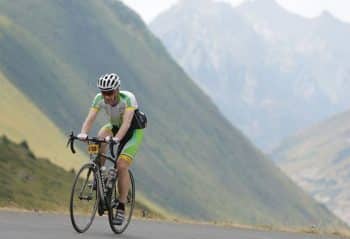
    The new editor of the Irish Times, Paul O’Neill, was brought up an only child in Waterford where his late father, Paddy, was editor of the ‘News and Star’. His mother Josie’s family, the Larkins, owned the well-known bar and grocery at The Duffry in Enniscorthy, now Donohoe’s/Pettitt’s. Paul started his career at that newspaper and worked for a while at the Cork Examiner. He is married to Jennifer and has two daughters. He is, at 52, five years younger than his predecessor, and an enthusiastic cyclist, though as he admits himself, more for health reasons than environmental concerns about fossil fuels. He cycles competitively with the Dundrum-based Orwell Wheelers. He has cycled the “Étape du tour’, a leg of the Tour de France – 138km from Saint-Jean-de-Maurienne to La Toussuire-Les Sybelles. “But the challenge wasn’t the distance. The true test lay in the climbs: a total of 61.5km uphill”. The challenges facing O’Neill are enormous. When the Irish Times broke the news on Twitter that a new editor had been installed, it incidentally highlighted one of the major problems the newspaper faces. A photo circulated of Paul O’Neill, taking over from Kevin O’Sullivan, who was stepping aside to take on the portfolios of agriculture, environment and science, showed the pair standing in the centre of a large circle as other Irish Times staff crowded round and listened to the announcement Such photos are a tradition in the Irish Times – they bespeak a hive of collegiality led by a winning editor. But as Twitter users quickly pointed out, that crowd was overwhelmingly made up of middle-aged men – pale, male and stale. In contrast to O’Sullivan’s appointment, which came after a lengthy period of speculation over the future direction of the newspaper as several candidates vied for the position, O’Neill’s promotion came on an otherwise unremarkable mid-week afternoon, without fanfare, or notice. “The challenges facing so-called old media companies have been well ventilated”, O’Neill was quoted as saying shortly after the announcement. “But the audience [sic] of The Irish Times continues to grow and now includes those who access our journalism via smartphones, iPads and desktops, as well as those who continue to read the newspaper. The media landscape is evolving rapidly and the future is not settled. But in a world of alternative facts, falsehoods and hidden agendas, I’m confident that The Irish Times and our independent journalism will continue to thrive. As people increasingly question the accuracy of the information presented to them, I believe the standards of quality and fairness associated with the Irish Times will be ever more relevant and valuable to them”. O’Neill was deputy editor (and is replaced by Denis Staunton), not to be confused with assistant editor, which is Fintan O’Toole, to both O’Sullivan and Geraldine Kennedy. He combined this with the title ‘Editorial Director’. Before that he had crossed over to the Dark Side for a time to work in public relations having taken a redundancy package from the paper at the turn of the century. Since he joined initially in 1989, he has been London correspondent, crime and news reporter and finance editor. He applied for the job last time around after Kennedy’s departure, and was very clearly regarded as the front runner for the post once O’Sullivan departed. In reported remarks on his departure O’Sullivan said his term as editor – the thirteenth in the paper’s history – “coincided with unprecedented turbulence and uncertainty for media businesses”. It has been rumoured that Dan Flinter, chairman of the board of the Irish Times Limited,and former boss of Enterprise Ireland, leant on O’Sullivan to move on. His removal was a cloak-and-dagger operation and it is indicative of low morale at the newspaper that none of the supposed standards watchdogs at the newspaper, which is guided by a lofty but precarious Trust arrangement and an “editorial committee”, complained about the furtive lack of proper interview procedures. That uncertainty about the future was also acknowledged by O’Neill in an interview with Sean O’Rourke on RTÉ radio, where he acknowledged the possibility that the Irish Times may eventually have to move to less frequent print editions, perhaps appearing in hard copy only on Saturdays. He had little to say about his editorial vision and nobody in the newspaper’s elevated governance seems to rate this as of much significance in the face of the need to adopt buzz concepts to address the accepted threats of digital, Google and Facebook. Cost-cutting not vision is the order of the day, still. In June last year the Irish Times announced plans to reduce costs by €3.5m over three years, including a target to cut employment costs in the business by €1.5m. Remarkably, the paper employs close to 400 staff but is currently completing a voluntary redundancy programme. Circulation has almost halved since its peak in 2008 and is down a third on O’Sullivan’s watch (compared to 28% at the Irish Independent). The Irish Times has managed to encourage readers to subscribe, both to print and digital offerings. Reading through statements both from the paper itself and the Audit Bureau of Circulation (ABC), it appears to have attracted 13,000 subscribers for the e-paper (a digital reproduction of the print product), and 12,000 more to access behind the website paywall, with an additional 30,000 paying for a joint web-and-print subscription.     These numbers allow the paper to claim a combined print+pixel circulation base of over 90,000, though the most recent ABC figure, counting only print sales, is a sobering 66,251. But even if the paper does manage to convert all of its print readers to digital (or – an even greater challenge – increase its total base by attracting new subscribers), it still faces the hard fact that digital advertising revenues are only a fraction of those it can attract for print. And there are only so many commercial features and “sponsored content” reports the paper can host before it starts to detract from the masthead’s credibility. To an

    Loading

    Read more

  • Posted in:

    A vision, with buy-in

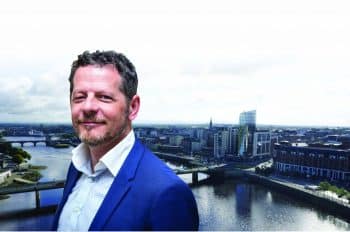
    History and economics John Moran is former Secretary General at the Department of Finance. I meet him for brunch in a Mexican restaurant on bank holiday Monday. He is bright and open, and brings along his ebullient mother (but that is another story). Before elevation to the most senior position in the Department of Finance Moran worked as head of the banking unit at the Department, which he joined after a stint at the Central Bank. Before that he worked as a senior banker and corporate lawyer mostly outside Ireland. He did a law degree and a Master’s in the US, and followed up with a degree in maths. I ask him what he’s up to now. “Basically since I left the Department I’ve set up a company, RHH, which is designed to do social entrepreneurship and strategic leadership. We do a number of roles with different charities like the Hunt Museum”, of which he is chair. It also lobbies for the likes of Nomura and Uber. As a social entrepreneur Moran supports a number of not-for-profit organisations drawn from interconnected spheres including education, and regional and urban development.  He has helped established and serves as chair of Narrative 4 Europe, based in Limerick, a not-for-profit organisation promoting social change through storytelling co-founded by Irish novelist Colum McCann, and is an active member of the Limerick Economic Forum, since November known as Limerick Twenty Thirty which is charged with developing key strategic sites in Limerick City and County that will act as anchors for enterprise and investment development across Limerick”. It has generated a national buzz about Limerick and sites like the Opera Site and Hanging Gardens. Moran was appointed a board member of the European Investment Bank (EIB), and is a ‘Chevalier de l’Ordre National du Merit’, or ‘Knight’ of France’s second highest national order of merit. A Francophile, he’s involved in the restoration of La Maison Carrie-Boyer, a 13th Century medieval home in Cordes-sur-Ciel near Albi in the South-West of France. The building is classified as a national monument. He is no longer involved in the juice bar he once ran in France. He lives mostly in Islandbridge in Dublin but is also restoring a Georgian house on Pery Square in the centre of historic Limerick. He looks back on his time in the Department with favour and in particular considers he was influential in effecting a change towards collection of data and a more evidence-based approach, one which perhaps surprisingly had been lacking until then. I probe him on whether he thinks the Department made mistakes during his time there but he certainly doesn’t think so. He defends Nama for selling property early as that was its remit. If it had not done so it is probable there would not have been the return to vibrancy in the property market that we are now benefitting from. He doesn’t agree the vulture (and he disagrees with the term) funds were indulged. He won’t be drawn on whether Nama could have expected to retrieve closer to the original, par values of loans instead of the discounted prices it paid and he certainly won’t be drawn to criticism of the way Project Eagle was handled. He believes it was right to exit Northern Ireland. He met Oak Tree and Lone Star in the immediate run-up to their putting in, successful, bids for Project Sands but does not recall engaging with Cerberus about Project Eagle, though Michael Noonan did, the day before bids were due. He and Noonan made their diaries available to the Public Accounts Committee. And of course Nama and the Department are far from conterminous. He accepts that the Anglo €34bn is gone but believes the State will recoup the rest of the €64bn advanced in the bank bailout from the bailees. In terms of his political philosophy he is unforthcoming but he’s passionately in favour of equality of opportunity. Limerick It’s in that context that he’s got involved in promoting the development of Limerick (he grew up in Patrickswell and there are hints of the accent through the mid-Atlantic and Merrion St). He feels at the moment too much development is going to the Greater Dublin Area. The people of cities outside Dublin are simply not benefitting from equality of opportunity. His vision for spatial strategy is of a spreading of the benefits of economic development around the country. He’s actively engaging with the government’s draft National Planning Framework. He’s a big believer in quality of life so I ask him if they ever looked at linking tax incentives to quality of life indicators in the Department when he was there. In fairness after failures with the likes of the Upper Shannon blanket tax incentives the Department of Finance had, by the time of his tenure, become hostile to property-based tax incentives but he says they had not looked at such linkages. He’s a little defensive. He notes accurately that the Department’s strategic plan “didn’t look just at GDP, but at quality of life too” and I ask him if that had been enough. He insists it was an “evolving agenda” to look at quality of life too. His vision seems ad hoc rather than comprehensivist. Though he doesn’t agree with tax incentivisation, if they are introduced they should be for the public realm, for the outside of people’s houses, not the inside. That benefits everyone. More generally, he thinks good planning should facilitate quality of life through; “Public realm: I think the first thing you have to do is invest properly in terms of public realm and public transport”. As to what this might mean for Limerick, he notes it “has a huge amount of green space downtown and in terms of reaching out and into the county and along the river. I think they should draw a red line around those areas and keep them. But grow the city in terms of density using the rest of the spaces”. For the historic city: “You have to come up

    Loading

    Read more

  • Posted in:

    Continuing someone else’s journey

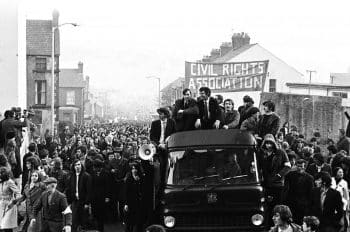
    Last month in Belfast the first of many commemorative events took place to mark the fiftieth anniversary of the formal founding of the Northern Ireland Civil Rights Association, NICRA. The organisation was pivotal in bringing together all those who were discontented with the status quo in the North. Within eighteen months, a wave of protest over civil rights engulfed Northern Ireland, forcing the Westminster government to implement a series of reforms (in access to housing, voting, and disbanding the B-Specials), which in turn toppled the local government and instigated almost thirty years of direct rule. The Linen Hall Library holds the most extensive collection of primary materials on the civil rights movement, and it has dedicated itself for this year and next to discussing the movement’s impact 50 years on. In this vein, the library hosted two events in April: the first, a talk by Professor Paul Arthur, who was a student at Queen’s University Belfast in the 1960s and a member of People’s Democracy. So far, his 1974 book is the only published account of the student movement in Belfast. The second event was a discussion panel on ‘Civil Rights – a missed opportunity?’ sponsored by the Connolly Association, which included speakers Professor Anthony Coughlan and Kevin McCorry. I noted three key things from both events. First, Paul Arthur spoke about the various agendas that existed within NICRA, including the student movement of which he was part. He prefaced some of this with a quote from Seamus Deane’s 1972 poem, ‘Derry’: “The unemployment in our bones Erupting on our hands in stones; The thought of violence a relief The act of violence a grief …”. For Arthur, these lines best encapsulate the ever-present wavering between militancy and constitutionalism that existed in the broader civil rights movement, a debate that has been identifiable in histories of the movement since. Professor Anthony Coughlan, in an article published for this magazine in February this year, firmly lays the blame for the explosion of violence from this period onwards at the door of People’s Democracy, a student-led group that was part of the broader civil rights movement. According to Coughlan, the People’s Democracy march from Belfast to Derry in January 1969 “raised the sectarian temperature markedly”. This need to scapegoat and to recriminate began almost immediately with the publication of the Cameron Report commissioned by the British government, a 1969 document that Coughlan suggests is “still the best account of the early Civil Rights period”. Later historians, such as Henry Patterson and Joe Lee, have continued in the same vein. As a result, the mainstream, consensus narrative of the civil rights movement in the North, tends, unfairly, to side-line the student impact or represent it as an irrelevant irritant to the more mature, sober and minimalist activities of NICRA and to the emerging political ideologies of a newly energised nationalism. But if we look closely at the Queen’s University student newspaper, the Gown, in the years leading up to this period, we can appreciate how wide the political scope of student activism had become. These students were internationalising the situation in Northern Ireland, arguably more than NICRA was, by linking it not only to the civil rights movement in the US, but more widely to student movements for free speech and freedom to assemble in Europe, to anti-colonial struggles in Africa and Vietnam, and to gender rights. The second thing that became clear at both events is that the civil rights movement is remembered differently by different people. Arthur perceptively remarked that in his reappraisal of the movement, there was a great deal of re-remembering and mis-remembering. Issues of civil rights, past and present, remain vital to the contested political culture in Northern Ireland. Equally important are the issues of memory, legacies of conflict, and dealing with the past, which continue to threaten the stability of the government there. As the centenary commemorations of the Irish revolution (1912-23) have revealed, memory is crucial to the understanding of Northern Ireland culture precisely because it is an indicator of collective desires and self-definitions. Since 1998, society in the North has been marked by a tendency towards increasingly divided memory. Events from the start of the Troubles have been interpreted in contrasting ways and the facts themselves are often disputed. There has been very little consensus about what happened, why it happened, and crucially, how to remember what happened. Even within communities, there has been a tendency to promote one set of memories over others. The civil rights movement circulates through Northern Irish memory in forms and through channels that are at once powerful, dangerous, and hotly contested. Debate continues on how much discrimination existed in Northern Ireland during the Stormont years (1921-1972) as well as the movement’s relationship to the violence of the 1970s and the 1980s. Yet remembrance is also a form of forgetting, and the dominant narrative of the civil rights movement – distilled from history and memory, twisted by ideology and political contestation, and embedded in museums, murals, public rituals, and textbooks – distorts and suppresses as much as it reveals. Current realities (the signing of the Good Friday Agreement in 1998 that enshrined civil rights at its core, the ongoing issues since over how to deal with the past, and austerity policies implemented since 2009 that affect living standards) combine and influence the ways in which people relate and integrate the dimensions of past and present experience. A battle over the movement’s legacy has been waged within the Catholic community over the last decade, with both Sinn Féin and the SDLP claiming to be the true inheritors of the movement. How the Protestant and unionist community remember the movement has yet to be explored. In the commemorations of the civil rights movement, and the origins of the conflict that are approaching in the next number of years, it is not enough simply to ‘debunk’ or ‘explode’ the myths that are associated with the movement over the last fifty years, but

    Loading

    Read more

  • Posted in:

    The Furthest Exit: Bannon’s complex agenda

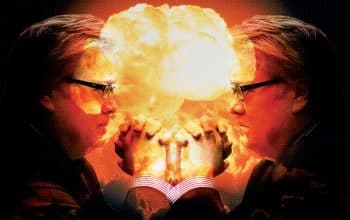
    Steve Bannon, President Trump’s chief strategist, was removed from the National Security Council in early April. Among the Kremlinologists who watch the Trump White House, this has been interpreted as a setback for the man whose neo-reactionary philosophy provides the guiding principles of Trumpism: Islamophobia, misogyny, xenophobia, and excited anticipation of a new American revolution. But Bannon’s ousting has also been called a disguised promotion, as he is restored to his proper role of the mostly unseen puppet-master. In the first part of this article in last month’s issue, I put Bannon in the context of the alt-right and drew the connections between him, Gamergate, Milo Yiannopoulos, 4chan and Alexander Dugin. Here I want to continue this profile of Bannon by looking at his political philosophy. Bannon subscribes to an esoteric version of history known as the ‘Fourth Turning’. Developed by amateur historians William Strauss and Neil Howe in the 1990s, the Fourth Turning applies the logic of cyclical history to the United States. Each turning represents a distinctive atmosphere that dominates a generation. Or better yet, to borrow a phrase from ‘True Detective’, a psychosphere, encompassing the social field of possibilities. In the first turning, following a period of crisis, the atmosphere is one of societal confidence built on a strong state and positively repressed individualism, known as “The High”. For Strauss and Howe, this period ran from the end of World War II to the Kennedy assassination in 1963. This is the era of the Greatest Generation and profound optimism in the American Dream. This turning was followed by “The Awakening”, where the state-individual relation was inverted. Characterised by a dismantling of the social order and the pursuit of individual autonomy, it descended, over time, into generalised confusion as society splintered. It ran up until the 1980s, and was followed by “The Unravelling” where individualism became unfettered to such an extent that societal ties became exceptionally weak. Then follows the final stage, the one Bannon believes we are entering, of “The Crisis,” where conditions require a radical re-assertion of the collective. One may wonder what the crisis was that shifted us into the Crisis. For Bannon the financial crisis of 2008 marked the moment when the individualism of the baby boomers was revealed in its full consequence: a stolen future. This is how he couches his vision when speaking to older conservative audiences, requiring that they own up to their failure and then pointing toward the rise, in line with Strauss and Howe, of a robust Millennial generation that will blast through the Crisis to get to the next High. Bannon has in mind a quite specific segment of the Millennial generation: the pick-up artists, the meme-warriors of Twitter and 4chan, and the campus-touring Milo enthusiasts. It also includes the Chad nationalists, a group of “norms” who might not explicitly position themselves on the political spectrum, but tend to be on the right. Did Chad vote for Trump? It’s implicit in his name, like some kind of metaphysical property. And it means Chad’s dad and his girlfriend and his fraternity did too. These people will quietly act to maintain Americanism, but not necessarily in a militant way. The decision might not always be theirs, however, as central to Bannon’s vision is an existential confrontation with Islam that will radicalise the entire Millennial generation away from individualism and back toward statism, since only a strong state could win such a battle. For Bannon, there is a multi-faceted project to accomplish. The State in its current decadent baby-boomer form must be dismantled. Yet this “deconstruction” (his own term) is simply a prelude to a complete regeneration of the society to be accomplished through total war. On this point, we find ourselves hoping that Trump’s personality will prove sufficiently resistant to Bannon’s apocalypticism. Some say it is General James “Mad Dog” Mattis, Secretary of Defense, who will be the greatest obstacle to Bannon’s vision. Surely this makes Mattis the world’s most unlikely dove. Maybe you know all this. You have heard about Bannon the puppeteer and the raw onslaught the alt-right has engaged Western culture with. Yet the story is even murkier. Alongside the alt-right exists another position, neoreaction, and it as close as this spectrum has to a philosophical system. Trumpist populism and Bannonesque esotericism are no doubt in the ascendant, but they are always threatened by their innate anarchism. There is a sense that the game might implode, that equilibrium could be restored, that a counter-populist movement might render Trump’s reign an aberration. Neoreaction, in contrast, is content to abide its time. Developed by the elusive Curtis Yarvin, under the penname Mencius Moldbug, neoreaction binds a disdain for stagnated democratic politics with a cold formalist system of neo-monarchism. Given the inefficiencies of democracy, only a strong leader, fully free to implement a political programme, can steady the ship. Neoreaction sees itself as an antidote to the Whiggish misreading of history that traces a continuous record of human progress. Instead of the Enlightenment, neoreaction ushers in the Dark Enlightenment. The most consistent formulation of the Dark Enlightenment comes not from Moldbug, but from the British philosopher Nick Land. Land has a storied history, emerging as one of the most exciting Continental philosophers in the 1990s before abandoning academia and the west for a freelance writing career in Shanghai. Throughout, he served as an intellectual lightning rod for the hugely diverse spectrum of alt-right and neoreactionary ideas. This has involved him extolling the virtues of cryptocurrencies, human biodiversity, and singularitarianism (space prevents me from developing these), but his most important contribution, is his emphasis on the all-too-easily overlooked libertarian concept of exit. In the 1970s and 1980s, libertarians became split over whether to enter representational politics. The ‘entryist’ wing established the Libertarian Party in the United Sates as a means to introduce the idea of libertarianism into mainstream politics and out of obscurity; similar parties have cropped up in other countries. The American party was eventually bought out by the

    Loading

    Read more

  • Posted in:

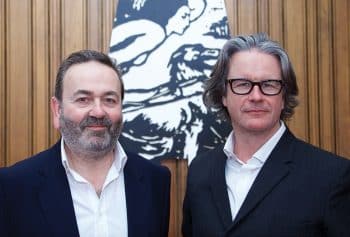
    McLaren and Murray, fresh new faces in control of the Abbey

    I enter the sempiternally dingy Abbey by the stage entrance and advance up the mid-century staircase to a poky room alive with two middle-aged but effervescent non-Irish Celts. The guy at the desk has said he sees a lot of them and they seem effortlessly in control. They’re informal, blithe, cheerful and open throughout our whistlestop chat, bantering with each other supportively, and joshing.     Can you just please describe your backgrounds and records in the arts? Murray: “I’m from South Wales (McLaren thinks this is shaping up to be like a dating pitch). I‘ve worked as usher, stage technician and eventually front-of-house manager, in the Citizens Theatre in Glasgow. Stayed at the bottom for quite some time. Worked for 7:84 Company in Glasgow – a political touring company particularly touring rural Scotland. Ran a building, a beautiful converted church, the Tron Theatre in Glasgow as creative producer. I was the inaugural executive producer of the new National Theatre of Scotland based on a model of a theatre without a building, without walls, for eleven years”. As to what he brings that is special he says “I hope I’m an imaginative producer I have an eye to initiate and exploit and get the most out of them and I have a good all-round knowledge, love, passion for the theatre”. McLaren stops us to note that “John Tiffany, maybe the most significant theatre director of his generation (much as it pains me to say it) characterises Neil Murray as ‘the best theatre director on the planet’”. Murray intervenes to say drink had been taken. McLaren: “Neil and I have been associates for 20 years. When Murray ran the Tron theatre, I ran a touring company called Theatre Babel and we toured across the planet. Like Irish theatre, Scottish theatre is very small. He ran a venue and I ran a touring company. We kinda needed each other. When I joined National Theatre of Scotland we worked together again. In the last five years we worked together on a number of significant projects especially around the social and political changes in Edinburgh. I’m not sure what I bring to the table”. Murray intervenes to explain that he’s “primarily a very fine director of plays” and McLaren agrees “I direct and design plays”. “Coming to Dublin, we didn’t see it as an opportunity to replace what had been before but to envisage a new working model”.         The Abbey describes its mission as “to create world-class theatre that actively engages with and reflects Irish society”. So what’s the vision for the Abbey, and has it changed? McLaren: “There’s nothing we could argue with. That mission statement is always going to be the case. The problem when you give a phrase like that is that it sounds like a set thing. It’s responsive to the ever-changing Irish and global society socially and economically that we find ourselves in. Murray intervenes “It doesn’t really dig into how we think the Abbey will be working and how it fits in Irish theatre and society”. McLaren resumes: “it’s a great privilege to inherit an organisation with such a remarkable past but we have to be cognisant of the fact that its best years are ahead of it. As an organisation it’s been a long time since it’s behaved and thought of itself as if it’s best years are ahead. It’s way too quick to rely on its past brilliance to justify its existence rather than what we will do next year or the year after”.   But the protagonists have always said this, I note. According to McLaren they already have. Murray says, “I think the way the building’s work in terms work we’re producing ourselves and presenting with others’ work It’s a different model already. We’re saying, ‘The national theatre stage belongs to other people as well, not just the Abbey’. That is something that’s been ignored. So for example tonight, Druid: Waiting for Godot. Druid haven’t been here for over a decade. It’s a brilliant production that should be seen at the national theatre. Our programme for the year reflects that more open approach”.   So will there be more co-productions? “More presentations, co-productions. A mixed economy. The days of being able to produce huge shows eight times a year: it’s not what the theatre public want – they want a faster turnaround of activity. Economically it doesn’t make sense to do that it makes sense to be lighter on your feet ,working with wider range of people and artists from Ireland and perhaps further afield. In the end the audience define what the Abbey is. Going back to values, we have to believe anything we put on the Abbey stage is hopefully world-class and reflects modern Ireland. McLaren says “We said we’d investigate the three words around national Theatre of Ireland. What does it mean to be National? For the first time ever we’re about to go to Leitrim simply because it’s about Leitrim, no other reason: because it’s there. Hitherto the company’s attitude would have been we’ll put on some matinées and ensure the good people of Leitrim will be able to see it on a Saturday afternoon or we’ll do a special gala performance. No we’re going to go and make it there and use locals to build the show. That’s the first time in the company’s history that it’s explored what it means to be truly geographically National and Irish, and the different kinds of Irishness from the diaspora through to the new Irish who don’t even speak even English: they also have a national theatre – we’re it and we have a building on Abbey St. But we’re not confined to that”.   Are there dangers to co-producers of subsuming to the Abbey and losing independence? McLaren notes: “We’re there to collaborate”. Murray says it’s “The opposite. ‘Dublin by Lamplight’ by Corn Exchange, ‘The Train’ by Rough Magic and many other shows would not have

    Loading

    Read more

  • Posted in:

    IFA: from pipsqueaks to bullies

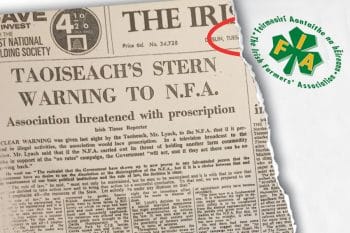
    Long ago, in a galaxy far, far away, Ireland’s National Farmers’ Association (NFA) was a political pariah, with then Taoiseach, Fianna Fáil’s Jack Lynch threatening to have the organisation proscribed, a move that would have placed every farmer in the NFA on the same legal footing as an IRA member. That was almost exactly 50 years ago, in April 1967, when tempers flared and relations between the NFA – forerunner to today’s politically powerful Irish Farmers Association (IFA) – and the state hit an all-time low. Just before dawn on April 24th, 1967, a series of co-ordinated Garda raids, led by Special Branch detectives and backed up by armed soldiers, descended in darkness on the homes of selected farm leaders. Later that evening, Jack Lynch was solemnly to address the nation on television and warn that if the NFA’s campaign of refusing to pay agricultural rates was not stood down, the consequences would be dire: “The restraint that the Government have shown up to now proves to any fair-minded person that the Government have no desire to see the dissolution or the disintegration of the NFA, but if it is a choice between that and the maintenance of our basic political institutions and the rule of law, the decision is clear”, he intoned. This was serious stuff. “By their speeches and actions, the NFA leaders have shown they are prepared to challenge the basic political institutions of this country. Questions of agricultural policy have become secondary”, said Lynch. Coming to the nub of the matter, he asked rhetorically if: “the right to decide major questions of agricultural policy is to be transferred from the elected representatives of the people and given over to the leaders of the NFA? For that, let there be no mistake, is what it has now come to”. The events of April 1967 had been brewing for over a year. The previous October, thousands of farmers marched from every corner of Ireland and converged on Dublin in an effort to meet Agriculture Minister, Charles J Haughey. The minister was unimpressed, famously describing the NFA as “pipsqueaks” so the main group dispersed, but a selected delegation of nine men chose to sit and protest on the steps of the Department of Agriculture. Gardaí lifted them from the steps onto the street, and there they remained, for 21 days and nights, into a chilly early November. During this period, Haughey left Agriculture, and was replaced by Neil Blaney. The deadlock was eventually broken and the nine men entered the Department of Agriculture to finally meet the new minister. The farmers’ Winter of Discontent continued, eventually boiling over with the Garda raids on April 24, 1967, during which 19 farmers were arrested and imprisoned for refusing to pay fines arising from an illegal road blockade. That morning, three farms in county Kilkenny, all owned by prominent NFA men, were targeted for simultaneous raids, including that of my father, the late Michael Gibbons, who had been one of the nine NFA men involved in the extended sit-down street protest (later nicknamed the Nine Frozen Arses). When my father refused to pay his rates bill, anything that could be physically lifted was seized by gardaí from the house and yard, including a radio set, clothes-dryer, horse-box, lawn-mower and tractor. I was three and a half at the time, but remember the morning vividly. Looking out my bedroom window at first light and seeing our front lawn and driveway swarming with what to me looked like hundreds of men in uniforms (I believe the actual number was closer to 40-50) was a sight I would never forget.         Ultimately, compromises were hammered out. We eventually got our property back and life returned to normal. In a quirk of history, my father’s only brother, Jim Gibbons was, at this time, a junior minister appointed by Lynch. He would go on to serve as defence minister and end up testifying against Haughey in the bitter Arms Trial in May 1970. He would also have the distinction of being the Agriculture minister who oversaw Ireland’s accession to the EEC in June, 1973. Over the decades since this tumultuous period, as political fortunes and reputations ebbed and flowed, the one clear winner was the NFA/IFA. Instead of being proscribed, it used its own political and negotiating savvy to oversee real improvements in the lot of ordinary farmers. It is no exaggeration to say that before implementation in Ireland of the EEC’s Common Agriculture Policy, many Irish farm families lived on or below the poverty line. This background of real struggle against both hardship and political exclusion forged the mettle of what would become the most formidable lobbying organisation this country has ever produced. Like many other organisations, continuous success in its own curious way would prove to be highly corrosive over time, leading to arrogance, intolerance of other positions and overconfidence in abundance. Sure enough, this hubris led, inevitably, to nemesis when the IFA was rocked to its foundations in 2015 with the revelations that its then general secretary, Pat Smith, had received pay and perks worth some €1m for 2013 and 2014. For good measure, his golden parachute on exiting his post was valued at a cool €2m. To put these numbers into context, the typical IFA farm family gets by with an on-farm income of around €24,000 a year. Every bit as jaw-dropping for ordinary farmers was how the then IFA president, Eddie Downey was receiving the guts of €200,000 annually, or some eight times the average farmer’s income, for what is a demanding but essentially part-time job. The Downey and Smith revelations were not isolated. Predecessors in both posts had also been drawing stupendous levels of compensation, and despite their howls of innocence, the nod-and-wink network within this most political of organisations meant a wide circle of people knew exactly what was going on, but chose to say nothing, hoping perhaps for their turn to clamber aboard the IFA

    Loading

    Read more

  • Posted in:

    National narrowcaster

    RTÉ’s Claire Byrne show sells short epic issues like the merits of veganism. In order to fulfil adequately its anointed role, a state broadcaster must be courageous, at times running counter to prevailing sentiments.

    Loading

    Read more

  • Posted in:

    Macron: Elected, not chosen

    In the Bible, Emmanuel is the name of the Messiah, the one who comes to save men. How ironic to see that the man who appears to save France from a far-right cataclysm bears this name. With a second round win of 66,1% against Marine Le Pen, the economic liberal candidate Emmanuel Macron of En Marche! (EM) was elected as the eighth president of France’s Fifth Republic on May 7, succeeding François Hollande, for whom he had acted as special counsellor and Minister for the Economy. However, France had never been so far from choosing someone to rule the country. Nearly half of those who voted Macron did so without supporting him. As fifteen years ago, in the 2002 presidential election, when president Jacques Chirac faced Jean-Marie Le Pen, the French people were forced into the decision to unite against the far-right. But there was a big difference: in 2017, to see Marine Le Pen in the second round of the election wasn’t a surprise. The National Front (FN), founded by Second World War collaborationists, made significant headway in the European and municipal elections in 2014, then in regional elections in 2015, and there have never been so many towns ruled by the party. Inside those towns, changes have begun: budget cuts for culture, for charity, and increases for security. One mayor even decided to re-arm local policemen. People were warned. Le Pen’s use of divisive and inflammatory language is dangerous. Perhaps prefiguring her loss she declared some days before the run-off election : “My voice was but the echo of the social violence that will explode in this country”. She was surly and dishonest in the second-round debate against Macron. TV viewers were afforded an unnerving opportunity to see how aggressive Le Pen was and how ill-versed she was on several subjects, including the monetary situation after a potential departure from EU. Not so long ago a French journalist and his cameraman were attacked by security guards after trying to ask Marine le Pen a question over allegations her security guard was paid as a parliamentary aid. The EU’s corruption watchdog accused Le Pen of using €340,000 of European funds to carry out non-Parliamentary work for the National Front. Le Pen said she wouldn’t even attend before the Paris prosecutor dealing with the matter until the election is over. Though clearly the blame does not attach directly to Le Pen, it is significant that some – apparently Russian agency – saw fit to hack and leak Macron emails on the eve of the election, and that the FN was not outraged. It may be a foretaste of darker days for democracy.     They were warned and still the FN got into the second round of a presidential election, ultimately gathering more than 20% of the voters. Jean-Marie had obtained 17% in the first round. Spontaneous protests of tens of thousands of people erupted across the country the day after that vote took place. A week after the 2002 first round, a million French citizens took to the streets, turning traditional May Day workers’ rallies into anti-Le Pen protests. The far-right leader was then demolished in the second round – improving his share of the vote by less than one percentage point; this year, there were few convulsions and Marine Le Pen obtained around a third of the second-round vote. Fifteen years ago, people blamed non-voters, and divisions among leftist candidates. In 2017 the explanations are less attractive. People didn’t react, or not as much as for François Fillon, whose demise was probably largely because of ‘Penelopegate’, when he was accused of paying his wife for fictitious activities by French newspaper Le Canard Enchaîné. If Marine Le Pen had been elected on May 7, it would have been a political earthquake, but because French society changed its view on politics, at least as much as because of the actual result that symptomised it. For the first time since the end of World War II, the results of this election broke France’s ancestral duellist politics. The country that invented the word ‘Left’ and ‘Right’ in politics, based on the position of the chairs in the Parliament after the Revolution, suddenly decided to blow away these two fragile notions. François Fillon, the candidate of the Républicains, was shot down by corruption allegations. On the Left wing, Benoît Hamon’s victory in the primary elections of the Parti socialist (PS) against former Prime minister Manuel Valls was a surprise and he carried the hopes for disappointed lefties indignant at Hollande’s economic liberalism after he turned in 2014. His goal was to create “a desirable future” and “make France’s heart beat again” and he was the only candidate, with radical leftist Jean-Luc Mélenchon, to make the environment a central concern. But he got nowhere, when so many socialists, including Manuel Valls himself, decided to join Emmanuel Macron. The man who claimed to be “neither right nor left” finally killed and buried the left, or part of it. The PS have to face up to wholesale defections, and undoubtedly be torn apart during the next parliamentary elections in June. Many were frightened to see the FN in the second round for the second time, but Emmanuel Macron, definitely saw this as a blessing from God. To face a far-right leader is a great opportunity in a country where a majority of voters will, where strategy requires it, vote for political opponents to defend the democratic values of a Republic. That explains the beaming face of Macron, when he addressed his supporters on the night of his first-round, even though his score was just two percentage points bigger than Le Pen’s (24% against 21.7%), and repaired with his celebrity mates to dine at La Rotonde. It also explains how preoccupied Macron was when he knew that not all the losing candidates called their electors to vote for him. François Fillon and Benoît Hamon did, but Jean-Luc Mélenchon didn’t. Actually, he didn’t say anything and looked exhausted. In

    Loading

    Read more

  • Posted in:

    Trump versus the public sector

    Steve Bannon, President Donald Trump’s chief strategist and beacon of the so-called ‘alt-right’, recently announced to cheers at the right-wing Conservative Political Action Conference (CPAC) that “the primary goal of the Trump administration” is “the deconstruction of the administrative state” or the dismantling of the public sector. Similarly, Trump’s oft-chanted populist campaign pledge to #DrainTheSwamp was calibrated to attract support from the small-government, anti-federal element of the American electorate. Since taking up in the Oval Office, the President’s actions (as well as his marked inactions) have demonstrated a relentless focus on the fulfilment of this promise to shrink the federal workforce, and to remove it from electoral control. Trump has gone to war with the public sector. On his first Monday as President, Trump signed an order imposing a near-total freeze on public-sector recruitment. His Presidential Memorandum also included a commitment to develop “a long-term plan to reduce the size of the Federal Government’s workforce through attrition”. Moreover, with one hundred days of his presidential term behind him, Trump has yet to fill a sizeable proportion of the roughly 4,000 federal appointments he is entitled to make. Where he has filled roles, Trump’s selections have been characterised by a fox-henhouse dynamic consistent with his hostility towards public-sector workers. In justification of his assault on the federal workforce, Trump relies on the standard-issue set of tired anti-public sector clichés about supposed inefficiency and laziness. His proposed solutions are as unoriginal as his critique: he wants to apply his brand of private-sector ‘The Apprentice’ logic to the federal workforce. A senior adviser in the administration recently said that “the government should be run like a great American company”. Superficially, Trump’s anti-public-sector rhetoric seems economically motivated. His press secretary, Sean Spicer, has argued that “federal employee health and retirement benefits require a level of generosity long since abandoned by most of the private sector” and demonstrate “a lack of respect for the American taxpayer”. In reality, however, Trump’s animosity towards the public sector has far less to do with economics than it has to do with core ideology. Structured, as it is, on precedent and procedure, the default setting of the bureaucracy, in the US as elsewhere, is the maintenance of order. It sits on a sort of ideological gimbal: it can remain stable in pivoting to serve worldviews either side of centre. Its procedures, in other words, can flex to reconcile small lurches to the right or left. There is, however, an inbuilt intolerance for the radical extremes: a fail-safe calibrated to trigger in the event of violent ideological swings. The federal workforce serves as a buffer – a kind of surge protector – between the people and the sometimes experimental enthusiasms of partisan politics. Trump sees the public sector as a political opponent: and he’s right to. Hillary Clinton won bureaucratic hotspots like Washington DC and Maryland with easy majorities, and 95% of political contributions made by federal employees went her way. It is not incidental that Trump tries to discredit the federal bureaucracy at every turn. Public-sector workers are accused, in slavish obedience to that age-old right-wing mythology, of being dispassionate, indifferent, cold and impersonal. When Trump and his team talk of applying private-sector logic to the public sector, they say the federal workforce needs to become more ‘responsive’, more ‘nimble’ and more ‘flexible’. These terms, however, are bywords for Trump’s desire to see a suspension of the transparent, impartial public system and its replacement by an opaque black-box system based on erratic discretion and exclusive loyalties. Nothing is more ‘nimble’ nor more ‘responsive’ than the capricious whim of a despot – think ‘off with his head’, or ‘you’re fired’.     The public bureaucracy is gender-neutral and colour-blind; it is uninterested in inherited differences in status or prestige. What codes as indifference through the looking glass of right-wing propaganda is, in reality, impartiality. What Breitbart calls impersonality is actually a commitment to radical tolerance. Methodologically, the federal workforce rigorously adheres to transparent procedure: its elevation of due process is possibly its most essential feature. Far from being some unfeeling monolith, the public sector operates on core values: values antithetical to those held by the Trump administration. The anatomy of an authoritarian regime is bespoken by inner circles: by cadres, cabals and coteries. Power is pooled in the hands of a few, and guarded there by populating the executive branch via nepotism, cronyism and patronage. The ideological clash between public-sector impartiality and Trumpian discretion is perfectly, almost poetically, captured in the fact that Trump, in a brazen act of nepotism, has appointed his son-in-law, Jared Kushner, to head up a White House ‘SWAT’ team, the ‘Office of American Innovation,’ charged with “scaling proven private-sector models” in the federal government. If a public-sector bureaucracy works without passion or prejudice, then an authoritarian regime works fast and loose on grace and favour. There are palms to grease rather than forms to fill and administrative decisions are made on a provisional, ad hoc basis. Disorder is weaponised and the state becomes permanently indecipherable. Since Trump’s election, the antibodies cryogenically embedded in the public-sector system have thawed and grown active. The federal bureaucracy has emerged as a sort of entrepreneurial check on Trump’s power. Much-maligned public-sector workers have been recast as folk heroes of the resistance as they take to ‘rogue’ twitter accounts, sign dissent memos en masse or leak prodigiously to the news media (je suis Sally Yates).  The IRS, remember, holds the ultimate article of kompromat – the tax returns. George Washington famously (perhaps apocryphally) remarked that the comparatively less contentious structures of the Senate should function as the saucer in which the hot tea of the House would cool. This function, however, is endangered. Whether it’s the erosion of the senatorial filibuster in the US or our own Senate’s brush with extinction, upper houses are, increasingly, being drawn down into the sinking sands of partisan politics. We have seen the public sector shift to fulfil some of this function. The

    Loading

    Read more

  • Posted in:

    The future of Labour

    These are challenging times for social democracy. Last year, my party took a beating in the general election. We lost many good TDs, and saw our share of the vote fall to 6.6%. Unfortunately, this result was in some ways a foretelling of what was to follow elsewhere. Over the last six weeks, we have seen the Dutch Labour Party drop to just 5.7% of the vote following a period in Government, while Benoit Hamon, the candidate of the French Socialist party secured just 6.4% of the vote in the first round of the French presidential election. Across the developed world, social democracy is facing a crisis. Populist movements on the right and left have been gaining support – much of it at the expense of traditional parties of the centre-left. There are plenty of commentators now writing obituaries for social democracy. But we have seen times like these before.  During the 1980s, Ronald Reagan and Margaret Thatcher were constructing a new economic doctrine. And social democracy was in crisis. The Irish Labour Party struggled during that decade. As did many social democratic parties across the continent. What was needed then is what is needed again now. A representation of our values; a reinvigoration of our organisation; and a radical restatement of who and what we are fighting for. We have no given right to exist as a political force. People will not vote for Labour because we are the oldest party in the state. They will not vote for us because of things we have done in the past. They will only vote for us when we show them that we are the party that wants to shape our future; to put decency, justice and equality at the heart of our republic, and indeed at the heart of our international order. Labour has always been the party of work. And casualisation of work is one of the great causes of insecurity of our age. Globalisation has changed things, and the automation of work might well accelerate that change. Casual employment and the gig economy are growing, while the idea job for life is gone in most sectors. In Ireland, job insecurity and involuntary temporary employment have increased substantially over recent years. While creating jobs is the most important factor to put this right, we need other levers too. The Liberal Democrat Leader Tim Farren said recently that the old battle between capital and labour is over.  Undoubtedly he was having a dig at Jeremy Corbyn’s party but I suspect that he thinks it’s genuinely true too. He’s wrong.  In fact he’s very wrong. The truth is that capital or the political right constantly finds new ways to exploit working people of all kinds.  And they are clever at it too.  Again to take an English example, you have the owners of zero-contact Sports Direct doubling as the owners of Newcastle United Football club. So battles that were won for workplace rights over the last hundred years now have to be won again.  Young people in particular bear the brunt of the new ‘flexibility’ at work – in many cases a concept of flexibility solely owned by the employer. And that is where the Labour Party comes in. Our biggest project over the coming months is to examine the future of work. Because we are not powerless in the face of these changes. It is possible to allow freelance workers to come together and negotiate with their bosses – our legislation to do exactly that is the only opposition bill to have passed either chamber since the last election. It is possible to tell the low pay commission to make sure that everybody earns a living wage – we have been calling for exactly that. And it is possible to say that the gender pay gap must be closed – our legislation to do just that will be debated in the Seanad on May 23rd. We need to build a broad agenda around the future of work. We are going to look in detail at the idea of a universal basic income, at new forms of workplace democracy, and at radical new ways of facilitating collective bargaining. And when I say we, I don’t just mean a couple of TDs or researchers in Leinster House. I want to reach out – to trade unions and academics, to civil society groups and to other political parties. And I want to build coalitions that can take this defining area of insecurity, and resolve it. A lot of this work might not grab headlines. But it does make a difference.  The legislation that allowed for the creation of sectoral employment orders was seen as a technical measure. But the resulting deal between employers and people who work in contract cleaning has seen pay across that sector rise from €9.75 an hour to €10.80 an hour by December next year. Almost 34,000 people will benefit. That’s not technical – it’s meaningful progress. The Labour Party and work have always been inextricably linked. We were formed from the trade union movement, and our links to that movement are deep and enduring.  But our agenda for our future is not limited to the workplace. We will grapple with every major cause of uncertainty in our society – insecurity of employment; poverty and lack of opportunity; costs of living; climate change – all of these are factors that have broken the long cherished social contract that made clear that we would hand to our children a world better than the one we inherited. That contract must now be rewritten. At one level, I think the Irish people are generally convinced of the facts of climate change. But we have yet to incorporate into our thinking what adjustments we in Ireland might have to make to truly take our role as leaders in this area seriously. I have been arguing that there are hard choices we face – reducing emissions while our agriculture sector thrives is one;

    Loading

    Read more

  • Posted in:

    Nobody’s Child

    PJ Rafferty’s mother Eileen was first brought to the Tuam Mother and Baby Home in 1951, aged 27. Pregnant outside of marriage, Eileen was discretely ushered into the home by the local parish priest, anxious to avoid a scandal in the Galway town. In an era of a Catholic Ireland seemingly devoid of empathy, compassion or indeed Christianity, pregnancy outside of marriage was, as PJ points out, a crime “akin to murder”; under a patriarchal church, it was the women who were punished, filtered out and forgotten. Although PJ’s memory of the home is fragile – a fact he puts down to something “terrible” having happened there, his experience of the home was that it shaped his childhood and teenage years and his brief relationship with his mother. “When my mother got pregnant, rumours started flying around and somebody went down and told the priest; he came up to the house and told her that she wouldn’t be able to go to church any more, being pregnant outside of marriage. He told her that it was a bad influence on all the people around the town and she’d be better off if she was kept indoors till such time the baby was due. Then he told her parents there was a place in Tuam where there were nuns who looked after women who had babies outside of marriage”. PJ’s mother spent 12 months at the Bon Secours-run Mother and Baby Home before being forced to leave without her baby. The reason for staying those 12 months, according to PJ, was that the nuns were anxious for babies to be breastfed, because it would “save them the trouble of buying milk and that”, as well as the fact they could have the women work there, looking after other babies, cleaning and washing. “My mother had to leave after 12 months because they didn’t want the bonding, so she had to get out; she said she wanted to bring the baby with her, and the nuns said ‘you’re not fit to keep him, he’s going to be kept here and fostered out’, and they closed the door on her face. So rather than leave Tuam, she got work in the town as a cleaner. Every time she was off during the week she would take ten minutes and walk up to the home and knock on the door, pleading and begging with the nuns, ‘please hand out my son, please let me see him’, and they’d tell her to go away; she spent five and a half years doing that while I was there. To think that my mother, if she had money, could buy me out of there, if she had money to give the nuns and say ‘here you are’. And I mean where were you supposed to get 100 pounds in those days? Sure you wouldn’t have it. And she could buy me. Jesus Christ, to think that you could buy your own baby”. Although PJ finds it difficult to remember life in the home, he vividly remembers the mattresses leaning up against the home’s windows each day, drying out from where children had wet them. He also recalls the alienation he felt in school, where children from the home were treated differently to the other children: “We were put in a room on our own and were cornered off in a section of the playground, and the nuns were watching you to make sure you weren’t playing with the other children. The other kids would be kicking around and playing their games and that. We weren’t allowed to talk to the other children. We were kept away from them because a lot of the parents didn’t like us mixing with them. They had this thing of us maybe carrying diseases and that. We were filth, the dirt of the earth really and truly. That’s the way we were treated, like we were filthy dirty”. PJ, Patrick Joseph – from Menlough in Ballinasloe – was fostered at six years of age and remembers walking to a car hand-in-hand with his foster mother. He recalls seeing a dog for the first time, and chickens and hens on his foster parents’ farm. Now 65, he has only fond memories of his foster parents, how “great” they were, and that only for them he doesn’t know where he would have been, that perhaps he would have killed himself. When PJ was in his twenties, he discovered that his mother was living and working in England and, having received a letter from her, travelled to Brixton to meet her for the first time. In what was an emotional reunion, they chatted, exchanged stories and took photos, but although there was some contact afterwards, the letters eventually stopped. It would be 2010, after PJ’s foster parents passed away, before his mother wrote to him again, prompting him to travel with his wife back to Brixton unannounced. “So then out of the blue we got a letter from my mother, and she said that her husband had died shortly after we’d seen her before in the 1970s. She said she didn’t want to interfere but could she become part of my life, part of my family. We decided we’d go back then, but that we wouldn’t tell her, in case she mightn’t open the door, that she could be nervous. We decided to take a chance on it, so we got to Brixton and walked down the street where she was living, and we walked on the opposite side in case she was looking out and might see us and recognise me. As it happened we saw this small elderly woman leaning on the wall, and we crossed the road over to her. She said ‘good morning’ and we said ‘good morning’ to her. We said we were looking for the new neighbours that moved in next door. I walked over to her and said ‘it’s maybe you I’m looking for, do you know

    Loading

    Read more

  • Posted in:

    Obituary: Terry Kelleher

    Terry Kelleher was born in 1948, in Dublin. His dad was a doctor in the British Army so he was educated in schools in Egypt, Austria, Germany, and eventually Wicklow. His elder brother John, later movie producer (‘Eat the Peach’) and film censor, recalls teaching him to walk, lured by sweets, on the Empress of Australia as it cruised to Egypt. They were close and later they would bunk into movie houses or, even better, act out the parts, and, as garrulous teenagers, interview each other. Terry spent six years in Clongowes Wood College in Kildare, winning prizes for Essays and Debating. He excelled at acting, famously featuring as loathsome Sir Richard Rich in ‘A Man for all Seasons’, amusingly opposite an older John Bruton as Cromwell. He did well academically and played prop on the Senior Cup Team. He was always strong. Perhaps under the usual parental pressure he completed a law degree in UCD though he never intended to practise it. He was a popular Director of DramSoc, working with Mary Finan and Veronica O’Mara (mother of actors Jason and Rebecca); and even acted a bit, including in ‘Anthony and Cleopatra’. The plays would go on in Newman House, in the Aula Maxima or Little Theatre (now the James Joyce centre). He became Deputy Editor of Hibernia Magazine in 1970 when it was in its heyday under the editorship of John Mulcahy, mostly writing about politics and culture and enjoying shepherding the often anonymous contributors. Hibernia in that period has been described as “a cross between the Good Wine Guide and Republican News” by Conor Cruise O’Brien, and as “irreverent”, “eclectic”, and “crusading” by John Horgan. Terry loved it. He moved on to the more workaday but, somewhat, better-paid Sunday Press around 1973. He wrote a guidebook to his beloved Dublin called ‘The Essential Dublin’. During the early stages of his relationship with Sheffield-born Rita, best friend of Terry’s sister Siún, he moved to London where he became a reporter in RTÉ’s London Office, on TV and, mostly, radio. Terry was outstanding. He married Rita and was a loving step-father to Rebecca and Dan. Jenni came along in 1981 and he could not have been more proud. In the mid-1970s he joined Thames Television, working first as a researcher, then a producer, later becoming Deputy Editor of ‘Thames News’. He was editor of Thames’ weekly magazine, London Reports and later its business affairs programme, ‘The City Programme’. He was made redundant with 2000 others when Thames lost its franchise and expired in 1991 in big-banging London. Hibernia in that period has been described as “a cross between the Good Wine Guide and Republican News” by Conor Cruise O’Brien, and as “irreverent”, “eclectic”, and “crusading” by John Horgan. Terry loved it. It was then that he entered his working prime – fuelled by a remarkable passion and integrity – establishing his own independent company, Platinum Productions, which made many high-quality programmes for Channel 4 and the BBC, including several editions of ‘Dispatches’ and specials for the ‘Money Programme’. In 1987 he produced and directed one of the most important miscarriage of justice documentaries ever made, presented by the formidable Paul Foot: ‘Murder at the Farm: Who Killed Carl Bridgewater?’. In 1978 13-year-old Carl Bridgewater had been shot in the head at close range at isolated Yew Tree farmhouse in Staffordshire as he did his paper-round. The Bridgewater Four were convicted of the killing during a burglary. Foot made the case that “Carl did not just interrupt the burglars or burglar, he knew them! The position in which the body was found indicates to me that someone asked or made Carl sit down. Then, he approached the boy and shot him at close range”. The thesis was convincing and in February 1997, after almost two decades of imprisonment, their convictions were overturned in the Court of appeal on technical grounds, and the three surviving defendants were released. The murder remains officially unsolved. In 2003 he upped sticks for St. Remy, one of the most charming towns in sun-kissed Provence, France, where Nostradamus was born and Vincent Van Gogh had been in the asylum. He spent perhaps his happiest years there, buying a house with a swimming pool and forging solid local friendships. Soccer-mad, he was thrilled when Jenni started working with the Football Association and later the Premiership in London. However, this was crowned when she got married to Tony Parks, one-time goalkeeper for Spurs, the hero who saved the final penalty in the shootout in the 1984 UEFA Cup final. The wedding was followed by revelries in the parkland of the gorgeous Hotel de l’Image in St. Remy. Little Lily was born three years ago. Terry was also best man at John’s wedding to Amanda last year in the town. These events were centrepieces of his last years. Sadly he had suffered ill health for decades. Having had run-ins with glaucoma and cancer while in London, he was diagnosed with Multiple sclerosis shortly after moving to St. Remy. This terrible disease sapped the energies of this, the most resilient of men, but his cheerfulness prevailed, year after year, even as he became painfully wheelchair-bound. It was too much in the end. The hospital in Arles told him he was losing the war and that all they could do was “accompany him”. At Easter, though not a religious man, he ‘celebrated’ the elevation of brother John’s long-suffering Sheffield United back into the Premiership, though he was a Wednesday man himself. He lapsed into a coma and by Easter Tuesday he was gone. All of his kids spoke proudly of him at the funeral in Nimes. A memorial service will be held in Dublin.

    Loading

    Read more