Anthony Coughlan

  • Posted in:

    The logic of following the UK out

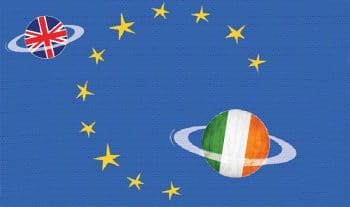
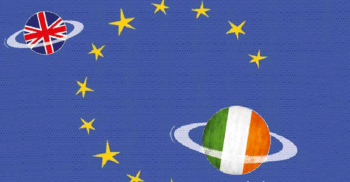
    If Britain leaves the EU single market and customs union while the Republic stays in the EU, the North-South border within Ireland will become an EU land frontier, with customs controls inevitable and possibly passport controls. EU-based laws and standards, for example in relation to crime and justice, would prevail in the South and British-based ones in the North. Logically therefore the only way to avoid adding new dimensions to the North-South border post-Brexit is for Brexit to be accompanied by Irexit. This thought may be so novel it will shock many. EU membership has brought Ireland good things. Most Irish people have positive attitudes towards it. But if the North is leaving the EU along with Britain we should be able to consider dispassionately the advantages of leaving too – and the drawbacks of remaining in it without the UK as a fellow member. Irexit clearly has some benefits. It would save us money for one thing. Since 2014 the Republic has become a net contributor to the EU Budget: for the previous forty years we were major net recipients of EU cash, mainly through the EU’s Common Agricultural Policy. From now on money from Brussels will be Irish taxpayers’ money recycled, as is already the case with the UK. This removes what hitherto has been the principal basis of Irish europhilia, official and unofficial – namely cash. That has always been more important here than ideological enthusiasm for Eurofederalism or ‘the EU project’. If the Republic remains in the EU post-Brexit it will have to pay more to the EU Budget as its proportionate contribution to help compensate for the loss of the UK’s annual net payment. On the other hand a bonus of leaving is that we would get our sea fisheries back. The value of annual fish-catches by foreign boats in Irish waters is a several-times multiple of whatever money we have got from the EU. As regards trade and investment, the Republic sends 61% by value of its goods exports and 66% of its services exports to countries that are outside the continental EU26, mostly English-speaking. It gets two-thirds of its imports from outside the EU26. The USA is the most important single-country market for the Republic’s foreign-owned firms and the UK for its Irish-owned ones – the latter being especially important for employment. The UK and US markets together are comparable in importance to that of the EU26 post-Brexit. Taking other English-speaking markets into account makes trade with the English-speaking world much more important for the Republic than the EU26, with Britain gone. This is a consideration also for foreign investors coming to Ireland. Economically and psychologically, Ireland is closer to Boston than Berlin, and to the UK than Germany. This puts exaggerated talk of the EU’s ‘giant market of 500 million’ in perspective. That shrinks anyway to 435 million with the UK gone. Some 7 billion people live outside the EU. It is not of course a question of the Republic having to choose between one export market and another if it should decide to leave the EU along with the UK. If common sense prevails in the negotiations, there should be continuing free trade between the Republic, the EU and the UK in the context of any Brexit or Irexit. Without Britain beside her in the EU Council of Ministers the Republic would be in a weaker position to defend its low rate of company profits tax, important for attracting foreign investment, for which Germany and the Brussels Commission are now gunning. It would be less well able to defend its fishery interests, its trade interests, its distinctive Anglo-Saxon-based traditions in the area of law and justice, which the EU aims to harmonise, and its military neutrality. The main argument for staying in the EU when the UK leaves is the negative one that we are members of the Eurozone while the UK is not. When the euro was established in 1999 our politicians decided to adopt the currency of an area with which we do just one third of our trade. They thought at the time that Britain would be bound to adopt the euro-currency too and that by going first they would show how “communautaire” they were. The Republic now desperately needs to get its own currency back so that it can devalue it along with sterling and the dollar, and not be stuck with an implicitly overvalued euro that is hitting its exports and encouraging competing imports. Failing that the North-bound shopping queues will grow. This is why Dublin should aim to leave the Eurozone and re-establish an Irish currency in a planned concerted manner, negotiating its departure with Germany, the UK and the ECB in private behind the scenes as part of its move to leave the EU along with the UK, rather than be forced to abandon the euro anyhow in some future Eurozone financial crisis. The UK will presumably revert to its traditional cheap food policy when it leaves the EU. Contrary to some Irish commentary, there is nothing immoral in a country importing its food from wherever in the world it can buy good quality products cheaply. At the same time the British Government will want to support UK farmers for political reasons, presumably by means of direct farm subsidies to replace the price supports they now get from the EU’s CAP. Nearly half the Republic’s agricultural output goes to the UK market at present, so such a development will have major implications for us. Will Irish farm producers be displaced in the UK market post-Brexit by New Zealand lamb, Brazilian beef, American chicken etc? These are the main reasons why the focus of intelligent Irish policy should now be on negotiating a comprehensive deal with London for this State to leave the EU along with the UK, while maintaining maximum free trade with both EU and UK post-Brexit. Such a deal should guarantee continued free access for Irish food exports to the UK

    Loading

    Read more

  • Posted in:

    Brushstrokes of a war criminal

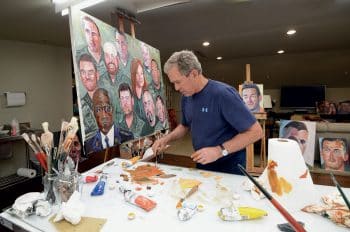
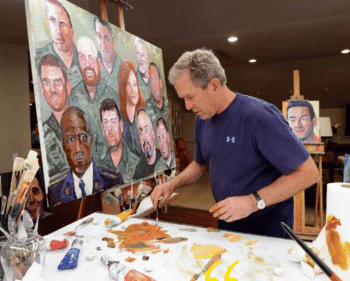
    Donald Trump conjures such intense images that it is difficult to frame recollections of a man who made him possible. What memories flood back in your mind’s eye when you think of his Republican predecessor? Weapons of Mass Destruction? That awful expression, like a ghost stirring at the back of your mind? Perhaps you smile? Cringe? Do you imagine him as the strong president standing amid the rubble of the World Trade Center, bullhorn in hand, shouting that “the people who knocked these buildings down will hear all of us soon”? Perhaps as the struggling guy-next-door mispronouncing words like ‘nuclear’? Or perhaps as the most powerful man in the world giving a press conference in Baghdad in the waning hours of his presidency, ducking at the last minute while a shoe, thrown by an Iraqi journalist, sails past his head? The man who smashed international law and the Constitution of the United States has recently been feted by even ‘liberal’ television talk-show hosts like Jimmy Kimmel and Ellen De Generes. It doesn’t matter; it’s all in the past. Shush! Marvel at his nice paintings, almost professional! Bush’s book of his paintings of servicemen, ‘Portraits of Courage’ currently sits atop the New York Times bestsellers list. Was there never a moment, in the words of Gore Vidal, when television’s cold, distorting eye was not relentlessly projecting a funhouse view of the world? “Pleikus” declared McGeorge Bundy, Lyndon Johnson’s National Security Advisor, “are like streetcars. Wait long enough and one will come sooner or later”. Bundy was referring to an incident during the Vietnam War when enemy soldiers attacked a poorly defended US military base in Pleiku, Central Vietnam. It was the pretext for President Johnson escalating the war in Vietnam, with disastrous results. Bush’s ‘Pleiku Incident’ was without doubt 9/11. In the 18 months after this attack, Bush set the US down a long road of unilateralism and ambivalence to international law and treaties. His administration declared the doctrine of “preventive war” and designated suspects captured in the War on Terror as “enemy combatants” – concepts unknown under international law. At the time of its establishment in January 2002, Secretary of Defense Donald Rumsfeld said Guantanamo was established to detain extraordinarily dangerous people, to interrogate detainees in an optimal setting, and to prosecute detainees for war crimes. In reality, the site has long been used for indefinite detention without trial. The first international treaty to sense the acrid cigar-breath was the Anti-Ballistic Missile Treaty. Signed with the Soviet Union in 1972 to ease Cold War tensions, Bush signalled his unilateral – in other words unlawful – intent to withdraw from it in December, 2001. Worse was to follow. Adrift now, Bush then declared in May, 2002 that the US was no longer bound by the 1969 Vienna Convention on the Law of Treaties which governs treaties between states. The International Criminal Court (ICC) is a permanent court, founded in 2002 by the Rome Statute to “bring to justice the perpetrators of the worst crimes known to humankind – war crimes, crimes against humanity, and genocide”, especially when national courts are unable or unwilling to do so, was next on the chopping board. Signed by President Clinton in December, 2000, Bush then took the astonishing step of retroactively un-signing it in May, 2002. The institution clearly panicked Bush, especially given what direction he knew US foreign policy would shortly take him and his buddies. Petrified of inadvertently doing something which might be construed as US acknowledgement of the ICC, Bush even barred US diplomat Richard Holbrooke from attending the court to give expert evidence in the trial of Serbian warlord, Slobodan Milosevic. This act alone ought to have warned everyone that even then Bush was dreaming of war and was taking steps to ensure that neither he nor any of his cronies could ever be hauled under the court’s scrupulous gaze. To make doubly sure, in August, 2002 Bush signed the American Services Members Protection Act which authorised the US to use force to free any member of its armed services arrested and detained at The Hague for war crimes. The Dutch government dubbed this the Netherlands Invasion Act. The bellicosity only increased. In November, 2002, furious that the international community would not support his Iraq war Bush issued an ultimatum: if the UN wouldn’t take action against Iraq, the US would, thus shredding international law which since 1946 had required that the UN Security Council issue a Resolution in favour of war before it could be initiated. Enemies now seemed to be everywhere, chief among them North Korea. The combined delicate efforts of both South Korea and Bill Clinton during the 1990s to bring North Korea in from the cold were blithely jettisoned as soon as Bush took office. Bush publicly declared that he “loathed Kim Jong Il” and that North Korea was now part of the ‘Axis of Evil’, alongside Iraq and Iran. Predictably alarmed, North Korea then withdrew from Nuclear Non-Proliferation talks and ejected weapons inspectors in January, 2003. When war came to Saddam in March, the North drew the obvious conclusion: the only way to deter the Americans was to acquire nuclear weapons. The catastrophic ‘Shock and Awe’ invasion of Iraq premised on the lie that Iraq possessed weapons of mass destruction generated the human horror of up to a million civilian deaths. When Iraqis rebelled against the invasion the US reacted with torture as in Abu Ghra’ib and massive violence in, for example, Fallujah and exploited sectarian divisions to maintain its fading power. The United Nations Special Rapporteur on torture, Professor Manfred Nowak, remarked on German television in January 2009 that Bush had lost his head of state immunity and under international law and that the US could start criminal proceedings against all those involved in these violations of the UN Convention Against Torture. It was a minority view, or at least a view that was in the minority amonth those in a position to do

    Loading

    Read more

  • Posted in:

    Theory of water services

    Even with the likelihood of charges for wasteful use of water, as recommended by the Report on the Funding of Domestic Public, the State will remain much more central to water provision than under erring market environmentalist models.

    Loading

    Read more

  • Posted in:

    Facebook owns you

    Around 25% of the population of the earth use Facebook. Its latest accounts, presenting figures up to December 31st 2016, reveal that, at peak, there were 1.83 billion active users, 1.74 billion of those connecting from a mobile device. Figures for Ireland are less clear-cut, but 65% to 78% of the adult population is estimated to be using the service. Stand on the main street of any town in Ireland. If you’re not on Facebook the likelihood is that the person next to you is. The latest figures for 2016 show revenues hitting $27.7bn. A little bit of maths, taking into account regular active users at approximately 75%, reveals that Facebook makes between $18 and $20 per active user every year. That’s pretty impressive for a company that offers a free service. Conventional wisdom suggests that a company can only be making money by selling something; so what exactly is Facebook selling?   Facebook’s real product Facebook is selling you. Not the real you, but the virtual you that lives and works online. Facebook, among others, has turned you into a product, and it sells the ability not just to reach you, but to very specifically target you based on a surprisingly intimate knowledge of what would make you a potential customer. Facebook has become so good at selling you, over and over again, that 84% of its revenue comes from advertising. You have been analysed, categorised, matched and packaged into a commodity that advertisers can turn their sights on using the tools that Facebook provides. You can be found based on your gender, age and ethnicity; your relationship and employment status; your education level and any interesting life events, such as birthdays, anniversaries, whether you’re newly engaged or recently married. Of course, for the 1.74 billion mobile users you can also be found based on where you are, where you were recently or on whether you are visiting a location or are at home. This is before it even gets started on your interests, your work, and your entertainment and social preferences. From food to hobbies to political affiliations a cursory examination of the various ways you can be targeted reveals no less than 250 criteria that can be selected. All for the sole purpose of grouping you into consumer groups with the intention of presenting advertising so specifically tailored to you that the likelihood of a sale increases. How much does that likelihood increase when you’re so targeted? 200%-300% is the conservative estimate.   How do you become a product? If you are only realising now that you have been ‘productised’ I wouldn’t be overly shocked as most of Facebook’s users are largely oblivious to what’s happened. In Facebook’s defence though, they are quite explicit in their terms and conditions: “For content that is covered by intellectual property rights, like photos and videos (IP content), you specifically give us the following permission, subject to your privacy and application settings: you grant us a non-exclusive, transferable, sub-licensable, royalty-free, worldwide license to use any IP content that you post on or in connection with Facebook (IP License). This IP License ends when you delete your IP content or your account unless your content has been shared with others, and they have not deleted it”. That’s right, worldwide and royalty free; you gave over the information and agreed to let Facebook use it for free. Moreover, scrutinising the various sub-areas of the terms and conditions, specifically the data policy, we find: “When we have location information, we use it to tailor our Services for you and others, like helping you to check-in and find local events or offers in your area or tell your friends that you are nearby. We conduct surveys and research, test features in development, and analyse the information we have to evaluate and improve products and services, develop new products or features, and conduct audits and troubleshooting activities”. Not only did you give it to them, you agreed to let them use it almost without restriction: your profile information; your messages; your likes and, though not often considered, your photographs. Facebook estimates that it receives 134,000 new photographs along with nearly 300,000 status updates every minute of every day. Facebook users are literally keeping the company informed of their every move. For Facebook, the challenge is simply to gather up as much information as it can about you as quickly and as easily as possible.   How to get people to monitor themselves Facebook has to convince you that you want to give it the information. It can’t directly ask you for it, you need to volunteer it. The process starts the moment you create an account, give over your name, age and gender. So far so good. Next, for the purposes of making it convenient to connect with your friends, you’re afforded the opportunity to import your contacts from your phone or your email system or from other networks such as LinkedIn. Excellent, now Facebook knows not only about you, but also all of your contacts including, maybe, some it didn’t know about before. Did you remember to remove phone numbers from your contact list before uploading it to Facebook? Of course you didn’t. Facebook now has an additional piece of information that can uniquely identify a person. Imagine if your friend explicitly didn’t add their phone number, or their address, not to worry: you just fixed that outstanding issue. For Facebook. Congratulations! You are now a data source and of course an early stage product. You could be a better product if you could be convinced to offer up more information about yourself. Your friends like this music and these movies, but how about you? Any other music or movies you like? Where did you go to school? How about university? Look: here’s a group of people who went there also. When did you say you attended? The greatest trick Facebook has managed to pull off is the omnipresent ‘Like’ button. Read an article;

    Loading

    Read more

  • Posted in:

    Nailing Harry Breen

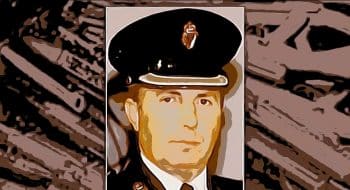
    RUC Chief Superintendent whose death was the Smithwick Tribunal’s focus, was not as innocent as the tribunal extraordinarily contrived to believe. Smithwick failed to ascertain how and why he was murdered and credible sources are now telling Village why Harry Breen may have been of particular interest to the IRA.

    Loading

    Read more

  • Posted in:

    Ancient myths for today’s dreams

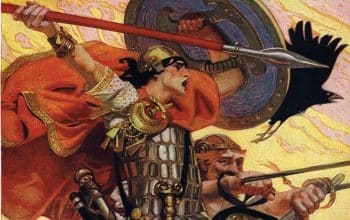
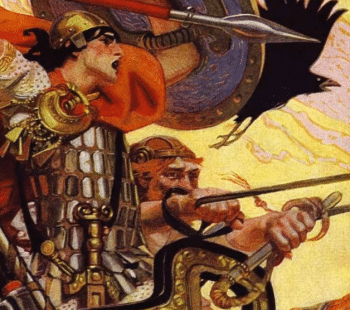
    The highest compliment I can pay Mark Williams is that after reading his ‘Ireland’s Immortals: A History of the Gods of Irish Myth’, I have an appetite to learn the Irish language. He exposes to the light a literary inheritance that has barely flickered in the Irish national consciousness since independence in 1922. It allows this nation to consider its origins, and observe how mythology involves a dynamic process of re-imagining, inclusive to all traditions. Williams lays down a storehouse of inspirational sagas including the Rabelaisian intrigue of ‘The Second Battle of Moytura’ and ‘The Tragic Deaths of the Children of Lir’, interpreted as a Christian parable. These and other subtle tales are a corrective to the fatalistic machismo of the character of Cú Chulainn from the Irish epic ‘Táin Bó Cualígne’, that has tended to incarnate the nationalist self-image. Scholars have found it difficult to define the nature of the Celtic immortals, or gods. J. R. R. Tolkien complained that “there is bright colour but no sense”, though the elves of his ‘Lord of the Rings’ were influenced by ‘Celtic’ mythology. The accuracy of the term ‘Celtic’ is itself doubtful when we consider the word’s Greek origin as ‘barbarian’, and the fragility of evidence derived from excavations at La Téne in Switzerland of the evidence of homogeneity of a contiguous continental ‘Celtic’ culture. Undeterred, modern ‘Celticism’ (a hybrid of ‘Celtic’ folklore and mysticism) incubated fuzzy ideas such as these expressed by the early twentieth-century theosophist Walter Evans-Wentz: “Of all European lands I venture to say that Ireland is the most mystical and, in the eyes of true Irishmen, as much the Magic Isle of Gods and Initiates now as it was when the Sacred Fires flashed from its purple, heather-covered mountain-tops and mysterious round towers, and the Great Mysteries drew to its hallowed shrines neophytes from the West as from the East, from India and Egypt as well as from Atlantis; and Erin’s mystic seeking sons will watch and wait for the relighting of the Fires and the restoration of the Old Druidic Mysteries”. Efforts to taxonomise the various myths and develop rituals of worship foundered, at times comically, but the ethereal motifs were a wellspring of inspiration during the fin de siècle Irish Revival. This engendered possibly the finest movement in English-language literature of the twentieth century: the early WB Yeats and late James Joyce drew on imagery from these tales. The corpus remains a powerful creative source, connecting us with enduring symbols that portray Carl Jung’s idea of a collective unconscious. Unfortunately today in Ireland, as elsewhere, the unconscious mind is rarely nurtured, and the Irish immortals hardly figure in ‘serious’ contemporary literature. Another revival may be brewing, however, associated with John Moriarty’s ‘philo-mythical approach’. Williams speculates that Irish worship of gods before the arrival of Christianity may have been in considerable flux due to late Iron Age agricultural decline. The evidence for Gaelic paganism is fragmented and mediated for us by a Christianity that brought literacy: the indigenous culture had not advanced beyond Ogham script. We have no evidence for how pagan deities were worshipped, and they tend to appear as numinous presences “immanent in the landscape”. Williams speculates that a taboo may have operated against poetic description of pagan worship. Nor do we encounter a central Mount Olympus or Asgard for their deities. Tara was the seat of the high kings, not of the Irish immortals. Their fragmented residences in síd mounds, haunting the countryside, reflect their banishment into the subterranean unconscious after the arrival of Christianity. As a reflection, or shadow, of a politically fragmented human society, their supposed location is unsurprising. It is important to emphasise that throughout the period the Bible remained the foundation of learning, and few other books were available. Thus we find Ba’al, a biblical Canaanite god, being associated with the feast of Bealtaine at the start of May in ‘Cormac’s Glossary’ (Sanas Cormac) c.900, rather than the native ‘Bel’. Moreover, access to the writings of Isidore of Seville (d.636) brought poets into contact with the myths of Classical Rome and Greece which influenced the ceaseless recasting of indigenous tropes. It might be assumed that the early Church brought a doctrinaire and prescriptive faith, but early medieval scholarship is infused with the language of paradox. Scholars were also acquainted with a Neoplatonism which posited a universal harmony attractive to poets. As when two ocean plates collide to produce an extirpation of life, the encounter between a relatively insulated native civilisation and wider European currents stoked great cultural ferment. From the eighth to the eleventh century a formidable vernacular Irish literature arose, although most of the poets are unknown. Williams says this must count as “an outstanding contribution to the literary inheritance of humanity”. It is also striking that many of the great works emerged at a point when the nation was suffering grievously under Viking attacks. This must have prompted deep questioning of God’s will, and the validity of their social institutions. The pre-existing deities offered imaginative tools with which to criticise society when overt attack was dangerous, and artistically limiting. Irish filid (poets) were experts in memorialisation of tradition, genealogies and vernacular composition, and were an exalted cast among the áes dána (skilled people). They were not clerics although, some of their education overlapped with priests’. In a highly stratified society they painted themselves as equal to kings. They were also legal authorities in a society spared full-time lawyers. As masters of language – and performance perhaps – they shaped the outlook of their audiences; They were more or less Percy Shelley’s “unacknowledged legislators”. These Irish poets learnt their trade, often operating under exacting metrical demands. According to Williams: “They were expert in grammatical analysis … in the highly formalised rules of poetic composition, and in training the memory to encompass the vast body of historical and legendary story, precedent, and genealogy which it was their business to know”. Pagan gods and lore were their discreet preserve,

    Loading

    Read more

  • Posted in:

    Saving the Cat

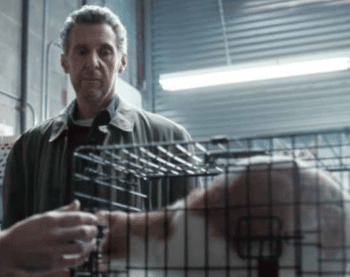
    ‘The Night Of’ complicates conventional scriptwriting formulas. The lawyer saves the cat, but the cat saves him. When Naz gets his saviour back all characters are freed to empathise, and survive.

    Loading

    Read more