Deirdre Mulrooney

  • Posted in:

    Their daughters’ fathers

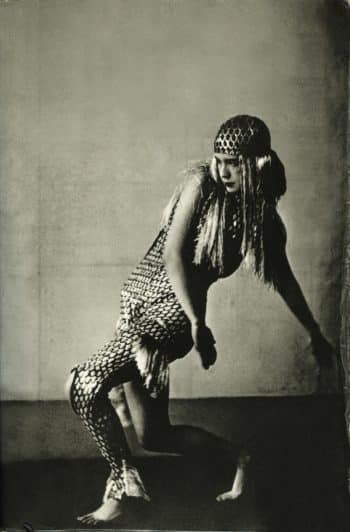
    Way back in 2004, I wrote an article for The Sunday Business Post, entitled ‘Play Boys, but few Play Women’ highlighting chronic gender imbalance in Irish Theatre, on the occasion of ‘Abbey One Hundred’, a virtually all-male programme celebrating the centenary the Abbey Theatre, (apart from one children’s play by Paula Meehan, and a shared run for Marina Carr’s ‘Portia Coughlan’ at the Peacock Theatre). That was before the dawn of social media, and my article, a lone voice in a sea of unquestioned misogyny, was received with resounding silence. Unfortunately, ‘his’ story has a habit of repeating itself, and more than a decade later, on October 28th, 2015 the Abbey Theatre proudly announced ‘Waking the Nation’, its – surprise, surprise – virtually all-male 1916 commemoration programme (apart from a lone monologue by Ali White entitled “Me, Mollser”, jutting out of the programme like Elizabeth O’Farrell’s incongruous little feet behind Patrick Pearse’s iconic 1916 surrender photograph). Nearly as bad was the playing of O’Farrell in both Jordan’s ‘Michael Collins’ and the recent ‘Rebellion’ series on RTE by men. This time, however, Twitter and Facebook ignited with rage at the outrageous gender imbalance, bringing an exciting counter-movement into being, with its own hashtag #WakingtheFeminists, abbreviated, wonderfully, to #WTF. Wasting no time on this occasion, Mná na hEireann, had a “storming of the Bastille” moment at the Abbey Theatre on November 12th, 2015, when over 30 female theatre professionals took to our national theatre’s stage, and the 450-seater auditorium over-owed with women demanding an end to this unacceptable gender imbalance, for ever. A contrite Fiach Mac Conaghail, director of the Abbey Theatre, sat in the auditorium and listened. After each of the 30+ women on stage had had their say, he stood up, looked up, and admitted: “I wasn’t thinking about gender balance. I did not look up. I failed to check my privilege. And I regret that”. If theatre holds up a mirror to society, this recurring gender imbalance at the Abbey Theatre is indeed a perfect reflection of Irish society, and the nature of Irish cultural ‘His’story – so far. We need look no further than to the iconic 1916 surrender photograph of Patrick Pearse for confirmation of this, with its dodgy silhouette of self-effacing inner city nurse Elizabeth O’Farrell who braved snipers to deliver the surrender order throughout Dublin’s rebel garrisons, only to be airbrushed out of the official surrender picture as published by The Daily Sketch. I was delighted to hear artist Jaki Irvine speak of Elizabeth O’Farrell and her 2013 book about the fearless nurse, ‘Days of Surrender’ (as yet unreviewed in Ireland), from the Abbey stage in its Theatre of Change symposium in January. Irvine is going on to set Elizabeth O’Farrell to music, along with her other female 1916 colleagues in her installation “If the Ground Should Open”, at the Irish Museum of Modern Art in September. Like Elizabeth O’Farrell who may indeed, as some claim, have deliberately taken a self-effacing step back when that 1916 Patrick Pearse surrender photograph was taken, making it easy for her little feet and large coat skirts to be airbrushed out of our Cúchulain- style national mythology, Lady Gregory (co-founder of the Abbey Theatre) did not actively seek recognition for co-authoring her iconic 1902 play ‘Cathleen Ni Houlihan’ with WB Yeats either. Similarly, a few decades later the self-effacing but fascinating George Yeats chan-nelled a myriad of voices to – yes – CO-AUTHOR ‘A Vision’ (1937), with her husband WB Yeats, but is rarely acknowledged as having done so. Like Elizabeth O’Farrell, the formidable George Yeats (about whom I am making the rst ever radio documentary, entitled ‘Georgie’s Vision’, funded by BAI Sound and Vision, for broadcast on RTE Lyric FM in Autumn 2016), took a step back, and went so far as to say “thank-you for leaving me out”. But – #WTF – is this shyness reason enough for the rest of us to facilitate, and hence perpetuate, the inaccurate masculinisation of, and erasure of women from Irish cultural history? Another important figure eclipsed by men is Lucia Joyce who could be Ireland’s answer to Camille Claudel, the well-regarded French sculptor who spent 30 years in an asylum (also Rodin’s lover and elder sister to poet, Claude Caudel). Lucia could not have been more different from her mother, Nora, whose entire raison d’être was her man, James Joyce. As well as his lover, cook, maid, and mother to his children, Nora was also James Joyce’s muse, most obviously inspiring Molly Bloom. Even in the Joyces’ modernist milieu, it was alright for a woman to be a muse, but not an artist herself, and certainly not an artist of the body (though in his masterpiece, ‘Ulysses’, James Joyce wrote the epic of the body). A modern young woman in 1920s Paris, Lucia expected her own career and identity, though she had grown up in weirdly close quarters with her unconventional family, and very much in the shadow of her father. When she protested “c’est moi qui est l’artiste”, alas, nobody listened to her. Tragically, Lucia Joyce (1907 – 1982), was never allowed to ful l her dream of being a professional modern dancer, despite her training with greats Emile Jacques-Dalcroze (founder of Eurhythmics); Raymond Duncan (brother of Isadora, who himself lived like a modern-day Ulysses in his Paris commune “Akademia Raymond Duncan”); Margaret Morris (grand-daughter of William Morris and founder of www.margaretmorrismovement.com); despite her seasons dancing with “Les Six de Rythme et Couleur”, and despite reviews like this one in the Paris Times: “Lucia Joyce is her father’s daughter. She has James Joyce’s enthusiasm, energy, and a not-yet-determined amount of his genius… When she reaches her full capacity for rhythmic dancing, James Joyce may yet be known as his daughter’s father”. Instead of being given the space to realise her ‘full capacity’, Lucia, who grew up immersed in iconoclastic counter culture and the avant-garde, found herself consigned to mental institutions – for life. Interestingly, after her father’s death in

    Loading

    Read more

  • Posted in:

    History is not Herstory

    Less than 30% of the writers in Village are women. And only 30% of the articles submitted for publication come from women. What’s going on? Village is politically correct and right-on. Uniquely it never, to take an example, markets magazines by putting attractive women on the cover. Village takes progressive social theory seriously. It consistently takes the most ‘liberal’ stance on abortion and reproductive rights. Most of all, and this is what determines so much of its stance, Village believes in inconvenient and prickly equality of outcome, not shiny and friendly equality of opportunity. In other words not just opening up for all, but giving the worse-off an actual leg up or a quota to compensate for the iniquities of history. This applies to women as much to any group. The new Dáil will have only 35 women out of 158. This is a more-than-50% improvement since 2011 and the number of female candidates was up to 163 from 86 in 2011 when it yielded 22 women out of 166 (up from 3 in 1973 and 22 in 2002 and 2007). Nationally, the average number of first-preference votes per man was 4,205. For women, it was 3,260. Village has given a good bit of of space to women who want to change this, to move towards fty percent female representation in parliament. The Electoral Act 2012, amusingly promoted by Phil Hogan and opposed by Fianna Fáil, applied a gender-quota rule that parties had to have at least 30% candidates of each sex or they lose half of their state funding. All parties except Direct Democracy Ireland applied their quota. Village supports this. I support this. That’s politics. We should push for immediate progress, everywhere. History and culture are different. The Abbey Theatre got into trouble recently because only one of the ten authors chosen for its 1916 commemorative programme, Waking the Nation, was a women. Other theatres and film bodies have taken similar flak. A recent rather unconvincing evocation of the Rising, Rebellion, made efforts to portray the events of that era with women to the fore. I disagree with these approaches. As to the Abbey’s Programme, what if the women took bog-standard anti-feminist positions, would they still merit advancement in the programme? Is it that a third of the writers should usually write pro-feminist pieces or is it that the third should have written pro-feminist pieces in this instance? Should there also be a certain number of works produced that have been written authors from racial minorities, from the young and the old, from LGBT and straight? Should it be the same with the actors? What about the audience? The answer to much of this is No. And as regards history, you’re trying to record the way things were: history. You shouldn’t, and you don’t need for any political reason to, distort it. All you can do with history is acknowledge and let it inform, though never determine, your politics. For the same reason that you don’t make the ruling classes working classes or younger than they were in the interests of some perceived correctness, you don’t pretend that women were the protagonists in the Rising. Unfortunately they were not. I also disagree more generally with distorting the facts to suit the ideology. The idea underpinning politics is to resolve the facts objectively and then apply the ideology. Not the other way around unless you thing your ideology is so weak that it won’t fit certain facts. In which case change your ideology, it was wrong. When the facts don‘t suit your ideology it is time to find a new ideology, or stay quiet; and more precisely to realise you should have had a better ideology in the first place The debate on women’s rights has become unintellectualised, entrenched and sometimes underinformed. For example a recent only partly-corrected Una Mullally article in the Irish Times misreported that Fianna Fáil’s policy was to have “up to a third of its candidates women”. She ridiculed the policy even though the policy did not, and legally and logically could not have, said this. It would certainly have been nice for those of us who believe that the point of that party is only ever to adopt progressive agendas, at the very last minute, if Fianna Fáil had got it so skewed, but they had not. Between Una Mullally and her employer they could not bring themselves to correct the article properly. The reason for the politics of women’s equality is that it has been an unequal world. It was an unequal world when they (men) made God a Man, it was unequal in 1916 and it’s still unequal because women earn less, are politically less powerful and have less autonomy than men. Only a fool would deny it. Because of the legacy of thousands of years of suppression women have not written as good, or indeed nearly as many, plays as men. Women also write differently from men, largely for socio-cultural reasons but also sometimes for reasons based in their physiological natures. The point is to change that by counterbalancing. Women of today who want it and show talent should get more training in playwrighting paid for by the state and its institutions, than that available to similar men, particularly training that helps them break down prejudices and that facilitates overcoming sexist obstacles to success. An admirable recently announced initiative from the Irish Film Board is doing roughly this. Such initiatives tend to generate equality of outcome. Regrettably in the arts it will be some generations before the volume of brilliant works by women rivals the volume of brilliant works by men, created over the aeons, even controlling for the heightened relevance of contemporariness. It is different with politics which, unlike history, does not or should not, trade in the past. It is possible, indeed imperative, to push for progressive change. It is, because of the nature of the discipline, and the period in which it trades – the past, not possible to push for change of

    Loading

    Read more

  • Posted in:

    Mojocon no Mojo con

    MoJoCon – the Mobile Journalism Conference which debuted in Dublin last year – has its roots almost a decade ago, when Glen Mulcahy, then working with RTE Nuacht, began experimenting with the camera on his Nokia N93 smartphone. “Video quality was atrociously bad, photographs were tiny, 1Mb was seen as huge, it was very much in its infancy”, recalls Mulcahy, now RTE’s head of innovation. “We were experimenting with that around the time Reuters had deployed the same tools to their journalists in the UK to create content for websites”. A handful of stories was produced to an acceptable broadcast quality using the mobile devices, and Mulcahy started keeping track of other broadcasters who were doing the same.“I thought, we need to bring everyone together, talk about what we’re doing, and that was the birth of MoJoCon”. From those beginnings, and networks built up through Circom, the European Association of Regional Broadcasters, MoJoCon has evolved into a “leading international media conference focusing on mobile journalism, mobile content creation, mobile photography and new technology all in one event”. Mulcahy may be an advocate for new technology, but he doesn’t expect RTÉ reporters will be carrying smartphones and selfie sticks by the end of the decade. “People still expect a particular kind of look when they turn on the television. You can’t do sports coverage on mobile, for example – you need those broadcast cameras, powerful zoom, all those expensive things. That said, there is very interesting case study, a station in Luxembourg, Léman Bleu, uses mobile to create content for their TV news. I think they are very brave to go this early”. “You will still see cameramen, you will still see satellite trucks in five years time, not journalists with selfie sticks. There are times when mobile works, but mobile is not mature enough yet to do 100% of the work”. Where he does see openings for new technology to expand are in non— broadcast media outlets, from newspapers to independent pod-and video-casts. “There are a few case studies in the Irish Times where I was absolutely blown away by some of the stuff they were able to do. They also very cleverly decided to upskill all their press photographers who were interested in doing it into shooting video with their DSLR cameras. So you have a new aesthetic. You definitely have better, although not necessarily radically more expensive, cameras and you also have some of the journalists who responded and went out shooting stuff with their phones”. “You don’t need a broadcast-quality camera to produce content that going to be delivered (back) onto mobile phones. I’m more and more coming to the opinion that there is a mobile ecosystem where we create on the mobile phone, edit on mobile phone, and deliver to mobile phones”. New technologies, and the ability to produce programming and news quickly and cheaply, also have implications for how RTÉ covers different communities, Mulcahy believes. “In the UK, there’s been a concerted effort by the BBC over the last 12 to 18 months to try and encourage hyperlocal sites. There is a UK government initiative where you can get a modest fund to basically try and get it off the ground. So there’s more that the government here could do to encourage that level of local community content”. “This is a device that most people have in their pocket. Maybe not everyone has a top-of- the-line Android or whatever, but lots of people have smartphones that can do pretty decent video, reasonably decent video”. “There is potential to give community-group newsletters, the ones that get stuffed on A4 sheets through letterboxes, a mobile angle. We could really energise community activism at grass roots level by showing them what you can do with video on mobile”. Looking to the future, as technologies (and screens) merge, Mulcahy can see a point where RTÉ produces video and audio not just for broadcast, but for the web, and for web first. As technologies mature, there is no strict reason why, for example, a new report compiled during the mid-afternoon should have to wait until the Nine news to be seen, when it can be immediately streamed to desktop computers or phones. Gerard Cunningham

    Loading

    Read more

  • Posted in:

    Less, but still, relevant

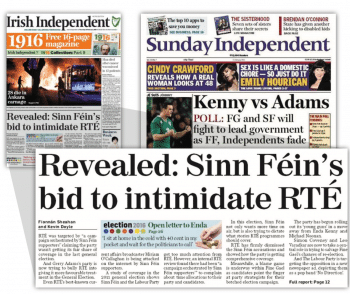
    From the point of view of the media, one of February’s biggest stories almost got lost in the election chaos. On Friday, February 19th, one week before polling day, the newspaper circulation figures for the second half of last year were published. In one sense, the story was a bit of a non-story: newspapers continue to sell fewer and fewer copies – the roughly 40 per cent collapse of sales that we’ve seen over the last decade or so was certainly accelerated by Ireland’s economic implosion; but whatever recovery somebody out there is enjoying, it’s not bringing newspapers back into our lives – they were down a few more per cent. That should be the starting point of any discussion about how newspapers covered the general election. This may indeed have been, as several commentators such as Oliver Callan have suggested, the most sensationalist, the most biased, the most trivial newspaper coverage of an election in the history of the State. Maybe. Whatever. There can be little doubt, though, that it was the most irrelevant. You can shout all you like about how much the journalism of the Irish daily press gets read online. “We’ve got more readers than ever (now if we could only get them to pay)” is a common refrain in the shrunken corridors of the press. The fact is that most of those readers are no longer committed to getting their news and views from any given paper, but rather they dip in and out, often critically. I suspect that on the day those circulation figures were published, more people saw a social-media post full of mockery, outrage or bemusement at the Irish Independent’s latest front-page denunciation of Sinn Féin than actually paid for a physical copy of that page. Since I merely saw an image on my phone, I still have no idea what Gerry Adams was planning to do with my pension. Is there a connection between the press’s hysteria this time around and the steady withering away of its relevance? I suspect as much. Like troubled children, the less attention we pay them, the louder they scream. Election seasons have always seen journalists at their most pompous and self-important: in the better class of newspaper the consequence is an obsessive-compulsive commitment to ‘fairness’. I can remember, back in the 1990s, a team in the Irish Times newsroom dedicated to measuring (literally, like with rulers) the coverage given to each party in a general election, with various formulae to adjust for the unfortunate fact that all column inches are not created equal. Other papers, of course, take a different approach. If there’s one thing we can say for certain about, say, the Indo’s notorious treatment of this election, it’s that they got us to notice how important they are. Once you understand the desperation of the press’s attention-seeking in its much-reduced state of health, it’s easier to understand why, for example, the Regency Hotel shooting managed to displace the election from page-ones for most of a week. If there’s one thing that the press does even more self-importantly than elections, it’s crime. This has little to do with the wonderful, generous resources gifted by Denis O’Brien and Rupert Murdoch to the investigation of wrong-doing and a lot to do with the impotence of convicted criminals to use the defamation laws to protect themselves. (No reputation to protect, no case, scumbag.) The hotel shootings showed definitively that crime journalism in Ireland is RELEVANT – more so even than the gardaí, who were absent while the crime-hacks and -snappers were very much on the scene. And when it came time to segue from “Hey, remember us! We’re newspapers! We cover crime!” to “Hey… elections!”, there was the lovely little link of Sinn Féin’s position on the Special Criminal Court. It seemed remarkably difficult to get anyone to recall a principled, non-Republican reason to oppose no-jury trials. So, even short of a major definitive research project, we can pretty safely say, that compared to times past, (1) newspapers are less relevant and (2) people are more inclined to see through media bias. (Check out Dr Rory Hearne’s research with water protesters to confirm the latter point.) However, this is not the same as saying (1) the media are irrelevant and (2) media bias doesn’t matter. When RTÉ – which unlike newspapers has a statutory obligation to be fair, to which it pays often hilarious lip-service – allowed crime-hack Paul Williams on the Late Late Show to use the issue of the Special Criminal Court to denounce Sinn Féin and its voters, on the very same day that he and we learned of his shrinking circulation relevance, it was not only a disgrace, it was most probably consequential for the election outcome. With the best will in the world – and even a half-decent will is a rarity – Sinn Féin and its voters remain another country for the vast majority of the established professionals in the Irish media. On his last NewsTalk broadcast before the election moratorium, George Hook recalled covering Mary-Lou McDonald on a canvas in Cabra: he scraped the phrase “work-ing-claaaass peeeople” over his tonsils as if he were describing a particularly dangerous safari. When the diverse regional accents of the various returning officers are a source of novelty and excitement on election-count days, you know the media have got a problem of uniformity. John Bowman turned up on RTE radio before the election with what academic Dr Conor McCabe described aptly as “the most Irish middle-class statement ever”. Bowman said: “I caught the election bug back in school when I was on the number 10 bus from Ballsbridge to Belvedere College, and the bus would pass by a sign outside the offices of the Irish Times…”. The problem is not Bowman personally, of course, but the fact that his background remains highly representative of the media. That ignorance partly accounts for the strange yet popular notion that the Labour Party has something to do with

    Loading

    Read more

  • Posted in:

    Election Times

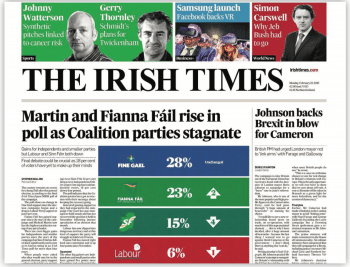
    The story of an election is much more than a few headlines, but the Irish Times front pages mercifully, if languidly, devoid of the kind of blatantly partisan positioning seen elsewhere, provide in hindsight a neat narrative of the campaign, with the slow realisation that Fine Gael was in trouble, the lack of a clear alternative emerging, and of course, “events, dear boy”. While its columnists and editorials may have declaimed preferences in the run-up to the general election, the Irish Times‘ front page generally affected a more neutral stance, certainly by comparison with the anti-Sinn Féin headlines which dominated the Irish Independent and its Sunday sister during the February campaign. The ‘newspaper of reference’ (formerly “of “record”) began the month in ‘phoney war’ mode, leading on Monday 1 February with coalition plans to “target home buyers and parents in poll pledges”. On the Tuesday, with still no election date declared, the story was “Taoiseach prepares Fine Gael ministers for election”. Perhaps ominously, on both days the below- the-fold story concerned the revelations regarding “Grace” a young woman with intellectual disabilities abused while in HSE care in a foster home. The story would feature again several times during the month and, by the end of the campaign, would threaten to inculpate Michael Noonan. Wednesday’s paper finally brought the official election notice, leading with Fine Gael ministers outlining their election promises, but the shine was short lived. Thursday, and the first election poll, brought “disappointing news for Coalition parties”. Much of the remainder of the campaign was spent trying to push back against those low poll numbers, which stubbornly refused to rise. By the first weekend, Fine Gael had announced a “tax U-turn to hit voters earning €100K” (the top 10% of all earners, though Irish Times readers would be better paid than the average). The election narrative was dominated at first by Fine Gael (at least on the front page) but it changed dramatically in the second week. The murderous Regency Hotel rampage called attention to cuts in Garda numbers and resources and Fine Gael, which prides itself as a law and order party, found itself on the back foot. At one point Sinn Féin’s Mary Lou McDonald attacked the government for being soft on crime during an RTÉ radio debate. By the end of the week, the lead story that Garda “may be issued with new weapons” helped to restore marginally Frances Fitzgerald’s battered image, but you know you (we?) are in trouble when Sinn Féin are attacking you from the right on crime. Meanwhile, bubbling below the fold, the news was no better. Lowry, Drumm and Luas strikes festered, and the Times awarded the first TV debate to Micheál Martin. Week Three began with Labour striking out to create a separate identity, promising “an abortion vote in any new deal” – definitely a plus for liberal Irish Times readers. Smaller parties got their first acknowledgement the following day, as the lead reported they did best in the previous night’s debate. For the rest of the week, it was almost as if the Irish Times tired of the “boring” election campaign, with more conventional “newsy” lead stories on an HSE inquiry into baby deaths, welfare benefits for migrants, and Brexit. Week Four began with the writing on the wall, summarised in a single Monday headline “Martin and FF rise in polls as Coalition stagnate”. Tuesday the paper reported Kenny and Martin had “equal backing in race for Taoiseach”, and the final TV debate failed to resolve anything for this hard-to-please newspaper as “leaders fail to land killer punch”, before Kenny’s “last-ditch call for vote in favour of stability.” Below the fold on the same day, the first mention of Sinn Féin in a front-page headline volunteered no favours: “Canvasser for Adams owns hay shed where ‘Slab’ Murphy cash was found”. ‘Slab’ was also the subject of one of the few passionate editorial columns (now perhaps self-deprecatingly titled “the Irish Times view”). Others quite reasonably despaired of the “short election, short of vision”. But while front pages covered national trends, debates and polls, and columnists inside the paper from Una Mullally (who, surprisingly for someone with a political agenda, gave up interest) to Breda O’Brien (vote for people of conscience, if you know what I mean) via Fintan O’Toole (who in the end detected an unlikely victory for social democracy) and Noel Whelan (who again somehow spotted the Fianna Fáil revolution implausibly early) ventilated partisan viewpoints, perhaps the most concise reportage on what happened on election day was by religious affairs correspondent Patsy McGarry, who on the day of the count reported from the north inner city, less than ten minutes from Tara St in a neighbourhood where few read the Irish Times, and fewer would share its editorial concerns: one, a hooded man, was picking up rubbish and putting it in a black plastic bag.“I didn’t vote. I don’t have a voting card. I was abroad for five years. It’s not important at all”. Gerard Cunningham

    Loading

    Read more

  • Posted in:

    The language of Ballymagash

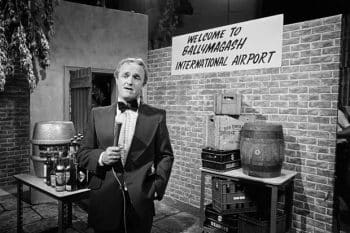
    The Fianna Gael area rep was practisin’ his language, goin’ forward. He was glad you had asked the question but would you please let him finish. He didn’t interrupt you. Can you hear him at the back? He would have no hand, act or part in this coalition. That was a redline issue. Nothing was agreed until everything was agreed. There was not a scintilla of evidence that the scal space was what the other guy said. A lot done, more to be done. Together let’s take the next steps forward and Let’s Keep the Recovery Going. Your hard work is working. Ireland’s working again. Now let’s keep it working. Working for you. Working for him. Working for Work. He was Standing Up for Ireland’s Future and Standing up for working families. An Ireland for all. Building a better future. A future you can believe in. Change you can believe in. Belief you can change in. New sports facilities you can change in. Changing Ireland for a changing Ireland. Not the same old, same old. New roads. No potholes. Bringing no potholes to the hard-working people of this constituency. The way forward. The Straight Road is Shortest, he mused. The long man for the long road. An end to the road to the end, for all. Democracy, republicanism, government a health service for all. Let’s keep the wheels moving: Real Plan Better Future. Making 2016 a year to believe in. Your Future, Our Future. A future for our children. A future for our county. A future you can believe in for your community. Your community, your team, your future. He had a five-point plan, a three-point programme, a contract with the people, he wanted a charter for the people, ordinary people, ordinary working people, ordinary families. A voice for you, a voice for our young people, a voice for older people. A voice that will he heard. A voice that will be heard in Dublin. No way in the wide earthly world. A voice at the table. Rewarding work, real change not spare change. A people’s debate. The people’s party. The people’s person. The republican party. The people’s republican party. An Ireland serving the people. A convention inside a commission inside an inquiry, inside a tribunal. What did he bring to the table: Integrity, Courage, Experience. And a record of delivery. Delivering on local issues with a national impact. His record stands for itself. Vote for experience and common sense. Jobs, Education, Health. People Who Deliver. Delivery you can believe in. Active in the country. Active in the county. Activism you can count on. Difference you can rely on. County country. Core values. Going forwards not backwards. Help him to help you to help ourselves. In these serious times you need a serious candidate. Action speaks louder than words. Keeping it real. Bringing the Motorway to Molahiffe. Bringing the Luas to Listowel. Bringing the DART to Dingle. Vote 1, 2, 3 in order of your preference. Never merge, never go into coalition with Fine Fail. Identical. For (nearly) a hundred years.

    Loading

    Read more

  • Posted in:

    Bouquets to Boulders

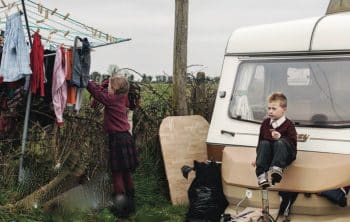
    It is critical that the next Government have a credible and robust National Traveller and Roma Inclusion Strategy. This will depend on political will. The last number of months have been particularly difficult for Travellers and Traveller organisations. In October 2015 we witnessed the horrific deaths of 10 Travellers in a fire at a below-standard halting site in Carrickmines. There was a general outpouring of sympathy for the bereaved Traveller families which seemed to break through the barriers of negative stereotype. Soon, however, we were forced to watch the bouquets turn back into boulders as the local authority failed to implement its plans to accommodate the bereaved families due to objections from local residents. This unleashed shocking levels of anti-Traveller hate speech on the airwaves and on social media. Meanwhile the families were left to live on a car-park while they buried their loved ones. In November 2015 Traveller ethnicity was discussed in Dáil Eireann for the first time. The Government told the Dáil that Traveller ethnicity would be dealt with in their new National Traveller and Roma Inclusion Strategy. But we had to watch the Minister for Equality, who had promised to deliver on this issue, back down. He blamed ‘focus group led’ politics. This disappointment was followed in January this year with the spectacle of riot police evicting Travellers from a Traveller halting site in Dundalk. This was apparently for their own safety. Ministers refused to get involved in local authority operations. The Government was exposed as having no plan for Travellers and Roma. The last Government told the United Nations that poor education outcomes for Traveller children and third-world living conditions for Traveller children would be dealt with in the new National Traveller and Roma Inclusion Strategy. However, It succeeded in putting Traveller issues on hold, just long enough to get to the General Election. The week before the election Travellers and Traveller organisations were involved in a round of consultations with the Department of Justice and Equality on the National Traveller and Roma Inclusion Strategy. It was ironic that outside these consultations, in the real world of General Election campaigning, Traveller issues were barely mentioned. Considerable space in print, on the broadcast media and on Social Media is readily available to decry Travellers and to blame many of the ills of society on them. However, when it comes to political discourse the space available seems to shrink. Travellers and Traveller organisations have been engaging with the State for 30 years now. In this time there have been significant milestones. The 1995-Government-appointed Task Force on Travellers was the first to provide a comprehensive agenda of policy proposals for equality for Travellers based on a recognition of the distinct culture and identity of the Traveller community. The 1998 Employment Equality Act and the 2000 Equal Status Act introduced, for the first time, a system of redress for people experiencing discrimination in employment and in the provision of goods and services, including Travellers. In 2010 the First All-Ireland Traveller Health Study was published which acknowledged the critical role that living conditions play in determining unacceptably-poor Traveller health levels. What we have failed to see in the last 30 years is the implementation of policy in accommodation, health, education and employment. Many of the recommendations of the 1995 Task Force report remain to be implemented. There has been little tangible improvement in the standard of Traveller living conditions. Travellers and Roma represent a small percentage of the total population. It is not beyond our means to ensure equality and human rights for Traveller and Roma. We need leadership that Travellers can believe in. We need Government to commit to implementing a National Traveller and Roma Strategy that: 1. Provides safe, culturally-appropriate accommodation for all Travellers and Roma. 2. Supports positive action to enable labour-market participation and employment for Travellers and Roma. 3. Reinstates and grow resources to ensure participation by and outcomes for Travellers and Roma in culturally appropriate education at all levels. 4. Implements the recommendations of the All- Ireland Traveller Health Study. 5. Recognises the distinct ethnic identity of the Traveller community and addresses the practical implications of this in policy, programmes and services. 6. Addresses deprivation among Travellers and Roma in an integrated strategy for economic equality for these communities. 7. Funds Traveller and Roma organisations to give voice to the issues faced by their communities and to participate in decision-making that affects them. 8. Promotes a campaign of public education to combat racism and to stimulate a valuing of ethnic diversity. 9. Builds capacity in the public sector to respond effectively to cultural diversity and to implement the public-sector duty to promote and implement equality and human rights. Ronnie Fay Ronnie Fay is Director of Pavee Point

    Loading

    Read more

  • Posted in:

    Celtic Tiger 3.0: Yea

    General election 2016 rose up with a bang and ran out with a sizzle. Days before the voting started and well before the results were known, two simple facts of life took hold over anyone’s rosy expectations for the future as heralded by the political campaigns – Left, Centre and Right – of the imaginary political spectrum that demarcates the insular and parochial Irish intellectual milieu. Firstly, virtually every party and every candidate, save for a handful of disparate voices, have now moved into Celtic Tiger 3.0 mode: promising lower taxes, more spending and a perpetual and forever-strengthening recovery. Secondly, GE 2016 lacked policy ideas about as much as the Sahara Desert lacks rain. Fianna Fáil and Fine Gael. Again. But now together. The Governing Coalition chose to do address its electorate from the perspective that policy continuity and stability (read: predictability) are the key drivers for future success. The challenging and challenged Centre-Left, led by FF, took to a traditional Irish oppositionalism, shouting loudly: “Not enough being promised and even less delivered!”. Sinn Féin opted for the complacent and comfortable “We are not them, but we promise even more” line. On the fringes of the spectrum, where smaller parties and the Independents struggled to get their voices out, there were ideas, debates, ideologies, ideals and un-Irish (at least according to the political elites’ metric of authenticity) integrity and passion. This was the small planet where oxygen owed, orbiting the Death Star of the status quo. But the planet was not big enough or perhaps the oxygen just inadequate. And it was not aided by the analysis coming from ‘outside’ the politics tent some-where deep within. Thus analysts who are academic and unaligned (at least ostensibly) opted to apply their usual policy models to the raw ideas often advocated by the newer political groups. On occasion this analysis was outright partisan, slating and praising similar proposals based solely on which party was doing the proposings. At times, things got ad hominem; at times: hysterical. An example of the latter was a research note from one of Ireland’s premier asse-management companies shouting about the risks of political instability that could be visited upon the Irish economy should the current Coalition be supplanted by a weaker form of Eurogroup parrot. Amid all this low-brow circus, few analysts and even fewer political leaders bothered to notice just how out of touch with the modern reality Irish politics has become. A country of 4.8 million people, drained of its power to influence the course of Europe and self-deprived of its will to chart an independent economic policy in the style of, say, Switzerland or even Denmark or Holland, Ireland is now navigating the high seas of global economic fortunes, rudderless. As noted passim during the ‘leaders’ debates of General Election 2016, over half of the Irish recovery miracle of 2014-2015 was passed down to us from high Frankfurt’s ECB offices. Euro devaluation, negative government-debt yields, ample bank liquidity and historically low interest rates. Together the beneficence of serendipity has sustained our exports, kept in check our imports, underpinned the temporary solvency of our banks and maintained a cap on mortgages and SME-debt arrears. About a quarter of our Celtic Phoenix story has been written by the US Fed and the eternal (we hope) dysfunctionality of the US taxation regime that enabled both strong demand for Multinational (MNC) production off-shoring from, and exports on-shoring into, North America from Ireland, while at the same time doing zilch to reduce the stonking incentives for Ireland-bound tax inversions. Having swallowed a propaganda pill of recovery, Irish consumers underwrote the rest of our growth, pushing up domestic consumption and forgetting (for now) the gargantuan rock of debt still hanging around their necks. Alas, the problem with the Celtic Phoenix – the very foundation of the Government’s ‘continuity = recovery’ thesis and the opposition’s ‘tax-less-spend-more’ proposition – is that its existence owes nearly everything to what happens outside the Dail and Merrion Street. Having ignored the changing world around us, our political elites have not only confirmed their provincial and insular nature, but put at risk Ireland’s economy and society. This will become evident in the next year or two. Let me explain why. Recent media and pundit coverage of the global economy, and of advanced economies, has focused on the rising degree of uncertainty surrounding growth prospects for 2016 and 2017. Much of the analysis is weak, tending to replay the clichés of the risks of ’monetary policy errors’, ‘emerging markets rot’, and ‘energy sector drag’. But the real four horsemen of the economic apocalypse are loudly banging on our castle gates. These four horsemen are: 1.Supply-side secular stagnation (technology-driven productivity growth slowdown); 2. Demand-side secular stagnation (demographically driven slump in global demand); 3. Debt overhang (the legacy of boom, bust and post-bust adjustments); and 4. Financial fragility(the risk of a major crisis brewing within the highly interconnected and interdependent global financial system). In this world neither monetary nor fiscal policies, defined within the constraints of traditional practices, work. Neither supply-side nor demand-side economics hold any serious answers. To see this consider Japan. By Keynesian standards, the country with Government debt at 248 percent of its GDP should be a roaring success. All of this stimulus should have produced at least a speck of sunshine on the dour growth horizon. And by monetary policy standards, Japan should be a roaring success – the Bank of Japan is now running negative interest rates, having pioneered zero-bound rates in February 1999. It has a balance sheet (a metric of quantitative easing) of 76% of GDP. Alas, latest forecasts put growth projections for Japan at 1% in 2016 and 0.45% in 2017. This is the equivalent of firing up a nuclear reactor to get kettle boiling. Next, consider the ‘stronger’ economic fortress, the US ,to whose fortunes Ireland is hip-linked through our (er… not quite OUR) exporters and investors. Here, the Congressional Budget Office’s latest forecast is that tbe budget deficit will rise from 2.5 percent of

    Loading

    Read more

  • Posted in:

    Responsive parties don’t want reform, responsibility or even power

    The election is over, but the prospect of forming a government is still somewhat distant. This probably shouldn’t surprise us. Apart from the outgoing Fine Gael-Labour government none of the other parties were really proposing to go into government. Their campaigns were based on a critique of the incumbent government. The Irish people roundly rejected the outgoing government. But it is not clear what positive choices the voters were making, if any. The result was remarkably similar to the result of the local elections in 2014. Local elections are regarded as second-order elections, in which voters aren’t making a decision on the choice on offer, rather making a judgement about the government of the day. These are protest elections. In 2016 each party came within 1.5 percentage points of their result in the local elections. This Dáil will have the appearance of a protest meeting. It’s not just the Trotskyite left, but also Sinn Féin and many independents. It is not that these don’t have any interest in policy – they do – but they have no interest in taking responsibility for policy delivery. At the moment Sinn Féin repeats relentlessly that it will not compromise its principles. We have rarely seen so many on the left anywhere greet the prospect of a right-wing government (of Fianna Fáil and Fine Gael) with such jubilation. But, problematically, they are in effect telling their voters – the ones living in hotels, or lying on hospital trolleys, or waiting for treatment – that they don’t matter. Those people will have to wait five years until the party is bigger, because their political movement’s long-term growth trumps effecting real change to people’s lives through compromise. These are ‘responsive’ politicians, responsive to every real or perceived grievance on the part of the citizens they represent. Populists on the left and right offered voters simple solutions to these grievances. All we needed to do was tax the rich, burn bond-holders, spend more money and everything would be solved. They appear to believe that we live in a world without external constraints. These parties and independents were not only responsive to voters’ concerns, they fed them. They sought to say to voters that any problems experienced by them or their own community were the direct responsibility of the state. Though many rise up as ‘community activists’, by being so demanding of the state they are actually disenfranchising their communities. The government parties’ politics were ‘responsible’. The Greens took responsibility. Labour took responsibility. Certainly they made mistakes; in pursuit of ‘responsibility’ they were often too anxious to please markets and Europe. They ignored, or weren’t responsive to, the often genuine concerns of voters. But surely the establishment parties’ unwillingness to promise the undeliverable wasn’t one of their mistakes? Between the harsh realism of ‘responsible’ politics and the utopianism of the ‘responsive’ politics, languish ordinary people who struggle with increasing insecurity. Issues such as rural services saw the rise of independents, issues such as the affordability of childcare, homes, and transport led to ‘responsible’ parties seeping votes to ‘responsive’ parties who have no real solutions. The ‘responsive’ don’t want reform, they want to protect failing systems. They offered few ideas beyond investing more money into services. That we already spend above OECD average proportions of GDP on health appears not to matter. They want to protect poorly designed redistributive payments that help create a small underclass so removed from society that many of us cannot actually understand them. Accepting that people’s diminished disposable income, which affects their ability to afford consumer goods – atter at-screen TVs – is a genuine problem that the state needs to care about, the ‘responsive’’s answers to issues such as the housing crisis are firmly rooted in the twentieth century – rent controls and rent allowance. They are more interested in protecting failing teachers than helping the children they damage. All their answers deal with the symptoms of inequality, accepting the disease of inequality of opportunity as if it is the natural order of things. If our politicians are going to be ‘responsive’, voters need to start to take responsibility. We should avail of the time over the next month or so when there is no ‘government’ to reflect on whether punishing parties who make compromises is going to deliver anything other than more fantastic promises by parties who eschew power and, especially, its responsibilities. Eoin O’Malley

    Loading

    Read more

  • Posted in:

    FF won’t see coalition as an ideological issue and FG is glued to stability

    The most extraordinary coalition formed in Ireland was the first one, in 1948. It involved Fine Gael and a then-new party headed by Sean McBride, Clann na Poblachta. The Clann was a lively mixture of liberals, left-wingers and Republicans with a deep immersion in the IRA. The surprise with the Clann was that its youthful enthusiasm and vigorous campaigns against partition very nearly toppled De Valera from his then hegemony over Irish politics. McBride himself was a former IRA Chief of Staff who subsequently cut out a career for himself as an international eminence becoming a Nobel Prize laureate and founding member of Amnesty International – the campaigning global Human Rights body. Because of lingering republican bitterness against General Richard Mulcahy’s role in the civil war, Mulcahy, the Fine Gael leader, stood aside to facilitate a coalition with the Clann and its tooth and claw republican militants. John A Costello became Taoiseach in the coalition instead. The point of all of this is to illustrate that, from the very outset, coalition formation in Ireland has been a pragmatic business where big parties and small ones dispense with ideological or philosophical differences in order to provide an alternative government and run the country. Down the years few, if any, Fine Gael or Labour leaders worried too much about the differences of left and right when it came to forming a government designed to extract Fianna Fáil from prolonged periods in power. In 1989 Charles Haughey led Fianna Fáil for the first time ever into a coalition arrangement with the Progressive Democrats, stating cheerily: “Sure, it was only me that could have done it”. His party colleagues resisted it furiously believing non-participation in coalition an absolute core value for the party up to that point. The bitterness of doing this coalition was magnified by the presence of Des O’Malley and his new party – composed of individuals who had fought Haughey, then split from him to create their own party. For Haughey it was just another deal but for the Progressive Democrats, who claimed to be policy-focused, it was about taxation and other precious policy items, including a public Tribunal into the goings on in the Beef Industry. Haughey worked hard to save his own skin and persuade his ministerial colleagues of the merits of going into coalition. Apparently at one stage in the discussions around the cabinet table he held out his arms sideways demanding in relation to the opposition: “D0 you want to give them all of this?”. Shortly afterwards the new Taoiseach Albert Reynolds formed a coalition with the Labour Party which followed an election in 1992 which featured advertisements generated by Fianna Fáil scaremongering about a left-wing takeover of the country by Labour. This was no small tactic and involved giant billboards and full-page newspaper adverts in a bid to frighten voters in a move that was redolent of the ‘red scare’ tactics of the 1950s and 1960s. During the actual campaign my father, the late Brian Lenihan Senior. When all about him were these banner advertisements called for an alignment with Labour rather than the PDs. His rationale was that Labour were more compatible with FF than what he viewed as the “Thatcherite ” Progressive Democrats. He was dismissed by the party bosses during the campaign only to find himself instrumental, behind the scenes, after the election in putting the coalition deal with Labour together. Albert Reynolds, a businessman, proved to be very pragmatic when faced with the post-election numbers and getting back into power. My father had key relationships and friendships within the Labour Party and within the labour movement generally. These relationships and ability to communicate became vital to the formation of this government. When people set out to cross party divides there is a need for credible and dependable intermediaries who can give assurances on policy and how the share out of ministries will play out when the negotiations get real. This was my own experience when I set out, at the request of Bertie Ahern, to put in motion the process of having a coalition with the Green Party in 2007. In fact the groundwork had begun in the immediate aftermath of the 2002 election. Ahern was already entertaining doubts about the future sustainability of the PD coalition because of problems with both policy and numbers. I knew a number of the key figures in the Green Party, including Trevor Sargent and had been in university with both Eamon Ryan and John Gormley. Part of the reason for having a coalition with the Greens was a concern within the party about the right-of-centre nature of the PD coalition, as well as a fear that the party was already becoming too visibly identified with the building industry and big capital. It was also made easier by the overarching atmosphere of mainstreaming environmental or green issues. When the post-election numbers showed a Green coalition was necessary Bertie pressed the buttons and appointed a skilled and experienced team of negotiators so that his own ministers were locked into the items agreed with the Greens. The government itself worked well together though it has to be said it was much more difficult for the Greens to get the coalition deal past their activists than it was for Bertie to get it past his parliamentary party. Rural TDs were the most resistant regarding Green policies on farming incentives as tantamount to treason. In the event they overcame their difficulties. As with the previous Labour Coalition, outside of the main negotiations, a series of reliable and discreet intermediaries were on hand to smooth out any issues that arose in the talks. Ahern himself was a very accomplished negotiator. General Election 2016 has been dominated by speculation of a grand coalition between the once very dominant big parties of Fianna Fáil and Fine Gael. The fact that both parties combined now count for slightly less than 50% of the popular vote has hastened a frenzy of speculation about such a

    Loading

    Read more

  • Posted in:

    History explains our Parochialism

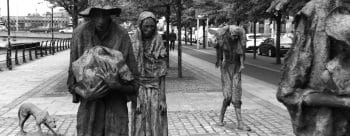
    In the 2012 documentary ‘Dreamtime Revisited’ poet-philosopher John Moriarity climbed Derada Hill in his adopted home of Connemara. Observing its hinterland he remarked that all about him was crooked, from the contours of the Oranmore River to the crooked coast towards the Aran Islands and the crooked horizon of the Twelve Bens. He calls this his “wonderful crooked world”. In most of the country that elliptical scene is familiar. And it seems to have found a reflection in a human character where straight lines are avoided: in our literature language has been distorted and remade; traditional Irish music allies bewitching interchange between minor and major keys with polyrhythmic time; in day- to-day exchanges a sense of humour is often prized above other qualities, including honesty. Travelling west from the Pale into wilder terrain these qualities grow more pronounced: mythos overwhelms logos in the sodden bog of collective memory. In France terroir connotes the long-standing relationship between a people and their landscape that is said to impart distinctive flavours to the food and wine produced there. In Ireland, where gastronomy has traditionally been awarded a low priority, terroir might be observed in linguistic and musical dissonances that spring from the undulating, even chaotic, landscape. We talk about what the Dutch would do if they lived in Ireland, but perhaps they are a product of the straight lines on their sunken horizon, and the practical concern of keeping the ocean at bay. Perhaps they would simply do surprisingly little. Even the Irish weather, grudgingly benign at least until recent times, finds a reflection in the periodically sullen and infuriatingly inconsistent Irish temperament. We might all recognise its description by Samuel Beckett’s character Molloy: “I know it was warm again the day I left but that meant nothing in my part of the world where it seemed to be warm or cold or mild at any time of the year”. The poor quality of the built infrastructure here would be insufferable in other parts of Europe at a similar latitude where it has been built to endure harsher winters. Ireland is on the periphery of Europe and this contributes to the strangeness of its culture and the fact that it takes a status quo, bordering on the ridiculous, for granted. Observed empirically, to some extent Ireland retains the political economy of a post-colonial outpost, now a tax haven. Une isle derriere une isle according to one French geographer – spared both Roman conquest and barbarian hordes – the country did not join the European mainstream. Ireland was a repository of learning and mysticism during a brief golden age, then passed into a millennium of obscurity before a shuddering encounter with an advanced civilisation from the neighbouring island. The ensuing appropriation imposed a system of individual private property ‘from Heaven to Hell’ distinct from what had been characteristically communal arrangements under native Brehon Law. Being the victim of the first adventure of the British Empire also necessarily generated an antipathy to rules and laws, since they were imposed in the interest of the coloniser, not the natives. Sui generis, Ireland is the only country whose population was greater in the 1840s than today, due to the Great Famine and its legacy. The unique trauma of starvation and forced emigration led to short-termism, and the ascendancy of expediency over ideology or even ideas. A current legacy of this attitude is the ingrained hostility to planning and indeed environmentalism: “you can’t eat the landscape”. The Irish Nation is a product of the late eighteenth century when the movement of the United Irishmen failed to unite all creeds: simultaneously in 1795 the orchestrated emergence of the Orange Order and of Maynooth University that created a quasi established Catholic Church put paid to the aspirations of Wolfe Tone and his colleagues. The Old English descendants of the Normans and the native Gael coalesced inviolably in the end, to form an overwhelmingly Catholic nation. The Normans might now be perceived as having tempered a native tendency towards the fast and loose, but contemporary English observers bemoaned the cultural slippage that attended the medieval wave of colonisation: as if the rivers flowing from the hilly regions inhabited by the Gael imbued the plain-dwelling Normans with their characteristics. The Protestant New English who arrived primarily in the seventeenth century descended into a familiar decadence albeit preserving a singular sectarian identity by avoiding miscegenation. Only in the North east corner, within the cultural orbit of lowland Scotland, did a distinct culture emerge. Ireland’s dramatic landscape is not unique, but what is unusual is first an isolation from and then a quite sudden absorption of its substantial population (by comparison with the equally untamed Scottish Highlands for instance) into as advanced a polity as early modern England’s. An Irishman Other has long acted as a foil to the sober, judicious Englishman and often revels in his allotted role as revolutionary misfit, bard and poet. From this we might trace a cultural tolerance of drunkenness. The contradictions between the two cultures engendered a great cultural ferment that ani- mated an Irish literary Renaissance that began at the end of the nineteenth century. In its wake Irishmen were awarded a remarkable four Nobel Prizes for literature, and this with James Joyce, widely regarded as the pre-eminent novelist of the twentieth century, missing out. Even a century later what seem parochial themes resonate beyond our shores such that an unremarkable rock band like U2 compose songs that connect with a global audience. But translate the crookedness of the Irish character into Irish politics and what do we find? If in literature the distortion of language can be art, in politics it is artifice. Corruption, famously found by the Mahon Tribunal to be “systemic and endemic” is the unreconstructed manifestation, but there are other more insidious twistednesses. They have spawned the laxity whereby a politician can say one thing to one crowd and another to the next. Enda Kenny can assert Ireland’s commitment to Climate Change while

    Loading

    Read more

  • Posted in:

    Lets talk about equality not facial space

    The Oxfam Davos Report published on January 18 got relatively little media coverage here and was buried after twenty-four hours. Yet its content is truly shocking, pointing to a world that is witnessing massive inequality and an ever-widening chasm in the wealth of the big majority of humanity as against that of a tiny elite. For the first time in history the wealth of the richest 1% is greater than the aggregated wealth of the remaining 99%. This should be a central feature in the current General Election campaign because it has huge ramifications for global developments that will impact on Ireland but also because chronic inequality is growing apace in this State also. You wouldn’t think that from the statements of the establishment political parties, nor from the issues emphasised by the big-business-owned media. In fact there is a concerted effort to not go there as seen in the controversy around the so-called ‘fiscal space’. The contrived debate on the fiscal space is really designed to shut down any meaningful discussion on what wealth exists here and how it should be shared and managed. It wants to confine commentary to the narrowest of parameters around an estimated €10 billion that will be available in extra public spending over the next five years based on assumptions of a certain level of economic growth. What this shuts out is any opening up of a debate on the massive wealth that exists outside of the current parameters of taxation policy and practice. Hence we have not only Fine Gael, Labour and Fianna Fail focusing obsessively on this, but Sinn Féin also chastising the other parties for being ‘irresponsible’ in their approach in exaggerating the amount available. Excluded therefore is any consideration of the €30 billion in extra wealth that the richest 300 in this State have garnered since 2010 according to the Sunday Independent Rich List while the majority groaned under the yoke of austerity. Excluded also are the massive profits reaped by big business including the major multinational corporations and the derisory tax that is levied on them. It is well known that the headline 12.5% corporation rate is but a vague target. It would be very generous to the corporations to say, as Eurostat figures do, that they pay an effective rate of 8.3% but if we were to take that as true, it would mean a very significant €2 billion each year could be raised if the headline were insisted on. Over five years that would immediately double the ‘fiscal space’. For every 1% increase after that there would be an extra annual €500 million for public investment and services. This is not even to take account of the work of Trinity College Associate Professor of Finance, Jim Stewart, who told an Oireachtas Subcommittee in 2014 that a massive €40 billion annual profits of Irish registered companies lies completely outside the tax net. The Anti Austerity Alliance Budget Statement from  October 2015 outlines how massively increased resources could be made available for major public investment in areas like social and affordable homes and greatly improved public services by taxing the real wealth that exists. Where these extra funds could be raised in addition to the corporation tax increased intake, would be a ‘millionaires’ tax on wealth, an increase in tax for individuals earning over €100,000 per year and a Financial Transactions Tax. Depending on the rates applied, extra income of up to €10 billion a year could be realised. In view of the Oxfam report and the growing inequality in Ireland itself the debate should urgently begin on national and international taxation policy and the massive shift of wealth from the 1% to the 99%. In the United States Bernie Sanders, describing himself as a democratic socialist, is generating major political waves and massive support among working people and the poor, with his call for a “‘political revolution”. The Left in Ireland is the only force that is attempting to inject similar ideas in to the election cam- paign here. If the electoral initiative of the Anti Austerity Alliance People Before Profit achieves the requisite seven Dáil deputies to form an official parliamentary group in the next Dáil, that debate can be significantly advanced here also. Joe Higgins TD is Campaign Manager for the Anti-Aus- terity Alliance. €40 billion annual profits of Irish registered companies lie completely outside the  tax net by Joe Higgins

    Loading

    Read more

  • Posted in:

    What percentage the tax-take needs to be

    POINTERS FOR ECONOMIC EQUALITY 1. Jobs and long-term Unemployment The recovery in jobs is an important contribution to addressing recent, recession induced, levels of economic inequality. However, it is not the only contribution required of the labour market. The key labour market, and perhaps key public policy, issue for the next decade will be long-term unemployment and the need for resourced and strategic interventions to assist large numbers of people getting back to work. The boom proved that most of these people will happily work. However, without active support, little of which is currently being provided, these people are likely to be trapped in long-term unemployment. 2. Fair Pay Fair pay is usually seen as a low-pay issue. However, there are fair-pay problems at both ends of the earnings distribution. With one in five workers living on less than the living wage, the challenge for many workers to make ends meet remains difficult. At the other end of the labour market high pay has become more and more disconnected from the reality of decent pay, average earnings, living costs and the appropriate rewards employees should get for their service. Policy aimed at addressing, and reducing, economic inequality will need to focus on pay at both ends of this distribution and pursue strategies to narrow the overall distribution. 3. Welfare The welfare system is the core mechanism for economic equality. Social-protection payments provide a safety net for almost all families and directly support the living standards of a large proportion of our population. The system dramatically alters the shape of our income distribution and enhances equality via child benefit, illness and disability payments, unemployment supports and old age pensions, among others. As the recovery unfolds, there is a danger that welfare will be deprioritised as the policy focus shifts elsewhere. The experience of the last Irish recovery, in the late 1990s is telling. In a few short years the poverty rates of welfare-dependent households sky-rocketed with, for example, pensioner poverty increasing from 5.9% in 1994 to 44.1% in 2001. Earnings increases and income tax reductions flowed to others and those dependent on welfare slipped further and further behind. It took some significant welfare increases in the early 2000s to address the legacy of these decisions. It is important for economic inequality to maintain the relative value of welfare payments and increase them in line with living costs and changes in earnings elsewhere in society. 4. Taxation There is an issue regarding the appropriateness and adequacy of current Government plans for the scale of the overall tax take, as set out in the Spring Statement and Budget 2016. While one can argue about how much or how little tax needs to be collected to run the country, the realistic range sits somewhere between 31% and 35% of GDP. However, current plans are for a tax take of around 29% of GDP; a figure that is unrealistic and puts unnecessary pressure on the appropriate provision of public services across the state. Where these services are under-delivered, it is those who are most disadvantaged in society who suffer most. There are economic-equality issues related to the nature of public spending and taxation changes that are planned. Taxation changes focused on income, whether through USC changes/abolition or changes to bands, rates and credits, will by definition benefit those with taxable income; people who are predominantly located in the top half of the income distribution. From the perspective of tackling, rather than enhancing, economic inequality, fairness in any structural reform of the taxation system, or offsetting accompanying measures is crucial. 5. Women On average women are better educated, brighter, and longer-lived yet are paid less and are more disadvantaged than men. This points towards structural problems that we need aggressively to address. The gender-specific nature of these inequalities is reinforced by the fact that they spread right across the income distribution. 6. Children One in five children live in a household with an income below the poverty line. The longterm implications and costs of childhood disadvantage are very high: multiples of the costs associated with addressing these issues now. The return on investing in addressing these issues now is many times the return available elsewhere; or indeed any benefit-cost ratio threshold. Early Childhood Care and Education programmes providing a free year of care and education for children of pre-school age, school meals in disadvantaged areas, adequate and affordable childcare facilities and targeted library services for children are just some of the options available. Dr Micheál Collins is Senior Research Officer at the Nevin Economic Research Institute (NERI) and an adjunct Professor of Economics at Trinity College Dublin.

    Loading

    Read more

  • Posted in:

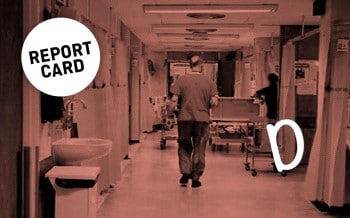
    Health – Report Card.

    Result: D A poor vision that failed. Everyone who is ordinarily resident in the country has access to public hospital services, whether they have health insurance, a medical card or nothing at all. The services may not be free and may be subject to waiting times depending on medical condition. Without a medical card patients are charged €100 for all treatment received in a public hospital accident and emergency room, though a referral letter obviates the charge. A White Paper on Universal Health Insurance was published in 2014 with a report on the potential costs of the White Paper model published in November 2015. The debate was always too much about the cost of this rather than on how a focus on insurance might actually serve the presumed goal of universal healthcare. In the end Leo Varadkar suspended it, likening universal health insurance to Irish Water. He claimed it would have been impossible to impose the extra fees without a backlash from struggling families. While denying the Coalition had performed a U-turn on its central health policy, he was unable to give any specific year as to when a new version will be introduced. He also appeared to criticise his predecessor James Reilly by alleging there had been an “obsession” with the Dutch form of UHI. Varadkar insists the Coalition remains committed to introducing the policy at some unspecified stage in the future. The Irish health system ranks 21st in the 2015 Euro Health Consumer Index, up one place from 2014 but down from 14th in 2013. Lower-income countries such as Macedonia, Croatia and Slovenia all rank ahead of Ireland in the index, which is led by the Netherlands and Switzerland. And there has been a litany of specific scandals and failures that have characterised the media discourse on health. Or the consistent overspends. Enda Kenny says his greatest disappointment as Taoiseach is ongoing stories of people’s negative experience with the health services. Most of the health issues in the general election arise inevitably not from abstract policy but from crises and failures to address long-standing problems. Unfortunately for the government the public perception of the health service remains that it is a sort of dysfunctional “Angola”: Rebecca O’Malley, Susie Long, Leas Cross, Áras Attracta, Savita Halappanavar and ‘Grace’, the woman with intellectual disabilities who was tortured and sexually abused in a foster home over thirteen years. Worse still the proportion of the Irish population that was over the age of 65 has been static at 11% for years. But forecasts suggest that the percentage of people over the age of 65 will rise to 26% by 2026. About 20,000 additional people turn 65 each year and the actual number of people over that age will double in the next few decades. Within that the number of “older old”, people over the age of 80, will double. Minister for Health Leo Varadkar no longer repeats the 2011 election pledge to bring an end to the hospital trolley crisis. The Government should move towards a similar system to that of the UK where trolley counts are not relied upon to examine waiting times. Meanwhile, though there has been some marginal improvement since last year, overcrowded Emergency Departments (EDs), famously described by actor Brendan Gleeson in 2004 on the Late Late Show as “unspeakable… like a military field hospital… a disgrace… a war crime” continue to make it difficult for staff to fully examine and adequately treat patients, risking cross-infection and patient safety. There have been improvements in the number of emergency consultants (though problems subsist at weekends and nights) and the out-of-hours availability of GPs but the biggest problems are the maintenance of too many EDs (30 countrywide) and the under-resourcing of alternative primary care. Furthermore there has been for example no systematic introduction of minor-injury clinics, or deployment of techniques like acute medical assessment and early-discharge planning, no improvement in GPs’ access to diagnostics to enable them to avoid sending patients to hospitals, or improvement in hospital IT. Report Card – Health

    Loading

    Read more

  • Posted in:

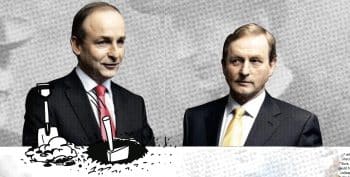
    Luck, charm, good handlers and a ruthless streak make him the man to beat in election 2016

    Enda Kenny has defied those detractors who have claimed for many years that he is not up to the job of leading the country. Or has he? His supporters claim that he has brought the country, and the economy, from the brink of complete meltdown to steady recovery and is now set to be the first Fine Gael leader to claim the title of Taoiseach in successive elections. Others say that timing and luck have played a huge part in his belated success after more than 40 years in the Dáil and that victory in this month’s poll is by no means certain. Over the past five years, Kenny has displayed many of the characteristics that marked the career of his long-term adversary, Bertie Ahern, including the ability to shake off, or at least postpone, controversies that would have caused terminal damage to other party leaders. His claim to have secured a significant debt write-down from his EU partners in June 2012 proved to be untrue. His siding with the ECB and the Bundesbank against the struggling Greek people who put the radical leftists of Syriza into power was self-serving and opportunist and arguably undermined any prospect of Ireland getting some early relief on its enormous legacy of banking debt. His instruction to the Secretary General of the Department of Justice, Brian Purcell, to make a late-night visit to the Garda Commissioner, Martin Callinan, leading to the resignation of both senior public servants and of his own long -time supporter, Alan Shatter, in mid-2014, is all a fog of obfuscation. Similarly, the manner in which the Commission of Inquiry he announced to examine the purchase of Siteserv by long-time party supporter, Denis O’Brien, and other IBRC sales in mid-2015, was allowed to run into the sand due to its restricted powers and inadequate terms of reference bears all the finger prints of his senior handlers. His outrageous and inaccurate remarks from Davos to Madrid to Paris on Ireland’s crisis and his government’s role in recovery have confirmed that he has not lost the habit of appearing the clown, unintentionally, at the most unexpected moments. Enda Kenny also merits opprobrium for his broken promise to fix the health system, the failure to deal with a deepening housing crisis and the widening of the income divide between the richest and most vulnerable during these past few years. Yet the stars, and international factors, including a strong dollar and sterling, unpredicted multi-national tax payments and the dramatic oil-price collapse have combined to see Kenny emerge as the architect of the fastest-growing economy in Europe and the cheerful bestower of a fistful of promises to simultaneously cut taxes, improve public services and recruit thousands of nurses, teachers and gardaí. Kenny has luck on his side. He was fortunate to lose the leadership contest against Michael Noonan after John Bruton lost the 1997 general election to Ahern and before the 2002 poll when the Fine Gael vote imploded. Kenny survived with his lowest ever first preference vote in Mayo and Noonan resigned. The Mayo TD took over the party in June 2002 after a battle with Richard Bruton. Kenny was helped by transfers from his soon-to-be key ally, Phil Hogan, in the run-off and after the elimination of Jim Mitchell. He faced into the 2007 general election as the blitz of his bizarre financial arrangements threatened to take out Ahern but failed to convince voters that he could do better than Fianna Fáil in managing a faltering economy. Once again, luck was on Kenny’s side as Brian Cowen replaced Ahern a year later and was engulfed by the banking and property collapse. In 2011, after two failed heaves against him, the Fine Gael leader hauled his party to an historic victory and into government with a resurgent Labour Party, after the Fianna Fáil/ Green administration collapsed in acrimony and the people gave it an unprecedented battering in the February election. There is no doubt that he has rid himself of the ‘Bertie lite’ tag that dogged him for years, although his closest aides still do not trust him enough to let him out on his own too often. Kenny maintains a quirky, hail-fellow-wellmet style that makes him seem like a country bumpkin but disguises a more ruthless political streak and shrewdness.. In mid-2014, Kenny publicly distanced his Enda Kenny: not so lite now Luck, charm, good handlers and a ruthless streak make him the man to beat in election 2016 by Frank Connolly He merits opprobrium for his broken promise to fix the health system, the failure to deal with a deepening housing crisis and the widening of the income divide between the richest and most vulnerable during these past few years February 2016 19 party from its key strategist, and his close friend, Frank Flannery who was embroiled in a financial scandal which erupted after details emerged of enormous salaries and other payments involving the Rehab charity and its senior executives. Flannery who had left the charity some years previously was still being well paid by Rehab for consultancy work which involved lobbying his colleagues in Fine Gael. He had a pass for Leinster House and free parking which the public was informed was being removed. It was a humiliating experience for the suave PR man and no doubt difficult for Kenny. A few weeks later the pair sat down for lunch in Dobbins restaurant near the Dáil along with another old friend and party elder, the late Bill O’ Herlihy. Kenny expressed a degree of regret that Flannery had been shafted and was sorry that he had to withdraw his valuable Dáil pass. “Don’t worry about that, Enda”, replied Flannery, or words to that effect, as he pulled the pass from his jacket pocket, to laughter all round. Kenny never forgets his friends even when the going gets tough. Kenny was gifted a Dáil seat for Mayo west in November 1975 after the premature death of his father, Henry, from cancer. The

    Loading

    Read more

  • Posted in:

    For social and economic progress and sustainable development

    As we face into a General Election it is appropriate that we consider how we could construct a fiscal policy that can deliver fiscal and financial stability and sustainable economic growth. A fiscal policy that can provide the investment required for the delivery of decent services and infrastructure and that can adapt to changing demographic pressures. The fundamental issue underpinning fiscal policy is that any decision to raise or reduce overall levels of taxation revenue or expenditure should be linked to demands on government resources. Now that Ireland is emerging from the recession there is a renewed focus on fiscal policy. It is important that we learn from the mistakes of the past and ensure that current and future policies work for the common good of all in Irish society. There has been much discussion and rumination on the fiscal policy of successive Governments in the decades leading up to the crisis, but less regarding what progressive fiscal policy might look like in the future. So…progressive fiscal policy should be able to deliver macroeconomic stability, investment, a just taxation system, strong social services and social infrastructure, good governance in terms of policy development and policy evaluation, and finally it must be sustainable in the longer term. It should incorporate demographic projections of future expenditure and revenue requirements. Ireland’s macroeconomic policy is, and will continue to be, heavily influenced by our commitments under the Fiscal Compact and the Stability and Growth Pact. However, this does not mean that there is not space for progressive fiscal policy. The Fiscal Compact introduced an expenditure benchmark but this does not mean that expenditure cannot increase above this benchmark; it simply requires that any expenditure above this benchmark be matched by the required revenue increase. This is important as Ireland will need significant levels of investment in the future if we are to address the current deficits in our infrastructure and services and they can adapt to meet the changing needs of our changing demography. Investment A programme that invested in social, economic and environmental infrastructure would contribute to growth which would in turn lower Ireland’s deficit and real-debt burden. It would also generate sustainable employment and begin to address the many infrastructural challenges we face in areas such as broadband and social housing, for example. Total investment as a percentage of GDP in Ireland was just under 17% in Ireland in 2014, the fourth lowest in the EU. Within this figure, Government investment accounts for just under 2% of GDP, the second lowest in the EU. Ireland is starting from a very low base and the present deficits in infrastructure make it clear that domestic investment is sorely needed to provide employment and improve quality of life and productivity; this would reduce short-term unemployment and increase the long-run productivity of the Irish economy. Debt It should not be overlooked that Ireland still faces substantial debt challenges despite the strong GDP growth figures for 2015. The rapid increase in our national debt, driven by the need to borrow both to replace disappearing taxation revenues and to fund emergency ‘investments’ in the failing commercial banks, has increased the ongoing annual costs associ ated with servicing the national debt. The scale of Ireland’s debt is still significant (General Government Debt stood at 97% of GDP in 2015) and we are vulnerable to international developments. If there are no additional liabilities arising from the banking sector and no further economic shocks, Ireland’s debt may be sustainable, assuming continuing low government debt yields and economic growth. However, deflation in the Eurozone could have implications for Ireland’s real debt burden if it continues. To increase debt sustainability, European authorities should also consider further changes to the status of the government bonds which were issued to replace the promissory notes including further extending the maturity and considering a lower interest rate. Future taxation needs The need for a wider tax base is a lesson painfully learnt by Ireland during recent years. A disastrous combination of a naïve housing policy, a failed regulatory system and foolish fiscal policy and economic planning caused a collapse in exchequer revenues. It is only through a determined effort to reform Ireland’s taxation system that these mistakes can be addressed and avoided in the future. Suggesting that any country’s tax take should increase normally produces negative responses. People think first of their incomes and increases in income tax, rather than more broadly of reforms to the tax base. It is important that we realise that taxation encompasses far more than just income tax, and that it is possible to reform and broaden Ireland’s tax base. There are a number of approaches available to Government. A brief (and not exhaustive) list could comprise: evaluation of tax expenditures/tax reliefs, corporation taxes, a site value tax and a financial transactions tax. The ex-ante evaluation of the costs and benefits of any proposed tax expenditure, the need to collect detailed information on each expenditure, the introduction of time limits for expenditures, the creation of an annual tax expenditures report as part of the Budget process and the regular scrutiny of this area by an Oireachtas committee should be part of all future fiscal policy. This is a simple and effective way to ensure that the expenditure in question is generating the required policy outcome and a return for the State. The issue of corporate tax contributions is principally one of fairness. From a societal perspective, it is important that corporations contribute in a reasonable and credible way to the costs of running the state in which they operate and benefit from. Introducing a minimum effective corporate tax rate of 6% would not only generate significant revenue, it would ensure a fair contribution from the corporate sector to the Irish exchequer. A recurring site value tax would be a better alternative than the current Government value- based local property tax. A site value tax would lead to more efficient land use within the structure of social, environmental and economic goals embodied

    Loading

    Read more

  • Posted in:

    Challenging the status quo with renewed vigour

    Village is now eleven years old and has been published by Ormond Quay Publications since 2008. From its foundation in 2004, Village has been one of the few local publications that systematically criticised the thrust of the direction of the economy and society. The twenty-year reigning economic orthodoxies have finally been thrown out even if policy-makers and, depressingly, many voters are playing catch-up. A leftist analysis could not be more timely as we risk repeating our past recklessnesses. Mores are changing, though short-termism and materialism remain ascendant in Ireland. Village Magazine does not dance to the ephemeral thrum of pragmatism, it stands for transcendent principles. Its motifs are equality of out-come, sustainability and accountability and because these ideas are timeless it has no intention of changing or confounding them. It promotes in its columns, as a badge in every edition makes clear, the fair distribution of resources, welfare, respect and opportunity in society by: the analysis and investigation of inequalities, unsustainable development, corruption, and the media’s role in their perpetuation; and by acute cultural analysis. In historical and international terms its analysis is mainstream radical left. For example egalitarians will favour high taxes to fund services, and will be broadly in favour of property taxes, whatever the mood of campaigners ‘on the ground’. It embraces controversy and attempts to take on the powerful and the furtive. This edition reprises many such articles: including features on Ansbacher, Donegal Planning, Denis O’Brien and the legal profession. Village aims to be ideological, investigative, news-breaking and even, without pretentiousness, culturally challenging. It assumes the best and the most of its readers. It aims to be sharp. Humour is not entirely beyond it. It blithely excludes certain pre-occupations including sport, weather, sex and road news. There is a stringent editorial filter. Neo-liberal, intolerant or ad hoc worldviews are typically relegated to the humour pages, or to well-flagged opinion pieces. But mostly Village aims to be inclusive. It is a forum for perspectives and voices not easily found elsewhere, including those of community activists, social-sector employees, environmentalists and NGOs generally. It aspires to the highest standards of journalism including hard-mindedness, risk-taking, bravery, constancy and – which is unusual in contemporary media, elegance. There is a danger of preaching to converts and Village makes a special effort not to rant or succumb to lazy prolix. We ask our contributors to address the principal arguments levied against them by their ideological and practical antagonists. And the aim certainly is not to be self-righteous or unforgiving. It will always be a battle for a magazine like Village that eschews a glossy approach and that does not champion the commercial. There is renewed energy and time for expansion of this magazine’s ambition and impact. We are aware that Village is dense but, in the era of ISIS, climate change and runaway inequality, we do not really apologise for the intensity of the information. We aim to make many of our articles evidence-rich one-stop-shops for the issues covered. We are now changing the design, that has been largely undisturbed for seven years to make it more user-friendly. This will take a number of editions to complete. The design is intended to be logical and clear; and to set off strong images. We have swapped a yellow-and-black theme for the red masthead. We include more infographics and ‘cheat sheets’, a new curved font, more use of full-page photos. We will publish more long-format articles. We hope more ads will leaven the effect of denseness. The website will be reinvigorated and its design mirror the print version’s. We will not be changing the substance or the editorial direction of the magazine. We will continue to publish articles that are issues rather than personality focused and avoid trite click bait, trivia, gossip and cheap objectifying images of semi-clad women (and men). We will market Village as “challenging” since that is important and a rarity. It will be styled Ireland’s only political and cultural magazine. We are grateful for your support over the years and welcome ideas on how we can improve. And Village wishes a Happy Christmas to all its readers!

    Loading

    Read more

  • Posted in:

    1916 values diverted

    One value of the 1916 Rising commemorations is to highlight the contrast between the aspirations of those who set out to establish an independent Irish State for the whole island of Ireland and the reality of what exists today – a partitioned country whose native language, Irish, is on the point of death as a cradle-spoken tongue, and in which the State that did come from the independence movement has been reduced to provincial or regional status in a supranational EU quasi-Federation that now makes most of our laws. The Easter Proclamation read: “We declare the right of the people of Ireland to the ownership of Ireland and to the unfettered control of Irish destinies to be sovereign and indefeasible”. “Indefeasible” means cannot be lost. That right may notionally exist still, but the reality of a sovereign Irish State in which its own Parliament and Government are the sole source of the laws prevailing in its territory has clearly been lost, as with the 27 other EU countries, through membership of the EU. Growing public awareness of this fact, in Ireland and other EU countries, is at the root of the current EU discontents. Article 29.4 of the Constitution, which was inserted by referendum in 1972 to enable Ireland to join the then European Economic Community (EEC), gives European law primacy over any countervailing Irish law. It reads: “No provision of this Constitution invalidates laws enacted, acts done or measures adopted by the State that are necessitated by the obligations of membership of the European Union, or prevents laws enacted, acts done or measures adopted by the said European Union from having the force of law in the State”. Realisation of the implications of supranational EU law being given primacy in this way over the provisions of the 1937 Irish Constitution that he had personally drafted led then President Eamon De Valera to say, somewhat poignantly, to his family on New Year’s Eve 1972, the day before this change took place: “I am the first and last President of an independent Irish Republic”. So Eamon O Cuív TD, De Valera’s grandson, who was present on that occasion, told me*. The loss of independence has gone much further since. In 1999 Ireland abolished its national currency and joined the Eurozone, thereby abandoning control of either its rate of interest or its exchange rate – the former essential for controlling credit, the latter for influencing economic competitiveness. EU Commission President Romano Prodi underlined the political significance of this when he said at the time, “The two pillars of the Nation State are the sword and the currency, and we have changed that”. The 1987 Single European Act, the 1992 Maastricht Treaty, the 1998 Amsterdam Treaty and the 2001 Nice Treaty saw further growth of EU powers and simultaneous diminution of national State powers. This culminated in the 2009 Treaty of Lisbon, which gave the EU the constitutional form of a supranational Federal State. Lisbon incorporated 99% of the provisions of the Treaty Establishing a Constitution for Europe that had been rejected by French and Dutch voters in referendums in 2005. Whereas the rejected constitutional treaty gave the EU a Federal Constitution directly, the Treaty of Lisbon did so indirectly, in the form of amendments to the existing EU treaties. Although the legal content of the two treaties was virtually the same, the French and Dutch were not allowed referendums on Lisbon. Ireland was the only EU country to be allowed that, because of the Supreme Court’s decision in the 1987 Crotty case that, as the Irish people were the repositories of State sovereignty, only they could agree to surrender it to the EU through a referendum. When Irish voters rejected ratifying Lisbon in 2008, they were made vote on exactly the same treaty the following year to deliver a different result. In the Lisbon Two referendum the constitutional amendment permitting Lisbon’s ratification differed from that in Lisbon One in that it included the sentence: “Ireland affirms its commitment to the European Union…”. Here was a supposedly independent Irish State affirming a constitutional “commitment” to a superior entity made up of other States – surely a remarkable development? Yet the Explanatory Handbook which the statutory Referendum Commission sent to all voter households, supposedly to inform them what the referendum was about, made no reference to this change. Neither, so far as I know, did anyone in the Irish media. The Lisbon Treaty replaced the existing European Community with a European Union that had full legal personality and its own constitution for the first time. It made citizens of the different Member States into real citizens of this new federal-type Union for the first time also. One can only be a citizen of a State. Before Lisbon, citizenship of the then embryonic EU was stated to “complement” national citizenship. It was an essentially notional or honorary concept. The Lisbon Treaty provided that EU citizenship should be “in addition to” one’s national citizenship, just as citizens of provincial states like California, Massachusetts, Bavaria or Brandenburg have two citizenships, for they are citizens also of their respective Federal States, the USA and Germany. Lisbon also gave explicit primacy to EU law over national law for the first time in an EU treaty. In most years nowadays arguably the majority of laws that are put through the national Parliaments of the EU Member States come from Brussels, although most people do not realise this. Eur-Lex estimates that there are currently some 134,000 EU rules, international agreements and legal acts binding on or affecting citizens across the EU. These include 1842 EU Directives, 11,547 Regulations, 18,545 Decisions, 15,023 EU Court verdicts and 62,397 international standards which the EU has signed up to and which are therefore binding on all its 28 members. If a Member States does not obey any one of these, the EU Court of Justice can impose heavy daily fines to enforce compliance. The EU Treaties prevent voters at national level, their parliaments and governments from amending or abolishing

    Loading

    Read more

  • Posted in:

    Hedgemony

    ‘Twas the night before Christmas, and the Minister for Arts, Heritage and the Gaeltacht was beavering away looking for ways to ensure that no creature was stirring. Especially not a mouse. On 23rd December last year, in the political dead of night, the Minister charged with protecting natural heritage announced a plan to make destroying it even easier for farmers. Heather Humphreys – who lives on a farm, is married to a farmer, and whose brother is the Ulster/North Leinster Regional Chairman of the Irish Farmers Association – took the regressive decision to weaken Section 40 of the Wildlife Act, which deals with the cutting of hedgerows and burning of uplands, on the basis that doing so “will help to address some of the challenges faced by those living in rural areas”. She didn’t address rural people whose challenges are that they actually like hedges and uplands. An already flimsy piece of environmental legislation and notoriously difficult to enforce, Section 40 of the Wildlife Act, 1976 and the subsequent Wildlife (Amendment) Act, 2000 ban cutting and burning between March 1st and August 31st on the well-evidenced grounds that this is the time of year when the birds – including endangered species such as curlew, yellowhammer, linnet and greenfinch – have their birdy babies. The legislation does make provisions to accommodate summer cutting for health and safety reasons (ie on dangerous stretches of road) and in “the ordinary course” of agriculture or forestry. Humphreys, however, contends that this is not, farmers are finding, enough. “I want to strike a balance here”, she said, in a press release that neglected to mention the enormous imbalance that already exists in favour of agriculture over nature. “While hedge-rows and upland areas are very important in terms of wildlife habitat, they also need to be managed in the interests of both farming and biodiversity”. That biodiversity is a prerequisite for farming seems to elude the Minister. Nevertheless, for what it’s worth, last month, for example, an international team of researchers (including Trinity College Dublin’s Yvonne Buckley) proved for the first time that biodiversity “strongly and consistently” enhances productivity. In addition, hedgerows and uplands are known to improve rainwater attenuation and filtration, mitigate flooding, harbour the species that control pests and provide important foraging for crop pollinators such as bees (a third of which are threatened in Ireland). They sequester carbon, support soil fertility, provide resilience to soil erosion and assimilate the nutrients in agricultural run-off. All that tedious old natural- balance stuff. The benefits are provided by the natural world to farmers for free, despite the fact that the environmental cost of farming remains unpaid (according to a 2015 FAO report, the unassailable Irish beef industry alone has racked up debts of at least $15bn in environmental destruction). What might not be lost on her, however, are the 15,000 citizen signatures which oppose the measures. A petition launched by Birdwatch Ireland, An Taisce, the Irish Wildlife Trust and the Hedgelaying Association of Ireland has shown that healthy uplands and hedgerows and the biodiversity they support are beloved by more people than might have been expected, and that a freshly-slaughtered one at the height of summer is something a lot of people, though perhaps no-one the Minister ever meets, don’t want to see. Nonetheless, the proposed changes will be included in the Heritage Bill 2015 on a “pilot” basis, for two years. According to the DAHG website: “Managed hedge cutting will be allowed, under strict criteria, during August to help ensure issues such as overgrown hedges affecting roads can be tackled. Power will also be given to the Minister to allow for controlled burning in certain areas around the country, to be specified by the Minister, during March, should it be necessary, for example, due to adverse weather conditions”. No detail has yet been provided on the “strict criteria” and no provisions for the effective monitoring or enforcement of these measures have been mentioned. To Humphreys and her ag-mates, hedgerows are the annoying prickly bits of brown and green between the luscious elds of monoculture through which Oscar nominees frolic in hazy late-summer sun. Like the overgrown fringes of small children, these superfluous strips of deficit require meticulous and regular trimming in order to avoid negative comment on their unkemptness. The atavistic and visceral commitment to ‘tidiness’ and post-Victorian standards of natural beauty is the exact opposite of what is needed for an environment that is robust enough to support an ever-intensifying agricultural system and resilient enough to absorb the environmental impact it produces. The ‘dog- whistle’ call from IFA Environment Chairman, Harold Kingston, for “a workable outcome” has as so often been met with a grovelling response that works for farmers only, in the short-term, if at all. Michael Smith

    Loading

    Read more

  • Posted in:

    How to save Irish

    Latin, a dead language, is taught in thousands of schools. A Latin online news bulletin gives the world’s news and carries ads. A radio station broadcasts the news weekly in Latin. Latin enthusiasts organise social gatherings. But despite all this, Latin remains a dead language. Is Irish on the way to becoming that? Most of us don’t want to speak Irish, but we like to have Irish in our lives. We cherish it, the surveys show, as a precious part of our national heritage. We are glad there are Gaelscoileanna, a Radio na Gaeltachta and a TG4; that the destinations of buses are shown in Irish as well as English, and to hear that there is a news-and-comment magazine in Irish on the internet. We would not like everything in Ireland to be in English only. However, it is one thing for a minority language under pressure by a dominant language to give pleasure to those who speak and write it and to comfort others by its presence in their lives. It is quite another for that language to live into the future as many of us hope it will. To do that it must at least be the spoken language of a sizeable self-renewing community as Latin, for example, is not. With the former Gaeltacht districts now completing Ireland’s shift from Irish to English, the Irish language has no such community. This fact constitutes an emergency for lovers of the Irish language; an emergency that needs to be countered by dramatic new action – not by the State which has lost interest in Irish but by the lovers of the language themselves. The most valuable achievement of the Irish language movement is that there are now several thousand men and women throughout Ireland who speak and write Irish well; that is, as correctly, and with as wide a vocabulary, as the average educated user of any other European language. Collectively, these people in their speech and writing are a national treasure because they embody the Irish language alive today. Indeed, because of their wide diversity of circumstance and occupation, they embody it more fully than any Gaeltacht ever did. The initiative that is called for is to convert this national human treasure, which embodies the Irish language as it is today, into a living ‘language bank’ that yields high interest—is self-renewing— through adding new people to its number each year. For a start, it would be a matter of establishing – insofar as now possible and with the personnel now available—the kind of community that is necessary for ensuring the continuance of Irish as a living language. The personnel available for that are those several thousand men and women who speak and write Irish well. Identify a thousand of them and obtain their consent to be jointly responsible – together with others whom they would admit to their number through an annual examination – for the survival of Irish as a spoken and written language. Have them agree on a collective name for the language community they would form; undertake to hold general and regional conventions; and choose a discreet badge that they would wear on their clothing to identify themselves to each other and to people generally. That badge would become a mark of positive distinction. The annual entrance examination for new members, which would become a big national occasion, would provide a prestigious goal for Gaelcholáistí and for the university courses in Irish. Apart from the holding of its conventions, this body of Irish-language perpetuators would carry out its remit simply by living, speaking and writing, and growing annually towards an initial complement of, say, 8000 members. The present Irish-language activities and occasions would continue undisturbed. Because the members of the language community would not be living next door to each other, they would not be a self-renewing community of the ideal kind. But it would be the best that can be done under present circumstances. The annual entry exam would give the secondary Gaelscoileanna and the university courses in Irish a concrete and prestigious goal to aim at. In time the initial goal of 8000 members might well need to be extended. It must be clear that unless this scheme or something like it is implemented, the spoken and written Irish language will enter in the coming years a period of gradual, ragged, ignominious, death, with very minority-interest programmes on radio and television recalling the real thing. Desmond Fennell Dr Desmond Fennell’s last book was ‘Third Stroke Did It: The Staggered End of European Civilisation’. www.desmondfennell.com

    Loading

    Read more