Ireland

Random entry RSS

  • Posted in:

    PAC fails to prick Tubridy’s story.

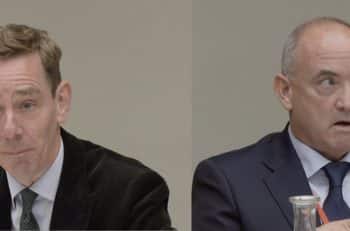
    Having promised to provide box office viewing, today’s Public Accounts Committee failed to deliver meaningful answers to important questions. By Conor O’Carroll After three hours of questioning by the Public Accounts Committee, Ryan Tubridy and his agent, Noel Kelly, emerged largely unscathed following a failure by the committee to ask direct, pointed questions that reached the heart of the ongoing scandal. Despite a long opening statement from Tubridy, it quickly became apparent that Kelly’s presence at the committee was to serve as a shield for his star talent. His insistence during his opening statement that “this is not the Ryan Tubridy scandal. This is the RTÉ scandal” is proof of that strategy. At one stage, while a question was being posed to Tubridy, Kelly even interjected, requesting permission to answer on behalf of his client. However, his eagerness to defend Tubridy was premature, as Tubridy himself turned to him and said, “we don’t even know the question yet”. Kelly later said that he “sees people as brands”, a stomach-turning equivalence that goes some way to explaining why he leapt to Tubridy’s defence at every opportunity. He was merely protecting brand Tubridy, hopeful no doubt that his star man will return to the airwaves in due course. During the following quizzing from members of the committee, a common theme emerged where Tubridy attempted to absolve himself of all ethical and moral responsibility, pointing the finger at his agent, who then in turn pointed the finger at RTÉ. While Kelly’s repeated answers of ‘we were just following RTÉ’s instructions’ bordered on unbelievable at times, the committee failed to bombard either witness with pointed follow-up questions. The closest we came to a bruising came from Alan Dillon TD, who focused on one of the most pertinent outstanding questions: was Noel Kelly, and by extension Ryan Tubridy, complicit in the potential fraud raised by RTÉ former Chief Financial Officer in a Public Accounts Committee hearing two weeks ago. However, Kelly resorted to the now tried and tested rebuttal, stating that “we were just following process…the lack of credibility is on RTÉ’s side”. Further questioning on the issue failed to move beyond this answer. Questions regarding why the invoices were met by two different companies (both owned by Noel Kelly), and later why the tripartite deal was not signed by Noel Kelly Management until April this year, were left similarly unresolved. The blame was laid squarely at the feet of RTÉ, with the insinuation being that Tubridy and Kelly were just pawns in the game of chess played by the executive board. Kelly’s insistence that the tripartite agreement was “brokered by RTÉ” further attempts to disassociate both himself and Tubridy from the mess created as a result of this scandal. Having been hyped up on social media as essential viewing since it was announced, today’s Public Accounts Committee failed to bring about answers to the remaining questions in this saga. Little was actually learnt about the details of the arrangement, and Kelly was largely permitted to reiterate the same response every time: It’s not us, it’s RTÉ. Disappointingly, perhaps the most memorable exchange came right at the end when Chair of the committee Brian Stanley TD asked what Noel Kelly sold for Cadbury’s. The laughter in the room and subsequent response on Twitter says it all about today’s hearing.

    Loading

    Read more

  • Posted in:

    Jarvey for Garvey

    Drogheda and Louth Councils disgrace themselves by finding spurious legal reasons not to consider rescinding the 1997 award of Freedom of Drogneda to the former head of the Christian Brothers who has been making life difficult for an abuse victim who is suing them. By Michael Smith Brother Edmund Garvey, 73, was given the Freedom of Drogheda, where he had been born, in 1997 when he was head of the Christian Brothers. He went out of his way on that occasion to apologise for hurtful experiences people suffered because of the order, or in its schools. However, in the last few years, he chose not to act as a nominee for the Brothers for the purpose of a High Court action for abuse, taken against the Brothers in 2019. Though certainly, that is his legal right, it meant that the more than 100 living members of the order at the time of the alleged abuse had to be made defendants in the case, six of whom live abroad, if the traumatised plaintiff wanted to sue the Brothers, a tall order. The High Court ordered judgment in default against 29 of them on 20 June. Damian O’Farrell is an independent Dublin Councillor from Clontarf and a survivor of the widespread abuse perpetrated by the Brothers. He obtained the first-ever criminal conviction against a Christian Brother, in 1998. Farrell wrote to Councillors in Louth last October asking them to rescind the freedom. Alleged victims hired a hotel in the town and asked Councillor to talk to them but only five of 29 turned up. Independent Louth councillor Maeve Yore has attempted to have the following motion tabled in the Council on two occasions: “That Louth County Council supports all victims of child sexual abuse and condemns the current litigation strategy chosen by the Christian Brothers order…and this Council calls on our members in the Borough District of Drogheda to rescind the Freedom of Drogheda bestowed on [Garvey]”. A letter from the Council to Yore states: “your most recent Motion will not be placed on the agenda of council for May as it is considered potentially defamatory and could expose the council to litigation”. It’s about as defamatory as a Bridget’s cross. On 10 May the Council replied to Yore’s solicitor, MacGuill and Company, confirming that it considered it was potentially defamatory: “It could be interpreted as making specific allegations against an identifiable person which, if unsubstantiated, could be injurious to the reputation of that person”. It suggested the Councillor submit alternative wording. Yore is said to be contemplating a complaint to the Standards in Public Office Commission though it is unlikely to find ethics grounds on what is essentially a procedural matter. She is also looking at a legal route. Section 140 of the Local Government Act 2001 states that “an elected council may by resolution require any particular act, matter or thing specifically mentioned in the resolution and which the local authority or the [CEO] concerned can lawfully do or effect, to be done or effected in the performance of the executive functions of the local authority”. Louth County Council should pass a resolution requiring its CEO, Joan Martin, to put a resolution rescinding the Freedom awarded to Brother Garvey which, whatever the Council thinks, is non-defamatory, on the ‘Clár’ or order sheet for expeditious discussion. Though the Cathaoirleach took legal advice that rescinding the Freedom is a matter for Drogheda Borough Council, it is in fact more appropriately dealt with by the full Louth Council rather than the legally depleted Drogheda Borough Council since, on 1 June 2014, the Borough Council was dissolved and the administration of the town was amalgamated with Louth County Council’s. Brother Garvey has not behaved well and it is entirely appropriate to call him to account, or eject him from the honour he was, unwisely, afforded by the Council in a slightly less cynical era. The CEO has already wasted enough of Councillor Yore’s time and legal fees. The Councillor might legitimately demand that if the CEO does not comply with this resolution and the law that she will hold the CEO and her agents personally liable for the costs including legal costs, of her non-compliance. More difficult for Councillor Yore will be obtaining the necessary two-thirds majority vote for her Section 140 Resolution. Without the political support the legal action will not be possible. However, the Mayor of Drogheda, Michelle Hall, signalled last December that at least nine of the ten Borough Councillors were against bringing forward a motion to rescind Brother Garvey’s Freedom. It is not clear why. What is extraordinary is, apart from one Sinn Féin County Councillor, the lack of support from the mainstream political parties, including the defiant Labour Party. locally or from their national representatives, for an attempt to undo a small part of the abuse that most of them at least accept is real. It’s to be hoped those parties will be held to account for their heedlessness.

    Loading

    Read more

  • Posted in:

    From the Temple of Bars to Listowel Writers Week

    Dermot McLaughlin mismanaged Temple Bar and, facilitated by the uncontrolled Arts Council which never took responsibility for failures in Temple Bar, is now arrogantly calling out mismanagement in Listowel. By Michael Smith Temple Bar Properties converted Temple Bar into a high-rent drink-driven cultural centre in the 1990s. Its focus then moved from physical regeneration to consolidating the cultural offering it was housing and, in 2006, it became Temple Bar Cultural Trust (TBCT), with a new board appointed by Dublin City Council. It was a private and limited not-for-profit company engaged in cultural development in Temple Bar, organising Temple Bar Food Market, concerts, circus, street, Culture Night and Handel’s Day. In 2005 it had an income of €2m, with €1.6m of this coming from its 50-strong property portfolio estimated to be worth at least €100m. Its CEO was Dermot McLaughlin, a 17-year Arts Council employee who had risen to become its assistant director. He was also a talented fiddler. Governance of TBCT was dysfunctional and in 2011 a review by Latitude, a consultancy, recommended it be wound up and subsumed into the Council. Independent City Councillor Mannix Flynn, a board member of TBCT, tabled a successful motion to that effect. The then city manager John Tierney agreed to commission a review of the organisation focusing on corporate governance standards, board representation and whether the trust was fulfilling its brief as a cultural promoter and enabler. However, a Council audit report published in March 2013 levelled charges of a different level of seriousness against TBCT, including failures of corporate governance and “control weaknesses and/or regulatory violations [that] represent unacceptable exposure and risk” for the company. McLaughlin remains a continuing consulting favourite for funding by the Arts Council of which he was once a senior employee The report found that the trust’s board minutes and papers were “not available” in relation to certain financial transactions, noting that TBCT’s business plan for 2010 and 2011 had not been approved by its board. There were found to be no appropriate financial procedures and the fact the same external auditors had been acting for over 10 years was deemed “in contravention of good corporate governance”. The party at most risk from these failures was the publicly-funded Arts Council which funds most of the cultural activity in Temple Bar, not exactly an oasis of private culture, to the tune of €9m in 2022. The Arts Council notably failed to investigate whether certain sums paid by it to institutions in Temple Bar were forwarded as intended to TBCT. A TBCT-commissioned review of the audit by former IBEC chief Turlough O’Sullivan found that the McLaughlin-fed board had “failed in its duty of oversight and governance by not enquiring into and satisfying itself that proper procedures were in place around financial transactions”. O’Sullivan was no subversive so it was telling that even he found this level of delinquency. McLaughlin resigned, agreeing not to pursue actions for defamation, and obtaining a substantial severance package after a disciplinary hearing into his role in offering generous redundancy packages to four senior staff members was cancelled. So what’s happened to the man who presided over the mess? Funny thing is McLaughlin doesn’t now mention his period in the van in Dublin’s Cultural Quarter. He remains a continuing consulting favourite for funding by his former employer, in the absence of a clear Arts Council policy on how it procures its consultants. According to now free agent Dermot McLaughlin he’s “been involved in voluntary work with organisations and on boards for many years. I enjoy being involved, I’m always interested in finding ways to help, and I love learning new things. So for me, voluntary work in enriching and valuable”. His voluntary work which came largely to an end after 2008 included spells as: Chairman (2011-2018) of Irish Traditional Music Archive; Chairman (current) of TG4 Gradam Ceoil selection panel (annual national traditional music awards); Chairman (2007-2011) of Dublin Dance Festival; Chairman (2007) of Údarás na Gaeltachta and Arts Council National Monitoring Committee on Gaeltacht arts; Board Member (2006-2008): Irish Architecture Foundation. Beyond this strings to McLaughlin’s bow include that he was: Board Member (2003-2005): Rough Magic Theatre Company; Founder and Board Member (1994 to date): Scoil Cheoil Frankie Kennedy; Founder and Committee Member (1982 to date): Cairdeas na bhFidléirí. In 2014 he set up his own independent consultancy practice, Creative Strategic Solutions. After that he was involved in the Arts Council of Northern Ireland’s Audit of Traditional Music in Northern Ireland (2014-15); the Arts Council’s review of contemporary music policy initiative (2015) Ealaín na Gaeltachta’s Competitive assessment of funding proposals (2015); and An Cosán Glas’s Business planning, negotiation strategy (2015). It’s amazing how far an unassailable relationship with the Arts Council can take a man. He also claims (admits?) he was involved in the “Meeting House Square €2.2m capital redevelopment, business planning and marketing project (2010)”. Sounds good, so let’s have a look at what the project architect says about this. Seán Harrington architects’ website is as sanguine as McLaughlin is about the situation. “There is a saying in Ireland that you can have four seasons in one day. Warm spring sunshine can lead to intense summer light. Lively autumn gales can turn to a sudden wintry shower because Irish skies are constantly changing. Seán Harrington architects was commissioned to find a solution. The innovative solution provides a convertible umbrella covering over a popular public square in Dublin Temple Bar area. The landmark umbrella projects bespoke design comprises of four 21-m high steel structural masts”. This is shameless and shocking when you realise the, admittedly attractive, umbrellas don’t work, never really did. In the last few weeks one of the brolly arms buckled and repair costs are so prohibitive as to make its reinstatement unlikely. The audit commissioned by Dublin City Council was particularly scathing about Temple Bar Square: “Board minutes were altered, deleting concerns raised by some Councillors, and provided to Ulster Bank to support a loan; Reams of financial data relating to the project were

    Loading

    Read more

  • Posted in:

    Casement was straight and not a paedophile

    Conor Lehihan probes ‘Anatomy of a Lie’ by Paul R Hyde. Sir Roger Casement was an icon for the British Empire in the Edwardian age. His two peripatetic reports on the degradation of natives and exploitation in the Congo and the Amazon were truly ground-breaking in the evolution of human rights. They were also solace for British people who had seen the imperial project discredited by the instigation of ‘Concentration Camps’ in the Second Boer War in South Africa. Knighted in 1911, Dublin-born Casement began to become more sympathetic to Irish nationalism due to his disenchantment with colonialism and a growing love for the Irish language. Significantly he never bothered to open the box containing the CMG that had come with his knighthood. He joined the Irish Volunteers and became a member of its national committee. He helped organise the Howth gun run and found a friend to part finance it. He later travelled to Germany, now at war with England, to enlist German support for a rebellion in Ireland. Before this, he had been in the USA to discuss his mission to Germany with Irish-American Fenians like John Devoy. Casement was caught landing arms at Banna Bay in Kerry and put on trial in London for treason. In an effort to discredit Casement, British officials claimed that he kept what became known as the ‘black diaries’ for the years 1903, 1910 and 1911, now kept in the public archive in Kew (London). They depict Casement as a homosexual who had many partners, had a fondness for young men and mostly paid for sex. The surreptitious campaign by the intelligence services was to frame Sir Roger as a moral degenerate who was owed no debt of sympathy for his earlier work on behalf of the Empire. Little difference was attached to the fundamental difference between homosexuality and paedophilia. Of course, prejudice persists to this day: it was revealing the online vituperation that greeted the advertisement in June 2023 by Kilmainham Gaol of ‘Pride Month Queer History tours of the Gaol’, much of it presumably from so-called republicans. The specific goal of the British establishment was to taint Casement to deny him a pardon from the death sentence in his trial for Treason in 1916. In his book, ‘Anatomy of a Lie’, Paul R Hyde shows that a British diplomat in Oslo fabricated a hasty report hinting that Casement enjoyed an “unnatural” relationship with his manservant. Hyde demonstrates through intense interrogation of the British documents the utter falsity of the original allegation. Furthermore, he discredits the effort by two Scotland Yard detectives to beef up the original Oslo allegation and gather reliable evidence which none of the possible witnesses were prepared to sign. Key figures from politics, the clergy, journalism and the administration were shown concocted details of Casement’s predatory sexuality allegedly culled from an actual diary that was forged from his own disparate notebooks and writings. When Casement heard of the rumours, he virulently denied they were in any way true; none of his close friends and colleagues ever apparently believed he was homosexual; and in the US and in Germany he was under intense surveillance yet allegations about his sexuality were never levelled Typed-up versions of the black diaries were circulated as the actual handwritten forged diaries had not yet been copied onto paper. The actual forged physical diaries were only produced after the smear campaign. The sheer detail of Hyde’s exegesis is impressive and reveals, point-by-point, the contradictions, factual errors and shoddy work the intelligence officers and policemen perpetrated in their effort to fit the spurious sexual allegations into the broader narrative of Casement’s day-to-day routine. Casement’s supporters have maintained his innocence. It has become an article of faith, particularly among supportive nationalists that the forged diaries maliciously rigged out a weakness for sex with young men, paedophilia; but that he was nevertheless homosexual. However, Hyde makes the point that none of the British and American surveillance threw up evidence of homosexual acts by Casement. In fairness to Hyde, he chooses not to enter into the debate about Casement’s sexuality but rather puts all his energy into proving that the black diaries are forgeries. Jeffrey Dudgeon, himself a distinguished gay-rights campaigner who published an edition of the diaries has also been cautious but in the end definitive. Noting that there is an absence of any evidence of heterosexual activity on the part of Casement, he has claimed: “His homosexual life was almost entirely out of sight and disconnected from his career and political work”. For this author, there is no evidence of homosexuality. For a start, when Casement heard of the rumours being circulated about him during his trial, he virulently denied there was any truth whatsoever to them. None of his close friends, including those that had worked with him as a professional, ever claimed before his execution or afterwards that they believed he was homosexual. Both in the USA and in Germany he was under intense surveillance. In the USA both the Fenians and British intelligence kept a close eye on his activities. The Germans and the Fenians both shared suspicions that Casement with his impeccable establishment credentials might have been sent by the British to infiltrate them. No allegations about his sexuality were ever levelled. Oh, what a tangled web we weave, when first we practise to deceive! Inference rather than proof may continue to dominate the controversy surrounding Casement’s sexuality and it has taken over one hundred years to disentangle the story to the point of informed and probable speculation. Scholarly writers and academic authors for many years accepted the authenticity of these forged diaries. However this, as Hyde points out, should not surprise anyone. Significant historians and hand-writing experts were all fooled by the famous Hitler diaries, with the elaborate hoax completed in a period of two years. The forgers of the Casement diaries did not have as much work to complete. The actual completion of the false narrative in physical form

    Loading

    Read more

  • Posted in:

    Review: Medea’s incomprehensible crime

    The new production at the Gate makes Medea’s children more than mere victims By Anna Mulligan Like the play itself, the set for Oonagh Murphy’s Medea walks the line between the mundane and the mythic. The children have a teddy bear named Hercules, and the play takes place in a bedroom whose sloping sides, rising inwards, give the impression of an attic or a crawl space. At the apex is a kind of hovering wooden grid, as if the technicolour bedroom is not an attic but a dungeon, an oubliette, where Medea’s two children have been forgotten.  This might be a reference to the eyes of the gods, watching as they might in Euripides’ play, from a safe distance. It’s hard to know; the play draws on its myths indirectly in ambiguous flashes of memory, as when Medea’s children (played on this particular night by Oscar Butler and Jude Lynch) loosely re-tell the contours of their father Jason’s adventures, passing the time in their locked bedroom. Murphy’s new version of Medea is effectively a retelling of the old story from the children’s point of view. While we wait in the locked room for the play’s titular character, the boys summarise, speculate about and replay the story of their parents. At one point, while fighting, the younger brother uses magic to escape the boundary of “his side of the room” and play keep-away with the golden fleece, until the elder makes a false promise to take it back, his fingers crossed. Medea and Jason’s magic and betrayal come up in their spat, but not in the children’s telling of the parental love story, which one boy says was a “win-win” – Jason got the fleece, Medea got to leave home, they both found love. No harm, no foul. The two young actors shine from the beginning of our time with them, when they act out a series of death games. First they try to play dead, quietly, for as long as possible, and then they take turns choosing their own death – shot by a nerf gun, mauled by a bear, hit by an arrow and then dead of a seizure. The games are edgily acted, comic and unnerving without being heavy-handed in their foreshadowing of the deaths that the audience knows are coming anyway.  There were times in this early section when I thought I was waiting for Medea, as the titular character and one who generally dominates any story she populates, but the strength of the script is that I was not. When Medea did arrive, there were times when I felt she was a distraction from the main event of the brothers’ story, which is a testament to the reframing achieved by Mulvaney and Sarks. The play returns in the meandering of the children’s reflections towards death, and whether dead things count; towards being small, and whether small people count. The adults in Medea are playing games with the children, but the play itself takes them seriously on their own terms – their skills, their questions, the deaths they choose for themselves, which are for laughs. Over and again the boys run full tilt into the locked door, rattling the handle, showing us that they are not by choice narrative footnotes. Not long before the climax of the plot, they have a contemplative conversation about the meaningfulness of being small – as small as specks, compared to the glow-in-the-dark stars papering their ceiling – but when they have drunk Medea’s poison, as instructed, she won’t let them lie back down in that corner, and die looking at the stars. It’s at this point that Eileen Walsh’s character of Medea breaks through her lyrical and sentimental register into a rage until they stand up and allow themselves to be dressed and staged by her, so that they die in her arms. Medea’s character is a difficult needle to thread; the play struggles with her. We meet her dressed for distress in her pyjamas, dishevelled, telegraphing her tortured love for her children, her bitterness with Jason, her despair at the prospect of returning home to her father. None of it rings true: her singsong declarations of eternal love for them do not feel authentic, but neither do her moments of stagey bitterness and resolve in planning the death of Jason’s new love seem any truer at their core. Her moment of rage when the children resist her cajoling is a moment of clarity – but what does it mean? The crime no one can make sense of is still the crime no one can make sense of. Walsh’s Medea tries on different motives, but does not commit. Is she turning to murder to avoid returning to Colchis? Is she destroying the thing – the people – that she thinks Jason wants and cares for the most? Is she attacking the evidence of her life with Jason, now destroyed? Is she bored? She stages the crime for Jason by taking the children from their contemplation in the dark among the stars to a beam of light from the finally open door, locked for so much of the action. She’s not hiding them; they are to be displayed. In this way, the play’s conclusion is intentionally inconclusive; neither she nor the audience get to see the look on Jason’s face when he understands whatever it is she wants him to understand. Jason’s absence is deeply felt in the bedroom, where his golden fleece – now a purloined jumper that still smells of him, kept in a drawer – is lovingly cradled.In Jason’s absence, the children are not needed outside the bedroom; Medea visits them to update them on their status in the acrimonious separation. This is the thematic heart of the new Medea; the children, forgotten, are trapped by the weight of our captivation with heroes and demigods like Jason and Medea, whose children are pawns and cannot escape. The contemporary framing – the bickering of the shared bedroom, the word

    Read more

  • Posted in:

    State land could provide 114,000 dwellings

    Both NAMA (The National Asset Management Agency) and Local Authorities have been criticised for ‘land-hoarding’, ‘sitting’ on sites particularly in Dublin and the Greater Dublin Area (GDA) and not developing land that could be used to address the current housing crisis. Despite the amount of land under their control, Minister Eoghan Murphy has recently asked the Attorney General if powers to effect Compulsory Purchase Orders (CPOs) could be upgraded to encourage those with vacant homes and land to sell quickly. The enhanced powers are part of a new strategy on vacant homes and land due to be announced by Government in June (1). The Minister’s strategy is puzzling given that the State itself has been using less than one percent of its current zoned development land-banks for housing every year. Public land potential: Local Authorities, NAMA and Government A year ago the Department of Housing pub- lished ‘the Rebuilding Ireland Land Availability Survey’ which included details of State-owned land. This report confirmed that Local Authorities own zoned residential land with capacity for 37,950 dwellings (on 1,211 hectares) and that this represented just a portion of State-owned land (2). However, based on individual returns from seven Local Authorities, the figures are much higher. Local Authorities own zoned land with capacity for 48,724 dwellings nationwide (1,317 hectares). Dublin City Council owns zoned residential land with capacity for more than 18,000 dwellings and in County Dublin there is the potential to build 29,278 dwellings. When it comes to the NAMA, the picture is similar. It currently controls the loans on enough development land to build 65,399 dwellings (1,691 hectares); in County Dublin NAMA controls land with the potential for 43,075 dwellings. (3) Nationwide the State controls development land with the capacity for 114,123 dwellings (3,008 hectares) – more than 17% of all zoned residential land by area and more than one quarter of the potential housing capacity in the country. In addition, according to the Irish Times, at least 334 sites or buildings controlled by the Government are lying idle across the State, some of them for more than 30 years. The worst offender is the Health Service Executive with 137 unused buildings or sites. The other 197 sites are shared between nine Government departments, and include Garda stations, courthouses, military barracks and customs posts. Almost half of all County Dublin residential development land is State-controlled and between NAMA and Local Authorities there is the capacity for 71,425 dwellings (1,212 hectares). These figures exclude holdings owned by the Housing Agency and other State and Semi-state bodies. In Dublin City three out of every four vacant residential zoned sites are either owned by Dublin City Council or NAMA debtors. REFERENCES  1. “Government ponders increasing compulsory purchase powers” Irish Times, 14 May 2018; https://www.irishtimes.com/news/ireland/irish-news/government-ponders-increasing-compulsory-purchase-powers-1.3185489 2.“Almost 40,000 social homes could be built by local authorities” Irish Times Nov 2017; https://www.irishtimes.com/news/social-affairs/ almost-40-000-social-homes-could-be-built-by-local-authorities-1.3301442 3. NAMA Residential Delivery Updates (December 2017): https://www.nama.ie/development-funding/nama-residential-delivery-updates/. There is a reduction of 238 hectares from end-2017. There are number of factors for the reduction, including: the land has been built on, The land has been sold, the land has been re-zoned, the debtor has repaid or refinanced their debts and their loans are no longer in NAMA. In 2017, 2,503 were completed by debtors/ receivers funded by NAMA. 7,200 since counting began in 2014. Public Housing: Demand and Supply In the four years since 2014, 7,200 new dwellings have been completed by NAMA debtors and Local Authorities built 818 social homes. In the past twelve months 17,914 new households experienced rental distress and signed-on for Housing Assistance Payment (HAP). Official figures report that Local Authorities built 780 social homes (4) and a further part-State funded 1,078 were built by not-for-profit Approved Housing Bodies (5). However, when ‘turnkey’ units purchased from the private sector from developers are removed, Local Authorities built just 394 homes last year. 11 Local Authorities including South Dublin County Council built no (zero) homes. Approved Housing Bodies (AHBs) built only 270. In contrast in 2017 10.5% of all new homes sold were purchased by AHBs or Local Authorities nationwide as social housing. One year’s supply of purpose-built social housing is meeting less than two weeks of subsidised housing demand. Last year eleven Local Authorities built no social housing, including South Dublin County Council, which has more than 7,500 on housing waiting lists. Dublin County Council built just 232 homes and have more than 40,200 on housing waiting lists. Official targets for 2018 social-housing builds and acquisitions have been increased by just 11% on last year’s levels(6) (expect less than 450 Local Authority builds this year nationwide. By the end of 2018 one in three tenancies will be in receipt of some form of State rent assistance, making up almost 1950m. At current rates of increase by 2019 this annual spend on rent assistance will increase to over 11.1bn per year. In addition to zoned residential development land, the State owns massive landbanks, significant parts of which may be suitable to be re-zoned to residential use in the longer term. Even if a large percentage of the land controlled and owned by the State is not suitable for development, there is still more than enough to build 10,000 social homes per year, a recommendation of the All Party Oireachtas Committee on Housing and Homelessness in 2016 (7). The price of local authority housing (in Dublin City) should be 1175,000 for one-bed units, 1183,000 for two-bed units and 1200,000 for three-bed units. According to Simon Coveney: “The St Michael’s estate regeneration team proposal, ‘Our Community a better way: campaign for fair rental homes’, [launched on 26 April in Buswell’s Hotel] comprised 300 homes, of which 150 of which were social and 150 were cost-rental. The State would fund the capital cost of all units at a cost of 156 million. There would be a mix of one, two and three-bedroom apartments costing on average 1175,000, 1183,000 and 1200,00, respectively. Average monthly rent on a cost-rental basis would be 1900”. REFERENCES 4. Overall social housing provision | Department of

    Loading

    Read more

  • Posted in:

    Nada from Nama

    The revelation that the National Asset Management Agency (NAMA) has failed to disclose “relevant material” to the Commission of Investigation into its controversial sale of its 11.5 billion (£1.24 million) Project Eagle loan portfolio in the North in 2014 will not come as any surprise. Many NAMA watchers have been wondering how the Commission, headed by retired High Court judge, John Cooke, has been progressing given that it is now more than a year since it was established. It took the previous two years to convince the reluctant former Minister for Finance, Michael Noonan, and then Taoiseach, Enda Kenny, to concede to a formal inquiry into the portfolio sale to US fund Cerberus despite the dramatic and shocking allegations of corporate and political corruption that first emerged in July 2015. At that time, Independent TD, Mick Wallace, told the Dáil that a sum of £7m had been lodged in an Isle of Man bank account in connection with the sale and that it was intended for political and business interests associated with Project Eagle. NAMA executives were not exactly forthcoming about the background to the loan disposal and rejected out of hand the conclusions of the Comptroller and Auditor General (C&AG), in September 2016 that the agency had incurred a loss of a potential €223m (£190m) from the sale. The C&AG, Seamus McCarthy, resisted intense pressure from Noonan, the Department of Finance and NAMA executives and board to withdraw his damning report which then formed the basis of an inquiry by the Public Accounts Committee in late 2016. Its report was even more damning of the agency and of Noonan’s role in permitting the sale to proceed despite knowledge of questionable fee payments relating to it. The finance committee at Stormont carried out its own investigation in 2015 to which many of the parties to the deal gave evidence – although the NAMA chairman, Frank Daly and chief executive, Brendan McDonagh declined an invitation to attend as did the senior staff and advisors of the agency most intimately connected to the Project Eagle sale. Although it was essentially a ‘value for money’ exercise the C&AG report highlighted serious conflicts of interest in the sale process, not least relating to the role of Frank Cushnahan, the former member of the Northern Ireland Advisory Committee of NAMA. The C&AG reported that NAMA underestimated the value of the loans, applied too high a discount and had failed to act when it discovered details of some £15m in “success fees” promised to Cushnahan, US law rm Brown Rudnick and Belfast solicitor, Ian Coulter of Tughans by US fund PIMCO before it withdrew from the sale in March 2014. Since then Cushnahan, Coulter and a former head of asset recovery at the agency, Ronnie Hanna, have been questioned by the National Crime Agency in connection with the deal while former first minister, Peter Robinson and his son Gareth, have also come under scrutiny for their role in the extraordinary Project Eagle affair. Hanna and Cushnahan were arrested in May 2016 while Coulter, a former head of the Confederation of British Industry in the North who was responsible for transferring some £5 million to the Isle of Man in late 2014 after the sale to Cerberus was completed was also subjected to a grilling by the NCA team. Property developer John Miskelly who admitted to the BBC some years ago that he had legitimately paid large sums of cash to Cushnahan, and had secretly taped his exchanges with the business consultant, was also arrested in 2017 as part of the NCA probe. Last month, it emerged that charges may now be brought against two of the nine people under investigation and there is intense speculation as to who, if anyone, will finally be brought to account over a property disposal that helped to Enrich Cerberus and associated accountancy, legal and other professionals at the expense of the public purse. Also intriguing is the recent decision by the DPP to withdraw charges against a former NAMA official who was accused of disclosing confidential information from the agency. In this case, NAMA executives made the complaint which led to the arrest of its former staff member Paul Pugh in 2013. Pugh was charged with intentionally disclosing loan and other details relating to builder, John McCabe and his UK company, McCabe Builders. Pugh was accused of sending the information to Gehane Tew k of London based Connaught & Whitehall Capital UK in June 2012. When the case came to court in recent months the DPP and investigating gardaí said that they were not proceeding with the prosecution for reasons that were not fully explained to the judge or the public. It appears that the NAMA executives whose complaint prompted the arrest of Pugh in the first place are now less than enthusiastic about pursuing the case, despite the five-year investigation into the matter. Not for the first time, NAMA has failed to disclose its reasons for not pursuing this case to conclusion. Frank Connolly

    Loading

    Read more

  • Posted in:

    Drain(Herit)age

    The office of Public Works (OPW, the State’s building service) proposes to construct up to 15km of flood defence walls and embankments in Cork City, including dykes, concrete walls and railings throughout the historic centre of the city. The works would be carried out under the Lower Lee (Cork City) Drainage Scheme (Flood Relief) and are an effort to mitigate the effects of climate-change driven flooding which all agree needs to be addressed in Cork. In some places the OPW walls would cover the entire frontage to the water of 16th, 17th and 18th Century historic quays while in others the new walls (and railings) would be constructed on top of older quays. Clearly the aesthetic and design of the scheme as presented is in stark contrast to the existing historic fabric and could not rationally be considered sensitive to the historic setting. Drawings for the scheme show the effect would be dramatic. The proposals have been viewed as a way of investing in the quays and the historic setting of Cork, and there are those, including some business groups, who want to secure the investment without questioning whether it is necessary or how the project is designed. However, Save Cork City and a growing number of opponents say that, like the main drainage project, the construction of the scheme would undermine local business in the historic city, destroy heritage and leave a barren landscape in the city centre that would lose the competitive advantage of its special character, over out-of-town locations in the Cork area. It says the widespread construction of drainage walls and pump chambers is ill-conceived in Cork where tampering with ground-water systems could lead to building subsidence and that water will rise within buildings, flooding the city from within as has long been the case, regardless of the works proposed. HR Wallingford international hydrological engineers, commissioned by Save Cork City, have said overtopping of quay walls after implementation of the OPW scheme could cause serious risk to life and the OPW has confirmed this may happen as early as 2049. Save Cork City say a tidal barrier at Little Island is the most economical and the fastest way to protect Cork. International experts agree, with Delft University saying it is “an interesting and attractive option” to protect the city. Emeritus Professor Philip O’Kane has extensively studied the upstream dams in Cork and, with HR Wallingford which has provided consultancy advice to the ESB over the years and the Port of Cork Authority, confirming that the dams are suitable to protect the city from fluvial flooding with little alteration to current practice or even electricity production. Save Cork City say the walls scheme is the largest scale planned destruction of heritage in the history of the state. They also say Cork has the largest intact urban Georgian waterway landscape in the World. Cork city has grown for a thousand years as a centre of trade. Its development was heavily influenced by its connections with Northern Europe and the south of England. Early Cork as seen in John Butt’s view of Cork c1740, (Crawford Art Gallery) shows a city of canals and waterways with fine Dutch style gabled, brick buildings. Ireland was a different place back then and Cork connected very fast with other trading cities especially in progressive and innovative Northern Europe. In 2017 Save Cork City ran an international design competition with a €10,000 prize for the quays of Cork to demonstrate what the city quays could be if sensitively repaired. The jury was chaired by Yvonne Farrell of Grafton Architects a multi-award-winning Irish practice and included Tim Lucas of Pryce Myers Engineers in London. The competition received entries from all over Europe and was won by Henry Harker and Francis Keane. The City Council and OPW largely ignored the exhibition and the results, in what was seen as a punitive response to a genuine effort to improve Cork. The winning design considers flood defence and provides for a tidal barrier that would cost less than the OPW and City Council scheme. Save Cork City describe the OPW designs as brutal and insensitive to the art of design in historic settings. It says Cork City Council now has an opportunity to repair the damage it inflicted on the city during the darker days of the later 20th Century. For example as part of the modernisation of the 18th-Century centre the City removed all cobbles from the quaysides, discarding them into the river; and built bridges that prevented boating on the river by being too low. It also demolished much of Cork’s 18th Century building stock. Save Cork City say the destruction has deeply affected the psychology of citizens and wants political support to protect the historic centre of the city and its quay scape. Cork City Council proposed to start the OPW scheme under a Part 8 process (where a local authority gives citizens an opportunity to comment on proposals). It duly consulted on the first phase of the OPW walls proposal – at Morrison’s Island. Tidal flooding has run into the city centre from low lying Morrison’s Island and protecting the area is seen as a priority for the City Council. Save Cork City says localised OPW walls at Morrison’s Island are a wasteful sticking-plaster-type solution and won’t solve the problem as many more areas are also vulnerable and the city would flood regardless. They question that the Council has not ever provided demountable protection to the area. The City Council says Morrison’s Island is a stand alone project, yet the OPW say it is not. Save Cork City has raised concerns as to why there has been no tender process for consultancy services for the “separate project”. It claims the City Council and OPW are supporting “project-splitting” methods to push the scheme against substantial public opposition. Clearly, the full project exceeds the size threshold over which an EIA is required. The City Council received an unprecedented 1491 submissions in response to its part 8 consultation process for the Morrison’s

    Loading

    Read more

  • Posted in:

    The silent clearance of North Kerry

    North Kerry has become the ‘renewable energy capital of Ireland’, by default rather than strategic design. This bountiful traditional farming landscape has been obliterated by an industrial landscape of wind turbines, situated in random pattern, at the behest of developers, and not the wider community. Of 411 turbines with full planning permission in Kerry, only 200 had been built as of May 2017. Since then another 100 have gone up, many in my own community. Between Beal (where I live) and Tarbert, we have 25 new turbines constructed in an area of 12 miles, some straddling the Wild Atlantic Way. 13 have been constructed and are now marketed as the Tullahinell Windfarm. The pity is it derived as a comedy of errors, enforced, by a bit of cute hoorism, on the part of Kerry County Council. Before any Renewable Energy policy plan had been created for Ireland, Kerry County Council had granted permission for 375 wind turbines in Kerry, principally in North and East Kerry: 225 of them on Stacks Mountain, which is a protected area for the hen harrier under the EU Habitats Directive. The gung-ho approach slipped under the radar of most people in the county and the permissions were granted with little opposition. It was only when the windfarm constructions started, that people realised what had happened. Even the National Parks and Wildlife Service, guardians of the Habitats Directive failed to exercise any clout in the planning process. Support from the powerful farming lobby and the posting of a dead hen harrier to the local newspaper stating that landowner rights were paramount, set the tone and laid a path for many more permissions. By 2007, the seeds had been deeply sown for an unofficial land clearance policy of North Kerry, orchestrated by Kerry County Council. The collapse of the so-called Celtic Tiger prompted a pause in the escalating growth of Ireland’s carbon emissions. Kerry County Council’s Development Plan, at the time stated that the strategic site, located in the Listowel Municipal District, is “eminently suitable for windfarms and is reserved for such purpose”. In 2012, for the purpose of drawing up a Renewable Energy Strategy for the County, Kerry County Council had to draw up a landscape character assessment. This, now infamous, assessment states “The majority of North Kerry landscapes were identified as ordinary, i.e. as landscapes of no particular merit in terms of amenity”. As regards the area around Ballybunion the Council asked itself: “Is this landscape important for scenery, tourism or recreation?” and answered “no”, stating bad planning, (which they granted). More generally on windfarm zonings for North Kerry the assessment stated “It is being zoned as Open to Consideration… and in order to properly assess the cumulative impact of numerous windfarms in the area’ And so most of the area of North Kerry has been zoned for windfarms, to the relative exclusion of the rest of the County. It is worth noting that the public consultations for the strategy, took place in Tralee and South Kerry. No public consultation took place in Listowel. People were asked at the meetings, where the windfarms should go, and naturally they all stuck their fingers on North Kerry. This was brought up at a Council meeting but the Council engineer stated that “all regulatory requirements were met”. North Kerry was stitched up. The planning and construction of the windfarm at Tullahinell has been a classic example of project splitting, facilitated by Kerry County Council. The consulting company for the farmer/landowner did a copy-and-paste job for serial applications. The planning files show that the consulting engineer, who was previously working with Kerry County Council, had a meeting with a senior planner about the applications. There were two applications for Tullahinel North and Larha, a total of four turbines. Madden’s bog, known locally as the runaway bog, is so wet that it ran away into the village of Ballylongford in 1898. On the Ordnance Survey maps you will see that two blue mud holes are marked on it, highlighting how wet and fluid it is. There is permission for 10 turbines but only nine have been built. During the construction, thousands of tonnes of peat have been moved. In the Runaway bog they had to dig down twice the normal depth, I believe. For our community it has been devastating. At one stage, it felt like the seven plagues of Egypt had descended upon us as the peat disturbance evicted thousands upon thousands of lizards and frogs. The construction traffic drawing in stone, concrete and other materials destroyed what were already bad roads. If you look at the geography of North Kerry it is mainly podzol underlined with a blue clay, a drained flood plain. Much of it is considered peatland which is one of the reasons why it has become a dumping ground for wind turbines and coniferous forestry. We only have to take a short spin back in history to the Napoleonic wars, to see a much more logical solution to many of our environmental problems. Scotsman Alexander Nimmo was one of the Bog Commissioners appointed to survey the south-west in 1811. He surveyed this peatland, as the agenda at the time was to drain it, in order to grow hemp for the production of canvas and rope. It was too large a project at the time and was perceived to be too emotive as peat was being used as a fuel. Agricultural practice has drained a lot of this peatland and now hemp has appeared on the horizon again. Hemp, with its carbon sequestering properties and up to 5000 uses, is poised to become an important component in the development of a true bio-economy for Ireland. It could also become the heart of a model for rural renaissance, by providing a truly sustainable and valuable crop for our farmers. Back in 1971 the IDA bought what is known as the Ballylong-ford land bank – 390 hectares of land zoned for enterprises that require deep water access. There is

    Loading

    Read more