admin

  • Posted in:

    Vertical Sprawl

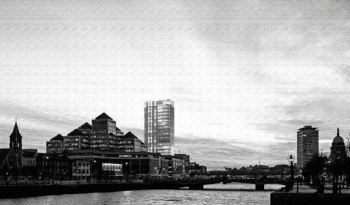
    Obfuscating high-rise with high density serves only deregulatory market-driven ideology by Gavin Daly Rule #101 of the neoliberal playbook – when faced with a housing supply crisis, attack the planning system! It has been thus at leasgt since Michael Heseltine, Thatcher’s bouffant environment secretary in the 1980s, launched his famous broadside against the “jobs locked up in the dusty filing cabinets of planning departments”. Of course, it matters little that there is zero evidence that the planning system is actually stifling supply – the ideology demands that planning regulation must remain firmly in the crosshairs. As planning academic Michael Gunder puts it – “planning is the chief remaining scapegoat of neoliberal governance”, a convenient patsy for contemporary political failures. Housing and planning Minister Eoghan Murphy’s latest wheeze in this anti-planning crusade is a draft diktat to all planning authorities to overrule, what he sees as the overly restrictive maximum building height caps in our towns and cities. Ostensibly justified on grounds of sustainable densification, a presumption in favour of increased buildings heights will now become a mandatory policy requirement in all urban development plans. It is hard to fathom how high-rise development, an entirely niche issue in the context of a very serious housing crisis, has come to dominate public discourse about city planning. Certainly, it has become a lighting-rod for those who see planning regulation as the chief villain and bugbear in impeding housing supply, and development more generally. Influential commentators throughout the mediascape, cheered on by business lobbies and rightwing YIMBY Twitterati, fulminate that we must go “Up!Up!Up!”. Quizzical voices, on the other hand, are traduced as anti-progress, NIMBY, luddites for having the temerity to condemn an entire generation to overpriced homes and endless commutes. It has, of course, long been documented that, contrary to common myth, a simplistic correlation between highrise and high-density is entirely misguided. It goes without saying that some of the tallest cities in the world are also, characteristically, the most sprawling. Indeed, Minister Murphy’s own cost modelling, published just last April, identifies building heights of up to six storeys as being optimal from a viability, density and affordability perspective. Above six storeys, building costs spiral exponentially, due to increased fire safety and other structural requirements. This is entirely counterproductive when the delivery of affordable homes for the estimated 100,000 people who languish on housing lists and the 10,000 homeless is the objective. A mid-rise urban form of six to eight storeys also accords with all international best-practice principles for the creation of high-density, high-quality, transit-oriented, ‘liveable’ and equitable urban spaces, as in oft-cited archetypes Amsterdam, Copenhagen and Barcelona. Indeed it also conforms with long-standing Irish planning guidelines and policies, such as the sustainable urban development guidelines introduced by Government in 2009. Dublin City Council has been debating this issue for nigh on two decades now, which has culminated in a general consensus for a building-height cap of eight storeys with some select locations designated as potentially suitable for higher rise development. So given that this debate has long been settled and the widespread acknowledgement that high-rise towers would make no meaningful contribution whatsoever to general housing affordability or urban density, why then is there a need for this latest edict from the Minister? Why does such an inconsequential fringe issue merit such an intervention and continue to enjoy such a prominent position in public debate? Cui bono? The answer, of course, lies in the hidden rationalities of a resurgent deregulatory ‘let the market rip’ urban growth machine politics and a planning system incessantly targeted by short-term profit-seeking masquerading as a supposed green shift to smart, sustainable urbanism. True to form, where its interests dictate, propertied power implicitly sets the terms of public discourse. Professor Brendan Gleeson of the University of Melbourne describes this global phenomenon as “vertical sprawl” driven by coalitions of property developers, agents and other rentiers seeking to maximise their yields from high-value land. Barely ten years after the collapse of the Celtic Tiger, where poor planning regulation was rightly fingered as a key contributor to financial ruin, we are again witnessing the creeping recrudescence of a discredited deregulatory ideology. It is little wonder that, following his umpteenth failure to secure planning permission for a high-rise tower in Dublin city centre, charlatan urbanist, Johnny Ronan, has publicly stated his intention to try once again. No doubt his dogged perseverance will one day pay off. Of course, it was Ireland’s original rightist ideologues, the Progressive Democrats, who were the progenitors for proposals to Manhattanise Dublin city centre with their ‘A New Heart for the City’ proposal for a gleaming, gentrified enclave of chrome and glass skyscrapers in the docklands, first mooted back in 2006 just before the economic implosion. Indeed, it was Ronan’s, now bankrupt, Treasury Holdings which was to the fore in ceaseless boom-time efforts (which haven’t gone away, you know) to relocate Dublin Port in order to clone a new sterile high-rise downtown. Throughout the western world, these phallic citadels of global financial capitalism exclusively target the corporate elite and the Frappuccinosipping affluent, creative classes. It is with no hint of irony that all the recent exemplars of tall buildings triumphantly depicted in Minister Murphy’s proposed guidelines as architectural prototypes, such as the loftily christened ‘Millennium Tower, ‘Elysium’, and ‘Capital Dock’, exclusively provide for upmarket corporate offices, hotels and highend condos. As DIT housing lecturer Lorcan Sirr coins it: “High rise is for high rollers”. This in the midst of an ongoing social housing calamity. That is why this debate really matters. The real rationality behind persistent clamours to lift building height restrictions lies not in specious claims of a supposedly green shift to intensified, highdensity compact urban forms or easing housing supply bottlenecks, but is synoptic of the battle for the type of cities we wish to create. Deliberately obfuscating high-rise with high density is a clever ruse which belies the deregulatory marketdriven ideology that underpins it, and serves only as an object to co-opt and deflect critique. What the

    Loading

    Read more

  • Posted in:

    (S)height

    Eoghan Murphy’s crude and desperate guidelines on Building Heights risk the aesthetic of our towns and cities By Michael Smith   Density is desirable We should all be able to agree the desirability of densification of the Dublin City area – in accordance with the principles of sustainable development. The advantages of density include being able to justify significant infrastructural, including public transportation but also for example parks, expenditure, which promotes the maximisation of quality of life.   Density and high-rise However, in low-rise cities overshadowing, the need for ground-level plazas and the expense and difficulty of building high (lifts, fire safety, design to avoid windtunnelling and overshadowing), particularly in low-rise environments, militate against high-rise producing high densities or affordable housing, legitimate current policy imperatives. Indeed, with the exception of the world’s megalopolises high–rise, in general, serves the developer, not the public interest.   Irish cities are not like New York! It is perfectly sensible to like New York and to be mostly happy when it goes higher still while recognising that Dublin City Centre (and other Irish towns and cities) a different unique selling point. When we think of Dublin, when tourists spend two days in Dublin, it is the low-rise historic character that IS the city. A Dublin that people overall like. It is fragile because a few twenty-storey buildings in the wrong place could change it forever. A policy of six-storey buildings on three-storey streets could change it forever.This is precisely what the lumbering time-serving of the Department of Housing and their uncertain Minister have delivered as their salvo at posterity.   What high-rise might involve There is no reason to think the sorts of applications that were closed down as ridiculous over the last 25 years would not resurface under these draft guidelines. Irish planning does not have the discipline to provide for discreet areas of high-rise that to not subvert its heritage. I recall for example applications for permission for a 16-storey development on the north side of Thomas Street, a 13-storey apartment block at the Tivoli Theatre on Francis St, a 12-storey residential scheme at School Street and a 13-storey building at Bridgefoot Street. There was a permission for a 16-storey tower for an Arnotts redevelopment plan, an 11-storey development on Chancery St, a 13-storey development on Merrion Road, and the approved demolition of most of the Clarence Hotel in favour of an oversailing cybership. I remember a Liberty-Hallheight sky-borne ski-slope structure over the Carlton site on O’Connell St. I remember when Treasury holdings wanted a 35 storey hotel to the rear of the Convention Centre and an application by Manor Park Homes for a 51-storey building on Thomas St in Dublin’s Liberties as well as Sean Dunne’s proposal in Ballsbridge for a 37-storey, 132-metre high residential tower that would of course have been “cut like a diamond”. Recently we had Johnny Ronan’s application for 22 storeys on Tara St, likened to a skybound fridge.   Rhetoric differs from reality Inevitably these applications are dressed up in property-supplement-speak as “crystalline”, ‘sculptural”, “breathtaking” and as heralding Ireland’s arrival in the exciting big-time. The reality – as we know from O’Connell Bridge House, Liberty Hall, Georges Quay etc as well as from much of England is that there can be few urban aesthetics as depressing and lumpen as an incoherent skyline.   Do it properly: scientifically assess carrying capacity In parts of low-rise historic cities there may indeed be a carrying capacity for high-rise. This needs to be methodically ascertained, using balloons and other geo-architectural techniques. It is extraordinary that the draft guidelines and accompanying Strategic Environmental Assessment provide for no such scientific exercise. I reserve my right to challenge the largely generic SEA which pays inadequate attention to material assets and the cultural especially architectural heritage; and for this reason is unlawful. Where, following assessment of local carrying capacity, high-rise development can be squeezed in in low-rise historic cities it is a good thing.   The model There are possible paradigms: all buildings, meaning buildings significantly higher than neighbourhood or surrounding buildings, may be considered only following adoption of Local Area Plans which should specifically provide for preservation in full of existing positive local and civic character; and should be prepared only after the fullest consultation and engagement with the public including local residents, public sector agencies, non governmental agencies, local community groups and commercial and business interests within the area. If possible, local community groups should be afforded reasonable costs for the making of submissions on Local Area Plans. This mechanism would provide for the proper assessment and consultation that must precede any significant change in the ethos of those parts of the city that may actually benefit (I believe there are some) from high-rise. We cannot tell in Dublin but it is to be expected that it would include most of Docklands, maybe Heuston, maybe around Connolly, probably in much of suburbia, particularly where architectural banality could benefit from counterpointing. Why not consider judicious place-affirming high-rise on the Long Mile Road, or in Dean’s Grange or Adamstown? The guidelines disdain character and locality. The draft guidelines criticise local authorities for “setting generic maximum height limits across their functional areas”, mainly in response to “local-level concerns like maintaining the character of an existing built-up area”, even though this could “undermine wider national policy objectives”. But surely these local concerns are legitimate? Anyone concerned with democracy or urban planning would. Because as described above this particular concern for character is entirely consistent with national policy objectives, including the demi-god, densification.   The guidelines are wrong about city-centre density Though it seems to have escaped the unimaginative but now policy-desperate Department of the Environment, recent studies confirm that densities within Inner City Dublin are high. Eurostat’s 2016 publication ‘Urban Europe – statistics on cities, towns and suburbs’ highlights the number of inhabitants per square kilometre. in the three highest density electoral areas in each EU country. The highest densities in Ireland are in Inner City Dublin, being:

    Loading

    Read more

  • Posted in:

    LauraKennedyWatch

    Recent publishings in the Irish Times from Laura Kennedy: Freelance writer, doctor in philosophy, columnist @IrishTimes and beauty columnist @IrishTimesMag   I wonder, not for the first time, how it is that many of the changes in my life have been punctuated by sitting on some park bench or other, listening to the faint trilling of children in a playground, and to the birds, if the season has them inclined to sing. This may sound like something a philosopher shouldn’t say, and I hope I’m not booted from the club for suggesting it, but time is a concept that doesn’t bear thinking about all that much. Sometimes, events occur in our lives which can prompt a reassessment of the things we think we know about ourselves… Such examples as I have witnessed include a man at a friend’s wedding who chose to become so drunk that while other guests were dancing to Rock the Boat, he thought it a good idea to simulate making love to the (already cut) wedding cake, which naturally was unable to proffer its consent. Suddenly, Jules leaned forward from his window seat and addressed the woman, who was sitting between me and the aisle. “Just so you know…,” he said calmly and with a benign smile on his face, ‘I am going to go the bathroom one hundred times during this flight’. Knowing that he would never actually do such a thing, I stifled a small chuckle as the plane began to ascend. Suddenly, a key worries in the front door lock, and himself trundles through, loud and large as always, holding a hurley and a paper bag. “I BROUGHT YOU A MUFFIN,” he shouts, waving the bag and totally unfazed to see me sitting on the floor. “IT’S BLUEBERRY.” I take the muffin from him gratefully. Home does not have to be a place. I Finished my doctorate because I had sacrificed and slowed progress in other areas of my life to sit in rooms with excellent dead guys such as Spinoza and William James, and I felt as though I deserved the piece of paper which certified the knowledge I had worked so hard to gain. After all, such pieces of paper represent leverage in the social and working world. The women I am having brunch with (brunch is a “notions” meal observed by notions Dublin types, and Aisling would strongly favour a sandwich with chips on the side) tell stories of Aislings they know or work with, or tell stories about themselves in an attempt to prove they are “actually a complete Aisling really”. My friend’s snippiness expresses itself as a sort of unfriendly absence of joy in someone else’s achievement, or the odd disparaging comment seemingly out of the blue. Recently, when a mutual acquaintance told my friend and I about someone we both know and like sadly getting a divorce, my snippy friend looked positively smug. The woman whose marriage is coming to an end had what most people would think of as an ideal marriage – financial comfort, a good job and a baby with almost unbelievably squeezable cheeks. I thought of that baby and felt terribly sad. My friend said, almost merrily “She’ll be less full of herself now anyway!”, before bouncing off to the bathroom. My companion and I stared after her, mouths slightlYagape, then looked at one another, unsure of what to say. It is difficult to attribute such meanness to anything other than resentment. An individual act that would improve all humankind: whenever you knock/ring on/at a front door, presume that the person inside is on the loo, and calculate how long it would take them to get off the loo before you knock/ring a second time. It’s what Kant should have done. The job of a beauty writer simply could not be nicer. Beauty products are not just frivolity; in many ways they are a sort of soundtrack to our lives. I know it is taboo as an adult to say you don’t have a lot of friends, if only because it is embarrassing to admit. If you have not developed a sturdy net of social connections by your 30s, there is a sort of taint on you; a kind of maudlin aspect that suggests there might be something wrong with you. Perhaps you had friends once, but you murdered them all and they are stuffed and arranged in your garden shed in an exact replica of Leonardo’s Last Supper, or maybe you’re just a crap friend. The sort of person who borrows money and never pays it back, or who puts their shoed feet on other people’s cream sofas while remarking on the asymmetry of their children’s faces. I was in my mid-20s when I found Narciso Eau de Parfum by Narciso Rodriguez (2; from €55 for 30mls), recommended to me by fellow beauty writer and friend Laura Bermingham while we were tearing through a French airport (there’s always time to stop to look at perfume).

    Loading

    Read more

  • Posted in:

    430,689 not 85,799

    We need to face up to what mature countries call housing need by Rory Hearne   There is general acceptance that the housing crisis has reached unacceptable levels. However, the government’s current policies are inadequate to address the crisis because, firstly, they underestimate the scale of the crisis. Secondly, they deny the overall housing policy framework of ‘Rebuilding Ireland’ has failed. This article makes the case that the level of housing ‘need’ is much higher than current official estimates and that Rebuilding Ireland should be jettisoned, and a new housing policy developed. A new housing policy for Ireland should start with the aim of ensuring everyone in this country has their right to a home fulfilled i.e. access to affordable, quality and secure housing, and this is to be achieved by the state playing a central role in ensuring the building of large-scale ‘public housing’. This public housing should be a new form of social and affordable housing – available for a range of incomes considerably higher than allowed by current social housing rules. This would involve the state, mainly through local authorities, but also through not-for-profit housing associations and co-ops, and a new state house building agency, using public land to build high-quality, well planned and environmentally sustainable ‘communities’ of-different housing types for a range of households including workers of all incomes, families, students, the elderly and those with disabilities. Key associated issues include facilitating and funding the correct amount of this ‘public’ housing. Firstly, in regard to estimating the real housing need it is clear that there is a large number of households which cannot afford housing. However, estimates of housing need are restricted to the households that qualify for social housing – currently the 85,799 households on local authority lists. This list does not include tenants who are in the privaterental sector in receipt of social housing supports like the Housing Assistance Payment (HAP) and the Rental Accommodation Scheme (RAS). These tenants do not have security of tenure (they can be evicted by landlords) and therefore they are still in housing need. Neither do the official lists include some homeless households, those in direct provision, and those in domestic-violence refuges, who are all clearly in housing need. Furthermore, there are approximately 35,000 home-owners over 360 days in arrears on their mortgages who are also clearly in major housing need. If you add these then the total social housing need becomes 185,505 households: over double current estimates of need. This figure demonstrates the real scale of the crisis. The problem is if policies are underestimating the real scale of need they are clearly going to be ineffective in meeting the actual level of need. However, we also know that the need for ‘affordable’ housing extends to many more households. It includes many renters in the private sector who are paying more than 30% of their income on rents (an internationally accepted definition of ‘affordable’ housing), it includes aspirant home owners who cannot afford current house prices, students and many adult children living at home with parents, couch-surfing, etc. While it is difficult to estimate how many households this includes, the ESRI notes that a third of renters in the private rental sector have ‘high’ housing costs. If you remove the 56,000 HAP and RAS households from the private rental sector, this equates to 85,000 households in need of affordable housing from the private-rental sector. Adding this to the estimate of housing need above gives a total of 270,505 households in need of social and affordable housing – three times the current social housing waiting list. Another way of estimating need is to compare how countries with effective housing systems assess it. In countries like the Netherlands, Sweden, Austria and Denmark, social housing (non-market housing) comprises between 24% and 40% of all housing stock. In Ireland just 10% of housing stock is social housing. A good target for Ireland then, if we are to solve the housing crisis permanently, is to bring our stock of social housing up to around 30% of total housing stock. This would equate to approximately 606,800 units. However, our current social housing stock is only 176,178 units. So we would need to add 430,689 public affordable units. If we were to do this over a reasonable timeframe, say ten years, then that means providing approximately 43,000 units per year of new public housing. This could be approximately, 27,000 for those qualifying for ‘social’ housing and 16,000 for those on higher incomes. When we compare these to the Rebuilding Ireland targets and its approach to delivery we can see clearly why the Government and Department of Housing have failed to solve this crisis. Rebuilding Ireland aims to provide between 21,000 and 26,000 ‘new’ social housing units per annum. These are interesting and useful figures because providing 26,000 new social housing units per annum, over 10 years, gets close to meeting the level of actual social housing need I have calculated earlier (at 270,000 households, but this is a static figure based on current need and assumes that housing need does not grow. In the current climate we can see this is not the case. However, the Rebuilding Ireland figures are completely misleading because approximately 18,000, or 70%, of these ‘new’ units are not new social housing stock but just various forms of subsidised private rental housing via HAP or RAS schemes. This is a vital point to understand because not only do HAP and RAS not provide security for tenants, they constitute very poor value for money as the state is handing over almost €750m a year to private landlords. Worse, it exacerbates the crisis by adding to demand rather than supply. The housing crisis is a crisis of supply, but it is the lack of social and affordable supply that is at its heart. There is increasing cross-society consensus that the state must build more social and affordable housing in the form of new public housing through cost rental and other forms of social and

    Loading

    Read more

  • Posted in:

    McWilliams regurgitates

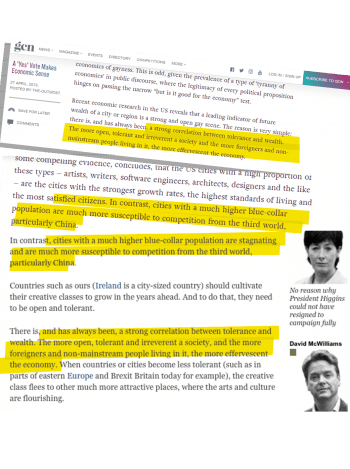
    But it’s only his own old articles by Emma Gilleece David McWilliams has been a household name since 1999 when he invented the term Celtic Tiger. Except he didn’t. Later that year he conceded it was an ex-pat City of London-based analyst called Kevin Gardiner who used the term in a Morgan Stanley report published in 1994. As late as 2005 the Irish Times was still reporting “that McWilliams coined the term ‘Celtic Tiger’”. An article in Village earlier this year postulated that, after this, McWilliams – a prolific and entertaining, though largely value-free, social commentator – seems to have privately resolved that no Celtic-Tiger-derived phenomenon in Irish society would go unnamed by him. So in his book the ‘Pope’s Children’ (2005) he introduced us to social icons like Breakfastroll Man, DIY Declan, Speedbump mom, Kell’s angel, Hi Co, Bouncy Castle man, Carrot Juice Contrarian, to Robopaddy, Low GI Jane, and The Expectocracy; and to phenomena of the time like the Wonderbra effect and Deckland. He was also famously the force behind the bank guarantee, though not of course as it was eventually implemented, and of the Global Irish Forum which achieved very little with a great deal of noise for the dark years from 2009 up to 2015 before quietly being put down. An academic from Trinity drew attention some time ago to issues with McWilliams drawing inspiration from well…himself. He reuses material from one organ in another. This might be forgiveable in a low-budget magazine but it is reprehensible in a star columnist, as McWilliams has for many years been. He currently has a prominent weekly column in the Irish Times Weekend Supplement. On June 30 McWilliams wrote a lengthy feature on the creative class in the Weekend section: ‘Ireland needs to nourish its creative class’. Its thrust was the same as a piece he wrote in February 2016 in the Irish Independent in. Both articles contain the phrase, “There is, and has always been, a strong correlation between tolerance and wealth. The more open, tolerant and irreverent a society, and the more foreigners and non-mainstream people living in it, the more effervescent the economy”. A little earlier both articles contain the following: “In contrast, cities with a much higher blue-collar population are stagnating and are much more susceptible to competition from the third world, particularly China”. On and on he goes (in both: “For example, in the US, there is a strong positive link between the creative class and the “gay index” (the concentration of gay people and the relative tolerance of legislation in a city or state). The reason for this is gay people are much more likely to feel comfortable settling in tolerant cities, and these places are also much more likely to display soft economic power. (This is not to say gay people are more creative, but where you see a significant presence of a creative class, you also see more gay people.)”. His thinking does, let it be said, sometimes evolve. In 2016 he felt Gays were ‘the last Outsiders” but by 2017 he noted that they were Outsiders “until recently”. A piece in Gay Community News in 2015 (Outsiders still) made the same arguments in the same phraseology. McWilliams’ articles on moving Dublin Port (one from the Irish Times in 2018: ‘David McWilliams: Dublin Port is a waste of space. Move it’ and the other from the Irish Independent in 2017: ‘Move Dublin Port and create new city on the water’ too are very similar. Perhaps there’s only one thing he wants to say about it. In the end McWilliams seems to have been pulled up on his compulsive repetitiveness by the Irish Times. However, as recently as 2 October an article ‘Why Ireland leads in tolerance towards immigrants’ borrows extensively from a paragraph from McWilliams’ blog ‘To fight far right we must help Muslims to fit in’ from 26 February 2017. In 2012, media watcher noticed that the blog of a new New Yorker staff writer’, Jonah Lehrer, “Why Smart People Are Stupid” copied, at times verbatim, three paragraphs from Lehrer’s 2011 Wall Street Journal story “The Science of Irrationality. In the end The New Yorker added editors’ notes to all five blog posts that “paragraphs,” “portions,” or “details” originally appeared in earlier Lehrer works. Perhaps plagiarism does not harm: perhaps people don’t mind paying for articles that are plagiarised; one only helps McWilliams isn’t paid for it.

    Loading

    Read more

  • Posted in:

    It was about McCabe not O’Sullivan and Fitzgerald

    Fine Gael learns the wrong lessons from the Charleton Tribunal report by Frank Connolly   The almost hysterical reaction of her former colleagues to the finding by Justice Peter Charleton that Frances Fitzgerald had done nothing to warrant her resignation from the cabinet in November 2017 is little short of mind-boggling. Instead of focusing on the extraordinary and shocking findings of the Disclosures Tribunal which found that a former Garda Commissioner, Martin Callinan, had attempted to destroy the character and reputation of Maurice McCabe and, with Garda press officer David Taylor, had run a smear campaign against the garda sergeant, cabinet members thought that the Fitzgerald exoneration was the most important detail to emerge. They also managed to avoid mention in their early comments of the fact that the HSE and the child protection agency, Tusla, had wrongly implicated McCabe in the rape of a young girl and that Tusla had passed on a file detailing absolutely false allegations against McCabe, to Garda headquarters. While it is understandable that Fitzgerald might seek to get some apology from those politicians who called for her resignation over what she claimed were misleading statements in the Dáil of what she knew or didn’t know of the State’s legal strategy against McCabe, her treatment pales into insignificance compared to the awful damage meted out by various authorities to the garda sergeant and his family. As with the findings of the Morris tribunal into Garda corruption in the North West Division, Charleton’s 300-page report is another damning indictment of the culture that permeates the force from the top, and of the failure of both the Department of Justice and successive governments to properly confront the breakdown in Garda discipline. “A country with an undisciplined police force is at risk from that police force”, Charleton observed, noting that the person who directed the smear campaign of McCabe on behalf of the Garda Commissioner and others has yet to face any significant punishment over his behaviour. That behaviour included David Taylor briefing journalists from a range of media outlets with the false claim that McCabe had been implicated in the abuse of the child of a garda colleague in a campaign that culminated with Callinan informing two politicians, a journalist and the Comptroller and Auditor General that the whistleblower had abused children. McCabe was “a kiddie fiddler”, Callinan told some he met as he hung around the hearing of the Public Accounts Committee in Leinster House before he publicly and infamously described McCabe and another whistleblower, John Wilson, as “disgusting”. A day later he went further and told PAC member and Fianna Fáil TD, John McGuinness, that McCabe had “sexually abused his family and an individual” and “that he was not to be trusted”. If it were not for McGuinness; Fine Gael TD, John Deasy; journalist Philip Bouchier Hayes; and the C&AG, Seamus McCarthy confirming to the tribunal what they were each separately told by Callinan, Sergeant McCabe would not have received the absolute vindication he received from Charleton. Charleton said McCabe was “a paradigm of decency, who was repulsively denigrated for being no more than a good citizen and police officer”. There must have been an element of deja vu for the High Court judge as he was a lead barrister acting for the Morris tribunal in the early 2000s when he was forced to endure a litany of lies and obfuscations from Garda witnesses during the lengthy hearings into the Donegal fiasco. In his latest report, the judge concluded that David Taylor gave “Nuremburg” type “daft” testimony that he was only carrying out orders from above. Taylor had implicated Nóirín O’Sullivan, who succeeded Callinan as Commissioner, in the smear campaign against McCabe but Charleton rejected this assertion. He did find that some of O’Sullivan’s evidence was “disappointing” and of course, the image of her sitting silently beside Callinan at the PAC hearing when he rounded on the “disgusting” whistleblowers will forever taint her legacy. What remains to be seen is whether there will be a more thorough investigation into the manner in which Tusla became embroiled in the campaign against McCabe and why hundreds of police officers, asked for their recollections, could not recall any such smearing exercise. In the meantime, it is reported that Taylor is to retire on full pension.

    Loading

    Read more

  • Posted in:

    Dial MI5 for Murder

    HAS SPOOK-TURNED-THRILLER WRITER DAME STELLA RIMMINGTON FORGOTTEN WHAT IS IN MI5’s TOP SECRET FILES? Dame Stella Rimmington has just published another of her bestselling Liz Carlyle spy yarns The Moscow Sleepers in time for the Christmas market. In it, the redoubtable Liz is set against some  very nasty men from Russia. This has all been done ten thousand times in one guise or another. This is all rather a shame because Stella Rimmington, a former Chair of the Judges for the Man Booker Prize, could probably produce a novel of real substance if she really put her mind to it. After all, she was theDirector-General of MI5, December 1991-1994, and spent a career knee deep in all sorts of skulduggery, including snooping on perfectly respectable MPs, trades unionists, civil rights groups and journalists. Since she joined MI5 in the late 1960s and left it in 1996, she must know virtually all of MI5’s most pitch-black secrets, especially those of the Troubles, though you certainly wouldn’t suspect this from her fictional output or her double-whitewashed 2001 memoirs, Open Secret, which may as well be a work of fiction. Rimmington is a dab hand at transforming fact into fiction; whether at a conscious or sub-conscious level is best left to the experts. Incredibly, she believes no one in MI5 ever lifted a finger to thwart the Labour PM Harold Wilson, seen by some in MI5 as a dastardly KGB stooge and traitor. This, despite the fact back that no less a figure than Lord John Hunt, the mighty and all-powerful Cabinet Secretary, 1973-79, acknowledged that it had indeed happened. In August 1996 Hunt told a Channel 4 documentary that, ‘There is no doubt at all that a few, a very few, malcontents in MI5, people who should not have been there in the first place, a lot of them like Peter Wright who were right-wing, malicious and had serious personal grudges, gave vent to these and spread damaging malicious stories about that Labour government.’ THE FORMER TOP SPY WHO DRAWS NO INSPIRATION FROM THE REAL SPY WORLD Unless she was sleep-climbing during her ascent to the top of MI5’s blood-soaked pole, Dame Stella must have heard something along the way about: MI5’s collusion with Loyalists hoods in Northern Ireland such as the Glennane Gang; The MI5-RUC shoot-to-kill scandal that John Stalker, the honest, admirable and principled Deputy Chief Constable of Manchester, investigated in the 1980s, only to be vilified as he edged closer to the truth about MI5’s complicity in the murder of a string of people including Michael Tighe, a 17 year-old with no links to any paramilitary group; The deeply sinister framing of Colin Wallace by Ian Cameron (Wallace wanted to stop MI5-protected child rape at Kincora Boys Home and other dirty tricks) and the pernicious vilification of Fred Holroyd – again perpetrated by Cameron – (Holroyd didn’t want to murder people for MI5); The brutal assassination of the Belfast solicitor Patrick Finucane in 1989 in front of his wife and young children by acknowledged British agents; The setting fire to the offices of that other honest, admirable and principled cop, Sir John Stephens in Belfast in 1990. His office was torched during his investigations of MI5’s exploitation of the UDA as proxy assassins with the aid of Brian Nelson, the Head of the UDA’s Intelligence department; MI5’s network of contacts inside Garda Intelligence; The print journalists in Dublin who were fed stories by HMG’s spooks. Since MI5 co-operated with MI6 in the Republic, Dame Stella must know which journalists had their noses in the trough and who just was rewarded with a pat on the back at meetings of the British-Irish Association or over dinner at the Dublin Embassy; The MI5-Red Hand Commando (RHC) attempt to place a bomb on Charles Haughey’s boat in Dingle harbour in the summer of 1981 when the RHC was led by a serial killing MI5 psychopath called John Dunlop McKeague. Did Stella ever read McKeague’s file? And while we are at it, what about Haughey’s file? Surely Stella she had read it by the time she became D-G at the end of 1991. Haughey didn’t retire as Taoiseach until 11 February 1992. Why hasn’t Stella drawn on any of this remarkable source material for her hitherto run-of-the-mill fiction? Has she forgotten everything in the files? In Open Secret, she wrote – merely in passing it must be stressed that – ‘Loyalist terrorists too had developed their operations and were constantly looking to increase and upgrade their arms and equipment.’ (211) That’s all very fine Stella, but please:   what part did Ian Cameron and all the other psychos in MI5 who served in NI play in helping them; in directing them; in covering-up for them? THE CORRUPTION OF THE SOUL Regrettably, like that other spook-turned-author, John Le Carre, formerly of MI5 and MI6, Stella steers well clear of what HMG’s real-life spooks got up to in Ireland in both her fictional and factual outpourings. For his part, Le Carre has managed to convince himself that he has attempted to ‘explore’ Britain’s ‘psyche’ and that in so doing, ‘it’s Secret Service [was] not an unreasonable place to look’. Regrettably, he never set any of his – admittedly brilliant – novels in an Irish setting. Does he not believe the Troubles had an effect on the British ‘psyche’ or were the crimes of HMG’s spooks just too much to deal with? Anthony Cavendish, who served in both MI5 and MI6, certainly wasn’t afraid to confront the truth. He described in his memoirs, Inside Intelligence, how as ‘the years go by, the lies take over from the truth and morality accepts the other demands which are made on an [intelligence] officer to get the job done’ and that ‘theft, deception, lies, mutilation and even murder are considered if and when necessary’. So, just what is the point of promoting Rimmington on the cover of her Liz Carlyle books as the ‘Former Head of MI5’, if she

    Loading

    Read more

  • Posted in:

    EU’re in the Line of Fire

    EU Digital Copyright Directive aims to reward content providers but overreaches on ordinary web users By Laurence O’Bryan   Our world is experiencing a cathartic period of change, thanks to the internet and social media. The President of the United States uses Twitter to rally popular support among his base, including people who believe, as he does, that race and immigration issues are intertwined and that high walls are the best way to deal with neighbours. A political world away in Nicaragua, the one-time darling of the left, Daniel Ortega, has seen real challenges emerging thanks to the widespread online dissemination of videos of his police thugs beating up protesters. He’s obviously still catching up with how to use the new tools. In Venezuela, independent web sites and social media report the black-market exchange rates and murder counts. That’s anathema if you’re trying to prop up a dying regime. In Tanzania the government has introduced a US$930 fee for bloggers to create content. And in Kenya resident Uhuru Kenyatta signed a cybercrimes bill, criminalising the publication of fake news. The web, and its promotion and suppression, has enveloped our small world. Clearly many despise the transparency that independent web sites and social media bring. Attempts to stifle new media are being proposed even in Ireland. A proposed EU Digital Copyright Directive was approved by the European Parliament on 12 September 2018, and will enter formal Trilogue discussions that are expected to conclude in January 2019. If formalised, each of the EU’s member countries would then be required to enact laws to support the directive. One of the key objectionable aspects of the new copyright directive is the requirement that bloggers and social media commentators install software to preapprove content. This suggestion is buried in a section of the proposed legislation. Article 13 of the ‘Proposal for a Directive on Copyright in the Digital Single Market’ is written in the language of bureaucrats. It is intended to enable “a fair balance between the rights and interests of authors and other rights holders on the one hand, and of users on the other”. Article 11 of the same Directive provides for the so-called “link tax,” which gives publishers a right to ask for paid licences when online platforms share their stories. The obvious target is aggregators like Google News, but there are wider applications. This is EU Big Brother overreaching. The idea is that online platforms become liable for content uploaded by users that infringes copyright – to the advantage of content-makers. But it’s not that simple. Even if you are e sympathetic to the notion of barring teenagers from uploading mashup videos without paying for the music track, and of YouTube paying up when those tracks are identified, you should recoil from the thought police installing a copyright check system before you upload anything to any web site. If you decided, after Article 13, to post a “quote” from a famous writer or retweet a picture of a demonstration, you might need to apply for a licence and have your post and Tweet pre-approved first by the EU’s software as the quote and picture could be owned by someone else. And the proposal to require all internet services to create filters to prevent copyrighted material being uploaded illegally, will be a levy racket which could put many smaller websites out of business. I run a web site which lists books to help readers find new authors. Am I to pay to have a software tool assess what I may and may not put up on our web sites? And given the many failings of existing copyright-identifying software, in my personal experience of our book trailers that have been incorrectly flagged, where we have paid for the music used, it seems likely that the tool will make mistakes. Article 13 has been criticised by Sir Tim Berners-Lee, inventor of the worldwide web, and Jimmy Wales founder of Wikipedia. Both have warned that Article 13 could “damage the free and open internet”. Even the United Nation’s human rights experts oppose Article 13 on the grounds of limiting the right to free speech. And the next likely step is an attack on ‘fake news’ – a European Commission group of experts has already been established – and then that EU filter software, and the terms of your licence to use it, could be used to stop you saying anything online that could constitute fake news. But one person’s fake news is another person’s truth. I am sure some EU bureaucrats would object to ‘The Iliad’ if it was to be published on Amazon for the first time, under Article 13, for its use of epic poetry from previous sources and the one-sided nature of its reporting of the Trojan war – of who the heroes were and who ran away. If there is a line to draw beyond which the EU must not pass Articles 11 and 13 point to it.   Laurence O’Bryan is an author and founder of BooksGoSocial and the Dublin Writers Conference.

    Loading

    Read more

  • Posted in:

    The Boy on the Meat Rack

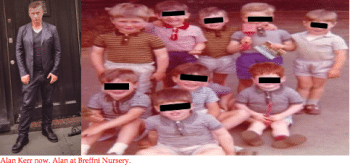
    A Life Derailed, Part 1 of the Story of Alan Kerr; By Joseph de Burca.  INTRODUCTION Alan Kerr was sexually abused by three men at Williamson House, a Belfast Corporation Welfare Department care home in Belfast. He was only six years of age when it started.  One of his abusers was Eric Witchell, the Office-in-Charge of the home. Witchell was a friend of both Joe Mains, the infamous paedophile and Warden of Kincora Boys’ Home and William McGrath, the Housefather at Kincora. Alan is the younger brother of Richard Kerr who has featured heavily in Village during the last two years. Alan did not realise he had a brother until he met Richard at Williamson House when he was six. He also met his sister at it and learned that he had another brother, and two other sisters; moreover, that both of his parents were still alive. Later, he was moved to Shore House where he was abused by another two men, one of whom may have been Witchell’s friend, William McGrath. Alan eventually fled from institutional care for a life on the streets of Belfast but it was no more than jumping out of the frying pan and into the fire. Having been neglected, groomed and abused throughout his childhood, and finding himself desperate for food and shelter while on the run, he fell into the hands of a network of calculating paedophiles who abused him. At one point in time he was manipulated into working for a while at a brothel off the Lisburn Road where boys as young as 13 were made available to Belfast’s paedophile community. Later again, he was trafficked to Birmingham and thence to London by Billy ‘B’, one of his abusers. Out of desperation and with neither an education nor any sort of a qualification, he would end up being exploited as a ‘rent boy’ at Victoria Station;  as  a ‘Dilly boy’ on the ‘Meat Rack’ at Piccadilly Circus;  and for approximately a year in a brothel in Earl’s Court alongside other boys who were younger than him; possibly even as young as 13 or 14. He also had a bizarre encounter with two members of the Royal Family. Alan’s life in London will be described in the next edition of Village. PART 1: A FOG OF FEAR AT BREFFNI NURSERY 1969-1974. ALAN AGED 0-6 INCARCERATING TODDLERS WHO CRIED AT NIGHT IN A PITCH-BLACK BOILER ROOM Alan Kerr was born on 8 May, 1968, and was taken into care at Breffni Nursery when he was only a few months old, sometime in late 1968 or early 1969. There was a lot of sobbing at night time in Breffni, a care home which catered for infants and pre-school children. Alan recalls how, if a child in the dormitory began to cry out loudly at night, some of the more brutal member of the night staff would put the child in a boiler room, well out of earshot. They were often left for hours alone in the pitch black. Alan often found himself crying because he was surrounded by cold strangers; had no family ‘to love me’; and had to cope with the unrelenting stress of a threatening environment. He too ended up in the boiler room on a number of occasions. He recalls one particular night when two of the night staff marched into the dormitory, hauled him out of bed and carried him to it, then pushed him inside and left him alone in the darkness four hours.   PART 2: RAPE AT WILLIAMSON HOUSE 1974-1978. ALAN AGED 6-9   ALAN KERR WAS SEXUALLY ASSAULTED ON HIS FIRST NIGHT AT WILLIAMSON HOUSE. HE WAS ONLY 6 YEARS OLD  A caveat must be entered before we proceed any further: Alan Kerr does not have access to his institutional records from Belfast and therefore cannot provide precise dates. Instead, he has done his best from memory. Alan left Breffni Nursery when he was about six, sometime in 1974, or thereabouts, and took up residence at Williamson House for the next two or three years. He describes it as being ‘worse’ than Breffni. ‘Things did happen there which I still can’t talk about.’ Alan would be abused by men who were not members of the staff at Williamson House; yet more proof of an organised child abuse ring operating in NI at this time. Astonishingly, the existing of a network has been dismissed by a series of lightweight inquiries which were no match for the corresponding heavyweight cover-ups organised by the British Establishment and which have lasted for nearly four decades. The most recent example of this was the mistake riddled Hart Report of January 2017, a document that even manages to contradict itself. ‘The abuse began on my first night at Williamson House when a man climbed into my bunk bed. I didn’t understand what was happening.’ The event was so traumatic, Alan manages to black it out most of the time and certainly prefers not to talk about it. Alan’s brother Richard and his sister were at Williamson House. Prior to his arrival, he had no idea that he had any family. He also discovered he had two other sisters and a brother. Alan, Richard and his sister were together for about a year before Richard was shipped out to Kincora Boys Home, perhaps the most concentrated cesspit of child sex abuse in Ireland at that time. Alan’s sister remained with him at Williamson House. He received his first visit – or at least the first visit he can remember – from his parents at the home. One of Alan’s abusers at Williamson House was Eric Witchell. He was a friend of Joe Mains, the Warden of Kincora, and William McGrath, the Housefather at Kincora. Although Witchell’s title was that of Officer-in-Charge, his responsibilities were confined to one of the two buildings at the institution, each of which was administered separately. Alan was not a resident on Witchell’s wing. Nonetheless, Witchell managed to lure

    Loading

    Read more

  • Posted in:

    The Secret Barrister, reviewed by David Langwallner

      The rage of London at the moment is a self-consciously anonymous blog called “The secret barrister” which is an exposé of the profession of a criminal barrister and indeed of the criminal justice system written by a junior counsel specialising in criminal law. This blog aims to provide a fly-on-the-wall view of the criminal justice system, and of life at the Criminal Bar in general. He writes for the New Statesman, The Sun, The Mirror and Huffington Post. His first book, ‘Stories of The Law and How It’s Broken, published in March, is a bestseller.     If the author had named himself the professional repercussions would not have stinted so, sagely, he has not. The book is written with an avowed sense of sadness, indignation and anger grounded in an overarching desire to secure a measure of fairness within the criminal justice system.  The morphology of the book is to take a criminal case from inception to conclusion to show what goes wrong – to demonstrate that which is unfair.   The book’s argument, delphically stated and perhaps not fleshed out in the detail it should, is that we are moving from a criminal justice system to a criminal system which risks presumptions of guilt. The presumption of innocence which is a British creation is central to justice in a civilised system. But the scruple-based process has become telescoped and mere accusation is now criminalisation. The hallowed, flawed system is losing its protections and safeguards. There is, in criminal justice possibly more than any other sphere of public life, a devastating lack of public education, exacerbated by inaccurate, ill-informed media reports and political pronouncements that betray an ignorance of the legal system that stretches up to the very top of government. This lack of understanding means that politicians escape scrutiny when terrible things are wreaked upon criminal justice – such as the policy that you can be wrongly accused of an offence, denied legal aid and then denied the cost of your private legal fees even when acquitted – and that, when we see a legal story reported in the press – such as the latest ‘look at how much legal aid this murderer received from your taxes – we often lack the tools to critically evaluate it”.     Now I agree with all this and it corresponds with my professional experience in Ireland and the United Kingdom. We are not far from the point that corrupt and (in Ireland) criminal state authorities use an accusation to create a snowball effect,  Often an accusation alone touted and reinforced by a dirty and compliant media is enough to destroy. Once the machinery of mediocrity and state incompetence gets a half baked sense of an accusation the whole thing trundles along and guilt or innocence are merely matters of happenstance. This is augmented by the cult of the pseudo-expert: a three-week training course alone underpinning the pontificator’s cant. This is accentuated in Ireland by our deeply corrupt and criminal professional classes and as we have seen the toxic relationship between  TUSLA, the Department of Injustice and the bar with its illusory independence. In the UK I have not seen not overt state criminality though I recognise the book’s theme of derelict state disclosure of favourable unused material in the practice of the criminal bar here in London where I am now working. In an extraordinary 87 per cent of cases audit trails show the disclosure of evidence to defence lawyers from the police or Crown Prosecution Service to be unsatisfactory, In my view this is systemic, as the police, social services, academics and an over-burdened professional class are making decisions in conditions of radical uncertainty and often with limited training.   Putting victims first, witness protection and the prohibition of hard and intimidating cross-examination is very dangerous. It protects liars and fabricators. A cloak of protection engineered by police, social workers and a dumbed down culture protecting those who enlist the nanny state of the semi competent.   Advocates have a right to annihilate people and not to be stopped in their tracks, as I was recently, if they reduce someone to tears where necessary.     Through lack of training, under-resourcing, lack of motivation and a drop in standards the system is descending in both jurisdictions into chaos.   The system’s flaws flaws are not those of the people who work within it, but are imposed: by the state. Each flaw is “either deliberately designed – such as the Innocence Tax, (the Legal Aid Act 2012 under which defendants find themselves massively out of pocket even when found not guilty)  or the restriction of compensation for miscarriages of justice – or is the product of populist, tough-on-crime, anti-defendant posturing, or betrays warped spending priorities where politicians persuade voters that one penny off a pint of lager is a better investment than a working justice system”.     Moreover, as the Secret Barrister notes, “Part of the problem, as well, is the legal profession. We do a stunningly poor job of explaining to people what the law is, and why it matters. Too many of us are content to busy ourselves in our own work, safe in the knowledge that what we do is important, but without feeling the need to deconstruct for the man on the street why two wigged figures incanting Latin before an old man wearing a giant purple robe, and the obscured codes and rules governing this mediaeval ritual, has any relevance to their everyday life. We then wonder why there is an obvious disconnect between the legal system and the people it exists to serve and protect”.   He is concerned about the ethical compass of vulture solicitors, as am I.   He does not say much about the art of the advocate per se but much about how cuts over time and an increasing workload have diminished the quality of justice and the profession.  He is scathing of minor prosecutions: “Much prosecuting in the

    Loading

    Read more

  • Posted in:

    THE DUP SKELETONS IN THERESA MAY’S CLOSET

    SIR ANTHONY BLUNT, BRITAIN AND MI5’S ARCH TRAITOR, WORMED HIS WAY BACK INTO THE GOOD BOOKS OF BRITISH INTELLIGENCE BY PROVIDING THEM WITH DETAILS OF A PAEDOPHILE NETWORK IN IRELAND OF WHICH HE WAS A MEMBER AND WHICH THEY LATER EXPLOITED FOR BLACKMAIL AND DESTABILISATION PURPOSES.  THERESA MAY YET CLINGS TO POWER WITH THE AID OF THE DEMOCRATIC UNIONIST PARTY (DUP), AT LEAST ONE OF WHOSE MOST SENIOR MEMBERS FREQUENTED THE SAME SEEDY PAEDOPHILE UNDERWORLD AS BLUNT IN THE MID AND LATE 1970s.  IF THE FULL TRUTH ABOUT THE VENAL ABUSE OF CHILDREN IN CARE IN NORTHERN IRELAND IN THE 1970s WAS TO EMERGE, IT WOULD THROW THE TORY-DUP CONFIDENCE AND SUPPLY ARRANGEMENT INTO TURMOIL.  THERESA MAY’S NAIVETY AND LACK OF CURIOSITY, FIRST AS HOME SECRETARY AND NOW AS PRIME MINISTER, HAS ENABLED AN ON-GOING COVER-UP OF THIS FAR-REACHING SCANDAL.  INTRODUCTION  Last month Village described how Eric Witchell, the paedophile who ran Williamson House for orphans and neglected children in Belfast, was a key figure in the Anglo-Irish Vice Ring. There is as yet no indication that he will be questioned by the Independent Inquiry into Child Sexual Abuse despite the fact he is one of the most important living witnesses to the existence of a vice ring which supplied children to VIPs abusers. They included Enoch Powell MP and a mysterious ‘refined’ Englishman who was a visitor to Northern Ireland (NI). The victim of the ‘refined’ Englishman is certain he was Sir Anthony Blunt, the infamous MI5 traitor, paedophile and Keeper of the Queen’s Pictures. Blunt was also a regular visitor to Ireland and active, albeit at a low level, in NI politics. He had an extensive circle of friends in Ireland, many of whom were also paedophiles. In Part 1 of this article we will look at aspects of Blunt’s background and some of his more sinister connections to Ireland before turning to the intriguing allegation that he was the ‘refined’ Englishman. In Part 2 we will describe the existence of a group of children who were defiled and broken by Witchell at Williamson House with the result they became sexually compliant playthings before they were sent to Kincora Boys Home where they became fodder in an MI5 blackmail operation. According to one of the victims, the operation revolved around a series of hotels including the Park Avenue and the Europa in Belfast, and the Queen’s Court in Bangor. Independent contemporaneous notes from a British Army psychological operations (PSYOPs) officer confirm the existence of a “prostitution ring supplying boys to hotels in Belfast and Bangor” at the time. The targets of the operation included working-class Loyalists from the UDA, UVF and DUP. We will refer to one of the DUP targets as “The Wife Beater”. He was a man with connections to paramilitaries and was despised by his party leader, Ian Paisley. In Part 3 we will tell the story of ‘Charles’, another of Witchell’s Williamson House victims. In 2017 the Hart Inquiry rejected the notion that a paedophile network had operated in Northern Ireland in the 1970s with official connivance. The Hart Report is littered with factual inaccuracies and has been shredded by commentators. Charles’ account – told here for the first time – undermines it even further. A WORLD OF PAIN Many of the boys who were sent to the hotels to satisfy the venal appetites of the strangers who preyed upon them at them and sometimes in their homes; and those who were abused inside the walls of Williamson House and/or Kincora by familiar staff members, were consigned to a life of depression, ill health, drug and alcohol abuse, isolation and – in a number of cases – suicide. Very few of the victims went on to form stable and lasting relationships or have families. It is now too late for one of them, Clint Massey, who lived a lonely and isolated existence. Towards the end of his life, he grew into a courageous Kincora campaigner. Sadly, he succumbed to cancer earlier this year without ever achieving justice. It was Massey who recalled a lot of “suits” arriving at Kincora, often in the evening. “In those days, there were loads of people over from London. I have always assumed they were senior figures from Whitehall. I certainly heard English accents”, he once revealed. None of the puppet masters in MI5, MI6, the Home Office, the Northern Ireland Office, the Foreign Office or Whitehall, who were responsible for this world of pain, have ever been made to answer for their egregious crimes. THERESA MAY, A PM  WHO CAN SEE NO EVIL Theresa May must shoulder the responsibility for the ongoing cover-up of this far-reaching scandal. When she was Home Secretary, she assigned the Kincora Boys Home probe to the Hart Inquiry which was not given the power to compel witnesses. Instead, she should have let the Independent Inquiry into Child Sex Abuse in London, which had such a power, deal with it. MI5 then proceeded to withhold the full truth about its penetration of the DUP from Hart and much more besides. A number of declassified files which were furnished to Hart reveal that the NIO (i.e. MI5) had informers inside the DUP. However, they raise more questions than answers. In particular, how many of MI5’s DUP informers were blackmail victims, i.e. men who were lured to the Park Avenue and the other hotels by Joe Mains, the Warden of Kincora, or his friend and fellow MI5 agent, John McKeague, to defile boys? See Village December 2017 and February 2018 for details about John McKeague’s links to MI5. THE DUP DOG THAT WAGS MAY’S TAIL Some DUP informers who were recruited while they were in their twenties are now in their sixties and early seventies and may still be active in the DUP. It would be a scandal if a single informer – recruited as a result of underage sexual blackmail – remains in the party that is now the tail that wags the British

    Loading

    Read more

  • Posted in:

    Nada from Nama

    The revelation that the National Asset Management Agency (NAMA) has failed to disclose “relevant material” to the Commission of Investigation into its controversial sale of its 11.5 billion (£1.24 million) Project Eagle loan portfolio in the North in 2014 will not come as any surprise. Many NAMA watchers have been wondering how the Commission, headed by retired High Court judge, John Cooke, has been progressing given that it is now more than a year since it was established. It took the previous two years to convince the reluctant former Minister for Finance, Michael Noonan, and then Taoiseach, Enda Kenny, to concede to a formal inquiry into the portfolio sale to US fund Cerberus despite the dramatic and shocking allegations of corporate and political corruption that first emerged in July 2015. At that time, Independent TD, Mick Wallace, told the Dáil that a sum of £7m had been lodged in an Isle of Man bank account in connection with the sale and that it was intended for political and business interests associated with Project Eagle. NAMA executives were not exactly forthcoming about the background to the loan disposal and rejected out of hand the conclusions of the Comptroller and Auditor General (C&AG), in September 2016 that the agency had incurred a loss of a potential €223m (£190m) from the sale. The C&AG, Seamus McCarthy, resisted intense pressure from Noonan, the Department of Finance and NAMA executives and board to withdraw his damning report which then formed the basis of an inquiry by the Public Accounts Committee in late 2016. Its report was even more damning of the agency and of Noonan’s role in permitting the sale to proceed despite knowledge of questionable fee payments relating to it. The finance committee at Stormont carried out its own investigation in 2015 to which many of the parties to the deal gave evidence – although the NAMA chairman, Frank Daly and chief executive, Brendan McDonagh declined an invitation to attend as did the senior staff and advisors of the agency most intimately connected to the Project Eagle sale. Although it was essentially a ‘value for money’ exercise the C&AG report highlighted serious conflicts of interest in the sale process, not least relating to the role of Frank Cushnahan, the former member of the Northern Ireland Advisory Committee of NAMA. The C&AG reported that NAMA underestimated the value of the loans, applied too high a discount and had failed to act when it discovered details of some £15m in “success fees” promised to Cushnahan, US law rm Brown Rudnick and Belfast solicitor, Ian Coulter of Tughans by US fund PIMCO before it withdrew from the sale in March 2014. Since then Cushnahan, Coulter and a former head of asset recovery at the agency, Ronnie Hanna, have been questioned by the National Crime Agency in connection with the deal while former first minister, Peter Robinson and his son Gareth, have also come under scrutiny for their role in the extraordinary Project Eagle affair. Hanna and Cushnahan were arrested in May 2016 while Coulter, a former head of the Confederation of British Industry in the North who was responsible for transferring some £5 million to the Isle of Man in late 2014 after the sale to Cerberus was completed was also subjected to a grilling by the NCA team. Property developer John Miskelly who admitted to the BBC some years ago that he had legitimately paid large sums of cash to Cushnahan, and had secretly taped his exchanges with the business consultant, was also arrested in 2017 as part of the NCA probe. Last month, it emerged that charges may now be brought against two of the nine people under investigation and there is intense speculation as to who, if anyone, will finally be brought to account over a property disposal that helped to Enrich Cerberus and associated accountancy, legal and other professionals at the expense of the public purse. Also intriguing is the recent decision by the DPP to withdraw charges against a former NAMA official who was accused of disclosing confidential information from the agency. In this case, NAMA executives made the complaint which led to the arrest of its former staff member Paul Pugh in 2013. Pugh was charged with intentionally disclosing loan and other details relating to builder, John McCabe and his UK company, McCabe Builders. Pugh was accused of sending the information to Gehane Tew k of London based Connaught & Whitehall Capital UK in June 2012. When the case came to court in recent months the DPP and investigating gardaí said that they were not proceeding with the prosecution for reasons that were not fully explained to the judge or the public. It appears that the NAMA executives whose complaint prompted the arrest of Pugh in the first place are now less than enthusiastic about pursuing the case, despite the five-year investigation into the matter. Not for the first time, NAMA has failed to disclose its reasons for not pursuing this case to conclusion. Frank Connolly

    Loading

    Read more

  • Posted in:

    Mr Eddie Sheehy and Village

      Mr Eddie Sheehy and Village   The Press Council of Ireland has decided to uphold an appeal by Mr Eddie Sheehy that two statements complained about in an article published by Village in March 2018 were inaccurate and therefore a breach of Principle 1 of the Code of Practice of the Press Council of Ireland. Decision of the Press Ombudsman On 25 June 2018 the Press Ombudsman upheld a complaint made by Mr Sheehy that Village breached Principle 4 (Respect for Rights) of the Code of Practice. He decided that he had insufficient evidence to make a decision on claims of a breach of Principle 1 (Truth and Accuracy). In March 2018 Village published an article on a Senior Counsel’s investigation and report into the compulsory purchase in 2004 of lands by Wicklow County Council.   Mr Eddie Sheehy (the complainant) was the Wicklow County Manager at the time the Compulsory Purchase Order (CPO) was made. The article also reported on a subsequent defamation action taken in the High Court by two County Councillors following the Council’s publication of a press release on the Senior Counsel’s findings.    Mr Sheehy complained that the article, which was published in print and online, contained a number of false and misleading allegations about him, and that it omitted to include a number of rebuttals made by barristers acting for him and Wicklow County Council in the defamation action. Mr Sheehy complained  about a number of particular statements in the article: that an Order made by him was  “false” and “misleading”; that the Senior Counsel was provided with two Manager’s Orders (when, he says, there was only one);  that a number of claims made by the barrister representing the plaintiffs in the defamation action, including one about a landbank  held by the County Council,  had been rebutted by barristers acting on behalf of the defendants (Mr Sheehy and Wicklow County Council); that in her judgment the Judge referred to the extensive documentation available to the Senior Counsel for his review but withheld from the Councillors; that claims in the article concerning  negotiations for the exchange of land were inaccurate and that no effort had been made by Village to contact him in advance of publication of the article. The editor of Village responded to the complaint defending the article as published. He stated that during court proceedings relating to the defamation action Mr Sheehy “accepted that there was a site of over 10 hectares (22 acres) of land which were zoned residential in the immediate vicinity” of the land subject to the CPO in 2004. The editor stated that Mr Sheehy had produced no documentation to support his contention that the 10 hectares had been “earmarked” for the development of Greystones harbour.  He said that the Judge cited the documents available to the Senior Counsel for his review which proved that Wicklow County Council owned the 22 acre site which was zoned residential for housing and said that on this basis it was “factual to state that the Manager’s Order on which the CPO was based was “false” and “misleading” as stated by the barrister representing the plaintiffs in the defamation action. In regard to the claim in the article that there had been two Manager’s Orders, he said that a second Order, dated November 2003, had been “referred to extensively during the High Court action and also in the detailed judgment … which was delivered on 10 July 2017”. In regard to the claims made by the barrister representing the defendants about a landbank held by the Council, the editor said that there was no documentation to support the claim that there was any legal or other impediment to providing social housing on the land, which was zoned for residential use. In regard to the statement in the article that the Judge in the defamation case referred to  extensive documentation available to the Senior Counsel for his review but “withheld” from the councillors,   the editor stated that  the defamation action judgment  referred to the fact that certain documents provided to the Senior Counsel for his investigation had not been in the “Room of Documents” made available to councillors at the time of the CPO. These included reports on possible flooding on the lands subject to the CPO. In regard to references in the article to negotiations for the exchange of land, the editor stood over what was published. In regard to Mr Sheehy’s complaint that he had not been contacted in advance of publication to respond to assertions made in the article the editor stated that efforts had been made to contact the Senior Counsel who had carried out the report and that he had “declined to comment”. In addition, the editor stated that Village had been in correspondence with Mr Sheehy and his officials “over several years” regarding some of the issues reported on in the article. Mr Sheehy responded to the editor’s submission. He described the article as “a partisan piece” that relied heavily on the plaintiffs’ Counsel in the defamation action without reference to “the counter submissions” of the defendants’ Counsel. He reiterated that there had only been one Manager’s Order and that when the plaintiffs’ Counsel had referred in the defamation action to a “2003 Order” it had been done so inadvertently. Mr Sheehy provided the Office of the Press Ombudsman with copies of documentation relating to the 2004 Manager’s Order. In regard to claims in the Village article of the withholding of documents from councillors at the time the CPO was made Mr Sheehy argued that these documents were created after the appointment of the Senior Counsel in 2012 to investigate the matters and could not have been withheld from councillors as they did not exist at the time of the CPO. Finally, in regard to the claim by the editor that the magazine had been in correspondence with Mr Sheehy and Wicklow County Council in the years before the article appeared Mr Sheehy stated that he had

    Loading

    Read more

  • Posted in:

    Law is boring

    by David Langwallner   I-am-a-lawyer. I’ve said it. You may feel that positions me on the level of an amoeba or vermin but I believe I am ethical, professionally competent, creative and that I and many of my colleagues often do good things fighting on behalf of the voiceless and the victimised. But I must admit there are problems within the profession domestically and worldwide. This article intends to illustrate some of the best and worst legal practice. Show me a lawyer who is genuinely intellectually interested for example in mergers and acquisitions law, save perhaps as the by-product of a professional skill well exercised, and I will call the person to book as a boor or a charlatan: not interested in mergers and acquisitions, but in the money to be got from fabricating an interest in mergers and acquisitions. The interest is fake. In fact an interest in mergers and acquisitions or taxation law connotes a deep-seated psychological malaise. There are far more interesting things in life and indeed law. Anyone who has ever worked in a corporate sweat shop, as I have – a place called Hughes, Hubbard and Reed in No 1 Wall Street “Hughes, Cupboard and Greed” – will confirm that to acquire the lucre you so assiduously seek you are boxed in a gilded corporate cage like a puffed battery hen spending as much time calculating the billable hours as actually working. Your friends think it is glamorous but you know it is ignominious. Much more important than the quality of work produced is the amount of time spent. And quality dedicated to securities and derivatives or mergers and acquisitions Oh super. Have you ever seen this stuff? You will serve as the twentieth-person backup in a deal represented by a composite document that is laboriously copy-checked and footnoted drawn from a crucial well-tested all-important template to produce something that might end up in a short hearing which you will probably not be involved in. Anyone interested in advocacy should steer far away from corporate law. There will be no showtime or theatrics. You will have no stake. This is anally-retentive churning, soul-destroying work. Practitioners of such ephemera subject themselves to endless, pointless work and no holidays. A good friend of mine, a corporate lawyer in New York, visited me for the first time in ten years on his first holiday in that time – a five-day break in Dublin – and he had to be at the computer for a few hours every day! Further, many lawyers I met on Wall Street in particular – but elsewhere too – seemed drawn unmitigated from the novel ‘American Psycho’, dangerously psycho- or socio-pathic – overorganised and compartmentalised, rigid and fetishistic. For the sake of completeness you may care to note that sex for these forensic Gordon Gekkos was a bookable appointment, boring and consumerised, between meetings. Dirty love in the afternoon. Don’t think of the day-to-day reality of the new you: shrivelled and desexed. Commodified. Ossified. Bored. Sold-out. Ascending the corporate law ladder: a misspent youth. For those who care for more gentlemanly or ladylike times there has been a foul but gradual, insidious penetration of American work practices into Ireland, blind to our native frugality, scrupulousness and indeed noble tradition of law dating back to bardic times. The IFSC is full of the elites of South County Dublin, lucubrating over the tedious clippings of global corporate avarice. Solicitors in the ‘big five’ firms are as specialist and hungry as any attorney on the seventieth story in Manhattan. They have even affected the jargon of brash US firms: corporate responsibility, doing a meeting and a range of moronic baseball analogies: touch base, rain check, curveball. In Ireland lawyers once loved – once had to love – language. Symptomatically, this country, the land of the Book of Kells and the monkish scripts, of Beckett and Joyce, characteristically generates poorly-written mass-produced textbooks like wallpaper: heavy on the facts of the law but low on criticism or analysis. In the end, anyone can write an Irish textbook on The Law of Dogs or of Parks, with a brief introduction by judge, probably over a bottle of wine, who skim-read the effort, expressing gratitude, nay respect, for the important contribution to our law. Better rather that someone should unleash The Irish Rumpole or true crime as Stig Larsen did in Sweden or as Scott Thorow and Grisham do in the states. Let us focus on law in reality not the paper rules of mass-produced textbooks. In fairness there is some civilised life at the Irish Bar. Adrian Hardiman was a famous Joycean. Frank Callinan, a senior counsel and Brian Cregan, a High Court judge, have tried their hand at Parnell with some éclat. John O’Donnell SC writes poetry and serves on the Arts Council. Not enough. Where is the Nell McCafferty who documented the dysfunctionalities of the lower courts a generation ago? We need a Dickens to chronicle the contemporary Jarnydyce v Jarnydyce that is our banking and debt collection mess. Corporate Law My East-End client was perfectly polite until after the acquittal. Then asked to meet for a ‘sing-song’ in a seedy alehouse: “I didn’t want to say it to you but you are Irish, and if you had messed up I would not have taken it kindly. Know what I mean son?” The threat was very clear. Needless to say I did not go for the pints. In any event it needs to be be said that police officers have issued me threats even more sinister – insinuating that I was some sort of juvenile delinquent gone wrong for anti-State work or Garda criticism; bugging my phones – an occupational hazard of a human rights lawyer, expressing their closeness to lower court officials and high ranking civil servants, perhaps issuing a death threat, as if we lived in a third-world police state. Nonetheless, give me an outing in criminal law for the Kray clan any time, over

    Loading

    Read more

  • Posted in:

    Boris Johnson

    Born “Alex” in Manhattan in 1964; son of largely absentee father, Stanley Johnson who later became a Tory MEP and leading champion of EU environmentalism

    Loading

    Read more

  • Posted in:

    Trump, making China Great again

    China has used Kim Jong-un to distract and bamboozle Donald Trump while in the background it has outmanoeuvred US economic and strategic interests in Asia. Beijing is now in pole position to dominate the South China Seas and the $5 trillion worth of trade which passes through it annually. Japan, the US and the UK will be the big losers

    Loading

    Read more