
Culture

Random entry RSS

  • Posted in:

    Robocobra Quartet

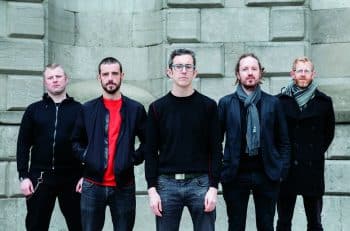
    Robocobra Quartet have been blazing a trail over the past few years. For artists, comparisons to admired figures can trepidate more than they motivate. Once a revered name is uttered and invoked in connection with an upcoming band, it becomes ineradicable from press releases, rehashed by gig promoters over social media, and used as an easy point of reference for journos and DJs with the luxury of only a few minutes’ research ahead of features. Your writer has the unfortunate honour of laying this burden on Belfast outfit Robocobra Quartet. While not, in fact, a quartet, but an assembly of musicians available on a given night, this constant shifting of sonic tectonics merely adds to the band’s unpredictability: a jarring and exciting racket that spurred a passing reference in a UK publication a number of years backto“Fugazi meets Charles Mingus”. Now a second album, ‘Plays Hard to Get’ is due on vinyl and digital formats in May, and as we get settled into a chat, the well-mannered and appealingly chipper Chris Ryan, speechifying drummer and bandleader, relates, with a wry smile, how this designation followed them as far as college radio in the United States while on tour there. But while it is exceptionally hard not to draw comparisons to sonic trailblazers past while pondering the angular, aggro jazz of Robocobra, the same seeming fluidity that applies to their musical broadsides extended across the range of the creative and production processes of their upcoming full-length. “There was definitely a much more blurred line between writing and recording on this one. Any time you commit something to recording, it always comes out a little different from imagined. In producing it, I wanted to respond to those changes and improvise just as much in the mixing and editing as in the actual performing. When you leave things malleable, it allows for the musicians to respond strongly and take ownership of their performances”. Material that’s aired in the run-up to the new record’s release has seen the band extend its range and explore the weird Venn diagram of sounds and textures available to them, especially in terms of jazz instrumentation and arrangement. “That’s interesting, I think the album is just much more extreme in all directions. It has some of the most gentle performances we’ve done but also some of the most dissonant violent noises we’ve ever made. Just a wider emotional-dynamic-range I guess”. Themes of alienation and trepidation are holdovers from the band’s first record, the embracingly-monikered ‘Music for All Occasions’, however modernity – in all its pettiness, distance and squalor are filtered through Ryan’s personality, experiences and spat-out verbiage throughout. While social commentary is no doubt at the heart of Robocobra Quartet’s music, the vitriol with which themes and concepts are thrown at the listener come from that certain place. “I find that I tend to get the most negative or dismal parts of my personality out through the lyrics, which kind of ‘cleanses’ me for real-life interactions, where I tend to be generally happy and polite. It’s hard to think about how something looks or feels when you’re in it, and even though the album is mastered and off to the vinyl plant, I still feel very much ‘in it’. Ask me again in about a year and maybe I’ll have a more eloquent response!”. With ‘Music for All Occasions’ now firmly in the rearview mirror for Ryan and associates, the conversation turns briefly to how he feels about the album now that he’s had some time to live with the finished product. Staying true to form and reflecting the band’s forward-looking nature, however, Ryan is eager to relate his experience in creating it to the grand vision he has for the new platter. “We definitely did that one a lot quicker than this record. There’s more of a simplicity to ‘Music For All Occasions’, but this album is much more layered. Some of my favourite albums offer you new things to hear with each listen, even after years. There’s a lot of the orchestration on this album that is somewhat buried, or momentary, to offer that kind of effect. There are drum machines, and string sections, and voices all over the place that are only really audible on headphones. Jeez… some mix engineer, eh?”. He laughs. The state of independent, experimental and otherwise ‘difficult’ music all over the island is one of rude health, across the genre spectrum. Hailing from a vital and busy Belfast scene that has carved a new identity for itself in recent years with precision post-punk and fearless experimentation, Ryan has a more nuanced take on the current upswing in noises and the people making them. “There are people doing beautiful things of their own volition all over the place, at all times. It’s usually the work of individuals with a will to make cool things, so I think it’s better to prop up those individuals, than thank the collective consciousness, which I think doesn’t really exist. Everything is in waves though, and I think even when things look terrible there are still people out there working hard and expressing themselves”. Off the back of the release of the new record, the band is touring the mainland UK and the continent throughout the summer, building on a live reputation that sees them neatly skewer the live demographics between the regular gig-going scene for noisy rock and the fringes of jazz-festival infrastructure. Balancing, as often, on the line between sincerity and irony, Ryan is quite specific about his thoughts heading into the fray. “There’s a really pretty petrol station in the north of England called Tebay Services on the M6 that is a little like paradise. That will be nice, especially in June which is when we’re on the UK leg. There are also a few promoters that we’ve worked with a few times before so it will be nice to say hello again and see how they’ve grown and changed. We’re just dipping our toes into mainland Europe at

    Loading

    Read more

  • Posted in:

    Avoiding League Relegation

    In Ireland, North and South. In the last 50 years no pub or shop has changed its language from English to Irish. In recent years, in the last pockets of the Gaeltacht, the young people have been switching to English. Clearly, the time has come for the Gaelic League, Conradh na Gaeilge, to take its last, this time decisive, action to save Irish, our ancestral language, from becoming a revered dead language like Latin, and instead keep it for the future spoken, written and joked in by thousands. The Gaelic League’s original aim in its glory days when it nourished the mind of the Irish Revolution was to make Irish again the language of the entire nation. After Independence, as the League realised that this was not going to happen, its aim became to preserve the Gaeltacht and to ensure that through the schools system and its own classes many thousands in the rest of Ireland would be able to speak and write Irish. That last aim has succeeded and it is now time to reap the harvest and put it to use. Many individuals, North and South, in many different occupations are now able to speak and write Irish well, and because they are in many different occupations they possess the Irish language more fully than the merely rural Gaeltacht did. In many cases, North and South, these persons amount to families where Irish is the family language. The League must seek out, for a start, 1500 of these people from the general population North and South and the Gaeltacht remnants; people who would pledge to speak and write Irish with each other and, if they have children, as their family language. Each of them above the age of twelve would wear a discreet badge to identify themselves to others. That for a start. Then each year, the elected committee of this community, which might call itself Na Caomhnóirí (Guardians), would hold an all-Ireland rally to coincide with Oireachtas na Gaeilge. Spaced through-out the year. Four regional committees would organise provincial gatherings. At these various coming togethers, they would discuss and decide what joint ventures – publications etc, – they would engage in. Na Caomhnóirí would call for new applicants and hold an annual entrance examination as a big public event. That annual event would give the secondary Gaelscoileanna and the university courses in Irish a concrete and prestigious goal to aim at. The entrance exam would be held each year until the number of members would reach 10,000. In this way, whatever else happens, the future of Irish as a spoken and written language would be assured into the future – into the new civilisation which will succeed the disintegrating European civilisation. And in that achievement the Gaelscoileanna, as feeder schools, would have a concrete goal to aim at. Unless action along these lines is taken, the so-called Irish language movement will plough ahead without any concrete goal to aim at and with diminishing support from a State that has lost interest. Probably TG4 and Raidió na Gaeltachta would continue for a while to broadcast and Irish would be spoken occasionally in the Dáil and as a cúpla focal at formal dinners. Latin, too, has its news media on the internet, and English football results are broadcast on radio in Latin. At important ceremonies of the Vatican and of many universities formal Latin is spoken. But because Latin is not spoken and joked in every day by a substantial living community, it is reckoned to be a dead language. To save Irish from becoming that and the League from becoming a historical curiosity, it is necessary to act decisively now in the manner I have outlined. Desmond Fennell Dr Desmond Fennell’s latest book is his autobiography ‘About Being Normal: My Life in Abnormal Circumstances’ (Somerville Press).

    Loading

    Read more

  • Posted in:

    The Right to have Rights

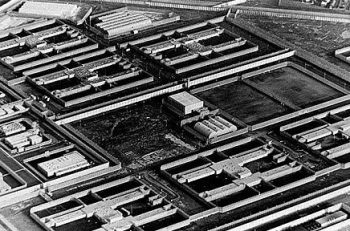
    Hannah Arendt’s famous phrase ‘the right to have rights’ was coined in her 1958 book ‘The Human Condition’. The condition of being stateless, of being a displaced person, which began its modern history in Europe with World War I, has been experienced since by untold millions who have had to listen to the claim that ‘human rights’ are universal and fundamental – but not for them. Once we had the glamorous figure of the cosmopolitan, the person who belonged to the world, the global community; that figure has been displaced by the refugee, who belongs nowhere, but is to be found everywhere in the paradigmatic settings of the modern and contemporary world – the prison camp, the internment zone, the refugee camp, the ghetto, the jail, the arena of suspension where people live in a place that is always outside the country that it is inside. Arendt pointed out that the creation of such places and conditions is a political decision, not just a terrible catastrophe. It is the prevailing form of the penal colony, the new home that we have built to house the theory of human rights. Since Arendt, and most especially in the indebted work of Giorgio Agamben, it has become clear that the concentration camp of the twentieth century was not some historical anomaly, but that it is actually one of the paradigm sites of Western modernity. The internment camp is a zone of suspension, of ‘rendition’, a place that is always outside the country it is inside – Guantanamo is the best-known example, although there many such places – our best- known example was The Maze in Northern Ireland. Those entrapped there expose the hollowness of any claim to universal human rights, to having rights just on the basis of being human. Arendt said it plainly: the refugee, the displaced person, has regularly been denied the right to have rights. The denial is a political decision. It takes its most popular form in the denial that there are any ‘political prisoners’ in the denying country, although enemy countries are full of them. Its political nature has been counterpointed more clearly since 1948, since the United Nations began its series of declarations of Human Rights, unabated since that date; rights of men, women, children, of minorities, of the disabled, of all indeed who can be characterised as having been ‘excluded’, which means that even the ‘poor’, a constituency which enlarges globally by the hour, faster than ever since the almost perpendicular rise of neo-liberalism in the decades before and after the financial crash. Reading these rights, as ‘declared’ (whatever that means), in that bland United Nations universalistic rhetoric, it is hard to know whether to laugh or cry. Such noble vacuities, such actual atrocities – produced by the same state systems that have prevailed since 1945. It was part of Arendt’s long argument, which began in 1943 with her essay “We Refugees” (about Jewish migrants who had become ‘stateless’, that condition in which they had no rights) that asked why European civilisation had so successfully produced the barbarism that made statelessness pandemic and human rights so unavailable to the millions of ‘displaced persons’ of World War II. Part of her answer was that this barbarism was so successful precisely because it was so concealed within or behind the declarations of universal rights and justice which the West, in the case of the American and the French Revolutions, had made central to the powerful ideology of what mutated into Western ‘freedom’. Arendt’s question then was: how could such an ideology be developed (as through the UN declarations) and simultaneously traduced (as in American foreign policy)? It is too feeble an explanation to put it down to hypocrisy. Hypocrisy on this scale occurs when the people who most sincerely believe in the peaceful principles are those who most regularly betray them in violent action. The British spent three centuries in perfecting their international reputation as hypocrites, a nation that believed itself to be peaceful even as it waged endless wars. Now that role has been assumed, largely, by the Americans. But, to achieve world domination is one thing; world hegemony is another. That’s what the World Wars were fought for. Arendt achieved notoriety with her reporting on the 1961 trial of the Nazi Adolf Eichmann, which was published in book form as ‘Eichmann in Jerusalem: A Report on the Banality of Evil’, where she developed the central figure of the ‘desk-murderer’, the bureaucrat who administered the death-camps. But her key point was that this was a show-trial, that pretended to be an example of universal justice triumphing over universal evil. Rather, it was in fact a national victory of the Israelis over their Nazi persecutors. In this exemplary instance, we are shown how the language of universalism can be used as a disguise for a state’s policies. The jurist who had the ambition to do that for a successful Nazi state, Carl Schmitt (1888-1985), described in his ‘Nomos of the Earth’ (1950), how the European system of international law had been replaced by an American one, with the UN as its legislature and the International Tribunal or Court as its executive. In effect, the language of universal rights was used to ratify the aims of American foreign policy; Nuremberg, Tokyo, Damascus, the Hague were, like the Moscow show trials of the 1930s, elaborate pretences that something objectively true was being defended from the current version of sectarian betrayal – war criminality, terrorism, the new terms of ‘war crime’ and its flourishing neighbourly companions, such as ‘ethnic cleansing’. Danilo Zolo has demonstrated in Victor’s Justice how the Kosovo war of 1999, that infamous intervention (to be followed by interventions in Iraq, Afghanistan , Libya and elsewhere, saving the ‘people’ of those countries for democracy, largely by killing and dispossessing them), with its International Court at the Hague, which could try anybody but Americans, is the most egregious example so far of how the language of universal rights has been perverted

    Loading

    Read more

  • Posted in:

    Songs of Inexperience

    U2 released ‘Songs of Experience’ before Christmas as a companion piece to 2014’s Songs of Innocence. Thematically, ‘Songs of Innocence’ was inspired by the band’s memories of their youth in Dublin in the 1970s with Bono describing it as “the most personal album we’ve written”. ‘Songs of Innocence’ touched upon these memories as perceived four decades on. The chances are slim that U2 will ever release the music they actually recorded in the 1970s – which also explored these themes – but at a time when they were raw and painful. A collection of primitive U2 demos – all recorded before their first official release in September 1979 – has been largely consigned to the vaults. Much to the dismay of avid fans, the black market bootleggers never managed to get their grubby hands on more than a few of them. While they are no astonishing gems in the vaults, the tapes do at least provide a few insights into how the U2 sound evolved. U2’s first demo session was the prize for winning a talent contest in Limerick in March 1978. While snippets from it have been broadcast during radio interviews with the band, the session has remained virtually out of bounds to the bootleggers; and even avid U2 websites profess ignorance about what was recorded. After four decades, Village will now finally – and exclusively – review U2’s first ever recording.     The CBS Sessions: ‘They Were Extremely Nervous And No One Was Expecting Miracles’ One of the judges at the Limerick talent contest was Jackie Hayden of CBS Ireland who became a critical figure in U2’s early success. The band’s bass player Adam Clayton felt Hayden “had a bit of flair and he wanted to sign Irish bands. The rest of the companies weren’t interested but he offered the best he could. He actually talked CBS into paying for our first demo tape”. The session took place in April 1978 at Keystone Studios in Dublin. According to Adam, “It was our first time in the studio and I think his first time as producer. He told us to set up as we would for a live show and play the set. It was all done in two-track. He thought that was a good way to do a demo. Then he took the tapes off to London to try to talk them into signing us and they just laughed. The tapes were awful. We didn’t know at the time, we had nothing to compare them with”. Hayden didn’t disagree. “After all”, he has said, “it was their first recording date, they were extremely nervous and no one was expecting miracles”. HANG UP The first song on the CBS session was called Hang Up. Like most of the original compositions, the lyrics evoke teenage angst. On this one Bono pleads on the phone to a soon-to-be ex-girlfriend not to “hang up/time is a cure/time can be found”. UNKNOWN TITLE (possibly SHE’S MY GIRL) The next track is also about teenage yearning but is far more interesting for a hint at how the U2 sound evolved. U2’s guitar player, The Edge, has explained that, “Adam is a very ostentatious sort of person, you know, very extravagant, so when he started playing bass he wasn’t interested in taking the bottom end of the sound spectrum at all. He wanted to be right up there in the mid ranges…In order to give the group any sort of clarity, therefore, I had to stay away from the bottom end of the guitar as much as I could. So, I tended to work around those ringing sounds”. This track displays one of Clayton’s early midspectrum forays. It also features an unremarkable Edge solo in the typical do-it-yourself garage-pub rock style of the time. STREET MISSIONS Another version of this song was eventually released by the bootleggers. This version is not as polished as the later version and the Edge’s contribution is far more restrained here. CONCENTRATION CAMP This song grew to become one of the highlights of U2’s live set in 1979 as they edged closer to a recording contract. It contains a solo courtesy of the Edge and is propelled by a strong bass but is distinguished by Bono’s rapid-fire vocal delivery which is quite unlike any of the other numbers they recorded during the session. The theme is elusive. However, references to “schooldays” suggest that Bono was venting his anger against the educational system. During an interview 1979 he revealed that as a pupil he had reacted against excessive demands for “intelligence in school – everything that it seemed you were not was pushed at you and I had a bit of a heavy reaction against that’. Instead, as he states in this track, he wanted to “live his life tonight”. UNKNOWN TITLE The fourth song is a slow number with vague echoes of Shadows and Tall Trees which appeared on their debut album Boy in 1980. The theme is also dominated by descriptions of life on the streets of Dublin city. INSIDE OUT This forgotten composition, written in 1978, captures U2’s continuing evolution and innovation. It sways on Clayton’s ropey bass. Meanwhile, Bono sings about his feeling that he is “inside out” in the “modern world”. The bootleggers did manage to get a hold of it from tapes of an early radio interview with Bono during which it was afforded an airing. BORN IN THE BACK IN THE STREETS U2 just about stumbles to the end of this track with Bono making excuses: “Doesn’t matter if we make a mess of it, does it?”. They didn’t run through it again so this incomplete version may well be all that remains of this arrangement. Aside from references to being born in the back streets, the lyrics make little sense. Bono admitted in 1979 that: “I never write lyrics until the last minute because they are constantly building as we work out the song. They build subconsciously because I find that

    Loading

    Read more

  • Posted in:

    History Rarely Repeats, But Often Rhymes

    For over a decade now, Dublin-based five-piece The Spook of the Thirteenth Lock have been fusing the folklore and musical traditions of their home city with sounds and processes from further afield, with elements of drone and post-rock sitting alongside the foundations of folk and trad across their previous pair of full-length records. In addressing and recontextualising tradition during the ‘decade of centenaries’, though, The Spook of the Thirteenth Lock have set themselves some massive tasks. In 2013, the band undertook to document and chronicle the lived experiences of the hundreds of thousands of workers denied basic human rights in the 1913 Strike and Lockout. The final product, ‘Lockout’, is a concept album in four movements, finally releasing this March via Dublin/Sapporo label Transduction, after a number of live airings in the intervening years. Having lived with their work for a while, band founder/vocalist/ lyricist Allen Blighe is content with the band’s work: “Initially it was planned as a short piece to tie into the Lockout anniversary but it grew legs. A lot happened, many were born, and many passed away in that time. We feel both happy and relieved to have created something original and ambitious, yet still quite cohesive”. Bassist/vocalist Enda Bates, himself no stranger to large-scale musical endeavours, expands on the size of the task at hand: “It was a big, complex project, both in terms of the writing and the production. We’re never stuck for ideas as a band, but the music does seem to take its own time. In the end, we’re very happy with the result and, despite the logistical demands, it was really great working with an electric-guitar orchestra”. Tackling the story of the Strike and Lockout with nuanced ramifications that lasted for generations, and that continue to reverberate in Irish society, and making of them a work for an eighteen-piece guitar orchestra was always going to be demanding on storytelling, compositional and logistical levels, according to Bates: “We knew we wanted to tell the story of the Lockout chronologically, and Allen had a list of key events he wanted to cover in the narrative. So we developed a timeline for the piece based on that, and it seemed to fall naturally into four sections. We already had some fragments of music written that seemed to fit nicely with certain events, and I had an idea for the opening in which each guitar comes in string by string and builds to a big crescendo before dropping back down to just Allen by himself. From then on we just worked through the timeline, sometimes arranging existing ideas for the orchestra, and sometimes writing new material to fit the narrative. The story of the Lockout contains moments of great hope and unity, but also plenty of violence and despair. We tried to represent this through very consonant material and this big, open C tuning on all the guitars, alongside some very dissonant rhythms and harmonies for the darker moments”. Blighe is keen to outline the serious research done on both the story’s main plot, and on concurrent events of the time, aiming to present a fuller picture of a society in turbulence. ”Much reading was done on the subject. Padraig Yeates’ excellent ‘Lockout: Dublin 1913’ was a big influence. Also, Jer O’Leary’s impassioned performances of Larkin speeches really struck a chord. There were many challenges in compressing such a complex story into an album. For example, we just didn’t have time to fit in anything on the controversy surrounding the so called “Dublin kiddies’ scheme”, where the church blocked efforts to send strikers’ children to sympathetic English families to escape the deprivation of the Lockout. Some other themes, such as those presented on ‘Suffrage’, part of the 4th movement, were important to include. This deals with the struggle for voting equality, and Markievicz’s legacy, one as chequered as many of her male contemporaries but judged more harshly for no other reason than her gender. Matching the music to the narrative was a really interesting process. In the past we’ve written the music first, and then found lyrical themes to apply. For this project we flipped that around, which was a rewarding change of approach”. There’s obviously a great resonance to the story today, over a hundred years later, with the current ideological impasse plateauing across Irish politics and working conditions getting ever tighter for countless people since the introduction of austerity. Blighe discusses the similarities: “The decade of centenaries has been an interesting time to reflect on what exactly Ireland is. Where 1916 and the war of independence were about the struggle for national sovereignty, the Lockout and the Civil War were struggles to define exactly what this nation might be. Things are different now but ‘history rarely repeats but often rhymes’. The Lockout was a struggle for a fairer deal for workers against a very hostile and callous bunch of Dublin employers headed by William Martin Murphy, head of the DUTC, the tram company and owner of the Irish Independent, who enjoyed the tacit support of the law and state. Today we have a few similar characters. Ireland since the collapse has been murky to say the least, and there are many questions about banking regulation, the wind-up of Anglo, NAMA deals such as Project Eagle, the sale of Siteserv, the write-off of debt at INM, the constant policing scandals as the disclosure tribunal continues to unfold, and most importantly, the housing crisis. There is a sense that the gains of the trade union movement are being systematically stripped back in the name of competitiveness in a system that hothouses inequality”. While that might seem grim, Blighe continues to outline what can be done domestically, and what lessons can be taken away from previous popular mobilisations. “Our fear is that if a positive left-wing movement, in the mode of the water protest movement is not generated to deal with this inequality, then we will see a slide to the far right. Irish nationalism

    Loading

    Read more

  • Posted in:

    Adventurers in immortality and Nazism

    The revised edition of ‘Francis Stuart: Artist and Outcast’ (Kiely, Liffey Press, Dublin 2007; Areopagitica, NC 2017) coincided this year with two other biographies about Nora O’Mara and John Lodwick, close friends of Stuart’s in wartime. The challenge for the biographer is to interrogate the sources about Stuart, O’Mara, and Lodwick each of whom was lured to a war zone, and establish the truth about their psychology, actions, personality and politics. Stuart and O’Mara became lovers while working for the Propaganda Ministry (Fichte Bund) in Berlin. Stuart’s notorious broadcasts made him, according to critic Cyril Connolly, “the Irish Haw-Haw”. Lodwick, who worked for British Special Operations was a Croix de Guerre hero and novelist hailed by writers from Somerset-Maugham to Anthony Burgess. O’Mara held many aliases: Nora O’Mara, Deirdre O’Mara and Roísín Ní Mheara. She is mentioned in James O’Donnell’s ‘The Bunker’ (2001) as Rosaleen James aka ‘Mata O’Hara’ so-nicknamed by Hitler’s SS adjutant, Otto Günsche. O’Mara was in fact Phyllis Ursula James, born in 1918. Her natural father is unknown, her mother Nora James “a ladies maid of Hyde Park”. She was adopted by Sir Ian and Lady Hamilton of 1 Hyde Park Gardens, and despite a privileged education, including at a finishing school in Germany, suffered psychologically as an orphan. This is also attested to in ‘Black List, Section H.’ The Bundesarchiv-Militärarchiv in Freiburg holds a letter from the Nazi Propaganda Ministry of 12 March 1942: “Frau O’Mara is being sent for 14 days of convalescence to Baden-Baden”. The letter suggests finding “a decent theatre engagement…and to help Frau O’Mara in case of need; it is requested to appropriate 500 RM (Reichmarks) from the Goebbels Fund”. The letter focuses on O’Mara’s status as an actress while working in the Haus des Rundfunk as a radio broadcaster alongside Stuart. O’Mara’s connections made her an insider with the Nazi regime. For example, Hitler’s personal pilot Hans Baur says he met her at a party in Goebbels’ villa in Schwanenwerder. The letter is intriguing as to how O’Mara penetrated the Reich’s higher echelons. She features in Stuart’s ‘Black List, Section H’ (King Penguin) as Susan Loyson, a distressed mother trying to get into German movies and theatre. The tempestuous O’Mara-Stuart relationship is pervasive in the book: she had two children, as did he back in Ireland from a failed marriage to Maud Gonne’s daughter, Iseult. While Stuart recanted his years in Berlin in interviews and especially ‘Black List, Section H,’ O’Mara’s loyalty to Nazism is clearly stated in two memoirs under the name Roísín Ní Mheara, ‘Cé hÍ Seo Amuigh’ (1992) and ‘I gCéin is I gCóngar’ (2006). The first caused a media scandal representing ‘neo-Nazism in Europe’ under the auspices of Gaelic-language publisher, Coiscéim. The government funders of the publisher had to answer for a text that evinced Holocaust denial like David Irving’s ‘Hitler’s War’ (1977). O’Mara’s overt anti-Semitism had first surfaced in January 1978 in her column in ‘Inniu’ denying the genocide in Bergen-Belsen. Her words are redolently vile: “there is plenty of evidence that the Germans did their serious best to solve the ‘Jewish problem’ humanely”. Stuart and O’Mara were blacklisted for being friends of pro-Nazi IRA activists Sean Russell and Frank Ryan who retain nationalist hero status. Russell died aboard a German U-boat on a mission with Ryan to Ireland during the war. Stuart was imprisoned by the French but released after a year. O’Mara’s release shortly after her arrest in Paris at the request of the post-war American and British authorities is mysterious since “MI5’s file on her was made to go away”. O’Mara’s foster-father, Sir Ian Hamilton, led the British Legion delegation in 1938 and was hosted by Hitler in Berchtesgaden, Obersalzberg. Making international news, Hamilton was photographed with Hitler as had other deviant foreign nationals including the runaway king Edward VIII. The memoir states O’Mara was “born in Switzerland” but in 1938 O’Mara was listed in Berlin’s Reichstheaterkammer Jahrbuch having established her identity as ‘Irish’. Her background and lineage were fake in a milieu where the bogus Nazi obsession with Aryanism and Jewishness in particular led to many reinventions of identity. The Abwehr, the SS, and the Geheime Staatspolizei sanctioned her profile as ‘Irish’, and her shadowy activities. O’Mara appears in John Francis O’Reilly’s ‘I Was A Spy in Ireland.’ He believed her cover-story. She was “Irish looking with unusual blue eyes and a peculiar walk as if she had at one time injured her back. Good-looking, but with rather an unwashed appearance”. O’Mara was obviously a spy for the Germans among their ‘adopted’ Irish gang of anti-British, pro-IRA supporters residing in Berlin and on the payroll. They included Stuart. William Warnock, the Irish chargé d’affaires in Berlin put on the record that O’Mara “was responsible for a raid by the SS on fellow broadcaster Liam Mullally’s flat”. The fact that she was quickly declassified by MI5 and the Americans after the war points perhaps to some sort of double-agent status. Francis Stuart’s novels had been highly praised, notably by Yeats who lost out in the tug-of-love with Iseult Gonne who married Stuart. Yeats’ proposed to Iseult twice but was blankly refused and he moved on speedily to marry Georgette Hyde-Lees. Yeats admired Stuart as poet and novelist, stating “he will be our great writer”. Stuart had returned to Berlin in January 1940 on a cultural visit organised by German Academic Exchange’s Helmut Clissmann (later assigned to the SS). This gets much space in ‘Black List, Section H.’ It has the highest political resonance in the novel since he acknowledges “being branded as a Nazi by those from whom most of his readers would have to come, scarcely augured well for his future”. Stuart’s Berlin years achieved everything he wanted for his art, albeit at the price of infamy. His twenty-five novels present a unity of thematic structure about war and its reality as counter-flow to so-called peace time. The extremes of Nazi Germany fulfilled his personal and psychological needs. The politics of

    Loading

    Read more

  • Posted in:

    The Shaker Hymn: There’s no redoing things

    Independent music is odd: for a wide umbrella of music that breeds the creative freedom and cultural autonomy needed to help progress the overall artistic discourse, there’s no shortage of revivalists of various stripes, rejigging and refreshing previously well-worn sonic tropes. It’s been hard in the past to look at Corkonian psych-poppers The Shaker Hymn and not get some degree of the warm-and-fuzzies: emerging from teenage adventures in the folk and alternative genres, second album ‘Do You Think You’re Clever?’ self-released last year and veered wildly into tape-hiss, big sounds and the kind of vocal harmonies the like of Supergrass would have been envious of at the outset of Britpop. It was a mix that intrigued a lot of people, and preceded a furious touring schedule in small towns and minor venues all over the country, before the band took a breather to try other things and collect their thoughts, ready for another salvo of new material. In that context the band’s new single, Dead Trees, is a surprise. Vocalist/guitarist Caoilian Sherlock, a naturally happy-go-lucky fellow, drops the youthful distrust of the band’s postMillennial fug in favour of fire-and-brimstone doomsaying, warning of an uncertain future, in direct contrast to his fine fettle as we meet at L’Attitude on Cork’s Union Quay. Sherlock is relaxed about the response the single has met with at the band’s gigs so far this winter, a return to live activity that foreshadows an upcoming third album. “It’s been good. I forgot what it was like to do gigs. We hadn’t performed in about a year, except for one gig in Belgium where we tested out all our new songs. It’s nice. The songs are different. It seems boring to other people, but they’re longer. I guess we’ve given up the idea of trying to impress anyone else, I think. When you’re a bit younger, you try and write something to get in the charts, or something. We’ve been doing that since we were sixteen. We’re twenty-eight, twenty-nine, now. The point of us being in a band is to give us that expression that comes from being together, so there’s less rules and a lot more of a democratic process going on between the four of us. The intention is to make the most exciting thing we can”. The process of creating music for record is obviously very different now from what it would have been in the days of the band’s broader influences; and in trying to bequeathe a document of where they are now the outfit have opted to keep recording their third album on tape to instill the same sense of urgency, immediacy, and the finality of limited takes into their tunes, though with permanence now underpinning the hard-won authenticity of fuzz and hiss,. “Music nerds will say, ‘oh, how exciting!’, but for those who don’t really care about the musicrecording process: we’ll be recording to tape, like they did up until the late Eighties, early Nineties. It means everything has to be done live. That’s exciting for us, ‘cause it’s a different process, there’s no sitting at the computer and redoing things. If you sound good or bad on the day, it doesn’t matter: that’s what happened, and that’s really exciting for us. We recorded two albums in three years and before that tons of EPs, so the recording process can get a bit flavourless. So for us, this is a bit of spice”, smiles Sherlock. Dead Trees itself touches on fairly hefty business, shifting creative focus from benign appraisals of the maladies of twenty-somethings in the binds of austerity and ladder-pulling, like in previous single Trophy Child, to altogether broader subject matter including the aforementioned doomerism. The question is: what prompted this turn for the thematically heavy? “Trophy Child was on our last album, and I couldn’t help but write about things that were going on around me. All my friends were going away to the UK, leaving Cork to go to Dublin, go to Australia and New Zealand, coming back, then going to South East Asia… much of that album was about that lost kind of feeling, not that I was stymied staying in Cork, but a lot of people around me were having the conversation about not knowing where to go. So a lot of the songs were about that. This time around I wanted to write from a more thematic point of view, as much as I could, but not so personal, more universal. So, I was doing a lot more travelling, as this album began to be written. I got to go to Iceland and LA, and other places I’d never seen, new landscapes, so I wanted to write something about nature, and the more I thought about it, the more I couldn’t not write about the world after Trump, and Brexit. There was a heavy feeling at the end of last year and the beginning of this year, so there’s a lot of that on this new album. There’s also a lot of joy and excitement, and a feeling of ‘ooh, what’s gonna happen next?’”. The band’s recent downtime allowed Sherlock to spread his wings, solo, as Saint Caoilian, releasing his début one-man effort, ‘The Faraway’, earlier in the year. Away from a shared creative endeavour, Sherlock’s tendencies toward lovelorn pop, summoning power-pop pioneers like Big Star, are writ large all over leadoff single I’ll Be a Fool For You. It led to a busy summer of gigs, both in support of his own record and of fellow Corkonian troubadour Marlene Enright, and with accelerating momentum, there’s little stopping him from continuing this in between bursts of band activity. “I’m recording another EP this December! It’s funny, the reason Saint Caoilian came about was because I had about fifty demos at home. They weren’t going anywhere, and they weren’t necessarily Shaker Hymn songs. On top of that, I’ve been in this band since I was sixteen, you can’t expect three other people to travel all

    Loading

    Read more