
Culture

Random entry RSS

  • Posted in:

    Review: The Fall of the Second Republic

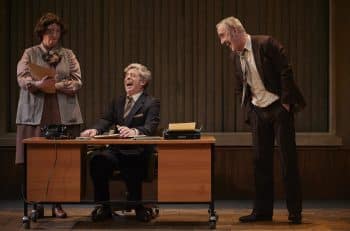
    This new co-production of the Corn Exchange and the Abbey falls at even the shortest hurdles By Rory O’Sullivan The best moment in The Fall of the Second Republic is at its end. Emer Hackett (Caitríona Ennis), a journalist, has spent the play trying to expose corruption in the government of Manny Spillane (Andrew Bennett), but has failed and Spillane has turned Ireland into a dictatorship. She is pregnant and says to her baby, “It will fall – one day”. The title then makes sense to the audience: the fall of the play’s corrupt system is always looked forward to, always thought to be just ahead, but never comes. It’s a clever reversal, dramatically and thematically interesting. The Fall of the Second Republic certainly contains some good moments like this. It’s also sometimes funny, even if the humour too often consists of stereotypes and people running loudly around a stage. Of course it is extremely rare to witness a play in which there are no good moments at all. There is usually too much stage-time and too many moving parts – actors, script, stage, audience – for everything to fail at once. Instead, what separates a professional play from something in the university players is that in the former there is an overarching coherence. Anyone can make a few dramatic moments, but only a playwright can write a drama, and only a director and actors can perform it. For this there needs to be a plot, characters, themes and a coherent theatrical world in which those three elements exist. Together these forces must all move as one: whenever a play is choosing between the coherence of its plot and the coherence of its characters, something has gone wrong. To do this well is difficult, which is why not everyone works in writing or theatre; but when fully realised, it is one of the most powerful things in the world, which is why tourists still visit Shakespeare’s birthplace and students read his works in school. You could think of it this way. It’s pointlessly broad to ask what art ‘is’, but simple enough to recognise what art is a category of, which is constructive reasoning. It doesn’t matter if that reasoning is of chord progressions or word progressions, events moving like clock-hands or emotional waves rolling over each other. Any great aesthetic effect exists only in the context of what is around it. Aristotle said that discovery and reversal are the core of every dramatic plot, but these both presuppose something. For the reversal of Oedipus’ fortunes to matter, for his discovery of what he has done to mean something, we need to experience a world and a character that tee them up. For all plays of all kinds, every moment must be there for a reason that can be justified as a product of its determinative logic.  The Fall of the Second Republic, written by Michael West, directed by Annie Ryan, a co-production of the Corn Exchange and the Abbey Theatre, is a thorough disappointment above all because it does not do any of this. The plot is nothing more than a record of the characters’ reactions to bizarre Dei ex Machina; the characters themselves are mere caricatures; thematically the play explores problems in Irish politics that no longer exist or never existed; the dramatic world lurches between different decades without ever explaining itself.  Is the Taoiseach, Manny Spillane, with his Garret-FitzGerald hair, an evil genius destroying the country’s institutions for money and power? Or is he a wailing incompetent, exploited by those around him and propped up by his devoted secretary, Goretti (Anna Healy)? In the play he is both: at once a fiendish caricature of Charles Haughey and a poor imitation of Jim Hacker. We are never provided with a sense of how these two personalities can fit together in a single character.  They contradict each other. Spillane ends up declaring martial law and turning Ireland into a dictatorship to save his political career and smother a newspaper story about corruption in the development of the fictional Irish Banking Centre (IBC). How Spillane is politically strong enough to end Irish democracy, but vulnerable enough to be brought down by a bad newspaper story, is never explained. If the Gardaí and judiciary are so deep within his pocket that he can arrest the entire opposition and Ceann Comhairle, why worry about a Tribunal? In general, this is the problem thematically with the play. If it is intended on any level to be politically relevant and to take corruption seriously, it fails because it is not coherent enough to capture the systemic and endemic corruption that actually prevailed in Ireland in the late 20th century. Instead, its politicians are a whimsical group of capricious murderers. Its comments not so much on Ireland in any decade as an absurd non-reality. The other main character apart from Spillane is the journalist Emer Hackett, whose personality stretches no further than ‘independent woman trying to do good’. There is nothing interesting about her, nothing whatsoever unpredictable. She is less a character than a bundle of attributes and experiences we’re all supposed to admire. She tries to do a good thing in a bad world with the deck stacked against her and it backfires. A few bells and whistles are attached to her story – she becomes pregnant, for example – but nothing that has not been overdone before. It is impossible to care about her. Where the play is original, it contradicts itself to absurdity; where it is consistent, it is maddeningly stereotypical. There is the inevitable abortion subplot as well as the drunken Irishman in the form of Billy Kinlan (Declan Conlon), Spillane’s Tánaiste and willing idiot. There are token references to Northern Ireland. A TD from Donegal (also played by Anna Healy) returns from a fact-finding mission in Derry. One subplot involves Emer’s boyfriend and fellow journalist, Finbar (John Doran), accepting a job covering the conflict in Northern Ireland, but the

    Read more

  • Posted in:

    Review: Hansel and Gretel charms without enchanting

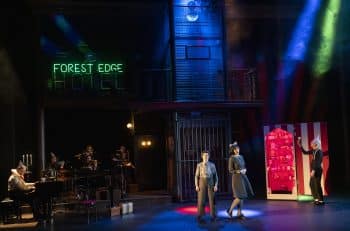
    This production by Theatre Lovett, the Irish National Opera and the Abbey Theatre is fun and artistic, but the opera’s libretto is lost in the woods By Rory O’Sullivan Engelbert Humperdinck (not that one, I’m afraid) produced the opera Hansel and Gretel from four songs he wrote to accompany a puppet show his nieces put on at home. Their mother, his sister, wrote the libretto, and it all premiered in 1893. It was conducted by no less a musician than Richard Strauss, the prelude to whose Also Sprach Zarathustra is instantly recognisable to everyone as the theme of 2001: A Space Odyssey. The opera was a hit and is now the main thing for which Humperdinck is remembered, though he had a full life besides and was an important part of the European musical scene. That said, like virtually every composer of his generation, he wrote in Wagner’s shadow. The music of Hansel and Gretel is mostly a deepening or reworking of folk-themes (e.g. ring-a-ring-a-rosey), but nearly always for Humperdinck to deepen something means to make it sound more like Wagner. The music all has a roundedness, a confidence that the instruments were made expertly by somebody and will sound good if only allowed their full range. Sometimes he makes them wild and dissonant, foreshadowing composers like Schoenberg whom he influenced. When he doesn’t know what to do – usually, in the rare moments when the music is secondary to the libretto – he backslides into Baroque primness: difficult, staccato-y stuff which is impressive in its own way but can feel like the aural equivalent of motion-sickness. In this production Carolyn Dobbin gives a commanding performance as the Witch, but everyone sings well.  The most fundamental problem with Hansel and Gretel as an opera is that, while the score is really very high-brow, the libretto can’t quite find its way up there. This translation by the British librettist David Pountney is usually successful, but the lines rhyme and occasionally they rhyme at all costs. When Gretel (Amy NÍ Fhearraigh) warns Hansel (Raphaela Mangan) against eating the candied-house they have just discovered in the woods, he says “Don’t be a tease / I eat what it sees”. The story, which everyone knows anyway, is so bare-bones that there is not much for the characters to say. ‘We are hungry’, Hansel and Gretel spend too long telling each other at the beginning; then, after they have left, their parents come out and say the same thing. That was most probably why the directors of this production, Muireann Ahern and Louis Lovett of Theatre Lovett, invested much more in the coherence of its atmosphere than its story. It is a co-production of them, the Irish National Opera and the Abbey, but it is they who add the professionalism and the know-how to make it a rewarding piece of theatre. For example, the whole set is the exterior of a dingy, run-down hotel on the edge of the story’s forest. It’s a dangerous conceit, since it involves forcing Hansel and Gretel to sing about being in a forest when they are obviously still in front of a hotel. But it creates a mood, and allows the show to take on a few themes: emotional and atmospheric arguments that challenge the audience intellectually.   For example, there is nearly an entire second play arranged around the opera, a dumb show between the scenes and set to music. It is often better than the opera itself because of its sense of atmosphere. In the Abbey’s Directors’ interview, Louis Lovett says that the show tries to “straddle the world between the fairytale and the modern”: that is, that it is all a mystery. But performers rarely understand that something can never be ‘about’ mystery, since ‘mystery’ is simply the thing you experience and never the thematic or emotional label for it. The dumb show therefore is really about exploring how it feels to encounter what you do not know, and its answer as varied as the notes of a violin.  The whole opera is supposed to be child-friendly (or as child-friendly as an opera can be) and sometimes that leads the show too easily to the blank feeling of ‘wonder,’ but more often it lets the music draw its own complex shapes, and there is an arc of reason and emotion in those. The slow-reveal at the beginning where the musicians walk out, take up and begin playing their instruments is the sort of thing that’s often-done and usually tedious. Here it isn’t: it’s absorbing, and atmospheric, livened by the performance of Raymond Keane as the silent “Night Watchman”. He arranges everything in the background with an air of supernatural mystery and some jokes. Every scene in the show is better for his being in it. But my sense is that even with all these complications, Hansel and Gretel lets everyone off too easily. The witch comes along and is effortlessly dispatched; her past victims are resurrected amid confusion; Hansel and Gretel’s parents find them, and all are suddenly a happy family. Nothing much ever feels like it is at stake in the opera, and without that its power to affect any audience is shackled. But overall, this particular production is clever and genuinely works as a piece of art. I’ll await the day Theatre Lovett decide to do Tosca.

    Read more

  • Posted in:

    Review: Medea’s incomprehensible crime

    The new production at the Gate makes Medea’s children more than mere victims By Anna Mulligan Like the play itself, the set for Oonagh Murphy’s Medea walks the line between the mundane and the mythic. The children have a teddy bear named Hercules, and the play takes place in a bedroom whose sloping sides, rising inwards, give the impression of an attic or a crawl space. At the apex is a kind of hovering wooden grid, as if the technicolour bedroom is not an attic but a dungeon, an oubliette, where Medea’s two children have been forgotten.  This might be a reference to the eyes of the gods, watching as they might in Euripides’ play, from a safe distance. It’s hard to know; the play draws on its myths indirectly in ambiguous flashes of memory, as when Medea’s children (played on this particular night by Oscar Butler and Jude Lynch) loosely re-tell the contours of their father Jason’s adventures, passing the time in their locked bedroom. Murphy’s new version of Medea is effectively a retelling of the old story from the children’s point of view. While we wait in the locked room for the play’s titular character, the boys summarise, speculate about and replay the story of their parents. At one point, while fighting, the younger brother uses magic to escape the boundary of “his side of the room” and play keep-away with the golden fleece, until the elder makes a false promise to take it back, his fingers crossed. Medea and Jason’s magic and betrayal come up in their spat, but not in the children’s telling of the parental love story, which one boy says was a “win-win” – Jason got the fleece, Medea got to leave home, they both found love. No harm, no foul. The two young actors shine from the beginning of our time with them, when they act out a series of death games. First they try to play dead, quietly, for as long as possible, and then they take turns choosing their own death – shot by a nerf gun, mauled by a bear, hit by an arrow and then dead of a seizure. The games are edgily acted, comic and unnerving without being heavy-handed in their foreshadowing of the deaths that the audience knows are coming anyway.  There were times in this early section when I thought I was waiting for Medea, as the titular character and one who generally dominates any story she populates, but the strength of the script is that I was not. When Medea did arrive, there were times when I felt she was a distraction from the main event of the brothers’ story, which is a testament to the reframing achieved by Mulvaney and Sarks. The play returns in the meandering of the children’s reflections towards death, and whether dead things count; towards being small, and whether small people count. The adults in Medea are playing games with the children, but the play itself takes them seriously on their own terms – their skills, their questions, the deaths they choose for themselves, which are for laughs. Over and again the boys run full tilt into the locked door, rattling the handle, showing us that they are not by choice narrative footnotes. Not long before the climax of the plot, they have a contemplative conversation about the meaningfulness of being small – as small as specks, compared to the glow-in-the-dark stars papering their ceiling – but when they have drunk Medea’s poison, as instructed, she won’t let them lie back down in that corner, and die looking at the stars. It’s at this point that Eileen Walsh’s character of Medea breaks through her lyrical and sentimental register into a rage until they stand up and allow themselves to be dressed and staged by her, so that they die in her arms. Medea’s character is a difficult needle to thread; the play struggles with her. We meet her dressed for distress in her pyjamas, dishevelled, telegraphing her tortured love for her children, her bitterness with Jason, her despair at the prospect of returning home to her father. None of it rings true: her singsong declarations of eternal love for them do not feel authentic, but neither do her moments of stagey bitterness and resolve in planning the death of Jason’s new love seem any truer at their core. Her moment of rage when the children resist her cajoling is a moment of clarity – but what does it mean? The crime no one can make sense of is still the crime no one can make sense of. Walsh’s Medea tries on different motives, but does not commit. Is she turning to murder to avoid returning to Colchis? Is she destroying the thing – the people – that she thinks Jason wants and cares for the most? Is she attacking the evidence of her life with Jason, now destroyed? Is she bored? She stages the crime for Jason by taking the children from their contemplation in the dark among the stars to a beam of light from the finally open door, locked for so much of the action. She’s not hiding them; they are to be displayed. In this way, the play’s conclusion is intentionally inconclusive; neither she nor the audience get to see the look on Jason’s face when he understands whatever it is she wants him to understand. Jason’s absence is deeply felt in the bedroom, where his golden fleece – now a purloined jumper that still smells of him, kept in a drawer – is lovingly cradled.In Jason’s absence, the children are not needed outside the bedroom; Medea visits them to update them on their status in the acrimonious separation. This is the thematic heart of the new Medea; the children, forgotten, are trapped by the weight of our captivation with heroes and demigods like Jason and Medea, whose children are pawns and cannot escape. The contemporary framing – the bickering of the shared bedroom, the word

    Read more

  • Posted in:

    Keeler Concealer: the British Establishment’s severe embarrassment at the depth of the Soviet Union’s penetration of MI5 and MI6.

    By David Burke The BBC’s lavish Christine Keeler drama concealed her claim that the Director-General of MI5 was a Soviet mole and ignored what she knew about the infidelities of Prince Philip. The real story is one of treachery, depravity, judicial corruption and the sexual abuse of children by VIPs such as Lord Mountbatten. The six-part BBC drama, ‘The Trial of Christine Keeler’,  has just come to an end. It was meant to be an accurate and comprehenisve portrayal of the notorious Profumo Affair during which a teenager, Christine Keeler, slept with Captain Eugene Ivanov, a Russian naval attaché at the Soviet Embassy in London, while also having a relationship with the much older John Profumo, the high-flying Conservative MP who was Secretary of State for War. Profumo, who met Keeler in July 1961, dramatically denied a relationship with her in the House of Commons but later admitted he had lied and, in June 1963, resigned in disgrace. Stephen Ward, the artist and society osteopath who had introduced Keeler to Profumo, was subsequently put on trial for living off the immoral earnings of prostitutes. He took an overdose of medication before the jury returned a verdict against him and died shortly thereafter. He was found guilty on two charges. 1. THE WIMPOLE MEWS SPY RING. The puzzle that lies at the heart of the BBC’s production is that it ignored the most significant claim Keeler made about the affair: that Sir Roger Hollis was a Soviet mole who was part of a network consisting of Stephen Ward and Sir Anthony Blunt. Hollis served as the Director-General of MI5, 1956 – 1965. Blunt was a KGB mole who penetrated MI5 during WW2. Keeler made the claim in her book, Secrets and Lies (2001). Keeler says she told Lord Denning about D-G Hollis in 1963 while the latter was carrying out his controversial inquiry into the affair and that he made notes of what she said. Hence, there is one straightforward way to resolve the question of D-G Hollis’ loyalty: declassify Denning’s files. Clearly, Keeler could not have known that D-G Hollis was a suspected Soviet mole until the 1980s when this allegation emerged into the public domain, except from her observation of him at Ward’s residence at Wimpole Mews where she had lived with Ward for a while. She said she was witness to a string of meetings between D-G Hollis and Ward at the address. There is a way to resolve the question of D-G Hollis’ loyalty: declassify Denning’s files. 2. THE TRUE DEPTH OF THE KGB’S PENETRATION OF MI5 AND MI6 MAY BE UNFATHOMABLE. Anthony Blunt joined MI5 at the start of WW2 and supplied the Soviets with classified and sensitive secrets throughout the conflict. The perceived wisdom is that he cut all links with Moscow after he retired from MI5 after the war ended and became the Surveyor of the King’s Pictures at Buckingham Palace. Keeler’s revelations, however, indicate that he was still an active Soviet agent as late as the early 1960s. Blunt eventually confessed his role as a Soviet agent and hence there is no doubt about his duplicity. If D-G Hollis was yet another traitor, it means that he had over a decade to plant and promote fellow conspirators up the ranks and turn a blind eye to Soviet operations directed against Britain and her colonies. (MI5 is responsible for the security of UK and her colonies; MI6 spies on foreign soil.) The British media has been obsessed with the hunt for the so-called ‘Fifth Man’ inside the Cambridge Spy Ring for decades. For many years D-G Hollis was viewed as a serious candidate for that perch. The Cambridge Ring consisted of Kim Philby, Guy Burgess, Blunt and Donald Maclean. British commentators now generally agree that a man called John Cairncross was the Fifth Man. Yet, there is no logical reason to believe there were only five high level traitors inside the Establishment or that Cambridge was the only campus visited by Soviet talent scouts. If Keeler’s revelations about D-G Hollis are reliable, there is a strong possibility that MI5 was nothing less than a burgeoning nest of traitors. Indeed, D-G Hollis was only one of an array of suspects. A slew of books have been published which make out cases against a variety of suspects including the man D-G Hollis appointed as his deputy, Graham Mitchell. Another senior MI5 officer, Guy Liddell, was also put under the microscope as was Lord Victor Rothschild who served in MI5 during WW2. There is no logical reason to believe there were only five high level traitors inside the Establishment or that Cambridge was the only campus visited by Soviet talent scouts. 3. AND THEN THERE WERE THE BLACKMAIL TARGETS Aside from ideologically motivated traitors, the KGB used blackmail to recruit reluctant informants. Incredible as it may seem, the FBI suspected Lord Mountbatten – who held a senior position in the Admiralty and had access to NATO secrets – was a traitor and monitored his private life. They learnt that he was a paedophile with a ‘lust for boys’. The Provisional IRA, who monitored and attempted to assassinate Sir Maurice Oldfield of MI6 in the mid-1970s, learnt he was a homosexual. If they knew, is it likely the KGB did not? In 2016 MI6 told the Hart Inquiry in Northern Ireland that Oldfield had a ‘relationship’ with the man who ran the notorious Kincora Boys’ Home in Belfast where sex abuse was rampant. If the Soviets knew even a fraction of this, why did they not destroy his career by exposing him? Instead, did they coerce him into spilling MI6 secrets? MI5 carried out an investigation into the possibility he had been blackmailed in 1980 and concluded he had not. Was Oldfield’s reputed successor as Deputy Chief of MI6, Sir Peter Hayman, another of their blackmail targets? Hayman was a notorious paedophile with a conviction for gross indecency in a public lavatory. One of his victims was

    Loading

    Read more

  • Posted in:

    Commemoration is always political

    By Rory O’Sullivan.  The most interesting thing to emerge from Charlie Flanagan’s atrocious interview on Drivetime yesterday (Tuesday) evening, apart from a lesson in how thoroughly politicians can squeeze their talking points into shapeless pulp when the going gets difficult, came when Mary Wilson asked him why the now-cancelled commemorations of the RIC and DMP officers of the War of Independence had been to take place in Dublin Castle. Diarmuid Ferriter, who had been  on the show about an hour before, made a special point of this: Dublin Castle was the spiritual home of British colonial rule in Ireland. It would be like commemorating America’s Vietnam War veterans in a napalm factory.    Flanagan responded that Dublin Castle was chosen because it is the location of a garden of remembrance for gardaí who have been killed in the line of duty. Drew Harris, the garda commissioner, was supposed to address the commemoration event; last September, Charlie Flanagan attended an interdenominational religious service for the dead RIC and DMP men which has been held every year by the HARP society, who are mostly ex-gardaí, since 2012. Here is what he said about the RIC and DMP to the Irish Times last week, before the controversy began: “They were doing what police officers do. As they saw it they were protecting communities from harm. They were maintaining the rule of law. These are fundamental to police services everywhere”.   The government’s narrative about the RIC and DMP is that they were, effectively, the gardaí of their day, mostly doing the same jobs as gardaí now. But this is completely against history, ignoring the hard efforts by the British government of the time to blur the distinction between police force and army. RIC police stations were called Barracks,  and most of the IRA’s weapons came from raiding those Barrackses, because most Barracks had enough weapons to kill the surrounding populace twice over. RIC men – Irish ones – committed some of the war’s most shocking atrocities, including the murder of the elected Lord Mayor of Cork Tomás Mac Curtain in his own home in the middle of the night. Today we know the Black and Tans as the Black and Tans, but this refers only to the uniforms some police officers wore. Formally there was no difference between the Black and Tans and the RIC; only the Auxiliaries were a separate division, though even they were still technically a wing of the constabulary.   It was for these very reasons that the RIC were disbanded by the Free State government and replaced with An Garda Síochána, the guardians of the peace, named after the French Third Republic’s civilian police force, the ones who aren’t the gendarmes. Their headquarters were moved to Phoenix Park, and they were and remain unarmed. The whole point of the gardaí is that, at least in theory, they are supposed to be police officers of the community and with the community rather than against them; agents of liberation rather than repression.    The effect of Fine Gael’s commemoration policy would have been to rewrite the histories of both police forces and lump them together. Maybe that doesn’t matter at all, or maybe it does. On the subject of commemorations in general, Diarmuid Ferriter argued on Drivetime that the State should step back and let communities and local councils commemorate instead so as to fit in as much as possible; which is fine as a general principle, but as advice it is really nothing more than a neat way of getting around the question. It was not the Kilmichael or Rosscarbery war of independence, but the Irish one, from which most facets of the country in one way or another emerged. The State must do something as the State, which will inevitably mean taking the events of the war and putting them into a narrative: the story of who we were and, by extension, of who we are and what we stand for. People commemorate people, but States and societies commemorate stories.   What this recent shambolic effort at commemoration shows about Fine Gael is what is so glaringly obvious about them once you see it that afterwards you can never unsee it again. Their grand narrative about the Irish nation is in effect that once upon a time we were very poor; then there was a lot of violence and abuse, caused by senseless attachments to things like nationalism and religion; then, under either Garret Fitzgerald or John Bruton, history ended and we figured out that all that really mattered was making money, which necessitated our being a really good place to do business. For Fine Gael countries are all arbitrary products of history, and governments simply economy-managers. There is no greater antipathy between two parties in the Dáil than between Fine Gael and Sinn Féin, and that is for the simple reason that neither one understands the other at all; they may as well be on different planets. In government Fine Gael’s position so far has been to commemorate everyone under the guise of ‘growing up’ or ‘moving on’: we are all to grow up out of nationalism and move on into profitable, tech-savvy neoliberalism.   But ironically, Fine Gael misunderstand even themselves: their worldview is not new at all, has not moved on from anywhere, and is in fact a tradition in Irish politics older than the State itself. Fine Gael’s real tradition is of middle-class Catholic constitutional nationalists, who wanted more control over their own affairs but were doing far too well under Britain to take up arms. They are Redmondites; or, more darkly, they are the political descendants of William Martin Murphy, the brutal head of the employers during the 1913 lockout. They are the people who Yeats meant when he wrote about “fumbling at the greasy till”, and just because they have read Fukuyama and agreed with him and dropped the hard Catholicism from their manifestos does not mean they are any newer

    Loading

    Read more

  • Posted in:

    Review: Not enough drama at Inish

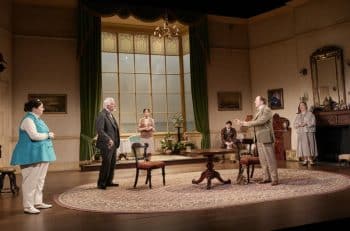
    By Rory O’Sullivan It is fitting that after a year mired in controversy, particularly over its relations with Irish actors and directors, the Abbey Theatre should choose ‘Drama at Inish’ for its Christmas show. Plays like this almost invariably swaddle audiences in a cotton wool of nostalgia for the easy days they depict, but which no one has ever lived through. For the Abbey that sense of nostalgia must be overpowering, since the playwright, Lennox Robinson, was one of its venerable institutions. After the deaths of Yeats and his collaborator, Augusta Gregory, Robinson became the world’s window into the Irish Literary Revival, telling war-stories at university debates just as David Norris does now. He looked and walked and talked just like Yeats. He also served as the Abbey’s General Manager for much of the 1910s and was on its Board of Directors for his whole life afterwards; according to some versions of the theatre’s history, it was largely because of Robinson that the theatre stayed open during some of its most difficult times. He was competent, careful and likeable: three rare qualities in a building full of artists. He was also genuinely a good playwright – but not a great one. His works tend to have beginnings, middles and ends; the characters are consistent and usually a little interesting, and the writing is mostly clever and original; but there is never much in the way of theme. The plays are full of stereotypes telling jokes or parodying something, and if there is any drama at all it is safely smothered in marriages at the end. They can be good fun, but nothing is ever at risk in them; they are the kind of plays that Ibsen built a career by destroying: ‘A Doll’s House’ without the famous twist. ‘Drama at Inish’ is a little more complicated than that, but not much. Set entirely in a hotel in ‘Inish’ – a mid-West Cork town equivalent to Schull – it begins with the arrival of an actor and actress from Dublin, Hector de la Mare (Nick Dunning) and Constance Constantia (Marion O’Dwyer), who have come to perform highbrow works from the theatrical canon in the town’s pavilion every evening for the tourist season. They have been hired by local business magnate John Twohig (Mark O’Regan), whose sister Lizzie (Aoibhinn McGinty) runs the hotel, in the hope that a departure from the usual circus-fare will draw holiday-makers to Inish and away from the towns nearby.  The characters are mostly parodies: the actors are snobbish and self-absorbed, Lizzie is a spiteful middle-aged spinster, and John is a drunk. His wife, Annie Twohig (Helen Norton), is overall a sensible person though without much personality, but their son, Eddie (Tommy Harris), is madly in love with Christine Lambert (Breffni Holahan), the city-slicking woman who comes down every year to audit the business accounts.  The shows turn out extremely popular, but soon the townspeople begin to behave like the characters in the plays. Eddie goes existential, reads Turgenev and threatens suicide; Lizzie becomes a Medea shouting recriminations at Peter Hurley (Marcus Lamb), her childhood friend, now the local TD, who apparently jilted her years before for another woman; a confused Peter points out that Lizzie and his wife have been friends for years. Near the play’s end, Peter breaks the party whip and sinks a government bill after seeing Ibsen’s ‘Enemy of the People’ the night before. When the chaos becomes too much, John and Annie dismiss the actors and invite the circus in for the rest of the Summer. ‘Drama at Inish’ itself is the sort of play an English Professor teaching Robinson would instinctively choose to lecture on: a play about what it means to perform and watch plays. On that particular topic, playwrights can usually manage to speak with some insight; here, the problem is not that the work lacks thematic moments, but that it doesn’t at all know what to do with them. One of the gags involves John Twohig ranting that he had worked hard to provide wealth and a house for his wife and son; “A Doll’s House?”, Constance Constantia asks with a ‘checkmate’ kind of a look; “Exactly”, John replies, as if it was obvious, and keeps ranting. Like the townspeople of Inish, the play skips uncomfortably over any moment where a theme threatens to jump in and complicate things. One of the subplots contains a revelation of a secret and possibly aborted pregnancy; ironically, it is so brushed-over that an audience could leave the theatre forgetting it occurred at all.   This fear of its own subject matter leaves the play with nowhere to go once its basic premise has been unfurled. The last act is little more than a series of dull and pointless vignettes involving characters we have never seen before: a journalist, a garda and a dumb-and-dumber sort of a local. The dismissal of the two performers at the end is businesslike and stilted; O’Dwyer tries to wring what she can out of Constantia’s half-drunken monologue, but there really is nothing much in it.  The show’s director, Cal McCrystal, spent his publicity hours telling rte.ie and ‘The Irish Times’  that none of this is really the important thing, and that if people laugh the show succeeds. He usually works as a comedy consultant for big films, and was brought in to direct as a kind of subject-matter expert, to the great chagrin of the actors and directors in dispute with the Abbey; who, ‘The Irish Times’ say, cited it as yet more proof of the theatre’s neglect of Irish talent. But McCrystal seems to have done the play some good: it often is funny, and strikes many notes other than the loud, frantic caricature that poor comic performances often hammer dead. Marion O’Dwyer’s performance is the best, lampooning the character of Constance Constantia without ever losing her. Ian O’Reilly (of Moonboy) also impresses in the middling-to-minor role of Michael, the coal boy; he has one big

    Loading

    Read more

  • Posted in:

    Review: Project Arts’ “Mother of Pearl” is more theory than theatre

    By Rory O’Sullivan   EMILY AOIBHEANN’S ‘Mother of Pearl’ is the second in a two-part production and follows ‘Sorry Gold’, which played at this year’s Dublin Fringe Festival. There are three dancers and three musicians in the cast: respectively, two women and a man, and two men and a woman. Aoibheann herself is one of the musicians, joined by guitarists Ciarán Byrne and Ronan Jackson. Its cinder-block walls make the stage feel like a warehouse; and the set, whose design team included the visual artist Liing Heaney, is dingy and dystopian like the cities of ‘Blade Runner’. The Project Arts Centre contributes to this, now firmly in the run-down-cinema rather than deconsecrated-church class of theatrical venue. The stage is more like the interior of an unconscious mind than a physical place, which as a setting works well for this gleefully abstract performance. The playbill tells us that “Pan, God of the Wild, travels to the Ocean to dance with a pearl – a freakish hyper object from a post-natural age”, but the show is not really interested in its story. ‘Mother of Pearl’ instead offers a game of moods and concepts: the ugly and the beautiful, the industrial and the ecological, the trapped and the transcendent. At the curtain’s rise we see Cathi Sell dancing in a sequined leotard andcradling a stone; to which, while working through contortions, her approach is in turn affectionate and dismissive. At times she seems about to throw it across the stage. Rainy crackling sounds play out as she moves, like water falling on stones. Then nearly fifteen minutes are given over to a tedious unveiling of the performers and objects onstage. They all start hidden under curtains. Taking advantage of this long distraction, Sell whirls away, drops the stone, changes clothes, and comes back. The musicians emerge and play an electric guitar, electric bass, and accordion. The other two dancers, Becky Neal and Michael Gillick, are revealed tangled among the objects. The objects are: a cluster of foot-sized platforms caged in wiry metal, two chairs and a kettle whose purpose I could not discern, some pyramidal scaffolding halfway between a set of monkey bars and a gallows, and the show’s eponymous pearl, appropriately white and smooth. But the pearl does not really come into it until the end of the show’s middle third, which is its best and contains some genuinely resonant theatre. With the guitars and accordion playing tone-music composed by Aoibheann herself, the contrasting ideas onstage finally take form and speak to one another. Sell and Neal dance almost as one body and coax Gillick, who is in theory the God Pan, down from the high scaffolding. Pan swings on the bars and wraps himself around them, beauty and terror embodied; we turn to see Sell and Neal entwined together on the clustered platforms; Pan runs everywhere around the stage in a Dionysiac frenzy; after some soul-searching, he joins the other dancers and they pull down the high scaffolding. Throughout all of this the pearl stands inert in the middle of the stage, an embodiment of aesthetic transcendence and perfection. It was the sphere, after all, that the Pan-worshipping Greeks considered the perfect shape, continuous and limitless in every direction. Parmenides and Plato both said it was the shape of the universe. When Pan is at last allowed access to the pearl it is only as part of a single consciousness merged with the other two dancers’. They take turns jumping around on top of it as the others hold it still. With these gears all rotating, the show is able to get some mileage out of its images and motifs. In an interview with the Irish Times Aoibheann cites the philosopher Tim Morton, who has argued against separating the concepts of nature and civilisation, contending that they are inextricably one. This argument grounds the show as the metal scaffolding, the pearl, Pan and the two dancers all flow in and out of one another like waves. In this ‘Mother of Pearl’ grazes the best of abstract theatre as it has existed since Beckett: a mode of reasoning without a conclusion, a reasoning of images and emotions rather than of mind. It should have stopped there. Instead the show ends with the theatrical equivalent of pumping diesel into a petrol engine. The dancers, and then the musicians too, all break off and run around the stage yelling, screaming and thrashing generally. Chairs are upturned; the curtains come back and are thrown around. Then it is on this chaos that the big black curtain closes to end the show. A woman behind the curtain screams sharply three times, enough to thoroughly discomfortthe whole audience, and the cue is given for everyone to applaud. The ending is rash and pointless and deadens the effect of what comes before. Like the soporific reveal of cast and set at the beginning, it is a gesture towards a fashionable kind of abstract theatre that aims to bully and disturb audiences. It is easy to shock an audience, but hard to shock an audience while doing good theatre. The beginning and end are certainly unsettling, but only that. Neither manages to negotiate a place in a performance whose successes are always in spite of them. Before the show’s run Aoibheann wrote a pretty exorbitant piece for rte.ie which is mostly about the meaning of the pearl. An oyster will create a pearl in response to some kind of irritant in its mouth: proverbially a grain of sand, in truth normally a parasite. It surrounds the irritant with a smooth coating that protects the oyster, and over time the coating becomes a pearl. For Aoibheann, the pearl basically stands for art itself: “I”, she writes, “am the irritant”. Later she asks the following, which I quote for you to puzzle over: “The extraction of the pearl kills the oyster. Considering nature, is product still more valued than ecology? Can we say the same about art?”. If the point

    Loading

    Read more