admin

  • Posted in:

    BBC Blackout on 50th Anniversary of the McGurk’s Bar Massacre?

      By Ciaran MacAirt. Family campaigners on legacy cases in the north of Ireland learn not to be precious about media coverage, especially when the British state is involved in the murders and subsequent cover-ups. On any other occasion, there are many reasons why a media outlet will not cover a story. In the fast-moving environment of the media, they may run out of time to report it or may miss it altogether. The outlet may not even consider it news, or it could be bumped by another article. If an article does not appear, it may even just be down to human error or misjudgement; on our part, it could be poor timing or media management. We all make mistakes. Last week, for example, our families were busy media-managing new evidence, a protest against police withholding evidence, and the build-up to the 50th anniversary of the McGurk’s Bar Massacre. 15 civilians including 2 children were murdered in the no-warning Loyalist bomb attack on 4th December 1971. Our families’ grief was compounded because the British state and its media blamed our loved ones for the bombing, so before we buried our loved ones, the British state buried the truth. Our Campaign for Truth began the moment the bomb exploded as first we had to prove the innocence of the victims. Since then, mostly through our own legacy archive research, we proved that the British armed forces knew that McGurk’s Bar was attacked, but instead colluded to blame the victims to suit the British state’s own narrow, sectarian, political agenda. In general, the British media followed suit and published the lies. Our Campaign for Truth began the moment the bomb exploded as first we had to prove the innocence of the victims. Since then, mostly through our own legacy archive research, we proved that the British armed forces knew that McGurk’s Bar was attacked, but instead colluded to blame the victims to suit the British state’s own narrow, sectarian, political agenda. In general, the British media followed suit and published the lies. Fast forward nearly half a century and the week before the 50th anniversary. We had a lot to tell the public in the run-up to Saturday 4th December and we launched our new website especially. We used a mix of web content, social media and press release. PR to the media specifically included: A complaint to the Parliamentary and Health Service Ombudsman in London against the Cabinet Office and its failure to investigate new evidence we found – the first complaint of its kind in a legacy case we believe [link] New archival evidence recorded by the British armed forces within minutes which was completely at odds with the lies told to the press by the British armed forces about McGurk’s Bar [link] A protest two days before the anniversary at the Policing Board against the Police Service Northern Ireland’s deliberate withholding of evidence relating to police collusion with the British Army in creating the McGurk’s Bar lies and blaming our loved ones. We even named a key architect of this secret agreement as we have archival proof – it is the infamous General Sir Frank Kitson, former Commander-in-Chief, UK Land Forces and Aide-de-Camp of the British Queen [link] The subsequent snub by the Chief Constable at the Policing Board of our families two days before the 50th anniversary of the atrocity [link]   Now, we were conscious that this was a lot of information for the press and public to manage but the families wanted me to press ahead and release. Each press release staggered throughout the week highlighted the fact that the week led to the 50th anniversary of the McGurk’s Bar Massacre. All of our other key local media outlets, including UTV, Belfast Telegraph/Sunday Life, Irish News and North Belfast News picked up on these press releases during the week, as did the Morning Star and The Canary in Britain and the Irish Times and Village Magazine in the capital. All of our other key local media outlets, including UTV, Belfast Telegraph/Sunday Life, Irish News and North Belfast News picked up on these press releases during the week, as did the Morning Star and The Canary in Britain and the Irish Times and Village Magazine in the capital. I spent most of Friday – the eve of the 50th anniversary – engaging with these outlets in time for the following day. I did not submit another press release on the day as we did not want to snowstorm the outlets and we had already drawn attention to the anniversary throughout the week. Nevertheless, nowhere on BBC NI News was the 50th anniversary marked in the week before, on the day or thereafter. I believe one of the religious ministers marked it during his Thought for the Day on Radio 4 which was very welcome, but to the best of my knowledge, nowhere on BBC Northern Ireland TV, Radio or Web was the 50th anniversary of the murder of 15 civilians marked in any way. I believe that we are diminished by the death of every victim and our loved ones are no more special than another family’s loved one, but the McGurk’s Bar Massacre is notable [unfortunately] if only for its ferocity and the death toll in a single bombing – 15 souls including 2 children. Another 16 could have perished but survived. The McGurk’s Bar Massacre remains the greatest loss of civilian life in any single murderous attack in Belfast since the Nazi Blitz in 1941. The McGurk’s Bar Massacre remains the greatest loss of civilian life in any single murderous attack in Belfast since the Nazi Blitz in 1941. The families’ Campaign for Truth is very much live and driven in the most part by the our own intensive legacy archive research which has been missed or buried by historical police investigators, academics, lawyers, and journalists over the last half century. So, history, death toll, human interest, notable anniversary could make for interesting

    Loading

    Read more

  • Posted in:

    Harry Kernoff, The Little Genius.

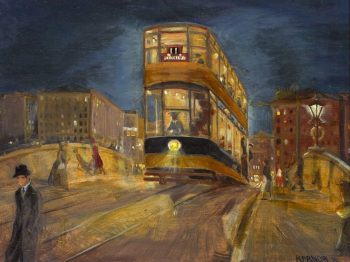
    By David Burke. The Liffey Press has just republished Kevin O’Connor’s 2012 gem, ‘Harry Kernoff, The Little Genius’, the only  full-length biography of the painter. The original edition became impossible to acquire years ago. The reprint is lavishly illustrated with hundreds of Kernoff’s pictures, made possible by years of detective work on the part of O’Connor, who managed to track so many of  them down. A few dozen are reproduced in colour. Kernoff’s family fled from Vitebsk, Russia, during the 1890s. The artist was born in London in 1900  and moved to Dublin in 1914. He spent most of his life without the recognition he so richly deserved, yet continued to paint the world around him.  O’Connor captures the essence of the man thus:  “He lived among and studied [Dublin’s] people, recording them in their infinite variety and was rivalled only by James Joyce in bequeathing a narrative of the city. As Joyce departed shortly after turn-of-the-century, Kernoff was left with the clear palette to record Dublin’s complexion as it changed with the century. By birth a Londoner, by family Russian, by religion Jewish, his paintings show iconic respect for those who impacted upon history in revolutionary times leavened with warm affection for the ordinary people who suffer the history”. One of his works, Misery Hill (1943), depicts the “despair of man who props his arse against the wall, a common posture of the time, his entire demeanour one of defeat”, as O’Connor puts it. “Other men, no better off, are followed by Kernoff’s cheerful poodle, a common whimsey in his work. Another man carries a sack of coal while a woman pushes a handcart of offal stew, another woman passes a poster Vote Labour. The area known as Misery Hill was on a long stretch of road faced by men from the slums hoping for a day’s work unloading ships. Unusual for the time, its realism was of a poverty largely ignored by most of his contemporaries, with the exception of George Collie. Indeed, it may be seen as another iconic painting, given the official denial of such poverty. Those that lived on state salaries were consoled by the emigration of males, a safety-valve on civic unrest. These particular paintings by Kernoff did not prove popular. In time, the district of Misery Hill would become so painful to urban planners as to be raised during the Celtic Tiger boom years of 2000, replaced by a New Dublin of hotels, walkways and desirable apartments with sea views-modelled on the Wall Street area of New York. But even that became fatally prescient as a model in the financial downturn of 2008, when the grandiose schemes were abandoned as the country coped with bankruptcy”. Kernoff began to receive recognition for his talent towards the end of his life. O’Connor’s book plants him among the greats of the 20th century.  Harry Kernoff died in 1974.      

    Loading

    Read more

  • Posted in:

    Rolling back the Eighth Amendment: the Church's power grab for the new national maternity hospital­­ — backed by government. By Marie O'Connor.

    The big day. The sun shone, marquees fluttered, caterers bustled. Everybody who was anybody was there, ‘old boys’, former nurses, family friends. The No 1 Army band heralded the arrival of the Archbishop of Dublin; His G33race was followed five minutes later by the Tánaiste and Mrs Childers. The Archbishop said Mass for some 1200 people after leading a procession to bless ‘the new Vincent’s’, also known as the Mary Aikenhead School of Nursing. After the speeches came a two-tier lunch, turkey in the cafeteria for staff, cold meats, salads, wines and coffee for distinguished guests. Acquisitions The following year, the Religious Sisters of Charity acquired St Michael’s Hospital, Dun Laoghaire, from the Sisters of Mercy. Thirty years later, in 2001, they established St Vincent’s Healthcare Group to own and manage their hospitals. In 2010, the RSC expanded their portfolio again, mortgaging a publicly-funded asset, St Vincent’s University Hospital, to fund the building of their new private hospital at Elm Park. A decade later, the congregation is poised to acquire a new multi-million maternity facility — set to be one of the biggest in Europe — built and maintained from the public purse. Succession The key RSC objective today is to guarantee that their ethos will continue to determine care in their facilities. The congregation is dying out, so succession problems arise, as they do for religious worldwide, the dwindling owners of hospitals, schools and other non-profit enterprises. The order, which comprises some 250 members in all, mainly in their 70s and 80s, is headquartered in Dublin. Controversially, the congregation refused to pay its agreed €3 million share for victims of institutional child abuse in 2012, following the publication of the Ryan Report into industrial and reform schools. The order subsequently declined to compensate the Magdalene women, having netted €45 million in 2001 from the sale of its land at Donnybrook, Dublin, site of a laundry it ran for over 150 years. The flouting of public-pay policy by the Vincent’s Group was also widely censured.  Vincent’s and Holles Street Vincent’s has always had a special relationship with the National Maternity Hospital, Holles Street, a privately owned-corporation under the aegis of the Catholic Archdioceses. For decades, the NMH led the way in symphysiotomy, an operation that unhinged a woman’s pelvis, performed in lieu of Caesarean section by doctors who disapproved of birth control.  Today a much more liberal regime prevails. As Tony Farmar’s centenary history of Holles Street shows, medical consultants practised privately in both hospitals from the 1890s. Archbishop John Charles McQuaid was the National Maternity Hospital’s (NMH) all powerful chairman when he performed the opening ceremony at Elm Park in 1970. Today, around 40 per cent of NMH consultants work in the RSC’s hospitals despite the religious restrictions imposed on their practices. A power grab In 2013, Minister for Health James Reilly announced the building of ‘the new NMH’ — then set to cost €150 million — at Elm Park. KPMG had recommended that Dublin’s three private maternity hospitals be co-located with acute general hospitals in 2008. Co-located single-speciality hospitals offer ready access to wider specialist care: hospitals retain their independence while sharing ancillary services. Initial agreement between Vincent’s and the NMH on co-location broke down. In or around September 2014, under a new chairman, James Menton, a former KPMG partner, the nun’s company made a takeover bid for the NMH, reportedly delaying the planning process until Holles Street caved in. The Mulvey report Incoming Minister for Health Simon Harris appointed Kieran Mulvey to broker an agreement between the two warring private entities in May 2016. Four months later, the then deputy chair of the NMH, Nicholas Kearns, and the hospital’s then Master, Dr Rhona Mahony, now a director of the Group, reportedly informed Mulvey that they were willing to dissolve the NMH charter to become a wholly-owned subsidiary of the nuns’ company. This offer was made without consulting either the NMH board or the governors, according to former master and former board member Peter Boylan, a strong opponent of the takeover by the nuns’ company. St Vincent’s Healthcare Group, the company founded by the order in 2001, was now set to own and control the new maternity hospital company, which is to be a wholly-owned subsidiary of the Group. Mulvey had no public-interest mandate. The report set out detailed proposals for the takeover: it did not question it, nor did it consider who should own the land underneath the new hospital. Simon Harris welcomed the publication of the Mulvey report in April 2017, in a U-turn from the government’s previous support for NMH independence from Vincent’s, expressed by his predecessor Leo Varadkar in May 2016. It was a watershed for the congregation’s plans. Pushback Public opposition grew. A mass demonstration took place at Leinster House, one of many, and over 100,000 signed a petition against the government’s proposal to gift the new facility to the RSC. Peter Boylan publicly expressed his concern that certain procedures would not be available in the new hospital because of its Catholic ethos. Responding on 25 April 2017, the chair of the Group, James Menton asserted that “in line with current policies and procedures at SVHG [the nuns’ company], any medical procedure which is in accordance with the laws of the Republic of Ireland will be carried out at the new hospital”. This is a remarkable claim— later repeated — that gives the impression that abortion and other procedures banned by the Catholic Church were, and would continue to be, provided at Vincent’s hospitals. The Irish Catholic Bishops’ Conference healthcare code The Irish Catholic Bishops’ Conference issued its ‘Code of Ethical Standards in Healthcare’ in 2018. Abortion is permitted only as a lifesaving  procedure.  Under all other circumstances, such as rape, the threat of suicide or the diagnosis of a fatal foetal abnormality, abortion is prohibited. Referral for abortion is also banned, because it  constitutes “formal co-operation with wrongdoing”, which is “never morally permissible”. Other prohibited practices include artificial contraception, IVF, surrogacy and

    Loading

    Read more

  • Posted in:

    A loathsome dirty trick. 4 December was the 50th anniversary of the infamous bombing of McGurk's Bar. The families have made a complaint to Parliamentary Ombudsman Against the Cabinet Office. By David Burke.

    Saturday the 4th of December was the 50th anniversary of the infamous bombing of McGurk’s bar in Belfast by the UVF.  15 people were killed in the massacre. The bomb reduced the building to rubble. The attack was the most devastating atrocity suffered by Belfast since the bombing of the city during the Second World War. Brigadier Frank Kitson, the counterinsurgency specialist in charge of Belfast, knew that the bar had been attacked by Loyalist paramilitaries, yet participated in a black propaganda operation to blame the atrocity on the occupants of the premises. He and others  portrayed the explosion as an IRA own goal, i.e. that McGurk’s was an IRA pub and the bomb had been left there for collection by Republican terrorists, but had gone off prematurely. This was a lie. Kitson is alive. He has never been asked why he covered up for the actions of the Loyalist murder gang. Kitson is alive. He has never been asked why he covered up for the actions of the Loyalist murder gang. Kitson’s lies were used by Tory politicians to mislead the House of Commons. The record has never been corrected. The British government is refusing to investigate what really happened. The most likely explanation for the deception is that it was designed to avoid calls for the internment of Loyalist terror groups. At the time Ted Heath and NI PM Brian Faulkner had decided not to intern the UDA, UVF and Red Hand Commando. Furthermore, Brigadier Kitson had entered into a conspiracy with Tommy Herron of the UDA’s Inner Council. It amounted to nothing less than an agreement for mass murder. Herron ran the UDA’s assassination squads in Belfast. They killed Catholics whether they were connected to the IRA or not. Herron was aided by Kitson’s allies in the RUC. Some of these RUC men were stationed at Mountpottinger RUC station in Belfast. They supplied murder weapons to Herron’s killers. This was how British State collusion with Loyalist murder gangs began in Northern Ireland. Herron maintained contact with Kitson through a Captain Bundy. Bundy later ran the notorious UDA killer and sadist, Albert ‘Ginger’ Baker’. His codename was ‘Broccoli’. Herron, Baker and others participated in the ghastly ‘Romper Room’ kidnap, torture and murder programme of Catholics they abducted on the streets of Belfast. If the truth about the UVF’s responsibility for the McGurk bombing had surfaced, Kitson’s strategy of collusion with the UDA would have been severely jeopardised while still in its infancy. Members of both organisations might have been rendered subject to internment. Instead, Kitson chose to vilify the innocent victims of the bombing as patrons of an IRA meeting place. Ciarán MacAirt is the grandson of two of the McGurk’s Bar victims. His grandmother, Kathleen Irvine was one of the fifteen civilians killed; his grandfather, John Irvine, was badly injured but survived. He has written a book which exposes the scandal in forensic detail. He has also produced an addendum which can be read here: The McGurk’s Bar Bombing Post-Script: https://mcgurksbar.com/wp-content/uploads/2020/10/McGurks-Bar-Post-Script-Final-Redux.pdf See also, the McGurk’s Bar Bombing and the Plot to Deceive Two Parliaments https://mcgurksbar.com/wp-content/uploads/2020/12/The-McGurks-Bar-Bombing-and-the-Plot-to-Deceive-Two-Parliaments-Report-Redux.pdf The scandal ranks among the most repellent dirty tricks of the Troubles and is part of a pattern of criminal wrongdoing perpetrated by Kitson that can be discerned in the Ballymurphy and Bloody Sunday massacre outrages. The scandal ranks among the most repellent dirty tricks of the Troubles and is part of a pattern of criminal wrongdoing perpetrated by Kitson that can be discerned in the Ballymurphy and Bloody Sunday massacre outrages. Yesterday, the Chief Constable of the PSNI refused to talk to a delegation representing the relatives of the families who mounted a dignified protest outside his office. The families of those killed and injured are still trying to find out the full truth about what happened to their relatives. Last month they made a complaint to the Parliamentary and Health Service Ombudsman (PHSO) in London against the British Cabinet Office. As far as the families are aware, this is the first complaint of its kind to the PHSO regarding a conflict legacy case and the Cabinet Office. The complaint concerns: The Cabinet Office’s decision not to investigate a serious complaint regarding a high-level, coordinated and sustained plot by senior members of the Civil Service, British Army and RUC to deceive both Stormont and Westminster governments about the true circumstances of the McGurk’s Bar Massacre; The Cabinet Office’s handling of the original complaint which was first raised in December 2020. The original complaint to the Cabinet Office on 11th December 2020 also included a request to the Cabinet Secretary, Simon Case, for an investigation following the publication of a report by Ciarán MacAirt. See pages 24-25 of The McGurk’s Bar Bombing and the Plot to Deceive Two Parliaments. The report also includes new evidence from secret British military and governmental archives proving that there was a high-level, coordinated and sustained plot to deceive both Parliaments at Stormont and Westminster. The plot and disinformation involved both Prime Ministers, Brian Faulkner and Edward Heath; the General Officer Commanding Lt. General Sir Harry Tuzo; Brigadier Frank Kitson; RUC Chief Constable Graham Shillington and his head of Special Branch; and leading Civil Servants across a number of government departments. The disinformation included blaming the victims of the McGurk’s Bar Massacre for the bombing following a secret agreement between the British Army and RUC hours after the explosion, and before all victims had even been identified; and burying evidence which proved that the British Army and RUC knew that the victims were innocent, and the bar had been attacked. Colum Eastwood MP, leader of the SDLP, counter-signed and submitted the complaint to the PHSO on behalf of the families on Wednesday 4 November 2021. Ciarán MacAirt has said: After undue delay, the Cabinet Office denied us access to an investigation despite new evidence of a high-level, coordinated and sustained plot by public servants and Government Departments to mislead Stormont and Westminster about the McGurk’s Bar Massacre,

    Loading

    Read more

  • Kitson

    Posted in:

    Frank Kitson, Collusion and the McGurk’s Bar Cover-Up. By Ciarán MacAirt.

    Saturday 4 December is the 50th anniversary of the McGurk’s Bar Massacre which, in 1971, was the greatest loss of civilian life in any single murderous attack in Ireland since the Nazi Blitz in 1941. 15 civilians including two children perished in the atrocity when Loyalist extremists planted a no-warning bomb in the hallway of McGurk’s Bar, a family-run pub in north Belfast. The McGurk family lived above their bar. In a split second, Patrick McGurk lost his wife, his only daughter, his brother-in-law, his livelihood and his home. He and his sons thankfully escaped, albeit injured. I am a grandson of two of the McGurk’s Bar Massacre victims. My grandmother, Kathleen Irvine, was one of the 15 civilians murdered. My grandfather, John, was badly injured but survived. Like the other survivors, he shouldered the physical and mental scars of that night every day until he died 22 years later. He had night terrors and his frightened family sometimes found him pushing the rubble away from himself as he slept or clawing at his mouth as if it had filled with pulverised mortar once again. An eight-year-old paperboy called Joseph McClory saw the bomber plant the bomb in the hallway and light its fuse. The man ran to a waiting car which then drove off, leaving the young boy behind. Joseph saw a local man about to turn the corner and go into the pub, but he shouted to him, “Mister, don’t go into that bar. There’s a bomb there.” The eight-year-old saved the man’s life and gave the Royal Ulster Constabulary a detailed statement regarding the attack on the bar and the escape of the bombers. The local man told the police that Joseph had indeed warned him and the bar exploded in seconds after that. Nevertheless, before we buried our loved ones, the British state buried the truth. Nevertheless, before we buried our loved ones, the British state buried the truth. Within hours and before all of the victims had been identified, police, the British Army and government officials briefed the press that the explosion was the result of an Irish Republican Army “own-goal”, to use their heinous language. Instead of trying to bring the pro-state mass murderers to justice, the British state instead blamed the bombing on the innocent civilians in the bar. Their only crime? The victims and survivors were Irish Catholics, and they were living and dying in a rotten, sectarian Orange state. Proof that the ‘Irish Question’ could not be solved by military and legal means alone came early in the conflict but was not heeded for another generation. Far from quelling what the British portrayed as localised unrest, the introduction of internment on the 9th August 1971 plunged the north of Ireland into an all-enveloping spiral of violence, destruction and death. The story of its failure is told in the death toll in the months prior to and following its introduction. Ten people (four British soldiers, four civilians and two Republican Volunteers) died in the four months leading up to internment. One hundred and twenty eight died in its four-month aftermath (sixty nine civilians and fifty nine combatants – thirteen Republican Volunteers and forty six British army, RUC, UDR and Loyalist personnel). Before Internment was introduced in August 1971, the British authorities had urged the Northern Ireland Prime Minister Brian Faulkner to include alleged Protestant extremists in the initial lifts. It could then be argued that the Special Powers were not designed to be directed solely against the Catholic community. Faulkner refused as he knew that he would not have the support of his party or the RUC. Instead, the British authorities formalized an “Arrest Policy for Protestants” (discovered by Pat Finucane Centre) which meant that no Protestants were interned until 1973 even though they had murdered well over a hundred civilians by then. Therefore, if it was admitted to the public that pro-state Loyalists had perpetrated the McGurk’s Bar Massacre on the 4th December 1971, the Northern Ireland government’s assertion to Whitehall that they were “no serious threat” would be completely untenable. As it was, internment without trial remained directed against the Irish Catholic community alone for another 14 months over the bloodiest year of the conflict. Even after that, alleged Protestant extremists only made up 5% of internees even though the Protestant community was around twice the size of the Irish Catholic community in the statelet. As Village Magazine examined (https://villagemagazine.ie/a-pact-sworn-by-devils-how-a-british-prime-minister-sold-his-soul-to-acquire-votes-to-enable-the-uk-to-join-the-european-economic-community-the-forerunner-of-the-eu/), Edward Heath and the Northern Ireland Prime Minister are in the frame for a sordid Faustian pact which bartered the maintenance of the highly discriminatory internment policy, Unionist votes in favour of the European Economic Community, and the cover-up of the McGurk’s Bar Massacre. So devastating and all-enveloping was this cover-up, that the victims and survivors of the McGurk’s Bar Massacre were blamed for the attack and their families are still fighting for scraps of truth and justice from the British table half a century later. The Loyalists who murdered them murdered many, many more civilians in the years afterwards although only one served any time whatsoever for the murders. The police had detailed information on them all from a covert human intelligence source relating to the bombing. The British state had much to bury, though. The British state had much to bury, though. We know from secret documents that it undermined Joseph McClory who saw the bomb being planted and the bombers escape. The McClory family received death threats afterwards. The British authorities ignored the witness testimony of the man he saved and all of the civilians who survived the bombing although they buried corroborating information from a witness at the bomb site the following day. The British state even ignored a public claim by Loyalists that its members blew up McGurk’s Bar. We now know too that the police and British Army had information relating to a suspect car within a minute of the explosion. It found and finger-printed what secret police records called the “car used in

    Loading

    Read more

  • Posted in:

    The deep Irish background to the Ghislaine Maxwell trial. By Joseph de Burca

    Ghislaine Maxwell goes on trial in NY tomorrow. She was a key figure in a paedophile network that serviced Royalty, most notably Prince Andrew. She was the right hand of Jeffrey Epstein who was the key player in the modern iteration of a well-established vice ring which overlapped with other similar groups and rippled across the Atlantic to Europe. Roy Cohn helped run the network before Epstein. Cohn was one of Donald Trump’s most influential mentors. Epstein and Cohn supplied children to influential figures including Royalty and senior politicians. The purpose was to gather ‘kompromat’ for blackmail purposes. Epstein was an operative of an as yet unnamed intelligence service in the sphere of the US. There is a shocking and sickening Irish connection to the Cohn-Epstein paedophile scandal. Village exposed it in July 2020. An in-depth account can be read here: Trump’s mentor: another sociopathic paedophile child-trafficker in the mix; from Roy Cohn to Epstein and Maxwell. See also: Trump’s child abusing attack dog. The only lawyer Trump professes to admire these days was a well-known paedophile, child trafficker and blackmailer who was disbarred from practice.  

    Loading

    Read more

  • Posted in:

    Homeless woman outmanoeuvred by Leitrim County Council.

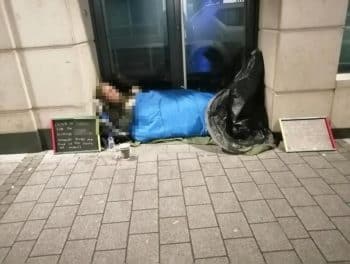
      ‘M’ is not the only person living rough in Carrick. She is the one who has had courage enough to take on the bureaucrats, media silence and the onset of savage weather. By Councillor Des Guckian I’m a (very) Independent Councillor for the Carrick-on-Shannon Electoral area. I have refused to join the large coalition that exists on the Council which controls appointment, zonings and land disposals, as well as across a range of necessary services, the day-to-day dispensing of justice.I do not close my eyes to injustices. In mid-September, I was told by a very concerned person that a woman (I’ll call her M) was sleeping rough on the streets of Carrick-on-Shannon. The next information I got was that she had presented as homeless to Leitrim Housing on 17 September. She was not well received and was, bluntly, told to go back to Dublin. This was despite evidence that she carried stating that she had properly signed out of a place in Finglas. A similar dismissal occurred a few days later. What convinced me that this was a great injustice was the knowledge that M had grown up in Carrick and had attended school there. Therefore she is a native of County Leitrim. She is a member of the Traveller community. According to Focus Ireland, the second quarter of 2020 was the first quarter in which the number of people exiting homelessness is higher than the number becoming homeless since this data began being published in 2014. Most councils were anxious to get the homeless off the streets during COVID, but not Leitrim. After the Council’s refusal to provide her with any form of emergency accommodation, M was forced into sleeping rough on the town’s streets. This is fraught with dangers. I wrote numerous emails to the Council’s Housing Department stating that M could be attacked, could die of hypothermia, and risked severe mental strain. I also pointed out that there were sad precedents, in Carrick, where homeless people had died while sleeping rough. All this was generally ignored by media, by Council officials and by the general population. I had queried Housing officials about homelessness in our County. The stock answer was that anyone presenting as homeless was looked after. I argued that M was a clear case giving the lie to such assertions. At the full Council meeting in September, two other Councillors asked questions about thehomelessness problem. The answers given by Housing officials were on the lines “We do a good job”. In further emails, I was told that National Department of Housing funding was available to help a Council defray most of the expenses incurred. It turned out that, for years now, Leitrim has had no emergency hostels and we have been offloading our homeless onto Sligo City. It is a logical assumption that Sligo benefited from funding provided for our homeless and for theirs. It took a long time to get Leitrim Housing to admit that they were avoiding the hard work and some expenses. On 22 September, M was accompanied by a Simon worker when she, again, presented at the Housing office. Again, she was refused. M made it clear that she was not going to be forced to leave Carrick and she resumed sleeping rough. I wrote to Housing Minister Darragh O’Brien, to the Irish Human Rights and Equality Commission and to Pavee Point. Nothing positive emerged, though Pavee told me they wrote twice to Leitrim Housing, but got nowhere. I put a motion, on M’s plight, before the Carrick Municipal meeting of 18 October. The Council officials just circled the wagons and my fellow Councillors were struck dumb. I thought something had been achieved, when, that very evening, the Council’s Traveller Liaison Officer visited M and promised to help her. It was a false dawn and she spent more nights on the streets. At the start of November, the Council obtained emergency accommodation for M in a flat, in Carrick, for four nights a week only, but she had scandalously to move out at the weekend to allow the owner to cater for the hen and stag parties that have become ubiquitous in Leitrim. At the Council’s Budget Meeting I put forward a motion that money should be set asideto provide a hostel, in Carrick, to provide emergency shelter for our homeless. Council officials managed to crush this motion with the aid of the coalition and it was not mentioned in media reports of the meeting. Embarrassingly, the budget itself was to provide an estimated €142,113 for “Homeless Service”, but a grand total of €444,611 for “Veterinary Service”. The latter, I was told, included a dog shelter. I commented that we could provide a shelter for dogs, but not for homeless people. I told the officials that if M died on the streets, they would be held responsible. That evening, the Council officials told M that they would provide B&B accommodation for her in far off Ballinamore, but if she stayed on the streets in Carrick, it would be her own responsibility. M remains on the streets of Carrick. Council officials just washed their hands of her. She is not the only person living rough in Carrick. She is the one who has had courage enough to take on the bureaucrats, media silence and the onset of savage weather to highlight her needs and her civil rights. Leitrim County Council commented: “It is the policy of Leitrim not to comment on individual cases. However, where a person presents as homeless, they are assessed and where appropriate an offer of temporary emergency accommodation is made through the provision of B&B accommodation. It is matter for the individual to accept or refuse this offer of temporary emergency accommodation”. Personally, I’m shocked that Council officials would behave in such a callous manner towards a fellow human being. A month before Christmas in modern Ireland, there is still no room at the inn.  

    Loading

    Read more

  • Posted in:

    Councillors await legal advice on transfer of O’ Devaney Gardens to developer whose scheme would breach Dublin City’s Development Plan. By Michael Smith.

    Councillors and the CEO are in a standoff as to whether the legal advice needs to be fully independent or if it can be delivered via the Law Agent who normally reports to the CEO. As with O’Devaney Gardens, in Oscar Traynor Road Councillors  appear to have allowed leeway the CEO to rewrite the Councillors’ agreement with the developer .

    Loading

    Read more

  • Posted in:

    Backstabbing and censorship, by Royal Command. Covering up smears, dirty tricks and child rape by the Royal Family.

    By Joseph de Burca. The BBC is resisting an attempt by Buckingham Palace to neutralise a documentary about a press-briefing war between princes William and Harry. It is entitled ‘The Princes and the Press’ and is scheduled for presentation by Amol Rajan on BBC2 on Monday night at 9 pm. It will be the first of a two part broadcast. The Queen, Prince Charles and Prince William are jointly threatening to boycott the TV organisation if doesn’t kow-tow to their wishes. No doubt behind the scenes, the usual tactic of promising knighthoods and other awards is taking place; equally, the making of threats to withhold them from likely future recipients. Prince Harry has no hope of matching that sort of an armoury. One of the known anti-Harry briefings to emanate from Buckingham Palace in recent times was a smear which called  the former’s mental health into question. ITV attempted to reveal this to the public last July but was forced to buckle at the last moment in a broadcast entitled, ‘Harry and William: What Went Wrong’. The BBC has a lamentable history of obsequiousness towards the Palace. The easy ride afforded to Prince Andrew over the Jeffrey Epstein scandal is a good example. The Corporation managed to misrepresent an exclusive interview with the Royal as a triumph for hard hitting journalism when it was nothing of the sort. It wasn’t just the failure to probe, Prince Andrew was not asked a single question about his relationship with the paedophile Lord Greville Janner. See: The Prince, the pauper and the paedophile peer: the dangerous questions the BBC failed to ask. The threat to boycott a TV station is a tried and tested technique deployed by the Royals. Officials at the Palace used it successfully to prevent ABC TV in the US from exposing Prince Andrew’s links to the Jeffrey Epstein child rape and trafficking scandal. The US TV station buckled, and Epstein and his paedophile network pursued children unimpeded for another few years as a result. Details about that can be read here: Judge a (future) king by his courtiers: Prince William and the Duchess of Cambridge, pawns in the cover-up of a transatlantic paedophile network. Meanwhile, the Palace continues to fight author Andrew Lownie’s campaign to release the diaries and papers of Lord Louis Mountbatten. Those papers may contain clues about the abuse of boys from Kincora Boys’ Home in Belfast. Further details about Mountbatten’s abhorrent sexual abuse of boys as young as 8 can be found at: SECOND UPDATE: Kincora boy abused by Mountbatten committed suicide months later. See also: Mountbatten, the Royal who abused boys aged 8-12. If the timeservers at the BBC finally stand up to the Palace it will be a first. The BBC’s record in making a mess of  issues like these is depressing. See also: Carl Beech and the ‘Useful idiots’ at the BBC. The incompetence of the BBC has now made it a pawn in the cover-up of VIP sex abuse. The darkest forces in MI5 and MI6 are the true beneficiaries of its inepitude. OTHER STORIES PUBLISHED BY VILLAGE MAGAZINE WHICH EXPOSE UK VIP SEX-ABUSE SCANDALS: Prince Andrew has no need to sweat after publication of the Janner paedophile report. James Molyneaux and the Kincora scandal. James Molyneaux was linked to Kincora child rapist in British PSYOPS document. Judge a (future) king by his courtiers: Prince William and the Duchess of Cambridge, pawns in the cover-up of a transatlantic paedophile network. With regard to Mountbatten: SECOND UPDATE: Kincora boy abused by Mountbatten committed suicide months later Also: Mountbatten, the Royal who abused boys aged 8-12. The British Government purchased Mountbatten’s archive for the benefit of historians (allegedly) but has locked it away. It may include details about his links to paedophile networks including the Anglo-Irish Vice Ring. With regard to Prince Andrew:  The Prince, the pauper and the paedophile peer: the dangerous questions the BBC failed to ask. With regard to Prince Philip: Prince Philip’s infidelity, love children and the Profumo scandal . With regard to Roy Cohn who was Donald Trump’s mentor: Trump’s mentor: another sociopathic paedophile child-trafficker in the mix; from Roy Cohn to Epstein and Maxwell. Village’s online book on the Anglo-Irish Vice Ring begins here: The Anglo-Irish Vice Ring. Chapters 1 – 3. The plot to discredit victims of VIP sex abuse: Carl Beech and the ‘Useful idiots’ at the BBC. The incompetence of the BBC has now made it a pawn in the cover-up of VIP sex abuse. The darkest forces in MI5 and MI6 are the true beneficiaries of its inepitude. With regard to Enoch Powell: Suffer little children. With regard to former British prime minister Ted Heath: Not just Ted Heath: British Establishment paedophilia and its links to Ireland With regard to Margaret Thatcher, MI5 and the murder of the lawyer Patrick Finucane: Thatcher’s Murder Machine, the British State assassination of Patrick Finucane. By Joseph de Burca.

    Loading

    Read more

  • Posted in:

    CAP still doesn’t fit. Modest recent reductions by EU and Department in perverse incentives still not enough to render agricultural policies sustainable

        By Caroline Hurley. This Sunday 21 November, the Irish Farmers Association (IFA) is spearheading another grinding Dublin city rally with tractors and machinery, one of a series to spotlight inadequate funding, and lack of government engagement with farmers’ leaders about changes in the Common Agricultural Policy. Farmers are a diverse bunch though, not uniformly represented by one voice, with a growing number welcoming measures they feel should have pertained all along. CAP Reform ‘Around ten million farms employing about twenty-two million workers make the EU one of the world’s leading agri-food producers and net exporters’ The EU’s Common Agricultural Policy (CAP) is undergoing another round of reforms. The EU budget agreement has provided for a total CAP funding for Ireland of €7.4 billion over the 5-year period from 2023 to 2027. The funding is split between Pillar 1 (direct payments and sectoral interventions including 25% for eco-schemes – €5.9 billion) and Pillar II (Rural Development including LEADER programmes – €1.56 billion). The Department of Agriculture (DAFM) has been translating the latest EU schemes into Ireland’s own CAP Strategic Plan 2023-2027 (CSP) for Irish farmers, still in its stranglehold despite environmental and climate measures gaining more purchase, especially with the passing of the Climate Action and Low Carbon Development Bill 2021 and Plan. Climate budgets for the period up to 2030 have just been allocated by the Climate Change Advisory Council (CCAC), seeking a paltry 21% to 30% reduction in emissions for the agriculture sector. ‘Professor John Sweeney of Maynooth University warns that expecting other sectors of society to make up for agriculture’s future deficit in curbing carbon could become an unbearable burden especially given the key impact of lifestock-created methane’ Professor John Sweeney of Maynooth University warns that expecting other sectors of society to make up for agriculture’s future deficit in curbing carbon could become an unbearable burden especially given the key impact of lifestock-created methane. Ireland’s alleged superior efficiency in dairy and beef production and agriculture’s unique economic place, are among counter-arguments cited. CCAC recommended cuts of between 11% to 19% cannot happen without mass mobilisation and conscious behaviour changes. Meanwhile at COP26 have just pledged to cut emissions 30% by 2030. On 20 October, after negotiations, analyses and public consultations, Minister for Agriculture Charlie McConalogue T.D. announced almost 30% increases in overall CSP funding, to rise to €9.8 billion in the 2023-2027 period, along with indicative allocations that would increase funding for Pillar II issues to €3.86 billion with €2.3 billion extra national funding provided. €723m of carbon tax funding has been earmarked for sustainable farming practices through a flagship agri-environment climate measure. 202407_c38f85e8-bd00-4c75-af3b-00ede0271c11 Donning the CAP The CAP evolved from the European Recovery Plan (ERP), lasting from 1948-1952 in Ireland and bankrolled through the American Marshall Plan during the precarious post-World War Two era. Eamon de Valera’s economic policy had stressed self-sufficiency using indigenous resources, in opposition to the globalising vision of larger world powers. During the precarious post-World War Two era. Eamon de Valera’s economic policy had stressed self-sufficiency using indigenous resources, in opposition to the globalised vision of larger world powers. Discouraging insularity, the Keynesian Marshall Plan Plan unevenly funded sixteen European countries with the proviso they would take the technical and economic advice given. According to Professor Bernadette Whelan “the Marshall Plan’s focus on public-private partnership, trade liberalisation, freeing up intra-European payments and trade, market organisation and financial stability were its most enduring legacy reinforcing to-day’s dominant neo-liberal economic ideology”. A seminal essay by Professor JL Sadie, ‘The Social Anthropology of Economic Development’ published in the 1960 Economic Journal, noted: “Economic development of an undeveloped people by themselves is not compatible with the maintenance of their traditional customs and mores. A break with the latter is prerequisite to economic progress…What is, therefore, required amounts to social disorganisation. Unhappiness and discontentment in the sense of wanting more than is obtainable at any moment is to be generated. The suffering and dislocation that may be caused in the process may be objectionable, but it appears to be the price that has to be paid for economic development: the condition of economic progress”. ‘When high wages and time-shortages prevail, the economic advantages of engaging in sustainable local practices are reduced’ When energy is scarce but time and labour abundant, people readily employ Schumacherian ‘small is beautiful’ methods, cultivating organically for local markets, building with earth and natural materials, and rejecting industrial campaigns. When high wages and time-shortages prevail, the economic advantages of engaging in sustainable local practices are reduced. The communal, physical work involved in land-care is usually inaccurately disparaged as unskilled labour but can be highly dignified and creative. Despite the health, social and self-actualisation gains associated with rural occupations, the proportion of a population engaged in agriculture has come to be taken as a measure of how underdeveloped a country is. The CAP has played a big part in fostering this perspective. CAP’s Warp and Woof After the Treaty of Rome established the EEC in 1957, the CAP was launched in 1962 to ensure food continuity under uncertainty and to address rural poverty. Managed by the European Commission’s Department for Agriculture and Rural Development, it became the EU’s biggest and most costly programme. Intended for farmers in all EU countries, the CAP cost €58 billion in 2019. The CAP’s two budget funds are the European agricultural guarantee fund (EAGF) for direct and market payments, and the European agricultural fund for rural development (EAFRD). ‘The CAP cost €58 billion in 2019. The CAP’s two budget funds are the European agricultural guarantee fund (EAGF) for direct and market payments, and the European agricultural fund for rural development (EAFRD)’ The CAP allocates direct income support for wage regulation, intervenes in markets to address situations such as price drops due to temporary oversupply, and funds rural development. Payments are managed at national level. Around ten million farms employing about twenty-two million workers make the EU one of the world’s leading agri-food producers and net exporters. The

    Loading

    Read more

  • Posted in:

    Bull island ‘Discovery Centre’ will hasten precipitous decline of its wildlife. The Centre aims to attract 55,000-60,000 visitors annually

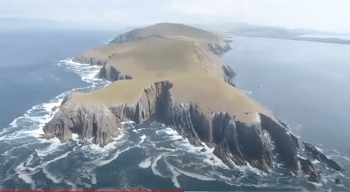
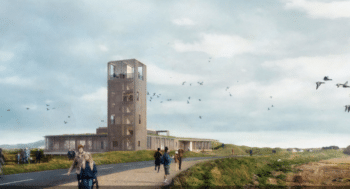
      By Sean Byrne. Until the beginning of the nineteenth century ships entering and leaving Dublin port frequently stuck on sand banks at the entrance to the port and had to wait until a high tide floated them in or out. To solve this problem, the Great South Wall and the North Bull Wall were built to narrow the entrance to the port and thereby increase the speed of the ebbing tide which would scour the sand banks.  The sand which was washed out built up behind the North Bull Wall, which was completed in 1825, and over the succeeding fifty years what is now the Bull Island was formed.  The Island became a habitat for many plants, animals and birds and from the early twentieth century its importance as a nature reserve was recognised. In 1931 Dublin City Council designated the island as Ireland’s first bird sanctuary. Today, Bull Island is the most designated site in Ireland. It is a UNESCO biosphere (the only such biosphere within a capital city boundary). The Island is also a National Nature Reserve, a Special Protection Area under the EU Birds Directive and a Special Area of Conservation under the EU Habitats Directive. Since 1995 Bull Island has been a Special Amenity Area, one of only three in the Republic of Ireland, a designation based on the Island’s outstanding beauty and nature conservation values. Dublin City Council (DCC) which has responsibility for Bull Island has completely failed to maintain the Island in a way that meets the requirements of these designations. Ironically, the map of Bull Island produced by DCC shows the hare, now long gone, the cuckoo which has not been heard for many years, a ringed plover nesting at the Sutton end, now gone because of disruption of its nesting sites, the short-eared owl now very uncommon, and a bar-tailed godwit now under pressure because of poor management of the nature reserve. The main reason for the reduction in Bull Island’s biodiversity is uncontrolled access to the island by dog walkers, many of whom let their dogs off leads. This has led to the disappearance of hares and a huge reduction in the number of little terns, skylark, linnet, reed bunting and red poll. Until the 1990s, an area at the northern tip of the island was fenced off to facilitate ground-nesting birds but when the fence was broken down it was not replaced. Another threat to the Island’s biodiversity is the extraction of water and installation of wastewater treatment plants by the two golf clubs, Royal Dublin and St Anne’s on the Island. DCC, insofar as it has managed the Island at all, has managed it as a park and leisure space rather than a significant and fragile nature reserve. That DCC regards Bull Island merely as a park, is clear from its ‘North Bull Island Nature Reserve Action Plan 2020-2025 for the Implementation of Management Objectives (May 2020)’. This Plan states that ‘the Nature Reserve will undoubtedly have a greater footfall as the urbanisation of Dublin continues’ and argues, without any evidence, that the Nature Reserve has a ‘capacity to carry additional footfall’. It then says that the damage which this additional footfall will cause to the Nature Reserve can ‘ultimately if necessary … be controlled using techniques which have proven successful in other nature reserves” without stating what these techniques are or where they have been successfully implemented. The only measure in the Plan to deal with the uncontrolled dog walking, which is the greatest threat to the Bull Island biosphere, is a proposal that people, with or without dogs, will be “requested” not to access the northern end of the Island and along the saltmarshes and that dog walkers will be “required” to keep dogs on lead within the sand dunes. The southern end of the beach will be an ‘off-leash’ area outside the bathing season.  These pitifully weak measures are to be “supported by signage, communication and awareness raising.”   The effectiveness of “awareness raising” can be judged from the fact that when there was a warden on the Bull Island, he was abused and threatened when he asked dog walkers to keep their dogs on leads. No warden has been employed for the past three years. The sign at the entrance to the beach from the causeway road saying that dogs should be kept on leads disappeared several years ago. An Interpretive Centre on Bull Island which, during the period it operated, did not open on Sundays and Bank Holidays was closed without explanation three years ago. Not content with neglecting the conservation of Bull Island, which has led to a severe loss of biodiversity, DCC with the support of Fáilte Ireland now plans to build an intrusive ‘Discovery Centre’ at the entrance to the beach on Bull Island at a cost of €10 million. This Centre aims to attract 55,000-60,000 visitors who will have to pay an entrance fee.  To be viable the Centre will need a spending footfall more suitable to a high-street shop than a critically important and fragile Nature Reserve. If the Discovery Centre is built, it will hasten the decline of the nature reserve and will display pictures of birds and mammals which will have disappeared by the time the Centre opens. Green Party leader Eamonn Ryan launched his party’s policy for biodiversity on Bull Island in January 2020 and Malcolm Noonan, Minister of State for Heritage was  pictured on Bull Island in March 2021 launching a scheme of grants for biodiversity projects. People concerned about the future of the nature reserve have asked both Ryan and Noonan and former Green Lord Mayor Hazel Chu to oppose the building of the Discovery Centre and to ensure that DCC implement conservation measures but have had no response, or in the case of Noonan, a dismissive response to their representations. The Green Party councillors on Dublin City Council have not opposed the building of the Discovery Centre or sought measures to conserve the

    Loading

    Read more

  • Posted in:

    Soldier F’s Bloody Sunday secrets. David Cleary knows enough to blackmail the British government.

    By David Burke, author of ‘Kitson’s Irish War: Mastermind of the Dirty War in Ireland’. 1. Kitson’s Private Army. Lance Corporal David Cleary was a member of the elite Support Company of the 1st Parachute Regiment which was commanded by Colonel Derek Wilford. Wilford reported upwards to Brigadier Frank Kitson. All were assigned to 39 Brigade area which operated in Belfast and its environs. Support Company of 1 Para was known as ‘Kitson’s Private Army’ and was infamous for its brutal behaviour in Belfast. Kitson reported upwards to General Ford at British Army HQNI at Thiepval Barracks, Lisburn. Lance Corporal Cleary was ‘gazetted’ or  ‘mentioned in dispatches’ for his “gallant” behaviour during the internment swoops of August 1971. Cleary could not have received that minor honour without the full support of his superiors. Clearly, he was one of the more important soldiers in Kitson’s Private Army. 2. Kitson’s Private Army is sent ‘on loan’ to Derry. Brigadier Patrick MacLellan of 8 Brigade in Derry also reported to General Ford. 1 Para was sent on loan to Brigadier MacLellan to assist him block a NICRA march from reaching the centre of Derry city on 30 January 1972. The troops of 1 Para were merely meant to man a few barriers and be on standby to conduct a possible snatch and arrest operation if rioting by youths got out of hand. On the afternoon of 30 January 1972, Cleary perpetrated his infamous murder spree. There are a number of indications that his behaviour was part of a ruthless counter-insurgency strategy formulated in Belfast behind the back of 8 Brigade. The plan was  to wipe out the IRA in the Bogside and Creggan and put an end to the ‘no-go’ area that had become known around the world as “Free Derry”. The official British narrative is that of Lord Saville. His inquiry concluded in 2010 that Cleary and his colleagues span out of control at the same time, disobeyed orders in unison and murdered unarmed civilians as a pack for some utterly inexplicable reason. 3. Military Intelligence and MI5. A clue as to what happened on Bloody Sunday can be gleaned from the fact British military intelligence and MI5 were in receipt of information that 40 Republican gunmen were going to be present in the vicinity of the Rossville Flats (shown on the map below). The information, however, was fallacious. What is crucial to appreciate is that the spy’s handlers believed the information was true. On Bloody Sunday the troops of Support Company raced up Rossville Street in a convoy of military personnel carriers (‘pigs’) which fanned out into an attack formation as if to confront a salvo of bullets from IRA gunmen. Instead, they encountered the harmless occupants of a nearby barricade and then proceeded to murder them before killing other unarmed civilians in the vicinity. The overwhelming majority of their victime were male and young. Typical, IRA volunteers were young men. Cleary was one of the most violent of the killers. He shot a number of people in the back. One of them was lying on the ground. He aimed at his anus so the bullet would travel up and demolish his spine. He blew apart the skull of another man who was walking towards a fallen victim while waving a piece of cloth. 4. Secret Orders. Aside from two or three Official IRA members who fired a few shots on Bloody Sunday, there were no armed and active Republicans in the Bogside. The Official IRA discharges did not spark the massacre. The Provisional IRA did not take up any arms at all that day. Support Company ended up murdering unarmed civilians, none of whom presented them with any danger. Shortly before the massacre,  Cleary (Soldier F) received a visit from his commander, Colonel Derek Wilford at the yard which the company was using as its temporary HQ beside a church. As Cleary let slip in a statement he made nearly 50 years ago to the Widgery tribunal, the visit was an ‘unusual’ development. For the avoidance of any doubt the word he – Cleary – used in that statement was ‘unusual’. Cleary and his Widgery tribunal minders must have included the reference to Wilford’s visit in the statement as there were multiple witnesses to it. Furthermore, Wilford was scheduled to testify at the Widgery tribunal where he was likely to describe his movements anyway. Cleary, however, did not reveal what orders Wilford gave him during their discussion. Soldier G, another of the  Bloody Sunday killers, was present for the meeting. Wilford probably gave them orders – or confirmed  earlier instructions  – to open fire as soon as they got out of their ‘pig’ at the 40 IRA gunmen the dubious intelligence source has said would be waiting for them. 5. C Company, the fig leaf for the assassins of Support Company. Wilford had taken C Company and Support Company to Derry. The soldiers of C Company dressed in the type of outfits they wore when arresting rioters in Belfast. Their clothing was light. They were unencumbered by equipment. All of this enabled them to run at speed to catch fleeing rioters. They formed up behind Barrier 14 (which can be seen on the left of the illustration with this article). MacLellan’s plan was to divert the NICRA march around the corner between William Street and Rossville Street up towards the Rossville Flats. Officially, C Company was under the command of Brigadier MacLellan of Derry’s 8 Brigade for the day. He had instructed all of the troops of 1 Para to remain on foot and confine their actions to the vicinity of William Street where the rioting was expected to take place. Unlike Support Company which disregarded most of MacLellan’s orders, C Company paid them some heed. 6. General Ford. Bloody Sunday would not have happened if C Company and Support Company had not been ordered into action. MacLellan had not wanted to release them but was told so to

    Loading

    Read more

  • Posted in:

    Judge Horner’s ruling creates the framework for a new Omagh inquiry.

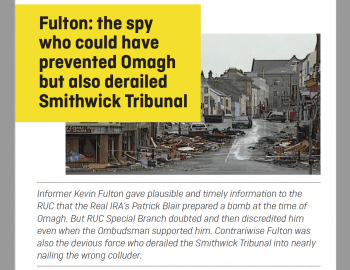
    By Deirdre Younge. On 8 October 2021, Judge Mark Horner in the High Court in Belfast gave the reasoned judgment behind his decision of 21 July that there should be a new Human Rights compliant investigation into the catastrophic bombing of Omagh on 15 August 1998. He suggested that preferably there should also be one conducted simultaneously in the Republic of Ireland. The judgment was on foot of a Judicial Review brought by Michael Gallagher in 2013. Gallagher was appealing the decision of the then Secretary of State for Northern Ireland Theresa Villiers not to set up a public inquiry into the bombing of Omagh by dissident republicans (referred to as DRs by Judge Horner).  Michael Gallagher’s son Aiden was one of the 29 people who died.  Judge Horner found that there were reasonable grounds for believing that the Omagh bomb could have been prevented. The case, conducted largely in closed session, heard closed (secret) intelligence from MI5 and other agencies as well as evidence in open court. The Judicial Review was of course a civil case but one which engaged issues of (UK)  National Security because of the intelligence material from M15 and other agencies which was revealed to the court. Mr Justice Horner put heavy emphasis on the intelligence given to his RUC CID handlers in 1998 of a British  agent/informant  ‘Kevin Fulton’ who had also been the central witness at the Smithwick Tribunal in Dublin, giving evidence in 2011. Fulton was a former FRU, Special Branch, MI5 and latterly RUC CID agent and informer ‘embedded’ with the IRA in Dundalk and Newry in the 1980s and 1990s. The Secretary of State for Northern Ireland is setting up a statutary inquiry into the Omagh bomb using the grounds on which Mr Justice Horner made his ruling, as the terms of reference. In an endorsement of Fulton’s highly contested intelligence leading up to the bombing the Judge said: “I am satisfied that it is arguable that the intelligence supplied by Kevin Fulton, either on its own or more importantly in conjunction with other intelligence about the activities of those who planned the Omagh bomb and other bombs had a real prospect of preventing this tragedy”. Neither Fulton nor his handlers claimed to have foreknowledge of the Omagh bomb itself but said he had warned handlers that a huge bomb was being prepared that was about to be moved north of the border days before the bomb.   The former Police Ombudsman Nuala O’Loan in her 2001 report and now Judge Horner believe that the intelligence Fulton gave his RUC handlers in the months, days and weeks running up to the bombing was crucial information that should have been acted on to prevent the bombing. Fulton and his handler gave evidence about this intelligence concerning dissident republicans to O’Loan and Smithwick.  The October /November print  issue of Village magazine contains an extensive analysis of the evidence of Fulton and his handler  leading up to the Omagh bombing and its aftermath, and explains the significance of this intelligence in detail. Reliable sources maintain that Keeley was not in fact a detached observer of events leading up to Omagh, as he maintains, but was deeply involved himself.    In his evidence to Smithwick in December 2011 Fulton describes the operation of the timer unit of a bomb. In Queen v Hoey (2006) Mr Justice Weir describes how such a safety mechanism was added to timer units in the run up to the Omagh Bomb. Of the ten arguments put forward by the applicants Mr Justice Horner accepted the following –  Ground 2: Information passed to police between June and August 1998 by a former British security agent known by the name of Kevin Fulton relating to DR* activity. Ground 6: Surveillance operations relating to events surrounding the Omagh bomb that were reported on in a BBC Panorama; in particular telephone and vehicle monitoring carried out by GCHQ. Ground 7/9: the tracking and pattern of telephone usage by DRs and the connection arising between different bomb attacks, including the same mobile telephone being used in the Omagh bomb and the bomb in Banbridge on 1 August 1998. Detective Chief Superintendent Norman Baxters evidence to the NIAC, [Northern Ireland Affairs Committee HOC] to the effect that investigators into previous attacks in 1998 did not have access to intelligence which may have enabled them to disrupt the DR gang by way of arrest or house searches prior to the Omagh bomb. There were a number of arguments put forward by the applicants which the Judge did not accept as grounds for a new inquiry: Ground 3: Information provided by David Rupert  Ground 4: Information sent to the RUC by AGS on 13  August 1998 relating to the particulars of the red Vauxhall Cavalier that was used in the Omagh bomb. Ground 5: Information shared by AGS with the RUC relating to intelligence obtained by Detective Sergeant John White from the agent known by the name of “Paddy Dixon” [in] relation to DR activity. Judge Horner concluded: “I am satisfied that grounds 2, 6, 7 and 9 when considered together give rise to plausible arguments that there was a real prospect of preventing the Omagh bombing. Judge Horner’s judgment is a vindication for Kevin Fulton over Omagh but like all informants and agents operating in the stygian underworld there is a dark side to Fulton which Village Magazine has also explored at length. (Like many British agents Fulton has a dark side: see Investigation: Killusion and How Drew Harris diverted the Smithwick Tribunal. The High Court  judgment was in the context of Mr Gallagher’s civil proceedings. Many victims or their families are taking civil actions against the State, not just to achieve some form of redress, but to gain an understanding of events through the discovery process.   Since 2013 such proceedings are often  conducted partly or wholly as ‘Closed Material Proceedings’  ( CMPs) for reasons of ‘National Security’ and to comply with human rights legislation to protect

    Loading

    Read more