admin

  • Posted in:

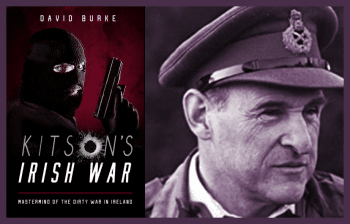
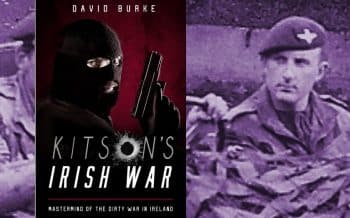
    Learning to Kill, an exclusive extract from the new book on General Sir Frank Kitson, mastermind of the Dirty War in Ireland.

    Kitson’s first overseas assignment was to Germany in 1946 with the rank of second lieutenant. He remained there for seven years. He found plenty of sport to occupy his spare time such as racing horses in Rhine Army competitions, trout fishing and ‘many wonderful opportunities for shooting … and by shooting I don’t mean plugging holes in targets’, he wrote.’ Playing bridge and attending the opera also helped to pass the time. By 13 September 1949, he had found his vocation and was appointed as an intelligence officer at the HQ of the Armoured Brigade in Germany. Half a world away, in October 1952, the Kenya Land and Freedom Army (KLFA) launched a rebellion against the white European colonist-settlers in their homeland. The British army and the local Kenya Regiment resisted them. The latter included British colonists, local auxiliary militia and some pro-British Kenyans. Later, MI5 was deployed to help suppress the rebellion. The KLFA, also known as the Mau-Mau, consisted of rebel tribesmen from the Kikuyu, Meru, Embu and other Kenyan communities. In July 1953, Kitson was transferred to Kenya ‘to do a job connected with Intelligence’. After seven years, he was glad to be leaving Germany. He was twenty-six. The Mau-Mau rebellion was inspired by a desire on the part of the Kikuyu and other Kenyans to reclaim by armed insurrection land taken from them by the British. Kitson, however, seemed to think that opposition to Britain was inspired in large part through the intercession of witchcraft. He had a rose-tinted view of Britain’s presence in the country: During the half century in which the British had ruled Kenya they had dispelled the fears which had formerly come from raiders, slavers and disease, but the fear of magic was still a powerful force. As I sat at home reading about the witch-doctors and their ways, I too felt that fear, flickering faintly across the four thousand miles which separated me from the Kikuyu. He did not see the Kikuyu as civilised people. Instead, he described how they: relied mainly on magic and therein lay the greatest of all the horrors which beset them. Most witch-doctors were not malign in the sense of wishing harm to their clients. On the contrary, they doubtless did their best. On the other hand they sat in the middle of a web of superstition which bound the whole tribe in thrall to an unseen world of spirits, omens, curses and blood. At this time in his life, Kitson kept a Bible by his bedside. A clue as to the type of Christian he was can be gauged by the fact that on his first Sunday in Nairobi he attended a service in the local Anglican cathedral and wrote later: ‘I sat next to an African woman who had bad halitosis and I was surprised to find that there was no segregation of races into separate parts of the building’. The British campaign against the Mau-Mau was merciless. In 1953, Gen. George Erskine, commander-in-chief of British armed forces in Kenya reported to the secretary of state for war, Anthony Head, that in the early days there had been a ‘great deal of indiscriminate shooting by the Army and Police’ and he was ‘quite certain’ that prisoners had been: beaten to extract information. It is a short step from beating to torture, and I am now sure, although it has taken me some time to realise it, that torture was a feature of many police posts. The method of deployment of the Army in the early days in small detachments working closely with the police … had evil results. … I very much hope it will not be necessary for [Her Majesty’s government] to send out any independent enquiry. If they did so they would have to investigate everything from the beginning of the Emergency and I think the revelation would be shattering. What were these ‘evil results’, the revelation of which would have been ‘shattering’? In Cruel Britannia, A Secret History of Torture, Ian Cobain summarises some of the atrocities in Kenya: Men were whipped, clubbed, subjected to electric shocks, mauled by dogs and chained to vehicles before being dragged around. Some were castrated. The same instruments used to crush testicles were used to remove fingers. It was far from uncommon for men to be beaten to death. Women were sexually violated with bottles, rodents and hot eggs. This all took place against a background of curfews, intern­ment and capital punishment. Over 1,200 Kenyans died dangling at the end of a noose. One of the torture victims was Hussein Onyango Obama who had served with the British army during the Second World War in Burma. When released after six months in detention, he was emaciated, suffering from a lice infestation of his hair and had difficulty walking. He died in 1979. His wife informed journalists that he had told her that the British had ‘sometimes squeezed [his] testicles with parallel metallic rods’. They had also ‘pierced his nails and buttocks with a sharp pin, with his hands and legs tied together with his face facing   down’. Hussein Onyango Obama was the grandfather of Barak Obama. One British officer quoted by David Anderson in ‘Histories of the Hanged’ revealed just how brutal the campaign became. He described how a police officer was interviewing three suspects: … one of them, a tall coal-black bastard, kept grinning at me, real insolent. I slapped him hard, but he kept on grinning at me, so I kicked him in the balls as hard as I could … when he finally got up on his feet he grinned at me again and I snapped. I really did. I stuck my revolver right in his grinning mouth … and I pulled the trigger. His brains went all over the side of the police station. The other two [suspects] were standing there looking blank … so I shot them both … when the sub-inspector drove up, I told him the [suspects]

    Loading

    Read more

  • Posted in:

    The D-G of MI5 who ordered the murder of Patrick Finucane has died.

    By Joseph de Burca 1. Getting away with murder. Sir Patrick Walker was in charge of MI5 when the Belfast solicitor Patrick Finucane was assassinated by MI5 agents. Those agents were handled by the RUC Special Branch on behalf of MI5. They included Tommy Lyttle, Brian Nelson, William Stobie and Ken Barret. The assassination, which was bloody and brutal, was carried out in front of Finucane’s wife and young family. The assassination, which was bloody and brutal, was carried out in front of Finucane’s wife and young family. The Canadian judge who investigated the matter, Peter Cory, told the widow of Patrick Finucane that he had seen documents which emanated from ‘Cabinet’ level about the killing. The most reasonable interpretation of this is that Walker was ordered, or had the sanction of Margaret Thatcher and some of those around her in Whitehall, to murder Finucane. The British State has resisted an inquiry into the Finucane assassination for decades. It has flouted agreements and court orders in so doing. When David Cameron was in 10 Downing Street, he told the Finucane family that he could not order a public inquiry into the scandal. When Finucane’s brother Martin asked him why, he turned to Mrs. Finucane and said: “Look, the last administration couldn’t deliver an inquiry in your husband’s case and neither can we”. According to Cameron this was because “there are people all around this place, [10 Downing Street], who won’t let it happen”. As he was saying this, he raised a finger and made a circular motion in the air. Theresa May, who was Cameron’s Home Secretary between 2010 and 2016, did not order a proper inquiry either whem she became prime minister. Walker’s death will please those in Whitehall who are pulling the strings in the background in resistance to the establishment of a full judicial inquiry into the murder. They are engaged in a tactic of ‘running down the clock’. There are very few people alive now who were directly involved in the plot against Finucane. Village magazine accused Walker of the murder years ago. He was named in one story which has been read more than 22,000 times. He did not sue. He did even seek a right of reply. His silence now condemns him. A full account of the Finucane assassination can be found here, especially at Part 4: Thatcher’s Murder Machine, the British State assassination of Patrick Finucane. By Joseph de Burca. 2. Northern Ireland, counter-terrorism and ‘Death on the Rock’. Walker garnered considerable experience in NI on his way up MI5’s blood soaked greasy pole. He served as assistant to David Ransen, the head of MI5 in NI during the late 1970s. He rose to become the head of MI5’s counter-terrorism division (F Branch), 1984-86. He became Deputy D-G in 1986. He was a bully given to flashes of temper when things went wrong. He was the D-G who oversaw the killing of three members of an IRA active service unit (ASU) in Gibraltar in 1988. That unit was planning the slaughter of a harmless ceremonial band and guard. Suffice it to say, many non-military bystanders and tourists would have been wiped out too. How the IRA planned to equate such a massacre with a ‘just war’ is anyone’s guess. The elimination of the ASU became notorious because the IRA volunteers were on a scouting mission and were unarmed. The SAS men who shot them were acting in tandem with MI5. Carmen Proetta, who witnessed the SAS soldiers in action spoke to the media. Her account contra dicted that of the British government. She was then portrayed in the UK press as a prostitute. No money for guessing who briefed the hacks with that lie. She was later awarded libel damages. One female witness who saw the SAS soldiers in action spoke to the media. Her account contradicted that of the British government. She was then portrayed in the UK press as a prostitute. No money for guessing who briefed the hacks with that lie. She was later awarded libel damages. 3. Protecting paedophile rings. Walker was also in charge of MI5 during the last real heave by British MPs and journalists (such as Paul Foot) to uncover the truth about the vile Kincora Boys’ Home sex abuse scandal. MI5 and MI6 used the home as a ‘honey trap’ to collect ‘compromat’ about Loyalist terrorists and politicians. As a result of the cover-up, the wider paedophile ring of which Kincora was a part survived intact. Kincora was part of the Anglo-Irish Vice Ring which overlapped with a multitude of other similar rings.  An incalculable number of children were raped as a result of Walker’s contribution to the cover-up. An incalculable number of children were raped as a result of Walker’s contribution to the cover-up. Walker undoubtedly knew all about Kincora from his earlier days working in NI as assistant to David Ransen. Furthermore, the FX section of MI5 was responsible for surveillance operations which included telephone tapping, photographing and video taping of MI5 ‘compromat’  targets. At least one Kincora boy was raped by a senior DUP figure on the first floor of the Park Avenue Hotel in Belfast in 1976. He was one of many recorded by MI5 at the venue. While this event took place before Walker took over FX, he would have read all the files and may even have reviewed photographs and videos in the possession of FX as the Kincora scandal became a massive headache for MI5 during the 1980s. By then the DUP figure was in a senior political  position from where he was able to assist the cover-up. This man was an associate of the terrorist, serial killer and paedophile John McKeague. 4. Sailing by the same dark compass as his mentor. Walker was placed in charge of MI5 at the behest of his predecessor, Sir Anton Duff. Duff was another of those who covered up for paedophiles and state assassins. Unfortunately, Walker sailed by the same

    Loading

    Read more

  • Posted in:

    Climate Finance Weak

    Climate Finance Week is worthy but can’t mask the fact Irish Finance needs to stop promoting high carbon emitters By John Vivian Cooke In “The Sun Also Rises”, Ernest Hemingway notes that there are two ways to go bankrupt: “gradually, then suddenly”. It is difficult not to draw the conclusion that, for all the earnest recognition of the scale of the climate crisis expressed by individual participants in Climate Finance Week 2021, Ireland`s financial institutions have missed this lesson. At least, that is the conclusion to be drawn from the depressingly modest targets and entirely inadequate timetables that the industry revealed during a week-long series of panels, presentations and seminars. Climate Finance Week Ireland is now in its fourth year and attracts over 5,000 virtual attendees. It is organised by Sustainable Finance Ireland in association with the Department of Finance, and sponsored by AIB.  Speakers included Gro Harlem Brundtland, James Cameron, Brian Hayes and Colin Hunt.   The conference´s set piece, “Irish Sustainable Finance Roadmap”, was notable for the absence of quantifiable milestone targets to achieve net zero industry by 2050. Instead, the focus was on identifying opportunities for new business and a detailed plan of preparatory actions, dedicated to capability building and consultations to be completed by next year`s conference. It is unsurprising that an industry event, convened to discuss the business implications of climate change, should focus on the opportunities for profit. So there was much talk about the implications of the loss of value of underlying assets held as investments or as collateral due to climate change, and, how best to position Ireland to maximise new business opportunities in financing the transition to a green economy. In this context, individual participants can be forgiven for showcasing their own products and services as the nature of any industry-run event is given to bouts of self-promotion.   Some consolation came from the genuine engagement by participants in treating the subject of climate change seriously and from sessions that gave details of the mechanisms by which the financial services industry will respond to the climate crisis.   Green Finance   There was widespread enthusiasm for the prospect of financing the transition to a green economy. Many participants are planning to develop a full ‘suite’ of green financial products to be marketed at advantageous prices. This is not to be sniffed at. The World Bank estimates that public funds will only cover about one third of the total cost of moving to a global net zero economy with the private sector funding the remaining costs. All parts of the economy will have significant borrowing requirements to pay for this transition and Irish financial institutions are eager to capture some of that business with green loans; green bonds; green equity funds; and climate insurance. But, in moving into the sustainable finance market, the industry is merely ensuring its own continued profitability by responding to market signals of future customer demand.   Disclosure and Reporting   The obligations on businesses to disclose the environmental and social impact of their business activities was a major theme that emerged. The International Financial Reporting Standards Foundation is expected to publish a global standard at the imminent COP 26 which will bring order to the patchwork of existing reporting standards. Such a global standard for measuring companies` carbon management will allow comparison between different sets of published ESG reports and, moreover, encourage further ESG reporting by removing the need to generate different data sets for different reporting standards. Irrespective of the outcome of COP 26, the EUis pushing ahead with new reporting regulations that update the 2014 Non-Financial Reporting Directive.   At the moment, Environmental, Social, and Governance (ESG) disclosures are published voluntarily in response to investor demands or as part of companies’ own ESG targets. However, it was noted that there is currently increased “supervisory engagement” with financial regulators as a prelude to the introduction of formal mandatory ESG disclosure regulations. The Bank of England is in the process of developing formal guidelines and, not only will companies have to disclose their GHG emissions but they will also have to disclose the financial risk to the value of the assets on their balance sheets from the impact of climate change. It was suggested that one possible consequence of similar reporting of financial risk would be the requirement that Irish banks might have to hold greater capital reserves over property they hold as collateral.   Capability Building   It was made clear throughout the week that Irish finance companies are not equipped to deliver a net zero financial industry in the immediate future. For the moment, they have neither the sufficient staff with relevant skills nor the business support and IT systems to become sustainable finance providers. As seen in the Roadmap, the industry is only in the very initial stages of laying the ground work for this change, and, most are still at the problem-scoping stage; still trying to figure out what sustainable finance would look like before they even begin to start to reconfigure their business models.   Sarah Dempsey, Head of Sustainability Communications and Partnerships at AIB, gave specific examples of how this problem manifests itself on a day-to-day basis. The current information systems that AIB uses predate the concept of carbon management and were designed to provide information for financial control and regulatory compliance. As a result, the bank does not have access to data for validating data carbon emissions. For example, a substantial portion of its historic mortgage book is secured by homes that have never had a BER rating. Moreover, its effort to decarbonise its operations has a lag time as smaller suppliers in a complex supply chain do not have the capacity to produce data on their own carbon emissions. In fact, AIB spent the last 12 months mapping their loan book against carbon emissions as preliminary step to designing a carbon management system. That AIB is seen as the leader among Irish banks in sustainable finance shows just

    Loading

    Read more

  • Posted in:

    Prince Andrew has no need to sweat after publication of the Janner paedophile report.

      By Joseph de Burca. Prince Andrew is hardly in a sweat after the publication of the report on Lord Greville Janner by the Independent Inquiry into Child Sexual Abuse (IICSA). Janner was a paedophile who abused boys and girls. IICSA has confirmed what has been known for decades, namely that witness statements taken by the British police went missing instead of being sent to the Director of Public Prosecutions. Aside from confirming known facts, the report has added little to our knowledge of VIP sex abuse. Interested readers are invited to look at Village’s free online book which addresses VIP child sex abuse. It starts here: The Anglo-Irish Vice Ring. Chapters 1 – 3. Janner was one of a special group of VIP paedophiles which was protected by Whitehall’s darkest forces including MI5.  Other beneficiaries included Margaret Thatcher’s private Secretary Sir Peter Morrison MP, Sir Cyril Smith MP and Sir Peter Hayman, the Deputy Chief of MI6. Significantly, during its investigation into Janner, IICSA received the evidence of a former ‘rent boy’ from Belfast called Alan Kerr. Kerr’s life story was published by Village over two parts in 2018. (This was before he engaged with IICSA.) As a child, Kerr was let down badly by the NI welfare system and became an underage prostitute. He ended up in London where he still lives. By the age of 18, Kerr had fallen into Janner’s clutches.  Janner once brought him to a performance of ‘The Prince and the Pauper’ where the pair met Prince Andrew. Prior to the event, Kerr was vetted by Scotland Yard/ MI5. The reason for the vetting was because Kerr was being put on the Royal’s guest list. The reason for the vetting was because Kerr was being put on the Royal’s guest list. The security officials approved his attendance. This happened despite the fact Kerr had convictions for sex related offences and was the brother of Richard Kerr, the boy who had blown the whistle on the Kincora Boys’ Home scandal in Belfast a few years earlier. MI5 was deeply involved in the Kincora scandal. Whatever about Kincora, Janner knew that Alan Kerr was a male prostitute who was known to the police. In other words, Janner was prepared to let Scotland Yard and MI5 know that he wanted to bring a practicing rent boy to the event. Clearly, Janner knew he had nothing to hide  from MI5. During the performance, Janner let Kerr and Prince Andrew talk to each other without interruption. The pair were seated directly behind Prince Andrew during the performance. Why did Prince Andrew seat Janner directly behind him? Prince Andrew is currently facing a civil legal action brought by Virginia Roberts (Giufree). She accuses him of having raped her. She was procured for the Royal by Jeffrey Epstein and Ghislaine Maxwell. It is beginning to look increasingly like Lord Janner was acting in a similar capacity for the Prince. Why did Janner think the Royal might be interested in meeting  and talking to a teenage rent boy? While the Prince was friendly and told Alan Kerr that he would be visiting Belfast later that year, he never made any arrangement to meet him again. Did MI5 warn the Royal subsequently that Alan Kerr was the younger brother of the boy who had blown the whistle on the Kincora scandal a few years earlier? None of this – nor anything remotely connected to it – is  addressed by the IICSA report. It is doubtful that the IICSA sought or was given MI5’s file on Alan Kerr or Prince Andrew. Alan Kerr is not named in the IICSA  Report. IICSA failed to investigate child sex abuse perpetrated by VIPs such as Enoch Powell MP, Jim Molyneaux MP and Knox Cunningham (all of whom were members of the Anglo-Irish Vice Ring) despite the fact IICSA was set up to probe sex abuse by VIPs. There is nothing in the IICSA report on Janner which even hints that it sought Prince Andrew’s guest list for the performance of ‘The Prince and the Pauper’ which Kerr attended as one of the listed guests. There is nothing in the IICSA report on Janner which even hints that it sought Prince Andrew’s guest list for the performance of ‘The Prince and the Pauper’ which Kerr attended as one of the listed guests Prince Andrew was not asked to provide evidence by the IICSA. Prince Andrew was not asked to provide evidence by the IICSA. Fr. Dougal McGuire would probably have done a better job at finding the truth about VIP abuse than the IICSA. Last week the Metropolitan police confirmed that it will not be investigating Prince Andrew for the abuse of Virginia Roberts. The sad and depressing reality is that MI5 has monitored the sexual excesses of members of the Royal Family, politicians and other persons of influence for decades. Lord Mountbatten was another member of the Royal Family who abused children, including boys from Kincora. Kincora was run by both MI5 and MI6. The boys Mountbatten abused were driven to him at his holiday castle in the Republic of Ireland by Joseph Mains, an MI5/6 agent who worked as the ‘warden’ at the home. MI6 has admitted a connection to the Kincora scandal. During the Hart Inquiry, MI6 revealed that its former Chief, Sir Maurice Oldfield, had a ‘relationship’ with Mains. Hart included this admission in his 2017 HIA report. The British media has ignored this fact. Put simply, MI5 and MI6 are untouchable as they are the repositories of a mountain of vile ‘compromat’ about British and Northern Irish VIPs. A glimpse of the power they exert was exposed by former British PM David Cameron. He told the family of Patrick Finucane, the solicitor who was murdered by MI5 agents in the UDA in 1989, that he could not order an inquiry into the assassination because people around him in Whitehall would not let it happen. Meanwhile, the British government continues to deny access

    Loading

    Read more

  • Posted in:

    THE LEGACY OF THE CONFLICT: UPDATE ON THE MODEST PROPOSALS

      Christopher Stanley, Litigation Consultant, KRW LAW LLP, Belfast.[i]     THE LEGACY OF THE CONFLICT: UPDATE ON THE MODEST PROPOSALS Christopher Stanley, Litigation Consultant, KRW LAW LLP, Belfast.[i] Earlier this year Village published my comment THE LEGACY OF THE CONFLICT: MR LEWIS’S MODEST PROPOSAL – Village Magazine. This comment concerned the following: “On 14 July 2021 Her Majesty’s Secretary of State for Northern Ireland, the Right Honourable Brandon Lewis MP (a lawyer by trade), made a statement in the House of Commons and his office published a Modest Proposal: ‘Addressing the Legacy of Northern Ireland’s Past’ (CP498). It  is fair to say that Mr Lewis’s Modest Proposal created a backlash within the community after its publication.” As the UK’s Parliament is now in session it is appropriate to update readers of Village on the progress of Mr Lewis’s Modest Proposals. Those Modest Proposals: The Draftsman Cometh As of today (26 October 2021) the British government has yet to publish its proposed legislation to “Address the Legacy of Northern Ireland’s Past”. There is still no prospect that there will be a public consultation before the introduction of legislation as it was introduced as a White Paper which means the government is not obliged to consult on the contents as opposed to a Green Paper. Mr Lewis made this point clear in his most recent oral evidence session to the Northern Ireland Affairs Committee (NIAC) on 27 October 2021: “Let us be clear: this was not a formal consultation in that sense. This was a Command Paper.” https://committees.parliament.uk/oralevidence/2917/pdf/ (last accessed 2 November 2021) In the UK there has been cross-party condemnation of the approach of the British government on this issue. There has also been condemnation from politicians in Ireland and USA and from international organisations including the European Human Rights Commissioner and the United Nations Special Rapporteurs. For example: The Council of Europe Commissioner for Human Rights has warned that the proposals are “indistinguishable from a blanket unconditional amnesty for those not yet convicted” and “would undermine human rights protections and cut off avenues to justice for victims and their families”. The relevant UN special rapporteurs have also expressed their concern regarding the proposals, which in their view would place the United Kingdom “in flagrant violation” of its international obligations. The Ad Hoc Committee to Protect the Good Friday Agreement (GFA) of the United States Senate wrote to the British Prime Minister Boris Johnson on 8 September 2021: “We find this proposal to be at odds with both the spirit and architecture of the Good Friday Agreement. It would abrogate the hard-won compromise regarding legacy issues in the NDNA and appears to us to represent a significant breach of several international human rights agreements to which the UK is a party. Equally important, the cross-community opposition to the current proposal in Northern Ireland should be enough to signal that this points not to reconciliation, but instead to continuing division there. Painful as it is, enduring reconciliation is dependent on accountability and transparency with respect to all participants in Troubles-related violence. There is no shortcut, and the GFA does not countenance one. It is tragic that so many years have been wasted with obfuscation and legal wrangling, but that does not justify abandoning the commitments made by the UK government to see the process through. While the GFA does not impose specific obligations with respect to legacy, it does mandate that both state parties observe and implement the European Convention on Human Rights. Toward this end, both governments are required to incorporate the European Convention into domestic law. The UK in particular must provide for “direct access to the courts, and remedies for breach of the Convention.” The UK addressed these duties domestically with the Human Rights Act of 1998. As a matter of international law, the UK has a double obligation to adhere to the European Convention, first as a party to that treaty, and second, through the GFA. Central to those protections under the European Convention is the right to life, set out in Article 2.” Ad-Hoc-Comm-letter-to-PM-on-Amnesty-Proposal-090821.pdf (caj.org.uk) (last accessed 20 October 2021) Dear Strasbourg: Keep off our Grass On 18 October 2021 the Secretary of State wrote to Clare Ovey of Department for the Execution of Judgments of the ECHR regarding the forthcoming review of the McKerr group of judgments by the Secretariat of Ministers of the Council of Europe. In his initial response he states: “The UK Government is committed to dealing with legacy issues in a way that supports information recovery and reconciliation, complies with international human rights obligations, and responds to the needs of individual victims and survivors, as well as society as a whole.” These Modest Proposals are clear evidence that this is not the commitment of the British government. The Modest Proposals offend and breach international human rights obligations and do not respond to the needs of relatives of victims and survivors. “The UKG proposals follow on from the principles set out in the Stormont House Agreement, while attempting to address the implementation problems within that agreement.” They do not follow the principles in the Stormont House Agreement 2014 (SHA 2014) “We think the best way to help Northern Ireland move towards reconciliation is through information recovery rather than an adversarial court process. It is therefore proposed that a statute of limitations would apply equally to all Troubles-related incidents.” “A meeting of the British-Irish Intergovernmental Conference (BIIGC) took place at Dublin Castle on 24 June 2021 . At this meeting the UK and Irish Governments agreed there was a need for a ‘process of intensive engagement’ with the Northern Ireland parties and others on legacy issues. This would build on previous discussions, take account of the views of all participants and include consideration of new proposals which the UK Government intended to bring forward.” MPs have confirmed to relatives of victims and survivors of the Conflict that NO ‘process of intensive engagement’ has occurred since 24 June 2021. As previously noted there

    Loading

    Read more

  • Posted in:

    Colin Wallace, the former British Army Psychological Operations officer, writes about Bloody Sunday in light of David Burke’s new book, Kitson’s Irish War, Mastermind of the Dirty War in Ireland.

    By Colin Wallace. 1. Memories of Brigadier Frank Kitson. David Burke’s fascinating new book on Frank Kitson includes a comprehensive analysis of what has become known around the world as ‘Bloody Sunday’. Reading it has stirred a lot of memories of the time I spent at Army HQ in Northern Ireland during the 1970s.  As the new book reveals,  Brigadier Kitson sometimes used me as a sounding board while we were both based at Thiepval Barracks, Lisburn. I remember him well coming to my office where he sat in a red armchair.  Unlike other senior officers, he never once called me to his office, which was on the other side of the complex. Intriguingly, he never spelt out to me precisely what had triggered the questions he put to me. The book also describes how the brigadier – as he was then – was encouraged by the Ministry of Defence to sue a British newspaper, The Daily Mirror. It had erroneously claimed  Brigadier Kitson had developed the five techniques which had been deployed against internees while he had served in Kenya. The ploy, as Burke describes, was designed to dampen the confidence of the media who were attacking the Army over those interrogation methods. Inevitably, with the passage of time, many of those distant memories have now morphed into a collage of blurred images, but some remain painfully in focus because of their emotional impact upon me at the time.   ‘Bloody Sunday’ is one of those.  Burke’s book covers a lot of ground including a lengthy section on the Bogside tragedy. He demonstrates that despite two major inquiries into the event, new information is still surfacing some 50 years after it. I believe his book makes an important contribution to the overall debate about what has become one of the most controversial and divisive episodes of that traumatic period. He demonstrates that despite two major inquiries into the event, new information is still surfacing some 50 years after it. I believe his book makes an important contribution to the overall debate about what has become one of the most controversial and divisive episodes of that traumatic period. 2. The Ministry of Defence (MoD) attempted to mislead the media about my role in Widgery. The complexity of the events surrounding ‘Bloody Sunday’ is well illustrated by the fact the initial Widgery Inquiry lasted 24 days and heard evidence from 114 witnesses.  The subsequent Saville Inquiry lasted five years and heard evidence from 922 witnesses.  It became the longest inquiry in British legal history!  Why did the additional 800 witnesses not appear at the Widgery Inquiry when their memories of the event were more likely to be fresh and, therefore, potentially more accurate? At the time of ‘Bloody Sunday’, I was part of the Army’s Psychological Operations (Psy Ops) unit.  My role was gathering and disseminating intelligence information in ways to assist the work of the Security Forces.  The work was sensitive and totally deniable.  In 1990, the MoD approached a number of journalists in an attempt to mislead the public about my role in Widgery Inquiry.  That was a pointless attempted cover-up because my role at Widgery had little, if anything, to do with Psy Ops.   However, MoD documents disclosed by the Government make it clear that, on 11 February 1972, I took over responsibility from Colonel Tugwell, the officer then in charge of Psy Ops in Northern Ireland, for what was known as ‘The Opposition Case’.  Another document compiled at the end of the Widgery Inquiry by the Deputy Director of the Army Legal Services, Lt Colonel  Colin Overbury, stated that I: “provided detailed background information (to the Army counsel) throughout the hearing“.  The Army legal Team also included two very experienced members of the Royal Military Police Special Investigation Branch who undertook ongoing research. It is now clear that some Government witnesses lied to the Saville Inquiry by falsely claiming that the Army had stopped using Psy Ops before ‘Bloody Sunday’ took place.  Why was that deception necessary and why was no action taken against those who committed perjury?  That failure tends to indicate that those witnesses were doing what was required of them by those in authority. Why was that deception necessary and why was no action taken against those who committed perjury?  That failure tends to indicate that those witnesses were doing what was required of them by those in authority. 3. An IRA ambush of a ‘distant cousin to the Queen’ during the Widgery tribunal was ‘quietly covered up’  One of my colleagues on the Army legal team was Major Henry Hugh-Smith of the Blues and Royals.  He was the team’s secretary and brought great energy and humour to his role.  He was described in Peerage News as “a distant cousin to the Queen”. All the members of Army team including the barristers stayed with the 2nd Battalion Royal Green Jackets, at Ballykelly, which is about half way between Derry and Coleraine where the Widgery Tribunal was being held. On the night before the final hearing, the Green Jackets invited Hugh and me to join one of their mobile patrols into the Bogside to see at first hand some of the locations featured in the Inquiry.  The lead Land Rover in which Henry was travelling was ambushed by the IRA.  An official account in Guards Magazine of what happened records that in the attack: “lasted eight minutes with some 600 rounds exchanged“.  It was believed that the IRA were using a variety of weapons in the ambush, including an American M60 machine-gun.  It is amazing that Army casualties were not higher. Two members of the IRA were killed in the ambush and Henry was shot in the right arm. His hand was subsequently amputated above the wrist.  I went to visit him early the following morning – the final day of the Inquiry – at Altnagelvin Hospital on the outskirts of Derry.  He was still very ill and heavily sedated. Two members of the IRA

    Loading

    Read more

  • Posted in:

    The boot is on the other foot. Former British 'PSYOPS' officer Colin Wallace sues the MoD. His case demonstrates that lying to Parliament did not start with Boris Johnson.

      By Joseph de Burca.     Introduction to Village’s online pamphlet on the Colin Wallace Affair. The Tory Government of Boris Johnson is routinely accused of deceiving the House of Commons. Many British commentators behave as if this is a new low in their democratic history.  Yet, there is nothing unusual about the situation. The UK’s Parliament has been misled by ministers at the behest of Britain’s intelligence services, especially MI5 for decades. MI5 is attached to the Home Office and is responsible for internal security. The deception of Parliament has been nowhere more evident than in the case of Colin Wallace, the man who tried to expose the notorious Kincora Boys’ Home child sex abuse scandal.  Village readers will be familiar with the case of Wallace. In the 1970s he worked at the British Army HQNI at Thiepval Barracks, Lisburn. He had a public job but also a clandestine one. On the surface, he performed public relations duties for the army. Towards this end, he briefed journalists about an array of routine military activities. His ‘open’ superior was Peter Broderick, a very senior official of the Ministry of Defence (MoD). Broderick served as the head of the Army Press Desk. Secretly, Wallace was also reporting to Col Maurice Tugwell and later Col Geoffrey Hutton who were in charge of the Information Policy Unit (IPU) which conducted psychological operations known as ‘PsyOps’.  Hutton took over from Col Tugwell in March 1973 and was in post for two years.  He was in charge when Wallace left NI in February 1975. Wallace has just issued proceedings in the High Court in Belfast with the intention of prising out further documents which are in the possession of the British government which will confirm his PsyOps role in detail.  In 1974-75 Ian Cameron of MI5 plotted against Wallace who wanted to expose the Kincora Boys’ Home scandal and was refusing to engage in smear campaigns directed against British politicians. During the course of his work, Wallace was ordered to leak certain documents to the journalist Robert Fisk. He was then disciplined for what he had done. At his disciplinary hearing, MI5 and others conspired to deceive the tribunal hearing his case. They alleged that he had only one role – his ordinary PR duties – and therefore should not have leaked anything sensitive to Fisk. Secretly, Cameron contacted the chair of the tribunal and told him that Wallace was in the UVF. Wallace, of course, had nothing to do with the UVF. Wallace lost his job. Worse still, in the 1980s he was framed for manslaughter on the basis of fabricated evidence by a corrupt Home Office pathologist who lied to the Court. The conviction was later overturned but not before Wallace spent six years in prison. The MoD has alleged that all of the files belonging to the IPU were destroyed in 1980.  The Ministry has admitted that those responsible for the destruction of the files have never been interviewed. It is highly unlikely that the documents were actually destroyed. In the main, this article – which is intended as an online version of the old fashioned pamphlet –  has been drawn together from reports which have already appeared in Village. This account has been prepared in response to the launch of Wallace’s legal action in Belfast. The materials included in the ‘pamphlet’ merely represent a portion of the evidence which shows that Wallace has been telling the truth for decades and the MoD, NIO, Home Office, Conservative Party and Whitehall have been lying. Readers should also watch the documentary ‘The Man Who Knew Too Much’ which is available on Youtube. More information about Colin Wallace can be found at:  https://en.wikipedia.org/wiki/Colin_Wallace WALLACE AND THE PERILOUS  PANTIES Wearing his IPU hat, Wallace and the members of his team were responsible for waging psychological warfare against Loyalist and Republican paramilitaries.  It is important to bear in mind that psychological warfare is not solely about spreading false information, it is about the use of intelligence and factual information in such a way as to influence the behaviour of others.  For example, one of Colin Wallace’s more amusing and notable successes was to deter female members and collaborators of the IRA from transporting explosives for the organisation. Wallace put a story into circulation that the static from the typical female pair of nylon knickers generated sufficient  electricity to explode the bomb materials being carried. As a result, there was a great reluctance to transport explosives. There was a scientific basis at the root of the story, as can be seen from a document entitled: ‘Ammunition and Explosives Safety Standards’. At pages 85-99 it stated: Explosives. The explosives or explosive mixtures that are sensitive to static discharge (electro-static sensitivity of 0.1 joule or less) when exposed are generally primer, initiator, detonator, igniter, tracer, incendiary, and pyrotechnic mixtures. In reality, the chances of explosions being caused by static electricity were very small. Similarly, the PsyOps unit pointed out that the use of nitro benzene in home-made explosives was potentially carcinogenic.  This claim is supported by the United States Environmental Protection Agency who considered nitro benzene a likely human carcinogen. See “Nitrobenzene CASRN 98-95-3 – IRIS – US EPA, ORD”.  An excellent account of Wallace’s exploitation of fears about devil worship stories can be watched on the Man Who Knew Too Much documentary. THE INFORMATION RESEARCH DEPARTMENT (IRD) The Army’s IPU was not the only organisation engaged in PsyOps. The notorious Information Research Department (IRD) was too. The IRD was part of the Foreign Office and worked closely with the British Secret Service, MI6, which is also attached to the Foreign Office. The IRD operated from a building in London called Riverbank House. The IRD was a Cold War Intelligence organisation designed to counter Soviet expansion globally. Inevitably, its staff became involved in the propaganda war in Ireland. The department’s representative in NI was Hugh Mooney, a graduate from Trinity College with Irish roots who had once worked for The Irish

    Loading

    Read more

  • Posted in:

    The British ‘Traitor King’ who contemplated settling in Ireland.

      By David Burke. Andrew Lownie will be known to many Village readers for the depth of his research into the life of Lord Louis Mountbatten and his wife, especially the former’s abuse of boys in the Republic of Ireland. During his research into Mountbatten, Lownie tried, and failed, to gain access to Garda logs showing who had visited Mountbatten at Classiebawn Castle in Sligo.  Lownie had more success earlier this year when he forced the British government to disclose some of Mountbatten’s diaries. The documents had been purchased by the British government and given to Southampton University but at some stage Whitehall had intervened to keep them under wraps. NO TRIAL FOR TREACHERY. In his captivating new book, Traitor King: The Scandalous Exile of the Duke and Duchess of Windsor, Lownie shreds the reputation of the Duke of Windsor, the former Edward VIII, who abdicated in 1936 so he could marry Wallis Simpson. The author confirms and elaborates on long-held suspicions that the Duke played fast and loose with the Nazi regime both before and during the Second World War. Lownie’s book describes grounds upon which the Duke could have been put on trial for treachery, so much so that the Nazis had come to view him as a potential puppet monarch, a British version of France’s Marshal Pétain. Lownie highlights a telegram sent on 15 August 1940 from Portugal while the Duke was on his way to the Bahamas. In it the Duke asked his Portuguese host, a Nazi sympathiser, to send “a communication” as soon as his action was required. The conclusion Lownie draws is that he was complicit in a plot to instal him as a puppet ruler in Britain after a negotiated peace with Hitler. Yet, somehow, the Duke never had to face the music. Churchill was one of a number of influential figures who prevented the post-war publication of captured German documents which detailed the Duke’s Nazi intrigues. Others were not so lucky. William Joyce, better known as Lord Haw Haw, sided with the Nazis in a very public way during the Second World War by becoming the voice of Nazi propaganda radio broadcasts to England. Despite the fact Joyce hailed from Galway, he was hauled back to England and executed for treason. John Amery was also executed. His father Leo was a Tory MP and minister. His brother Julian would marry the daughter of Prime Minister Harold Macmillan and go on to hold a number of government ministerial positions. None of these connections were sufficient to save the life of John Amery. THE MI5 TRAITOR WITH LINKS TO IRELAND WHO KNEW ABOUT THE DUKE’S TREACHERY. The Duke’s treachery had ramifications for Ireland. After the war ended, an MI5 officer called Anthony Blunt was sent to Germany to retrieve some of the embarrassing correspondence that had passed between the Duke and the Nazis. Blunt remained in MI5 while also serving as the Keeper of the King’s Pictures at Buckingham Palace. When it belatedly emerged that he had been working for the Russians while in MI5, his knowledge about the Nazi correspondence played a part in saving him from prosecution. By then he was the Keeper of the Queen’s pictures, a job he was able to retain notwithstanding his treachery. As part of a secret immunity deal he struck in 1964 with the Government, Blunt was granted an amnesty for all the crimes he had committed. These included the abuse of children ensnared by the Anglo-Irish vice ring of which the Duke’s relative Mountbatten was a leading member. Had Blunt been prosecuted, it is conceivable that his role in the abuse of children in Ireland might have emerged much earlier and the activities of the vice ring shut down. Part of the passage in Lownie’s book relating to Blunt’s mission to Germany reads as follows: In 1979, Blunt was publicly revealed to have been a Russian spy since the 1930s, though he had privately confessed to the intelligence services in 1964. The MI5 officer Peter Wright, who interrogated him, was informed by the Queen’s private secretary, Sir Michael Adeane, that Blunt had undertaken an “assignment … on behalf of the Palace – a visit to Germany”. Wright was told not to “pursue the matter…Strictly speaking it is not relevant to considerations of national security”, It looks like the trip [by Blunt] to Kronberg [in Germany] was a cover for a fishing expedition, which suggests that there was something else the Royal Family was worried about. “George VI had every reason to believe that the Hesse archives might contain a “Windsor file”, because Prince Philip of Hesse had been an intermediary, via the Duke of Kent, between Hitler and the Duke of Windsor”, claimed Prince Wolfgang of Hesse to the Sunday Times. It was a belief supported by the wartime intelligence officer Hugh Trevor-Roper, later Regius Professor of Modern History at Oxford University. It is confirmed by Andrew Sinclair, who spent eighteen months researching a biography of Vicky, The Other Victoria, who wrote that Blunt had retrieved “the Duke of Windsor’s correspondence with his German princely cousins, some of whom held high office in the Nazi party”. John Loftus, a lawyer with the US Justice Department, interviewed two former US military intelligence officers .. attached to General Patton’s forces, who confirmed that they had seen references to communications between the Duke of Windsor and Hitler. The documents had been found in a “villa that was owned by a close relative of the Duke which was occupied as an American officer’s club.” There can be little doubt that Blunt provided a report about – if not copies of – the Royal correspondence to Moscow. Ironically, Vladimir Putin and his circle would have ready access to them whereas British politicians would be turned away from Buckingham Palace if they made inquiries about the fate of the originals. A HOME IN IRELAND. There is an intriguing Irish angle to the book. After the war the Duke and Duchess

    Loading

    Read more

  • Posted in:

    Licence to Lie. Freddie Scappaticci, a British agent inside the IRA, sought immunity from prosecution from British legal authorities so he could claim he was not Agent Stakeknife at a secret meeting with a tribunal in Dublin.

    By Deirdre Younge.   Introduction. Freddie Scappaticci became an agent for British Army intelligence in 1978. A member of the IRA in Belfast he worked his way up the IRA hierarchy,  eventually becoming  second in command of the ‘Internal Security Unit”,  known as the feared “nutting squad”. He joined the British Army’s newly-formed Force Research Unit in 1982.  Scappaticci has consistently claimed he is not an agent called ‘Stakeknife’ or ‘Steaknife’ including in his dealings with the Smithwick Tribunal in Dublin. The latter was established to investigate allegations of Garda collusion in the murders of Chief Superintendent Harry Breen and Superintendent Bob Buchanan in South Armagh, after they had left a meeting in Dundalk Garda Station in March 1989. Operation Kenova investigating the agent believed to be Scappaticci has  submitted files to the Public Prosecution Service in relation to perjury charges. Scappaticci had an extensive engagement with the Smithwick Tribunal set up in 2005 which reported in 2013. Though he did not give sworn evidence his legal team argued on his behalf that he was not an agent called ‘’Steaknife’ or ‘Stakeknife’. Through letters obtained through Freedom of information requests to the Lord Advocate of Scotland and the Attorney General of England and Wales it is clear that Scappaticci obtained protection from prosecution or immunity in relation to his interactions with Smithwick from the Lord Advocate of Scotland. He did not not receive a similar immunity or amnesty from the Attorney General of the UK despite Smithwick’s assertions that witnesses from the UK and Northern Ireland had received such protection.Documents obtained through Freedom of Information requests to the (Irish) Department of Justice show Scappaticci was paid his full legal costs of 382,270 euro in 2015. The bills were paid by the Department of Justice, signed off by the Department of Public Expenditure. The Letter from the British Attorney General.   The absence of such an amnesty has enormous implications in light of perjury allegations against Scappaticci in relation to his continual denials that he is an agent called ‘Steaknife’ or ‘Stakeknife’. It also calls into question the decision by the Smithwick Tribunal, set up in 2005 by Dail Eireann, not to reveal details of covert meetings with him and the decision by the Irish State to pay Scappaticci  nearly 400,000 in legal costs, primarily to claim he was not a British Military Intelligence and MI5  Agent called Steaknife or Stakeknife. Senior legal sources assert that Scappaticci spent three days in Dublin talking to the Tribunal. Documents released by the Department of Justice under FOI in relation to substantial legal costs paid to him in 2015, indicate extensive interactions between Scappaticci and the Tribunal. Smithwick on amnesty In the opening chapters of his 2013 report Judge Peter Smithwick has a chapter on amnesty for witnesses and the legal cover afforded by the Irish Tribunals of Evidence Act as follows: Any witness before the Tribunal would have protection in this jurisdiction from criminal prosecution on the basis of evidence given before it. The protection is enshrined in section 5 of the Tribunals of Inquiry (Evidence) Act 1979 which provides as follows: A statement or admission made by a person before a Tribunal or when being examined in pursuance of a commission or request issued under subsection (1) of section 1 of the Principal Act shall not be admissible as evidence against that person in any criminal proceedings (other than proceedings in relation to an offence under subsection (2) ( c ) (as inserted by this Act) of that section) – ( and that is a reference to the offence of providing false testimony to the Tribunal) and subsection (3) of that section shall be construed and have effect accordingly. The Judge went on to explain how witnesses from outside the jurisdiction could be provided with legal cover, particularly those from Northern Ireland and the UK – “However, given the cross-border aspects of the Inquiry, it was equally important to securing the attendance of witnesses that such protection be extended to the United Kingdom. The Tribunal therefore sought and received an undertaking from the then Attorney General of England and Wales, the Right Hon.,The Baroness Scotland Q.C., to similar effect. Subsequent to the devolution of policing and Justice powers to Northern Ireland on the 12th April 2010, Sir Alistair Frasier, the Director of Public Prosecutions for Northern Ireland confirmed that he would continue to honour Baroness Scotland’s undertaking. After the change of Government in the United Kingdom…the new Attorney General of England and Wales..Dominic Grieve Q.C M.P provided the Tribunal with confirmation that Baroness Scotland’s undertaking would continue to apply. The Tribunal subsequently, at the request of Freddie Scappaticci, sought and received a similar undertaking from the Lord Advocate, in relation to Scotland. This was given in terms specific to Mr Scappaticci..”(Page 9, the final Smithwick report, 2013). Judge Smithwick went on to to refer specifically to Scappaticci in the one and only reference to him in the Tribunal report, as follows : The Tribunal subsequently, at the request of Freddie Scappaticci, sought and received a similar undertaking in relation to Scotland. This was given in terms specific to Mr Scappaticci..   The Lord Advocate of Scotland in his role as Crown Prosecutor gave Freddie Scappaticci an amnesty to cover his interactions with the Smithwick Tribunal so that he could provide “a full account” to the Tribunal in 2012. The AG of England and Wales it is now apparent gave no such amnesty to Scappaticci. Other witnesses from the UK and Northern Ireland included Scappaticci’s former FRU, British Army Intelligence handler, retired Major David Moyles, other British army officers, as well as ex RUC and PSNI officers. Witnesses also included representatives of the IRA ASU who talked to the Tribunal from 2008 onwards. First representation Scappaticci’s solicitor first made an application for legal representation in 2006 but this was refused However his legal representative, Belfast solicitor Michael Flanagan submitted his first bill in relation to meetings in 2007. Like all Scappaticci’s covert

    Loading

    Read more

  • Posted in:

    When the Official IRA and the UDA became Partners in Crime and Murder…and nearly killed me.

    By Ed Moloney. The document reproduced above is the opening five-paragraph extract of a four-page, forty-paragraph Ulster Defence Association (UDA) intelligence report, or ‘memo’ as it is titled, describing the genesis of the corrupt relationship that developed in the late 1970s between the Official IRA and some leading members of the UDA. Since both groups dealt in death as well as thievery and racketeering, some people lost their lives as a result, others came uncomfortably close to that fate. I was one those who had a lucky escape. Targeted by the Official IRA for my journalism in The Irish Times, my name was put on a hit list by OIRA and the UDA was given a false story that I was an intelligence officer for the INLA, using my work as a cover. But for the fact that the UDA leaders knew me well enough to smell a rat, I almost certainly would have been killed and my name besmirched in death. On the day I got the phone call from Gawn Street, asking to see me, I assumed a routine encounter would follow. The UDA leaders enjoyed the company of journalists and sometimes what might follow would be a story worth the trip. There were three senior figures waiting to see me. Since two are now long dead – John McMichael and Davy Payne – no harm can be done by naming them. The third is still living so he will remain nameless. The trio told me that I had been named as an undercover INLA activist but they had investigated and found the charge to be baseless. I subsequently learned that a senior figure in the Official IRA called Harry McKeown, was the source of the accusation. But he was only the errand boy in this case. The deal began with a self-serving pact between the UDA and the Official IRA but it eventually emerged that the UDA leadership had sanctioned deals with all the republican paramilitary groups, including the Provisional IRA and the INLA – although not everyone in the UDA power structure was aware of the arrangements. The corrupt relationship between the UDA and OIRA centered on self-enriching rackets – involving the extortion of building sites and/or tax exemption frauds in the construction industry – but in the case of the Provisional IRA it revolved around a so-called ‘top man’s agreement’, in which the Provos and the UDA agreed that their respective leaders would not be targeted for assassination. Needless to say this arrangement was a tightly guarded secret in both organisations and was known about only at the highest echelons of both groups and even then known selectively. In practice ‘the top man’s’ deal was honoured as much in the breach. It broke down on both sides several times. On two occasions the UDA tried to kill Gerry Adams, while the IRA succeeded in assassinating the UDA’s military leader, John McMichael. This was almost certainly due to the fact that not all those in the UDA’s top tier knew about the deals with the OIRA and PIRA. The fact that McMichael was investigating Jim Craig’s role in the corruption when he met his death may be more than a coincidence, and suggestions persist to this day that Craig set up McMichael for IRA assassination. Another attempt on Adams’ life was sabotaged by the British Army with the aid of the UDA British Army spy, Brian Nelson. But when Adams was badly wounded in a March 1984 UDA ambush in Belfast city centre, an indignant Joe Haughey phoned the UDA HQ in Gawn Street in East Belfast on behalf of the Provos to complain about this breach of the ‘top man’s agreement’. Craig was eventually shot dead by his own side, mostly on the initiative of the late Tommy Lyttle who led a putsch which also saw UDA Supreme Commander Andy Tyrie ousted. On the weekend that Craig was gunned down, in an East Belfast bar, Lyttle took a trip to Scotland, giving himself the perfect alibi. All these convulsions can credibly be traced back to the corrupt deal cut between the Official IRA and the UDA. Much more successful and enduring was the racketeering deal between the Official IRA and the UDA, an arrangement that was sanctioned by at least some of the UDA’s Gawn Street leadership and which enriched both organisations and individuals in leadership positions. The rackets centred on the construction industry and took two forms. First was the straightforward extortion of building sites using threats of violence. But much more lucrative, albeit more complex and difficult to arrange, were tax exemption frauds. These swindles worked in various ways; the most popular was to deduct income tax from bricklayers, roofers, plumbers etc employed on a job but fail to send the money on to the inland revenue. When the time came to pay up, the tax man would discover the business had folded. In practice, of course, the UDA, the Official IRA and their respective leaders arranged the bankruptcy of their businesses and then pocketed the government’s share of tax owed., The key figure in the scam, someone who made all this corruption possible, was Harry McKeown, an Official IRA member and one-time construction company owner who knew the corrupt side of the business better than most involved in the building trade. Without his accumulated knowledge the scam would never have got off the ground. McKeown had been a member of the IRA before the 1970 split and then went with the Officials at the parting of the ways. He was arrested in the August 1971 internment swoop but released the following year. In April 1972 he gave this interview to the New York Times, in which he indignantly complained that internment had cost him a thriving construction business. Former Observer and Irish Times journalist, Kevin Myers knew Harry McKeown well, better than I who had met him during my brief sojourn with the Republican Clubs in 1972. He wrote this tribute to him, in the Irish Independent, after his

    Loading

    Read more

  • Posted in:

    Philanderer Phil’s will.

    Prince Philip’s testament will be locked away for 90 years. What is the British Royal Family hiding? By Joseph de Burca. Prince Philip’s will is to be locked away in a safe controlled by the Family Division of Britain’s High Court. The justification for this is to preserve the ‘dignity’ of Queen Elizabeth. The odds are that Elizabeth’s blushes are being spared because her wayway husband has made provision for one or more of his former lovers – and possibly also his love children. The application to bury the will was made by Britain’s attorney-general at tax-payers’ expense. For more clues about the secret half siblings of Charles, Anne, Andrew and Edward see Prince Philip’s infidelity, love children and the Profumo scandal .

    Loading

    Read more

  • Posted in:

    The shooting of Marian Brown. A near 50-year cover-up is blown apart.

    By David Burke. Marian Brown, a 17-year old teenager, was shot dead in Belfast in June of 1972. For nearly half a century the British Government has denied that she was killed by British soldiers. Her family campaigned for the truth for five decades with the aid of researchers and lawyers. Armed with new information from the Historical Enquiries Team report into the case, Ó Muirigh Solicitors, who acted for the Brown family, petitioned the Attorney General for a new inquest in 2018. The petition was successful. After the inquest, Ó Muirigh Solicitors initiated civil proceedings against the British Ministry of Defence (MoD). Back in 2017, the Coroner’s Office had asked Ciaran MacAirt of Paper Trail to help target archival evidence. This he did and concluded that same year that Ms. Brown had been shot by British soldiers. Paper Trail did not publish its conclusions until this morning lest it interfere with the legal action against the MoD. The MoD has now settled the action with the victim’s family. The settlement vindicates the effort of all of those involved in this pursuit of justice. Significantly, the case highlights the injustice of Boris Johnson’s attempts to thwart similar cases through legislation. If Johnson succeeds, relatives of other victims will be denied justice and closure. MacAirt’s foray into Britain’s archives allowed him to conclude in 2017 “that British Army soldiers poured fire into the area” where Ms. Brown and three other teenagers had been shot. MacAirt’s also concluded that “either the British Army believed it was firing at gunmen … and the teenagers were in the line of fire; or the British Army patrols and sanger [fortification] were responding to each other’s firing and either shot the teenagers by mistake or targeted them deliberately”. Paper Trail also felt that the “British Army did not follow its own so-called Yellow Card Rules as the soldier(s) who fired the fatal shots had no clear target, no clear line of sight, and called no warnings”. A detailed article on the shooting can now be found on the Paper Trail website  at: https://www.papertrail.pro/the-killing-of-marian-brown/ The report brings to light one particularly distressing aspect of the tragedy: What makes the killing of Marian Brown more poignant is not only that the British armed forces covered up the circumstances of her death and that her family have fought for two generations for the truth, but also because Marian’s family did not know that she was pregnant at the time. Her family only discovered that she was carrying a baby when they were both killed when the Historical Enquiries Team (HET) reviewed her post-mortem files 40 years later. In a heart-breaking interview with Maurice Fitzmaurice in the Mirror, Marian’s brother, Richard, said: “It’s two people I lost that day… Our mother passed away and she never knew about the grandchild she never had.”  

    Loading

    Read more

  • Posted in:

    Come out of there, Katherine Zappone.

    Freedom of Expression had a lucky escape. By Vanessa Foran. Katherine Zappone, once upon a time, was packaged as a hero to liberals, a wrapper she was very eager to envelop herself in as she set out to make such a name for herself that she hoovered in a Taoiseach’s pick for the Seanad.  There she railed and railed against cronyism. That is what we all saw and heard. It is extraordinary how this one-time beacon of transparency has run to ground after a scandal. Yet this piece is not about her own hypocritical and absenteeist cronyism but about her more general competence, and fitness for office. As a professional politician her electoral record was poor to start with.  Her first attempt in 2016 managed 6.6% and benefited enormously from transfers, yet it took a full recount to get her into the final Dáil seat in Dublin South West.  By 2020, her first preference dropped to 5.5% and transfers were not so generous, and she was out. While she was appointed a Minister on her first Dáil term on her first attempt, within barely three years of her Constituency office opening its doors, the voters of Dublin South West did not re-elect its only Minister.  Shortly after her election in 2016, the now Minister for Children and Youth Affairs, was enmired  in controversy when she claimed excessive expenses for mileage.   The Sunday Times reported that she stood to earn €80,000 over the following five years from these expenses as she stated she lived more than 25 km from Leinster House. The paper, however, reported that AA’s Route Planner put the distance at less than 22 km. During her time in the Seanad, Zappone was paid expenses on that same basis; that she lived farther than 25 km from Leinster House  No matter where a voter is on the political spectrum, politicians overstepping on expenses is a spot all voters share agreement on.   Katherine Zappone’s performance as Minister for Children and Youth Affairs was abysmal, and the Fine Gael leadership had the best view of it. So why were Fine Gael’s elite in the vanguard of her over-promotion to a position as Special Envoy with an emphasis on Freedom of Expression and LGBTQ+ rights? Katherine Zappone’s performance as Minister for Children and Youth Affairs was abysmal, and the Fine Gael leadership had the best view of it. So why were Fine Gael’s elite in the vanguard of her over-promotion to a position as Special Envoy with an emphasis on Freedom of Expression and LGBTQ+ rights? From the moment she accepted the seal of office, she routinely delayed the Commission Report into the Mother and Baby Homes, and tormented the survivors every step of the way; and she did it as if it was a condition of the appointment to office.   Even as an Independent TD and Minister she carried on with the agreed protocol developed by the Department of the Taoiseach from Enda Kenny’s era, with assistance from the Religious Orders of course.  A policy that still exists with Minister Roderic O’Gorman.  But that is not the story we are writing about; for now. While Katherine Zappone was their Minister, she patronised the Mother and Baby Home survivors with insincere compassion – the very worst kind of politicking – with her opportunistic photobombing and staged nodding at the horrors being unearthed at each burial, or dump-site if you like, that unfolded during her short term.  She portrayed herself as the Survivors’ Champion, a woman of compassion, decency and integrity to the many survivor groups, their families and supporters, yet she was everything but.   Just on this element of her Ministerial portfolio alone, we should be allowed say this without contradiction; Irish Liberals should choose their Heroes more carefully. She also got into hot water for meeting Garda whistleblower Maurice McCabe privately in 2017  when Tusla – the child protection agency which functioned under her Departmental aegis – had kept a false allegation of sexual impropriety against McCabe on file for nearly two years after it had been debunked. This prevented other Cabinet members, such as the Minister for Justice, following up on the scandal. ‘Enda the Road: Nine Days that Toppled a Taoiseach’ by journalist and broadcaster Gavan Reilly, reveals how behind the scenes, Taoiseach Enda Kenny’s Department sought to stop a statement being issued by Zappone’s Department on what was known about a Tusla file relating to McCabe: “Kenny’s team were profoundly displeased that Zappone’s handlers issued the statement without their full agreement”. Reilly claimed that after a car-crash  interview where he falsely recalled with specific detail how he had spoken to Zappone before her meeting with the McCabes, Kenny’s trustworthiness took a hit from which he never recovered”.  Even on a day-to-day, operational level, the Minister for Children and Youth Affairs Katherine Zappone was publicly criticised in a report card derived directedly from the Dáil Public Accounts Committee, making it absolutely fair to say the current Cabinet also has a good idea of Katherine Zappone’s work ethic and performance as a Minister with a specifically prescribed and well-funded portfolio. In the closing season as her only term as a TD and Minister, her use or lack of, the resources in her hands were officially declared “unacceptable”.  Year 2019 ended with Katherine Zappone leaving €58.7 million that taxpayers gave her for vulnerable children and young adults, unspent.   She returned €58.7 million to the Exchequer to fund other stuff, like the ‘disappointment money’ suddenly required by Paschal Donohue and Michael McGrath, Ministers for Finance and Public Expenditure respectively, for the many TDs who weren’t returned to the Dáil just a month later.  In fact, she was one of them herself. Not putting her Department’s full allocation from Budget 2019 to work, conduced to around 6,000 children still being without a Social Worker by the time Katherine Zappone put herself in front of the voters of Dublin South West a second time.   The Cabinet  knew what they were doing since her handling of creches and childcare services during the first lockdown as an acting Minister was inept, and nothing else. Late March and

    Loading

    Read more

  • Posted in:

    THE LEGACY OF THE CONFLICT: MR LEWIS’S MODEST PROPOSAL

    Christopher Stanley, Litigation Consultant, KRW LAW LLP, Belfast[1] In 1729, Jonathan Swift published his Juvenalian satirical essay “A Modest Proposal For preventing the Children of Poor People From being a Burthen to Their Parents or Country, and for making them Beneficial to the Publick”. As readers of Village know Swift’s essay suggests that the impoverished Irish might ease their economic troubles by selling their children as food to rich gentlemen and ladies.  Swift’s essay created a backlash within the community after its publication. [i] On 14 July 2021 Her Majesty’s Secretary of State for Northern Ireland, the Right Honourable Brandon Lewis MP (a lawyer by trade), made a statement in the House of Commons and his office published a Modest Proposal: “Addressing the Legacy of Northern Ireland’s Past” (CP498). It  is fair to say that Mr Lewis’s Modest Proposal created a backlash within the community after its publication. [ii] This most recent British government proposal to address the out-workings of the Legacy of the Conflict in Northern Ireland (Dealing with the Past) adds only a little flesh to the bones of Mr Lewis’s plans published at the start of pandemic lockdown in 2020. This was by way of a Press Release “UK Government sets out way forward on the legacy of the past in Northern Ireland” (18 March 2020). That statement marked a dramatic change of tack from the “New Decade, New Approach” (January 2020) of the Right Honourable Julian Smith CBE MP, Secretary of State for Northern Ireland, and Simon Coveney TD, Tánaiste and Minister for Foreign Affairs and Trade, published to restore devolved government in Northern Ireland. The British government agreed that: “16. As part of the Government’s wider legislative agenda, the Government will, within 100 days, publish and introduce legislation in the UK Parliament to implement the Stormont House Agreement, to address Northern Ireland legacy issues. The Government will now start an intensive process with the Northern Ireland parties, and the Irish Government as appropriate, to maintain a broad-based consensus on these issues, recognising that any such UK Parliament legislation should have the consent of the NI Assembly” (page 49) The Irish government made the following commitment: “The Government affirms its commitment to working with the UK Government to support the establishment of the Stormont House Agreement legacy institutions as a matter of urgency, including by introducing necessary implementing legislation in the Oireachtas, to deal with the legacy of the Troubles and support reconciliation, meeting the legitimate needs and expectations of victims and survivors” In under one hundred days Mr Lewis, on behalf of his government, had torn up the “New Decade, New Approach” joint cross-border agreement and in the process abandoned the hard fought for Stormont House Agreement 2014. The Right Honourable Julian Smith CBE MP became, like Syme, in George Orwell’s 1984, an unperson. His fate to be shared, if the Modest Proposal comes to pass, by all relatives of victims and survivors of the Conflict in Northern Ireland [iii] The 18 March 2020 Press Release stated that the UK Government “will now begin an intensive period of engagement with the Northern Ireland political parties, and the Irish government, to discuss these proposals in detail.” It did not. What it did do were behind closed-door briefings, no public consultation, and controversial secret meetings at Lambeth Palace with a select few specially chosen to attend. There is no public record. The restrictions of the lockdown provided perfect cover to ferment policy in private within the deserted village of Whitehall and Westminster. The 18 March 2020  Press Release was both blunt and absent in detail and clearly had an audience in mind: the Tory backbench and those Shire and Red Wall Conservatives who would probably have agreed with Tom Denning’s own Modest proposal in his assessment of The Birmingham Six. “We shouldn’t have had all these campaigns to get them released if they’d been hanged. They’d have been forgotten and the whole community would have been satisfied.” Mr Lewis proposed: A new independent body focused on providing information to families and swift examinations of all unresolved deaths from the Troubles End to the cycle of reinvestigations that has failed victims and veterans for too long Ensuring that Northern Ireland veterans receive equal treatment to their counterparts who served overseas. The focus on veterans signalled a dismantling of the ‘no hierarchy of victims’ as both a political, moral and legal principle (as defined in statute by way of the Victims and Survivors (Northern Ireland) Order 2006 section 3). The focus on veterans  also  opened the way to the contentious issue of a statute of limitation and an amnesty. “We owe a huge debt of gratitude to our Armed Forces for their service in Northern Ireland. That’s why these proposals also put an end to repeated reinvestigations where there is no new compelling evidence and deliver on our promise to protect veterans from vexatious claims.” As was asked at the time of the Press Release: An amnesty for who? Soldiers and ‘Terrorists’ Who are the veterans? Soldiers and other members of the British security forces – spies, agents and informers (from all paramilitary groups). (What vexatious claims?) [iv] The publication of Modest Proposal adds, as I noted, only a little flesh to the bones of the press release but is in the spirit of Swift’s Juvenalian satire in its draconian intent to offer a complete, or final, solution, to the Legacy of the Conflict. “Addressing the Legacy of Northern Ireland’s Past” is an apparently impressive 32-page document. But there is a lot of white space (listen to the void of the white noise) and the type face is large. Of the 32-pages the modest proposal is modestly set out in 24 pages, which is one page longer that the 23 years since the Belfast-Good Friday Agreement 1998. On page two of his Foreword, Mr Lewis calms the Tory back bench and his Cabinet colleagues: “The current system for addressing the events of that dark and difficult period of our national

    Loading

    Read more

  • Posted in:

    Fianna Failing

    Only 25% think the Fianna Fáil Taoiseach, Mr Martin, is the most influential politician in government. By Conor Lenihan. The latest opinion poll, this time from the Irish Mail on Sunday, posits more bad news for Fianna Fáil and its somewhat beleaguered leader Micheál Martin. Fianna Fáil’s opinion-poll rating continues to languish around the 15% level while their colleagues in government, Fine Gael, remain in robust polling health at 24% support. In contrast to Fianna Fáil, Sinn Féin are reaping a rich harvest of support placing them well on course to be the largest party in Ireland after the next general election. In political circles it is now taken as inevitable that Sinn Féin will be in government soon. The fate awaiting Fianna Fáil, as distinct from Fine Gael, is an inevitable further drubbing at the polls and possible total extinction. The strength of a party’s leader’s ratings tends to bid up the overall party rating in an election. Equally if the leader is lagging the party level of support this tends to bring the overall support for the party down on polling day. In its latest poll the Mail on Sunday threw in two extra questions that are not usually asked. One on whom those polled felt was most influencing the direction of government policy: Leo Varadkar emerged as the winner with a score of 54%. This is remarkable because the Taoiseach Micheál Martin only chalked up 25% –  embarrassingly adrift of Varadkar. This will only add to the perception that Varadkar and Fine Gael are running  rings around Fianna Fáil in government. The fact that Martin and his ministers rushed to defend Varadkar over Fine Gael blunders with the Zappone appointment has added to the unease in Fianna Fáil. To add to Martin’s woes the same poll showed a majority favoured him stepping down as Fianna Fáil leader when he ceased to be Taoiseach. The challenge for Martin’s parliamentary colleagues is whether they should seek to remove  Martin now or wait until Leo Varadkar comes back in as Taouseach. There are at least 14 of his parliamentary party whio who are prepared to move on Martin. Only five more TDs would be enough to shift him. Others within his ministerial ranks must be getting nervous; or now reckon that they might secure promotion if there was a quick change of leadership. The same thinking must surely apply to those who feel aggrieved at being excluded from the Martin ministerial line-up. Fianna Fáil party inquests into both the 2020 general election and the disastrous showing in the Dublin Bay South by-election are due soon. The discussions around these should crystallise sentiment on the leadership issue. Potential contenders for Martin’s position within the current cabinet must be considering whether their chances are endangered if they continue with him in charge as they may become damaged by association. For the supporters of non-cabinet contender Jim O’Callaghan there must now be an imperative to stage a contest even if it is only to make a point. O’Callaghan has been urging caution on his supporters in a bid not to alienate support from as yet “undecided” or wavering deputies. This is fast becoming a perilous balancing act on his part. Efforts  to sign a leadership-heave letter, led by Marc MacSharry, seem to have foundered in the run into the summer. There is such a disparity now between the views of members of the parliamentary party and those who hold appointed government office that it has become volatile. There is a new and fractious energy as we emerge from the worst of Covid into a likely autumn and winter of discontent. The prize for some of those who wish to replace Martin is the possibility of holding the office of Taoiseach before it is handed back to Varadkar at the end of next year. Conor Lenihan is a former Minister for Science, Technology & Innovation. He served as Fianna Fáil deputy for Dublin South West for 14 years.   

    Loading

    Read more

  • Posted in:

    Another bloody mess. Frank Kitson’s contribution to the wars in Afghanistan and Iraq. 300,000 have died in Afghanistan since 1979.

    By David Burke. 1. The counter-insurgency gurus. During the period 1970-72 Brigadier (later General Sir) Frank Kitson served as Brigadier of 39 Brigade in Belfast. It is arguable that he caused more damage to relations between the British government and the Nationalist community than any other individual in the British Army. There are many stories about Kitson on this website, and readers are invited to visit them. Despite the hornets’ nest he kicked over in Ireland, Kitson rose up the ranks of the British Army and was hailed as a counterinsurgency expert around the globe. He even served as Queen Elizabeth’s aide de camp. Unfortunately, Kitson did not learn much from his mistakes in Ireland. Nor did the American counterinsurgency specialist, General David Petraeus. The latter served as commander of the United States Central Command and Coalition Forces in Iraq and Afghanistan. Petraeus viewed Kitson as some sort of guru. In 2006 when Petraeus was planning the so-called military  ‘surge’ in Iraq, he visited Kitson for guidance and advice. Kitson was in retirement at the time but was happy to share his views with the American. The ‘surge’ involved an increase in the number of American troops to provide security to Baghdad and Al Anbar Governorate. It served as the template for the 2009 ‘surge’ of 30,000 troops in Afghanistan which was meant to stabilise the country and defeat the Taliban. 2. Petraeus supports Kitson in his defence of Mary Heenan’s action against him. On 27 April 2015, Kitson was cited as a co-defendant along with the British Ministry of Defence in an action taken by Mary Heenan. She is the widow of Eugene ‘Paddy’ Heenan. Her husband was murdered by Albert ‘Ginger’ Baker’s UDA gang. Baker was commanded by Tommy Herron, a senior UDA figure. Herron oversaw UDA assassination teams in the early 1970s. Herron and Baker were allies of British military intelligence. Herron entered into his alliance with British army counter-insurgents during Kitson’s tour of duty in Belfast. It is to be hoped that more details will emerge during the forthcoming trial. Baker did not join the UDA until sometime in the second half of 1972, by which time Kitson had left Northern Ireland. What is crucial, however, is that Baker was put in contact with British military intelligence by Herron. Baker is still alive. Although Baker has said little in recent decades, back in the 1980s he spoke at length about his connections to British military intelligence and explained how the UDA conducted operations with guns supplied by the RUC. Petraeus undoubtedly kept in contact with his hero during the rest of his military career. He was appointed as Director of the CIA by President Barack Obama and served in that role between 2011 and 2012. At the very least, Petraeus monitored how his British hero was faring. In November 2019, he came out in defence of Kitson by attacking the type of legal action Heenan had initiated. Petraeus did so in the forward to a paper he wrote, ‘Lawfare – the Judicialisation of War’. He argued that this development was “as much of a threat to Britain’s fighting capacity as would be a failure to meet NATO budgetary targets, and it risks putting the special relationship under increasing strain … The extent to which those who served decades ago in Northern Ireland, including the highly distinguished soldier-scholar General Sir Frank Kitson, remain exposed to legal risk is striking and appalling”. Mary Heenan’s action against Kitson and the Ministry of Defence has not yet received a trial date. No doubt every trick will be used to delay it as long as possible. Kitson is participating in the defence of the action. It is important to note that it is a civil action, not a state prosecution and Mary Heenan is in control of whether or not it will proceed. If it is not derailed by Northern Ireland Office and MoD dirty tricks, the Heenan prosecution could prove to be one of the most important legal actions to arise out of the Troubles. If it is not derailed by Northern Ireland Office and MoD dirty tricks, the Heenan prosecution could prove one of the most important legal actions to arise out of the Troubles. One person who will await the trial with concern for the ‘highly distinguished soldier-scholar’ Frank Kitson is his great admirer, David Petraeus. 3.The Man who boasted about starting the war against the Soviets in Afghanistan in July of 1978. 300,000 have died since then.   The tragedy in Afghanistan was started in July of 1978 by American intelligence dirty tricks. Zbigniew Brzezinski, the US National Security adviser to President Jimmy Carter, admitted during an interview that he instigated the turmoil. He confessed this to a French reporter – on the record. The Americans, he boasted, were plotting against Afghanistan even before the country was invaded by the Soviets. See Obit(ch)uary: Zbigniew Brzezinski It is inconceivable that Brzezinski and his subordinates did not consult the British about their intentions in 1978. The Americans held their British partners in very high esteem in those days. The role of MI6 (Britain’s overseas intelligence service) and the British Army’s special forces in the plotting against Afghanistan before the Soviet invasion in 1979, has yet to emerge. All told about 212,000 people died during the Afghanistan war waged by the US, UK and their allies. At least 70,000 died during the earlier conflict involving the Soviets. The real overall figure probably exceeds 300,000. Many more were maimed and injured.

    Loading

    Read more

  • Posted in:

    EXCLUSIVE. 22 years of lies and cover-ups by Ireland’s leaders.

    Taoiseach, Tánaiste, multiple Ministers, civil service, Garda, official inquiries and EU complicit in wrecking the life of one of Ireland’s leading business representatives. How a former CEO of ISME has been shafted by the State because of two key sensitivities in Irish politics: the relationship between the Social Partners (unions and employers) and government, of which he was critical; and the relationship between the EU and the government. In July’s Village magazine Frank Mulcahy detailed the malevolent and spurious accusations of criminal fraud levelled against him in 1999, about which he has now lodged a criminal complaint. This is an updated online account of his experiences over the last two decades including his response to the Tánaiste’s latest reply of 29 July 2021 in which Micheál Martin passed the buck to his civil servants. By Frank Mulcahy How I got dragged into this mess During the currency crisis in 1993 Bertie Ahern broke protocol. To my utter amazement, he instructed me as the then Director of the Small Firms Association (SFA), to reveal to the waiting press that he was making available £50 million for troubled businesses. Perhaps he had his own reasons. Nevertheless, overnight I became a mini celebrity in the small business community. I used that status to criticise various powerful sectoral institutions, most notably the associated banks. When two years later IBEC acted on these sectoral written demands that I be silenced – under threat by the four associated banks that they would stop funding the big business organisation, I had gained sufficient authority and support to successfully launch the Irish Small and Medium Enterprise Association (ISME). As the Executive Director of ISME I expressed the growing frustration among our members with the direction of social partnership and the failure, as the members perceived it, of big business-representative bodies to articulate the damage that the was doing to small businesses. ISME developed a distinctive media profile focusing on a critical approach that was distinctly at odds with the then-prevailing consensus. We were, I thought, the Robin Hood of lobby groups – principled, provocative and persistent. Unique Status That gave ISME a unique status among business groups, and a disproportionate media profile greatly envied by others clamouring for column inches. I became a thorn in the side of the civil service, big business, the banks and the unions. Contrary to all predictions, within a short period ISME had established itself as a financial and political success. Within a short few years we had purchased and paid for a four-storey office building on Kildare St on the back of funding that eluded most equivalent representative bodies. I had part-funded that purchase by not drawing any salary in the first year. In the subsequent years I had accepted a salary, half what I had enjoyed in IBEC, on the basis that my losses would eventually be made good. I was somewhat surprised when in 1997, after a mere four years, both Michael McDowell and Liz O’Donnell, protagonists in the pro-market Progressive Democrats, informed me that they regarded ISME as the genuine voice of business, an opinion that Tánaiste Mary Harney had, they said, mirrored to the CEO of IBEC. Many years later, several retired civil servants confirmed that that was the political stance, adding that they had vigorously disagreed with the Tánaiste’s position. It was an unusual fracture between government and civil service, that was to play out as tragedy, for me. The following year, at the ISME AGM in March 1998, Geraldine Harney, the then-Tánaiste’s sister, a well-known business journalist, took me to one side; she then cautioned that I was going to be removed by the three of my fellow directors with whom I had established ISME – close drinking friends! Naturally I dismissed the suggestion as preposterous. It made no sense. ISME was to be given co-equal status with IBEC in the partnership process. ISME was to be given co-equal status with IBEC in the partnership process. However, as my role in that offer was unacceptable to my former employers IBEC, to the banks and the civil servants, all of whom had been the focused target of my trenchant criticisms, I was to be sacrificed. I had no idea of these behind the scene developments when suddenly in September 1998 the ISME Chairman Seamus Butler offered £100,000 to have me voluntarily depart. His inducement was accompanied by several faxed threats from ISME directors Hynes and Faulkner, including of a “hatchet job” and the faxed reminders that “nobody has implied anything Yet, other than poor controls…” and “you know how I like to win”. The sinister threat, Hynes’ fax “No one has implied anything Yet….“ “I am answerable to nobody” – Seamus Butler. The ISME Chairman who offered the £100,000 inducement. As we shall see in Part 3, many years later he sought to deny the inducement, emailing: “what part of fuck off dont you understand“. When I spurned his financial inducement, the campaign of vilification in private and in the national media kicked off, leading to my eventual dismissal in May 1999. That dismissal came on foot of a complaint to the Garda in which Seamus Butler complained that I had defrauded the EU in 1997 in the drawing down of grants from the Department of Enterprise, Trade and Employment. The allegation was based solely on the claim that ISME had infringed the EU’s administrative rules by submitting invoices to claim reimbursement in advance of the invoices being paid. Note, I was not accused of having benefited in any way from the alleged infringement of EU rules. Twelve years later it would emerge that the Department perpetrated the infringement and I was the fall guy! However, what was not known to those outside the privileged bureaucratic bubble was that the grant rules had been significantly changed two months after ISME’s application for payment had been submitted in September 1997. Those new audit rules were set out in EU Regulation 2064/97. Proof that the State lied from the outset. In Part 2 of this article I will outline in some detail how and why the highest officials in the land got personally ensnared in a dog fight with the EU Commission. How, from self interest, I was collateral damage, easily surrendered along with the integrity of the Dáil, several ministers for Enterprise including Micheál Martin and the former Taoiseach Bertie Ahern, among other prominent politicians Complaint made by Butler to fraud squad Some history is here warranted. At 3 pm on 5 March 1999 I was informed by the prominent journalist, David Murphy, of  Butler’s complaint to the Fraud Squad. I was temporarily stunned, since I had no prior knowledge and had neither been advised nor questioned by the ISME chairman or indeed anybody before he complained to the Garda that I had defrauded the EU. Given that Butler had been party to the earlier faxed threats of a hatchet job and of using poor controls to allege fraud, I assumed that the Garda would see the complaint for what it was. In addition, since the Department had effectively prepared ISME’s payment application, I expected that the truth would out itself in due course. How could it not? Yet, to my utter consternation and continuing disbelief a file was somehow sent by the Garda to the DPP. As a consequence of that report, before the DPP had adjudicated, I was dismissed, rendered unemployable and have now been deprived of my good name for more than two decades. As I write, it remains the public position of the Department of Enterprise and the Garda authorities that Butler’s original complaint to the Garda was justified. Exhausted and befuddled after two years of public hostilities, in 2000 I set about establishing the facts. It took me several years before I began to suspect that the State might be engaged in subterfuge and several more years before I knew that the State was so involved, but the question always remained – why? Between 1999 and 2004, my 50 or so Freedom of Information (FOI) requests served only to support the State’s ostensible complete good faith when it maintained that the allegation

    Loading

    Read more

  • Posted in:

    Bridal Shower

    A recent protest, perhaps the world’s smallest that was improperly touted by the media as spontaneous, featured more wedding organisers than brides By Jed Lonstein Recently a story appeared in all the major media outlets in Ireland. It was a protest without precedent. There were no marker-scrawled placards or grim-faced anoraks, no barriers or batons. Five beauteous brides, a joy in white, one clutching a bouquet, assembled like a troupe of ballet dancers smiling and simpering for the assembled photographers and press corps which vastly outnumbered the betrothed belligerents who in the end added two lads to make up the numbers. They demanded to be heard. Their demands were simple and atavistic: the right to a big wedding with all their friends and family. Within hours news reached the government and – fearful of the rising public, emerging from its collective cabin-fever – the government relented and granted their agenda of innocence. It was a story of triumph over tyranny, five strong women who weren’t going to take it any more. But, like so many Irish marriages, it had a dark side. For it was also a tale of innocence exploited. Although most of the articles pointed out who the ‘protest’ was organised by –  WIPA The Wedding International Professionals Association, they all referred to the lobbyists as brides-to-be and even – amusingly perhaps – bridezillas. However, with chapters from Atlanta, to New York, from Chicago via Las Vegas to Seattle; and in Ireland, the protest was the opposite of a grassroots eruption.  None of this is new. In late December 2019, The Business Post’s Aaron Rogan ran a story on attempts to reform Ireland’s gambling laws. People were terrified that their winnings would be cut by up to 50%.  However little was made of the fact that winnings of €5000 or less would remain untouched. Cue busloads of senior citizens marching on Leinster House with placards declaring, ‘Hands Off Our Balls’. Led by Jack Potts, a seven-foot cat-in-a-hat and mascot for his company which operates four bingo halls in Dublin alone, they were joined by Michael Healy Rae and, within days, the government had backed down. What appeared to be an organic response was in fact organised by the PR guru, Paul Allen. The  wedding ‘protest’, possibly the smallest demo ever staged in Ireland (picture, say, the intensity of a Renua rally), included Brianna Cullen, Orla O’Huadaigh, Orla Hogan, Ali O’Mara  and Anna Killen. Brianna Cullen is a wedding planner working for Tara Fay who organised the event and is the founding member and president of WIPA Ireland. Fay features in Harpers’ Bazaar USA as one of the top wedding planners in the world. Orla O’Huadhaigh lists herself as a ‘Talent Acquisition Partner’ at ActiveCampaign, a corporate marketing company.  Orla Hogan is a wedding planner – her Linkedin describes her as a final-year student seeking experience in event management. In her own words she has shadowed a wedding planner over the past year. Ali O’Mara may be an actual protestor and for that reason I will not expound on her further. The story originally appeared on evoke.ie, which has featured some of the participants before and would be well aware of their identities, though it found no reason to point this out. Pictured in the Irish Examiner is a photo-shoot of Tony Barry – down on one knee before Anna Killen. Tony is a self-professed out-of-work waiter, but as The Times points out, he is the son of Claire Henley who used to cater for high-end weddings, pre-pandemic. Elsewhere, in the Mirror, a Paudie Herlihy is quoted as showing his support for the cause as his keenly bridal daughter is currently still thwarted due to the restrictions. As a father myself, I felt for him, but was also uneasy about his wedding DVD production which he less endearingly chose not to disclose. Perhaps this simply does not matter. These are mostly people whose livelihoods have been affected by the lockdown and why shouldn’t they protest?  To me, it’s a case of marketing and self-promotion masquerading as genuine and valid protest. Had they been clear about who they were and what their motives were it would have represented a certain tawdry integrity. But no.  This event was utterly fake. What makes it infuriating is that every national publication along with thejournal.ie and  joe.ie either didn’t care who the organisations involved were or were simply complicit.  It’s the silly season and, on a sunny day in Dublin five women photographed by  the glossiest of photographers, in snow-white regalia, bouquets in hand and accompanied by tuxedoed gentlemen of endless cheer was just too good to ignore.  However, in the era of fake news where people take their vaccine advice from random strangers who shout the loudest, I feel this is precisely the time for real journalism to differentiate itself  in stark contrast – by boosting verifiable sources and diligent background investigation.   After all scruple  is the only advantage they have over thirty-character tweets, tin-foil facebook pages and blind, tribal charlatanism.  Mainstream media is brawling for its life right now and when its credibility comes into question it loses a perceived unique selling point of long standing, and – worse – opens the door to the manipulations of the cynics and liars without.

    Loading

    Read more