

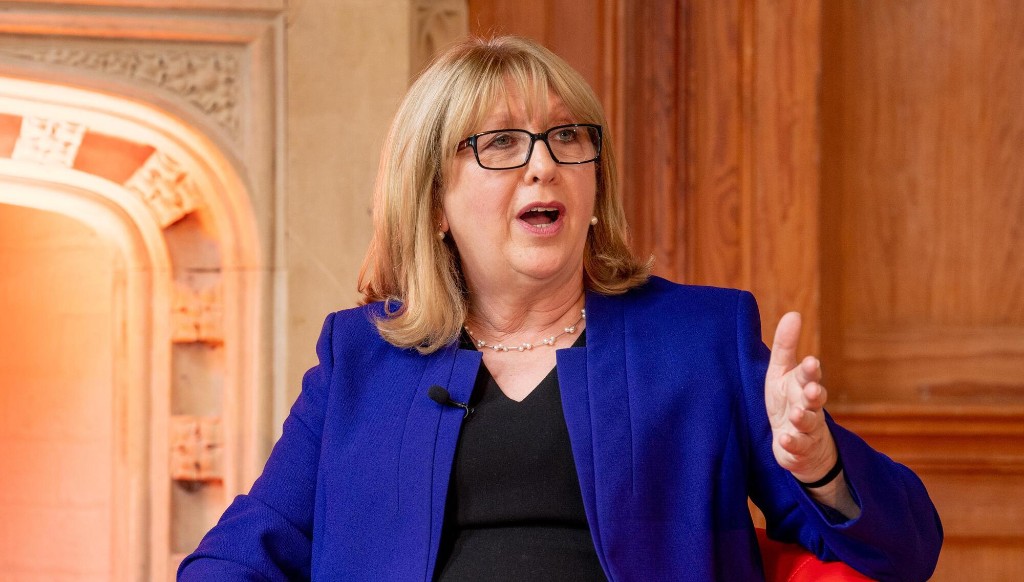
How Mary McAleese’s post-presidential embrace of UAE institutions jars with the bridge-building that defined her presidency
Former Irish President Mary McAleese has always preferred consensus to confrontation. She is intelligent, immensely articulate and capable of astonishing lawyerly command of detail. Yet there has also been something curiously elusive about her public philosophy. According to her Trinity College bio, “Dr McAleese is the author of Reconciled Being (1997), Building Bridges (2011), Quo Vadis (2013), Children’s Rights and Obligations in Canon Law (2019), Here’s the Story: A Memoir (2020) and The Seventeen Irish Martyrs (2022)”. Most people would need several lives before they would commit anything to paper on any one of those topics.
Beneath her uniquely relentless rhetoric of bridge-building, inclusion and reconciliation lurks a politics that has often seemed more instinctive or atavistic than analytical: a half-baked Fianna Fáilish liberalism in which dialogue is almost always preferable to conflict, institutions deserve the benefit of the doubt and engagement is treated as a virtue in itself. It’s what enabled her to spoof up the Queen of England with a Wow for her Irish without ever losing her pervasive nationalism or the Queen ever expressing any actual values.
It always disgorges speeches rich in the language of dignity and respect but surprisingly thin on the harder questions of power. Alongside it runs a curious penchant for cliché and an extraordinary willingness to expend intellectual energy on theological minutiae — the kind of ecclesiastical angels-on-pinheads debates over Catholic doctrine that fascinated her long after most Irish people had moved on. For all her undoubted gifts, it has often been difficult to identify a settled political philosophy beyond moderation itself.
That matters because moderation, admirable in democratic politics, can become something else entirely when confronted by authoritarian power.
But the UAE is a problem. It routinely ranks near the bottom of many international indexes for human rights and press freedom.
Migrant workers in the UAE face widespread abuses and exposure to dangerous heat-related health risks. Immigrant protestors are subject to rapid and unfair trials and torture. It is an absolute monarchy. Political parties are prohibited. Protests and demonstrations are prohibited. Competitive national elections do not exist. Censorship is widespread. Millions of migrant workers remained subject to the kafala sponsorship system, under which employers exercised extraordinary control over employees’ lives. Sharia courts have exclusive jurisdiction to hear family disputes. Exercise of LGBTQ+ rights leads to harassment and prosecution. The UAE was one of the principal military participants in the Saudi-led intervention in Yemen from 2015. UN experts have criticised its support for proxy forces accused of arbitrary detention, torture and other abuses. The UAE has supplied weapons to Sudan’s Rapid Support Forces, which have been implicated in ethnic cleansing of 10,000 civilians in Darfur, according to a 2024 UN report. UAE has €2.5 trillion in foreign investments.
An NGO called Boycott UAE argues that particularly in the Middle East and Africa, “Unlike traditional foreign investment that may empower local industries or foster economic reciprocity, the UAE’s approach is extractive and monopolistic” and designed to embed itself in host countries.
Mary McAleese’s links to UAE are longstanding. Over her 14 years in the Áras, she became a recurring presence within a web of Emirati-sponsored institutions, policy forums and dialogue initiatives. Again and again she accepted invitations from organisations established, financed or closely connected with the government of the UAE.
In a release in April Boycott UAE says she is part of a broader “Gulf-speaking-circuit”.
In 2009, while still President of Ireland, she addressed the Higher Colleges of Technology in Abu Dhabi. Her speech praised the country’s educational development, economic ambition and investment in knowledge. She declared, “We know we need good friends and partners in the wider world”.
At the end of 2017, she was among the first to visit the Louvre Abu Dhabi when it opened.
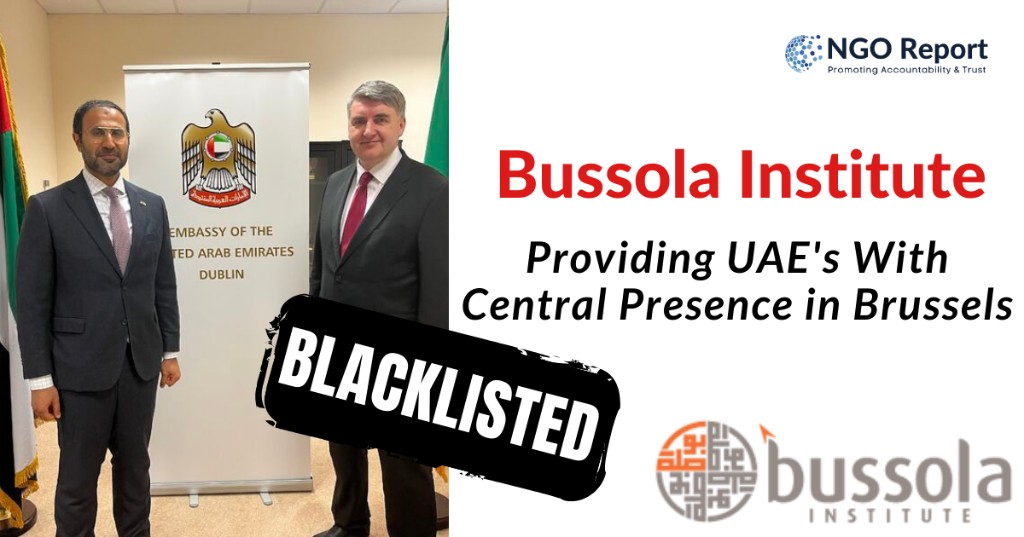
Her main dubious association is the organisation at the centre of this story, the Bussola Institute, established in Brussels in 2017. It is an independent, non-profit research organisation dedicated to strengthening relations between the European Union and the Gulf Cooperation Council. Its website speaks the reassuring language of evidence-based policy, dialogue, mutual understanding and academic research. Bussola even says it is a “bridge”. A McAleesean landscape then. Conferences discuss education, moderation, tolerance, artificial intelligence, women’s leadership and intercultural cooperation. You know the sort. It allows UAE to present itself as a moderate and reliable partner, particularly on security issues.
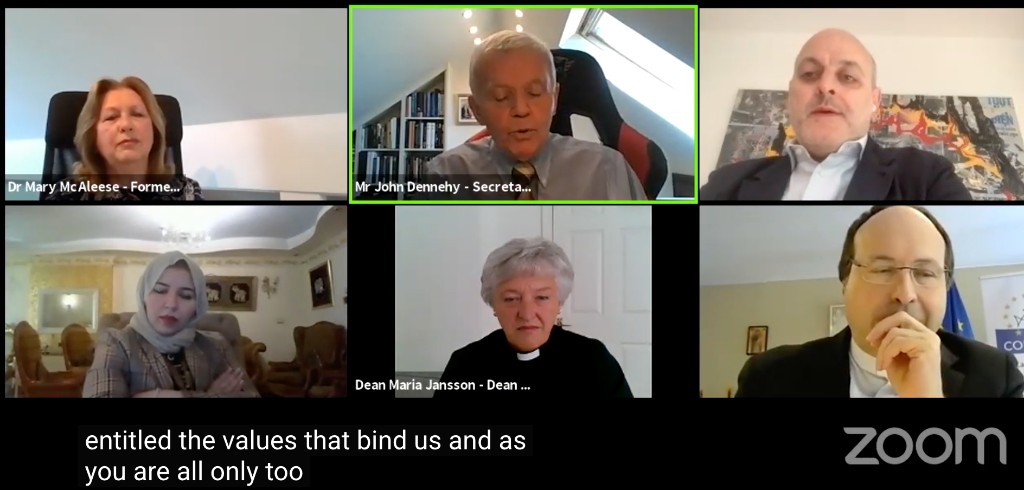
Bussola Institute’s 2020 webinar ‘Prayer in a Time of Crisis: Solidarity Through Faith’ featured former President McAleese.
The NGO Report project, which monitors organisations it believes facilitate authoritarian influence, is not impressed.
It argues that Bussola functions as a sophisticated instrument of UAE soft power, providing Abu Dhabi with a permanent and respectable presence at the heart of European policymaking.
Its policy output consistently reinforces themes central to Emirati foreign policy while avoiding scrutiny of the UAE itself.
Of course too its finances remain unusually opaque. Remarkably, Bussola has never publicly identified the sources of its funding. Its entry in the European Union Transparency Register declares an annual budget of around €400,000 and estimates annual lobbying expenditure of between €50,000 and €90,000. Five members of staff are accredited for access to the European Parliament.
McAleese is an Honorary Board Member. Its General Secretary was John Dennehy, the former Secretary General of the Department of Education and Science. Its Honorary Advisory Board was chaired by former Spanish Prime Minister José María Aznar and included former NATO Secretary General Anders Fogh Rasmussen.
At first glance the position appears ceremonial. It is not clear if, or on what basis, the former President is paid.
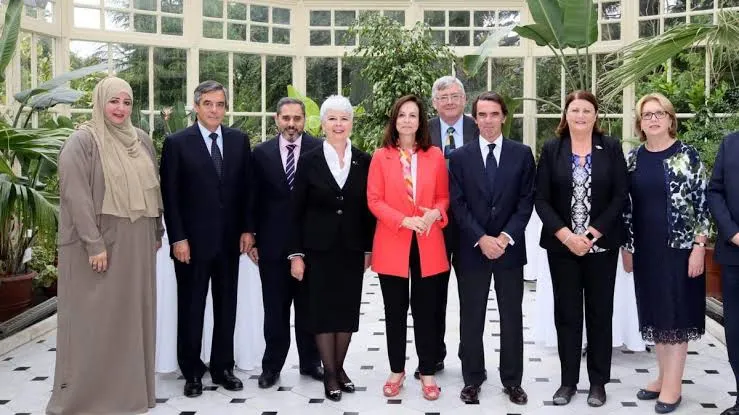
In June 2018 the Bussola Institute held one of its flagship conferences not in Brussels but in Farmleigh, the State’s official guest residence in Dublin’s Phoenix Park. Farmleigh is no ordinary venue. It is reserved for visiting heads of state, diplomatic functions and occasions carrying the imprimatur of the Irish State itself.
According to The Sunday Times, the Department of Foreign Affairs obtained approval from the Taoiseach’s office for Bussola’s use of Farmleigh. Simon Coveney, then Tánaiste and Minister for Foreign Affairs, addressed the conference after a request from Mary McAleese. During the same visit Bussola signed a memorandum of understanding with Dublin City University to explore research cooperation on tolerance, diversity and inclusion. DCU subsequently clarified that no collaborative research had proceeded and that it had received no funding from Bussola. The memorandum was of misunderstanding.
Security analyst Andreas Krieg of King’s College London warned at the time that organisations such as Bussola projected “a degree of academic objectivity” while serving, in his view, the foreign-policy interests of the UAE.
In 2019, McAleese hosted a Bussola forum on ‘the values that bind us’, in Brussels.
In 2020 McAleese told a Bussola webinar: “We should be pushing and pushing to ensure that the relationship between the European Union and the Gulf states, which we are about the business of trying to enhance and develop, [is strengthened, and] that what can be done is being done, is being done with alacrity, with speed, with power, with determination”.
According to the April 2026 Boycott UAE report, McAleese subsequently became a frequent participant in conferences, webinars and dialogue initiatives organised by UAE or UAE-linked bodies. One example highlighted is the 2022 Qudwa initiative, where discussions centred upon values, education and leadership.
The report argues that these appearances were not merely academic engagements but formed part of a broader strategy through which internationally respected public figures helped reinforce the Emirates’ preferred image abroad.
The Boycott UAE report’s central criticism is not that McAleese visited the UAE. It is that, over many years of engagement, there is no evidence that she publicly confronted the Emirati authorities over the issues that have most troubled international human-rights organisations. While speaking eloquently about values, education, tolerance and coexistence, she appears never to have made the systematic exploitation of migrant labour, the detention of political dissidents or the absence of democratic freedoms central to her interventions.
The UAE has been unusually candid about its ambitions. It has repeatedly spoken of becoming a global soft-power leader, investing enormous resources in culture, education, sport and policy influence.
Rather than relying upon conventional lobbyists alone, the UAE has increasingly sought legitimacy through association with respected Western public figures. The Boycott UAE report claims that the strategy succeeds only because figures such as McAleese repeatedly choose to participate, bringing with them reputations painstakingly earned in democratic public life.
The NGO Report argues that organisations such as Bussola occupy an important place within the UAE’s wider strategy of influence. They are neither conventional lobbying firms nor wholly independent academic institutions. Instead they inhabit a grey zone where research merges with strategic communications facilitated by diplomacy and networking.
The Boycott UAE report argues that McAleese became unusually valuable within precisely that frame. McAleese was not recruited because she was an expert on Fiqh law, Hadith studies or Middle Eastern geopolitics. Her presence was intended to suggest that respectable people found respectable company there, and that organisations she endorsed deserved the confidence of democratic Europe.
And this is the nub. Throughout McAleese’s unending presidency, she argued that peace without justice was incomplete. That inclusion required the active participation of those excluded. Yet her Emirati engagements rarely reflected those principles in any obvious way.
If McAleese consistently challenged her Emirati hosts behind closed doors, she has certainly not said so publicly. The public record is overwhelmingly of cordial engagement.
“Bridges are not virtuous in themselves. They derive their moral character from what they connect”
Nor is McAleese the only former Irish leader whose post-office international associations have attracted scrutiny. Mary Robinson, a more viable political proposition for Village, got into trouble for her mates in the UAE also. Former Taoiseach Bertie Ahern recently found himself embroiled in controversy over his chairmanship of the Irish-based AB Foundation, whose name became associated with a proposed technology and cryptocurrency resort project in Timor-Leste. Ahern emphatically denied any involvement in the development itself or in promotional material attributed to him, stating that he had “zero” connection with the project beyond his charitable role. No doubt they were both on bridges for Ireland.
Perhaps McAleese believes she has prolonged the bridge-building that defined her presidency. Bridges are not virtuous in themselves. They derive their moral character from what they connect and whom they ultimately serve. Michael D Higgins and Catherine Connolly do not go on so much about bridges but if they had built them they would not have been to the UAE. It is unethical to build a bridge unless you can justify what is happening at the other end.
Mary McAleese did not reply to a list of questions from Village, before our deadline.
