Frank Connolly

  • Posted in:

    Resignation as probes proceed into €116m education body

    The resignation of the chairman and vice-chairman of the Kildare and Wicklow Education and Training Board (KWETB) in early December is the latest dramatic development in a controversy that has already been marked by the early retirement of its chief executive, Seamus Ashe. Chairman and Wicklow councillor Jim Ruttle and vice-chairman, Kildare Fine Gael councillor, Brendan Weld announced their resignations in early December after a number of different inquiries were launched into various matters relating to the KWETB, which has an annual budget of €116m. Controversy erupted following a report by the Comptroller and Auditor General (C&AG) which queried the KWETB accounts for 2016 and raised issues including the award of tenders, the rent of properties and the use of vehicles controlled by the board. Among the matters raised was the rent of a property in Naas to a company, Postbrook Ltd controlled by Jennifer Ashe, a daughter of the chief executive, as reported previously by Village. The refusal by the C&AG to approve the accounts and other matters he raised prompted the appointment by education minister, Richard Bruton, of an independent consultant, Dr Richard Thorn to investigate various issues at the KWETB. A potentially more serious issue engulfing the Board and its executives was the intervention of the Health and Safety Authority (HSA) in a dispute over the safety of a new school extension, funded by the KWETB, at St Conleth’s Community College, in Newbridge. The National Economic Crime Bureau (aka the Fraud Squad) has also been called in to look at this aspect of the growing controversy. In late November, the architects on the project, MCOH based in Tullamore, County Offaly, issued a notice to construction company, K & J Townmore Construction Ltd., another Tullamore-based operation, to cease work on the almost completed school extension pending provision of certification required to guarantee the quality and safety of the work. In particular, MCOH, the assigned certifier, sought a testing report for precast concrete frame work and for precast hollowcore floors as well as further information required by the HSA. A senior HSA executive, Kevin Brannigan, also wrote to Townmore in recent weeks seeking information which he required in order to satisfy its requirements about the quality of work at the school extension which is due to open for students in the new year. On 5 December, Brannigan complained to Townmore about “a dripfeed of emails/memory stick” which had been sent to him as a “result of me identifying deficiencies” with regard to proposals by the construction company to resolve outstanding certification and other matters. Among the issues in contention is the quality and certification of work completed by a now liquidated company, Concrete Designs Concepts Ltd (CDC) which Townmore had contracted to supply beams and columns. Brannigan wrote that he had “expected for some time a structured proposal with clear identification of the specific number of identified beams/ columns, designed/manufactured by CDC; a defined methodology of what processes you intend to adopt such as scanning and if any destructive/ intrusive testing is intended to be undertaken; and clear identification of the body/persons who will undertake the analysis…”. A further meeting between the companies involved and the HSA took place on Tuesday, 12th December, to try and resolve the outstanding issues. In parallel with the HSA investigation, the High Court heard arguments on affidavit from Townmore which was seeking to force Wexford company, Drumderry Aggregate Ltd, to provide required certification for the hollowcore floors it installed in the school. Drumderry claimed that it could not certify the work as the floors were now connected to beams and columns which it did not manufacture. In a recent affidavit provided to the High Court, Drumderry claimed that the floors it installed are attached and connected to columns which it did not erect. It stated: “The columns are not CE marked as required. The result is that the Defendant (Drumderry) cannot certify that its floors are installed in accordance with the drawings it was given”. Complicating this is a claim by Drumderry owner, Sam Deacon, that CDC Ltd had been created by a former employee of his and had used the headed notepaper of his company without permission, among other misdeeds. If this was not enough of a headache for the KWETB as well as the contractors and others involved in the St Conleth’s project, an appearance before the Public Accounts Committee (PAC) of the Oireachtas revived earlier complaints of mismanagement in the education sector in Kildare stretching back several years. At a PAC hearing on 16 November, Seamus Ashe confirmed that he had previously appeared before the committee in 2012 in his capacity as a senior executive with Kildare VEC. Sinn Fein TD, Mary Lou McDonald, reminded Ashe that his 2012 appearance at the PAC was in connection with “the sorry saga of €180,000 worth of computers and support services bought from a former employee”. She said: “We heard of failings in Kildare VEC’s handling of a €23m school building development, as a consequence of which the Department (of Education) had to bail out the VEC to the tune of €20m. Issues were raised relating to land and property and a school development, with €139,150 paid to an auctioneer in 2008 without a competitive tender…”. Ashe confirmed that a year later, he was appointed as chief executive to the newly established KWETB. Asked whether the previous issues relating to poor governance were raised prior to his appointment, Ashe replied that he had been redeployed within the public service. Asked about the current investigation into the KWETB by independent consultant, Dr Richard Thorn, following the refusal by the C&AG to approve its 2016 accounts, Ashe said that he was “precluded from discussing that matter”. McDonald asked whether his decision to retire at the end of December was “influenced in any way by the fact that the investigation is under way?”. “Not in the slightest… It is for personal reasons”, he replied. Ashe told the hearing that they had been advised not to

    Loading

    Read more

  • Posted in:

    Careless about Kerr

    The Ulster Freedom Fighters will not be well pleased The Ulster Freedom Fighters (UFF) will not be well pleased to learn that their name has been taken in vain by a distasteful group of conmen hellbent on covering up the existence of a VIP paedophile network in Ireland and the UK. We will refer to these nasty specimens collectively as the “Paedophile Protection League (PPL)”. The UFF’s name was misappropriated by the PPL in an attempt to intimidate the courageous Kincora Boys’ Home survivor Richard Kerr to whom an anonymous threatening letter was sent late last year. Kerr, who lives in Dallas, Texas, was a resident at Williamson House in the early and mid-1970s, and later at Kincora (1975-77). He was abused at both homes. He was later abused in England by various highborn lowlifes, including Sir Peter Hayman, the former Deputy Chief of MI6, who infamously left paedophile material on a London bus whence it was picked up by the police; and a senior and highly influential member of Margaret Thatcher’s Cabinet. Village will identify this minister in due course. Before we turn to the threatening letter a little additional context might assist in explicating the underlying menace of it: Richard Kerr was a close friend of Steven Waring who was also a resident at Kincora. He committed suicide by plunging into the sea from the Belfast-Liverpool Monarch Ferry in 1977 rather than suffer any further abuse. Kerr has been haunted by his death ever since. Like Kerr, Waring had been taken out of Kincora and subjected to vile abuse on both sides of the Irish Sea. In November 2016 Kerr received the following anonymous letter: “DEAR RICHARD, HAVING READ AN ONLINE ARTICLE ABOUT YOU TODAY CONCERNING YOUR BEHAVIOUR IN LONDON IN 2015, A GROUP OF SURVIVORS HAVE RESEARCHED AND DISCUSSED YOUR ALLEGATIONS. IT IS OF MANY UK-BASED SURVIVORS OPINION THAT YOU ARE PLAYING A GAME AND WORKING FOR THE ABUSERS STILL. THERE ARE FIRST HAND ACCOUNTS OF YOUR BEHAVIOUR IN DOLPHIN SQUARE AND IN KINCORA INCLUDING ACCOUNTS OF YOU ACTING AS FACILITATOR FOR ABUSERS. THERE ARE ALSO ALLEGATIONS AND ACCOUNTS OF YOU ACTIVELY TRYING TO DISCREDIT OTHER SURVIVORS INCLUDING THE SUSPICION THAT YOU IN FACT KILLED STEVEN ON THE BOAT, RATHER THAN THE STORY YOU TELL OF HIM COMMITTING SUICIDE. WE DO NOT HAVE ANYONE IN TEXAS TO ACT AGAINST YOU. YOU HAVE BEEN DISCUSSED AT A VERY HIGH LEVEL AND ALTHOUGH THIS IS NOT A THREAT, AS A GROUP WE WOULD LIKE TO INFORM YOU THAT YOU ARE NO LONGER WELCOME IN THE UK OR IN NORTHERN IRELAND AND IF YOU ARE SEEN, ACTIVE SERVICE UNITS OF THE ULSTER FREEDOM FIGHTERS AND THEIR FRIENDS WILL FORCIBLY REMOVE YOU TO AN AIRPORT. YOU ARE OBVIOUSLY A SURVIVOR OF ABUSE SO BY OUR OWN CODE WE CANNOT ORDER ANYTHING MORE; HOWEVER FEELINGS ARE RUNNING SO HIGH ABOUT YOU THAT WE CANNOT GUARANTEE YOUR SAFETY AND WELLBEING IN THE UK OR NORTHERN IRELAND”. The address which exposes the source of the anonymous threatening letter The anonymous letter was posted from south East Anglia. There is, however, little or no mystery about the identity of its true author. Richard Kerr had made a number of trips to Ireland and the UK before he received the letter. During these trips he was – as he puts it himself – “hijacked” by some very unsavoury characters whom he instinctively distrusted and to whom he decided not to provide his address in Texas. This group pretended they were interested in exposing the VIP paedophile ring but in reality wanted to find out what Kerr was going to say about it and discredit him. They made the monumental error of taking Kerr for a fool when in fact they were the amateurs . Instead of providing his own address, Kerr gave them the address of a trusted confidant who lived on the North Central Express Way in Dallas. Yes, you guessed it: the PPL threatening letter was subsequently sent to the confidant. The North Central Express Way address was also provided to the BBC’s ‘Panorama’ programme. However, since the staff at ‘Panorama’ are not known for sending vile threatening letters to child-abuse survivors, the odds must be high that it was sent by the PPL or their allies in MI5/6. In addition, two others were provided with the address, both of whom can be discounted as the author of the letter. Why would the PPL go to such lengths in an effort to intimidate and upset Richard Kerr? Why go to all this trouble if the VIP vice-ring had never existed? The letter is consistent with the fact that it was and is still being protected. Tory blowhards and the Jimmy Savile defence The PPL was behind a spectacularly successful attempt to hoodwink politicians, journalists and the British public generally about the non-existence of the VIP vicering. They achieved this by acting as spin doctors for a troupe of fraudulent witnesses who alleged they had been victims of child sex abuse. The intention all along was to lure genuine victims like Richard Kerr into their orbit and tar them all with the same absurdist brush. Regrettably, the stench emanating from the preposterous false witness ‘Nick’, has tainted all child sex-abuse victims as fantasists or liars. The Wiltshire Police, which investigated Ted Heath’s history as a child molester, have said they intend to prosecute ‘Nick’ for wasting police time. He made a series of claims that were so risible that countless members of the British public became doubtful about other – genuine – witnesses. It is important for MI5’s sake that ‘Nicks’ defence will not be that he was acting on orders from his MI5 handlers at Thames House. After the Wiltshire Police released their findings about Ted Heath’s molestation of children two months ago, an array of bloated Tories stampeded into radio and TV stations across the UK bleating that nothing the Wiltshire Police discovered could possibly be taken seriously because of ‘Nick’ who

    Loading

    Read more

  • Posted in:

    Terror ‘Nure

    In the wealthy suburbs of south Dublin, the redbricked facade of Terenure College has stood out as a beacon of respectability and status for more than 150 years. A training ground for the elite of Irish society, run by the Carmelite order of priests, it has produced captains of business, pioneering doctors and legal giants. Legends of Irish rugby have been reared on its hallowed sporting fields, which lavishly sprawl over some of the most valuable land in the country. The school website boasts of an “atmosphere of welcome and warmth” and a “history to be proud of”. But behind the cloistered walls of this exclusive boys’ school, a dark and chilling chapter from its past is about to be revealed. A number of former pupils have come forward claiming they were subjected to a regime of rampant sexual abuse and sadistic violence at the hands of those entrusted with their care during the 1960s and 1970s. Middle-aged men now, they tell stories of sordid assaults and relentless groping by predatory teachers, the emotional wounds of which remain unhealed today. Some of the abuse happened openly in class in front of other pupils while the perpetrator taught, showing no fear of being caught or punished. It also took place in the playground, at the swimming pool and in locker rooms as they showered. For the first time, evidence has also emerged that the Carmelite order has covertly paid out significant sums of money as compensation for sexual abuse. Until now, this compensation scheme has been kept from public sight or scrutiny. Despite several requests, neither the Carmelite Order or Terenure College will confirm whether An Garda Síochána were informed about the deeply disturbing allegations behind the scheme. Former pupils who attended the school in the 1960s and 70s have alleged that a number of staff, both priests and lay teachers, abused them. They identify the same men repeatedly, claiming these individuals engaged in warped paedophile and sadistic behaviour but were never held to account. Fr Aidan O’Donovan, a long-serving member of the teaching staff, was one of the most notorious. President of the school’s Pioneer Council and spiritual director of the Carmelite Third Order, an ancient branch of the order established for lay people, in the eyes of parents and staff, he appeared a charming priest and devoted teacher. But some of his old students recoil in terror at mention of his name. “He always had a boy on his knee during class”, says Martin, who attended Terenure in the 1970s and whose identity has been protected. “He was a great story-teller and to be asked to sit on his knee during stories was like getting a star. It was almost an honour. As soon as you sat up on his lap, his hand would go straight up. We all wore short trousers so it was easy for him to interfere with us. He molested me on several occasions in front of the rest of the class not caring whether anyone could see. Once, I got an infection in my anus because he had put his fingers inside me. I had to stay at home because I had a fever from it. The worst thing was not being able to tell my parents how it happened because you were afraid you wouldn’t be believed. The sexual abuse was just one side of life at Terenure. It was quite normal to be beaten around the place. You would be brought to the top of the class, stripped from your waist down and beaten with a bamboo cane on your bare backside. It was horrific but from a very early age you were told to ‘take it like a man’. We were a rugby school. We had to be seen to be tough. I used to go home with red marks on my hands and legs from being beaten and my parents would blame me for upsetting the teachers. I can only imagine how they would have reacted if I had told them about the sexual abuse”. Another past pupil, now in his 50s, is haunted by a number of encounters he endured at the hands of the same priest. “Apart from the sadistic beatings many of us endured, they were always touching you up and grabbing you. Fr O’Donovan was a well-known ‘kiddy-fiddler’. I remember him putting his hand down the front of my trousers and holding me while I was going to the toilet. That was the sort of twisted thing we were put through. If I had gone home to my mother and told her what was happening, she would have killed me. So I used to hide in Bushy Park and just not go to school at all. The abuse destroyed my life, and 40 years later, I am still very angry they have got away with it”. Another former pupil abused by O’Donovan describes him as the “quintessential wolf in sheep’s clothing. He would ingratiate himself with parents who fawned over him in the hope that their son might be given a place on the rugby team while at the same time sexually abusing their boy and leaving him permanently damaged. We called him Donewax. He would take you to his knee smiling and before long have his hand down your pants. If he didn’t take you to his knee he would sit on the edge of the small bench seat at our double desks and while inanely reading from a school book fondle your privates inside your pants. One thing that I vividly recall is the fact that his brown habit had openings where the pockets should be. This allowed him to fondle himself with one hand as he abused you, while appearing to anyone looking to just have his hand in his pocket”. Fr Aidan O’Donovan died in 2013. Former pupils who claim to have been abused by him say they are outraged he never faced justice. Many have felt unable to speak up

    Loading

    Read more

  • Posted in:

    DUP and Down

    The DemocraticUnionist Party (DUP)’s stance on Brexit has left it out of kilter with a key part of its constituency, the business community. It appears to have campaigned for a referendum result it did not expect and has recently drawn the attentions of Europe to a position on Customs Union and the Single Market that appears like shooting itself in its collective foot. This is politically confusing since the Party has presented itself as the most pro-business of the North’s four main parties. Much of the Unionist ‘old money’ which once backed the Ulster Unionist Party now backs it. Both Arlene Foster and Simon Hamilton, as Economy Ministers, were seen as strongly probusiness. However, it is a paradox that Sinn Féin, perceived as having a notably more leftist stance, is more in tune with business in its stance on Brexit. The North’s main business organisations were strongly pro-Remain. The Confederation of British Industry (CBI) issued a statement with two other business organisations before the Referendum. This said: “Northern Ireland is the most vulnerable part of the UK in the event of the UK leaving the EU (confirmed by the recent Oxford Economics study) which will create enormous uncertainty, impacting on investment, jobs, and living standards for the next decade and beyond”. At the time, the CBI’s Nigel Smyth said: “Every credible business survey has demonstrated majority support by Northern Ireland’s private sector employers for remaining within the EU. Being in the EU provides a strong platform for Northern Ireland to attract investment, and to export our goods and services, helping to create jobs and improve living standards”. As First Minister, Foster criticised the Remain side for its “prophecies of doom,” though she was generally quite quiet through the campaign. While the DUP was always Eurosceptic, it seems to have supported Brexit because of one of the burdens of its pervasive historical baggage, as well as its need to placate part of its base. There are ongoing questions about a £425,000 donation from a mysterious Scottishbased pro-Brexit group, recycled to buy advertising in Britain. The Open Democracy website claims the donation was illegal and Parliament is investigating the matter. The Electoral Commission said in August it had investigated a “regulated entity” over failures to comply with election law and fined the entity £6,000. Further information was withheld under provisions of election law dating back to Northern Ireland’s Troubles that allow details of political donations in the province to be kept secret. Significantly, at the start of the Referendum campaign Arlene Foster said “we fully expect that DUP members and voters will hold a range of differing personal views as to what is in the best interests of the United Kingdom. They are fully entitled to do so …”. Pre-Referendum, there was no indication the DUP had prepared for the Leave victory. Indeed its political preparation for Brexit remains patchy, as we saw with its dramatically last-minute intervention as its ally Theresa May was on the cusp of agreeing a deal with the EU. In January this year Hamilton launched his Department’s ‘Economy 2030 – a Draft Industrial Strategy for Northern Ireland’. Though the launch was six months after the Referendum, it included incredibly only one reference to the challenges of Brexit: “Exporting remains central to our Industrial Strategy and, with a changing economic landscape on the horizon as a result of exiting the European Union, it is vital that we are responsive and adaptable in the ways we seek to achieve our objectives on trading globally. We are already taking forward new approaches to drive improvements in our commercial success in overseas markets and this will continue and evolve as uncertainty around the future diminishes, and as new trading opportunities emerge in the future”. Showing the same opaqueness of vision, there were only three mentions of work with the South and all refer to other jurisdictions also: the fruit of six months consideration of dealing with the Referendum’s result were wafer-thin. Meanwhile, the DUP’s Westminster group is enjoying its day in the sun, propping up May’s government. That group is dominated by ‘old DUP’, while the group in the suspended Assembly is dominated by modernisers. This group, which inevitably appeals more both to the British and Irish governments and most of the media is anxious for restoration of the Assembly: not just from fear of losing salaries and expenses, but from fear of a Corbyn government, from which the Assembly would give a certain political protection.

    Loading

    Read more

  • Posted in:

    Ready, steady…

    The row over Brexit and the subsequent confusion over the legal status of the agreement made between the British government and EU negotiators on 8 December, has overshadowed significant movement in the political dynamic involving the main political parties. After emerging somewhat battered and bruised from his ultimately futile defence of former Justice Minister, Frances Fitzgerald, the Fine Gael leader recovered with an unexpected boost in an opinion poll published during the tense heat of the Brexit discussions. The Ipsos/MRBI poll for the Irish Times, published on the eve of the Brexit breakthrough, gave Leo Varadkar’s party a stunning 11 point lead (36% + 5) over Fianna Fáil (25% – 4) and a ten-point advantage over Micheál Martin in the personal satisfaction ratings. The crisis over Fitzgerald’s failure to act on a planned Garda legal strategy to attack the integrity of Maurice McCabe during the O’Higgins inquiry in 2015 came close to forcing an unwanted general election before Christmas. After that threat was averted, much to the relief of most politicians and media organisations, pundits widely assumed that the political crisis had almost certainly brought forward the prospect of an election early in the new year. The opinion poll put paid to that particular prediction and made it more likely that Fianna Fáil will be reluctant to breach the confidence and supply agreement with the Government in advance of the third budget it envisaged. The referendum on abortion due to take place before the summer is another factor that will inhibit politicians of both parties from bringing matters to a cliff edge in the medium term. Martin and his more abrasive colleagues, who were openly baiting Varadkar to go for broke over the Fitzgerald debacle, are now the ones licking their wounds and along with others are forced to suck up the indignity of a Blueshirt leader taking the battle to Albion over Brexit. As always the poll results, impressive as they are and showing the largest lead for Fine Gael over Fianna Fáil since 2015, are only useful until the next one, and also fail to take account of future challenges, expected and otherwise, facing this historically unstable political arrangement. The most significant known change is the imminent transfer of power within Sinn Féin from Gerry Adams to Mary Lou McDonald, a prospect that will almost certainly boost the party’s current poll MRBI standing from its current 19% (unchanged). With Labour stagnant and independents and other left-wing groups also largely unchanged the new year will likely reinforce a political landscape where there are three parties in contention when it comes to forming the next government. The decision by the Sinn Féin ard fheis in November to drop its previous condition that it will only go into government if it is the largest party has altered the balance of relations between the three. While it may be a statement of the obvious it has forced FG and, more so, FF, to adopt an even more hostile attitude to the republicans who are barking at their heels in the government formation stakes. With McDonald, arguably the most competent and impressive performer in the Oireachtas, taking the leadership reins by March there is a more intriguing choice on offer to the electorate when the time comes. Sinn Féin insists that it will only enter government on the basis of a detailed programme with cast-iron guarantees of delivery on agreed timescales and there is no reason to believe otherwise. Indeed, with or without the ‘Mary Lou factor’, the approach of its collective leadership that has determined its progress over recent years in the politics of the South, will almost certainly be to avoid the fate of smaller, leftwing, parties which always suffer from association with larger right-wing coalition partners. That Sinn Féin also has a range of talented, potential cabinet members in its ranks, will make its prospective partners less rather than more anxious to invite them into the exclusive tent of government, dominated for decades by the two-and-a-half-party system. Alternatively, if the left including Sinn Féin, Labour, the Social Democrats, left independents, Solidarity/PBP and others could bring their total vote close to 40%, unlikely as it may seem at this point, then other options may open. Of course, if a deal with Sinn Féin is a step too far for Fine Gael and Fianna Fáil they could always enter into a long-awaited embrace, ignore their marginal and minor differences and prepare the way for a grand coalition and ultimately a single centre-right political bloc. Their choice.

    Loading

    Read more

  • Posted in:

    The Rule of Law in Ireland, end 2017

    This article asks what is meant by the concept of The Rule of Law and, after the resignation of a second Minister for Justice in two years, whether such a concept is honoured in Ireland today? Dysfunctionality and hypocrisy have dug a chasm between the theoretical affirmation of the rule of law by lawyers in this state, and reality. It renders the very nature of our democracy fragile.   1. The Rule of Law in Theory The legal philosopher John Finnis indicated that the rule of law is: “The name commonly given to the state of affairs in which a legal system is legally in good shape”.   2. The practice Let’s then stress test the case of the Irish state today. The Constitution as interpreted in the courts Yes of course rights exist in our constitutional matrix and in our still fine, if both dated and shop-worn, constitution, and are enforced by the courts in many instances; but there is also cause for concern about undue deference to the executive, which has led to the non-enforcement of social and economic rights by the courts and an abundance of judicial caution on other rights-based claims – particularly claims where issues of financial disequilibrium or that amorphous blob ‘public policy’ are cited. Judge Gerard Hogan of the Court of Appeal, an eminent constitutional academic, recently noted that the record of the Irish courts in upholding substantive constitutional rights has been disappointing, indeed “baffling”, in the last twenty years and stressed disquieting developments in due process and criminal justice. He noted that the recent Supreme Court decision deriving a right to work for asylum seekers “is probably the first time in 25 years or so that the Supreme Court has invalidated a major item of social legislation or social policy”. The State: the Garda and the Department of Justice There are widespread violations of and due process by the state itself and a demonstrable associated relative unaccountability, particularly in the case of the police force and justice department with the latter secrecy-driven tail wagging the former mad dog. The Charleton Tribunal is now grappling with the collateral implications of the Maurice McCabe scandal: allegations that the police with help from the HSE were framing McCabe, a Garda whistleblower, and others for child sex abuse. The Department of Justice acquiesced in smearing McCabe in that tribunal, ultimately forcing the resignation of the Tánaiste Frances Fitzgerald, former Minister for Justice, in late November. Considering also that up to two million breathalyser tests have been falsified by gardaí, law enforcement seems to have become systemic law-breaking. Journalist Fintan O’ Toole recently described the Department of Justice as subverting the state. We must address the possibility that the most dangerous subversives are those who have misappropriated the raiments of the state.   3. The Contribution of Lord Bingham Lord Bingham in a celebrated lecture (published in The Cambridge Law Journal, 2007) developed the following rule closely followed by eight sub rules as to what constitutes the rule of law. First, the general rule and the core of the rule of law according to the judge is that: “All persons and authorities within the state, whether public or private, should be bound by and entitled to the benefit of laws publicly and prospectively promulgated and publicly administered in the courts”. It should be noted that such a rule is violated when retroactive legislation is passed or a retroactive decision such as A v Governor of Arbor Hill Prison are reached – regardless of its merit as policy. Judges deferring to the mob mentality or refusing to make decisions in conformity with the rule of law out of deference to a twisted sense of populism act misguidedly and not in conformity with the rule of law. It is also noticeable that the Proceeds of Crime Act was upheld on constitutional criteria even though it operates retroactively. Lord Bingham then developed eight sub-rules from the above generic statement all of which merit close attention and delineation. First, the judge considered, “the law must be accessible and so far as possible intelligible, clear and predictable: a norm is not law unless it is formulated with sufficient precision to enable the citizen to regulate his conduct”. In this respect the layers of ambiguity and discretion inherent in say the Proceeds of Crime Act 1996 which allows for the confiscation of assets, theoretically without charge, on the say-so of a Chief Superintendent that someone is a criminal is bizarre. The over-deference to government on policy breaches the Rule of Law but has been overindulged by our Superior Courts, particularly since the economic downturn. A disequilibrium in the public finances is not an argument to discount or counteract a claim of rights. So, for example, vague discretionary non-review of the Financial Services Ombudsman process and long-standing deference to administrative structures in asylum, banking and environmental matters will not stand up to historical scrutiny. Second, Bingham considers that “general questions of legal right and liability the judge should ordinarily be resolved by application of the law and not the exercise of discretion”. Discretion is in reality too prevalent a feature in our sentencing policies. A recent ‘Prime Time’ programme exposed the scandal of the extent of use of the ‘poor box’ by District Court judges to avoid imposing convictions. ‘Discretion’ also dominates for example in our family courts. Discretion at a different level is utilised by the Garda not least in the penalty points sphere. The Garda Síochána Ombudsman Commission reported in November that 442 gardaí had cancelled penalty points in the case of one 700 times across 17 counties. Nobody knows how many of the 74,000 fixed-charge notices cancelled were legitimate and how many were not. And of course none of them will face sanctions. The third rule the judge enunciates is a vision of a type of equality: “The laws of the land should apply equally to all, save to the extent that objective differences justify differentiation”. Well of course we

    Loading

    Read more

  • Posted in:

    Why Pay Teachers [They’re Only Women]?

    Last month, Minister for Education and Skills Richard Bruton mentioned that “the idea of courses to upskill homemakers were among a number of steps under consideration” to deal with the shortfall of teachers in key subject areas. Calling them “homemakers” may have been correctly gender-neutral, but the issues at stake are not. How could they be, given that women vastly predominate among stay-at-home parents, and among teachers? Why wouldn’t Irish mammies see their role as unpaid child minders extend to the classroom and shouldn’t they be delighted if the government decides to throw them a few euro for doing so? As a lecturer, activist and member of the Teachers Union of Ireland, I have been struck that the numerous public-service pay agreements over recent years have totally failed to address the relation of gender to the teaching profession. The government, trade unions and the media failed to comment on the fact that since the 1970s there has been an almost total feminisation of teaching in Ireland. According to the Central Statistics Office, women account for almost nine out of every ten teachers at primary level, and more than seven out of ten at second level. In the primary system, you have a 17% chance of being a principal if you are a man, but only 8% if you are a woman. So if primary school teaching is now an almost entirely female profession, how is it that men are twice as likely to become a school principal? Why are the majority of teachers now women, and why do men do better when it comes to promotion? There are two problems facing us here: the feminisation of teaching, and gender inequality when it comes to promotion. When a profession or job becomes feminised, there is a correlating depreciation in salaries. This is borne out by researchers such as Emily Murphy and Daniel Oesch, who point out that “in female-dominated professions salaries are lower and it is not only women with children, but also childless women, who earn lower wages”. According to a report by the Primary Education Committee, set up by the Minister for Education and Science in 2003, “There is a strong argument that jobs involving care work have been systematically devalued. For example, teaching and nursing are female-dominated professions while engineering and software development are male-dominated”. A recently qualified primary or secondary teacher starts on a basic salary of €34,602, rising to €43,292 after five years, and incrementally up to the top of the scale at €64,701. But it takes 27 years to reach this level. By contrast, according to the most recent Morgan McKinley salary guide for 2017, a Dublin-based qualified accountant starts on €45-55K, which increases after three years to between €55K and €65K, and after two more years to between €65K and €70K. A Dublin-based software (e.g. Android) developer can expect to start on €30-40K and to reach €85K after five years. Over the course of a career, therefore, teachers earn less than other professionals, and they endure incredibly slow career progression and mobility. Moreover, the 27-year incremental scale has since 2012 had a proportionally negative impact on career average pensions. As the teaching profession is dominated by women, what has developed is a system where women are systematically paid less, and where they will be most at risk of income poverty when it comes to living off their pensions. With such low salaries and lack of mobility and progression, not to mention increasing workloads, men are choosing not to become teachers. When male primary school teachers ten years into the profession were asked in a 2005 survey what would attract more men into the profession the answer most frequently given was “more money (improved salary structure/financial rewards/ promotion prospects)”. The next most common factor was the poor public image of the profession, which seems strange given the level of education and achievement required to enter. The CAO entry requirement for primary school teaching in 2017 was 451-466 points. New regulations introduced this year require entrants to score at least 60% in Leaving Cert Higher Level Irish. For secondary school teaching, an honours Bachelors degree is required, followed by a two-year Professional Masters in Education (PME). Not only does it take a lot of time to become a teacher, but there are financial expenses too. With the minimum number of years to acquire a primary teaching qualification at four years, and five years for a secondary school teacher (a three-year minimum degree plus two more years), the financial expenses start to mount: a basic degree is €3,000 per year, and the PME costs approximately €10,000. It is outrageous that, despite all this, our educational system does not value teachers and refuses to pay them commensurate with their professional qualifications and expertise. In fact, in the recent talks for the current pay agreement, the government has made it clear that it would rather permanently instate a lower rate of pay for new teachers entering the profession. The message is that teaching is ‘women’s work’ that doesn’t merit fair or equitable pay. Since the ballooning of state debt that was part of the decision to bail out the bondholders in 2008, all sectors of education in Ireland have suffered severe reductions in funding. At primary and secondary levels, the pupilteacher ratio has increased and moratoriums have been placed on recruitment to posts of responsibility, severely limiting promotional opportunities. Among Institutes of Technology, there was a 35% cut in funding between 2008 and 2015, but during the same period student numbers rose by 32% and full-time academic staff numbers fell by almost 10%. The Further Education sector has also undergone similar ‘reform’. From the point of view of teachers and lecturers, these cuts have created severe additional workload pressure, all in a context where the new norms of precarious employment status and hourly paid contracts are exacerbating income poverty. Numerous high-profile cases in Irish universities have also highlighted gender discrimination when it comes to promotion. It is no

    Loading

    Read more

  • Posted in:

    Buildings At Risk

    Heritage and the Irish Psyche The cynic who knows the price of everything and the value of nothing drives the perception of properties in Ireland. There is a belief within the Irish psyche that new is best, even when it comes to our historic properties. We flock to perambulate around our country houses and their gardens once they have been restored, often to the point of sanitisation. However, we wince at the sight of a crumbling beauty, and the mere thought of the cost and effort it takes to bring it back to glory. There are thousands of derelict historic properties strewn across the country. Our planning laws are toothless and we seem unable to incentivise maintenance, most particularly of accommodation over shops. Shifts in our economic and political landscape also frame how we perceive this cultural legacy, often alien in design but built, beautifully, by Irish artesans. It is only a generation ago that one of the major factors leading to the demise of the country house was de-roofing as owners struggled to find ways to avoid paying oppressive rates. The National Attitude towards these buildings has evolved from hostility to indifference without anyone noticing. Hostility only resurfaces when there’s any sort of economic (or social) imperative. The Regime for Protection Who protects it? So whose job is it to look after significant buildings? Legislation enables Local Authorities to protect buildings and to take action if they are vulnerable. However, lack of funding, resources, manpower and wit; the cost of litigation; and inertia militate against, and there is – at bottom – no legal obligation for local authorities to do anything, so mostly they don’t. One way to protect a historic property is to list it on the Record of Protected Structures, and especially if built before 1700, the Record of National Monuments. Each Local Authority puts together a Protected Structures list for each Development Plan taking suggestions from the National Inventory of Architectural Heritage, a unit of the Department of Culture, Heritage and the Gaeltacht. As valuable as this database is, it is only a representative sample of the architectural heritage of each county and not updated regularly. For example Limerick Cty’s was last conducted in 2005. Volunteers For such a small country numerous charities have been set up to raise awareness of and restore our historic properties. An Taisce, established in 1948 owns many properties including Booterstown Marsh, the Boyne Canal and Crocnafarragh blanket bog, Glenveagh, in Donegal. The Irish Georgian Society has restored many properties and provides strategic funding for particular conservation projects such as some on Henrietta Street in Dublin. The Buildings of Ireland Charitable Trust set up in 2005, the Irish Heritage Trust was established in 2006 as a joint initiative between the voluntary sector and the government, receiving approximately one third of its financial support from the State. So far its projects have been Fota House and Gardens, Strokestown Park, and the Irish National Famine Museum in Roscommon – with Johnstown Castle, Estate and Gardens (Wexford) proposed for the coming years. The Irish Landmark Trust for Ireland, a non-profit organisation set up in 1992 has restored 30 properties. Public and private owners typically agree to let it take properties on 50-year leases that allow them to make them suitable for holiday accommodation. Once a lease expires, the property reverts to the owner. Dublin Civic Trust provides pro-active advice on Dublin and completed an audit ‘Dublin’s Wasting Assets’ in 1997 which was revisited in 2001 and 2010. Irish Buildings at Risk Buildings at Risk are heritage assets, such as protected structures or scheduled monuments that are at risk as a result of neglect, decay or inappropriate development, or are vulnerable to becoming so. A major part of this is a lack of property maintenance. We don’t give servicing our cars a second thought but yet we question the upkeep of these hard-working living machines. As to buildings that become dilapidated a national buildings at risk register would raise awareness of problems and act as a catalyst in marrying up potential resources with suitable available properties. Robert O’Byrne, Vice-President of the Irish Georgian Society, who writes on vanishing period homes in The Irish Aesthete blog, advocates such a register. “By having a list you raise its profile: you raise the security level. Otherwise buildings at risk can be invisible. A long-term ideal would be an annual buildings list like the World Monuments Fund Top Ten”. Not everyone shares this enthusiasm: one retired senior advisor to the Department told me that a register would be “a shopping list for thieves”. He believes it would leave the Department open to legal action from property owners citing the public list for the robbery of their original fireplaces or the lead from their roofs. Geraldine Walsh, CEO of Dublin Civic Trust notes: “Yes, An Taisce have compiled an excellent Buildings at Risk document, but an annual review of it should be funded by the State in order to independently maintain the process and to keep the list of the buildings identified updated. It should be co-ordinated with the local authorities’ Derelict Sites database. The UK NGOs, including English Heritage, Historic Environment Scotland, Ulster Heritage Society and SPAB all publish their list of buildings at risk annually. A particularly useful aspect of their work is publicising those properties that are available for sale to prospective purchasers”. Lists of vulnerable buildings are not enough, as Will Derham, author of ‘Lost Ireland, 1860- 1960’ points out: “As we have seen recently in the renting sector, building standards require enforcement. A statutory buildings-at-risk register would be a small, but welcome step in the direction of fully protecting and preserving the nation’s built heritage”. But a State that lacks a culture of enforcement, from banking to spatial planning to police accountability, needs to think hard about how it is going to handle the more ethereal imperative of historic-building conservation and restoration. International Experience of Buildings at Risk In England an annual Heritage at

    Loading

    Read more

  • Posted in:

    O’Brien Comium

    Trinity College’s recent Conor Cruise O’Brien centenary symposium was a largely uncritical exercise. It was especially notable that it was so as it focused on Irish politics. Invited US academics, who discussed O’Brien’s assessment of the American Revolution, appeared unaware of O’Brien’s distinctly illiberal local contribution. Reverential tones underpinned contemplation of O’Brien’s analysis of Irish nationalism. Remarks at Gerry Adams’ expense massaged the prejudices of the mainly elderly audience. Critical observations came mainly from the floor. Audio from an evening session, put up online by TCD, omitted audience interventions. In a way, that was appropriate. O’Brien’s main contribution to the ‘Troubles’ was perfection of radio and television censorship. He achieved that with amending legislation and intimidation of broadcasters, while Minister for Posts & Telegraphs, 1973-77. Many of the academics and journalists chosen to speak referred to “Conor”, whether or not they knew him. A Labour Party activist questioned this from the floor during the last session. He remarked that O’Brien’s 1977 defeat was generally welcomed, including by some on Labour’s left, and asked why no speakers reflected that majority view. One participant, who knew O’Brien quite well, momentarily punctured the semi-sacral nature of the proceedings. In opening the evening session, TCD Chancellor and former Irish President Mary Robinson, recalled how her participation in a public meeting in 1974, in opposition to internment in Northern Ireland. It “enraged” O’Brien. She was, he said, “dancing to the tune of the IRA”. The audience might have been forgiven for expecting the speaker following, barrister and historian Frank Callanan, to tell us more. It was not to be. After her remarks Robinson left the Edmund Burke Hall. The theme of hommage to O’Brien re-congealed around the platform, which included Margaret O’Callaghan from Queen’s University Belfast and former Labour leader Ruairí Quinn. President Michael D Higgins also attended. I pointed out (in remarks that were omitted) that O’Brien insinuated also that Robinson silently acquiesced in the killing of judges. The then-minister, a secret supporter of police brutality, told journalists they were IRA stooges and hacks. The brutality of O’Brien’s language eased his transition from verbal opposition towards explicit support for censorship. Before chastising Robinson, he entered RTÉ and sensed an IRA “spiritual occupation”. Eoghan Harris, RTÉ’s then best-known republican ideologue, was disciplined for broadcasting a programme on internment. Harris told the symposium he was actually a secret supporter of the author of his misfortune. He was not, as is assumed, converted later while producing agricultural and children’s programmes. O’Brien shifted his focus in 1976, the year he amended broadcasting censorship. He threatened to imprison Irish Press editor Tim Pat Coogan for publishing letters O’Brien disliked. Coogan was told this by O’Brien’s interviewer, an alarmed Bernard Nossiter of the Washington Post. Coogan published the threat and republished the letters. In 1979, as Observer editor in chief, O’Brien terminated the contract of Ireland correspondent and leading feminist Mary Holland. She was, he said, “a very poor judge of Irish Catholics”, who “include…the most expert conmen and conwomen in the world”. O’Brien observed of Holland’s ten-years-of-the-Troubles profile of Derry woman Mary Nellis: “Irish republicanism – especially the killing strain of it – has a very high propensity to run in families… the mother is most often the carrier”. Such sectarian and misogynistic perspectives did not interest Friday morning lecturers, Sunday Independent columnist Eoghan Harris and Irish Times journalist Stephen Collins, on their hero as “journalist and editor”. It was left to Susan McKay in the last session to criticise O’Brien’s sacking of Holland. Margaret O’Callaghan delivered an appreciative paper on the 1973-77 Fine Gael Labour government’s subdued remembrance of 1916. She did not discuss its 1976 prohibition of Sinn Féin’s annual 1916 commemoration, which thousands defied. The 1976 platform included Labour TD David Thornley; and the daughter of executed 1916 leader, and Labour Party founder, James Connolly. The ban was accompanied, typically, by threats to sack participants in public-sector jobs. RTÉ’s director general Oliver Maloney directed the Irish-language programme Féach not to cover the banned commemoration. That was testament to an emerging culture of selfcensorship fostered by O’Brien. This did not interest O’Callaghan. Speakers suggested that O’Brien’s 1976 amending legislation liberalised censorship, a foolish thought originated by O’Brien. Before O’Brien’s new measure came into force in January 1977, he declared RTÉ’s pre-existing censorship order too liberal. It permitted interviews with Sinn Féin representatives. O’Brien banned them with terminology from his soon-to-be-enacted measure. The TCD symposium censored the real Conor Cruise O’Brien, once described as “a champion of the overdog”. The real O’Brien can be heard on ‘Bowman Sunday’ talking over Kadar Asmal, former head of the Irish Anti-Apartheid Movement (RTÉ Radio 1, 5 November), while opposing an academic boycott of Apartheid South Africa.   Niall Meehan is the author of The Embers of Revisionism, which considers Conor Cruise O’Brien. On sale at Books Upstairs, Dublin

    Loading

    Read more

  • Posted in:

    Radical Love

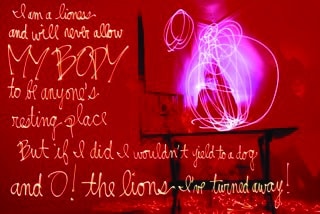
    ‘I deem as heroic those who have the harder task, face it unflinchingly and live. In this world, women do that.’ – James Salter ‘I know too well those marvellous lips. By Allah, I’m not lying if I say I love sipping their finerthanwine delicious dew.’ – Hafsa Bint Al-Hajj Arrakuniyya about her lover Abu Ja’far – Twelfth century Granada ‘All lovers wear my castoff clothes and jewels and gulp down my overspilt drink. I have raced with lovers at love’s racetrack and beaten them all at my own pace.’ – Ishraqa al-Muharibiyya, pre-Islam   At a time when women from Arab and Muslim cultures are facing the dual oppression of gendered racism from without and sexism from within, Radical Love #FemaleLust pushes them centre stage and celebrates their self-expression on their own terms. Frustrated with the burial of female voices across history, we found inspiration in those that rang out loud and strong across the Arab world thousands of years ago. Over 1000 years ago, women across the Arab world from Iraq to Andalusia were writing poems that read like the best Pop lyrics – succinct and sweet in their indignant pride and defiance, their passionate seduction and longing. The lust for love. Mostly from the Muslim world of the seventh to the twelfth centuries, these women challenge preconceptions of faith, class, and the female experience long ago. They capture some of what there is to relish in this swirling and confounding life and living. Whatever external restraints were placed on these women, they retained a vitality and independence of spirit, a powerful tonic to these troubling times. The lust for life. The lust for love and life was so apparent the show’s title suggested itself. To demonstrate the timelessness of the female energy so viscerally evoked in these words, an idea struck to ask female artists across the globe to use the poetry as inspiration for new work. With no more to go on than the individual poem they received in the post, 48 female artists from various cultures (half Arab or Muslim) created paintings, sculpture, photography and textile art. Moreover, they are just sublime. Radical Love #FemaleLust is a dialogue between past and present, words and visuals, and between different faiths and cultures. Most but not all the artworks will show in Dublin and the artists featured include young Spanish, Turkish, Saudi Arabian, British-Iranian and Egyptian photographers, a Palestinian calligrapher, a Jamaican painter, four Syrian artists who’ve been displaced, an Irish sculptor and an English stained-glass artist. It ran in London at the Crypt Gallery in February and at the Women of the World festival in May, and comes to Dublin’s Gallery X on 65 South William St , 10-26 November. Donations to help cover expenses incurred in bringing it to Dublin are greatly needed. All the beautiful artworks are for sale with profits split between the artists and Global Fund for Women, helping Syrian refugees. Poems showcased are from Abdullah al Udhari’s collection ‘Classical Poems by Arab Women’, recently re-published by Saqi books with a foreword by Mona Eltahawy.   Radical Love #FemaleLust is curated by Róisín O’Laughlin

    Loading

    Read more

  • Posted in:

    One Cheer For The Sugar Tax

    In the early 1980s the government decided to try to get children to drink more milk. I’m not sure that there had been a problem with children not drinking milk. As I recall, that’s all we drank. Yet it introduced a free milk scheme. The milk was to be distributed through schools and it was packaged in a sort of rough plastic bag. If it had arrived cool, by the time we were given the milk it was warm and smelled rancid. We used to have fights using the gone-off milk on the way home from school. If the policy was intended to get children to drink more milk, and not designed to alleviate the then-growing butter mountain, the policy failed. The government is still concerned about children’s diets. Since the 1980s there has been an increase in the number of children who are overweight and diagnosed with type II diabetes – the one related to poor diet. When confronted with such figures the first response should be to question the data. As we can see with Garda data on crime, even measurement of clearcut things is rarely simple. Data are based on man-made decisions, collected by humans, and so can be subject to human biases. The measure of weight using Body Mass Index (BMI) is somewhat controversial, though some of the criticism is overdone. We know for instance that muscle weighs more than fat, and so very fit people can be classed as overweight. We also know that all fat isn’t equal. Fat around the bum and thighs may not be wanted, but it’s not deadly in the way visceral fat around the organs at the belly is. Weight itself isn’t a problem, it’s what weight is associated with. But as a measure BMI broadly correlates with other measures of health, and has the advantage of being relatively easy to measure. We also do it right. Though expensive, we now measure a genuine random sample of people in Ireland, with interviewers willing to call to targeted respondents multiple times. This is rare. It’s also rare to survey over 7,000 people, which allows us to see where they live and who they are in greater detail than most other surveys would. So let’s assume that the data are broadly right, and about 60 per cent of adults are overweight or obese. The government’s concern has led to a number of policies being introduced. One is to give out free samples of healthy food in primary schools – in a Food Dudes programme. It’s the modern equivalent of the milk-in-schools scheme, and it makes the same mistakes. The fresh vegetables and fruit are not that fresh, and so children who don’t normally eat fresh fruit and vegetables will be left (even) less likely to try them again. In the recent budget Paschal Donohoe announced another policy, which has been dubbed a sugar tax. It isn’t actually a sugar tax: processed sugar is zero-rated for VAT and will continue to be. It’s a tax on sugar-sweetened beverages. Sugar is seen by some as today’s tobacco. Whether it is or not is less clear. There’s no evidence that sugar has properties that are addictive in the way nicotine is, but it’s also clear that there is a link between sugar-sweetened processed foods and diseases such as diabetes. However, if we look to UK data (which we are culturally and economically closest to) we are consuming fewer calories now than in the 1980s. However, the nutritional value of the calories we are consuming may have changed. Milk consumption among US children and adolescents has halved since the 1960s, largely replaced by sugar-sweetened beverages. So even though we don’t have good time-series data for Ireland, and the Healthy Ireland survey doesn’t give us very fine grained data on what we are eating, we’re probably consuming more sugar now than in the past. So how do we deal with this? And will Paschal Donohoe’s intervention work? Taxes affect behaviour. We often don’t want them to affect behaviour – taxes on work tend to deter people from offering or taking up employment; taxes on goods may stop people from trading goods, suppressing economic activity. But what if those goods are ones we don’t really want people to consume, or certainly not in large volumes? As long ago as 1776 Adam Smith, who didn’t want taxes that distort the economy, nevertheless noted that “Sugar, rum, and tobacco are commodities which are nowhere necessaries of life, which are become objects of almost universal consumption, and which are therefore extremely proper subjects of taxation”. Whether these taxes would work depends on their price elasticities. That is, the extent to which price changes cause changes in demand. Demand for tobacco is shown to be highly inelastic to changes in prices. Increased prices have little impact on consumption. The tax on cigarettes is now about 400% and, while smoking has reduced that is mainly because of lower take-up and people quitting for health reasons, though no doubt the price helps. It can raise a lot of revenue for the state. But even this huge tax might not affect consumption among existing smokers. In Ireland the tax introduced by Donohoe on sugar-sweetened beverages (SSBs) is modest. He is “introducing a tax at a rate of 30 cent per litre on drinks with over 8 g of sugar per 100 ml and a reduced rate of 20 cent per litre on drinks with between 5g and 8g of sugar per 100 ml”. A can of Coke will go up by 10 cent. This is roughly a 10% tax. Will it deter people? Research by Mathew Harding and Michael Lovenheim, published in the Journal of Health Economics, on elasticity of demand suggests that sweet snacks are quite inelastic, which might mean taxes won’t affect behaviour much. However, using modelling techniques, which are themselves problematic, they found it might work: a 20% tax on high-sugar products might reduce sugar consumption by 16%. There have been

    Loading

    Read more

  • Posted in:

    Don’t Feed The Bots

    One in four Twitter followers of Philip Boucher Hayes is a fake account, the RTÉ broadcaster announced on his Twitter feed recently. Around the end of August, Boucher Hayes had noticed an uptick in new followers on Twitter, which he had monitored since. “Previously 100/150 people would follow me every week”, Boucher Hayes posted on Twitter. “Suddenly it became 800/1500 a week. Most had Irish-sounding names. None had tweeted. They were all following the same high-profile Irish accounts”. Boucher Hayes noted that many of the accounts had usernames consisting of a name followed by a series of random digits, such as @ John87654321 or @Mary12345678. This pattern, suggestive of names being mass-generated automatically, had also been seen earlier in the year among many ‘Brexit-bots’ in the UK. Although Boucher Hayes reported the increase in fake followers to Twitter, the pattern continued unchecked. “Either most of the high-profile Irish accounts have grossly inflated numbers of followers (which is admittedly a bit of a “so what?”) or someone is amassing a very large Twitter mob for some as yet unidentified purpose”, Boucher Hayes posted. “Either way it further erodes confidence in an increasingly compromised platform. Twitter doesn’t seem worried, maybe its users will be”. The same phenomenon may also account for the large numbers of fake followers identified for the @rte2fm radio account by the anonymous account of ‘Secret RTE Producer’ (@rtesecretpro), and would certainly make more sense than the national broadcaster spending licence-fee money to boost a social-media headcount. Perhaps reflecting official sensitivities, as Village was going to press, 2FM had reduced from thousands to 45 the number of accounts it was following. In recent testimony to the US congress, Twitter estimated five percent (16 million) of its accounts belong to fake users. Bots in turn can be divided into subgroupings. Spambots post URLs, hoping to encourage users to click on them, either to sell a product, or to lead users to a malicious website, which can infect their browsers and take over their laptops or phones. By contrast, influence bots seek to influence public opinion, whether by spamming hashtags, promoting artificial trends, pushing smear campaigns and death campaigns, or boosting political propaganda. “Artificial trends can bury real trends, keeping them off the public and media’s radar. Smear campaigns and death threats can both intimidate vocal opponents and dissuade would-be speakers. The link between propaganda and legitimate political speech is a fine one, of course, and in some cases is entirely in the eye of the beholder. Nevertheless, bots can be used to amplify the propagandist’s desired message”, noted Nathalie Marechal, a researcher with the University of California, writing in the International Journal of Communication in 2016. A 2016 study found that Twitter’s algorithms would eliminate a bot which tweeted spam links, but would not delete the associated accounts that retweeted the original post. This meant bot networks could all retweet a message hundreds of times, at the loss of only a handful of original tweeting accounts each time. Analysts at the University of Washington in Seattle studied a network which they named the Syrian Social Botnet, which worked not only by posting pro-Assad news and promoting astroturfing, but by flooding timelines with irrelevant news. A hashtag about the Syrian civil war would be flooded with irrelevant reports about other stories, for example from Hurricane Sandy, swamping the system with noise and making the hashtag useless for search purposes, a practice known as smokescreening. Another network – the Star Wars Botnet – discovered by researchers at University College London, numbering over 300,000 accounts, was so-called because the accounts each posted random snippets of text from Star Wars novels in the minutes after they were set up. A large number of the bots followed a handful of real users, and it seems to have been built for this purpose, and sold to users who wanted to inflate their follower counts and exaggerate their popularity. Bots can also be used to create page impressions, as Twitter and Facebook accounts are often used as logins by readers of news sites. This could exaggerate page views and ad impressions on websites seeking to defraud advertisers. A second botnet uncovered by the same London-based researchers numbered over 500,000 accounts, and was behind a large-scale spamming attack on Twitter in 2012. Gavin Sheridan, who worked as innovation director with Storyful, the News Corp-owned online news-verification company started by Mark Little in 2010, says it is not possible to determine who might be behind this nascent bot army until it is activated. (And indeed, now that it had been noticed, its usefulness may have been diminished to such an extent that it is never used). “I’ve read a lot of research, and I’ve seen the bot armies myself”, says Sheridan. “There were bot armies for California leaving the Union, for Texas leaving the union, there are pro-Erdogan ones in Turkey, one for Catalonia, one for Scotland leaving the UK: all bot armies in some shape or form”. “I started looking at [the Irish botnet] about two weeks ago. I wasn’t being followed by them but I noticed them following other people. A couple of people contacted me and said that they seemed to be being followed by strange accounts. There’s a couple of interesting things about these bots. One thing is the rapidity with which they are following certain users, the second thing is that they appear to have Irish-sounding names, not all of them, but a certain number, so if I look at, say, a prominent member of the Repeal the Eighth movement, I’ll see that of the last 50 followers, about half are newly set up – in the last few weeks. They have never tweeted and engage in no other activity. Some follow 50, some follow 80 accounts, that include people prominent in the Repeal the Eighth campaign. I’d have to analyse every single checking account to see if they follow people on the other side of the debate, but so far they’re also

    Loading

    Read more

  • Posted in:

    10 From the ’10s [so far]

    The creation of lists and listicles titilatingly combines the writer’s self-indulgence with a gratifying boxticked clarity. The October 1 edition of the Sunday Times did this better than most, on a subject of notorious sensitivity – music, as a much-feted “101 Irish Albums We Love” list, compiled by Something Happens vocalist/Newstalk doyen Tom Dunne, ripped the bandage from the hairy arm of unending argument over objective stances on a subjective medium. Was ‘Astral Weeks’ really that good? Was the chase for the next U2 really the best thing for Irish music? Why aren’t hip-hop innovators Scary Éire, techno wild-children The Fourth Dimension or black-metal trailblazers Primordial ever on these all-timer lists? The big takeaway from this latest bout of squabbling, however, was a note of disappointment for readers under thirty: one of the country’s highest-profile disc-jocks and champions of music programming had included only one (1) single independently-released album from this decade on an otherwise comprehensive list. Just one from the current gilded age of independently-released music in Ireland. While the debate has cooled down to the usual simmer among Irish music pedants, it would be a misuse of space here not to create a companion piece to balance the conversation. And here it is: a list, though by no means definitive, of ten Irish records from this decade you should be adding to your collection (or Spotify account). The rules are simple: albums released since 2010, open-genre policy, no big-name reunions, no major-label releases, no bores. ADEBISI SHANK This Is The Second Album of a Band Called Adebisi Shank (2011, Richter Collective) A day-zero event in the current chapter of independent music in Ireland, the Wexford trio’s second long-player marked their transition from fret-burning, pedal-stacking math-rock noisemakers to something more. Post-rock and its associated sub-genres set about rearranging the furniture to magic something new out of an established setup. With the beep-boop, oddlymetered intro to opener ‘International Dreambeat’, the intention was apparent: clear the living room and make way for a futuristic anime parade. The following forty minutes are unlike anything this country has produced, ever. AND SO I WATCH YOU FROM AFAR Gangs (2012, Richter Collective) North Shore four-piece And So I Watch You From Afar had also been grafting for years on sweetly melodic, yet no-less-deft tunes that packed the detail of math-rock, the dynamic & breathing space of post-rock and the velocity of metal into its ebbs and flows. A self-titled début LP saw the band begin to make themselves a space; ‘Gangs’ threw explosives in and cleared their path through. ‘Search:Party:Animal’ is a shot of concentrated adrenaline, ‘…Samara to Belfast’ oozes tension, while single ‘7 Billion People All Alive at Once’ takes a pretty, building piece of post-rock and detonates it into a grin-inducing, la-la waltz. A special record from a band that was phosphorescent LAURA SHEERAN What the World Knows (2012, self-release) While Ireland has a proud tradition in improvisation and the avant-garde, there are very few artists who have contrived to force together the sheer love of the process with a singular, driven vision for every aspect of creation, quite like Galwegian Laura Sheeran. What the World Knows gifted us our first longform glimpse of Sheeran’s internal creative world, stark and melancholic, playing with arrangement and form, but always maintaining her strong and steady voice as the eye of the storm, as best demonstrated on ‘Hurricane’. BANTUM Legion (2013, ElevenEleven) Dublin-resident Corkman Ruairí Lynch was a favourite among bloggers earlier in the decade, featuring an eclectic, yet accessible take on a wide swathe of electronica. Début long-player ‘Legion’ sanded his sound down to the grain, leaving only the swelling, full heart of a creator and the friendships behind the collaborations. Singles ‘Oh My Days’ and ‘Legion’ both heave with a wistful, yet ultimately upbeat, riff on internal monologues; the former nesting Eimear O’Donovan’s vocals amid layers of reverb and delay, the latter providing an eighties-indie glow of earnestness to warm, yet haunting electronic pop. LYNCHED Cold Old Fire (2014, self-release) Under Austerity, tone-deaf cries from mainstream music press bemoaned the lack of protest music as with previous generations, before moving along to the next shiny thing. If they’d bothered looking around, they would have found the band currently known as Lankum, recasting lost folk gems from around the world for the modern condition, and co-penning the definitive modern recession song in the album’s title track. In the process, the Dublin four-piece began their transformation into the custodians of the Irish folk tradition, a contrast from the stuffy gatekeeping of the musical friends of conservative Ireland. ILENKUS The Crossing (2014, self-release) With a keen ear for technicality and a fervour for the weight of sludgy, metallic tones, Galwegian five-piece Ilenkus have always shoved to the forefront of their music something casual observers have wrongly remarked is missing from the genre: humanity. The band’s second full-length is a brave, honest work that confronts internal and external issues, from the painful, cathartic and intricate title track, to the pointed sociopolitical barbs of ‘Over the Fire, Under the Smoke’ (sent viral that year for a one-take promo video that saw Chris Brennan perform his gutturally yowled vocals on a walk down Galway’s Shop Street). NAIVE TED The Inevitable Heel Turn (2015, self-release) By day mild-mannered social worker/music teacher Andy Connolly. By night skratchador enmascarado Naive Ted. A longtime fixture on a small but dedicated Irish turntablism scene as one-man duo Deviant and Naive Ted, Limerickbased Connolly emerged to a wider, albeit cultish, spotlight via a series of chance encounters culminating in his work ending up as entrance music on Japanese national television, accompanying Wicklow pro-wrestling superstar Fergal Devitt and his villainous Bullet Club gang. The full-length that followed was bananas, as old-school skratchology met a multi-polar range of samples before being thrown, full-force, at Steve Reich-esque experimentation and being thoroughly deconstructed accordingly. SHARDBORNE Living Bridges (2015, Out on a Limb) Metal in Ireland has always been kept alive by community efforts, from gigs and labels to

    Loading

    Read more

  • Posted in:

    Villager – November 2017

    Nominative Determinism An English Tory with the damning name of Chris Pincher has been accused of making unwanted advances including by way of an unwanted neck massage, to an athlete, while wearing a bathrobe. The victim, a former Olympic rower, who divulged the disputed details is appropriately called Alex Story. Similarly rapacious, the former British pensions secretary, Stephen Crabb, was referred to the Conservatives’ unpleasant sounding ‘disciplinary panel’ after admitting he sent suggestive text messages to a teenager.   If you Vote for Monkeys… When the Independent Alliance was forming, it should have worked out its policy on comprising delegations to tin-pot dictators.   Stellar Fair play to Paddy McKillen jr for his voluptuous rejuvenation of the art deco Stella Cinema in Rathmines. Through his company, Press-up, he has also restored and reopened the former Dollard Printing Works, next to the Clarence Hotel on Dublin’s Wellington Quay, as high-ceilinged restaurants and bars. It’s not so long since his Dad – collaborating with Bono and the Edge – got permission to demolish the whole lot, including the Clarence Hotel and Dollard building (except for the front wall), for a new spaceship-style hotel.   Oh no, Bono For some reason Bono seems to spend all day trying to pay less and less tax. He is the poster boy for raw global capitalism, though be leavens his image by his passion for charity (not to be confused with justice). The increasingly bigassed rock-constellation bought a shopping centre, not in Paradise but in Lithuania, which has paid no tax despite having made profits. The company was later transferred to zero-company-tax Guernsey. In a statement, the U2 frontman said he would be “extremely distressed if even as a passive minority investor…anything less than exemplary was done with my name anywhere near it”. Some years he outlined his approach to these things “It’s just some smart people we have working for us trying to be sensible about the way we’re taxed.” Meanwhile Lithuania’s tax authorities have said they are preparing to examine the details of the business over concerns that it avoided profit tax. They commenced “an inspection on taxpayers based on the evaluation of risk of tax breaches. Taxpayers having offshore transactions more often score higher points of risk”, they said. Bono did not apparently contrive artificial structures to avoid paying tax as did, for example, some of the stars of the execrable ‘Mrs Brown’s Boys’. However, experts in Lithuania have suggested the underlying company incorporated for the purchase of the property may have broken local rules to reduce its tax bill. More fundamentally Bono’s adventurous, and greedy, tax roving serves to boost ultra-low tax jurisdictions and elaborate structures for cheating tax. And it is these things which are so harmful, not only to ordinary people in developed countries but also to the developing world. When plutocrats like Bono “shop around” different countries for the best tax deal they fan the flames of tax competition, putting ever more pressure on countries around the world to cut their tax rates.   Avoiding Tax, Responsibility and Villager’s Attention One of the ‘Mrs Brown’s Boys’ chaps caught up in the offshore shiftiness painted a picture of himself so inept that he had to google what tax avoidance was. Topping that, Villager had to google what ‘Mrs Brown’s Boys’ was.   If You’re Looking for Murderous Cover-Up Look No Further Northern Ireland High Court Judge Seamus Treacy has said he will compel the PSNI’s Chief Constable to complete an investigation into the activities of the one-time so-called Glenanne Gang, based at a County Armagh farm, which has been linked to up to 120 murders almost all of whom were “upwardly mobile” Catholic civilians with no links to Irish republican paramilitaries, including those of 33 people in the 1974 Dublin and Monaghan bombings and of Miami Showband in 1975. The gang included members of the UVF, RUC and UDR. A report into its alleged activities by the Historical Enquiries Team (HET) is 80% complete but unpublished. Earlier this year, a judge ruled that the PSNI had breached the human rights of the victims’ families and it had frustrated “any possibility of an effective investigation”.   Doing Dunnes Dunnes Stores cashier Mary Manning knew little about apartheid when, at the age of twenty-one, she refused to register the sale of two Outspan South African grapefruits under a directive from her union. In her memoir, ‘Striking Back – The Untold Story of an Anti-Apartheid Striker (Collins Press), Manning recounts how, on 19 July 1984, she was suspended and nine of her co-workers walked out in support. She said, “We all assumed we would shortly return to work but instead we were on that picket line for 2 years and 9 months”. The searing account of the strikers’ struggle against apartheid and the Irish Establishment will be launched on Friday 24 November at 6.30pm in the Gutter Bookshop, Temple Bar, as part of the inaugural Festival of Politics, by Joe Higgins, Socialist Party activist and former TD and MEP.   Villagrrr Newsbrands journalism awards are a misnomer, as well as a smugfest. For a start, they’re not for news brands or journalists but for newspaper journalists. At a recent drawnout gala event in the Mansion House that a bitter Villager avoided, they judged seven Irish Times journalists awardworthy. No-one else got more than three. The newspaper of reference’s dominance reflects the mutual loathings of newspaper rivals, manifest in nihilistic voting strategies, more than any particular respect for the mediocre Irish Times. Encapsulating the second-rate standards, the Best Headline of the Year went to the Irish Daily Star for the banner, ‘Quarter Pounder with Sleaze’, for a cover about a 44-year-old man who exposed himself to a teenager working in McDonald’s. Village’s best ever headline, over a story about distortions of the reality of fish farming, was ‘Lice, damned lies, and statistics’. Not that Newsbrands noticed. The editor says Village isn’t even a brand. The event was sponsored by the larcenous National Lottery

    Loading

    Read more

  • Posted in:

    On Visiting Bosnia 25 Years Later

    2017 marks 25 years since the start of the Bosnian war which followed the breakup of the formerly Communist Socialist Federal Republic of Yugoslavia. After Slovenia and Croatia seceded from Yugoslavia in 1991, the multi-ethnic Socialist Republic of Bosnia and Herzegovina passed a 1992 referendum for independence. Nearly half of its citizens were Bosnian Muslims. Nearly a third were Orthodox Serbs and the rest mostly Croatian Catholics. Independence was rejected by the political representatives of the Bosnian Serbs, who had boycotted the referendum though it gained international recognition. The Bosnian Serbs, led by roly-poly poet Radovan Karadžic and supported by the Serbian government of Slobodan Miloševic and the Yugoslav People’s Army (JNA), mobilised their forces inside Bosnia and Herzegovina to secure ethnic Serb territory. War and ethnic cleansing followed. Around 100,000 people were killed, 2.2 million people were displaced, and an estimated 12,000–20,000 women – mostly Bosnian Muslims – were raped. These were Crimes against Humanity. It was the worst conflict in Europe since World War II. The concept of Crimes against Humanity had its apotheosis in the Nuremberg Tribunal, of which more later, but its inception may derive from the discourse in Sophocles ‘Antigone’ as to whether an immoral law is a law. In that play, the Rosetta stone of modern natural law, the heroine Antigone observes to the harsh positivist King of Thebes Creon who will not allow her brother, who has fought against him, to be buried properly, allegedly violating the principles of the Natural Law that: “Yes; for it was not Zeus that had published me that edict; not such are the laws set among men by the justice who neither dwells with the gods below; nor deemed I that thy decrees were of such force, that a mortal could override the unwritten and unfailing statutes of heaven. For their life is not of to-day or yesterday, but from all time, and no man knows when they were first put forth…”. Therefore Antigone asserts that the positivistic law of Creon is not a law as it is immoral; or perhaps that an immoral law is not a law; or that if a law so violates humanitarian principles it cannot be deemed a law. This, in my view, is the source of Crimes against Humanity. Later for the Roman orator, statesman and part-time Natural Lawyer, Cicero, positive laws that contravened the natural law could be struck down. Cicero indicated that a legislature which determined that theft or adultery were lawful would be not be making laws, but rather acting as a band of robbers. From Cicero’s perspective, an unjust law is not a law: “Those who formulated wicked and unjust statutes for nations, thereby breaking their promises and agreements, put into effect anything but laws”. Most famous of all early Christian lawyers, St Augustine of Hippo said “lex iniusta non est lex” (an unjust law is not a law). But still, immorality as such was not deemed a crime against humanity though the ground has been laid. In jurisprudential terms the last century saw a considerable revival in natural law thinking. The World Wars, the horrors of the Holocaust, the aftermath of colonialism, the nuclear age, economic instability and scientific doubt all cumulatively led to the emergence of human rights from 1945 onwards which I think has morphed into a form of secular religion and all of it related to Crimes against Humanity. A crucial juristic figure was the German Gustav Radbruch (1878-1949), both a law professor and a government minister during the Weimar Republic. It is often argued that his earlier writings were positivistic – based on the philosophical system that recognises only that which can be scientifically verified or which is capable of logical or mathematical proof, and therefore rejecting metaphysics, natural law and theism. In 1932 he was a relativist in terms of the question as to whether or not moral standards existed in law. He wrote that a judge had an obligation to uphold an unjust law. However, after the Second World War he changed his mind. In his famous Radbruch’s Formula (Radbruchsche Formel) he argued that where statute law was incompatible with positivist law to an intolerable degree, and where it negated the principle of equality which is central to justice, it could be disregarded. In 1946 he wrote: “[P]reference is given to the positive law, duly enacted and secured by state power, even where it is unjust and fails to benefit the people unless it conflicts with justice to so intolerable a level that a statute becomes in effect false law and must therefore yield to justice…where there is not even an attempt at justice. Where equality, the core of justice, is deliberately betrayed in positive law then the statute is not merely false law it lacks completely the very nature of law”. Radbruch suggested that where there is intolerance and betrayal by government, the law ceases to be valid and must yield to justice. For Radbruch justice (Gerechtigkeit) was linked to human rights. Thus in Funf Minuten Rechtsphilosophie he argued for “justice as moral equality – applying the same measure to all or guaranteeing human rights to all”. As legal philosopher HLA Hart indicates: “His considered reflections led him to the doctrine that the fundamental principles of humanitarian morality were part of the very concept of Recht or legality and that no positive enactment or statute, however clearly it was expressed and however clearly it conformed with the formal criteria of validity of a legal system, could be valid if it contravened basic principles of morality”. Radbruch had a broad conception of such fundamental laws. He contended that there was a law which was above statute: “However one may like to describe it: the law of God, the law of nature, the law of reason”. Such a law rendered invalid positive laws that did not conform to justice; he argued that Nazi laws did not “partake of the character of law at all; they were not just wrong law,

    Loading

    Read more

  • Posted in:

    Bat and Man

    Did bats figure in your Hallowe’en? They neither relate much to the Bat Man super-paradigm nor to the spooky, ghoulish, symbols of death that Hallowe’en stories would have you believe. Instead they may hold the key to eternal youth. This was one of the topics discussed at the ninth Irish Bat Conference held in October. The trend for many mammals is to ‘Live fast and die young’. Small animals with a high metabolic rate (e.g. mice) tend to have short (and exciting) lives. Larger animals with a slower metabolism tend to live longer. However, bats seem to turn this rule upside down. Bats have an extremely high metabolic rate when flying, but are very long-lived – and don’t seem to suffer from age-related illnesses such as arthritis. Professor Emma Teeling and her team in UCD have been working on bats, and trying to unravel the secrets of healthy old age. One theory is that something weird is happening with bats’ telomeres. Telomeres are caps at the ends of our chromosomes, which prevent the chromosome deteriorating, or fusing with other chromosomes. They act like the bits of plastic on the ends of your shoelaces – stopping the shoelaces, or genes – from fraying. In humans, these telomeres get shorter with age. However with bats the length of the telomeres seems to shorten and lengthen – and it is not age related. Is this the bats’ secret – for eternal youth? Or perhaps it’s autophagy – where our bodies break down and clear out dysfunctional cells. Our ability to do this decreases as we age. But this doesn’t seem to happen with bats – perhaps because flight puts an oxidative stress on a bat, and they have developed a better system for clearing cellular damage. Or is it their gut micro fauna? Emma Teeling and her team have captured bats to study these processes .And the studied bats are well loved; every captured bat also gets a feed of a mealworm to make up for the temporary inconvenience of being handled by a human. And how do humans interact with bats? A presentation by Christian Voigt from Berlin spoke about the effects of human activity on bats. He looked at three types of human activity – farming, wind power generation, and lighting. Using bat detectors, he studied farmland in Germany, and found that bats prefer complex landscapes to monocultures. Small ponds and lakes were very important, as are edge structures – basically, the more types of habitat you have on your farm, the more species you will attract. Studies by Dr Danilo Russo looked at the economic value of bats to farmers. He tracked bats and found their highest feeding activity was where cows were resting. They appear to eat midges and mosquitoes which prey on the cattle, causing loss of weight to the cows and decreased milk production. As herd size increases, so does bat activity – until the herd size reaches 60. He proposed that cattle are kept near large maternity roosts, and that farmers should do all they can to encourage bats (natural pest controllers) on their lands. Russol also suggested using DNA analysis of bat droppings to look for pests before they actually turn up on the farm – the bats may be keeping the pests at bay, and looking at the droppings could provide an exciting warning system which would alert us to the presence of specific pests before they have a chance to multiply uncontrollably. The intrepid Christian Voigt tagged some Noctule bats and we watched in horror some footage of bats flying through wind turbines. In Germany 10-12 bats are killed annually per turbine, in the absence of mitigation. So, officially 250,000 German bats are killed every year – but Voigt is not persuaded. He claimed it is an underestimate, as it is based on the numbers of carcasses found per turbine. His own studies show that the problem is not just direct collision, where you find the dead bat on the ground. Rather the most common cause of death is fractures. Indirect collisions, turbulence and changes in pressure causes barotrauma, where blood fills the abdomen, thorax, or lungs and ruptures ears and eyes. The bat may survive a few days, but will ultimately die, away from the turbine. Its carcass is rarely detected by those who monitor these things. Sadly, while at least the tagged male bats seemed to avoid turbines, female bats seemed to be attracted to them, perhaps sweetly thinking they were trees. Christian Voigt flew drones at wind turbines to monitor the turbulence caused by them, and detected wind turbulence both in front of, and behind, turbines, stretching as far as 600 metres from the turbine. Given the suspiciously low level of post-construction monitoring of windfarms in Ireland, our windfarm developments could have a serious effect on our bat population. And bats are slow to reproduce. Most bats, even fit ones, have one young every one-to-two years. Light pollution – light – can have a seriously detrimental effect on wildlife. Dark Skies projects are being set up throughout the world to encourage black ways (as opposed to green ways or blue ways) – dark areas, for nature. However, light pollution can also have serious health impacts for people. High light levels in cities affect our Circadian rhythm, causing sleep disturbance, which can lead to depression. Astronomers also campaign for dark skies. Predictably, bats are particularly sensitive to light. One consequence of too much light is loss of roost. If a roost is illuminated, some species of bats may be unable to use it. Bats such as Daubenton’s, Natterer’s and Whiskered are very sensitive to light pollution. A study by Alison Fure (2006) found Daubenton’s bats sensitive to light levels as low as 1 lux. Another downside is delayed emergence from roost. Bats sample the light at their roost before coming out. If the light levels are high, they will not emerge. However, most insects are found shortly after dusk, so

    Loading

    Read more

  • Posted in:

    Lowry and Sinclair

    I recently concluded a criminal case in the Crown Court in Manchester; a city I had not visited in over 20 years. Much has changed while I’ve been gone. It is a little less frenetic, with no Tony Wilson or Hacienda club, and a good deal more gentrified. Salford, the traditional working-class area, immortalised in the works of such working-class poets of music as John Cooper Clark and Mark E Smith, is no longer as bleak and industrial as it was 20 years ago, but has acquired a glossy riverside sheen, or rather façade. Appearances are always deceptive, and much is still very rundown indeed. Perhaps the most famous chronicler of Mancunian and Northern working-class existence is the painter LS Lowry, to whom there is dedicated a fabulous museum in the designer-revamped Salford: a huge treasure, free to the public and staffed by authentic people of the utmost friendliness. The museum is there, along with a northern version of a Daniel Libeskind structure – actually designed by James Sterling, containing the imperial war museum, northern branch; two theatres; and sundry other cultural delights. The paintings, once seen en masse in the beautiful gallery in the Lowry Centre, are indeed like the ‘matchstalk men and matchstalk cats and dogs’ that I remember children singing about in my youth. Humanity is represented by little emaciated speckled archetypes, often scurrying around in droves near the citadels of northern capitalism, the industrial factory. The people appear as miniature figurines to highlight the backdrop as in an industrial Canaletto view of Venice. The people are all like dots of insignificance: working-class cyphers, their lives dedicated to the service of their paymasters. If you wander away from the totemic works there are, not as famous but more precise, evocations of workingclass existence. A drunken brawl, a funeral congregation in black, the Sunday best for the big occasion: dour. The celebration of shortened lives in rank conditions. These paintings are stark but full of empathy, observed calmly and with rational detachment, as indeed are some of his portraits, and he is a remarkable portrait painter, though I had not realised it. Separately, some weeks ago on a visit to Dublin I spoke to a friend, the librarian in the IFI bookstore, an oasis of modern civilisation in an ever-bleaker city. We conversed and he intimated to me that he had read a recent article by me in the Dublin Review of Books, where I noted the need for a new Orwell to chronicle how the poor die in our nefarious third-world state. No, he firmly intimated, we need not Orwell but that great chronicler of American depression-era working-class life, Upton Sinclair. In Sinclair’s most famous book ‘The Jungle’ he demonstrated sub-standard conditions of workers in the Chicago meat-packing industry and many of his works including ‘Oil’, which became the film ‘There Will be Blood’, are attacks on unbridled, greedy capitalism and what it does to the human spirit. Lowry and Sinclair are ever more relevant as we return to the present. The Marxist analysis of dead capital sucking the blood of labour is more pertinent than ever. I know the tropes and nuances are different, and that the culture has shifted. I know with Marx that identifying the problem does not solve it but recognise the communist manifesto will not work. The existence of the ordinary person in under-paid and over-worked corporatism is not unlike the heyday of Victorian capitalism, or indeed the Great Depression, with the modern version of the factory being the bleak buildings of financial services and corporate law firms. Death by overwork while serving the interest of the plutocracy has become banal in much of western society. Ordinary people console themselves often, as in a seminal painting of Lowry, in the consolations of booze, the Friday night out, the office party. Oblivion. Blowing the limited amounts of disposable income they have, which has not been hoovered up by inflated rents, and mortgages which may never be repaid. Certainly in Ireland there is little or no ‘real’ economic growth as such. Those who have wealth and property run the country like a feudal oligarchy, abusing state structures to go after anyone that poses a threat to their interests. They often mask it well. But deep-seated criminality and thuggery are intrinsic to the modus operandi of our ruling classes and the tactics of surveillance, fabricated cases and false or political prosecutions endemic to a system descending into anarchy, where vested interests are using ever more desperate and ruthless tactics of human exploitation. There is a pattern to all of this. As Arundhati Roy intimates in her monograph ‘Capitalism: A Ghost Story’, and her recent novel ‘The Ministry of Small Things’, the pattern is that globalised capitalism is ‘cartelising’ the world into a small number of people who control the wealth and assets, and enforce penury and degradation on the mass of the population who are deemed surplus to requirements. That word “surplus” implies disposability by any means necessary. Thrown in a river, locked up in prison, shot. Exposers of the systemic corruption such as Roy in India have been jailed for their temerity in pointing out the growth of the rotten neoliberal agenda. Lives are being destroyed or truncated and the lunatics of the corporatocracy and the insanely rich are pillaging the planet with a speed and rapacity never witnessed before. In their wake, they are destroying equality of opportunity and the ability of ordinary people to work themselves out of the poverty trap. It is not just the working class but all of us, including the educated middle class, who are suffering. So, the working middle classes are confronted with longer working hours, increased competition and migration through neoliberalism – a wholesale race to the bottom. As Roy demonstrates in her ‘Capitalism’ book droves of Indian farmers are committing suicide because of the punitive conditions imposed on them. Suicide rates are exorbitant for failed businessmen, lonely farmers and the homeless of Ireland. A

    Loading

    Read more

  • Posted in:

    Acting Deep, and Acting Shallow

    In September, Elisabeth Moss twice used the word “fuck” as she accepted the best-actress Emmy for her role in the TV series ‘The Handmaid’s Tale’. As it was a live broadcast, the network (CBS) was using a time delay and so was able to bleep out the offending words. There were many reports online and on television in the hours and days that followed about the gaffe. None of them included the actual “fucks” as they were never broadcast, but then neither did practically all of the reporting outlets use the word either, opting for “f-bomb” or “f—” instead. Perhaps the attack on puritanism, which is at the heart of the show and the novel it is based on, is more necessary even than the liberal media establishment thinks. And yet, was it a gaffe? Two other gestures by Moss on that night may cast some light on the matter. First, the soles of her shoes had the handwritten message “off” on one shoe and, presumably, “fuck” on the other. The credit for this is perhaps equally due to her stylist, Karla Welch, who displayed the sole of the “off” shoe on Instagram with this message: “You”ll have to guess what the other shoes says.… our note to the patriarchy #teamresistance”. This “fuck” goes unseen, just as the other went unheard, but the message is clear enough. The other notable gesture by Moss from the same ceremony is captured in a cheekily smiling photo of her holding two award statues with her right middle finger raised to the camera. This did the rounds on Instagram too, after Moss posted it on her own profile. Those “fucks” seem a little less spontaneous now. And so what?, you may ask. The reason why this celebrity tittle-tattle is of interest is that Moss is a Scientologist, and her behaviour on the night was analysed by some commentators as being a deliberate Scientologist ploy. In a story that circulated in very similar versions on The Hollywood Reporter, Mashable, The New York Daily News and elsewhere, Moss’s speech is described as following the Scientologist practice of ‘going down the tone scale’ in public utterances, in order to make yourself more relatable to the average person. High-tone speech and behaviour are a turn-off, apparently, and Moss’s actions at the Emmys and various other on-camera bird-flipping incidents down the years are alleged to fit this kind of deceptive thinking. So what is real, and what is acted, in her actions? It’s an interesting question because her profession is to act, and she is undoubtedly excellent in ‘The Handmaid’s Tale’, as she has been in the two seasons of ‘Top of the Lake’, and as she was for years in ‘Mad Men’. In all of these, her major roles, Moss plays an obedient, or obedient-seeming, efficient performer of tasks expected of her, who occasionally and dramatically breaches the bounds that she ought to respect. These flashes are what keeps us interested in her. And they are the moments when we think we might be able to see the real actor, the common thread of her concerns working across various TV stories. ‘The Handmaid’s Tale’ is the story of women who live as sex slaves and are forced to be surrogate mothers in a misogynistic near-future America. The problem that the dystopian society faces with these ‘handmaids’ is that they are impossible to live without, as they are the only fertile women left, and they are impossible to live with, as the narrative makes clear. As a result, they are made visible and invisible. They cannot be imprisoned in some cage in the basement because their role in society is sacred and ceremonialised. So they are imprisoned in a fully public, open prison. They may not speak out of turn, they may not show their faces and they may not have any independent existence. They do not even have enough power over their own lives to be able to end them. Their mode of speech and interacting with one another is a way of expressing this odd position. The costumes and the sexual politics, and the frontierism of a society under threat from an unnamed enemy, all point to puritanical America (and England). The characters must act a certain way with one another and speak in a highly coded manner. As part of their training for this new acting role in society, they are forced to publicly condemn each others’ previous lives in the abhorrent finishing school that is the segue between the end of their normal, pre-dystopia lives and the beginning of their lives as handmaids. Much of the enjoyment of watching the characters in this show comes from trying to interpret whether this emotional labour that the women are performing is merely on the surface, or deeply felt. The distinction is that between what is known as shallow acting, which is the smile and bare minimum of eye contact you get at a burger restaurant, and deep acting, where people in service positions really align their inner beliefs with those of the organisations they work for. In ‘The Handmaid’s Tale’, we gradually realise that all of the handmaids are engaged in shallow acting, and this realisation has the force of making them seem to be liberated on the inside, and lends optimism to their plight, and opens up the possibility of a second season (which is on the way). Many critics of Scientology, whose numbers are legion, have pointed out the irony that Moss is receiving accolades for her portrayal of a victim of a totalitarian cult. Viewing her in this light, and examining her actions and words on that Emmy night, are we confronted with the maniacal, glazed-eye, single-mindedness of the cult member, trapped inside a web of self-deceiving, selfimproving, self-belief that Scientology helps people be, as Moss herself has recently said, “a better you, not necessarily changing who you are”? Is any of this important? Does it matter that it is Moss who delivers

    Loading

    Read more

  • Posted in:

    Referendum Practice

    The Government intends to hold seven referendums over the next two years, and the Citizens’ Convention is due to consider Ireland’s referendum practice before it winds up next spring. With a contentious abortion referendum looming up soon after that, this is a good time to consider how we run referendums. A code of good practice in referendums was adopted in 2007 by the Council of Europe’s Venice Commission for Democracy through Law. The Supreme Court cited this code in its 2012 McCrystal judgment which found that a Government information booklet in the children’s rights referendum of that year contained significant errors and ruled that it had to be withdrawn. Referendums in Ireland are forms of direct legislation in which citizens vote on a Bill to amend the Constitution, the basic law of the State. It is the citizens, not TDs and Senators, who are making the law on these occasions. Once an issue is put before the People for decision, the Government, as Government, should not interfere. It should not, for example, spend public money, which comes from voters on both sides in a referendum, to push the side it favours, any more than it should be able to loot the Exchequer to bribe voters in elections. Of course the political parties that make up the Government can spend their own money for partisan purposes, but that is different from the Government, as Government, doing so. Between 1987 and 1995 Irish Governments massively abused the referendum process. In 1987 the Supreme Court in its Crotty judgment on the Single European Act (SEA) required the Government to put any treaty that entailed a surrender of sovereignty before the People for decision. As the People are the repositories of sovereignty, only they can surrender it – in the case of the SEA to the supranational EU. Voters at the time would have passed the SEA referendum comfortably, but to make assurance doubly sure the Charles Haughey-led Government of the day spent taxpayers’ money in full-page newpaper adverts: ‘Ten Reasons for Voting Yes’. This had never been done before in any of the eleven referendums that had been held since the Constitution was adopted in 1937. The same thing happened in the 1992 Maastricht Treaty referendum on replacing the púnt with the euro. On that occasion the Albert Reynolds-led Government commissioned a private company to place the Vote Yes adverts. One of them read: ‘A Vote No Disempowers Women’! Patricia McKenna put a stop to this abuse of public funds by taking her famous case in the context of the 1995 Divorce Referendum. The Council of Europe’s Code of Good Practice in Referendums accords with the Supreme Court’s ruling in McKenna that partisan expenditure of public money in referendums is unconstitutional, undemocratic and unfair. The Government’s response was to establish a new statutory body, the Referendum Commission, to give citizens information in referendums. The 1998 Referendum Act that established the Referendum Commission charged it with producing and publicising two statements, one telling citizens what the referendum was about, and the other setting out the main arguments for and against the proposed constitutional amendment. The Referendum Commission is not a permanent body, although idealy it should be, as its UK equivalent is. It is called into being anew every time there is a referendum and the Government appoints a new chairman each time. Its four regular members are the Ombudsman, the Comptroller and Auditor General and the Clerks of the Dáil and Seanad. On the Commission’s first outings in the 1998 Amsterdam Treaty and Good Friday Agreement referendums and the 2001 and 2002 Nice Treaty referendums its chairman was Mr Justice T.A. Finlay. As a retired Chief Justice he was not open to subsequent Government patronage. Both sides recognised that Justice Finlay carried out his statutory duties impeccably. Since 2001 successive Referendum Commission chairmen have all been High Court judges, of which, unfortunately, the same cannot be said. When citizen-voters rejected the constitutional amendment to ratify the EU’s Nice Treaty in 2001 the Bertie Ahern-led Government of the day removed from the Referendum Commission its function of setting out the main Yes-side and No-side arguments. It did so because it judged that that had been too helpful to the No-side in Nice One and it wanted that function removed for the referendum re-run in Nice Two in 2002 so as to get a different result. With one day’s notice to the Opposition, the Government put all stages of the requisite change to the Referendum Act through both houses of the Oireachtas in a single day, the last day before rising for the Christmas holidays in December 2001, when most people were concentrating on the seasonal festivities. Fine Gael, Labour and the Greens voted against the change. Setting out the main pros and cons of any referendum proposition in a fair and objective manner is fully in accordance with the Council of Europe’s Code of Good Practice in Referendums. This states that in order to encourage a wellinformed citizenry on these occasions: “The best solution is for the authorities to provide voters with an explanatory text setting out not only their viewpoint or that of persons supporting it, but also the opposing viewpoint in a balanced way, or to send voters balanced campaign material from the proposal’s supporters and opponents”. It is surely a pity that Ireland’s pioneering step in encouraging more politically educated voters in referendums was brought to naught in the way described. It is unfortunate that the original remit of the Referendum Commission was not given more of a chance to prove itself, and that the Commission was deprived of its Yes-No function because it proved inconvenient for the Government in such a politically important referendum as that on the Nice Treaty. After all the need for citizens to be properly and fairly informed of the main Yes-side and No-side arguments applies in all referendums regardless of the issue. In carrying out its original Yes-No function Mr Justice Finlay’s Referendum Commission

    Loading

    Read more

  • Posted in:

    Stormont Should Correct HIAI Report to Reflect Police Paedophile Delinquency

    In January 2017 the Historical Institutional Abuse Inquiry (HIAI) reported on the treatment of children in care in Northern Ireland. The Inquiry, chaired by Sir Anthony Hart, conducted its extensive task with considerable speed and reported on the day of President Donald Trump’s inauguration. The Inquiry shared something else with the then incumbent US president, a reluctance to process unwelcome information. The Inquiry ignored evidence that from 1971- 73 an accused and then convicted serial child-abuser named Dr Morris Fraser continued to work with vulnerable institutionalised children. The HIAI also refused to examine how and why police protected the internationally-known child psychiatrist from exposure and from professional censure, for a year after he was found guilty of abuse. The HIAI was asked to make recommendations and findings concerning institutional failings with regard to children in the care of the state and/or of its agencies. It was tasked also with indicating if failings were systemic. The HIAI failed to do so in the case of Morris Fraser. This is more than merely a story of out-of-date attitudes and of the embarrassing proclivities of wayward medical folk. It concerns something officially rotten in the state of Northern Ireland in 1972, that a public inquiry in 2016 felt unable to scrutinise. The HIAI Report, chapter 26, page 82, briefly considered and then dismissed discussion of Fraser’s work and of his official treatment. It found that: “… the way the medical authorities and the police dealt with Dr Fraser after his [May 1972] conviction in London are not matters that fall within the Terms of Reference of this Inquiry and we have not considered them” The finding was based on the Inquiry’s view that Fraser’s interaction with institutionalised children was peripheral to his main work with outpatient children. Volume seven of the HIAI Report dealt with Lissue Hospital’s in-patient child psychiatric unit, where abuse allegations were rife. Chapter 24, page 22, paragraph 84, stated: “It is probable that Dr Morris Fraser worked at Lissue Hospital as a Senior Psychiatric Registrar in the course of his training”. This is followed by error-strewn commentary on Fraser’s 1972 child-abuse conviction in the UK and, two years later, in the US. The HIAI stated that “Dr Fraser was convicted again of sexual offences against a child in New York in May 1973”. In fact, Fraser was convicted in June 1974 of abusing three boys, not one. He was merely arrested in May 1973. The complacent commentary concluded in paragraph 87 with: “Dr Fraser continued to work elsewhere as a psychiatrist, though not with children, and he then took early retirement”. In fact, the four-times convicted paedophile abused children and associated with abusers until he was persuaded to remove himself from the medical register in November 1995. Fraser made use of his medical status to groom children for his own use and for the benefit of other paedophiles. Paragraph 87 began, “there is no evidence of Dr Fraser’s work at Lissue…”. These nothing-to-see-here findings were partially based on 13 April 2016 testimony from Dr William Nelson at HIAI hearings. He was the first director of the new Lissue children’s psychiatric unit, that opened in 1971. Under remarkably brief and light questioning, Dr Nelson suggested, from memory, that Fraser might have been at Lissue for “a short time”, but that his “main work” was over 10 miles away, at the Royal Victoria Hospital “in out-patients”. There are two issues of concern. The first involves documentary evidence, in the HIAI’s possession, querying Dr Nelson’s recollection of events over four decades earlier. The HIAI ignored the documentation. The second relates to how Dr Fraser came to perform clearly established duties in Lissue, even though he was simultaneously (unbeknown to colleagues) a convicted paedophile offender. I will deal with each issue in turn. Some Background The reason for the HIAI’s curiosity about Fraser is because, on 17 May 1972 at Bow Street Magistrates’ Court Dr Fraser pleaded guilty to having sexually abused in London in August 1971, a 13 year-old Belfast boy. Fraser had brought three boys from Belfast to London, ostensibly on a scouting trip. Fraser was conditionally discharged with a £50 fine and was bound over for three years. His co-accused, Ian Bell, whose case was considered separately. Bell pleaded not guilty at Bow Street to abusing a 10-year-old, and went on to Crown Court, where he was convicted after changing his plea. As is the case today, in 1972 police could either hide from, or present to, the public, an accused person and the crimes with which they were charged. In this case an internationally-known child psychiatrist was processed through a court late in the evening, after 9pm, without anyone noticing. Fraser started giving off signs of being an officially protected species of paedophile. Inexplicably, Dr Fraser continued to see children in the Royal Victoria Hospital, and to enjoy a prominent newspaper, radio and television profile in Ireland, Britain and the US. That is because police did not tell the NI Hospitals Authority, Fraser’s employer, of his abuse conviction. One year later, in May 1973 on the other side of the world, Fraser was stopped temporarily in his tracks. He was arrested in New York as part of an eight-man child abuse ring. Unlike Fraser’s effectively secret October 1971 arrest and May 1972 conviction, his 1973 New York arrest was covered in the US, followed by British and Irish, news media. In February 1974 in Suffolk County, NY, Fraser’s guilty plea, to abusing three boys, was reported briefly in the New York Times. Fraser was convicted in June 1974 and was again conditionally discharged. Disturbingly, the judge was not informed of Fraser’s 1972 London conviction. Fraser’s US conviction and subsequent deportation were ignored by news outlets. Fraser should have been, but was not then brought back before a UK court, having broken the terms of his May 1972 three-year ‘conditional’ discharge. The HIAI ignored all of this because it said that Fraser worked with outpatient children and not with

    Loading

    Read more