

How public cash funding Expressway shadow fleet has been exposed using the State’s own real-time tracking data
Bus Éireann operates both PSO Obligation services funded by the State subvention and Expressway intercity services which operate on a commercial basis and do not receive any State subvention.
In the late summer of 2021, a co-ordinated, subversive and dry-humoured campaign swept through Dublin and went viral online. It insisted, with absolute, straight-laced certainty, that the capital’s Luas light rail system was, and had always been, entirely free of charge. What began as a local online jest grew to such a pitch that the state transport apparatus panicked; documents later released under Freedom of Information revealed that the National Transport Authority (NTA) had scrambled to contact An Garda Síochána’s Dublin Metropolitan Assistant Commissioner and the state’s fraud unit to put a stop to this “false messaging”.
The irony, of course, is that while the NTA was summoning An Garda Síochána to police a digital mirage, a far more material transport illusion was being systematically engineered right under its own nose; this time, the trick turns not on a free Luas ride, but on the glossy annual reports of the state’s own monopolies.
By siphoning these public assets off their mandated routes to run the commercial, unsubsidised Expressway brand, Bus Éireann is executing a massive, state-funded market distortion, essentially running a commercial shadow fleet at the direct expense of the taxpayer and every private, independent operator in the country.
To fully grasp the magnitude of this administrative arbitrage, one must move past the abstract, five-year €1.2 billion contractual umbrella. The landmark Direct Award Contract (DAC) 2024–2029 was formally signed by the National Transport Authority and Bus Éireann in December 2024; this secured the state operator’s exclusive control over non-competitive routes. While this sweeping agreement sets the legal framework, it is the annual exchequer figures that reveal the true scale of this state-funded cash pipeline. In 2024 alone, according to the NTA’s official audited Annual Report and Financial Statements, the exchequer allocation for PSO rail, bus, and tram subventions reached a record €701.1 million. When passenger fares and other commercial revenues are added to the ledger, total operational public transport expenditure surpassed €1.16 billion in a single twelve-month period. Of this exchequer bounty, €103.7 million was paid directly as a cash subvention to Bus Éireann under Subhead B3.1; this represents a massive increase from the €82.1 million paid in 2023.
How can Bus Éireann claim ignorance of where its own assets are deployed, when those very assets are broadcasting their non-compliance in real time, every single second of the day?
When a single semi-state operator is receiving over €103 million annually in direct state subsidies specifically to preserve unprofitable, socially necessary regional links, the systematic diversion of those very assets to shore up its private, commercial Expressway brand is not merely a contract infraction. It represents a profound, state-subsidised market distortion funded directly by the Irish public.
The public first caught a glimpse of this modern trickery when an investigative report by Gary Meneely in The Irish Sun, in October 2024, exposed a serious operational breach. A high-specification coach operating the commercial Expressway Route 55 (Waterford–Limerick) service had been involved in a collision on Sunday, October 13, 2024, during its 15:40 run. When the details of the crash emerged, observers noted with alarm that the vehicle in question was not a commercial bus operating at market risk, but a taxpayer-funded PSO coach bearing the Transport for Ireland (TFI) livery. Confronted with this evidence, Bus Éireann admitted to The Irish Sun that the use of PSO vehicles on Expressway services occurs under “exceptional circumstances” and for a “set leasing fee”. However, the company slammed the brakes on a string of follow-up questions; they refused to disclose the amount of the leasing fee, or how often Expressway had fallen back on the state-funded fleet over the preceding five years. Insiders speaking to the publication confirmed that the state-supported setup grants Expressway “a competitive benefit” by letting the commercial arm simply fall back on NTA-owned stock whenever it runs short.
This “rare instances” defence has been repeated at the highest level of government. When a Deputy raised a Bus Éireann Expressway route directly in Dáil Éireann, the Minister for Transport deployed the standard, anaesthetising ministerial formula to reassure the Dáil and the public before waving the matter away entirely:
“As Minister for Transport, I have responsibility for policy and overall funding in relation to public transport; however, I am not involved in the day-to-day operations of public transport. […] Bus Éireann’s Expressway services […] are commercial bus services and as such responsibility for the operation of those services is a matter for the company.”
However, the comprehensive telematics data compiled and aggregated directly by Village from the NTA’s official Transport for Ireland (TFI) GTFS-Realtime API has revealed this public ministerial assurance and the operator’s official statements to be works of fiction. The real-time tracking data shows that this is not an occasional asset swap sent out to pull a commercial service on a stormy night. It is a systemic, calculated arrangement of administrative double-jobbing. Between January 28 and November 16, 2025 — a period of just ten and a half months — taxpayer-funded PSO vehicles were diverted to run commercial Expressway routes no fewer than 1,252 times. There is no indication that anything has changed since last November; the practice remains active, systematically exploiting the State’s transport assets for private gain.
The forensic data: unmasking the systematic abuse
To dismantle the state operator’s defence, one must examine the hard telemetry. The TFI GTFS-Realtime API operates as an automated, continuous positional log generated by the onboard equipment of every PSO-funded vehicle. This AVL infrastructure forms a core component of the NTA’s statutory contract-monitoring system, these timestamped traces amount to direct evidence created by the Authority’s own compliance mechanism. Taken together, the asset identifiers, service codes, and GPS tracks form a coherent evidential chain showing PSO-funded vehicles performing movements along designated commercial corridors.
To establish these breaches beyond administrative deniability, the tracking methodology relied on a simple, structural truth of Bus Éireann’s fleet composition. The vehicle codes appearing in the NTA’s real-time feeds — specifically the VWD (Volvo Wright Double-Deck), EWD (Electric Wright Double-Deck), PAD (People-Mover Alexander Double-Deck), and LF (Low-Floor Coach) models — are uniquely state-owned assets. These specific models are purchased directly under the NTA’s capital programme and are strictly ring-fenced for public service contracts. Crucially, Bus Éireann’s commercial Expressway division does not own, lease, or operate a single vehicle of these models. There is no commercial counterpart to an LF, a VWD, an EWD, or a PAD in the Expressway fleet. Therefore, when the GTFS-Realtime API logs one of these specific models navigating a commercial intercity route, it is not a matter of visual misidentification; it is mathematical proof of a public asset performing a private run.
The data analysed by Village documents 1,252 distinct, timestamped instances of unauthorized asset diversion that occurred within the 10.5-month sample period. This high-volume violation count proves a structural failure of internal controls and a deliberate, management-directed scheme, not isolated clerical errors. The dataset, compiled directly from the National Transport Authority’s own real-time APIs, represents objective, timestamped operational events that occurred exactly as recorded by the state’s compliance infrastructure, rendering the evidence indisputable.
These 1,252 breaches were distributed across 140 unique PSO-designated vehicles. This represents a highly coordinated, structural reliance on public assets to maintain commercial output. The vehicle codes appearing in these logs correspond directly to PSO-designated fleet categories purchased under the NTA’s capital programme, including the aforementioned state-only units. Yet their presence on Expressway services was routine, planned, and recurrent. Specific vehicles became de facto full-time employees of Expressway’s commercial division.
For example, the coach with the unique fleet identifier VB465 (Registration: 202-D-21577, a taxpayer-funded interurban low-floor coach) was logged operating on commercial routes 86 times. Close behind were VB459 (Registration: 202-D-19065, 84 times), VB430 (Registration: 192-D-23740, 72 times), VB468 (Registration: 211-D-7502, 61 times), and VB605 (Registration: 231-D-12966, 59 times).
The structural sleight of hand detailed in these logs does not exist in isolation; it sits atop a long history of institutional panic within the state transport operator. This is not the first time Bus Éireann has found itself caught between the demands of the open market and the legal boundaries of public finance. A review of historical Oireachtas debates and previous financial crises reveals that Expressway has spent over a decade under severe commercial pressure from more agile, unsubsidised private entrants.
During the major transport restructurings of 2013 and 2017, both management consultants and independent financial reports repeatedly warned that the state operator was legally precluded from injecting state funds into its loss-making commercial network. Dáil records show explicit acknowledgments that any attempt to cross-subsidise these competitive routes would inevitably encounter European Union competition and state aid issues. Faced with a clear legal prohibition on direct financial bailouts, it appears that the state operator simply found a shift in mechanics: substituting physical capital instead of liquid cash. By systematically deploying high-specification, NTA-owned PSO coaches onto corridors like Route 64, the company found a way to bypass the explicit restriction on cash subventions while achieving identical economic protection.
Route by route: the anatomy of market distortion
These buses were not operating out of a single rogue garage. The API logs show the practice is systemic, spreading through major depots in Broadstone, Summerhill, Waterford, Limerick, Tralee, Ballina, Sligo, Dundalk, Cavan, Cork, and cross-border into Derry. The API data covers fourteen genuine commercial Expressway corridors, with usage heavily concentrated on specific long-distance lines.
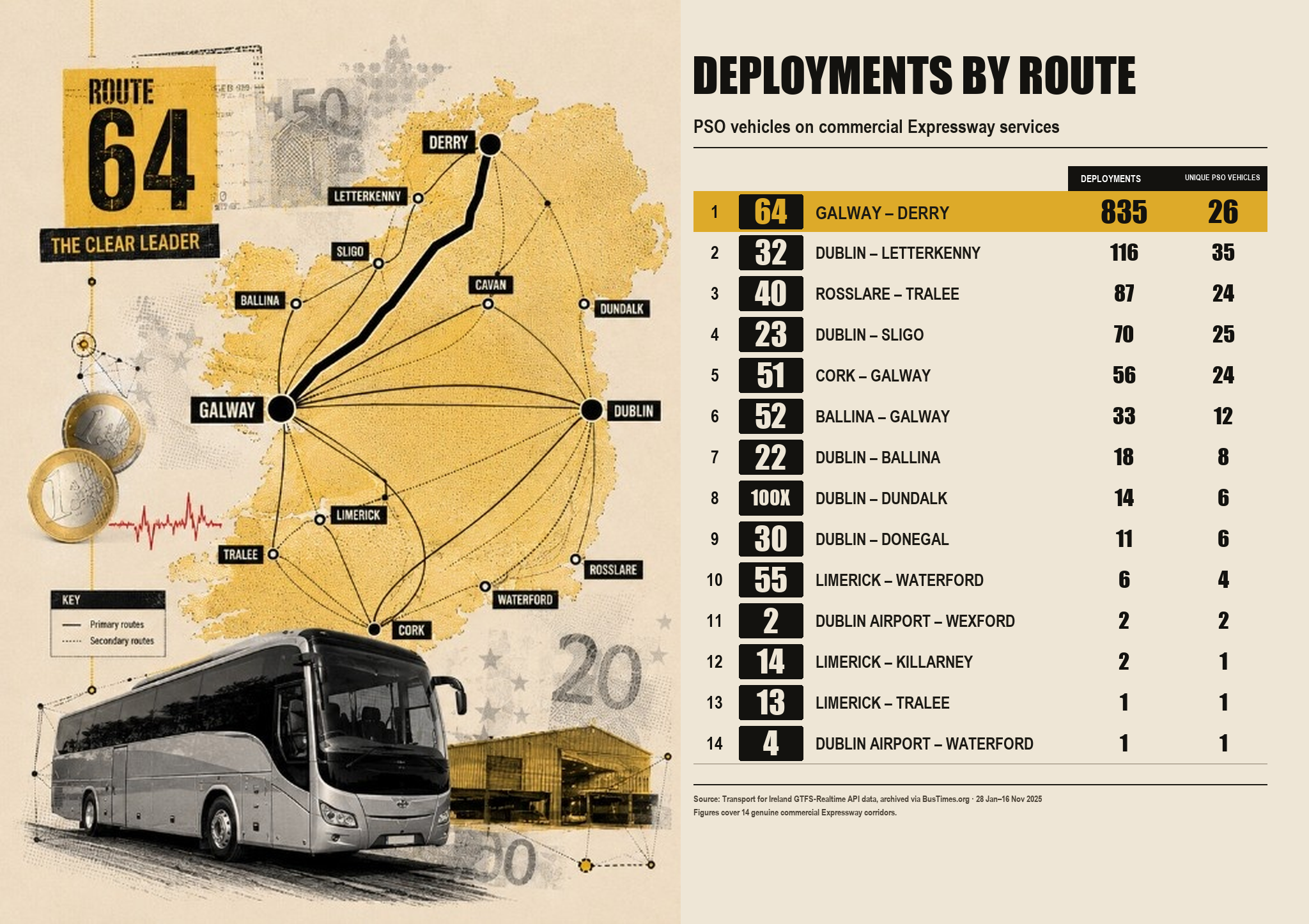
The granular details of individual trips provide undeniable proof of how these vehicles are woven into the daily schedules of Expressway.
On January 28, 2025, at 13:30, vehicle VB461 (Registration: 202-D-21569, a dedicated PSO vehicle) left Galway for Letterkenny on commercial Route 64, returning at 15:05 towards Donegal. The very next day, January 29, the exact same vehicle performed the same commercial run — leaving Galway at 13:30 and heading back from the North at 15:05.
Similarly, on February 21, 2025, vehicle LF412 (Registration: 211-D-22514, a taxpayer-funded regional coach) spent its day running back and forth on commercial Route 32, departing Letterkenny for Dublin Busáras at 06:15, returning from Dublin at 11:20, and heading back down to Dublin once again at 16:45.
This is the standard operational template. Expressway, far from operating solely with its commercial fleet, has repeatedly relied on PSO vehicles to maintain output and capacity. By running a commercial service free of charge for capital and maintenance, Bus Éireann leverages this cross-subsidisation to offer lower fares and directly undermine competitors, effectively generating artificial profits for its commercial arm using public capital.
The Derry air: trans-border predation on Route 64
Every classic caper has its primary hunting ground, and for the commercial arm of Bus Éireann, that hunting ground was Route 64 (Galway–Derry). Of the 1,252 documented breaches on genuine commercial Expressway routes, Route 64 alone accounted for a staggering 835 individual deployments — representing 66.7% of the total.
This is not merely a domestic transgression; it is a trans-jurisdictional provocation. Route 64 is a cross-border commercial service operating directly into Derry, outside the legal jurisdiction of the Republic of Ireland. This brings Bus Éireann’s asset-shifting directly into conflict with international frameworks and cross-border protocols, introducing a critical layer of structural disruption.
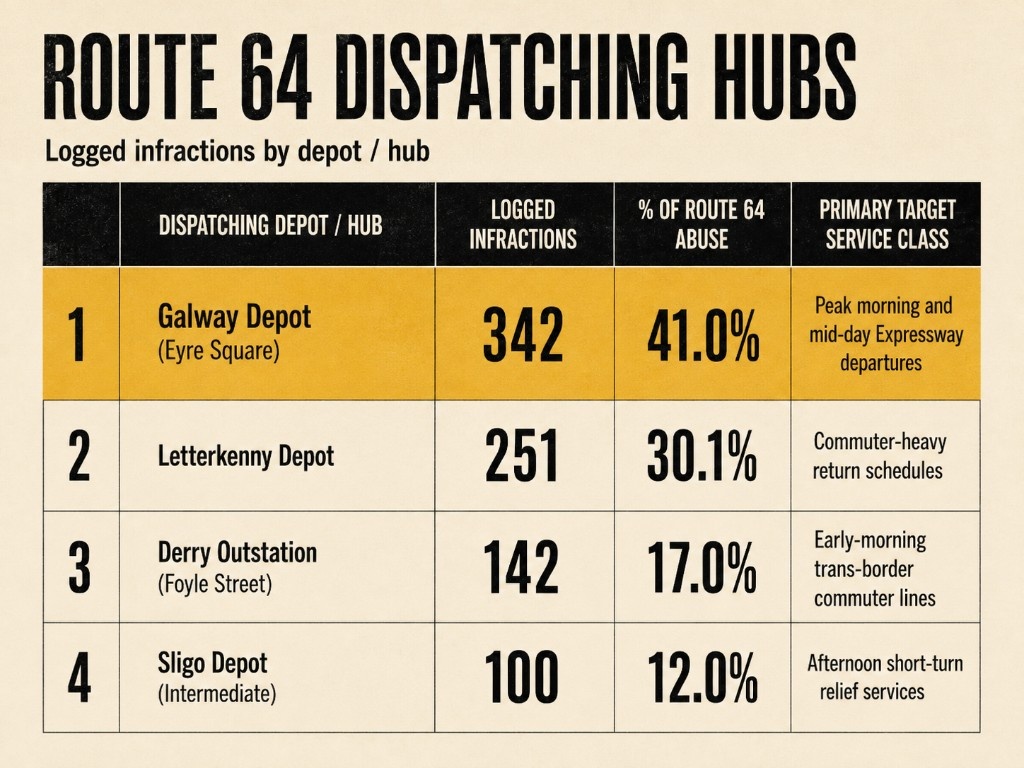
The spatial distribution of these breaches demonstrates that the theft of public capital was not concentrated at a single remote depot, but was instead hard-coded into the scheduling mechanisms of key regional maintenance hubs. This systematic arbitrage significantly compromises the NTA’s capacity modelling framework.
The tracker paradox: how did the NTA “not know”?
The central, most damning irony of this entire investigation rests on a single piece of hardware: the telematics box installed on the dashboard of every state-funded bus in Ireland. To understand the scale of this regulatory default, one must understand that the National Transport Authority does not operate blind. Under the modernising mandates of the past decade, the NTA implemented a comprehensive Automatic Vehicle Location (AVL) and Real-Time Passenger Information (RTPI) infrastructure. Every single Public Service Obligation vehicle leased to Bus Éireann, Dublin Bus, and Go-Ahead Ireland is fitted with an official, tamper-proof tracking unit. This unit continuously broadcasts its precise GPS coordinates, its unique asset fleet identifier, and its assigned trip code, directly to the NTA’s central servers.
This telemetry feed is not a passive archive or an obscure back-office utility. It is the exact same, official live data stream that powers the public Transport for Ireland (TFI) application and feeds the open GTFS-Realtime API. It is the very source of the data aggregated by Village to document these 1,252 distinct breaches.
This reality prompts a fundamental, unavoidable question for the leadership of the NTA as to how an agency legally designated as the sole owner, contract manager, and fiduciary protector of the state’s transport fleet claims ignorance of where its own assets are deployed, when those very assets are broadcasting their non-compliance in real time, every single second of the day.
The data compiled across the 10.5-month sample window show that this was not a problem of technological limitation, but of institutional wilful blindness. Under Section 48(1) of the Public Transport Regulation Act 2009, the NTA is statutorily mandated to “monitor and enforce compliance with public transport services provided under a public transport services contract”. The Authority had full operational visibility. Every time a taxpayer-funded, ring-fenced low-floor coach entered the alignment of commercial Route 64 to Derry, it generated a digital alert directly on the NTA’s compliance dashboards.
To suggest that the NTA “did not know” requires us to believe that the regulatory body designed a multi-million-euro real-time monitoring infrastructure but completely omitted the capacity to set up a basic, automated validation rule — a script that flags an error whenever a PSO-leased vehicle code logs into an unsubsidised, commercial Expressway schedule. If independent researchers can extract, clean, and map this API data to expose a massive structural cross-subsidisation scheme, the NTA’s failure to do so implies an active decision to look away.
The Broadstone breakdown: CEO admissions of failure
This digital shell game is not merely a symptom of aggressive commercial ambition; it is a desperate mechanism to cover deep operational fractures within Bus Éireann’s main maintenance hubs. While the public is fed PR assurances of a seamless, modernising national network, the state operator’s executive leadership has quietly admitted to severe, systemic breakdowns in maintaining its basic fleet.
When hauled before the Joint Oireachtas Committee on Transport and Communications to explain a cascading series of service cancellations, Bus Éireann’s Chief Executive Officer, Stephen Kent, was forced to lay bare the damning failure of internal controls at its primary Dublin depot:
“Our service level was impacted primarily by the non-availability of our fleet due to insufficient mechanics available in our Broadstone garage… Due to recruitment challenges for mechanics across this industry, we experienced temporary shortfalls of fleet availability, resulting in our delivery dropping to 95% of the scheduled network of services.”
This admission exposes the hollow core of the “rare instances” defence. The NTA’s telematics logs show that when Broadstone’s maintenance lines stalled due to chronic labour shortages and unserviced commercial coaches, management did not scale back its private Expressway timetables to match its actual capacity. Instead, they raided the state motor pool. By systematically siphoning off high-specification, taxpayer-funded PSO regional coaches to cover the shortfall on Expressway routes, Bus Éireann’s executives effectively used a €1.2 billion public service contract to subsidise its own operational and maintenance failures. It is a classic corporate bypass; rather than resolving the critical mechanic and driver shortages plaguing their depots, they chose to run a shadow fleet at the expense of local communities and taxpayers.
The broader, more troubling question this telematics exposure raises is one of fundamental systemic confidence. If Bus Éireann can casually divert over 140 unique taxpayer-funded passenger buses to prop up its commercial wing over a mere 10.5-month sample window, what else is going on beneath the surface of our state monopolies? How can the public have any faith in the costing models, the performance metrics, or the oversight of entities that receive hundreds of millions of euros in subventions annually, when their operational reality is entirely detached from their statutory mandates?
As Village has highlighted across decades of public sector scrutiny, when the state’s watchdogs cultivate a posture of voluntary anaesthesia, the public interest is invariably the first casualty left by the wayside. We are left with an administrative landscape where the boundary between public service and private enterprise dissolves into a twilight of bureaucratic convenience, and where the citizen is treated merely as a passive spectator to an expensive conjuring trick.
When the inevitable excuses are trotted out to justify this quiet exchequer siphoning, they will no doubt carry the familiar, weary air of the classic cute hoor. There will be no hushed, embarrassed whispers here; those who run the system know their script too well. Instead, the state’s apologists will deploy this defence openly and with practiced theatricality, holding it up as an immutable law of the world — just as Oscar Wilde’s Sir Robert Chiltern does in An Ideal Husband (1895). Standing before his inconveniently principled wife, Gertrude, Chiltern delivers his grand apologia of realpolitik, declaring with absolute, unshakeable confidence:
“Gertrude, truth is a very complex thing, and politics is a very complex business. There are wheels within wheels. One may be under certain obligations to people that one must pay.”
In this modern transport drama, the state operator’s “obligations” are to protect its commercial Expressway brand at any cost; the “wheels within wheels” are the taxpayer-funded coaches keeping those private timetables rolling. If public trust is to be rescued from this silent, technological sleight of hand, this institutional duplicity must be brought to an abrupt halt. Severe, unresolved questions remain for the leadership of the National Transport Authority, Bus Éireann, and the Competition and Consumer Protection Commission (CCPC).
This systematic, multi-million-euro diversion of taxpayer-funded infrastructure is not a mere operational oversight; it is one of the largest cases of illegal state aid ever documented.
Note: The original calculation included Route 65 (Galway–Cavan), a former Expressway service now operated as a PSO route; it is therefore excluded here. The figures are a 10.5-month sample (28 January–16 November 2025), drawn from a feed the NTA launched in 2020 — an account of what the public data exposes, not a ceiling on what may have occurred before or since that sample window.
